

A GPX4-dependent cancer cell state underlies the clear-cell morphology and confers sensitivity to ferroptosis
Open accessThe DOI matches its Crossref record; 82 of the 82 references it cites were found in a registry or an index.
Abstract
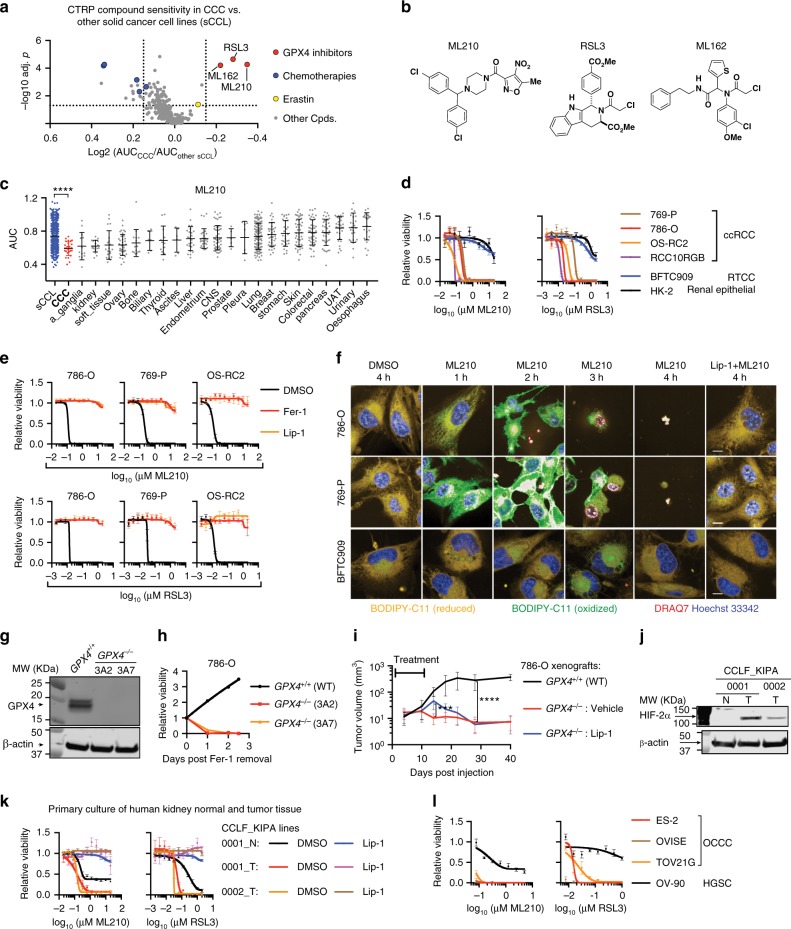
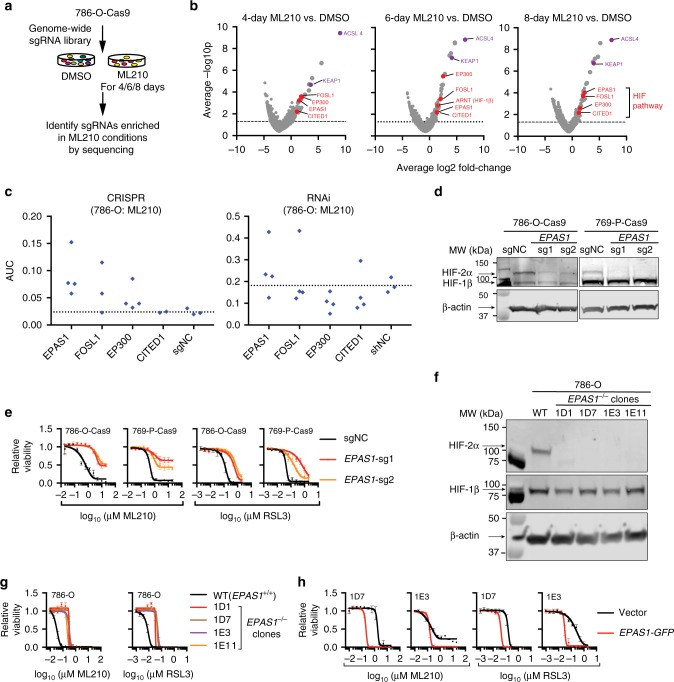
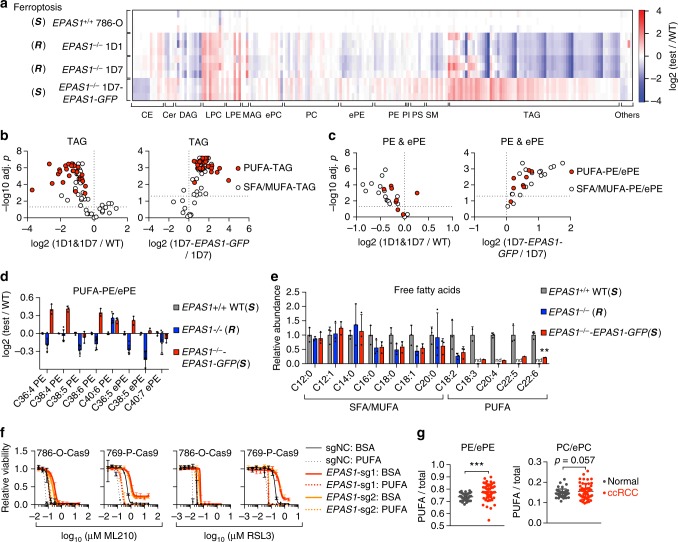
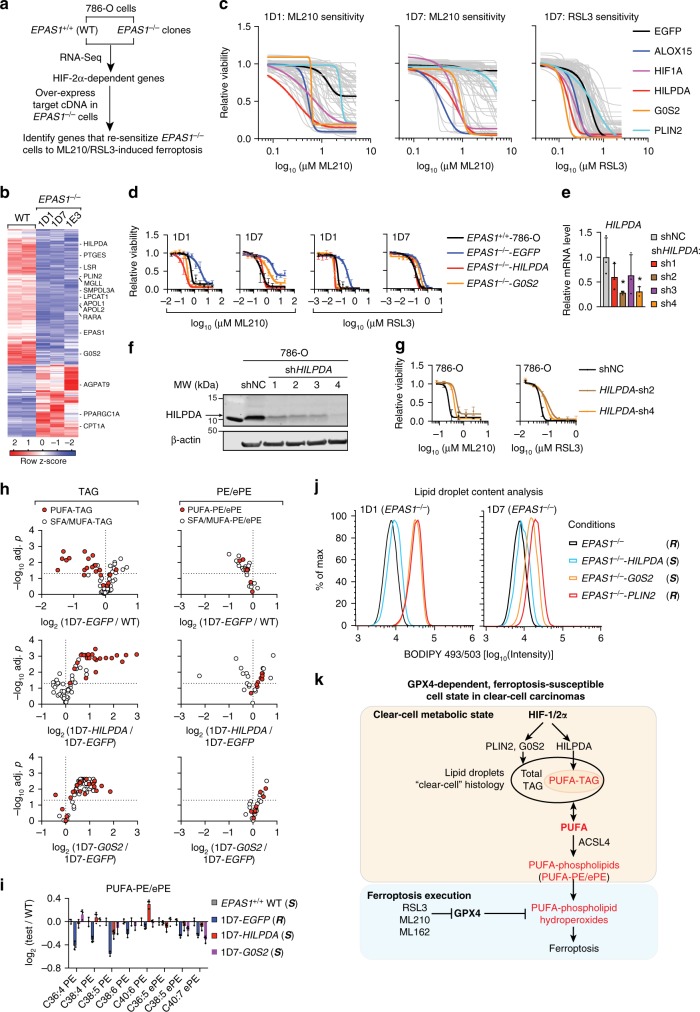
Clear-cell carcinomas (CCCs) are a histological group of highly aggressive malignancies commonly originating in the kidney and ovary. CCCs are distinguished by aberrant lipid and glycogen accumulation and are refractory to a broad range of anti-cancer therapies. Here we identify an intrinsic vulnerability to ferroptosis associated with the unique metabolic state in CCCs. This vulnerability transcends lineage and genetic landscape, and can be exploited by inhibiting glutathione peroxidase 4 (GPX4) with small-molecules. Using CRISPR screening and lipidomic profiling, we identify the hypoxia-inducible factor (HIF) pathway as a driver of this vulnerability. In renal CCCs, HIF-2α selectively enriches polyunsaturated lipids, the rate-limiting substrates for lipid peroxidation, by activating the expression of hypoxia-inducible, lipid droplet-associated protein (HILPDA). Our study suggests targeting GPX4 as a therapeutic opportunity in CCCs, and highlights that therapeutic approaches can be identified on the basis of cell states manifested by morphological and metabolic features in hard-to-treat cancers.
Overview
The claims and statistics of this paper haven’t been checked yet.
Free: it reads the open-access text and checks the first 5 claims that cite a source we can check. Create a free account to check every claim.
Integrity signals
Registry
Cites
Statistics
Figures
Verification
Claims the paper makes
The claims and statistics of this paper haven’t been checked yet.
Free: it reads the open-access text and checks the first 5 claims that cite a source we can check. Create a free account to check every claim.
Claims other papers make about this one
Each is checked against this paper’s own text: does it say what the citing paper says it does?
The check wasn’t confident either way, so it gives no verdict — never disputed.
In the citing paper
“Bortezomib, a proteasome inhibitor, inhibits the recruitment of p300 and blocks the PI3K/Akt/TOR pathway, which inhibits HIF-1α synthesis and activation at multiple levels, but does not affect HIF-2α [24,90].”
From Revisiting the HIF switch in the tumor and its immune microenvironment. (2022) · cites this paper as [90]
Experimental — accuracy not yet measured
Self-check
Percentages, sums and reported differences re-computed from the paper’s own numbers.
The self-check needs the paper’s full text.
Citations
Cites
Ferroptosis: An Iron-Dependent Form of Nonapoptotic Cell Death
Dixon, S. J., Lemberg, K. M., Lamprecht, M. R., Skouta, R., Zaitsev, E. M., Gleason, C. E., Patel, D. N., Bauer, A. J., Cantley, A. M., Yang, W. S., et al. (2012) · Cell · doi:10.1016/j.cell.2012.03.042 · Cited by 18,691
Integrative Analysis of Complex Cancer Genomics and Clinical Profiles Using the cBioPortal
Gao, J., Aksoy, B. A., Dogrusoz, U., Dresdner, G., Gross, B., Sumer, S. O., Sun, Y., Jacobsen, A., Sinha, R., Larsson, E., et al. (2013) · Science Signaling · doi:10.1126/scisignal.2004088 · Cited by 15,160
The Cancer Cell Line Encyclopedia enables predictive modelling of anticancer drug sensitivity
Barretina, J., Caponigro, G., Stransky, N., Venkatesan, K., Margolin, A. A., Kim, S., Wilson, C. J., Lehár, J., Kryukov, G. V., Sonkin, D., et al. (2012) · Nature · doi:10.1038/nature11003 · Cited by 7,950
Regulation of Ferroptotic Cancer Cell Death by GPX4
Yang, W. S., SriRamaratnam, R., Welsch, M. E., Shimada, K., Skouta, R., Viswanathan, V. S., Cheah, J. H., Clemons, P. A., Shamji, A. F., Clish, C. B., et al. (2014) · Cell · doi:10.1016/j.cell.2013.12.010 · Cited by 7,713
Self-citationFerroptosis: A Regulated Cell Death Nexus Linking Metabolism, Redox Biology, and Disease
Stockwell, B. R., Friedmann Angeli, J. P., Bayir, H., Bush, A. I., Conrad, M., Dixon, S. J., Fulda, S., Gascón, S., Hatzios, S. K., Kagan, V. E., et al. (2017) · Cell · doi:10.1016/j.cell.2017.09.021 · Cited by 7,695
Optimized sgRNA design to maximize activity and minimize off-target effects of CRISPR-Cas9
Doench, J. G., Fusi, N., Sullender, M., Hegde, M., Vaimberg, E. W., Donovan, K. F., Smith, I., Tothova, Z., Wilen, C., Orchard, R., et al. (2016) · Nature Biotechnology · doi:10.1038/nbt.3437 · Cited by 4,637
Self-citationACSL4 dictates ferroptosis sensitivity by shaping cellular lipid composition
Doll, S., Proneth, B., Tyurina, Y. Y., Panzilius, E., Kobayashi, S., Ingold, I., Irmler, M., Beckers, J., Aichler, M., Walch, A., et al. (2017) · Nature Chemical Biology · doi:10.1038/nchembio.2239 · Cited by 4,293
Inactivation of the ferroptosis regulator Gpx4 triggers acute renal failure in mice
Friedmann Angeli, J. P., Schneider, M., Proneth, B., Tyurina, Y. Y., Tyurin, V. A., Hammond, V. J., Herbach, N., Aichler, M., Walch, A., Eggenhofer, E., et al. (2014) · Nature Cell Biology · doi:10.1038/ncb3064 · Cited by 3,732
Comprehensive molecular characterization of clear cell renal cell carcinoma
The Cancer Genome Atlas Research Network (2013) · Nature · doi:10.1038/nature12222 · Cited by 3,485
Defining a Cancer Dependency Map
Tsherniak, A., Vazquez, F., Montgomery, P. G., Weir, B. A., Kryukov, G., Cowley, G. S., Gill, S., Harrington, W. F., Pantel, S., Krill-Burger, J. M., et al. (2017) · Cell · doi:10.1016/j.cell.2017.06.010 · Cited by 3,276
Self-citation
Cited by
Items 901–952 of 952
Zhang, Y., Suo, C., & Sun, L. (2026) · Chinese Medical Journal · doi:10.1097/cm9.0000000000004174
Li, Z., Gao, J., Fu, J., Zhang, X., Zhou, Y., Li, C., Nam, J., & Gao, H. (2026) · Molecular Biomedicine · doi:10.1186/s43556-026-00546-w
Selenium deficiency triggers intestinal ferroptosis in mice via oxidative stress
Gai, L., Shi, L., Xia, Y., Wang, Q., Yang, R., Wang, Z., Zhu, Z., Miao, S., Huang, Y., Hu, J., et al. (2026) · Biochemical and Biophysical Research Communications · doi:10.1016/j.bbrc.2026.154480
Renal cell carcinoma: molecular understanding and therapeutic development
Hou, T., Hua, X., Wei Min, N. I., Yan, P., Inuzuka, H., & Wei, W. (2026) · Cell Death and Differentiation · doi:10.1038/s41418-026-01857-9
Sun, L., Zhao, X., Li, X., Zhu, Z., & Wu, G. (2026) · International Journal of Nanomedicine · doi:10.2147/ijn.s590442
CRISPR screens for the discovery of novel ferroptosis targets: progress and perspectives
Yu, W., Cui, Y., Zhao, Q., & Luo, L. (2026) · Biochemical Pharmacology · doi:10.1016/j.bcp.2026.118410
Liu, J., Li, J., Li, B., & Liang, H. (2026) · Cancer Medicine · doi:10.1002/cam4.72257
SRSF3 confers cuproptosis resistance in oral cancer by suppressing FDX1 expression
Zhang, Z., Yan, L., Guo, J., & Jia, R. (2026) · Cellular Signalling · doi:10.1016/j.cellsig.2026.112891
Zhu, Z., Jiang, L., Sun, T., Chen, X., Chen, H., & Li, J. (2026) · ACS Nano · doi:10.1021/acsnano.6c10760
Chen, X., Wei, Z., Gu, M., Liu, P., Yang, Y., & 任凱蒂 (2026) · Genes & Diseases · doi:10.1016/j.gendis.2026.102469
Verde, C. D., Vítek, L., Tiribelli, C., & Gazzin, S. (2026) · Biomolecules · doi:10.3390/biom16091371
Interconnected death: crosstalk among ferroptosis, cuproptosis, and pyroptosis in cancer
Liu, Y., Liu, J., Zeng, D., Chen, L., Wei, C., Qiu, X., Fu, L., & Deng, Z. (2026) · Molecular Cancer · doi:10.1186/s12943-026-02799-z
Zhang, T., Huang, Y., Cheng, P., Qin, S., Cao, Y., Xie, M., & Wang, J. (2026) · Frontiers in Oncology · doi:10.3389/fonc.2026.1934498
The role of HILPDA in diseases: Mechanisms and functional insights
Congcong, X., Liu, Y., 吴延庆, & Xia, H. (2026) · Journal of Lipid Research · doi:10.1016/j.jlr.2026.101160
Олеговна, В. А., Shchekin, V. S., Ильшатович, Т. И., Ирекович, В. Т., & Павлов, В. Н. (2026) · Cancer Urology · doi:10.17650/1726-9776-2026-22-2-116-124
Targeted extracellular degradation of LRP8 promotes ferroptosis in cancer cells
Zhao, F., Inague, A., Peters-Clarke, T. M., Chen, Y., Ganjave, S. D., Zhang, Y., Miao, K., Yao, Z., Wu, Y., Seto, M. K. C., et al. (2026) · Proceedings of the National Academy of Sciences · doi:10.1073/pnas.2616933123
Surface-Aware Generative Design of Selective Inhibitors for Protein–Membrane AdsorptionPreprint
Park, B., & Lehn, R. C. V. (2026) · ChemRxiv · doi:10.26434/chemrxiv.15010044/v1
Al-nakhle, H. H., & Doha, Z. O. (2026) · Medicina · doi:10.3390/medicina62101971
Yin, Y., Wang, J., Li, D., & Qiu, D. (2026) · Frontiers in Oncology · doi:10.3389/fonc.2026.1952158
Lipid Metabolic Rewiring in Cancer Drug Resistance: Pathways, Networks, and Therapeutic Strategies
Chang, S. N., Raggi, C., & Exil, V. (2026) · International Journal of Molecular Sciences · doi:10.3390/ijms272210316
Pan, Z., Han, J. R., Naowarojna, N., Graham, E. T., Roth, J. A., Wang, W., Xie, G., Wang, X., Li, H., & Zou, Y. (2026) · ACS Chemical Biology · doi:10.1021/acschembio.6c00581
Self-citationTian, S., Chen, H., Zhao, W., Shen, D., Wang, C., Zhao, X., Liu, H., Ma, X., Zhang, X., & 麦海星 (2026) · Scientific Reports · doi:10.1038/s41598-026-70052-0
Precision Targeting of Ferroptosis: From Molecular Defense Networks to Disease-Specific Translation
Yue, J., Yang, C., & Wang, X. (2026) · Journal of Bio-X Research · doi:10.34133/jbioxresearch.0097
Metabolic hallmarks of regulated cell death
Kang, R., Chen, X., Kroemer, G., & Tang, D. (2026) · Cell Research · doi:10.1038/s41422-026-01306-9
BindingDB Entry 50022029: Research progress on GPX4 targeted compounds.
BindingDB (2025) · UC San Diego · doi:10.7270/q2z03dt5
Ferroptosis Susceptibility: a Metabolic Amplifier of Bone Remodeling
Kuo, L. I. U., ZHANG, R., Liu, Y.-S., & Rong-Yan, Z. H. O. U. (2026) · PROGRESS IN BIOCHEMISTRY AND BIOPHYSICS · doi:10.3724/j.pibb.2026.0275
Monzen, S., Kotani, A., Tatara, M., Muro, A., Fukushi, Y., Wójcik, A., & Mariya, Y. (2026) · Cancers · doi:10.3390/cancers18213500
ISR addiction: Co-opting a stress sentinel to fuel tumor resilience and therapy resistance
Wang, S.-Y., Wang, Y., Qi, D.-Y., & Jin, W. (2026) · Neoplasia · doi:10.1016/j.neo.2026.101388
Ke, Z., Zhang, X., Wang, B., Tang, H., Zhou, J., Chen, X., Gu, M., Tang, Z., Gao, Q., Zhu, Q., et al. (2026) · Chemical Engineering Journal · doi:10.1016/j.cej.2026.183818
Xu, F., Xu, X., Yang, Y., & Song, X. (2026) · Journal of Inflammation Research · doi:10.2147/jir.s638426
Metabolic Pathways and Immune Interactions in Renal Cell Carcinoma
Lucarelli, G. T., Rutigliano, M., Milella, M., Caniglia, A., Ditonno, P., & Lasorsa, F. M. (2026) · Cancers · doi:10.3390/cancers18223600
Lu, Y., Pan, Z., Bai, L., Xiao, S., Gu, X., Li, J., Shi, W., Zhang, X., Liu, S., Lu, C., et al. (2026) · RSC Chemical Biology · doi:10.1039/d6cb00321d
Self-citationRyu, S., Lee, Y., Hong, J., & Lee, K. (2026) · Biomaterials · doi:10.1016/j.biomaterials.2026.124778
Wang, T., Liu, Y., Li, Q., Luo, Y., Liu, D., & Li, B. (2022) · doi:10.3389/fimmu.2022.999823.s001
Chen, Y., Liu, A., Liu, H., Cai, G., Lu, N., & Chen, J. (2023) · doi:10.3389/fcell.2023.1210714.s004
Zhang, K., Zhang, Q., Jia, R., Xiang, S., & Xu, L. (2023) · doi:10.3389/fcell.2023.1156383.s001
Xu, Z., Xie, Y., Mao, Y., Huang, J., Mei, X., Song, J., Sun, Y., Yao, Z., & Shi, W. (2021) · doi:10.3389/fgene.2021.758981.s001
Guo, Y., Shrestha, A., Maskey, N., Dong, X., Zheng, Z., Yang, F., Wang, R., Ma, W., Liu, J., Li, C., et al. (2022) · doi:10.3389/fendo.2022.762589.s001
Wang, Z., Han, J., Guo, Z., Wu, H., Liu, Y., Wang, W., Zhang, C., & Liu, J. (2023) · doi:10.3389/fonc.2023.1097692.s006
Self-citationXia, M., Wang, S., Ye, Y., Tu, Y., Huang, T., & Gao, L. (2022) · doi:10.3389/fimmu.2022.995645.s003
Fan, S., Li, J., Gao, Y., Ma, Y., Sun, C., Tian, Z., Du, Y., Wang, J., Li, H., Yu, M., et al. (2026) · Cell Reports · doi:10.1016/j.celrep.2026.118282
Self-citationYu, J., Xie, X., Zhang, Y., Jiang, F., & Wu, C. (2022) · doi:10.3389/fmed.2022.906001.s002
Wen, K., Yan, Y., Shi, J., Hu, L., Wang, W., Liao, H., Li, H., Zhu, Y., Mao, K., & Xiao, Z. (2021) · doi:10.3389/fmolb.2021.809672.s004
Self-citationHe, J., Huang, W., Li, X., Wang, J., Nie, Y., Li, G., Wang, X., Cao, H., Chen, X., & Wang, X. (2023) · doi:10.3389/fgene.2022.988909.s002
Yu, L., Luo, Y., Ding, X., Tang, M., Gao, H., Zhang, R., Chen, M., Liu, Y., Chen, Q., Ouyang, Y., et al. (2023) · doi:10.3389/fonc.2023.1146617.s002
Ene, C. D., Ene, C., Nicolae, I., Capusa, C., Mitran, M. I., Mitran, C. I., Matei, C. N., Rinja, E. M., Georgescu, S. R., & Tampa, M. Ş. (2026) · Life · doi:10.3390/life16111924
Shi, J., Fan, F., Wang, J., Zheng, G., Runchen, Z., Guo, L., Zhang, X., Wang, Y., & Ma, C. (2026) · Metabolism and Target Organ Damage · doi:10.20517/mtod.2025.190
Dizon, J. R., Anwar, A., Chaudhary, J., Debose-Boyd, R., & Corbin, I. R. (2026) · Free Radical Biology and Medicine · doi:10.1016/j.freeradbiomed.2026.11.027
Sun, T., Xuzhong, L., Gui, Z., Hu, J., & Lu, P. (2026) · Research Square · doi:10.21203/rs.3.rs-11412062/v1
Metadata
- Authors
- Zou, Y., Palte, M. J., Deik, A. A., Li, H., Eaton, J. K., Wang, W., Tseng, Y.-Y., Deasy, R., Kost-Alimova, M., Dančík, V., Leshchiner, E. S., Viswanathan, V. S., Signoretti, S., Choueiri, T. K., Boehm, J. S., Wagner, B. K., Doench, J. G., Clish, C. B., Clemons, P. A., & Schreiber, S. L.
- Affiliations
- Broad Institute (US)
- Brigham and Women's Hospital (US)
- Corresponding author
- Schreiber, Stuart L.
- ORCID
- Venue
- Nature Communications
- Published
- 2019-04-08
- Volume
- 10
- Issue
- 1
- Pages
- 1617-1617
- ISSN
- 2041-1723 (ISSN-L)
- PMC
- PMC6453886
- OpenAlex
- W2932111434
- Semantic Scholar
- bcc57fb0d4bd3179b8bfa5bc6905f8903dab292b
- Cited by
- 887
- References
- 72
- Citations by year
- 2026: 94 · 2025: 141 · 2024: 163 · 2023: 166 · 2022: 144 · 2021: 98 · 2020: 69 · 2019: 11
- FWCI
- 59.33
- Type
- journal article
- Language
- en
- Open access
- gold
- doi.org
- Licence
- cc-by
- creativecommons.org/licenses/by/4.0 (tdm)
- creativecommons.org/licenses/by/4.0 (vor)
- Locations
- Nature Communications (publishedVersion, cc-by)
- Europe PMC (PubMed Central) (publishedVersion, cc-by)
- PubMed Central (publishedVersion, cc-by)
- PubMed (publishedVersion)
- RePEc: Research Papers in Economics (submittedVersion)
- DOAJ (DOAJ: Directory of Open Access Journals) (submittedVersion, cc-by-sa)
- DOAJ (DOAJ: Directory of Open Access Journals) (submittedVersion)
- Funders
- Dana-Farber/Harvard Cancer Center (CA101942)
- National Institutes of Health
- National Heart, Lung, and Blood Institute (T32HL007627)
- National Cancer Institute (U01CA217848, P50CA101942, CA101942)
- National Institute of Diabetes and Digestive and Kidney Diseases (P30DK040561)
- Topics
- Life Sciences › Biochemistry, Genetics and Molecular Biology › Cancer Research › Ferroptosis and cancer prognosis
- Life Sciences › Biochemistry, Genetics and Molecular Biology › Cancer Research › Cancer, Hypoxia, and Metabolism
- Life Sciences › Biochemistry, Genetics and Molecular Biology › Cancer Research › Cancer, Lipids, and Metabolism
- Keywords
- clear cell carcinoma, ferroptosis, GPX4, HIF-2α, HILPDA, lipid peroxidation, polyunsaturated lipids, lipidomics, clear cell renal cell carcinoma, ovarian clear cell carcinoma, cancer cell states, metabolic vulnerability, hypoxia
- MeSH terms
- Phospholipid Hydroperoxide Glutathione Peroxidase, Endothelial PAS Domain-Containing Protein 1, Aged, Animals, Carcinoma, Renal Cell, Female, Glutathione Peroxidase, Humans, Iron, Kidney Neoplasms, Male, Mice, Nude, Middle Aged, Neoplasm Proteins, Lipid Peroxidation, Gene Expression Regulation, Neoplastic, Apoptosis, Gene Expression Profiling, Xenograft Model Antitumor Assays, RNA Interference, Cell Line, Tumor, Basic Helix-Loop-Helix Proteins, Gene Knockout Techniques, HEK293 Cells, CRISPR-Cas Systems
About these checks
Registry, retraction, Cites and statistics results are computed, not judged, with one exception: a printed reference that no index lists is read once by a model before it counts as a citation error. Claims are extracted by a model and kept only when their quote appears verbatim in the text; each cited source is then checked, with a model’s help, for whether it says what the claim relies on. Those verdicts can be wrong — read the claim’s quote and the cited source before relying on one.
Statistics and arithmetic are recomputed, not judged.
Confidence bands are shown only for fields calibrated on our annotated test set. None is calibrated yet, so no band is shown.
What counts as a claim ›How we measure confidence ›How we check this ›
Are you an author, or do you see a problem with this page? Request a review
Data sources
Bibliographic data: Semantic Scholar, OpenAlex, Crossref.
Contains information from the Semantic Scholar Academic Graph Datasets, made available under the ODC Attribution License (ODC-BY 1.0).
Semantic Scholar’s data is described in: Kinney, R., et al. (2023). The Semantic Scholar Open Data Platform. arXiv:2301.10140.
