

Sex-specific association between gut microbiome and fat distribution
Open accessThe DOI matches its Crossref record; 45 of the 45 references it cites were found in a registry or an index.
Abstract
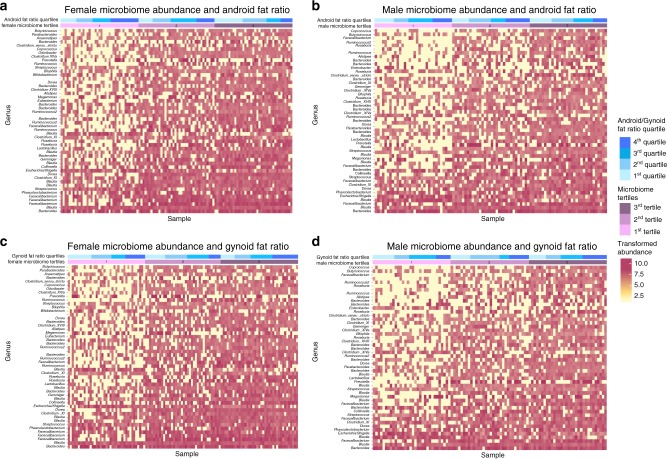
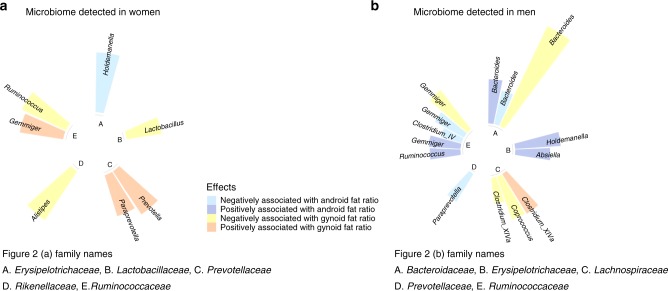
The gut microbiome has been linked to host obesity; however, sex-specific associations between microbiome and fat distribution are not well understood. Here we show sex-specific microbiome signatures contributing to obesity despite both sexes having similar gut microbiome characteristics, including overall abundance and diversity. Our comparisons of the taxa associated with the android fat ratio in men and women found that there is no widespread species-level overlap. We did observe overlap between the sexes at the genus and family levels in the gut microbiome, such as Holdemanella and Gemmiger; however, they had opposite correlations with fat distribution in men and women. Our findings support a role for fat distribution in sex-specific relationships with the composition of the microbiome. Our results suggest that studies of the gut microbiome and abdominal obesity-related disease outcomes should account for sex-specific differences.
Overview
The claims and statistics of this paper haven’t been checked yet.
Free: it reads the open-access text and checks the first 5 claims that cite a source we can check. Create a free account to check every claim.
Integrity signals
Registry
Cites
Statistics
Figures
Verification
Claims the paper makes
The claims and statistics of this paper haven’t been checked yet.
Free: it reads the open-access text and checks the first 5 claims that cite a source we can check. Create a free account to check every claim.
Claims other papers make about this one
Each is checked against this paper’s own text: does it say what the citing paper says it does?
The cited source says what the claim attributes to it.
In the citing paper
“Studies have shown that certain strains of Lactobacillus and Ruminococcus genera exhibit a negative association with the gynoid fat ratio in women but not in men. Meanwhile, different taxa from the Holdemanella genus, Erysipelotrichaceae family, exhibited a negative association with android fat ratio in women but a positive association in men(Min et al., 2019).”
From Impact of probiotics on weight loss, glucose and lipid metabolism in overweight or obese women: A meta-analysis of randomized controlled trials (2024) · cites this paper as Min et al., 2019
Self-check
Percentages, sums and reported differences re-computed from the paper’s own numbers.
The self-check needs the paper’s full text.
Citations
Cites
1 retracted
Million, M., Maraninchi, M., Henry, M., Armougom, F., Richet, H., Carrieri, P., Valero, R., Raccah, D., Vialettes, B., & Raoult, D. (2012) · International Journal of Obesity · doi:10.1038/ijo.2011.153 · Cited by 663
RetractedControlling the False Discovery Rate: A Practical and Powerful Approach to Multiple Testing
Benjamini, Y., & Hochberg, Y. (1995) · Journal of the Royal Statistical Society Series B: Statistical Methodology · doi:10.1111/j.2517-6161.1995.tb02031.x · Cited by 109,482
Moderated estimation of fold change and dispersion for RNA-seq data with DESeq2
Love, M. I., Huber, W., & Anders, S. (2014) · Genome Biology · doi:10.1186/s13059-014-0550-8 · Cited by 95,106
DADA2: High–resolution sample inference from Illumina amplicon data
Callahan, B. J., McMurdie, P. J., Rosen, M. J., Han, A. W., Johnson, A. J. A., & Holmes, S. P. (2016) · Nature Methods · doi:10.1038/nmeth.3869 · Cited by 35,698
Differential expression analysis for sequence count data
Anders, S., & Huber, W. (2010) · Genome Biology · doi:10.1186/gb-2010-11-10-r106 · Cited by 15,581
An obesity-associated gut microbiome with increased capacity for energy harvest
Turnbaugh, P. J., Ley, R. E., Mahowald, M. A., Magrini, V., Mardis, E. R., & Gordon, J. I. (2006) · Nature · doi:10.1038/nature05414 · Cited by 12,444
Yusuf, S., Hawken, S., Ôunpuu, S., Dans, T., Avezum, A., Lanas, F., McQueen, M., Budaj, A., Pais, P., Varigos, J., et al. (2004) · The Lancet · doi:10.1016/s0140-6736(04)17018-9 · Cited by 12,026
Greengenes, a Chimera-Checked 16S rRNA Gene Database and Workbench Compatible with ARB
DeSantis, T. Z., Hugenholtz, P., Larsen, N., Rojas, M., Brodie, E. L., Keller, K., Huber, T., Dalevi, D., Hu, P., & Andersen, G. L. (2006) · Applied and Environmental Microbiology · doi:10.1128/aem.03006-05 · Cited by 10,891
The gut microbiota as an environmental factor that regulates fat storage
Bäckhed, F., Ding, H., Wang, T., Hooper, L. V., Koh, G. Y., Nagy, A., Semenkovich, C. F., & Gordon, J. I. (2004) · Proceedings of the National Academy of Sciences · doi:10.1073/pnas.0407076101 · Cited by 6,245
The Microbial Metabolites, Short-Chain Fatty Acids, Regulate Colonic T reg Cell Homeostasis
Smith, P. M., Howitt, M. R., Panikov, N., Michaud, M., Gallini, C. A., Bohlooly-Y, M., Glickman, J. N., & Garrett, W. S. (2013) · Science · doi:10.1126/science.1241165 · Cited by 5,413
Cited by
Reporting guidelines for human microbiome research: the STORMS checklist
Mirzayi, C., Renson, A., Genomic Standards Consortium, Massive Analysis and Quality Control Society, Furlanello, C., Sansone, S.-A., Zohra, F., Elsafoury, S., Geistlinger, L., Kasselman, L. J., et al. (2021) · Nature Medicine · doi:10.1038/s41591-021-01552-x · Cited by 521
“After the first round of edits, the checklist was then applied to a recent microbiome study 22 by group members.”
MethodMechanisms of sex differences in Alzheimer’s disease
Lopez-Lee, C., Torres, E. R. S., Carling, G., & Gan, L. (2024) · Neuron · doi:10.1016/j.neuron.2024.01.024 · Cited by 376
“133,134 The microbiome also appears to affect processes that have exhibited sex biases and are central to neurodegenerative disease, such as inflammation and phagocytosis 135 (Figure 2).”
Tavella, T., Rampelli, S., Guidarelli, G., Bazzocchi, A., Gasperini, C., Pujos-Guillot, E., Comte, B., Barone, M., Biagi, E., Candela, M., et al. (2021) · Gut Microbes · doi:10.1080/19490976.2021.1880221 · Cited by 298
“Unlike a recent study in a Chinese adult population, which reported a sex-specific association between the gut microbiome layout and fat distribution, using DXA data for android and gynoid fat, the microbial communities defining the three elderly groups in our work are neither sex-related nor age-driven.(28) However,…”
ResultHow biological sex of the host shapes its gut microbiota
Valeri, F., & Endres, K. (2021) · Frontiers in Neuroendocrinology · doi:10.1016/j.yfrne.2021.100912 · Cited by 264
“(Min et al., 2019) associated different fat distribution between male and female with differences in the gut microbiota composition.”
BackgroundCoronary artery disease is associated with an altered gut microbiome composition
Toya, T., Corban, M. T., Marrietta, E., Horwath, I. E., Lerman, L. O., Murray, J. A., & Lerman, A. (2020) · PLOS ONE · doi:10.1371/journal.pone.0227147 · Cited by 130
Shobeiri, P., Kalantari, A., Teixeira, A. L., & Rezaei, N. (2022) · Biology of Sex Differences · doi:10.1186/s13293-022-00422-6 · Cited by 100
“In women, android fat ratio was negatively connected with Holdemanella and positively correlated with Gemmiger, but in males, android fat ratio was favorably correlated with Holdemanella and negatively correlated with Gemmiger [24].”
BackgroundResultSex differences in autophagy-mediated diseases: toward precision medicine
Shang, D., Wang, L., Klionsky, D. J., Cheng, H., & Zhou, R. (2021) · Autophagy · doi:10.1080/15548627.2020.1752511 · Cited by 93
“A recent study showed that the gut microbiome is associated with obesity and fat distribution [31].”
BackgroundWei, Y., Liang, J., Su, Y., Wang, J., Amakye, W. K., Pan, J., Chu, X., Ma, B., Song, Y., Li, Y., et al. (2020) · Clinical Nutrition · doi:10.1016/j.clnu.2020.11.014 · Cited by 71
Li, F., Zhang, T., He, Y., Gu, W., Yang, X., Zhao, R., & Yu, J. (2019) · Journal of Ethnopharmacology · doi:10.1016/j.jep.2019.112232 · Cited by 61
Factors Affecting Gut Microbiome in Daily Diet
Su, Q., & Liu, Q. (2021) · Frontiers in Nutrition · doi:10.3389/fnut.2021.644138 · Cited by 68
“What’s more interesting is that gut microbes can even determine the distribution of fat in the body, thus forming different body shapes (60).”
BackgroundQuality of Life and a Surveillant Endocannabinoid System
Reis, R. A. D. M., Isaac, A. R., Freitas, H. R., de Almeida, M. M., Schuck, P. F., Ferreira, G. C., Andrade‐da‐Costa, B. L. D. S., & Trevenzoli, I. H. (2021) · Frontiers in Neuroscience · doi:10.3389/fnins.2021.747229 · Cited by 68
“…(Figure 6; Lopez-Gallardo et al., 2012; Stringer et al., 2013; Ramirez-Lopez et al., 2015, 2016a,b; Romano-Lopez et al., 2016; Almeida et al., 2017, 2019, 2020; Dias-Rocha et al., 2018; Gandhi et al., 2018; Miranda et al., 2018; de Oliveira et al., 2019; Soares et al., 2019; Rivera et al., 2020).”
Sex and Gender Differences in Obesity: Biological, Sociocultural, and Clinical Perspectives
Kim, H., Kim, S., & Sung, M. (2025) · The World Journal of Men s Health · doi:10.5534/wjmh.250126 · Cited by 95
“The genera Bacteroides, Absiella, Holdemanella , and Gemmiger were positively associated with android fat ratio in men, whereas Bacteroides, Paraprevotella, Clostridium_IV , and Gemmiger had negative associations with android fat ratio in women [61].”
The gut microbiota response to helminth infection depends on host sex and genotype
Ling, F., Steinel, N. C., Weber, J. N., Ma, L., Smith, C. C. R., Corrêa, D. T., Zhu, B., Bolnick, D. I., & Wang, G. (2020) · The ISME Journal · doi:10.1038/s41396-020-0589-3 · Cited by 56
Schreurs, M. P. H., van Steenwijk, P. J. D. V., Romano, A., Dieleman, S., & Werner, H. M. J. (2021) · Journal of Clinical Medicine · doi:10.3390/jcm10132916 · Cited by 62
“Sex-specific effects, seemingly more present in women, and fat distribution differences (e.g., male/gynoid) need to be further explored including changes at phyla and family level as highlighted by Miranda and Min [45,47].”
BackgroundInfluentialSex as a Biological Variable in Nutrition Research: From Human Studies to Animal Models
Chen, Y., Kim, M., Paye, S. M., & Benayoun, B. A. (2022) · Annual Review of Nutrition · doi:10.1146/annurev-nutr-062220-105852 · Cited by 62
Methods in microbiome research: Past, present, and future
Gotschlich, E. C., Colbert, R. A., & Gill, T. (2019) · Best Practice & Research Clinical Rheumatology · doi:10.1016/j.berh.2020.101498 · Cited by 60
“There is not much known in humans about the sex-microbiome relationship but recent data has suggested that gut microbial diversity may be inversely associated with the android fat ratio (central adiposity) (95).”
BackgroundCharacteristics of the urinary microbiome in kidney stone patients with hypertension
Liu, F., Zhang, N., Peng, J. C., Zhai, Q., Li, C., Yu, D., Yan, W. S., Zhang, Y., Lv, L., Xu, X., et al. (2020) · Journal of Translational Medicine · doi:10.1186/s12967-020-02282-3 · Cited by 54
Liu, Y., Li, W., Yang, H., Zhang, X., Wang, W., Jia, S., Xiang, B., Wang, Y., Miao, L., Zhang, H., et al. (2021) · Frontiers in Cellular and Infection Microbiology · doi:10.3389/fcimb.2021.645951 · Cited by 56
“Abundance of Holdemanella has been observed to correlate with gender (Min et al., 2019).”
BackgroundShen, Y., Laue, H. E., Shrubsole, M. J., Wu, H., Bloomquist, T. R., Larouche, A., Zhao, K., Gao, F., Boivin, A., Prada, D., et al. (2022) · Environmental Health Perspectives · doi:10.1289/ehp9674 · Cited by 43
“…child sex, family income at delivery (continuous), delivery mode (vaginal or cesarean), perinatal BMI (continuous), pregnancy complications (yes or no), and preexisting conditions (yes or no) (Laue et al. 2020a; Min et al. 2019; Mitchell et al. 2020; Thion et al. 2018; Vujkovic-Cvijin et al. 2020).”
BackgroundMa, M., Liu, X., Jia, G., Geng, B., & Xia, Y. (2022) · BMC Endocrine Disorders · doi:10.1186/s12902-022-01087-3 · Cited by 43
“Metabolomics [28], microbiomics [29], and the dietary lifestyle of individuals might all be involved.”
BackgroundMultitable Methods for Microbiome Data Integration
Sankaran, K., & Holmes, S. (2019) · Frontiers in Genetics · doi:10.3389/fgene.2019.00627 · Cited by 44
“For more concrete motivation, we consider data from the WELL-China study, which is focused on the relationships between various indicators of wellness (Min et al., 2019).”
MethodSelf-citationCuevas‐Sierra, A., Milagro, F. I., Guruceaga, E., Cuervo, M., Goñi, L., García‐Granero, M., Martínez, J. A., & Riezu‐Boj, J. I. (2022) · Clinical Nutrition · doi:10.1016/j.clnu.2022.06.008 · Cited by 43
Barretto, S. A., Lasserre, F., Huillet, M., Régnier, M., Polizzi, A., Lippi, Y., Fougerat, A., Person, E., Bruel, S., Bétoulières, C., et al. (2021) · Microbiome · doi:10.1186/s40168-021-01050-9 · Cited by 42
“Our current findings therefore raise the question, “How much of the current knowledge about gut microbial impact on the host’s liver and metabolism holds true in females?” Interestingly, a sex-specific association between gut microbes and fat distribution has recently been observed in humans [60].”
BackgroundGut microbiota–mitochondrial inter-talk in non-alcoholic fatty liver disease
Zhang, Q., Xing, W., Wang, Q., Tang, Z., Wang, Y., & Gao, W. (2022) · Frontiers in Nutrition · doi:10.3389/fnut.2022.934113 · Cited by 43
“Male and female sexes have different microbiome species associated with fat distribution, and sometimes, the same family and genus of microbiomes have different associations with fat distribution in the two sexes (32).”
BackgroundCuevas‐Sierra, A., Romo‐Hualde, A., Aranaz, P., Goñi, L., Cuervo, M., Martínez, J. A., Milagro, F. I., & Riezu‐Boj, J. I. (2021) · European Journal of Nutrition · doi:10.1007/s00394-021-02508-0 · Cited by 46
Implications of innate immune sexual dimorphism for MASLD pathogenesis and treatment
Booijink, R. S., Ramachandran, P., & Bansal, R. (2024) · Trends in Pharmacological Sciences · doi:10.1016/j.tips.2024.05.004 · Cited by 37
Watanabe, S., Kameoka, S., Shinozaki, N. O., Ryuichi, K. U. B. O., Nishida, A., Kuriyama, M., & Takeda, A. (2021) · Bioscience of Microbiota Food and Health · doi:10.12938/bmfh.2020-038 · Cited by 38
“[18] conducted an association study to identify bacterial compositions associated with men and women, and showed similar microbiota characteristics, including overall abundance and diversity,”
BackgroundWu, I., Liao, Y.-C., Tsai, T.-H., Lin, C.-H., Shen, Z., Chan, Y.-H., Tu, C.-W., Chou, Y.-J., Lo, C.-J., Yeh, C., et al. (2025) · Gut Microbes · doi:10.1080/19490976.2025.2473506 · Cited by 40
Xue, L., Ding, Y., Qin, Q., Liu, L., Ding, X., Zhou, Y., Liu, K., Singla, R. K., Shen, K., Din, A. U., et al. (2023) · Frontiers in Cellular and Infection Microbiology · doi:10.3389/fcimb.2022.1043971 · Cited by 28
Current clinical translation of microbiome medicines
McCoubrey, L. E., Elbadawi, M., & Basit, A. W. (2022) · Trends in Pharmacological Sciences · doi:10.1016/j.tips.2022.02.001 · Cited by 29
Cao, N., Zhao, F., Kwok, L.-Y., Wang, H., & Sun, Z. (2024) · Current Research in Food Science · doi:10.1016/j.crfs.2024.100810 · Cited by 24
“Furthermore, the distribution of body fat that varies between males and females, is influenced by the composition of the gut microbiome (Min et al., 2019; Valeri and Endres, 2021).”
Sex-specific post-inflammatory dysbiosis mediates chronic visceral pain in colitis
Arzamendi, M. J., Habibyan, Y. B., Defaye, M., Shute, A., Baggio, C. H., Chan, R., Ohland, C., Bihan, D. G., Lewis, I. A., Sharkey, K. A., et al. (2024) · Gut Microbes · doi:10.1080/19490976.2024.2409207 · Cited by 27
Gut microbiome and daytime function in Chinese patients with major depressive disorder
Zhang, Q., Yun, Y., An, H., Zhao, W., Ma, T., Wang, Z., & Yang, F. (2022) · Journal of Psychosomatic Research · doi:10.1016/j.jpsychores.2022.110787 · Cited by 27
Sex-specific interventions to prevent and manage frailty
Reid, N., Young, A., Hanjani, L. S., Hubbard, R. E., & Gordon, E. H. (2022) · Maturitas · doi:10.1016/j.maturitas.2022.05.012 · Cited by 26
Toya, T., Ӧzcan, I., Corban, M., Sara, J. D. S., Marietta, E. V., Ahmad, A., Horwath, I. E., Loeffler, D. L., Murray, J. A., Lerman, L. O., et al. (2021) · PLoS ONE · doi:10.1371/journal.pone.0249187 · Cited by 25
“Age and sex are the crucial determinants of the gut microbiome composition [46,47].”
BackgroundWalker, J. W. T., Joy, A. A., Vos, L. J., Stenson, T. H., Mackey, J. R., Jovel, J., Kao, D. H., Madsen, K. L., & Wong, G. K. (2023) · BMC Medicine · doi:10.1186/s12916-023-02751-8 · Cited by 27
“Android fat deposition is a sensitive predictor of subsequent metabolic disease [30] and more recently, an inverse association between intestinal microbial diversity and android fat distribution was reported [31].”
BackgroundJi, Y., Su, A., Ma, G., Tao, T., Fang, D., Zhao, L., & Hu, Q. (2020) · Journal of Functional Foods · doi:10.1016/j.jff.2020.103901 · Cited by 23
Bahitham, W., Alghamdi, S., Omer, I., Alsudais, A. S., Hakeem, I., Alghamdi, A., Abualnaja, R., Sanai, F. M., Rosado, A. S., & Sergi, C. M. (2024) · Biomedicines · doi:10.3390/biomedicines12030550 · Cited by 24
Cohort Profile: WELL Living Laboratory in China (WELL-China)
Yan, M., Zhao, X., Stafford, R. S., Ma, X., Chen, S., Gan, D., Chen, W., Huang, C., Chen, L., Gao, P., et al. (2020) · International Journal of Epidemiology · doi:10.1093/ije/dyaa283 · Cited by 21
Self-citationCoker, M. O., Lebeaux, R. M., Hoen, A. G., Moroishi, Y., Gilbert‐Diamond, D., Dade, E. F., Palys, T. J., Madan, J. C., & Karagas, M. R. (2022) · Scientific Reports · doi:10.1038/s41598-022-14668-y · Cited by 25
Gut microbiome is more stable in males than in females during the development of colorectal cancer
Liao, H., Li, C., Ai, Y., & Kou, Y. (2020) · Journal of Applied Microbiology · doi:10.1111/jam.14943 · Cited by 23
Mohr, A. E., Jasbi, P., Wyst, K. B. V., van Woerden, I., Shi, X., Gu, H., Whisner, C. M., & Bruening, M. M. (2022) · Scientific Reports · doi:10.1038/s41598-022-18515-y · Cited by 26
Characterization of the gut microbiota in polycystic ovary syndrome with dyslipidemia
Yang, T., Li, G., Xu, Y., He, X., Song, B., & Cao, Y. (2024) · BMC Microbiology · doi:10.1186/s12866-024-03329-x · Cited by 22
“Similarly, Holdemanella genus was negatively associated with gynoid fat ratios in women [53].”
BackgroundHu, J., Wei, S., Gu, Y., Wang, Y., Feng, Y., Sheng, J., Hu, L., Gu, C., Peng, J. C., Tian, Y., et al. (2022) · Frontiers in Immunology · doi:10.3389/fimmu.2022.843695 · Cited by 20
Android fat as a determinant of metabolic syndrome: Sex differences
Bi, X., Loo, Y. T., & Henry, C. J. (2018) · Nutrition · doi:10.1016/j.nut.2018.05.016 · Cited by 18
Fang, X., Wu, H., Wang, X., Lian, F., Li, M., Miao, R., Wei, J., & Tian, J. (2022) · Frontiers in Pharmacology · doi:10.3389/fphar.2022.870407 · Cited by 27
“, 2021), and it has been reported that theHoldemanella genus showed a positive association with the android fat ratio in men (Min et al., 2019).”
BackgroundSong, B., Zhao, K., Zhou, S. B., Xue, Y., Lu, H., Jia, X., & Wang, S. (2023) · Frontiers in Nutrition · doi:10.3389/fnut.2023.1057759 · Cited by 18
“Various factors can lead to changes in the gut microbiota, in turn affecting fat distribution (32).”
BackgroundGogokhia, L., Taur, Y., Juluru, K., Yagan, N., Zhu, Y., Pamer, E. G., & Glesby, M. J. (2019) · JAIDS Journal of Acquired Immune Deficiency Syndromes · doi:10.1097/qai.0000000000002229 · Cited by 17
Song, M., Yuan, F., Li, X., Ma, X., Yin, X., Rouchka, E. C., Zhang, X., Deng, Z., Prough, R. A., & McClain, C. J. (2021) · Biology of Sex Differences · doi:10.1186/s13293-020-00346-z · Cited by 18
Self-citationDistinct gut microbiotas between southern elephant seals and Weddell seals of Antarctica
Kim, M., Cho, H., & Lee, W. Y. (2020) · The Journal of Microbiology · doi:10.1007/s12275-020-0524-3 · Cited by 18
Tilves, C., Tanaka, T., Differding, M. K., Spira, A. P., Chia, C. W., Ferrucci, L., & Mueller, N. T. (2023) · Obesity · doi:10.1002/oby.23717 · Cited by 17
Li, D., Wu, Y., Hu, Z., Wang, T., Zhang, L., Zhou, Y., Tong, X., Xu, J., & Qin, L. (2022) · Antioxidants · doi:10.3390/antiox11081508 · Cited by 16
Zhang, S., Ru, X., Zhang, L., Gonçalves, D., & Yang, H. (2022) · Aquaculture · doi:10.1016/j.aquaculture.2022.738787 · Cited by 16
Mayer, E. F., Marón, G. M., Dallas, R. H., Ferrolino, J. A. A., Tang, L., Sun, Y., Danziger‐Isakov, L. A., Paulsen, G. C., Fisher, B. T., Vora, S. B., et al. (2020) · American Journal of Transplantation · doi:10.1111/ajt.15826 · Cited by 15
Metabolomic Profiles of Plasma Retinol-Associated Dyslipidemia in Men and Women
Wang, N., Ru, Y., Yang, Z., Sun, C., Li, S., Yan, M., Zhao, X., Lü, Y., Hsing, A. W., & Zhu, S. (2021) · Frontiers in Nutrition · doi:10.3389/fnut.2021.740435 · Cited by 15
“Details of the recruitment strategy and sampling scheme have been reported previously (20, 21).”
MethodSelf-citationTian, R., Hong, J., Zhao, J., Zhou, D., Liu, Y., Jiao, Z., Song, J., Zhang, Y., Meng, L., & Yu, M. (2022) · Mediators of Inflammation · doi:10.1155/2022/2078520 · Cited by 15
“Mediators of In fl ammation [35].”
Gut Biogeography Accentuates Sex-Related Differences in the Murine Microbiome
de la Campa, M. O. A., Curtis-Joseph, N., Beekman, C. N., & Belenky, P. A. (2024) · Microorganisms · doi:10.3390/microorganisms12010221 · Cited by 13
“The microbiota has also been shown to vary between females and males [11].”
BackgroundKahleová, H., Holtz, D. N., Strom, N., Reau, A. L., Kolipaka, S., Schmidt, N., Hata, E., Znayenko‐Miller, T., Holubkov, R., & Barnard, N. D. (2023) · Complementary Therapies in Medicine · doi:10.1016/j.ctim.2023.103002 · Cited by 17
Ru, Y., Wang, N., Yan, M., Wang, X., McGurie, V., Duan, M., Xu, X., Zhao, X., Wu, Y., Lü, Y., et al. (2020) · Clinical Nutrition · doi:10.1016/j.clnu.2020.12.006 · Cited by 18
Self-citationVelasco, C., Dunn, C. M., Sturdy, C., Izda, V., Martin, J., Rivas, A., McNaughton, J., & Jeffries, M. A. (2021) · PLoS ONE · doi:10.1371/journal.pone.0248322 · Cited by 13
“Although not evaluated directly in the context of OA, sex-specific differences in the gut microbiome have been described in association with known OA risk factors, including high fat diet-induced obesity [49, 50] and advanced age [51].”
BackgroundFu, C., Ni, J., Huang, R., Gao, Y., Li, S., Li, Y., JinjinLi, Zhong, K., & Zhang, P. (2023) · Genomics · doi:10.1016/j.ygeno.2023.110647 · Cited by 16
Obesogenic effects of six classes of emerging contaminants
Wu, S., Tong, C., & Liu, J. (2024) · Journal of Environmental Sciences · doi:10.1016/j.jes.2024.03.032 · Cited by 14
Sex differences in ketogenic diet: are men more likely than women to lose weight?
Jiao, Y., Chen, X., Liu, L., Lu, Y., Gao, M., Wang, Q., Chi, X., & Mo, Y. (2025) · Frontiers in Nutrition · doi:10.3389/fnut.2025.1600927 · Cited by 16
Gong, S., Ting-Ting, Y. E., Wang, M., Hong, Z., Liu, L., Chen, H., & Qian, J. (2020) · Chinese Journal of Natural Medicines · doi:10.1016/s1875-5364(20)30010-8 · Cited by 14
Mirzayi, C. A., Renson, A., Zohra, F., Elsafoury, S., Geistlinger, L., Kasselman, L., Eckenrode, K., van de Wijgert, J. H. H. M., Loughman, A., Marques, F. Z., et al. (2020) · bioRxiv (Cold Spring Harbor Laboratory) · doi:10.1101/2020.06.24.167353 · Cited by 12
González-Soltero, R., Tabone, M., Larrosa, M., Bailén, M., & Bressa, C. (2024) · Frontiers in Nutrition · doi:10.3389/fnut.2024.1423472 · Cited by 12
Gut Microbiota in Women with Eating Disorders: A New Frontier in Pathophysiology and Treatment
Marano, G., Rossi, S., Sfratta, G., Acanfora, M., Anesini, M. B., Traversi, G., Lisci, F. M., Rinaldi, L., Pola, R., Gasbarrini, A., et al. (2025) · Nutrients · doi:10.3390/nu17142316 · Cited by 14
“Lastly, Holdemanella and Gemmiger show negative correlations with body fat distribution across sexes [68].”
Rudyk, M. P., Hurmach, Y., Serhiichuk, T., Akulenko, I., Skivka, L. M., Berehova, T. V., & Остапченко, Л. І. (2023) · Heliyon · doi:10.1016/j.heliyon.2023.e13381 · Cited by 9
“reported about the existence of sex-specific microbiome patterns associated with fat distribution in male and female individuals [28].”
BackgroundShi, Y., Kan, J., Wang, W., Cao, Y., Wu, Y., Chen, X., Zheng, W., Yang, F., Du, J., He, W., et al. (2024) · Obesity · doi:10.1002/oby.24099 · Cited by 8
“Previous studies conducted in humans have shown associations of alterations in the gut microbiota with obesity and fat distribution [15 – 17].”
Self-citationMemili, A., Lulla, A., Liu, H., Shikany, J. M., Jacobs, D. R., Langsetmo, L., North, K. E., Jones, C. D., Launer, L. J., & Meyer, K. A. (2022) · Journal of Nutrition · doi:10.1016/j.tjnut.2022.12.019 · Cited by 9
Impact of Bacillus licheniformis from yaks following antibiotic therapy in mouse model
Zeng, Z., Gong, S., Quan, C., Zhou, S., Kulyar, M. F., Iqbal, M., Li, Y., Li, X. O., & Li, J. (2024) · Applied Microbiology and Biotechnology · doi:10.1007/s00253-023-12866-w · Cited by 8
“Studies have shown that the composition and diversity of GM are influenced by the animal, e.g., sex, species, and genetic composition (Min et al. 2019), as well as environmental factors, e.g., temperature, climate, nutrition, transportation, and solar radiation (Zeppa et al. 2020; Resch et al.…”
Nosocomial infections in female compared with male patients with decompensated liver cirrhosis
Griemsmann, M., Tergast, T. L., Simon, N., Kabbani, A., Manns, M. P., Wedemeyer, H. H., Cornberg, M., & Maasoumy, B. (2022) · Scientific Reports · doi:10.1038/s41598-022-07084-9 · Cited by 10
Hu, B., He, X., Tan, J., Ma, Y., Wang, G., Liu, S., Li, M., Guo, Y., Sun, R., Sun, M., et al. (2022) · Frontiers in Veterinary Science · doi:10.3389/fvets.2022.957053 · Cited by 8
Impact of clozapine monotherapy on gut microbiota and metabolism in people with schizophrenia
Yin, F., Shi, Z., Ma, X., Ding, K., Zhang, Y., & Ma, S. (2023) · Frontiers in Microbiology · doi:10.3389/fmicb.2023.1253156 · Cited by 7
Self-citationZhou, Q., Lou, Y., Shan, C., Ye, Z., Wu, D., Li, P., Breukink, E. J., & Gu, Q. (2025) · Food Bioscience · doi:10.1016/j.fbio.2025.106136 · Cited by 6
Wei, Z., Chen, G., & Tang, Z.-Z. (2025) · Genome biology · doi:10.1186/s13059-025-03721-4 · Cited by 5
“It can also be of interest to identify microbial signatures with heterogeneous associations across populations (e.g., microbial features associated with the covariate in females but not in males) [63].”
Chen, J., Liu, Y., Guo, H., Wang, B., Sun, Z., & Yu, J. (2020) · Diabetes Metabolic Syndrome and Obesity · doi:10.2147/dmso.s255908 · Cited by 6
Chen, Y., He, L.-X., Chen, J., Xu, X. S., Wang, J.-J., Zhan, X.-H., Jiao, J.-W., Dong, G., Li, E., & Xu, L. (2022) · iScience · doi:10.1016/j.isci.2022.104894 · Cited by 6
“Studies have found that fat distribution andobesity inadults may also contribute to sex-dependent microbiological differences (Min et al., 2019).”
BackgroundEastern coastal Chinese diet associated with reduced obesity and improved cardiometabolic health
Shi, Y., Kan, J., Yu, Y., Yang, X., He, W., Yuan, C., Li, X., Wu, Q., Hao, Y., Jiang, Y., et al. (2026) · Nature Health · doi:10.1038/s44360-026-00079-0 · Cited by 7
Self-citationMoreno-López, R., Lazaro-Martin, B., Díez, C., Navarro‐Gómez, M. L., & Tarancón‐Díez, L. (2026) · Frontiers in Endocrinology · doi:10.3389/fendo.2026.1734023 · Cited by 6
Guan, M., Dong, T. S., Subramanyam, V., Guo, Y., Bhatt, R. R., Vaughan, A., Barry, R. L., & Gupta, A. (2023) · Scientific Reports · doi:10.1038/s41598-023-37009-z · Cited by 6
Essential Fatty Acids along the Women’s Life Cycle and Promotion of a Well-balanced Metabolism
Marchiori, G. N., Eynard, A. R., & Soria, E. A. (2023) · Current Women s Health Reviews · doi:10.2174/0115734048247312230929092327 · Cited by 6
Bayesian network-guided sparse regression with flexible varying effects
Ren, Y., Peterson, C. B., & Vannucci, M. (2024) · Biometrics · doi:10.1093/biomtc/ujae111 · Cited by 3
“These variations align with studies indicating sex-dependent relationships between microbiome composition and body fat (Min et al., 2019), including sex-specific effects of Ruminococcaceae .”
ResultRosa, F. L., Guzzardi, M. A., Pardo-Tendero, M., Barone, M., Ruocco, C., Conti, G., Panetta, D., Riabitch, D., Bernardi, S., Giorgetti, A., et al. (2025) · Molecular Metabolism · doi:10.1016/j.molmet.2025.102157 · Cited by 3
“Although sex-speci fi c microbiome signatures have been implicated in differential susceptibility to obesity and metabolic disorders [51,52], our use of sex-matched donors and recipients limits the ability to disentangle the independent effects of sex from those of fecal microbiota composition.”
Kissmann, A., Paß, F., Ruzicka, H.-M., Dorst, I., Stieger, K. R., Weil, T., Gihring, A., Elad, L., Knippschild, U., & Rosenau, F. (2024) · Women · doi:10.3390/women4010007 · Cited by 3
“In order to eliminate potential differences in microbiome composition due to sex [60], we opted to include a healthy lean male volunteer (volunteer 2), along with a respective female person (volunteer 1), as controls.”
MethodHe, W., Zhao, X., Yang, Z., Yan, M., Wu, Y., Kang, Q., Frost, E., Gao, P., Yang, Y., Chen, X., et al. (2022) · Scientific Reports · doi:10.1038/s41598-022-15333-0 · Cited by 3
Self-citationGender assessment of the gut microbiome in obese patients
Kotrova, A., Shishkin, A. N., Voropaeva, L. S., Lavrenova, N. S., Слепых, Л. А., Lukashenko, M., & Ермоленко, Е. И. (2021) · Экспериментальная и клиническая гастроэнтерология · doi:10.31146/1682-8658-ecg-194-10-91-99 · Cited by 5
Shi, Y., Kan, J., Li, X., Yu, Y., Yuan, C., Jiang, Y. H., Wu, Q., Hao, Y., Wang, N., Wang, W., et al. (2024) · medRxiv · doi:10.1101/2024.07.10.24310112 · Cited by 2
Self-citationAn exciting future for microbial molecular biology and physiology
Bridges, A. A., Guthrie, L., Lehman, M. K., Kellogg, E. H., Miranda, S. W., Pountain, A. W., Shiver, A. L., Varble, A., Kaplan, H. B., Shank, E. A., et al. (2025) · mBio · doi:10.1128/mbio.00694-25 · Cited by 11
“…example, sparse canonical correspondence analysis led to the identifi cation of associations between microbial species and clinical variables of participants in a multifactorial study of well-being (20), exemplifying the value of analyzing count and continuous data (reviewed in reference 15).”
Sex differences in the gut microbiome and related metabolites: role in cardiometabolic disease
Wang, Y., Cheng, E., & Peters, B. A. (2026) · Gut Microbes · doi:10.1080/19490976.2026.2721752 · Cited by 2
“167,168 Firmicutes and Bacteroidetes are the two dominant bacterial phyla in the human gut, making up > 90% of the total bacterial species.”
Rui‐hua, C., Lin, Y., Xu, H., Yu‐fan, W., & Yong‐de, P. (2024) · Journal of Diabetes · doi:10.1111/1753-0407.70023 · Cited by 2
“As body fat distribution differed between men and women, 25 men have lower percentages of total body fat but are prone to abdominal adiposity than women; sex-specific relationship of VFA with cardiac hemodynamics and atherosclerosis using sex subgroup analysis is essential.”
BackgroundSun, G., Yang, X., Wei, Q., Xia, T., Zhang, L., Wang, X., & Zhang, H. (2021) · The European Zoological Journal · doi:10.1080/24750263.2021.1994045 · Cited by 2
Shah, S. A. U. R., Tang, B., He, D.-K., Ahmad, M., Nabi, G., Wang, C.-Q., Fan, F., Zheng, J.-S., Wang, K.-X., & Hao, Y.-J. (2025) · Current Zoology · doi:10.1093/cz/zoaf053
“Studies exploring sex-specific relations between the microbiome and fat distribution indicate the presence of sex-related alterations in gut microbiota (Min et al. 2019).”
Sex specific gut bacterial community structure: implications for frailty risk in people with HIV
Zaparte, A., Lammons, J. W., Taylor, C. M., Luo, M., Lin, H., Siggins, R. W., Molina, P. E., & Welsh, D. A. (2025) · GeroScience · doi:10.1007/s11357-025-01923-z · Cited by 2
Wang, H., Chen, Y., Guli, M., Li, Z., Li, Z., Xu, W., & Wu, Z. (2020) · Nutrition Clinique et Métabolisme · doi:10.1016/j.nupar.2020.05.005 · Cited by 1
Sexual dimorphism in colon is mediated by an androgen-IL33+ stromal cell axis
Wang, H., Jing, B., Zou, J., Lan, T., Hu, M., Lin, L., Cheng, H., & Zhou, R. (2025) · Cell & Bioscience · doi:10.1186/s13578-025-01493-9 · Cited by 1
“Given that android fat mass was higher in men relative to women [91], MT1 is probably involved in sex difference of intestinal fat metabolism in an androgen-AR-regulated manner.”
He, W., Zhao, X., Yang, Z., Yan, M., Wu, Y., Kang, Q., Frost, E., Gao, P. Z., Yang, Y., Chen, X., et al. (2022) · Research Square · doi:10.21203/rs.3.rs-1279952/v1 · Cited by 1
Self-citationGut microbiome co-abundance networks varies with age, sex, smoking status and body mass indexPreprint
Boetto, C., Romero, V. B., Henches, L., Frouin, A., Auvergne, A., Patin, É., Bredon, M., Kennedy, S., Duffy, D., Quintana‐Murci, L., et al. (2024) · medRxiv · doi:10.1101/2024.04.30.24306630 · Cited by 1
Watanabe, S., Kameoka, S., Shinozaki, N. O., Kubo, R., Nishida, A., Kuriyama, M., & Takeda, A. K. (2020) · bioRxiv (Cold Spring Harbor Laboratory) · doi:10.1101/2020.02.25.965459
“Min et al [18] conducted an association study to identify bacterial compositions associated with men and women and showed similar microbiota characteristics, including overall abundance and diversity, between men and women.”
BackgroundSex as a modulator of lipid metabolism and metabolic disease
Vergnes, L., Riestenberg, C. K., & Reue, K. (2020) · Elsevier eBooks · doi:10.1016/b978-0-12-819404-1.00003-8
Metadata
- Authors
- Min, Y., Ma, X., Sankaran, K., Ru, Y., Chen, L., Baiocchi, M., & Zhu, S.
- Affiliations
- Women's Hospital, School of Medicine, Zhejiang University (CN)
- Stanford University (US)
- Corresponding author
- Zhu, Shankuan
- Venue
- Nature Communications
- Published
- 2019-06-03
- Volume
- 10
- Issue
- 1
- Pages
- 2408-2408
- ISSN
- 2041-1723 (ISSN-L)
- PMC
- PMC6546740
- OpenAlex
- W2947986400
- Semantic Scholar
- d21f3dab5e38393f7aacff1b42439dbd96df5516
- Cited by
- 133
- References
- 45
- Citations by year
- 2026: 5 · 2025: 11 · 2024: 19 · 2023: 13 · 2022: 36 · 2021: 26 · 2020: 17 · 2019: 5
- FWCI
- 7.53
- Type
- journal article
- Language
- en
- Open access
- gold
- doi.org
- Licence
- cc-by
- creativecommons.org/licenses/by/4.0 (tdm)
- creativecommons.org/licenses/by/4.0 (vor)
- Locations
- Nature Communications (publishedVersion, cc-by)
- Europe PMC (PubMed Central) (publishedVersion, cc-by)
- PubMed Central (publishedVersion, cc-by)
- PubMed (publishedVersion)
- RePEc: Research Papers in Economics (submittedVersion)
- DOAJ (DOAJ: Directory of Open Access Journals) (submittedVersion)
- DOAJ (DOAJ: Directory of Open Access Journals) (submittedVersion, cc-by-sa)
- Funders
- Cyrus Tang Foundation
- Topics
- Life Sciences › Biochemistry, Genetics and Molecular Biology › Molecular Biology › Gut microbiota and health
- Health Sciences › Dentistry › Periodontics › Oral microbiology and periodontitis research
- Health Sciences › Medicine › Endocrinology, Diabetes and Metabolism › Adipokines, Inflammation, and Metabolic Diseases
- Keywords
- gut microbiota, sex differences, body fat distribution, android fat, obesity, abdominal obesity, microbiota composition, Holdemanella, Gemmiger
- MeSH terms
- Gastrointestinal Microbiome, Adult, Aged, Female, Humans, Male, Middle Aged, RNA, Ribosomal, 16S, Sex Factors, Absorptiometry, Photon, Body Fat Distribution
About these checks
Registry, retraction, Cites and statistics results are computed, not judged, with one exception: a printed reference that no index lists is read once by a model before it counts as a citation error. Claims are extracted by a model and kept only when their quote appears verbatim in the text; each cited source is then checked, with a model’s help, for whether it says what the claim relies on. Those verdicts can be wrong — read the claim’s quote and the cited source before relying on one.
Statistics and arithmetic are recomputed, not judged.
Confidence bands are shown only for fields calibrated on our annotated test set. None is calibrated yet, so no band is shown.
What counts as a claim ›How we measure confidence ›How we check this ›
Are you an author, or do you see a problem with this page? Request a review
Data sources
Bibliographic data: Semantic Scholar, OpenAlex, Crossref.
Contains information from the Semantic Scholar Academic Graph Datasets, made available under the ODC Attribution License (ODC-BY 1.0).
Semantic Scholar’s data is described in: Kinney, R., et al. (2023). The Semantic Scholar Open Data Platform. arXiv:2301.10140.
