

The DOI matches its Crossref record; 63 of the 63 references it cites were found in a registry or an index.
P2X7 receptor induces mitochondrial failure in monocytes and compromises NLRP3 inflammasome activation during sepsis
Open accessAbstract
Sepsis is characterized by a systemic inflammatory response followed by immunosuppression of the host. Metabolic defects and mitochondrial failure are common in immunocompromised patients with sepsis. The NLRP3 inflammasome is important for establishing an inflammatory response after activation by the purinergic P2X7 receptor. Here, we study a cohort of individuals with intra-abdominal origin sepsis and show that patient monocytes have impaired NLRP3 activation by the P2X7 receptor. Furthermore, most sepsis-related deaths are among patients whose NLRP3 activation is profoundly altered. In monocytes from sepsis patients, the P2X7 receptor is associated with mitochondrial dysfunction. Furthermore, activation of the P2X7 receptor results in mitochondrial damage, which in turn inhibits NLRP3 activation by HIF-1α. We show that mortality increases in a mouse model of sepsis when the P2X7 receptor is activated in vivo. These data reveal a molecular mechanism initiated by the P2X7 receptor that contributes to NLRP3 impairment during infection.
Overview
The claims and statistics of this paper haven’t been checked yet.
Run the check — free, no account needed. It reads the open-access text and checks the sources it cites.
Integrity signals
Registry
Cites
Statistics
Figures
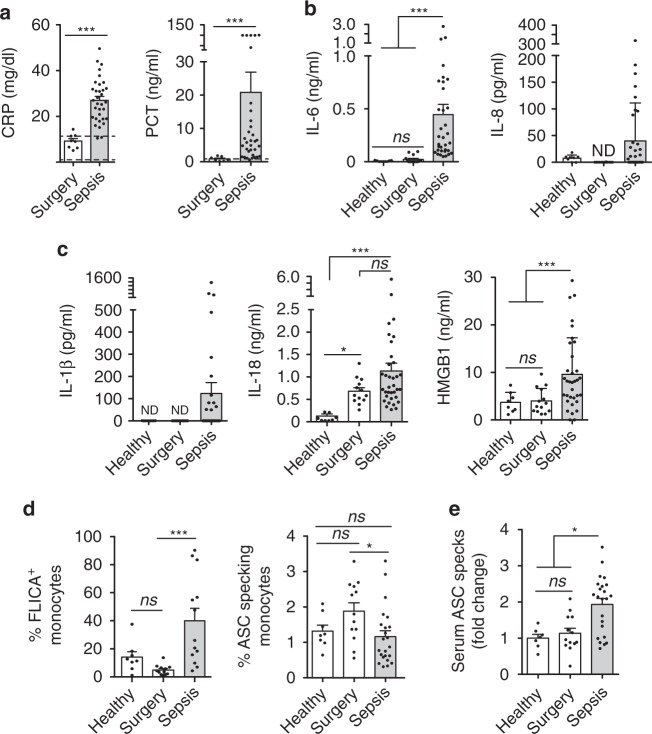
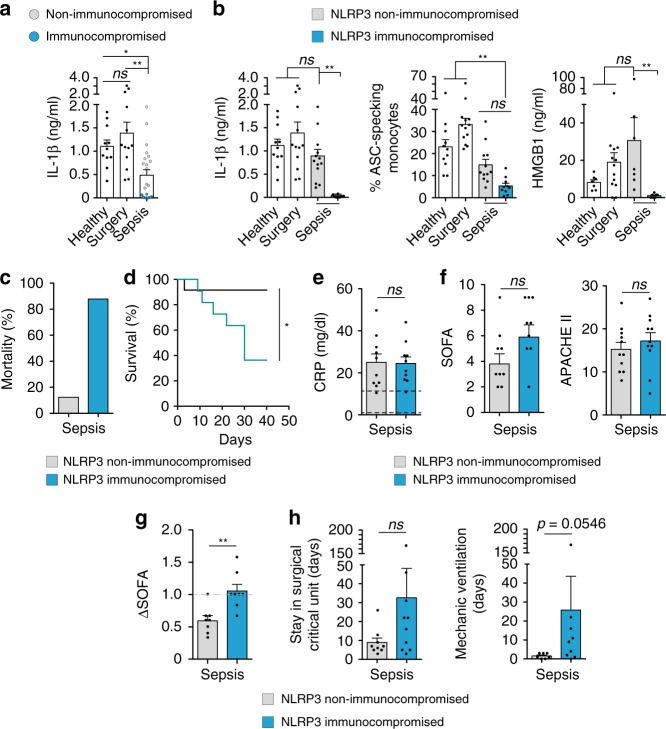
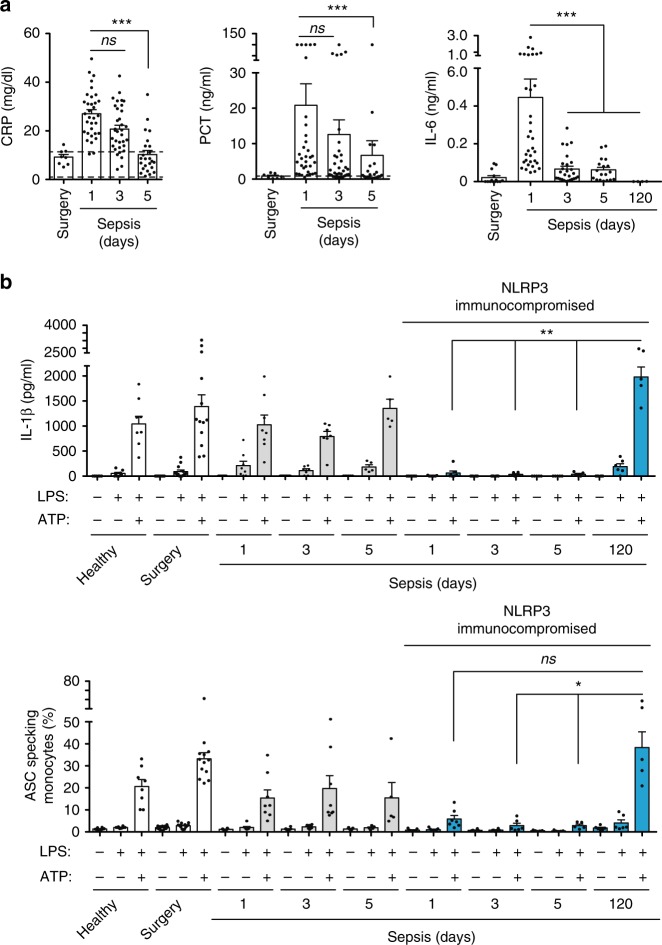
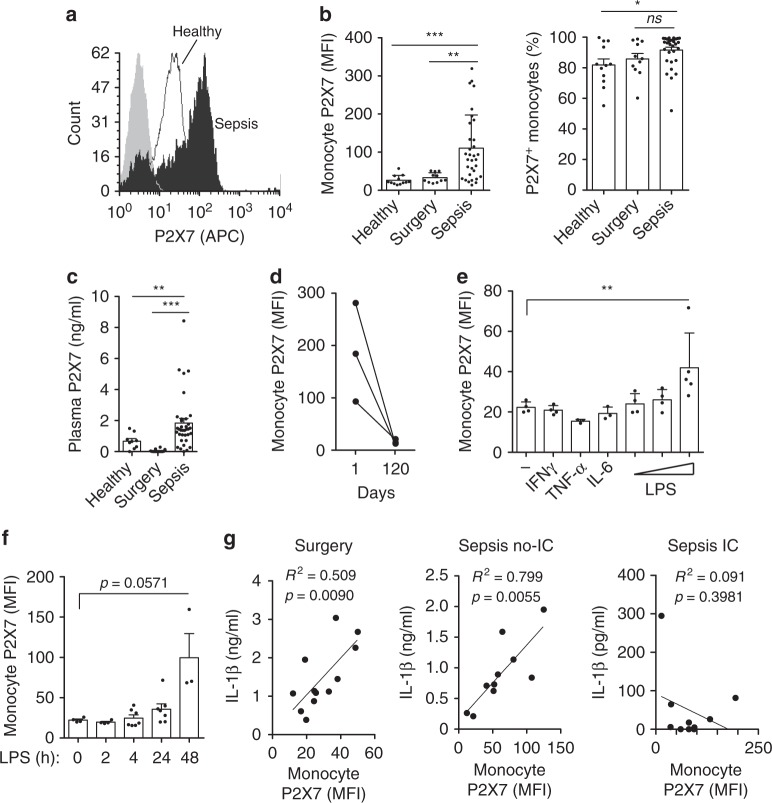
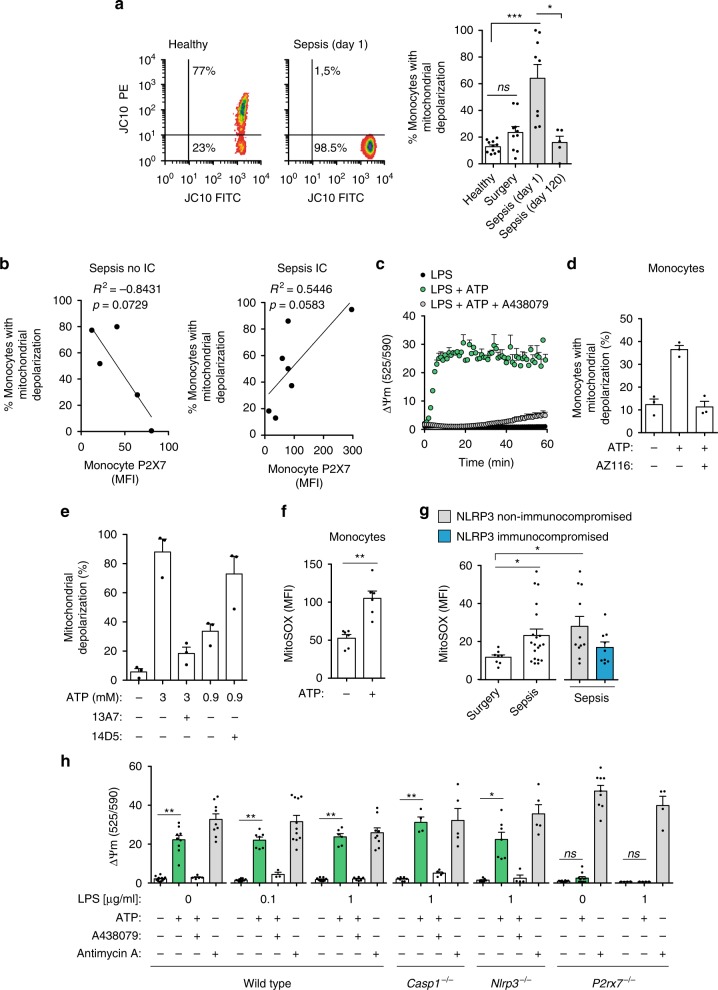
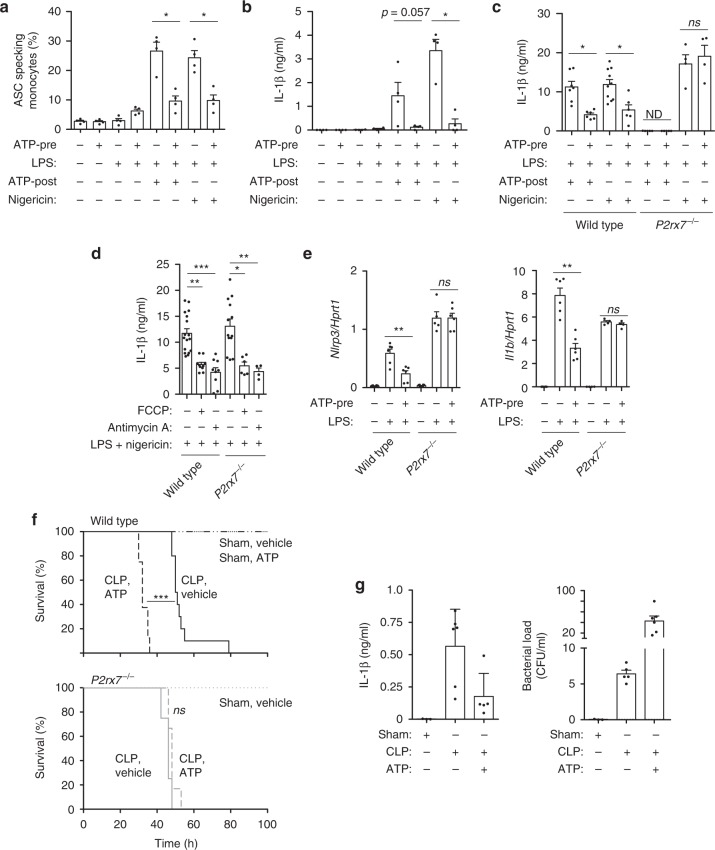
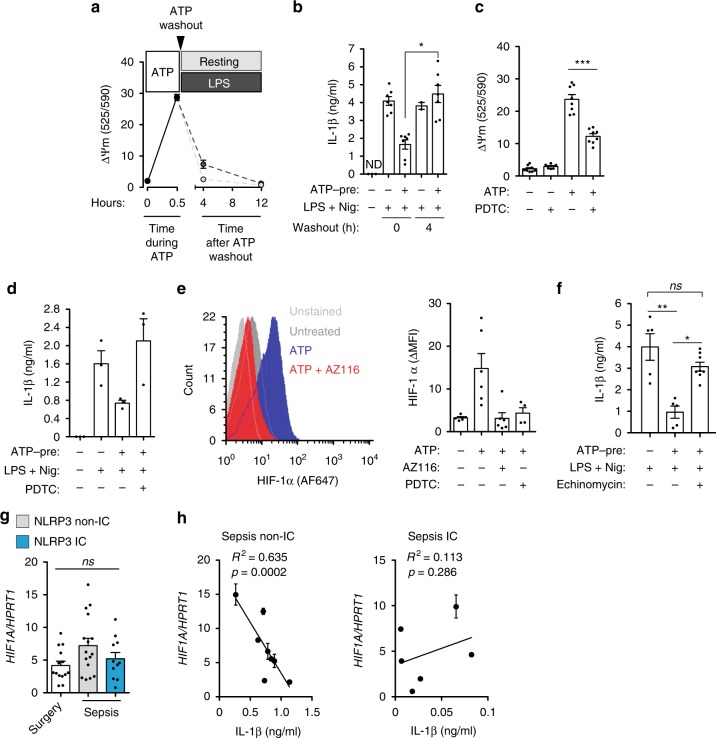
Verification
Claims the paper makes
The claims and statistics of this paper haven’t been checked yet.
Run the check — free, no account needed. It reads the open-access text and checks the sources it cites.
Claims other papers make about this one
Each is checked against this paper’s own text: does it say what the citing paper says it does?
The cited source says what the claim attributes to it.
In the citing paper
“It was already reported its capacity to modulate acute and chronic infection [81, 82], inflammatory diseases [82], sepsis [83, 84], neuropathic pain [85], and T-cell activation [86].”
From Hyperactivation of P2X7 receptors as a culprit of COVID-19 neuropathology (2021) · cites this paper as [83]
Self-check
Percentages, sums and reported differences re-computed from the paper’s own numbers.
The self-check needs the paper’s full text.
Citations
Cites
Origin and physiological roles of inflammation
Medzhitov, R. (2008) · Nature · doi:10.1038/nature07201 · Cited by 6,618
2001 SCCM/ESICM/ACCP/ATS/SIS International Sepsis Definitions Conference
Levy, M. M., Fink, M. P., Marshall, J. C., Abraham, E. H., Angus, D. C., Cook, D., Cohen, J., Opal, S. M., Vincent, J., & Ramsay, G. (2003) · Critical Care Medicine · doi:10.1097/01.ccm.0000050454.01978.3b · Cited by 5,976
Schroder, K., & Tschopp, J. (2010) · Cell · doi:10.1016/j.cell.2010.01.040 · Cited by 5,475
Severe Sepsis and Septic Shock
Angus, D. C., & van der Poll, T. (2013) · New England Journal of Medicine · doi:10.1056/nejmra1208623 · Cited by 4,119
Activation and regulation of the inflammasomes
Latz, E., Xiao, T. S., & Stutz, A. (2013) · Nature Reviews Immunology · doi:10.1038/nri3452 · Cited by 2,884
Sepsis-induced immunosuppression: from cellular dysfunctions to immunotherapy
Hotchkiss, R. S., Monneret, G., & Payen, D. (2013) · Nature Reviews Immunology · doi:10.1038/nri3552 · Cited by 2,772
Mills, E. L., Kelly, B., Logan, A., Costa, A. S. H., Varma, M., Bryant, C. E., Tourlomousis, P., Däbritz, J. H. M., Gottlieb, E., Latorre, I., et al. (2016) · Cell · doi:10.1016/j.cell.2016.08.064 · Cited by 2,291
mTOR- and HIF-1α–mediated aerobic glycolysis as metabolic basis for trained immunity
Cheng, S.-C., Quintin, J., Cramer, R. A., Shepardson, K. M., Saeed, S., Kumar, V., Giamarellos-Bourboulis, E. J., Martens, J. H. A., Rao, N. A., Aghajanirefah, A., et al. (2014) · Science · doi:10.1126/science.1250684 · Cited by 2,224
Immunosuppression in Patients Who Die of Sepsis and Multiple Organ Failure
Boomer, J. S., To, K. B., Chang, K. C., Takasu, O., Osborne, D. F., Walton, A. H., Bricker, T. L., Jarman, S. D., Kreisel, D., Krupnick, A. S., et al. (2011) · JAMA · doi:10.1001/jama.2011.1829 · Cited by 1,839
Endotoxin tolerance: new mechanisms, molecules and clinical significance
Biswas, S. K., & Lopez-Collazo, E. (2009) · Trends in Immunology · doi:10.1016/j.it.2009.07.009 · Cited by 1,318
Cited by
Sorted by citations
Items 201–233 of 233
Chen, H., Deng, Y., Gan, X., Li, Y., Huang, W., Lu, L., Wei, L., Su, L., Luo, J., Zou, B., et al. (2020) · Figshare · doi:10.6084/m9.figshare.12134238
Togre, N. S., Mekala, N. K., Bhoj, P. S., Mogadala, N., Winfield, M., Trivedi, J., Grove, D., Kotnala, S., Rom, S., Sriram, U., et al. (2024) · Figshare · doi:10.6084/m9.figshare.27129360
Togre, N. S., Mekala, N. K., Bhoj, P. S., Mogadala, N., Winfield, M., Trivedi, J., Grove, D., Kotnala, S., Rom, S., Sriram, U., et al. (2024) · Figshare · doi:10.6084/m9.figshare.27129366
Peng, F., Chang, W., Sun, Q., Xu, X., Xie, J., Qiu, H., & Yang, Y. (2020) · Figshare · doi:10.6084/m9.figshare.12812316
Guo, Y., Zhang, H., Lv, Z., Du, Y., Li, D., Fang, H., You, J., Yu, L., & Li, R. (2023) · Figshare · doi:10.6084/m9.figshare.22621558
Schneider, S., Merfort, I., Idzko, M., & Zech, A. (2022) · Figshare · doi:10.6084/m9.figshare.20035632
Angosto-Bazarra, D., Alarcón‐Vila, C., Hurtado‐Navarro, L., Baños, M. C., Rivers‐Auty, J., & Pelegrı́n, P. (2022) · Figshare · doi:10.6084/m9.figshare.18070867
Self-citationTogre, N. S., Mekala, N. K., Bhoj, P. S., Mogadala, N., Winfield, M., Trivedi, J., Grove, D., Kotnala, S., Rom, S., Sriram, U., et al. (2024) · Figshare · doi:10.6084/m9.figshare.27129357
Togre, N. S., Mekala, N. K., Bhoj, P. S., Mogadala, N., Winfield, M., Trivedi, J., Grove, D., Kotnala, S., Rom, S., Sriram, U., et al. (2024) · Figshare · doi:10.6084/m9.figshare.27129342
Guo, Y., Zhang, H., Lv, Z., Du, Y., Li, D., Fang, H., You, J., Yu, L., & Li, R. (2023) · Figshare · doi:10.6084/m9.figshare.22621561
Togre, N. S., Mekala, N. K., Bhoj, P. S., Mogadala, N., Winfield, M., Trivedi, J., Grove, D., Kotnala, S., Rom, S., Sriram, U., et al. (2024) · Figshare · doi:10.6084/m9.figshare.27129345
Togre, N. S., Mekala, N. K., Bhoj, P. S., Mogadala, N., Winfield, M., Trivedi, J., Grove, D., Kotnala, S., Rom, S., Sriram, U., et al. (2024) · Figshare · doi:10.6084/m9.figshare.27129336
Angosto-Bazarra, D., Alarcón‐Vila, C., Hurtado‐Navarro, L., Baños, M. C., Rivers‐Auty, J., & Pelegrı́n, P. (2022) · Figshare · doi:10.6084/m9.figshare.18070873
Self-citationTogre, N. S., Mekala, N. K., Bhoj, P. S., Mogadala, N., Winfield, M., Trivedi, J., Grove, D., Kotnala, S., Rom, S., Sriram, U., et al. (2024) · Figshare · doi:10.6084/m9.figshare.27129348
Angosto-Bazarra, D., Alarcón‐Vila, C., Hurtado‐Navarro, L., Baños, M. C., Rivers‐Auty, J., & Pelegrı́n, P. (2022) · Figshare · doi:10.6084/m9.figshare.18070858
Self-citationAngosto-Bazarra, D., Alarcón‐Vila, C., Hurtado‐Navarro, L., Baños, M. C., Rivers‐Auty, J., & Pelegrı́n, P. (2022) · Figshare · doi:10.6084/m9.figshare.18070882
Self-citationTogre, N. S., Mekala, N. K., Bhoj, P. S., Mogadala, N., Winfield, M., Trivedi, J., Grove, D., Kotnala, S., Rom, S., Sriram, U., et al. (2024) · Figshare · doi:10.6084/m9.figshare.27129354
Chen, H., Deng, Y., Gan, X., Li, Y., Huang, W., Lu, L., Wei, L., Su, L., Luo, J., Zou, B., et al. (2020) · Figshare · doi:10.6084/m9.figshare.12134250
Togre, N. S., Mekala, N. K., Bhoj, P. S., Mogadala, N., Winfield, M., Trivedi, J., Grove, D., Kotnala, S., Rom, S., Sriram, U., et al. (2024) · Figshare · doi:10.6084/m9.figshare.27129330
Togre, N. S., Mekala, N. K., Bhoj, P. S., Mogadala, N., Winfield, M., Trivedi, J., Grove, D., Kotnala, S., Rom, S., Sriram, U., et al. (2024) · Figshare · doi:10.6084/m9.figshare.27129351
Additional file 1 of Energetic dysfunction in sepsis: a narrative review
Preau, S., Vodovar, D., Jung, B., Lancel, S., Zafrani, L., Flatres, A., Oualha, M., Voiriot, G., Jouan, Y., Joffre, J., et al. (2021) · Figshare · doi:10.6084/m9.figshare.14905992
Togre, N. S., Mekala, N. K., Bhoj, P. S., Mogadala, N., Winfield, M., Trivedi, J., Grove, D., Kotnala, S., Rom, S., Sriram, U., et al. (2024) · Figshare · doi:10.6084/m9.figshare.27129339
Togre, N. S., Mekala, N. K., Bhoj, P. S., Mogadala, N., Winfield, M., Trivedi, J., Grove, D., Kotnala, S., Rom, S., Sriram, U., et al. (2024) · Figshare · doi:10.6084/m9.figshare.27129333
Guo, Y., Zhang, H., Lv, Z., Du, Y., Li, D., Fang, H., You, J., Yu, L., & Li, R. (2023) · Figshare · doi:10.6084/m9.figshare.22621564
Lei, H.-W., Zhang, F., Chai, R.-T., Lin, J.-W., Xie, J.-C., Zhang, S.-L., Zhang, J. I.-X., Ni, M.-Y., Zhao, J., Chen, M.-M., et al. (2026) · World Journal of Traditional Chinese Medicine · doi:10.4103/wjtcm.wjtcm_39_25
Extracellular ATP in inflammatory disorders
Fhaily, L. E., Abad, C., Tan, Y., & Adriouch, S. (2026) · Elsevier eBooks · doi:10.1016/b978-0-443-30250-3.00031-x
Self-citationLiao, X., Chen, Y., Cheng, Y., Gong, B., Zhang, Z., Qu, X., & Zhou, G. (2026) · European journal of medical research · doi:10.1186/s40001-026-04448-z
“The expression of P2X7 receptors on the surface of monocytes in patients with sepsis is significantly upregulated, and there is early impairment in the activation of the NLRP3 inflammasome, with the degree of this impairment being closely related to the prognosis of patients [150].”
Xie, S., Lyu, F., Gao, K., Chen, Q., 陈梅玲, Yan, X., Li, T., Li, H., Zhao, Y., Qu, L., et al. (2026) · Chinese Medical Journal · doi:10.1097/cm9.0000000000004108
Multiomics Identification of Novel Diagnostic Biomarkers and Precise Therapeutic Targets for Sepsis
Gu, M., Chen, X., Tang, N., & Hu, X. (2026) · International Journal of Clinical Practice · doi:10.1155/ijcp/3132904
The P2X7 receptor: insights from the murine monoclonal antibody clone L4
Sluyter, R., Elhage, A., Bartlett, R., Watson, D., Stokes, L., Skarratt, K. K., Fuller, S. J., & Gu, B. J. (2026) · Purinergic Signalling · doi:10.1007/s11302-026-10176-0
“Cell-surface P2X7 is also increased on monocytes, primarily CD14 + CD16 − and CD14 + CD16 + monocytes, from patients with sepsis but not on monocytes from surgery patients or healthy individuals [69].”
Martínez-García, J. J., Rodríguez, S., Guijarro, A., Quevedo-Romero, I., Mateo, S. V., Molina‐López, C., Hurtado‐Navarro, L., Baroja‐Mazo, A., & Pelegrín, P. (2026) · Metabolism · doi:10.1016/j.metabol.2026.156766
Self-citationXu, Q., Sun, W., Li, L., Liu, N., & Liu, B. (2026) · Frontiers in Pharmacology · doi:10.3389/fphar.2026.1901368
Deng, J., Lu, J., Wang, W., & 刘庆阳 (2026) · Life Sciences · doi:10.1016/j.lfs.2026.124749
Metadata
- Authors
- Martínez-García, J. J., Martínez-Banaclocha, H., Angosto-Bazarra, D., de Torre-Minguela, C., Baroja-Mazo, A., Alarcón-Vila, C., Martínez-Alarcón, L., Amores-Iniesta, J., Martín-Sánchez, F., Ercole, G. A., Martínez, C. M., González-Lisorge, A., Fernández-Pacheco, J., Martínez-Gil, P., Adriouch, S., Koch-Nolte, F., Luján, J., Acosta-Villegas, F., Parrilla, P., García-Palenciano, C., & Pelegrin, P.
- Affiliations
- Instituto Murciano de Investigación Biosanitaria (ES)
- Hospital Universitario Virgen de la Arrixaca (ES)
- Inserm (FR)
- ORCID
- Venue
- Nature Communications
- Published
- 2019-06-20
- Volume
- 10
- Issue
- 1
- Pages
- 2711-2711
- ISSN
- 2041-1723 (ISSN-L)
- PMC
- PMC6586640
- OpenAlex
- W2952125019
- Cited by
- 233
- References
- 63
- Citations by year
- 2026: 16 · 2025: 16 · 2024: 44 · 2023: 48 · 2022: 39 · 2021: 34 · 2020: 33 · 2019: 3
- FWCI
- 9.01
- Type
- journal article
- Language
- en
- Open access
- gold
- doi.org
- Locations
- Nature Communications (publishedVersion, cc-by)
- PubMed Central (publishedVersion, cc-by)
- PubMed (publishedVersion)
- Hispana (publishedVersion, cc-by)
- HAL (submittedVersion, other-oa)
- RePEc: Research Papers in Economics (submittedVersion)
- DOAJ (DOAJ: Directory of Open Access Journals) (submittedVersion, cc-by-sa)
- DOAJ (DOAJ: Directory of Open Access Journals) (submittedVersion)
- Funders
- Institute for Research in Biomedicine
- Ablynx
- European Cooperation in Science and Technology (BM-1406)
- Ministerio de Economía y Competitividad (FJCI-2014-22041, PI13/00174, CD13/00059)
- Ministerio de Asuntos Económicos y Transformación Digital, Gobierno de España (SAF2017‐88276‐R)
- European Regional Development Fund (PI13/00174)
- Topics
- Life Sciences › Biochemistry, Genetics and Molecular Biology › Molecular Biology › Inflammasome and immune disorders
- Life Sciences › Biochemistry, Genetics and Molecular Biology › Physiology › Adenosine and Purinergic Signaling
- Health Sciences › Medicine › Critical Care and Intensive Care Medicine › Sepsis Diagnosis and Treatment
- Keywords
- P2X7 receptor, NLRP3 inflammasome, mitochondrial dysfunction, monocytes, sepsis, HIF-1α, purinergic signaling, immunosuppression, sepsis mortality, abdominal sepsis, mouse sepsis model
- MeSH terms
- NLR Family, Pyrin Domain-Containing 3 Protein, Adult, Aged, Aged, 80 and over, Animals, Disease Models, Animal, Female, Follow-Up Studies, Humans, Macrophages, Male, Middle Aged, Mitochondria, Monocytes, Up-Regulation, Sepsis, Mice, Hypoxia-Inducible Factor 1, alpha Subunit, Receptors, Purinergic P2X7, Inflammasomes, Mitochondrial Dynamics
About these checks
Registry, retraction, Cites and statistics results are computed, not judged, with one exception: a printed reference that no index lists is read once by a model before it counts as a citation error. Claims are extracted by a model and kept only when their quote appears verbatim in the text; each cited source is then checked, with a model’s help, for whether it says what the claim relies on. Those verdicts can be wrong — read the claim’s quote and the cited source before relying on one.
Statistics and arithmetic are recomputed, not judged.
Confidence bands are shown only for fields calibrated on our annotated test set. None is calibrated yet, so no band is shown.
What counts as a claim ›How we measure confidence ›How we check this ›
Are you an author, or do you see a problem with this page? Request a review
