

Prebiotic condensation through wet–dry cycling regulated by deliquescence
Open accessThe DOI matches its Crossref record; 57 of the 57 references it cites were found in a registry or an index.
Abstract
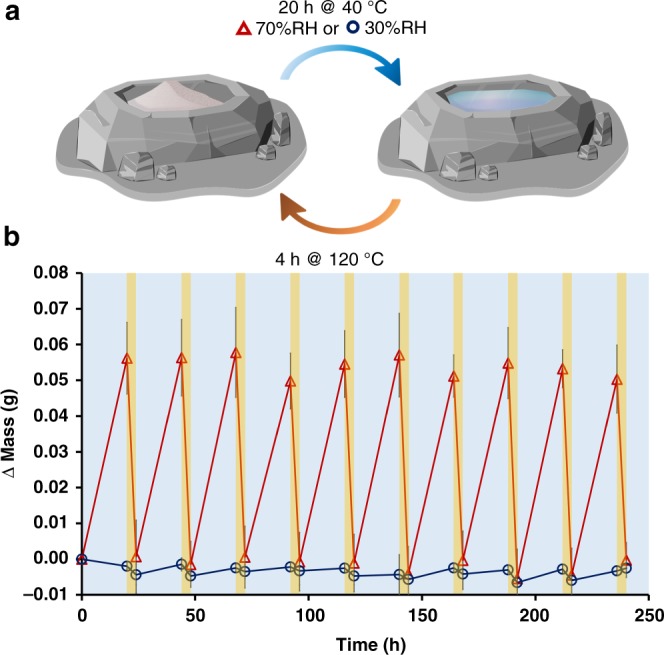
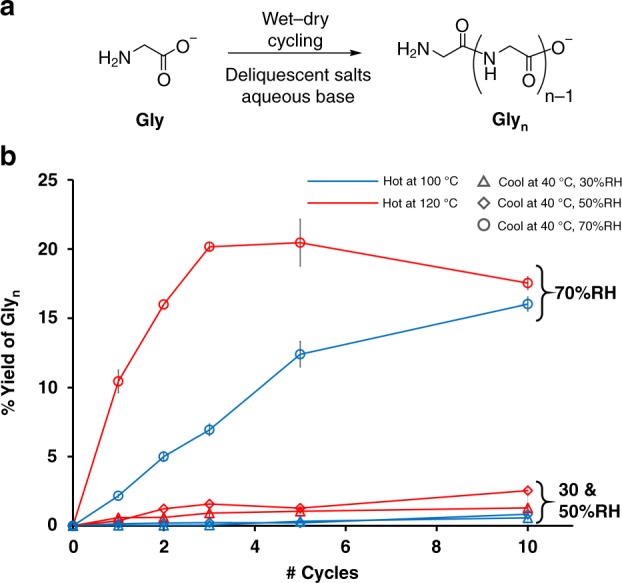
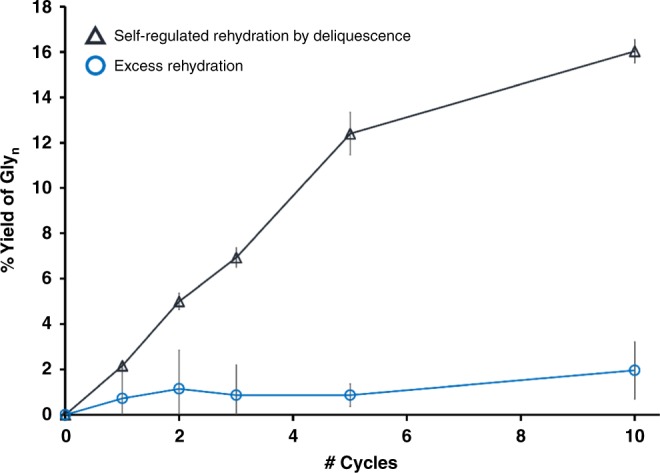
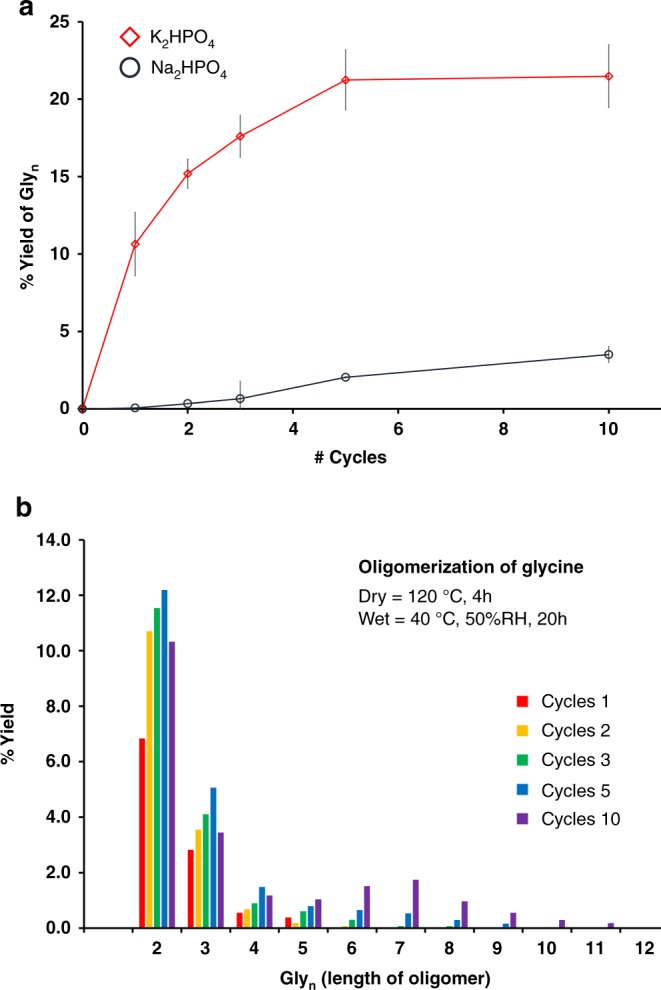
Wet–dry cycling is widely regarded as a means of driving condensation reactions under prebiotic conditions to generate mixtures of prospective biopolymers. A criticism of this model is its reliance on unpredictable rehydration events, like rainstorms. Here, we report the ability of deliquescent minerals to mediate the oligomerization of glycine during iterative wet–dry cycles. The reaction mixtures evaporate to dryness at high temperatures and spontaneously reacquire water vapor to form aqueous solutions at low temperatures. Deliquescent mixtures can foster yields of oligomerization over ten-fold higher than non-deliquescent controls. The deliquescent mixtures tightly regulate their moisture content, which is crucial, as too little water precludes dissolution of the reactants while too much water favors hydrolysis over condensation. The model also suggests a potential reason why life evolved to favor the enrichment of potassium: so living systems could acquire and retain sufficient water to serve as a solvent for biochemical reactions.
Overview
The claims and statistics of this paper haven’t been checked yet.
Free: it reads the open-access text and checks the first 5 claims that cite a source we can check. Create a free account to check every claim.
Integrity signals
Registry
Cites
Statistics
Figures
Verification
Claims the paper makes
The claims and statistics of this paper haven’t been checked yet.
Free: it reads the open-access text and checks the first 5 claims that cite a source we can check. Create a free account to check every claim.
Self-check
Percentages, sums and reported differences re-computed from the paper’s own numbers.
The self-check needs the paper’s full text.
Citations
Cites
A Production of Amino Acids Under Possible Primitive Earth Conditions
Miller, S. L. (1953) · Science · doi:10.1126/science.117.3046.528 · Cited by 3,522
The Chemical Evolution of the Atmosphere and Oceans
Holland, H. D. (1984) · doi:10.1515/9780691220239 · Cited by 1,836
Westheimer, F. H. (1987) · Science · doi:10.1126/science.2434996 · Cited by 1,711
Szostak, J. W., Bartel, D. P., & Luisi, P. L. (2001) · Nature · doi:10.1038/35053176 · Cited by 1,681
Common origins of RNA, protein and lipid precursors in a cyanosulfidic protometabolism
Patel, B. H., Percivalle, C., Ritson, D. J., Duffy, C. D., & Sutherland, J. D. (2015) · Nature Chemistry · doi:10.1038/nchem.2202 · Cited by 949
Experimental Models of Primitive Cellular Compartments: Encapsulation, Growth, and Division
Hanczyc, M. M., Fujikawa, S. M., & Szostak, J. W. (2003) · Science · doi:10.1126/science.1089904 · Cited by 848
Production of Some Organic Compounds under Possible Primitive Earth Conditions1
Miller, S. L. (1955) · Journal of the American Chemical Society · doi:10.1021/ja01614a001 · Cited by 827
Phase Transitions of Aqueous Atmospheric Particles
Martin, S. T. (2000) · Chemical Reviews · doi:10.1021/cr990034t · Cited by 718
Spectral evidence for hydrated salts in recurring slope lineae on Mars
Ojha, L., Wilhelm, M. B., Murchie, S. L., McEwen, A. S., Wray, J. J., Hanley, J., Massé, M., & Chojnacki, M. (2015) · Nature Geoscience · doi:10.1038/ngeo2546 · Cited by 617
Composition and temperature dependence of the deliquescence properties of hygroscopic aerosols
Tang, I. N., & Munkelwitz, H. R. (1993) · Atmospheric Environment. Part A. General Topics · doi:10.1016/0960-1686(93)90204-c · Cited by 477
Cited by
Items 101–135 of 135
Prebiotic Chemistry in the Wild: How Geology Interferes with the Origins of LifePreprint
Walton, C. R., Rimmer, P. B., Williams, H. M., & Shorttle, O. (2020) · ChemRxiv · doi:10.26434/chemrxiv.13198205.v1 · Cited by 3
Knecht, L. N., Gruchola, S., Cockell, C. S., Perl, S. M., Wilhelm, M. B., Schmidt, P. K., de Koning, C., Tulej, M., Thomas, N., Wurz, P., et al. (2025) · The Planetary Science Journal · doi:10.3847/psj/ade3d1 · Cited by 1
Thuan, J. C., Koirala, A., Pirez, J., & Ohata, J. (2025) · ACS Bio & Med Chem Au · doi:10.1021/acsbiomedchemau.5c00167 · Cited by 2
Yu, S., Zheng, X., Guo, X., Zhang, L., Zhao, Y., & Ying, J. (2025) · Chemical Communications · doi:10.1039/d5cc06016h · Cited by 1
The master molecule that built biology: How water shaped the chemistry of life
DiGiacomo, J., Rose, G. D., & Williams, L. D. (2026) · Protein Science · doi:10.1002/pro.70532 · Cited by 4
Prebiotic chemistry: From dust to molecules and beyond
Camprubí, E., Markovitch, O., Muchowska, K. B., Otto, S., & ten Kate, I. L. (2022) · Elsevier eBooks · doi:10.1016/b978-0-12-824162-2.00005-1 · Cited by 1
Chen, Q., Xu, H.-X., Zhao, B., Patehebieke, Y., Zhao, Z., & Wang, X. (2025) · Science China Chemistry · doi:10.1007/s11426-024-2445-6 · Cited by 1
Astrobiology in Europe, 20 years of expectations
Brack, A. (2021) · International Journal of Astrobiology · doi:10.1017/s1473550421000227 · Cited by 3
From Amino Acids to Peptides before the Coming of Ribosomes
Leqraa, N., & Vallée, Y. (2022) · Royal Society of Chemistry eBooks · doi:10.1039/9781839164798-00177 · Cited by 2
Prebiotic Chemistry in the Wild: How Geology Interferes with the Origins of LifePreprint
Walton, C. R., Rimmer, P. B., Williams, H. M., & Shorttle, O. (2020) · ChemRxiv · doi:10.26434/chemrxiv.13198205 · Cited by 2
Brack, A. (2020) · Wiley eBooks · doi:10.1002/9780470015902.a0029235 · Cited by 1
Fares, H. M., Marras, A. E., Ting, J., Tirrell, M., & Keating, C. D. (2020) · ChemRxiv · doi:10.26434/chemrxiv.12278318 · Cited by 1
Rational ignorance in the search for extra-terrestrial life
Zanders, E. D. (2023) · New Astronomy Reviews · doi:10.1016/j.newar.2023.101675
Symmetry Breaking and Chiral Amplification in Prebiotic Ligation ReactionsPreprint
Deng, M., Yu, J., & Blackmond, D. G. (2024) · Research Square · doi:10.21203/rs.3.rs-3694563/v2 · Cited by 1
Luo, H., & Zhong, L. (2024) · SSRN Electronic Journal · doi:10.2139/ssrn.4790415
Enrichment of Potassium During Simulated Weathering of Chloride Evaporites
Zaman, M. R.-U., Ranciglio, D. J., Mooney, B. E. W., & Bracher, P. J. (2025) · ACS Earth and Space Chemistry · doi:10.1021/acsearthspacechem.3c00376
Self-citationOrigin of Complex Biomolecules on the Dawn of Lifeforms
Stowe, D. F. (2025) · Springer eBooks · doi:10.1007/978-3-031-76668-8_3
Chen, M., Li, D., & Yang, G. (2025) · ACS Earth and Space Chemistry · doi:10.1021/acsearthspacechem.5c00115
Ahmed, T., Verma, A., & Takayama, S. (2025) · Biomacromolecules · doi:10.1021/acs.biomac.5c00926
Molecular evolution of Ser-His dipeptide and its applications
Cai, H., Liu, Y., & Zhao, Y. (2025) · Chinese Science Bulletin (Chinese Version) · doi:10.1360/csb-2025-5198
Jones, C. K., Leung, M., Tu, C., Ebadirad, S., Marshall, N. L., Tan, L., & Lyons, T. W. (2025) · Elsevier eBooks · doi:10.1016/b978-0-323-95547-8.00003-3
Harvesting chemical power from cyclic environments
Jaiswal, P., Haugerud, I. S., Vuijk, H. D., & Weber, C. A. (2026) · Physical Review Research · doi:10.1103/kfmy-lb48 · Cited by 2
Sustainable Synthesis and Emulsifying Potential of N-Acyl Glycine as a Biodegradable SurfactantPreprint
Lee, H.-S., Bang, G.-H., & Lee, K. (2025) · SSRN Electronic Journal · doi:10.2139/ssrn.5984914
Prebiotic oligomerization of amino acids: A step in molecular evolution toward biological complexity
Vargas-García, A., & Heredia, A. (2026) · Biosystems · doi:10.1016/j.biosystems.2026.105773
Fonseca-González, E., Fuentes-Carreón, C. A., & Heredia, A. (2026) · Journal of Molecular Evolution · doi:10.1007/s00239-026-10309-4
“…the concentration of organic compounds and the removal of reaction byproducts (including water from condensation reactions), namely, it promoted the formation of increasingly complex polymers through continuous dehydration-rehydration processes (Saladino et al. 2019; Campbell et al. 2019).”
Samrout, O. E. (2023) · theses.fr (ABES) · doi:10.70675/525964dbza68dz4d85zac2bz3dfaae5b26b5 · Cited by 1
Blanco, C. (2026) · Royal Society Open Science · doi:10.1098/rsos.251750
Ezerzer, Y., Hiregange, D., Bashan, A., Yonath, A., & Frenkel‐Pinter, M. (2026) · BioCosmos · doi:10.2478/biocosmos-2026-0002 · Cited by 1
“During dehydration, hydroxy acids readily form esters via condensation-dehydration reactions (13, 35–39).”
The enzyme-free regioselective phosphorylation of ribonucleosides is promoted by metal ions
Mistri, M., & Jash, B. (2026) · Organic & Biomolecular Chemistry · doi:10.1039/d6ob00404k
Humanity’s Place in the Universe: Peer Complexity, SETI, and the Fermi Paradox
Nielsen, J. N. (2026) · World-systems evolution and global futures · doi:10.1007/978-3-032-20517-9_15
Coacervates protect RNA against hydrolysis under wet-dry cycling conditionsPreprint
Pei, J., Bevilacqua, P. C., & Keating, C. D. (2026) · bioRxiv (Cold Spring Harbor Laboratory) · doi:10.64898/2026.08.03.742545
Synthesis of N-acyl glycine and its application as a food co-emulsifier
Lee, H.-S., Bang, G.-H., & Lee, K.-T. (2026) · Applied Food Research · doi:10.1016/j.afres.2026.102521
Haja, R., & Nmeribe, O. D. (2026) · Extreme Life Biospeology & Astrobiology · doi:10.67784/0045 · Cited by 1
The Role of Pyrophosphate in the Origin of Life: An Energy-Based Hypothesis
Villa‐Bellosta, R. (2026) · Biology · doi:10.3390/biology15181592
“Wet–dry cycling would have been particularly favourable because evaporation concentrates solutes and lowers water activity, whereas limited rehydration restores a liquid phase in which reactants and products can become mobile [32].”
InfluentialOleoscopicity and Organic Deliquescence of Hydrophobic Compounds Under a Hydrocarbon Atmosphere
Skaggs, S. K., Smith, K. A., Ankrom, M. J., & Bracher, P. J. (2026) · Journal of Physical Organic Chemistry · doi:10.1002/poc.70096
Self-citation
Metadata
- Authors
- Campbell, T. D., Febrian, R., McCarthy, J. T., Kleinschmidt, H. E., Forsythe, J. G., & Bracher, P. J.
- Affiliations
- Saint Louis University (US)
- College of Charleston (US)
- Corresponding author
- Bracher, Paul J.
- ORCID
- Venue
- Nature Communications
- Published
- 2019-10-04
- Volume
- 10
- Issue
- 1
- Pages
- 4508-4508
- ISSN
- 2041-1723 (ISSN-L)
- PMC
- PMC6778215
- OpenAlex
- W2978071906
- Semantic Scholar
- 707b41927f9df3200b92bf78c966aabc597029fa
- Cited by
- 136
- References
- 57
- Citations by year
- 2026: 17 · 2025: 21 · 2024: 19 · 2023: 20 · 2022: 20 · 2021: 19 · 2020: 17 · 2019: 3
- FWCI
- 7.92
- Type
- journal article
- Language
- en
- Open access
- gold
- doi.org
- Licence
- cc-by
- creativecommons.org/licenses/by/4.0 (tdm)
- creativecommons.org/licenses/by/4.0 (vor)
- Locations
- Nature Communications (publishedVersion, cc-by)
- PubMed Central (publishedVersion, cc-by)
- PubMed (publishedVersion)
- RePEc: Research Papers in Economics (submittedVersion)
- DOAJ (DOAJ: Directory of Open Access Journals) (submittedVersion, cc-by-sa)
- DOAJ (DOAJ: Directory of Open Access Journals) (submittedVersion)
- Funders
- National Science Foundation (1504217, 1626501)
- National Aeronautics and Space Administration (80NSSC17K0521, CHE-1504217)
- Saint Louis University
- Nuclear Safety and Security Commission
- Division of Chemistry (CHE-1504217, 1504217, CHE-1626501)
- Topics
- Physical Sciences › Physics and Astronomy › Astronomy and Astrophysics › Origins and Evolution of Life
- Physical Sciences › Physics and Astronomy › Astronomy and Astrophysics › Space Science and Extraterrestrial Life
- Physical Sciences › Environmental Science › Global and Planetary Change › Earth Systems and Cosmic Evolution
- Keywords
- prebiotic chemistry, wet-dry cycling, deliquescence, condensation reactions, moisture control, rehydration, hydrolysis, potassium enrichment, origin of life
- MeSH terms
- Biopolymers, Hot Temperature, Humidity, Hydrolysis, Solubility, Water, Prebiotics, Polymerization
About these checks
Registry, retraction, Cites and statistics results are computed, not judged, with one exception: a printed reference that no index lists is read once by a model before it counts as a citation error. Claims are extracted by a model and kept only when their quote appears verbatim in the text; each cited source is then checked, with a model’s help, for whether it says what the claim relies on. Those verdicts can be wrong — read the claim’s quote and the cited source before relying on one.
Statistics and arithmetic are recomputed, not judged.
Confidence bands are shown only for fields calibrated on our annotated test set. None is calibrated yet, so no band is shown.
What counts as a claim ›How we measure confidence ›How we check this ›
Are you an author, or do you see a problem with this page? Request a review
Data sources
Bibliographic data: Semantic Scholar, OpenAlex, Crossref.
Contains information from the Semantic Scholar Academic Graph Datasets, made available under the ODC Attribution License (ODC-BY 1.0).
Semantic Scholar’s data is described in: Kinney, R., et al. (2023). The Semantic Scholar Open Data Platform. arXiv:2301.10140.
