

Prebiotic condensation through wet–dry cycling regulated by deliquescence
Open accessThe DOI matches its Crossref record; 57 of the 57 references it cites were found in a registry or an index.
Abstract
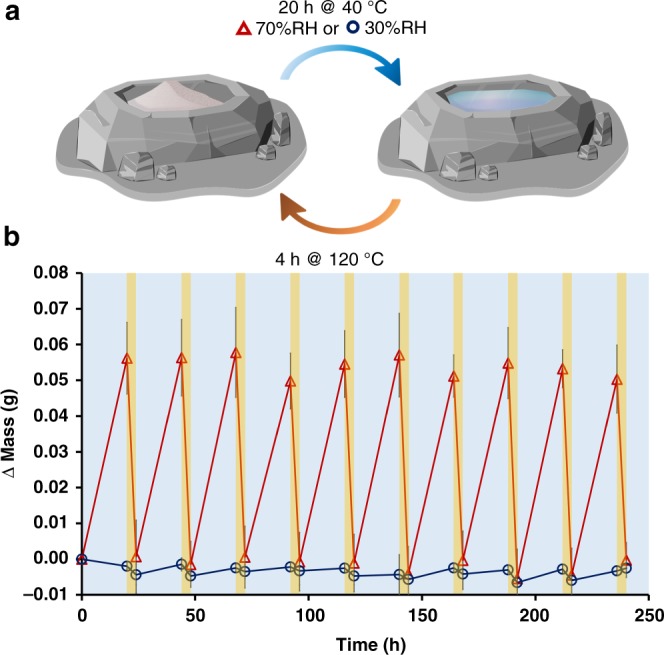
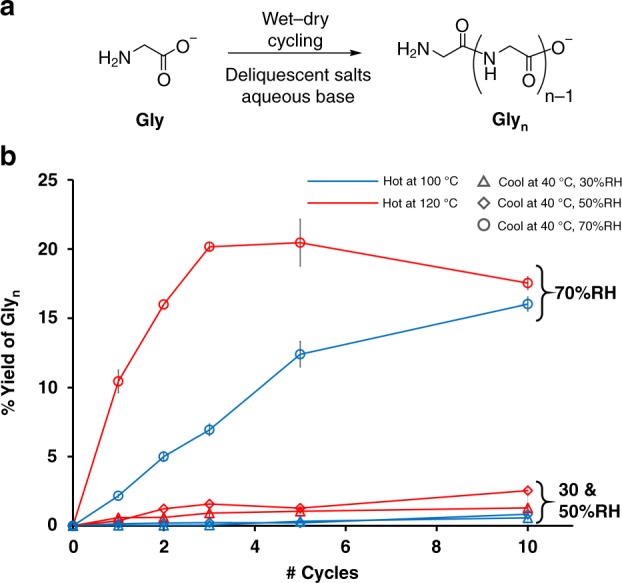
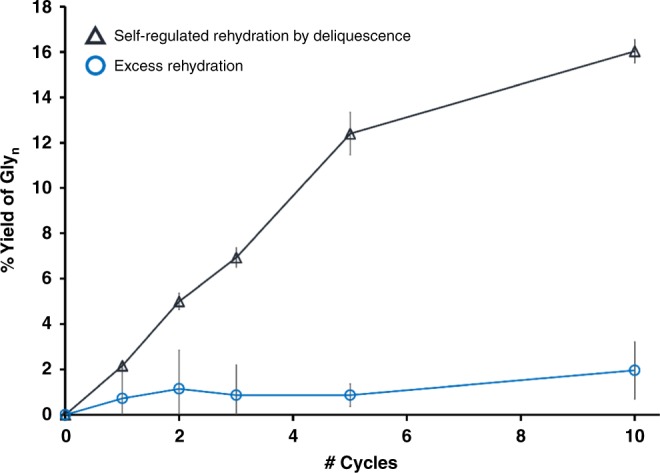
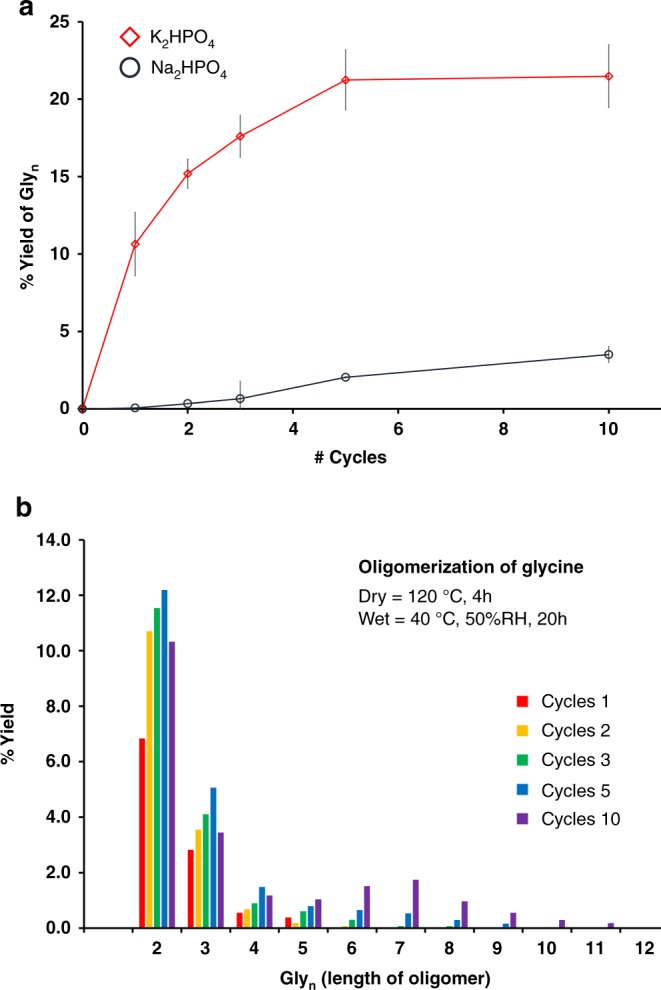
Wet–dry cycling is widely regarded as a means of driving condensation reactions under prebiotic conditions to generate mixtures of prospective biopolymers. A criticism of this model is its reliance on unpredictable rehydration events, like rainstorms. Here, we report the ability of deliquescent minerals to mediate the oligomerization of glycine during iterative wet–dry cycles. The reaction mixtures evaporate to dryness at high temperatures and spontaneously reacquire water vapor to form aqueous solutions at low temperatures. Deliquescent mixtures can foster yields of oligomerization over ten-fold higher than non-deliquescent controls. The deliquescent mixtures tightly regulate their moisture content, which is crucial, as too little water precludes dissolution of the reactants while too much water favors hydrolysis over condensation. The model also suggests a potential reason why life evolved to favor the enrichment of potassium: so living systems could acquire and retain sufficient water to serve as a solvent for biochemical reactions.
Overview
The claims and statistics of this paper haven’t been checked yet.
Free: it reads the open-access text and checks the first 5 claims that cite a source we can check. Create a free account to check every claim.
Integrity signals
Registry
Cites
Statistics
Figures
Verification
Claims the paper makes
The claims and statistics of this paper haven’t been checked yet.
Free: it reads the open-access text and checks the first 5 claims that cite a source we can check. Create a free account to check every claim.
Self-check
Percentages, sums and reported differences re-computed from the paper’s own numbers.
The self-check needs the paper’s full text.
Citations
Cites
A Production of Amino Acids Under Possible Primitive Earth Conditions
Miller, S. L. (1953) · Science · doi:10.1126/science.117.3046.528 · Cited by 3,522
The Chemical Evolution of the Atmosphere and Oceans
Holland, H. D. (1984) · doi:10.1515/9780691220239 · Cited by 1,836
Westheimer, F. H. (1987) · Science · doi:10.1126/science.2434996 · Cited by 1,711
Szostak, J. W., Bartel, D. P., & Luisi, P. L. (2001) · Nature · doi:10.1038/35053176 · Cited by 1,681
Common origins of RNA, protein and lipid precursors in a cyanosulfidic protometabolism
Patel, B. H., Percivalle, C., Ritson, D. J., Duffy, C. D., & Sutherland, J. D. (2015) · Nature Chemistry · doi:10.1038/nchem.2202 · Cited by 949
Experimental Models of Primitive Cellular Compartments: Encapsulation, Growth, and Division
Hanczyc, M. M., Fujikawa, S. M., & Szostak, J. W. (2003) · Science · doi:10.1126/science.1089904 · Cited by 848
Production of Some Organic Compounds under Possible Primitive Earth Conditions1
Miller, S. L. (1955) · Journal of the American Chemical Society · doi:10.1021/ja01614a001 · Cited by 827
Phase Transitions of Aqueous Atmospheric Particles
Martin, S. T. (2000) · Chemical Reviews · doi:10.1021/cr990034t · Cited by 718
Spectral evidence for hydrated salts in recurring slope lineae on Mars
Ojha, L., Wilhelm, M. B., Murchie, S. L., McEwen, A. S., Wray, J. J., Hanley, J., Massé, M., & Chojnacki, M. (2015) · Nature Geoscience · doi:10.1038/ngeo2546 · Cited by 617
Composition and temperature dependence of the deliquescence properties of hygroscopic aerosols
Tang, I. N., & Munkelwitz, H. R. (1993) · Atmospheric Environment. Part A. General Topics · doi:10.1016/0960-1686(93)90204-c · Cited by 477
Cited by
The Hot Spring Hypothesis for an Origin of Life
Damer, B., & Deamer, D. (2020) · Astrobiology · doi:10.1089/ast.2019.2045 · Cited by 478
“Hydration driven by precipitation, dew, humidity changes, or deliquescence (Campbell et al., 2019) can then release organics and begin to promote the condensation reactions described in Section I.”
BackgroundInfluentialPrebiotic Peptides: Molecular Hubs in the Origin of Life
Frenkel-Pinter, M., Samanta, M., Ashkenasy, G., & Leman, L. J. (2020) · Chemical Reviews · doi:10.1021/acs.chemrev.9b00664 · Cited by 354
A carbonate-rich lake solution to the phosphate problem of the origin of life
Toner, J. D., & Catling, D. C. (2020) · Proceedings of the National Academy of Sciences · doi:10.1073/pnas.1916109117 · Cited by 201
“Condensation reactions may also have been promoted by deliquescence of highly soluble evaporites (51).”
Fedorenko, A., Grinberg, M., Orevi, T., & Kashtan, N. (2020) · Scientific Reports · doi:10.1038/s41598-020-79625-z · Cited by 163
Holden, D. T., Morato, N. M., & Cooks, R. G. (2022) · Proceedings of the National Academy of Sciences · doi:10.1073/pnas.2212642119 · Cited by 147
How Droplets Can Accelerate Reactions─Coacervate Protocells as Catalytic Microcompartments
Smokers, I. B. A., Visser, B. S., Slootbeek, A. D., Huck, W. T. S., & Spruijt, E. (2024) · Accounts of Chemical Research · doi:10.1021/acs.accounts.4c00114 · Cited by 176
Guo, W., Kinghorn, A. B., Zhang, Y., Li, Q., Poonam, A. D., Tanner, J. A., & Shum, H. C. (2021) · Nature Communications · doi:10.1038/s41467-021-23410-7 · Cited by 98
Fares, H. M., Marras, A. E., Ting, J., Tirrell, M., & Keating, C. D. (2020) · Nature Communications · doi:10.1038/s41467-020-19184-z · Cited by 90
Symmetry breaking and chiral amplification in prebiotic ligation reactions
Deng, M., Yu, J., & Blackmond, D. G. (2024) · Nature · doi:10.1038/s41586-024-07059-y · Cited by 99
“Alternative approaches include wet–dry cycling 16 or mineral catalysis 17,18 .”
Mechanochemical Prebiotic Peptide Bond Formation**
Stolar, T., Grubešić, S., Cindro, N., Meštrović, E., Užarević, K., & Hernández, J. G. (2021) · Angewandte Chemie International Edition · doi:10.1002/anie.202100806 · Cited by 65
Sustained wet–dry cycling on early Mars
Rapin, W., Dromart, G., Clark, B. C., Schieber, J., Kite, E. S., Kah, L. C., Thompson, L. M., Gasnault, O., Lasue, J., Meslin, P., et al. (2023) · Nature · doi:10.1038/s41586-023-06220-3 · Cited by 76
Origin of Life on Mars: Suitability and Opportunities
Clark, B. C., Kolb, V. M., Steele, A., House, C. H., Lanza, N., Gasda, P. J., VanBommel, S. J. V., NEWSOM, H. E., & Martínez‐Frías, J. (2021) · Life · doi:10.3390/life11060539 · Cited by 59
“Wet–dry cycling yields for oligopeptide formation from glycine has been shown to be enhanced by as much as 10× when deliquescent salts are present, especially those of potassium phosphates, which also invoke a possible direct relevance of K to the OoL [208].”
BackgroundJoshi, M. P., Sawant, A. A., & Rajamani, S. (2021) · Chemical Science · doi:10.1039/d0sc05650b · Cited by 50
Maguire, O. R., Smokers, I. B. A., & Huck, W. T. S. (2021) · Nature Communications · doi:10.1038/s41467-021-25555-x · Cited by 48
Dynamic Environmental Conditions Affect the Composition of a Model Prebiotic Reaction Network
van Duppen, P., Daines, E., Robinson, W. E., & Huck, W. T. S. (2023) · Journal of the American Chemical Society · doi:10.1021/jacs.3c00908 · Cited by 46
Dai, K., Pol, M. D., Saile, L., Sharma, A., Liu, B., Thomann, R., Trefs, J. L., Qiu, D., Moser, S., Wiesler, S., et al. (2023) · Journal of the American Chemical Society · doi:10.1021/jacs.3c07918 · Cited by 45
Thresholds in Origin of Life Scenarios
Jeancolas, C., Malaterre, C., & Nghe, P. (2020) · iScience · doi:10.1016/j.isci.2020.101756 · Cited by 44
“, 2019), where concentration thresholds are overcome during wet-dry cycles in ponds (Campbell et al., 2019), where steps of nucleobase synthesis occur at the junction of interconnecting streams (Patel et al.”
BackgroundOn the conditions for mimicking natural selection in chemical systems
Danger, G., d’Hendecourt, L., & Pascal, R. (2020) · Nature Reviews Chemistry · doi:10.1038/s41570-019-0155-6 · Cited by 40
A Constructive Way to Think about Different Hydrothermal Environments for the Origins of Life
Omran, A. P., & Pasek, M. A. (2020) · Life · doi:10.3390/life10040036 · Cited by 41
“Products would accumulate in pools when it rained or rehydrated otherwise [5,11].”
BackgroundPrebiotic oligomerization and self-assembly of structurally diverse xenobiological monomers
Chandru, K., Jia, T. Z., Mamajanov, I., Bapat, N. V., & Cleaves, H. J. (2020) · Scientific Reports · doi:10.1038/s41598-020-74223-5 · Cited by 35
Hydrophobic-cationic peptides modulate RNA polymerase ribozyme activity by accretion
Li, P., Holliger, P., & Tagami, S. (2022) · Nature Communications · doi:10.1038/s41467-022-30590-3 · Cited by 40
Liquid Crystal Peptide/DNA Coacervates in the Context of Prebiotic Molecular Evolution
Jia, T. Z., & Fraccia, T. P. (2020) · Crystals · doi:10.3390/cryst10110964 · Cited by 34
“Wet-dry cycles can occur geochemically through precipitation/evaporation events (caused by seasonal or diurnal cycles) [80] or through deliquescence [81].”
BackgroundUrability: A Property of Planetary Bodies That Can Support an Origin of Life
Deamer, D. W., Cary, F., & Damer, B. (2022) · Astrobiology · doi:10.1089/ast.2021.0173 · Cited by 29
“…the monomers undergo condensation reactions that produce oligopeptides linked by peptide bonds (Forsythe et al. , 2015; Rodriguez-Garcia et al. , 2015; Campbell et al. , 2019) and mononucleotides linked by phosphoester bonds (Rajamani et al. , 2008; DaSilva et al. , 2014; DeGuzman et al. , 2014).”
Saha, A., Yi, R., Fahrenbach, A. C., Wang, A., & Jia, T. Z. (2022) · Life · doi:10.3390/life12101595 · Cited by 26
Oxazolone mediated peptide chain extension and homochirality in aqueous microdroplets
Qiu, L., & Cooks, R. G. (2024) · Proceedings of the National Academy of Sciences · doi:10.1073/pnas.2309360120 · Cited by 25
On the Roles of Protein Intrinsic Disorder in the Origin of Life and Evolution
Uversky, V. N. (2024) · Life · doi:10.3390/life14101307 · Cited by 24
Archean phosphorus recycling facilitated by ultraviolet radiation
Farr, O., Hao, J., Liu, W., Fehon, N., Reinfelder, J. R., Yee, N., & Falkowski, P. G. (2023) · Proceedings of the National Academy of Sciences · doi:10.1073/pnas.2307524120 · Cited by 26
Boron-assisted abiotic polypeptide synthesis
Sumie, Y., Sato, K., Kakegawa, T., & Furukawa, Y. (2023) · Communications Chemistry · doi:10.1038/s42004-023-00885-7 · Cited by 32
Connecting primitive phase separation to biotechnology, synthetic biology, and engineering
Jia, T. Z., Wang, P., Niwa, T., & Mamajanov, I. (2021) · Journal of Biosciences · doi:10.1007/s12038-021-00204-z · Cited by 25
Abiotic formation of hexoses and disaccharides in aqueous microdroplets
Edwards, M. Q., Holden, D. T., & Cooks, R. G. (2025) · Chemical Science · doi:10.1039/d4sc08402k · Cited by 23
A Short Tale of the Origin of Proteins and Ribosome Evolution
Farías‐Rico, J. A., & Mourra-Díaz, C. M. (2022) · Microorganisms · doi:10.3390/microorganisms10112115 · Cited by 26
“Later on, the first peptides could have arisen through condensation and wet–dry cycles [28].”
BackgroundRapid solidification of Earth’s magma ocean limits early lunar recession
Korenaga, J. (2023) · Icarus · doi:10.1016/j.icarus.2023.115564 · Cited by 27
“Some of major abiogenesis hypotheses require the presence of exposed landmasses, on which wet-dry cycles can promote the polymerization of organic compounds (Campblel et al., 2019; Damer and Deamer, 2020), but the stable operation of wet-dry cycles would be jeopardized if exposed landmasses are frequently swamped by h…”
BackgroundLife in a Droplet: Microbial Ecology in Microscopic Surface Wetness
Orevi, T., & Kashtan, N. (2021) · Frontiers in Microbiology · doi:10.3389/fmicb.2021.655459 · Cited by 24
Microfluidic Droplet Cluster with Distributed Evaporation Rates as a Model for Bioaerosols
Agrawal, A. V., Gopu, M., Mukherjee, R., & Mampallil, D. (2022) · Langmuir · doi:10.1021/acs.langmuir.1c03273 · Cited by 20
Luo, H., & Zhong, L. (2024) · Building and Environment · doi:10.1016/j.buildenv.2024.111752 · Cited by 20
Prebiotic Chemistry: The Role of Trimetaphosphate in Prebiotic Chemical Evolution
Gan, D., Ying, J., & Zhao, Y. (2022) · Frontiers in Chemistry · doi:10.3389/fchem.2022.941228 · Cited by 25
“Wet-dry cycling is viewed as a mechanism for driving the condensation reaction that generates biopolymers, and numerous publications have described the synthesis of prebiotic peptides under dry-wet cycling circumstances (Figure 2) (Forsythe et al., 2015; Campbell et al., 2019).”
BackgroundPrebiotic access to enantioenriched glyceraldehyde mediated by peptides
Yu, J., Jones, A. X., Legnani, L., & Blackmond, D. G. (2021) · Chemical Science · doi:10.1039/d1sc01250a · Cited by 18
Febrian, R., Roddy, J. P., Chang, C., Devall, C. T., & Bracher, P. J. (2021) · ACS Omega · doi:10.1021/acsomega.9b02610 · Cited by 20
Self-citationPotassium at the Origins of Life: Did Biology Emerge from Biotite in Micaceous Clay?
Hansma, H. G. (2022) · Life · doi:10.3390/life12020301 · Cited by 20
“Bracher’s group has also researched the advantages of K+ during life’s origins [11,20].”
BackgroundChapter 4: A Geological and Chemical Context for the Origins of Life on Early Earth
Rodriguez, L. E., Altair, T., Hermis, N. Y., Jia, T. Z., Roche, T. P., Steller, L. H., & Weber, J. M. (2024) · Astrobiology · doi:10.1089/ast.2021.0139 · Cited by 24
“Poly-merization could have been promoted by low water activity induced by wet-dry cycling, freeze-thaw cycling, hydration of inorganic salts, or the presence of brines (Da Silva et al., 2015; Forsythe et al., 2015; Campbell et al., 2019).”
Formation of extraterrestrial peptides and their derivatives
Krasnokutski, S. A., Jäger, C., Henning, T. K., Rodier, C., Blancart‐Remaury, Q., & Poinot, P. (2024) · Science Advances · doi:10.1126/sciadv.adj7179 · Cited by 20
“Therefore, the formation of peptides was considered to occur via the action of catalysts or different concentration processes, such as wet-dry cycling ( 22 ).”
BackgroundOrigin of Species before Origin of Life: The Role of Speciation in Chemical Evolution
Jia, T. Z., Caudan, M., & Mamajanov, I. (2021) · Life · doi:10.3390/life11020154 · Cited by 23
“Fatty acid vesicles have also shown to be assembled in geological conditions such as on mineral surfaces [88] or through processes such as dehydration/rehydration cycles in hot spring environments [89,90]; these dehydration/rehydration cycles could also have been necessary for polymerization of other prebiotically rel…”
BackgroundGao, M., Du, N., Yao, Z., Li, Y., Chen, N., & Hou, W. (2021) · Soft Matter · doi:10.1039/d0sm02229b · Cited by 16
Maguire, O. R., Smokers, I. B. A., Oosterom, B. G., Zheliezniak, A., & Huck, W. T. S. (2024) · Journal of the American Chemical Society · doi:10.1021/jacs.4c01156 · Cited by 18
The effect of relative humidity on CaCl2 nanoparticles studied by soft X-ray absorption spectroscopy
Abid, A. R., Reinhardt, M., Boudjemia, N., Pelimanni, E., Milosavljević, A., Saak, C., Huttula, M., Björneholm, O., & Patanen, M. (2021) · RSC Advances · doi:10.1039/d0ra08943e · Cited by 4
Volcanic Island lightning prebiotic chemistry and the origin of life in the early Hadean eon
Bada, J. L. (2023) · Nature Communications · doi:10.1038/s41467-023-37894-y · Cited by 19
Chien, C.-Y., & Yu, S. (2020) · Chemical Communications · doi:10.1039/d0cc03319g · Cited by 15
A material‐based panspermia hypothesis: The potential of polymer gels and membraneless droplets
Sithamparam, M., Satthiyasilan, N., Chen, C., Jia, T. Z., & Chandru, K. (2022) · Biopolymers · doi:10.1002/bip.23486 · Cited by 16
Emergence of Order in Origin-of-Life Scenarios on Mineral Surfaces: Polyglycine Chains on Silica
Samrout, O. E., Fabbiani, M., Berlier, G., Lambert, J., & Martra, G. (2022) · Langmuir · doi:10.1021/acs.langmuir.2c02106 · Cited by 16
Nonequilibrium Wet–Dry Cycling Acts as a Catalyst for Chemical Reactions
Haugerud, I. S., Jaiswal, P., & Weber, C. A. (2024) · The Journal of Physical Chemistry B · doi:10.1021/acs.jpcb.3c05824 · Cited by 16
Glycine to Oligoglycine via Sequential Trimetaphosphate Activation Steps in Drying Environments
Boigenzahn, H., & Yin, J. (2022) · Origins of Life and Evolution of Biospheres · doi:10.1007/s11084-022-09634-7 · Cited by 17
Asgard archaea in saline environments
Banciu, H. L., Gridan, I. M., Zety, A. V., & Baricz, A. (2022) · Extremophiles · doi:10.1007/s00792-022-01266-z · Cited by 14
“For example, “salt-induced peptide formation (SIPF)” scenario assumes that high-salt settings such as 3 M NaCl (Rode 1999) or deliquescent chloride salt mixtures (Campbell et al. 2019) have promoted the condensation of organic molecules such as peptides at tidal zones prone to wetting–drying cycles.”
BackgroundProline Behavior in Model Prebiotic Peptides Formed by Wet–Dry Cycling
Ervin, J. N., Bouza, M., Fernández, F. M., & Forsythe, J. G. (2020) · ACS Earth and Space Chemistry · doi:10.1021/acsearthspacechem.0c00119 · Cited by 14
Self-citationWet-dry cycles protect surface-colonizing bacteria from major antibiotic classes
Beizman-Magen, Y., Grinberg, M., Orevi, T., & Kashtan, N. (2021) · The ISME Journal · doi:10.1038/s41396-021-01051-4 · Cited by 14
Lozoya‐Colinas, A., Clifton, B. E., Grover, M. A., & Hud, N. V. (2021) · ChemBioChem · doi:10.1002/cbic.202100495 · Cited by 11
Li, Y., Kurokawa, H., Sekine, Y., Kebukawa, Y., Nakano, Y., Kitadai, N., Zhang, N., Zang, X., Ueno, Y., Fujimori, G., et al. (2023) · Science Advances · doi:10.1126/sciadv.adh7845 · Cited by 13
“Peptide can be formed by polymerization of free amino acids through dehydration as has been well studied ( 87 ).”
BackgroundAmino Acid Specific Nonenzymatic Montmorillonite‐Promoted RNA Polymerization
Namani, T., Snyder, S. R., Eagan, J. M., Bevilacqua, P. C., Wesdemiotis, C., & Sahai, N. (2021) · ChemSystemsChem · doi:10.1002/syst.202000060 · Cited by 15
Distributed evaporation of water-in-oil emulsion drops on solid surfaces
Gopu, M., & Mampallil, D. (2022) · Physics of Fluids · doi:10.1063/5.0107471 · Cited by 12
Dehydration Enhances Prebiotic Lipid Remodeling and Vesicle Formation in Acidic Environments
Steller, L. H., Kranendonk, M. J. V., & Wang, A. (2022) · ACS Central Science · doi:10.1021/acscentsci.1c01365 · Cited by 17
Can comets deliver prebiotic molecules to rocky exoplanets?
Anslow, R. J., Bonsor, A., & Rimmer, P. B. (2023) · Proceedings of the Royal Society A Mathematical Physical and Engineering Sciences · doi:10.1098/rspa.2023.0434 · Cited by 20
“It is thought this wet–dry cycling will effectively drive the required biogeochemical reactions crucial for RNA production on the early-Earth, and therefore play an important role in the initial emergence of life (e.g. [28,29]).”
BackgroundZaia, D. A. M., & Zaia, C. T. B. V. (2020) · Symmetry · doi:10.3390/sym12122046 · Cited by 11
“[134] suggested performing wet/dry cycles using the deliquesce of the salts.”
MethodQualitative Monitoring of Proto-Peptide Condensation by Differential FTIR Spectroscopy
Rezaeerod, K., Heinzmann, H., Torrence, A. V., Patel, J., & Forsythe, J. G. (2024) · ACS Earth and Space Chemistry · doi:10.1021/acsearthspacechem.3c00257 · Cited by 9
Self-citationElucidating the Mechanism of Freeze‐Thaw Driven Content Mixing between Protocells
Peter, B., & Schwille, P. (2023) · ChemSystemsChem · doi:10.1002/syst.202300008 · Cited by 12
Ranjan, S., Abdelazim, K., Lozano, G. G., Mandal, S., Zhou, C. Y., Kufner, C. L., Todd, Z. R., Sahai, N., & Sasselov, D. D. (2023) · AGU Advances · doi:10.1029/2023av000926 · Cited by 15
“This means that a pond experiencing slow seasonal wet-dry cycling as invoked by some prebiotic chemistries (Becker et al., 2018; Campbell et al., 2019; Deamer & Damer, 2017; Pearce et al., 2017) would inevitably have passed through S[IV]-rich phases.”
BackgroundYing, J., Ding, R., Liu, Y., & Zhao, Y. (2021) · Chinese Journal of Chemistry · doi:10.1002/cjoc.202100120 · Cited by 11
Root-Bernstein, R. S., & Brown, A. W. (2022) · Life · doi:10.3390/life12101508 · Cited by 11
“[74] have employed deliquescent minerals to modify and improve the effectiveness of dry-wet cycling in the production of prebiotic condensation reactions.”
BackgroundHo, K. O., Leung, M. Y., Pang, Y. Y., Wong, K. C., Ng, P. H., & Yang, S. (2020) · ACS Applied Polymer Materials · doi:10.1021/acsapm.0c00964 · Cited by 14
Prebiotic Membranes and Micelles Do Not Inhibit Peptide Formation During Dehydration
Cohen, Z. R., Kessenich, B. L., Hazra, A., Nguyen, J., Johnson, R. S., MacCoss, M. J., Lalić, G., Black, R. A., & Keller, S. L. (2021) · ChemBioChem · doi:10.1002/cbic.202100614 · Cited by 10
High-Yield Prebiotic Polymerization of 2′,3′-Cyclic Nucleotides under Wet–Dry Cycling
Caimi, F., Langlais, J., Fontana, F., Wunnava, S., Bellini, T., Braun, D., & Fraccia, T. P. (2025) · ACS Central Science · doi:10.1021/acscentsci.5c00488 · Cited by 14
Heat‐Flow‐Driven Nonequilibria for Prebiotic Chemistry
Mast, C. B. (2024) · ChemSystemsChem · doi:10.1002/syst.202400039 · Cited by 10
Schnorr, W. E., & Childers, W. S. (2024) · ChemSystemsChem · doi:10.1002/syst.202400011 · Cited by 8
Prebiotic Peptide Synthesis: How Did Longest Peptide Appear?
Yang, Y., Wang, Z., Bai, J., & Qiao, H. (2025) · Journal of Molecular Evolution · doi:10.1007/s00239-025-10237-9 · Cited by 12
“A variety of possible prebiotic routes have been explored, including thermal polymerization (Fox and Harada 1958; Harada 1959; Mita et al. 2005), clay and minerals catalysis (Lahav et al. 1978; Basiuk et al. 1990; Bujdák and Rode 1997, 1999a, b; Lambert 2008; Martra et al. 2014; Silva et al. 2020; Samrout et al. 2023a…”
InfluentialRedox chemistry of early Earth and the origin of life
Moldogazieva, N. T., Terentiev, A. A., Mokhosoev, I. M., & Astakhov, D. V. (2026) · Communications Chemistry · doi:10.1038/s42004-026-01969-w · Cited by 12
“…of water change 221 ; (iii) the formation of some organic molecules in a nonpolar phase prior to transfer to the water phase 222,223 ; and (iv) the involvement of wet-dry cycles that could have occurred in the Hadean shallow water environments, enabling polymerization of macromolecules 224,225 .”
Evolution of Realistic Organic Mixtures for the Origins of Life through Wet–Dry Cycling
Foster, K. D., Hillman, B., Rajaei, V., Seng, K., & Maurer, S. (2022) · Sci · doi:10.3390/sci4020022 · Cited by 10
Febrian, R., Ona, W. J., Araneda, J. F., Riegel, S. D., & Bracher, P. J. (2019) · ACS Earth and Space Chemistry · doi:10.1021/acsearthspacechem.9b00221 · Cited by 6
Self-citationMechanochemical Prebiotic Peptide Bond Formation**
Stolar, T., Grubešić, S., Cindro, N., Meštrović, E., Užarević, K., & Hernández, J. G. (2021) · Angewandte Chemie · doi:10.1002/ange.202100806 · Cited by 9
Electrophoresis-enhanced paper spray mass spectrometry
Holden, D. T., Shira, B. A., Le, M. T., & Cooks, R. G. (2025) · Talanta · doi:10.1016/j.talanta.2025.128099 · Cited by 5
On the emergence of metabolism: the evolution of proteins that powered life
Nanda, V., Siess, J., Jagilinki, B. P., Hazen, R. M., Kamerlin, S. C. L., Koder, R. L., Noy, D., Silberg, J. J., Tezcan, F. A., Ulijn, R. V., et al. (2025) · Philosophical Transactions of the Royal Society B Biological Sciences · doi:10.1098/rstb.2024.0090 · Cited by 9
Regioselective ribonucleoside synthesis through Ti-catalysed ribosylation of nucleobases
Chen, Q.-Q., Zhao, Z.-R., Patehebieke, Y., & Wang, X. (2023) · Nature Synthesis · doi:10.1038/s44160-022-00206-1 · Cited by 7
Cannelli, S. M. C., Gupta, R. S., Nguyen, T., Poddar, A., Sharma, S., Vithole, P. V., & Jia, T. Z. (2023) · Peptide Science · doi:10.1002/pep2.24331 · Cited by 6
Abiotic formation of glycine-alanine peptides in alkaline evaporative environments
Stimmer, J. A., Kakegawa, T., & Furukawa, Y. (2024) · GEOCHEMICAL JOURNAL · doi:10.2343/geochemj.gj24018 · Cited by 4
“This characteristic is consistent with many previous works on the thermal oligomeriza‐ tion of Gly (e.g., Cleaves et al. , 2009; Campbell et al. , 2019).”
Tino, C., Stüeken, E. E., Gregory, D. D., & Lyons, T. W. (2025) · Geobiology · doi:10.1111/gbi.70018 · Cited by 6
Tsai, Y.-T., Huang, C.-W., & Yu, S. (2021) · Physical Chemistry Chemical Physics · doi:10.1039/d1cp03243g · Cited by 4
Peptide condensation and hydrolysis mechanisms from a proton-transfer network perspective
Herriman, T., & Szilagyi, R. K. (2023) · Organic & Biomolecular Chemistry · doi:10.1039/d3ob00410d · Cited by 5
Edri, R., Joshi, M. P., Frenkel‐Pinter, M., Hud, N. V., Keating, C. D., & Leman, L. J. (2025) · Astrobiology · doi:10.1177/15311074251365943 · Cited by 8
“Environments with alternative solvents or low water activity may have also facilitated prebiotic polymer formation (Campbell et al., 2019; He et al., 2017; Lozoya-Colinas et al., 2022; Rode, 1999).”
Verma, A., Mateo, T., Botero, J. Q., Mohankumar, N., & Fraccia, T. P. (2024) · Life · doi:10.3390/life14040472 · Cited by 4
“Several investigations have shown that during the dry phase, concentrated organic compounds can accumulate and condensation reactions are promoted by the reduced water activity [11].”
BackgroundDai, K., Pol, M. D., Saile, L., Sharma, A., Liu, B., Thomann, R., Trefs, J. L., Qiu, D., Moser, S., Wiesler, S., et al. (2023) · ChemRxiv · doi:10.26434/chemrxiv-2023-lg3cw · Cited by 4
Fiori, F., Carboni, D., Anedda, R., Menduti, L., Stolojan, V., Pinna, A., Forni, D. D., Poddesu, B., Lori, F., Calvillo, L., et al. (2025) · Carbon · doi:10.1016/j.carbon.2025.120771 · Cited by 3
Mimura, K., & Okada, R. (2022) · Geochimica et Cosmochimica Acta · doi:10.1016/j.gca.2022.01.030 · Cited by 3
Hydration conditions as a critical factor in antibiotic-mediated bacterial competition outcomes
Beizman-Magen, Y., Orevi, T., & Kashtan, N. (2024) · Applied and Environmental Microbiology · doi:10.1128/aem.02004-24 · Cited by 3
“Bacillaene’s mode of action involves the inhibition of protein synthesis, and it is therefore mostly potent on metabolically active target cells (55, 67, 68).”
Ditzler, M. A., Popović, M., & Zajkowski, T. (2022) · Elsevier eBooks · doi:10.1016/b978-0-12-824162-2.00010-5 · Cited by 4
Symmetry Breaking and Chiral Amplification in Prebiotic Ligation ReactionsPreprint
Deng, M., Yu, J., & Blackmond, D. G. (2023) · Research Square · doi:10.21203/rs.3.rs-3694563/v1 · Cited by 4
Constraining the survival of HCN during cometary impacts
McDonald, C. H., Bonsor, A., Rae, A. S. P., Rimmer, P. B., Anslow, R. J., & Todd, Z. R. (2025) · Icarus · doi:10.1016/j.icarus.2025.116704 · Cited by 10
Potentially Prebiotic Synthesis of a 3′-Amino-3′-deoxyribonucleoside
Sammons, S. R., Giurgiu, C., Szostak, J. W., & O’Flaherty, D. K. (2025) · Journal of the American Chemical Society · doi:10.1021/jacs.5c08614 · Cited by 2
Chen, F., Zhao, Y., & Ying, J. (2026) · Fundamental Research · doi:10.1016/j.fmre.2026.01.017 · Cited by 2
“These include mechanochemical dehydration reactions on mineral surfaces, wet-dry cycle models, reaction within microdroplets, and volcanic activity [ 75 , 76 ].”
Damer, B., & Deamer, D. W. (2026) · Astrobiology · doi:10.1177/15311074261428661 · Cited by 3
“Other workers have also formed peptides and depsipeptides through wet – dry cycles (Forsythe et al., 2015), by gentle hydration – dehydration regulated by deliquescence (Campbell et al., 2019), and by using phospholipids as an organizing matrix (Joshi et al., 2021).”
Yang, Z., Li, Y., Kitadai, N., Yamamoto, M., Ueno, Y., Lu, Y., Li, A., Adachi, K., Yamaguchi, A., Hashizume, D., et al. (2026) · Proceedings of the National Academy of Sciences · doi:10.1073/pnas.2515805123 · Cited by 2
“Amino acids have been generally considered as chemically stable end products (67) or substrates for peptide synthesis in the preb-iotic era (56, 57).”
Dehydration promotes phosphoramidate-linked amino acidyl and peptido adenosine conjugates
Deckel, Y., Brown, J. J., Senthilkumar, T., & Fahrenbach, A. C. (2024) · Chemical Communications · doi:10.1039/d4cc03602f · Cited by 2
Fox, A. C., Boettger, J. D., Berger, E. L., & Burton, A. S. (2023) · Life · doi:10.3390/life13091796 · Cited by 2
“Several mechanisms have been proposed to provide a prebiotically plausible route to peptide formation under early Earth conditions, including mineral catalysts [3–6], condensation reagents [7,8], metal ions [9] or environmentally mediated dehydration such as wet–dry cycling [10,11].”
BackgroundKalapos, M. P., & Lidia de, B. A. R. I. (2024) · Biosystems · doi:10.1016/j.biosystems.2024.105288 · Cited by 2
Metadata
- Authors
- Campbell, T. D., Febrian, R., McCarthy, J. T., Kleinschmidt, H. E., Forsythe, J. G., & Bracher, P. J.
- Affiliations
- Saint Louis University (US)
- College of Charleston (US)
- Corresponding author
- Bracher, Paul J.
- ORCID
- Venue
- Nature Communications
- Published
- 2019-10-04
- Volume
- 10
- Issue
- 1
- Pages
- 4508-4508
- ISSN
- 2041-1723 (ISSN-L)
- PMC
- PMC6778215
- OpenAlex
- W2978071906
- Semantic Scholar
- 707b41927f9df3200b92bf78c966aabc597029fa
- Cited by
- 136
- References
- 57
- Citations by year
- 2026: 17 · 2025: 21 · 2024: 19 · 2023: 20 · 2022: 20 · 2021: 19 · 2020: 17 · 2019: 3
- FWCI
- 7.92
- Type
- journal article
- Language
- en
- Open access
- gold
- doi.org
- Licence
- cc-by
- creativecommons.org/licenses/by/4.0 (tdm)
- creativecommons.org/licenses/by/4.0 (vor)
- Locations
- Nature Communications (publishedVersion, cc-by)
- PubMed Central (publishedVersion, cc-by)
- PubMed (publishedVersion)
- RePEc: Research Papers in Economics (submittedVersion)
- DOAJ (DOAJ: Directory of Open Access Journals) (submittedVersion, cc-by-sa)
- DOAJ (DOAJ: Directory of Open Access Journals) (submittedVersion)
- Funders
- National Science Foundation (1504217, 1626501)
- National Aeronautics and Space Administration (80NSSC17K0521, CHE-1504217)
- Saint Louis University
- Nuclear Safety and Security Commission
- Division of Chemistry (CHE-1504217, 1504217, CHE-1626501)
- Topics
- Physical Sciences › Physics and Astronomy › Astronomy and Astrophysics › Origins and Evolution of Life
- Physical Sciences › Physics and Astronomy › Astronomy and Astrophysics › Space Science and Extraterrestrial Life
- Physical Sciences › Environmental Science › Global and Planetary Change › Earth Systems and Cosmic Evolution
- Keywords
- prebiotic chemistry, wet-dry cycling, deliquescence, condensation reactions, moisture control, rehydration, hydrolysis, potassium enrichment, origin of life
- MeSH terms
- Biopolymers, Hot Temperature, Humidity, Hydrolysis, Solubility, Water, Prebiotics, Polymerization
About these checks
Registry, retraction, Cites and statistics results are computed, not judged, with one exception: a printed reference that no index lists is read once by a model before it counts as a citation error. Claims are extracted by a model and kept only when their quote appears verbatim in the text; each cited source is then checked, with a model’s help, for whether it says what the claim relies on. Those verdicts can be wrong — read the claim’s quote and the cited source before relying on one.
Statistics and arithmetic are recomputed, not judged.
Confidence bands are shown only for fields calibrated on our annotated test set. None is calibrated yet, so no band is shown.
What counts as a claim ›How we measure confidence ›How we check this ›
Are you an author, or do you see a problem with this page? Request a review
Data sources
Bibliographic data: Semantic Scholar, OpenAlex, Crossref.
Contains information from the Semantic Scholar Academic Graph Datasets, made available under the ODC Attribution License (ODC-BY 1.0).
Semantic Scholar’s data is described in: Kinney, R., et al. (2023). The Semantic Scholar Open Data Platform. arXiv:2301.10140.
