

The structural basis for RNA selectivity by the IMP family of RNA-binding proteins
Open accessPublished version of a preprint
The DOI matches its Crossref record; 64 of the 64 references it cites were found in a registry or an index.
Abstract
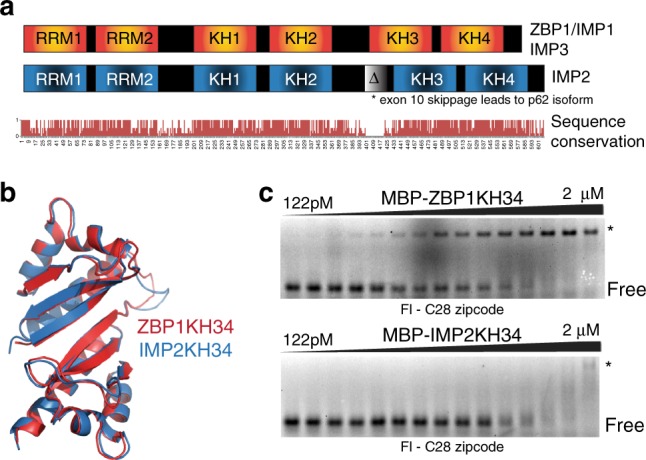
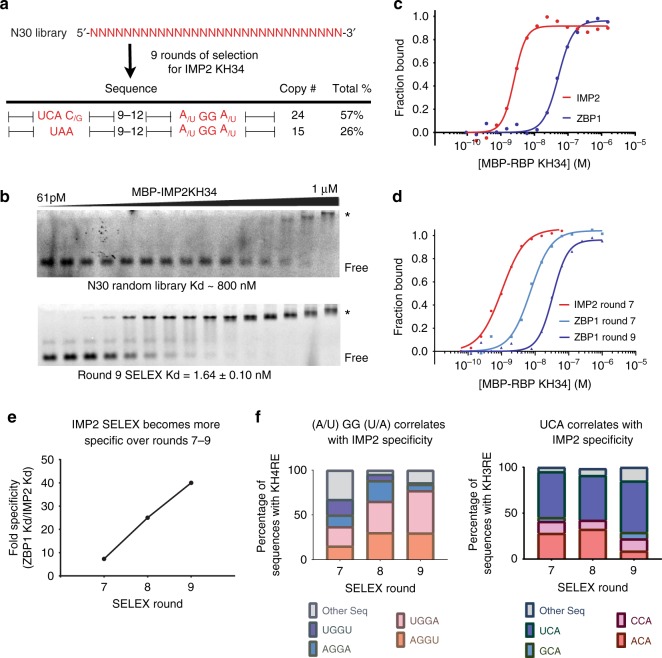
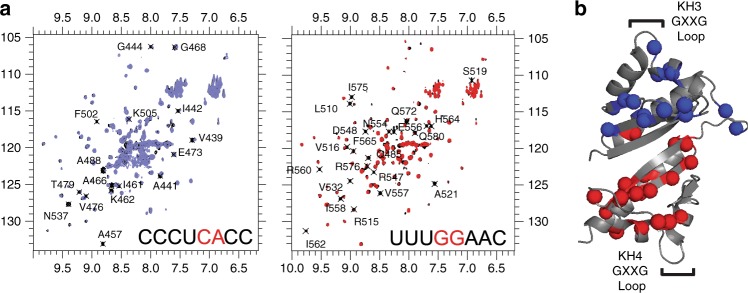
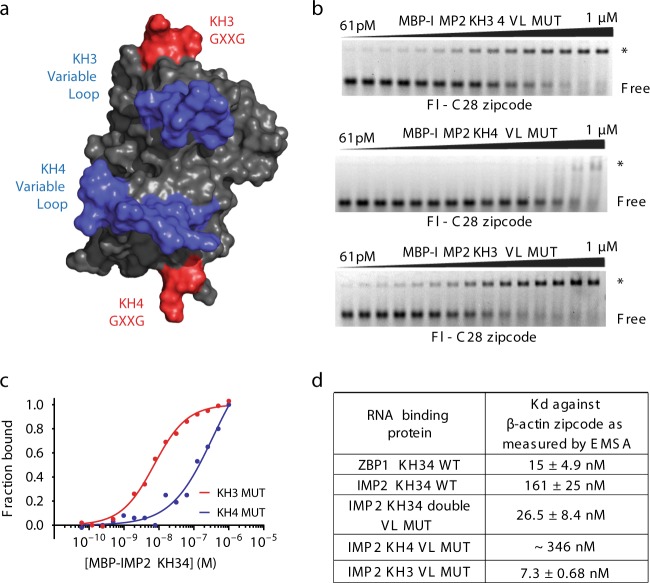
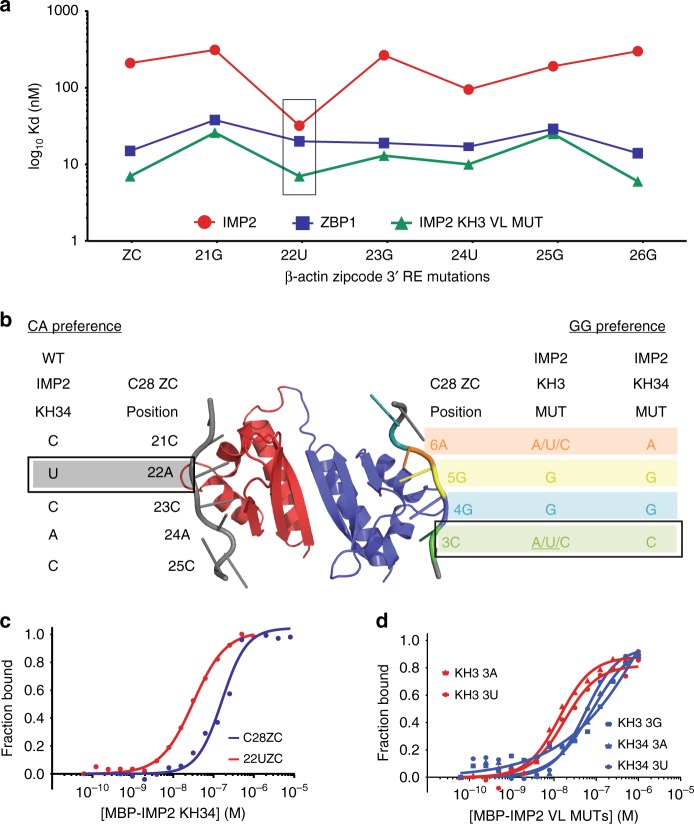
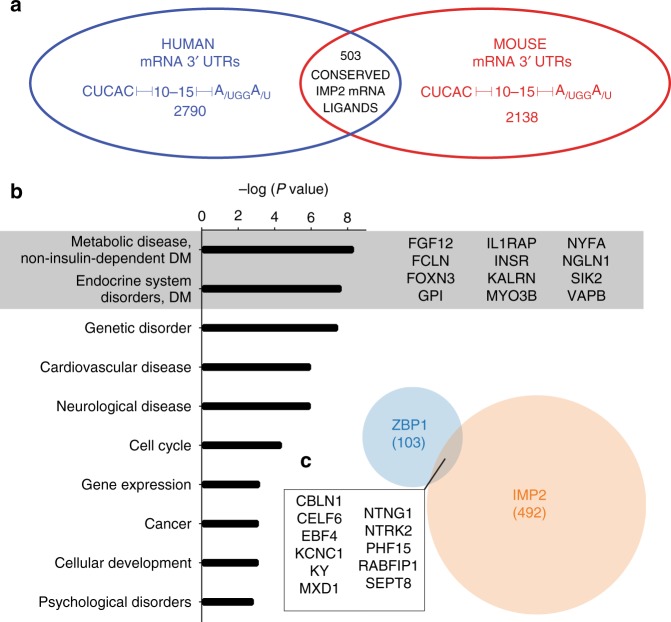
The IGF2 mRNA-binding proteins (ZBP1/IMP1, IMP2, IMP3) are highly conserved post-transcriptional regulators of RNA stability, localization and translation. They play important roles in cell migration, neural development, metabolism and cancer cell survival. The knockout phenotypes of individual IMP proteins suggest that each family member regulates a unique pool of RNAs, yet evidence and an underlying mechanism for this is lacking. Here, we combine systematic evolution of ligands by exponential enrichment (SELEX) and NMR spectroscopy to demonstrate that the major RNA-binding domains of the two most distantly related IMPs (ZBP1 and IMP2) bind to different consensus sequences and regulate targets consistent with their knockout phenotypes and roles in disease. We find that the targeting specificity of each IMP is determined by few amino acids in their variable loops. As variable loops often differ amongst KH domain paralogs, we hypothesize that this is a general mechanism for evolving specificity and regulation of the transcriptome.
Overview
The claims and statistics of this paper haven’t been checked yet.
Free: it reads the open-access text and checks the first 5 claims that cite a source we can check. Create a free account to check every claim.
Integrity signals
Registry
Cites
Statistics
Figures
Verification
Claims the paper makes
The claims and statistics of this paper haven’t been checked yet.
Free: it reads the open-access text and checks the first 5 claims that cite a source we can check. Create a free account to check every claim.
Claims other papers make about this one
Each is checked against this paper’s own text: does it say what the citing paper says it does?
The source backs part of the claim, not all of it — or backs it for a different population, condition or comparison.
In the citing paper
“IMP1 and IMP2 share over 70% sequence identity; however, only 56% homology is shared among all three members [6].”
From IMPlications of IMP2 in RNA Biology and Disease (2025) · cites this paper as [6]
Experimental — accuracy not yet measuredThe cited source says what the claim attributes to it.
In the citing paper
“Despite structural similarities, IMP2 binds to a distinct set of RNA targets and consensus binding motifs, as compared to IMP1 or IMP3 [6].”
From IMPlications of IMP2 in RNA Biology and Disease (2025) · cites this paper as [6]
The cited source says what the claim attributes to it.
In the citing paper
“The specificity of target selection among IMP family members is influenced by variations in the KH3/4 domains [6].”
From IMPlications of IMP2 in RNA Biology and Disease (2025) · cites this paper as [6]
The cited source says what the claim attributes to it.
In the citing paper
“IMP1 and IMP2 possess an equivalent number of RNA sequence motifs, including two RNA recognition motifs (RRM) and four hnRNP K homology (KH) domains [6].”
From IMPlications of IMP2 in RNA Biology and Disease (2025) · cites this paper as [6]
The cited source says what the claim attributes to it.
In the citing paper
“Unlike IMP1 and IMP3, which are typically expressed only during developmental stages, IMP2 persists into adulthood, displaying expression throughout the entire lifespan [6].”
From IMPlications of IMP2 in RNA Biology and Disease (2025) · cites this paper as [6]
Self-check
Percentages, sums and reported differences re-computed from the paper’s own numbers.
The self-check needs the paper’s full text.
Citations
Cites
Coot : model-building tools for molecular graphics
Emsley, P., & Cowtan, K. (2004) · Acta Crystallographica Section D Biological Crystallography · doi:10.1107/s0907444904019158 · Cited by 30,571
The CCP4 suite: programs for protein crystallography
Collaborative Computational Project, N. 4. (1994) · Acta Crystallographica Section D Biological Crystallography · doi:10.1107/s0907444994003112 · Cited by 17,270
NMRPipe: A multidimensional spectral processing system based on UNIX pipes
Delaglio, F., Grzesiek, S., Vuister, G., Zhu, G., Pfeifer, J., & Bax, A. (1995) · Journal of Biomolecular NMR · doi:10.1007/bf00197809 · Cited by 15,965
Near-optimal probabilistic RNA-seq quantification
Bray, N. L., Pimentel, H., Melsted, P., & Pachter, L. (2016) · Nature Biotechnology · doi:10.1038/nbt.3519 · Cited by 9,723
PHENIX : building new software for automated crystallographic structure determination
Adams, P. D., Grosse-Kunstleve, R. W., Hung, L.-W., Ioerger, T. R., McCoy, A. J., Moriarty, N. W., Read, R. J., Sacchettini, J. C., Sauter, N. K., & Terwilliger, T. C. (2002) · Acta Crystallographica Section D Biological Crystallography · doi:10.1107/s0907444902016657 · Cited by 4,361
MolProbity: all-atom contacts and structure validation for proteins and nucleic acids
Davis, I. W., Leaver-Fay, A., Chen, V. B., Block, J. N., Kapral, G. J., Wang, X., Murray, L. W., Arendall, W. B., Snoeyink, J., Richardson, J. S., et al. (2007) · Nucleic Acids Research · doi:10.1093/nar/gkm216 · Cited by 3,896
Ashkenazy, H., Abadi, S., Martz, E., Chay, O., Mayrose, I., Pupko, T., & Ben-Tal, N. (2016) · Nucleic Acids Research · doi:10.1093/nar/gkw408 · Cited by 3,163
Recognition of RNA N6-methyladenosine by IGF2BP proteins enhances mRNA stability and translation
Huang, H., Weng, H., Sun, W., Qin, X., Shi, H., Wu, H., Zhao, B. S., Mesquita, A., Liu, C., Yuan, C. L., et al. (2018) · Nature Cell Biology · doi:10.1038/s41556-018-0045-z · Cited by 2,997
Transcriptome-wide Identification of RNA-Binding Protein and MicroRNA Target Sites by PAR-CLIP
Hafner, M., Landthaler, M., Burger, L., Khorshid, M., Hausser, J., Berninger, P., Rothballer, A., Ascano, M., Jungkamp, A.-C., Munschauer, M., et al. (2010) · Cell · doi:10.1016/j.cell.2010.03.009 · Cited by 2,873
FMRP Stalls Ribosomal Translocation on mRNAs Linked to Synaptic Function and Autism
Darnell, J. C., Van Driesche, S. J., Zhang, C., Hung, K. Y. S., Mele, A., Fraser, C. E., Stone, E. F., Chen, C., Fak, J. J., Chi, S. W., et al. (2011) · Cell · doi:10.1016/j.cell.2011.06.013 · Cited by 2,072
NMRFAM-SPARKY: enhanced software for biomolecular NMR spectroscopy
Lee, W., Tonelli, M., & Markley, J. L. (2015) · Bioinformatics · doi:10.1093/bioinformatics/btu830 · Cited by 2,045
A census of human RNA-binding proteins
Gerstberger, S., Hafner, M., & Tuschl, T. (2014) · Nature Reviews Genetics · doi:10.1038/nrg3813 · Cited by 2,032
Wishart, D. S., Bigam, C. G., Holm, A., Hodges, R. S., & Sykes, B. D. (1995) · Journal of Biomolecular NMR · doi:10.1007/bf00227471 · Cited by 1,628
Terwilliger, T. C., Grosse-Kunstleve, R. W., Afonine, P. V., Moriarty, N. W., Zwart, P. H., Hung, L.-W., Read, R. J., & Adams, P. D. (2008) · Acta Crystallographica Section D Biological Crystallography · doi:10.1107/s090744490705024x · Cited by 1,462
CLIP Identifies Nova-Regulated RNA Networks in the Brain
Ule, J., Jensen, K. B., Ruggiu, M., Mele, A., Ule, A., & Darnell, R. B. (2003) · Science · doi:10.1126/science.1090095 · Cited by 1,120
Wishart, D. S., Bigam, C. G., Holm, A., Hodges, R. S., & Sykes, B. D. (1995) · Journal of Biomolecular NMR · doi:10.1007/bf00211764 · Cited by 1,012
Pushing the boundaries of molecular replacement with maximum likelihood
Read, R. J. (2001) · Acta Crystallographica Section D Biological Crystallography · doi:10.1107/s0907444901012471 · Cited by 819
Bell, J. L., Wächter, K., Mühleck, B., Pazaitis, N., Köhn, M., Lederer, M., & Hüttelmaier, S. (2013) · Cellular and Molecular Life Sciences · doi:10.1007/s00018-012-1186-z · Cited by 783
Spatial regulation of β-actin translation by Src-dependent phosphorylation of ZBP1
Hüttelmaier, S., Zenklusen, D., Lederer, M., Dictenberg, J., Lorenz, M., Meng, X., Bassell, G. J., Condeelis, J., & Singer, R. H. (2005) · Nature · doi:10.1038/nature04115 · Cited by 647
Self-citationCharacterization of a β-Actin mRNA Zipcode-Binding Protein
Ross, A. F., Oleynikov, Y., Kislauskis, E. H., Taneja, K. L., & Singer, R. H. (1997) · Molecular and Cellular Biology · doi:10.1128/mcb.17.4.2158 · Cited by 561
Self-citationCcpNmr AnalysisAssign: a flexible platform for integrated NMR analysis
Skinner, S. P., Fogh, R. H., Boucher, W., Ragan, T. J., Mureddu, L. G., & Vuister, G. W. (2016) · Journal of Biomolecular NMR · doi:10.1007/s10858-016-0060-y · Cited by 513
Kislauskis, E. H., Zhu, X., & Singer, R. H. (1994) · The Journal of cell biology · doi:10.1083/jcb.127.2.441 · Cited by 509
Self-citationStructure and function of KH domains
Valverde, R., Edwards, L., & Regan, L. (2008) · The FEBS Journal · doi:10.1111/j.1742-4658.2008.06411.x · Cited by 506
A quantitative analysis of CLIP methods for identifying binding sites of RNA-binding proteins
Kishore, S., Jaskiewicz, L., Burger, L., Hausser, J., Khorshid, M., & Zavolan, M. (2011) · Nature Methods · doi:10.1038/nmeth.1608 · Cited by 471
Imp2 controls oxidative phosphorylation and is crucial for preserving glioblastoma cancer stem cells
Janiszewska, M., Suvà, M. L., Riggi, N., Houtkooper, R. H., Auwerx, J., Clément-Schatlo, V., Radovanovic, I., Rheinbay, E., Provero, P., & Stamenkovic, I. (2012) · Genes & Development · doi:10.1101/gad.188292.112 · Cited by 452
Sequence-Specific RNA Binding by a Nova KH Domain
Lewis, H. A., Musunuru, K., Jensen, K. B., Edo, C., Chen, H., Darnell, R. B., & Burley, S. K. (2000) · Cell · doi:10.1016/s0092-8674(00)80668-6 · Cited by 324
Degrauwe, N., Suvà, M.-L., Janiszewska, M., Riggi, N., & Stamenkovic, I. (2016) · Genes & Development · doi:10.1101/gad.287540.116 · Cited by 324
Mechanisms of dendritic mRNA transport and its role in synaptic tagging
Doyle, M., & Kiebler, M. A. (2011) · The EMBO Journal · doi:10.1038/emboj.2011.278 · Cited by 288
The role of the oncofetal IGF2 mRNA-binding protein 3 (IGF2BP3) in cancer
Lederer, M., Bley, N., Schleifer, C., & Hüttelmaier, S. (2014) · Seminars in Cancer Biology · doi:10.1016/j.semcancer.2014.07.006 · Cited by 287
Farina, K. L., Hüttelmaier, S., Musunuru, K., Darnell, R., & Singer, R. H. (2003) · The Journal of Cell Biology · doi:10.1083/jcb.200206003 · Cited by 271
Self-citationStructure-function studies of FMRP RGG peptide recognition of an RNA duplex-quadruplex junction
Phan, A. T., Kuryavyi, V., Darnell, J. C., Serganov, A., Majumdar, A., Ilin, S., Raslin, T., Polonskaia, A., Chen, C., Clain, D., et al. (2011) · Nature Structural & Molecular Biology · doi:10.1038/nsmb.2064 · Cited by 257
Hansen, T. V. O., Hammer, N. A., Nielsen, J., Madsen, M., Dalbaeck, C., Wewer, U. M., Christiansen, J., & Nielsen, F. C. (2004) · Molecular and Cellular Biology · doi:10.1128/mcb.24.10.4448-4464.2004 · Cited by 251
CRD-BP mediates stabilization of βTrCP1 and c-myc mRNA in response to β-catenin signalling
Noubissi, F. K., Elcheva, I., Bhatia, N., Shakoori, A., Ougolkov, A., Liu, J., Minamoto, T., Ross, J., Fuchs, S. Y., & Spiegelman, V. S. (2006) · Nature · doi:10.1038/nature04839 · Cited by 243
VICKZ proteins: a multi‐talented family of regulatory RNA‐binding proteins
Yisraeli, J. K. (2005) · Biology of the Cell · doi:10.1042/bc20040151 · Cited by 231
mTOR phosphorylates IMP2 to promote IGF2 mRNA translation by internal ribosomal entry
Dai, N., Rapley, J., Angel, M., Yanik, M. F., Blower, M. D., & Avruch, J. (2011) · Genes & Development · doi:10.1101/gad.2042311 · Cited by 208
ZBP1 recognition of β-actin zipcode induces RNA looping
Chao, J. A., Patskovsky, Y., Patel, V., Levy, M., Almo, S. C., & Singer, R. H. (2010) · Genes & Development · doi:10.1101/gad.1862910 · Cited by 204
Self-citationComprehensive Genomic Characterization of RNA-Binding Proteins across Human Cancers
Wang, Z.-L., Li, B., Luo, Y.-X., Lin, Q., Liu, S.-R., Zhang, X.-Q., Zhou, H., Yang, J.-H., & Qu, L.-H. (2018) · Cell Reports · doi:10.1016/j.celrep.2017.12.035 · Cited by 204
Vasilyev, N., Polonskaia, A., Darnell, J. C., Darnell, R. B., Patel, D. J., & Serganov, A. (2015) · Proceedings of the National Academy of Sciences · doi:10.1073/pnas.1515737112 · Cited by 200
Dai, N., Zhao, L., Wrighting, D., Krämer, D., Majithia, A., Wang, Y., Cracan, V., Borges-Rivera, D., Mootha, V. K., Nahrendorf, M., et al. (2015) · Cell Metabolism · doi:10.1016/j.cmet.2015.03.006 · Cited by 188
Glutamate-induced RNA localization and translation in neurons
Yoon, Y. J., Wu, B., Buxbaum, A. R., Das, S., Tsai, A., English, B. P., Grimm, J. B., Lavis, L. D., & Singer, R. H. (2016) · Proceedings of the National Academy of Sciences · doi:10.1073/pnas.1614267113 · Cited by 184
Self-citationSpatial arrangement of an RNA zipcode identifies mRNAs under post-transcriptional control
Patel, V. L., Mitra, S., Harris, R., Buxbaum, A. R., Lionnet, T., Brenowitz, M., Girvin, M., Levy, M., Almo, S. C., Singer, R. H., et al. (2012) · Genes & Development · doi:10.1101/gad.177428.111 · Cited by 166
Self-citationAdvances and challenges in the detection of transcriptome‐wide protein– RNA interactions
Wheeler, E. C., Van Nostrand, E. L., & Yeo, G. W. (2018) · WIREs RNA · doi:10.1002/wrna.1436 · Cited by 163
Conway, A. E., Van Nostrand, E. L., Pratt, G. A., Aigner, S., Wilbert, M. L., Sundararaman, B., Freese, P., Lambert, N. J., Sathe, S., Liang, T. Y., et al. (2016) · Cell Reports · doi:10.1016/j.celrep.2016.03.052 · Cited by 155
β-Actin mRNA compartmentalization enhances focal adhesion stability and directs cell migration
Katz, Z., Wells, A. L., Park, H. Y., Wu, B., Shenoy, S. M., & Singer, R. H. (2012) · Genes & Development · doi:10.1101/gad.190413.112 · Cited by 152
Self-citationKH domains with impaired nucleic acid binding as a tool for functional analysis
Hollingworth, D., Candel, A. M., Nicastro, G., Martin, S. R., Briata, P., Gherzi, R., & Ramos, A. (2012) · Nucleic Acids Research · doi:10.1093/nar/gks368 · Cited by 146
Wächter, K., Köhn, M., Stöhr, N., & Hüttelmaier, S. (2013) · bchm · doi:10.1515/hsz-2013-0111 · Cited by 144
Imaging mRNA In Vivo, from Birth to Death
Tutucci, E., Livingston, N. M., Singer, R. H., & Wu, B. (2018) · Annual Review of Biophysics · doi:10.1146/annurev-biophys-070317-033037 · Cited by 136
Self-citationMapping translation 'hot-spots' in live cells by tracking single molecules of mRNA and ribosomes
Katz, Z. B., English, B. P., Lionnet, T., Yoon, Y. J., Monnier, N., Ovryn, B., Bathe, M., & Singer, R. H. (2016) · eLife · doi:10.7554/elife.10415 · Cited by 134
Self-citationCrystal structures of Nova-1 and Nova-2 K-homology RNA-binding domains
Lewis, H. A., Chen, H., Edo, C., Buckanovich, R. J., Yang, Y. Y. L., Musunuru, K., Ru, Z., Darnell, R. B., & Burley, S. K. (1999) · Structure · doi:10.1016/s0969-2126(99)80025-2 · Cited by 122
Aberrant Expression of Fetal RNA-Binding Protein p62 in Liver Cancer and Liver Cirrhosis
Lu, M., Nakamura, R. M., Dent, E. D., Zhang, J.-Y., Nielsen, F. C., Christiansen, J., Chan, E. K. L., & Tan, E. M. (2001) · American Journal Of Pathology · doi:10.1016/s0002-9440(10)61770-1 · Cited by 119
Single-Cell and Single-Molecule Analysis of Gene Expression Regulation
Vera, M., Biswas, J., Senecal, A., Singer, R. H., & Park, H. Y. (2016) · Annual Review of Genetics · doi:10.1146/annurev-genet-120215-034854 · Cited by 111
Self-citationQuantifying Protein-mRNA Interactions in Single Live Cells
Wu, B., Buxbaum, A. R., Katz, Z., Yoon, Y. J., & Singer, R. H. (2015) · Cell · doi:10.1016/j.cell.2015.05.054 · Cited by 104
Self-citationDai, N., Ji, F., Wright, J., Minichiello, L., Sadreyev, R., & Avruch, J. (2017) · eLife · doi:10.7554/elife.27155 · Cited by 103
Combinatorial recognition of clustered RNA elements by the multidomain RNA-binding protein IMP3
Schneider, T., Hung, L.-H., Aziz, M., Wilmen, A., Thaum, S., Wagner, J., Janowski, R., Müller, S., Schreiner, S., Friedhoff, P., et al. (2019) · Nature Communications · doi:10.1038/s41467-019-09769-8 · Cited by 101
Gu, W., Katz, Z., Wu, B., Park, H. Y., Li, D., Lin, S., Wells, A. L., & Singer, R. H. (2012) · Journal of Cell Science · doi:10.1242/jcs.086132 · Cited by 95
Self-citationGu, W., Pan, F., & Singer, R. H. (2009) · Journal of Cell Science · doi:10.1242/jcs.045278 · Cited by 80
Self-citationRNP transport in cell biology: the long and winding road
Eliscovich, C., & Singer, R. H. (2017) · Current Opinion in Cell Biology · doi:10.1016/j.ceb.2017.02.008 · Cited by 72
Self-citationTeplova, M., Malinina, L., Darnell, J. C., Song, J., Lu, M., Abagyan, R., Musunuru, K., Teplov, A., Burley, S. K., Darnell, R. B., et al. (2011) · Structure · doi:10.1016/j.str.2011.05.002 · Cited by 71
Mechanism of β-actin mRNA Recognition by ZBP1
Nicastro, G., Candel, A. M., Uhl, M., Oregioni, A., Hollingworth, D., Backofen, R., Martin, S. R., & Ramos, A. (2017) · Cell Reports · doi:10.1016/j.celrep.2016.12.091 · Cited by 68
Kessler, S. M., Pokorny, J., Zimmer, V., Laggai, S., Lammert, F., Bohle, R. M., & Kiemer, A. K. (2013) · American Journal of Physiology-Gastrointestinal and Liver Physiology · doi:10.1152/ajpgi.00005.2012 · Cited by 64
Noncanonical G recognition mediates KSRP regulation of let-7 biogenesis
Nicastro, G., García‐Mayoral, M. F., Hollingworth, D., Kelly, G. P., Martin, S. R., Briata, P., Gherzi, R., & Ramos, A. (2012) · Nature Structural & Molecular Biology · doi:10.1038/nsmb.2427 · Cited by 60
Fluorescence Imaging Methods to Investigate Translation in Single Cells
Biswas, J., Liu, Y., Singer, R. H., & Wu, B. (2018) · Cold Spring Harbor Perspectives in Biology · doi:10.1101/cshperspect.a032722 · Cited by 46
Self-citationBarghash, A., Helms, V., & Kessler, S. M. (2015) · Scandinavian Journal of Immunology · doi:10.1111/sji.12307 · Cited by 41
Transgenic expression of ZBP1 in neurons suppresses cocaine-associated conditioning
Lapidus, K. A. B., Nwokafor, C., Scott, D., Baroni, T. E., Tenenbaum, S. A., Hiroi, N., Singer, R. H., & Czaplinski, K. (2012) · Learning & Memory · doi:10.1101/lm.024471.111 · Cited by 7
Self-citation
Cited by
Intracellular mRNA transport and localized translation
Das, S., Vera, M., Gandin, V., Singer, R. H., & Tutucci, E. (2021) · Nature Reviews Molecular Cell Biology · doi:10.1038/s41580-021-00356-8 · Cited by 382
Self-citationRNA packaging into extracellular vesicles: An orchestra of RNA‐binding proteins?
Fabbiano, F., Corsi, J., Gurrieri, E., Trevisan, C., Notarangelo, M., & D'Agostino, V. G. (2020) · Journal of Extracellular Vesicles · doi:10.1002/jev2.12043 · Cited by 302
An oncopeptide regulates m6A recognition by the m6A reader IGF2BP1 and tumorigenesis
Zhu, S., Wang, J.-Z., Chen, D., He, Y.-T., Meng, N., Chen, M., Lu, R.-X., Chen, X.-H., Zhang, X.-L., & Yan, G.-R. (2020) · Nature Communications · doi:10.1038/s41467-020-15403-9 · Cited by 258
The IGF2BP family of RNA binding proteins links epitranscriptomics to cancer
Ramesh-Kumar, D., & Guil, S. (2022) · Seminars in Cancer Biology · doi:10.1016/j.semcancer.2022.05.009 · Cited by 167
Li, J., Gao, X., Zhang, Z., Lai, Y., Lin, X., Lin, B., Ma, M., Liang, X., Li, X., Lv, W., et al. (2021) · Molecular Cancer · doi:10.1186/s12943-021-01444-1 · Cited by 116
Metadata
- Authors
- Biswas, J., Patel, V. L., Bhaskar, V., Chao, J. A., Singer, R. H., & Eliscovich, C.
- Affiliations
- Albert Einstein College of Medicine (US)
- Massachusetts General Hospital (US)
- Friedrich Miescher Institute (CH)
- Corresponding author
- Singer, Robert H.
- Eliscovich, Carolina
- ORCID
- Venue
- Nature Communications
- Published
- 2019-09-30
- Volume
- 10
- Issue
- 1
- Pages
- 4440-4440
- ISSN
- 2041-1723 (ISSN-L)
- PMC
- PMC6768852
- OpenAlex
- W2975633269
- Cited by
- 84
- References
- 63
- Citations by year
- 2026: 9 · 2025: 13 · 2024: 30 · 2023: 8 · 2022: 10 · 2021: 8 · 2020: 5 · 2019: 1
- FWCI
- 2.07
- Type
- journal article
- Language
- en
- Open access
- gold
- doi.org
- Licence
- cc-by
- creativecommons.org/licenses/by/4.0 (tdm)
- creativecommons.org/licenses/by/4.0 (vor)
- Locations
- Nature Communications (publishedVersion, cc-by)
- bioRxiv (Cold Spring Harbor Laboratory) (acceptedVersion)
- PubMed Central (publishedVersion, cc-by)
- PubMed (publishedVersion)
- OSTI OAI (U.S. Department of Energy Office of Scientific and Technical Information) (submittedVersion)
- RePEc: Research Papers in Economics (submittedVersion)
- DOAJ (DOAJ: Directory of Open Access Journals) (submittedVersion)
- DOAJ (DOAJ: Directory of Open Access Journals) (submittedVersion, cc-by-sa)
- Funders
- U.S. Department of Health & Human Services | NIH | National Institute of General Medical Sciences (T32GM007288)
- U.S. Department of Health & Human Services | NIH | National Cancer Institute (F30CA214009)
- U.S. Department of Health & Human Services | NIH | NIH Office of the Director (1S10OD016305)
- U.S. Department of Health & Human Services | NIH | National Institute of Neurological Disorders and Stroke (5R01NS083085)
- Topics
- Life Sciences › Biochemistry, Genetics and Molecular Biology › Molecular Biology › RNA Research and Splicing
- Life Sciences › Biochemistry, Genetics and Molecular Biology › Molecular Biology › RNA and protein synthesis mechanisms
- Life Sciences › Biochemistry, Genetics and Molecular Biology › Molecular Biology › RNA regulation and disease
- Keywords
- RNA-binding proteins, ZBP1, IGF2BP2, IGF2BP3, KH domain, RNA binding specificity, variable loop, post-transcriptional regulation, RNA stability, RNA localization, translational regulation, SELEX, NMR spectroscopy
- MeSH terms
- Protein Domains, Animals, Base Sequence, DNA-Binding Proteins, Gene Expression Regulation, Humans, Ligands, Models, Molecular, Mutation, Magnetic Resonance Spectroscopy, Protein Binding, RNA, RNA, Messenger, RNA-Binding Proteins, Crystallography, X-Ray, Ribonucleoproteins, Small Nucleolar, RNA Stability, Mice, SELEX Aptamer Technique, Gene Knockdown Techniques, Transcriptome
About these checks
Registry, retraction, Cites and statistics results are computed, not judged, with one exception: a printed reference that no index lists is read once by a model before it counts as a citation error. Claims are extracted by a model and kept only when their quote appears verbatim in the text; each cited source is then checked, with a model’s help, for whether it says what the claim relies on. Those verdicts can be wrong — read the claim’s quote and the cited source before relying on one.
Statistics and arithmetic are recomputed, not judged.
Confidence bands are shown only for fields calibrated on our annotated test set. None is calibrated yet, so no band is shown.
What counts as a claim ›How we measure confidence ›How we check this ›
Are you an author, or do you see a problem with this page? Request a review
Data sources
Bibliographic data: Semantic Scholar, OpenAlex, Crossref.
Contains information from the Semantic Scholar Academic Graph Datasets, made available under the ODC Attribution License (ODC-BY 1.0).
Semantic Scholar’s data is described in: Kinney, R., et al. (2023). The Semantic Scholar Open Data Platform. arXiv:2301.10140.
