

The DOI matches its Crossref record; 68 of the 68 references it cites were found in a registry or an index.
Meta-analysis of randomised controlled trials testing behavioural interventions to promote household action on climate change
Open accessAbstract
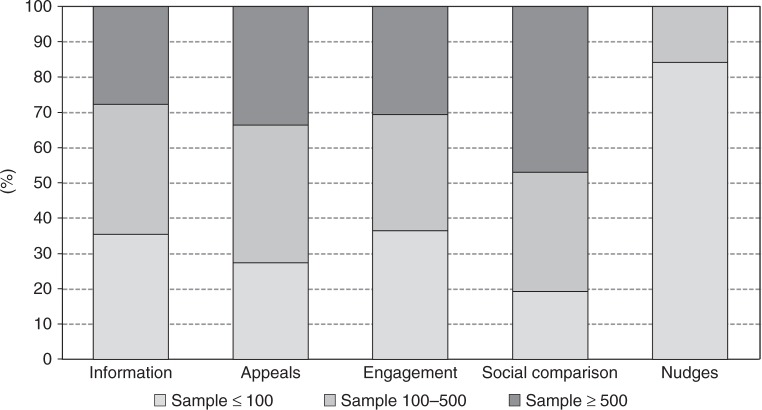
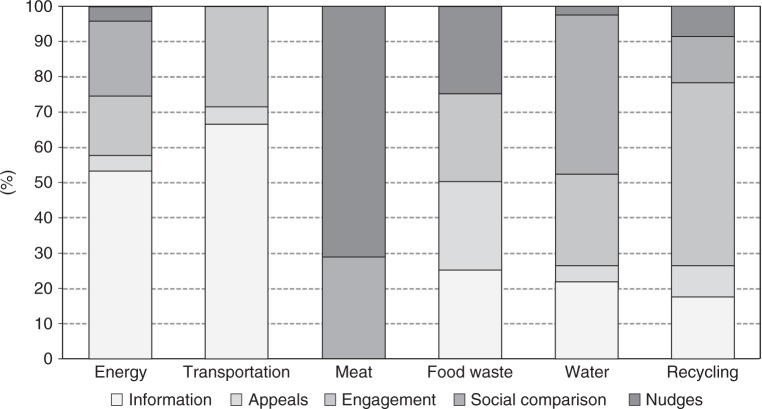
No consensus exists regarding which are the most effective mechanisms to promote household action on climate change. We present a meta-analysis of randomised controlled trials comprising 3,092,678 observations, which estimates the effects of behavioural interventions holding other factors constant. Here we show that behavioural interventions promote climate change mitigation to a very small degree while the intervention lasts ( d = −0.093 95% CI −0.160, −0.055), with no evidence of sustained positive effects once the intervention ends. With the exception of recycling, most household mitigation behaviours show a low behavioural plasticity. The intervention with the highest average effect size is choice architecture (nudges) but this strategy has been tested in a limited number of behaviours. Our results do not imply behavioural interventions are less effective than alternative strategies such as financial incentives or regulations, nor exclude the possibility that behavioural interventions could have stronger effects when used in combination with alternative strategies.
Overview
The claims and statistics of this paper haven’t been checked yet.
Run the check — free, no account needed. It reads the open-access text and checks the sources it cites.
Integrity signals
Registry
Cites
Statistics
Figures
Verification
Claims the paper makes
The claims and statistics of this paper haven’t been checked yet.
Run the check — free, no account needed. It reads the open-access text and checks the sources it cites.
Claims other papers make about this one
Each is checked against this paper’s own text: does it say what the citing paper says it does?
In the citing paper
“Improve options, such as energy-efficient appliances, insulation and prosumer renewables on rooftops, may similarly reduce GHG emissions, combined, by 50% (30-70%) 42,46,47 .”
From Demand-side solutions to climate change mitigation consistent with high levels of well-being (2022) · cites this paper as [46]
Self-check
Percentages, sums and reported differences re-computed from the paper’s own numbers.
The self-check needs the paper’s full text.
Citations
Cites
Preferred Reporting Items for Systematic Reviews and Meta-Analyses: the PRISMA statement
Moher, D., Liberati, A., Tetzlaff, J., Altman, D. G., & for the PRISMA Group (2009) · BMJ · doi:10.1136/bmj.b2535 · Cited by 83,823
Faul, F., Erdfelder, E., Lang, A.-G., & Buchner, A. (2007) · Behavior Research Methods · doi:10.3758/bf03193146 · Cited by 65,971
Preferred reporting items for systematic reviews and meta-analyses: the PRISMA Statement.
(2009) · PubMed Central · Cited by 44,859
Preferred reporting items for systematic reviews and meta-analyses: The PRISMA statement
Moher, D., Liberati, A., Tetzlaff, J., Altman, D. G., & the PRISMA Group* (2009) · Annals of Internal Medicine · doi:10.7326/0003-4819-151-4-200908180-00135 · Cited by 37,554
Quantifying heterogeneity in a meta‐analysis
Higgins, J. P. T., & Thompson, S. G. (2002) · Statistics in Medicine · doi:10.1002/sim.1186 · Cited by 36,763
Cochrane Handbook for Systematic Reviews of Interventions: Cochrane Book Series
(2008) · doi:10.1002/9780470712184 · Cited by 25,048
Nudge: improving decisions about health, wealth, and happiness
(2008) · Choice Reviews Online · doi:10.5860/choice.46-0977 · Cited by 11,624
Developing and evaluating complex interventions: the new Medical Research Council guidance
Craig, P., Dieppe, P., Macintyre, S., Michie, S., Nazareth, I., & Petticrew, M. (2008) · BMJ · doi:10.1136/bmj.a1655 · Cited by 10,995
The United States Department of Agriculture
True, A. C. (1912) · The Annals of the American Academy of Political and Social Science · doi:10.1177/000271621204000113 · Cited by 5,104
Webb, T. L., & Sheeran, P. (2006) · Psychological Bulletin · doi:10.1037/0033-2909.132.2.249 · Cited by 3,732
How are habits formed: modelling habit formation in the real world
Lally, P., van Jaarsveld, C. H. M., Potts, H. W. W., & Wardle, J. (2010) · European Journal of Social Psychology · doi:10.1002/ejsp.674 · Cited by 2,036
Normative social influence is underdetected
Nolan, J. M., Schultz, P. W., Cialdini, R. B., Goldstein, N. J., & Griskevicius, V. (2008) · Personality and Social Psychology Bulletin · doi:10.1177/0146167208316691 · Cited by 1,772
Predictors of public climate change awareness and risk perception around the world
Lee, T. M., Markowitz, E. M., Howe, P. D., Ko, C., & Leiserowitz, A. (2015) · Nature Climate Change · doi:10.1038/nclimate2728 · Cited by 1,506
Household actions can provide a behavioral wedge to rapidly reduce US carbon emissions
Dietz, T., Gardner, G. T., Gilligan, J., Stern, P. C., & Vandenbergh, M. P. (2009) · Proceedings of the National Academy of Sciences · doi:10.1073/pnas.0908738106 · Cited by 1,450
The stepped wedge cluster randomised trial: rationale, design, analysis, and reporting
Hemming, K., Haines, T. P., Chilton, P. J., Girling, A. J., & Lilford, R. J. (2015) · BMJ · doi:10.1136/bmj.h391 · Cited by 1,410
meta-analysis bias in location and selection of studies
Egger, M., & Smith, G. D. (1998) · BMJ · doi:10.1136/bmj.316.7124.61 · Cited by 1,374
Allcott, H., & Rogers, T. (2014) · American Economic Review · doi:10.1257/aer.104.10.3003 · Cited by 1,340
Cumulative Meta-Analysis of Therapeutic Trials for Myocardial Infarction
Lau, J., Antman, E. M., Jimenez-Silva, J., Kupelnick, B., Mosteller, F., & Chalmers, T. C. (1992) · New England Journal of Medicine · doi:10.1056/nejm199207233270406 · Cited by 1,140
Dilling, L., & Lemos, M. (2011) · Global Environmental Change · doi:10.1016/j.gloenvcha.2010.11.006 · Cited by 1,120
Kontopantelis, E., Doran, T., Springate, D. A., Buchan, I., & Reeves, D. (2015) · BMJ · doi:10.1136/bmj.h2750 · Cited by 1,001
A common language effect size statistic
McGraw, K. O., & Wong, S. P. (1992) · Psychological Bulletin · doi:10.1037/0033-2909.111.2.361 · Cited by 934
Harbord, R. M., & Higgins, J. P. T. (2008) · The Stata Journal: Promoting communications on statistics and Stata · doi:10.1177/1536867x0800800403 · Cited by 897
Allcott, H., & Mullainathan, S. (2010) · Science · doi:10.1126/science.1180775 · Cited by 852
Social influence approaches to encourage resource conservation: a meta-analysis
Abrahamse, W., & Steg, L. (2013) · Global Environmental Change · doi:10.1016/j.gloenvcha.2013.07.029 · Cited by 802
Osbaldiston, R., & Schott, J. P. (2012) · Environment and Behavior · doi:10.1177/0013916511402673 · Cited by 754
Issues in the meta-analysis of cluster randomized trials
Donner, A., & Klar, N. (2002) · Statistics in Medicine · doi:10.1002/sim.1301 · Cited by 734
Sterne, J. A. C., & Harbord, R. M. (2004) · The Stata Journal: Promoting communications on statistics and Stata · doi:10.1177/1536867x0400400204 · Cited by 708
Regression Discontinuity Designs Using Covariates
Calónico, S., Cattaneo, M. D., Farrell, M. H., & Titiunik, R. (2018) · The Review of Economics and Statistics · doi:10.1162/rest_a_00760 · Cited by 679
Delmas, M. A., Fischlein, M., & Asensio, O. I. (2013) · Energy Policy · doi:10.1016/j.enpol.2013.05.109 · Cited by 672
Information, Incentives, and Proenvironmental Consumer Behavior
Stern, P. C. (1999) · Journal of Consumer Policy · doi:10.1023/a:1006211709570 · Cited by 667
Psychology's contributions to understanding and addressing global climate change.
Swim, J. K., Stern, P. C., Doherty, T. J., Clayton, S., Reser, J., Weber, E. U., Gifford, R., & Howard, G. S. (2011) · American Psychologist · doi:10.1037/a0023220 · Cited by 523
Allen, M. A., Antwi‐Agyei, P., Aragón‐Durand, F., Babiker, M. H., Bertoldi, P., Bind, M., Brown, S. A., Buckeridge, M. S., Camilloni, I. A., Cartwright, A., et al. (2019) · Cited by 521
The importance of covariate selection in controlling for selection bias in observational studies.
Steiner, P. M., Cook, T. D., Shadish, W. R., & Clark, M. H. (2010) · Psychological Methods · doi:10.1037/a0018719 · Cited by 490
Impact Evaluation in Practice, Second Edition
Gertler, P., Martínez, S., Prémand, P., Rawlings, L. B., & Vermeersch, C. M. J. (2016) · Washington, DC: Inter-American Development Bank and World Bank eBooks · doi:10.1596/978-1-4648-0779-4 · Cited by 414
Ferraro, P. J., Miranda, J. J., & Price, M. (2011) · American Economic Review · doi:10.1257/aer.101.3.318 · Cited by 393
The roles of users in shaping transitions to new energy systems
Schot, J., Kanger, L., & Verbong, G. P. J. (2016) · Nature Energy · doi:10.1038/nenergy.2016.54 · Cited by 376
Contributions of psychology to limiting climate change.
Stern, P. C. (2011) · American Psychologist · doi:10.1037/a0023235 · Cited by 363
Design, analysis and presentation of factorial randomised controlled trials
Montgomery, A. A., Peters, T. J., & Little, P. S. (2003) · BMC Medical Research Methodology · doi:10.1186/1471-2288-3-26 · Cited by 320
Updated tests for small-study effects in meta-analyses
Harbord, R. M., Harris, R. J., & Sterne, J. A. C. (2009) · The Stata Journal: Promoting communications on statistics and Stata · doi:10.1177/1536867x0900900202 · Cited by 307
Commitment and Behavior Change
Lokhorst, A. M., Werner, C. M., Staats, H., van Dijk, E., & Gale, J. L. (2011) · Environment and Behavior · doi:10.1177/0013916511411477 · Cited by 296
Cash for Coolers: Evaluating a Large-Scale Appliance Replacement Program in Mexico
Davis, L. W., Fuchs, A., & Gertler, P. (2014) · American Economic Journal Economic Policy · doi:10.1257/pol.6.4.207 · Cited by 273
Recycling Behaviour Among Householders: Synthesizing Determinants Via a Meta-analysis
Miafodzyeva, S., & Brandt, N. (2012) · Waste and Biomass Valorization · doi:10.1007/s12649-012-9144-4 · Cited by 259
Blind Spots in Policy Analysis: What Economics Doesn't Say about Energy Use
Stern, P. C. (1986) · Journal of Policy Analysis and Management · doi:10.1002/pam.4050050202 · Cited by 237
Webb, T. L., Sheeran, P., & Łuszczyńska, A. (2008) · British Journal of Social Psychology · doi:10.1348/014466608x370591 · Cited by 234
Opportunities and insights for reducing fossil fuel consumption by households and organizations
Stern, P. C., Janda, K. B., Brown, M. A., Steg, L., Vine, E., & Lutzenhiser, L. (2016) · Nature Energy · doi:10.1038/nenergy.2016.43 · Cited by 233
Kurz, V. (2018) · Journal of Environmental Economics and Management · doi:10.1016/j.jeem.2018.06.005 · Cited by 199
From intention to action: Can nudges help consumers to choose renewable energy?
Momsen, K., & Stoerk, T. (2014) · Energy Policy · doi:10.1016/j.enpol.2014.07.008 · Cited by 197
The Effectiveness of Incentives for Residential Energy Conservation
Stern, P. C., Aronson, E., Darley, J. M., Hill, D. H., Hirst, E., Kempton, W. M., & Wilbanks, T. J. (1986) · Evaluation Review · doi:10.1177/0193841x8601000201 · Cited by 196
Contextual control of instrumental actions and habits.
Thrailkill, E. A., & Bouton, M. E. (2015) · Journal of Experimental Psychology: Animal Learning and Cognition · doi:10.1037/xan0000045 · Cited by 165
The Hawthorne effect and energy awareness
Schwartz, D., Fischhoff, B., Krishnamurti, T., & Sowell, F. (2013) · Proceedings of the National Academy of Sciences · doi:10.1073/pnas.1301687110 · Cited by 163
Blind Spots in Policy Analysis: What Economics Doesn't Say about Energy Use
Stern, P. C. (1986) · Journal of Policy Analysis and Management · doi:10.2307/3323541 · Cited by 155
Carroll, J., Lyons, S., & Denny, E. (2014) · Energy Economics · doi:10.1016/j.eneco.2014.07.007 · Cited by 151
Metaan: Random-effects Meta-analysis
Kontopantelis, E., & Reeves, D. (2010) · The Stata Journal Promoting communications on statistics and Stata · doi:10.1177/1536867x1001000307 · Cited by 150
Rethinking the Relationship between Social/Nonprofit Marketing and Commercial Marketing
Andreasen, A. R. (2011) · Journal of Public Policy & Marketing · doi:10.1509/jppm.09.035 · Cited by 143
Howell, R. (2012) · Environment and Behavior · doi:10.1177/0013916512452428 · Cited by 126
Bol, L., Hacker, D. J., Walck, C. C., & Nunnery, J. A. (2012) · Contemporary Educational Psychology · doi:10.1016/j.cedpsych.2012.02.004 · Cited by 102
Frey, E., & Rogers, T. (2014) · Policy Insights from the Behavioral and Brain Sciences · doi:10.1177/2372732214550405 · Cited by 95
Sunstein, C. R., & Reisch, L. A. (2013) · Kyklos · doi:10.1111/kykl.12028 · Cited by 84
Comparing the relative mitigation potential of individual pro-environmental behaviors
Lacroix, K. (2018) · Journal of Cleaner Production · doi:10.1016/j.jclepro.2018.05.068 · Cited by 78
Exceptions to the rule of informed consent for research with an intervention
Rebers, S., Aaronson, N. K., van Leeuwen, F. E., & Schmidt, M. K. (2016) · BMC Medical Ethics · doi:10.1186/s12910-016-0092-6 · Cited by 71
Setting a standard for electricity pilot studies
Davis, A. L., Krishnamurti, T., Fischhoff, B., & de Bruin, W. B. (2013) · Energy Policy · doi:10.1016/j.enpol.2013.07.093 · Cited by 68
Introductory Comment–The Green Paradox: A Supply-Side View of the Climate Problem
Sinn, H. (2015) · Review of Environmental Economics and Policy · doi:10.1093/reep/rev011 · Cited by 63
Contributions of psychology to limiting climate change
Wolske, K. S., & Stern, P. C. (2018) · Elsevier eBooks · doi:10.1016/b978-0-12-813130-5.00007-2 · Cited by 62
A quasi-experimental investigation of message appeal variations on organ donor registration rates.
Siegel, J. T., Alvaro, E. M., Crano, W. D., Lac, A., Ting, S. A., & Jones, S. P. (2008) · Health Psychology · doi:10.1037/0278-6133.27.2.170 · Cited by 53
Sarkies, M., Skinner, E. H., Bowles, K., Morris, M. E., Williams, C., O’Brien, L., Bardoel, A., Martin, J., Holland, A. E., Carey, L. M., et al. (2019) · Implementation Science · doi:10.1186/s13012-019-0896-0 · Cited by 42
Adaptive Intervention Designs to Promote Behavioral Change in Adults: What Is the Evidence?
Miller, C. K. (2019) · Current Diabetes Reports · doi:10.1007/s11892-019-1127-4 · Cited by 32
Exploring the energy benefits of advanced water metering
Berger, M. A., USDOE, Hans, L., Piscopo, K., & Sohn, M. D. (2016) · doi:10.2172/1345196 · Cited by 8
Dataset Nisa et al. 2019 NComms.xlsx
Nisa, C. F., Bélanger, J. J., Schumpe, B. M., & Faller, D. G. (2019) · Figshare · doi:10.6084/m9.figshare.9641999 · Cited by 2
Self-citation
Research works printed but not linked: 3
- US Department of Energy. Saving Water Saves Energy. Technical Report. https://www.osti.gov/servlets/purl/927020 (2006).
- Steichen, T. J., Egger, M. & Sterne, J. Modification of the metabias program. Stata Tech. Bull. 44, 3 (1998).
- Higgins, J. P. T. & Green, S. Cochrane Handbook for Systematic Reviews of Interventions, Vol. 4. Version 5.1.0 updated March 2011 (The Cochrane Collaboration, 2011).
Cited by
Sorted by citations
Mertens, S., Herberz, M., Hahnel, U. J. J., & Brosch, T. (2021) · Proceedings of the National Academy of Sciences · doi:10.1073/pnas.2107346118 · Cited by 864
Demand-side solutions to climate change mitigation consistent with high levels of well-being
Creutzig, F., Niamir, L., Bai, X., Callaghan, M., Cullen, J., Díaz-José, J., Figueroa, M., Grubler, A., Lamb, W. F., Leip, A., et al. (2022) · Nature Climate Change · doi:10.1038/s41558-021-01219-y · Cited by 579
van Valkengoed, A. M., Abrahamse, W., & Steg, L. (2022) · Nature Human Behaviour · doi:10.1038/s41562-022-01473-w · Cited by 364
Addressing climate change with behavioral science: A global intervention tournament in 63 countries
Vlasceanu, M., Doell, K. C., Bak-Coleman, J. B., Todorova, B., Berkebile-Weinberg, M., Grayson, S., Patel, Y. H., Goldwert, D., Pei, Y., Chakroff, A., et al. (2024) · Science Advances · doi:10.1126/sciadv.adj5778 · Cited by 380
Self-citationChristine Wamsler, B., Osberg, G., Osika, W., Herndersson, H., & Luis Mundaca, T. (2021) · Global Environmental Change · doi:10.1016/j.gloenvcha.2021.102373 · Cited by 247
Metadata
- Authors
- Nisa, C. F., Bélanger, J. J., Schumpe, B. M., & Faller, D. G.
- Affiliations
- New York University Abu Dhabi (AE)
- Corresponding author
- Nisa, Claudia F.
- Venue
- Nature Communications
- Published
- 2019-10-04
- Volume
- 10
- Issue
- 1
- Pages
- 4545-4545
- ISSN
- 2041-1723 (ISSN-L)
- PMC
- PMC6778105
- OpenAlex
- W2978033587
- Cited by
- 349
- References
- 68
- Citations by year
- 2026: 43 · 2025: 63 · 2024: 59 · 2023: 61 · 2022: 53 · 2021: 42 · 2020: 26 · 2019: 1
- FWCI
- 3.93
- Type
- journal article
- Language
- en
- Open access
- gold
- doi.org
- Locations
- Nature Communications (publishedVersion, cc-by)
- PubMed Central (publishedVersion, cc-by)
- PubMed (publishedVersion)
- RePEc: Research Papers in Economics (submittedVersion)
- DOAJ (DOAJ: Directory of Open Access Journals) (submittedVersion, cc-by-sa)
- DOAJ (DOAJ: Directory of Open Access Journals) (submittedVersion)
- Funders
- York University
- Topics
- Physical Sciences › Environmental Science › Management, Monitoring, Policy and Law › Pro-Environmental Behavior and Attitudes
- Social Sciences › Sociology and Political Science › Climate Change Communication and Perception
- Social Sciences › Decision Sciences › General Decision Sciences › Decision-Making and Behavioral Economics
- Keywords
- behavioral interventions, nudging, choice architecture, recycling, behavioral plasticity, intervention effectiveness, sustainable behavior, financial incentives, environmental regulation
- MeSH terms
- Adaptation, Psychological, Family Characteristics, Humans, Motivation, Randomized Controlled Trials as Topic, Behavior Control, Information Dissemination, Climate Change, Recycling
About these checks
Registry, retraction, Cites and statistics results are computed, not judged, with one exception: a printed reference that no index lists is read once by a model before it counts as a citation error. Claims are extracted by a model and kept only when their quote appears verbatim in the text; each cited source is then checked, with a model’s help, for whether it says what the claim relies on. Those verdicts can be wrong — read the claim’s quote and the cited source before relying on one.
Statistics and arithmetic are recomputed, not judged.
Confidence bands are shown only for fields calibrated on our annotated test set. None is calibrated yet, so no band is shown.
What counts as a claim ›How we measure confidence ›How we check this ›
Are you an author, or do you see a problem with this page? Request a review
