

Synaptic density marker SV2A is reduced in schizophrenia patients and unaffected by antipsychotics in rats
Open accessThe DOI matches its Crossref record; 88 of the 88 references it cites were found in a registry or an index.
Abstract
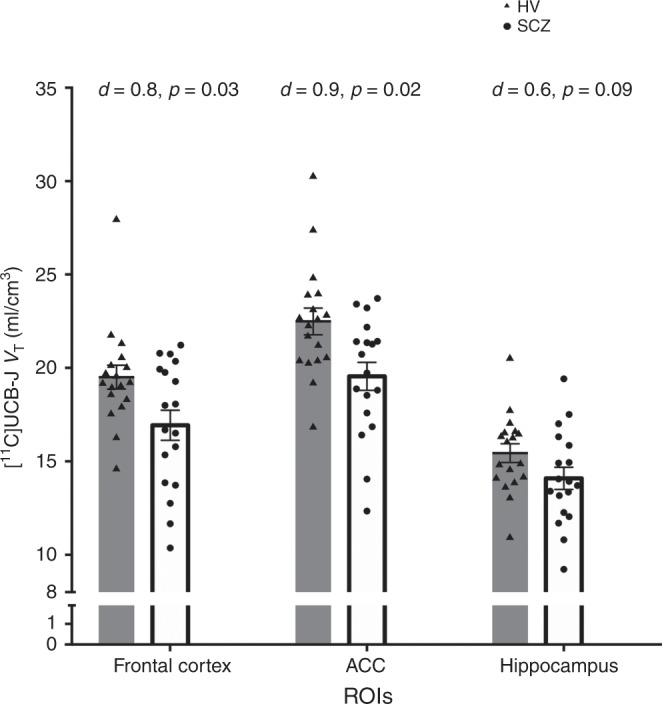
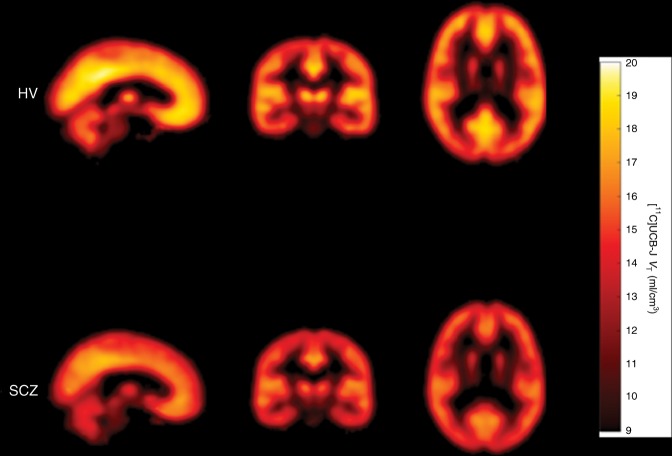
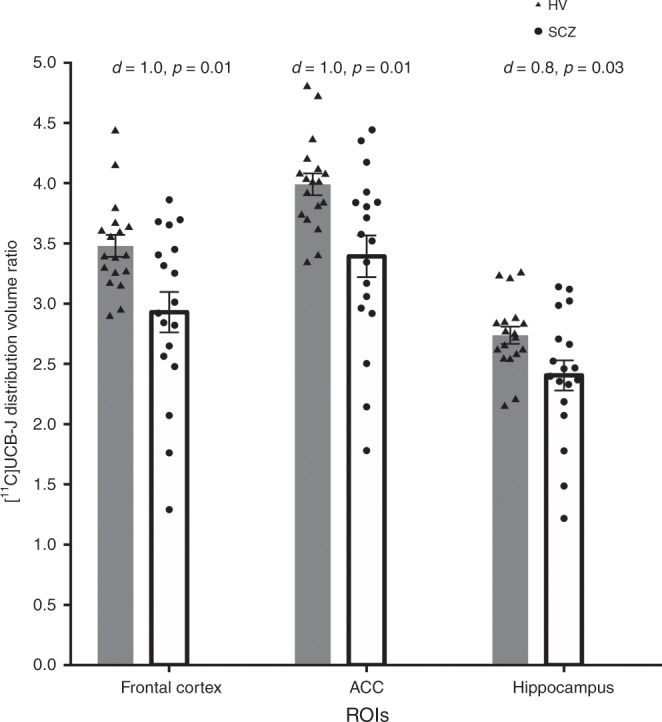
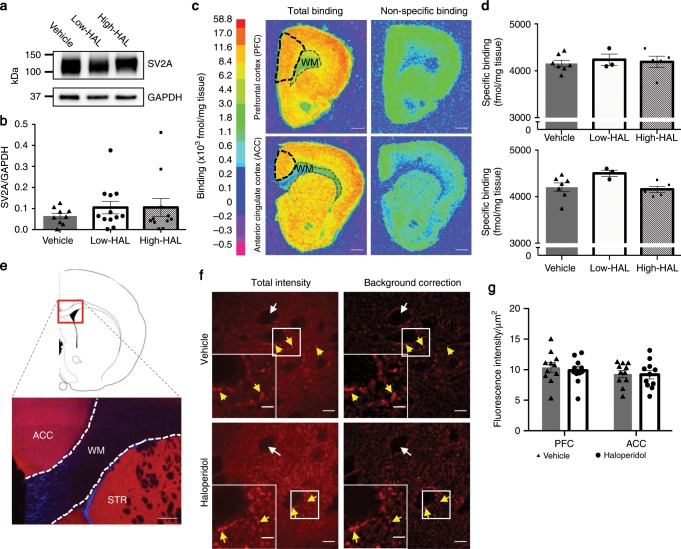
Synaptic dysfunction is hypothesised to play a key role in schizophrenia pathogenesis, but this has not been tested directly in vivo. Here, we investigated synaptic vesicle glycoprotein 2A (SV2A) levels and their relationship to symptoms and structural brain measures using [ 11 C]UCB-J positron emission tomography in 18 patients with schizophrenia and 18 controls. We found significant group and group-by-region interaction effects on volume of distribution ( V T ). [ 11 C]UCB-J V T was significantly lower in the frontal and anterior cingulate cortices in schizophrenia with large effect sizes (Cohen’s d = 0.8-0.9), but there was no significant difference in the hippocampus. We also investigated the effects of antipsychotic drug administration on SV2A levels in Sprague-Dawley rats using western blotting, [ 3 H]UCB-J autoradiography and immunostaining with confocal microscopy, finding no significant effects on any measure. These findings indicate that there are lower synaptic terminal protein levels in schizophrenia in vivo and that antipsychotic drug exposure is unlikely to account for them.
Overview
The claims and statistics of this paper haven’t been checked yet.
Free: it reads the open-access text and checks the first 5 claims that cite a source we can check. Create a free account to check every claim.
Integrity signals
Registry
Cites
Statistics
Figures
Verification
Claims the paper makes
The claims and statistics of this paper haven’t been checked yet.
Free: it reads the open-access text and checks the first 5 claims that cite a source we can check. Create a free account to check every claim.
Claims other papers make about this one
Each is checked against this paper’s own text: does it say what the citing paper says it does?
The source backs part of the claim, not all of it — or backs it for a different population, condition or comparison.
In the citing paper
“PET studies on several neuropsychiatric disorders linked to synaptic dysfunction, including depression, have found lower cerebral SV2A density in patients compared to healthy individuals [17–22].”
From Effects of escitalopram on synaptic density in the healthy human brain: a randomized controlled trial (2023) · cites this paper as [21]
Experimental — accuracy not yet measuredThe cited source says what the claim attributes to it.
In the citing paper
“The use of VTs also make our results more easily comparable to other [11C]UCB-J PET studies on related topics [20–23, 53, 57, 58].”
From Effects of escitalopram on synaptic density in the healthy human brain: a randomized controlled trial (2023) · cites this paper as [21]
The cited source says what the claim attributes to it.
In the citing paper
“Similar results were observed in patients with schizophrenia (107).”
From Psychedelics and Other Psychoplastogens for Treating Mental Illness. (2021) · cites this paper as [107]
In the citing paper
“positron emission tomography studies have shown increased synaptic density in sensory cortices and decreased synaptic density in superior frontal areas in people at risk for psychotic symptoms.”
From Towards an Integrative Account of Potential Mechanisms Mediating the Path From Sleep Dysfunction to Hallucinations (2025) · cites this paper as [95]
Self-check
Percentages, sums and reported differences re-computed from the paper’s own numbers.
The self-check needs the paper’s full text.
Citations
Cites
Controlling the False Discovery Rate: A Practical and Powerful Approach to Multiple Testing
Benjamini, Y., & Hochberg, Y. (1995) · Journal of the Royal Statistical Society Series B: Statistical Methodology · doi:10.1111/j.2517-6161.1995.tb02031.x · Cited by 109,482
The Positive and Negative Syndrome Scale (PANSS) for schizophrenia.
Kay, S. R., Fiszbein, A., & Opler, L. A. (1987) · Schizophrenia Bulletin · doi:10.1093/schbul/13.2.261 · Cited by 21,378
Tzourio-Mazoyer, N., Landeau, B., Papathanassiou, D., Crivello, F., Etard, O., Delcroix, N., Mazoyer, B., & Joliot, M. (2002) · NeuroImage · doi:10.1006/nimg.2001.0978 · Cited by 16,319
Implications of Normal Brain Development for the Pathogenesis of Schizophrenia
Weinberger, D. R. (1987) · Archives of General Psychiatry · doi:10.1001/archpsyc.1987.01800190080012 · Cited by 3,724
Schizophrenia risk from complex variation of complement component 4
Sekar, A., Bialas, A. R., de Rivera, H., Davis, A., Hammond, T. R., Kamitaki, N., Tooley, K., Presumey, J., Baum, M., Van Doren, V., et al. (2016) · Nature · doi:10.1038/nature16549 · Cited by 2,394
Schizophrenia genes, gene expression, and neuropathology: on the matter of their convergence
Harrison, P. J., & Weinberger, D. R. (2005) · Molecular Psychiatry · doi:10.1038/sj.mp.4001558 · Cited by 2,020
Consensus Nomenclature for in vivo Imaging of Reversibly Binding Radioligands
Innis, R. B., Cunningham, V. J., Delforge, J., Fujita, M., Gjedde, A., Gunn, R. N., Holden, J., Houle, S., Huang, S.-C., Ichise, M., et al. (2007) · Journal of Cerebral Blood Flow & Metabolism · doi:10.1038/sj.jcbfm.9600493 · Cited by 1,955
Self-citationDecreased Dendritic Spine Density on Prefrontal Cortical Pyramidal Neurons in Schizophrenia
Glantz, L. A., & Lewis, D. A. (2000) · Archives of General Psychiatry · doi:10.1001/archpsyc.57.1.65 · Cited by 1,636
De novo mutations in schizophrenia implicate synaptic networks
Fromer, M., Pocklington, A. J., Kavanagh, D. H., Williams, H. J., Dwyer, S., Gormley, P., Georgieva, L., Rees, E., Palta, P., Ruderfer, D. M., et al. (2014) · Nature · doi:10.1038/nature12929 · Cited by 1,617
The synaptic vesicle protein SV2A is the binding site for the antiepileptic drug levetiracetam
Lynch, B. A., Lambeng, N., Nocka, K., Kensel-Hammes, P., Bajjalieh, S. M., Matagne, A., & Fuks, B. (2004) · Proceedings of the National Academy of Sciences · doi:10.1073/pnas.0308208101 · Cited by 1,610
Cited by
Items 201–240 of 240
Witt, K. M., Kidwell, M., Doorduin, J., de Vries, E. F. J., Sommer, I. E., Day, D. J., Ellenbroek, B. A., & Guerrin, C. G. J. (2025) · Progress in Neuro-Psychopharmacology and Biological Psychiatry · doi:10.1016/j.pnpbp.2025.111490
Armony, J., & Vuilleumier, P. (2025) · Cambridge University Press eBooks · doi:10.1017/9781009342919.005
Mapping the Human Emotion Circuits with Positron Emission Tomography
Nummenmaa, L., & Hirvonen, J. (2025) · Cambridge University Press eBooks · doi:10.1017/9781009342919.009
A schizophrenia-associated radial glia cell state perturbs early human brain developmentPreprint
Malwade, S., Samudyata, S., Lekander, J. G., Langeder, A., Weinberger, K., Koskuvi, M., Oliveira, A. O., Lehtonen, Š., Arroyo‐García, L. E., Corvin, A. P., et al. (2025) · bioRxiv (Cold Spring Harbor Laboratory) · doi:10.1101/2025.10.24.684395
“Notably, reduced synapse density is a well-documented feature early in the course of SCZ 38,39 , and prior studies using 2D cellular models derived from SCZ patients have shown excessive microglial uptake of synaptic structures, an effect driven by both synapse-and microglia-related factors 17 .”
Neuroimmune Cascade Linking Systemic Autoimmunity and Psychiatric DisordersPreprint
Dimitriev, A. (2025) · Research Square · doi:10.21203/rs.3.rs-7884352/v1
Kammerer, R. A., & Korkhov, V. M. (2025) · Trends in Neurosciences · doi:10.1016/j.tins.2025.10.003 · Cited by 1
Carceller, H., Hidalgo, M. R., Escartí, M. J., Nacher, J., de la Iglesia-Vayá, M., & García-García, F. (2024) · Figshare · doi:10.6084/m9.figshare.26754448
Carceller, H., Hidalgo, M. R., Escartí, M. J., Nacher, J., de la Iglesia-Vayá, M., & García-García, F. (2024) · Figshare · doi:10.6084/m9.figshare.26754415
Carceller, H., Hidalgo, M. R., Escartí, M. J., Nacher, J., de la Iglesia-Vayá, M., & García-García, F. (2024) · Figshare · doi:10.6084/m9.figshare.26754442
Carceller, H., Hidalgo, M. R., Escartí, M. J., Nacher, J., de la Iglesia-Vayá, M., & García-García, F. (2024) · Figshare · doi:10.6084/m9.figshare.26754439
Carceller, H., Hidalgo, M. R., Escartí, M. J., Nacher, J., de la Iglesia-Vayá, M., & García-García, F. (2024) · Figshare · doi:10.6084/m9.figshare.26754412
Husain, M. O., Jones, B. D. M., Arshad, U., Ameis, S. H., Mirfallah, G., Schifani, C., Rodak, T., Aiken, M., Shafique, M., Ahmed, F., et al. (2024) · Figshare · doi:10.6084/m9.figshare.26066220
Carceller, H., Hidalgo, M. R., Escartí, M. J., Nacher, J., de la Iglesia-Vayá, M., & García-García, F. (2024) · Figshare · doi:10.6084/m9.figshare.26388914
Carceller, H., Hidalgo, M. R., Escartí, M. J., Nacher, J., de la Iglesia-Vayá, M., & García-García, F. (2024) · Figshare · doi:10.6084/m9.figshare.26754445
Husain, M. O., Jones, B., Arshad, U., Ameis, S. H., Mirfallah, G., Schifani, C., Rodak, T., Aiken, M., Shafique, M., Ahmed, F., et al. (2024) · Figshare · doi:10.6084/m9.figshare.26736453
Husain, M. O., Jones, B., Arshad, U., Ameis, S. H., Mirfallah, G., Schifani, C., Rodak, T., Aiken, M., Shafique, M., Ahmed, F., et al. (2024) · Figshare · doi:10.6084/m9.figshare.26066140
Carceller, H., Hidalgo, M. R., Escartí, M. J., Nacher, J., de la Iglesia-Vayá, M., & García-García, F. (2024) · Figshare · doi:10.6084/m9.figshare.26754451
Carceller, H., Hidalgo, M. R., Escartí, M. J., Nacher, J., de la Iglesia-Vayá, M., & García-García, F. (2024) · Figshare · doi:10.6084/m9.figshare.26754421
Carceller, H., Hidalgo, M. R., Escartí, M. J., Nacher, J., de la Iglesia-Vayá, M., & García-García, F. (2024) · Figshare · doi:10.6084/m9.figshare.26754424
Carceller, H., Hidalgo, M. R., Escartí, M. J., Nacher, J., de la Iglesia-Vayá, M., & García-García, F. (2024) · Figshare · doi:10.6084/m9.figshare.26754433
Carceller, H., Hidalgo, M. R., Escartí, M. J., Nacher, J., de la Iglesia-Vayá, M., & García-García, F. (2024) · Figshare · doi:10.6084/m9.figshare.26754430
Carceller, H., Hidalgo, M. R., Escartí, M. J., Nacher, J., de la Iglesia-Vayá, M., & García-García, F. (2024) · Figshare · doi:10.6084/m9.figshare.26754436
Carceller, H., Hidalgo, M. R., Escartí, M. J., Nacher, J., de la Iglesia-Vayá, M., & García-García, F. (2024) · Figshare · doi:10.6084/m9.figshare.26754427
Carceller, H., Hidalgo, M. R., Escartí, M. J., Nacher, J., de la Iglesia-Vayá, M., & García-García, F. (2024) · Figshare · doi:10.6084/m9.figshare.26388860
Shatalina, E., Whitehurst, T., Onwordi, E. C., Gilbert, B. J., Rizzo, G., Whittington, A., Mansur, A., Tsukada, H., Marques, T. R., Natesan, S., et al. (2024) · Figshare · doi:10.6084/m9.figshare.25632930
Self-citationChen, B.-Y., Lin, J., Tseng, H., Huang, C.-C., Chen, P.-S., Li, C.-H., Yao, C.-Y., Cheng, W.-L., Wang, T., Jang, F.-L., et al. (2026) · Schizophrenia Research · doi:10.1016/j.schres.2026.01.015
Su, E., Valencia, N. M. S., Le, J., Liu, E. C., & Wilson, J. L. (2026) · Frontiers in Drug Discovery · doi:10.3389/fddsv.2025.1686789
“We applied a regularized linear regression model to identify relationships between PathFX-identified drug network genes and clinical outcomes such as efficacy and acceptability.”
Esuaikoh, V., Ibegbulam, S., Cook, A. J., McFarland, B., Nunnington, N., Perera, A., Feng, J., Cale, J. A., & King, M. V. (2026) · Frontiers in Cellular Neuroscience · doi:10.3389/fncel.2026.1784522
Stress and synaptic density in psychosis and clinical high risk: evidence from [18F]SynVesT-1 PET
Blasco, M. B., Aji, K. N., Ramos-Jiménez, C., Chartrand, D. A., Hsiao, C. H.-H., Hopewell, R., Massarweh, G., Cohen, J., Rusjan, P., & Mizrahi, R. (2026) · Translational Psychiatry · doi:10.1038/s41398-026-03993-9
“To date, PET studies across different stages of schizophrenia spectrum disorders - including two in schizophrenia (duration of illness ~ 17 years) [7, 8], three in early-stage psychosis (duration of illness 3 years) [6, 9, 10], and one in individuals at clinical high risk (CHR) [9] show lower…”
Mechanism Matters: Advancing Beyond Descriptive Psychiatry?
Hyman, S. E. (2026) · Cambridge University Press eBooks · doi:10.1017/9781009390620.035
Kendler, K. S., Parnas, J., & Zachar, P. (2026) · Cambridge University Press eBooks · doi:10.1017/9781009390620.033
Li, W.-P., Laupman, K. E., Beekhuis-Hoekstra, S. D., Thanou, E., Klaassen, R. V., Sullivan, P. F., Posthuma, D., SMIT, A. B., Koopmans, F., & Heine, V. M. (2026) · Cells · doi:10.3390/cells15121052
Saito, Y., Syeda, W. T., Gurleyen, Y., Rapado‐Castro, M., Biase, M. A. D., Wannan, C., Mito, R., & Pantelis, C. (2026) · Biological Psychiatry Cognitive Neuroscience and Neuroimaging · doi:10.1016/j.bpsc.2026.05.015
Howes, O. D., Arumuham, A., & Heurich, M. (2026) · Proceedings of the National Academy of Sciences · doi:10.1073/pnas.2613745123
Self-citationRanganathan, M., Jakob, S., Cerrato, F. E., Spillane, L. U., Daryoush, T., Shuster, S., Dokholyan, K., Herrera, S. N., Koo, B. B., Markowitz, C., et al. (2026) · Schizophrenia Bulletin · doi:10.1093/schbul/sbag113
“34 The over-pruning hypothesis is also consistent with the typical ag e of onset of schizophrenia, 30 , 35 during a final period of brain maturation characterized by synaptic reorganization with net synapse elimination.”
Automated Radiosynthesis and Quality Evaluation of [18F]BIBD-181 for Translational SV2A PET ImagingPreprint
Yang, Z., Zhang, Y., Qiao, Z., Li, S., Wu, Z., & Ai, L. (2026) · SSRN Electronic Journal · doi:10.2139/ssrn.7347225
Onwordi, E. C., & Howes, O. D. (2026) · Biological Psychiatry Cognitive Neuroscience and Neuroimaging · doi:10.1016/j.bpsc.2026.08.008
Self-citationYngwe, H., Sigray, P. P., Andersson, M., Bolin, M., Beckman, M., Ekman, C. J., Tiger, M., & Lundberg, J. (2026) · medRxiv · doi:10.64898/2026.10.27.26366602 · Cited by 1
Metadata
- Authors
- Onwordi, E. C., Halff, E. F., Whitehurst, T., Mansur, A., Cotel, M.-C., Wells, L., Creeney, H., Bonsall, D., Rogdaki, M., Shatalina, E., Reis Marques, T., Rabiner, E. A., Gunn, R. N., Natesan, S., Vernon, A. C., & Howes, O. D.
- Affiliations
- King's College London (GB)
- Hammersmith Hospital (GB)
- Invicro (United Kingdom) (GB)
- Corresponding author
- Howes, Oliver D.
- ORCID
- Venue
- Nature Communications
- Published
- 2020-01-14
- Volume
- 11
- Issue
- 1
- Pages
- 246-246
- ISSN
- 2041-1723 (ISSN-L)
- PMC
- PMC6959348
- OpenAlex
- W2997938254
- Semantic Scholar
- cb2124094b62b4eb5233e7bbd6cccecef99afce7
- Cited by
- 243
- References
- 88
- Citations by year
- 2026: 21 · 2025: 32 · 2024: 44 · 2023: 33 · 2022: 45 · 2021: 41 · 2020: 26
- FWCI
- 26.29
- Type
- journal article
- Language
- en
- Open access
- gold
- doi.org
- Licence
- cc-by
- creativecommons.org/licenses/by/4.0 (tdm)
- creativecommons.org/licenses/by/4.0 (vor)
- Locations
- Nature Communications (publishedVersion, cc-by)
- PubMed Central (publishedVersion, cc-by)
- PubMed (publishedVersion)
- RePEc: Research Papers in Economics (submittedVersion)
- DOAJ (DOAJ: Directory of Open Access Journals) (submittedVersion)
- DOAJ (DOAJ: Directory of Open Access Journals) (submittedVersion, cc-by-sa)
- Research Portal (King's College London) (submittedVersion, cc-by)
- Spiral (Imperial College London) (submittedVersion, other-oa)
- Funders
- RCUK | Medical Research Council
- Topics
- Health Sciences › Medicine › Psychiatry and Mental health › Schizophrenia research and treatment
- Life Sciences › Neuroscience › Cellular and Molecular Neuroscience › Neurotransmitter Receptor Influence on Behavior
- Life Sciences › Neuroscience › Cellular and Molecular Neuroscience › Neuroscience and Neuropharmacology Research
- Keywords
- schizophrenia, synaptic density, SV2A, antipsychotic drugs, synaptic dysfunction, volume of distribution, frontal cortex, anterior cingulate cortex, hippocampus
- MeSH terms
- Animals, Brain, Female, Frontal Lobe, Gyrus Cinguli, Humans, Male, Membrane Glycoproteins, Nerve Tissue Proteins, Organ Specificity, Pyridines, Pyrrolidinones, Schizophrenia, Antipsychotic Agents, Rats, Sprague-Dawley, Positron-Emission Tomography, Rats
About these checks
Registry, retraction, Cites and statistics results are computed, not judged, with one exception: a printed reference that no index lists is read once by a model before it counts as a citation error. Claims are extracted by a model and kept only when their quote appears verbatim in the text; each cited source is then checked, with a model’s help, for whether it says what the claim relies on. Those verdicts can be wrong — read the claim’s quote and the cited source before relying on one.
Statistics and arithmetic are recomputed, not judged.
Confidence bands are shown only for fields calibrated on our annotated test set. None is calibrated yet, so no band is shown.
What counts as a claim ›How we measure confidence ›How we check this ›
Are you an author, or do you see a problem with this page? Request a review
Data sources
Bibliographic data: Semantic Scholar, OpenAlex, Crossref.
Contains information from the Semantic Scholar Academic Graph Datasets, made available under the ODC Attribution License (ODC-BY 1.0).
Semantic Scholar’s data is described in: Kinney, R., et al. (2023). The Semantic Scholar Open Data Platform. arXiv:2301.10140.
