

The place-cell representation of volumetric space in rats
Open accessPublished version of a preprint
The DOI matches its Crossref record; 32 of the 32 references it cites were found in a registry or an index.
Abstract
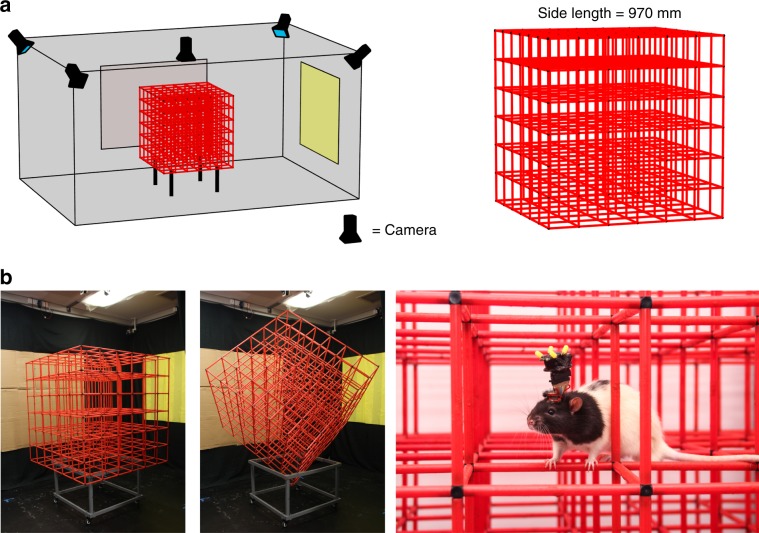
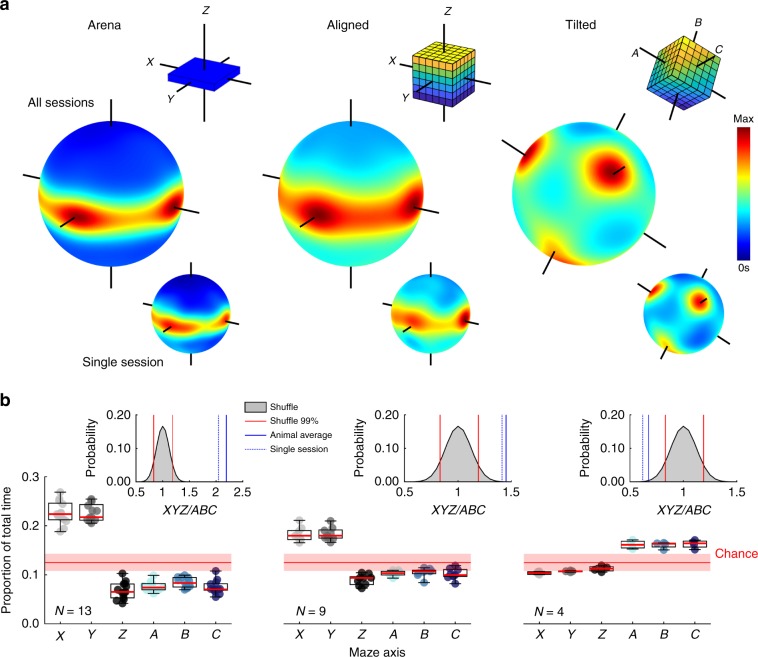
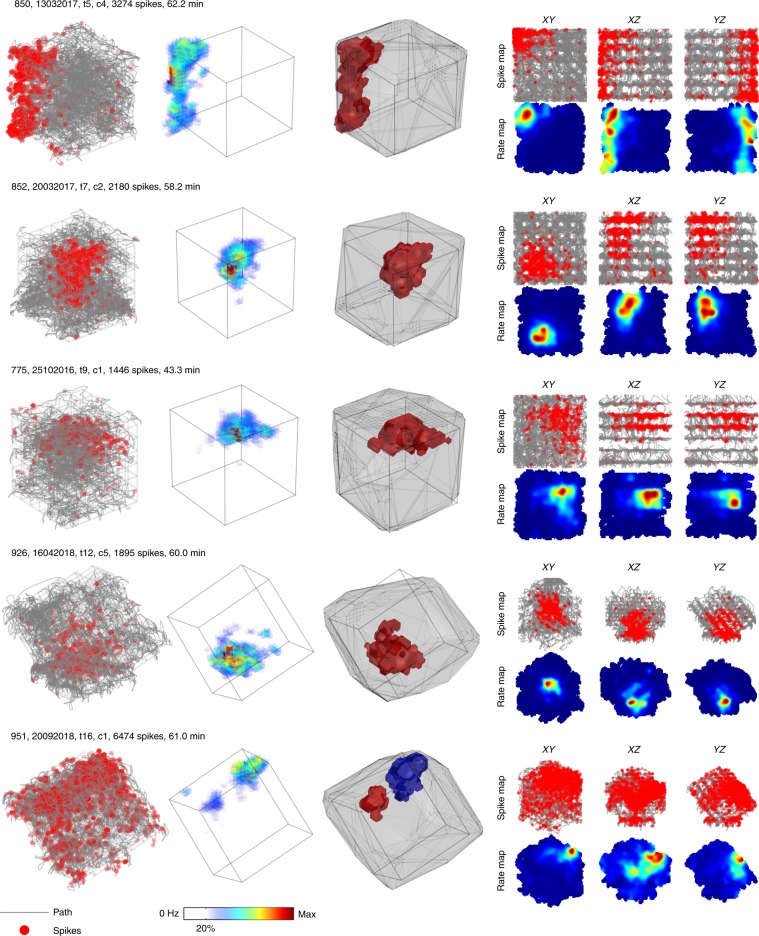
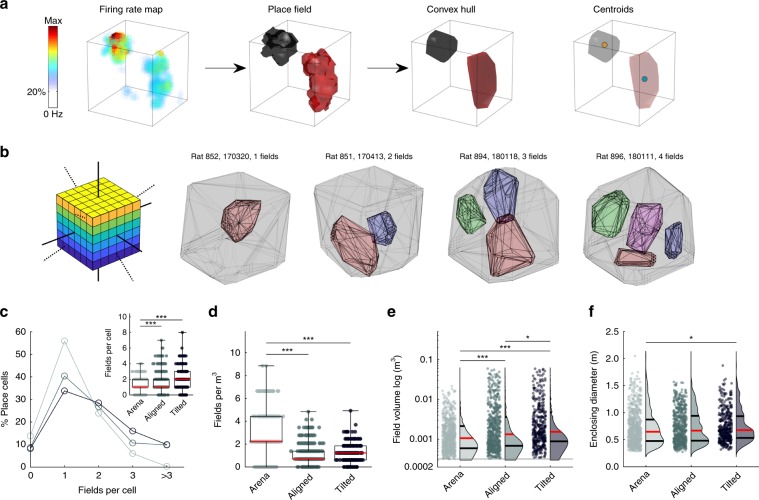
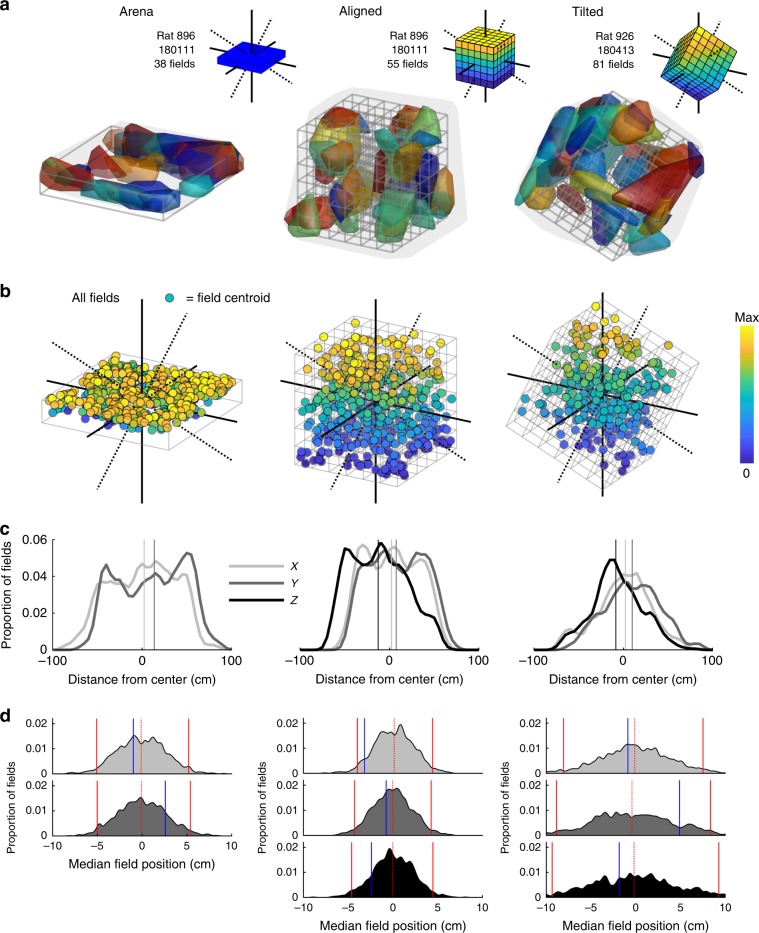
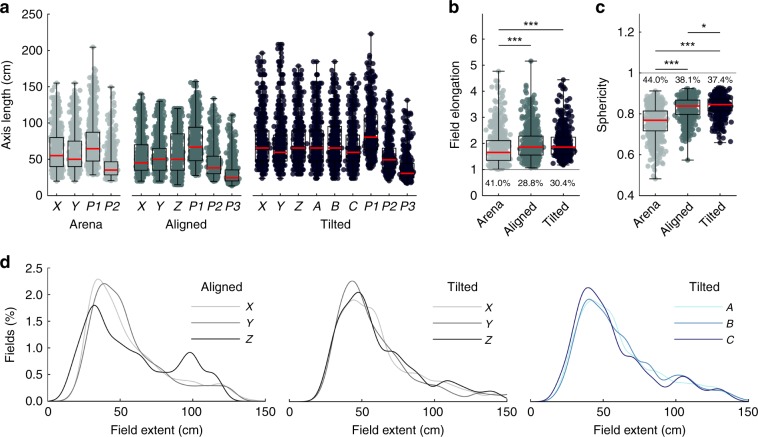
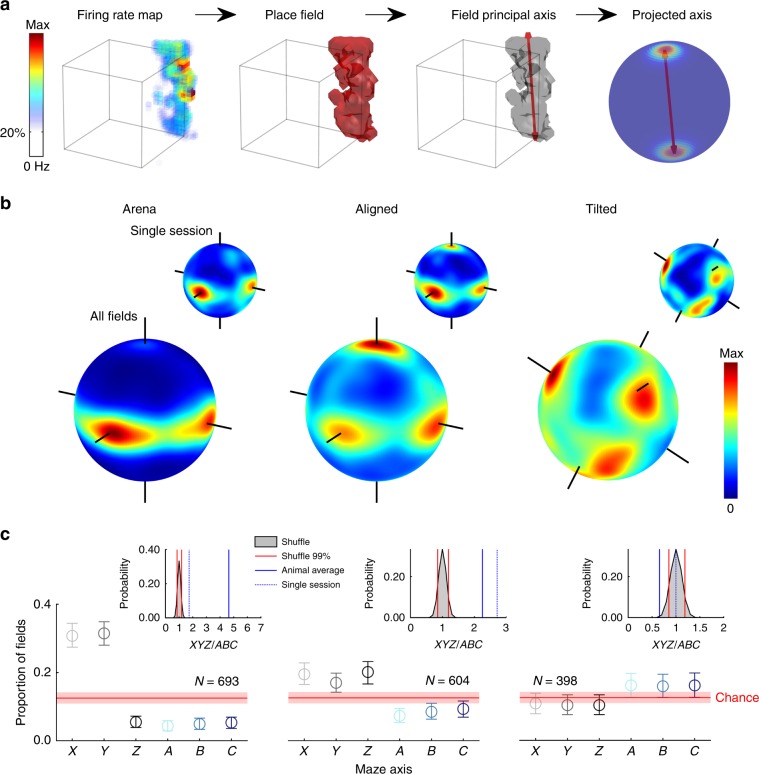
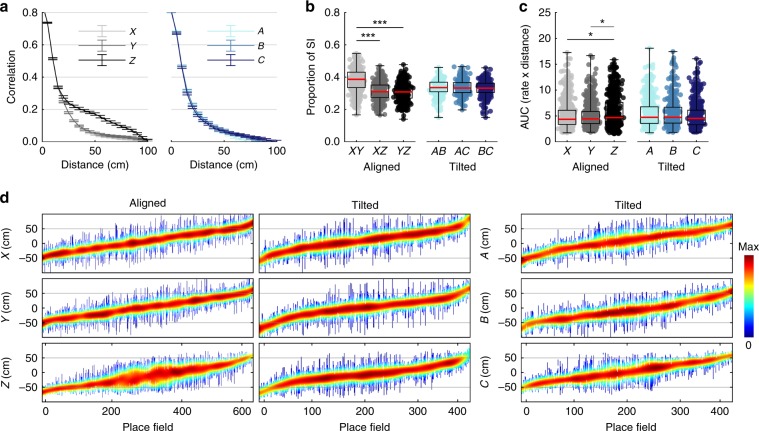
Place cells are spatially modulated neurons found in the hippocampus that underlie spatial memory and navigation: how these neurons represent 3D space is crucial for a full understanding of spatial cognition. We wirelessly recorded place cells in rats as they explored a cubic lattice climbing frame which could be aligned or tilted with respect to gravity. Place cells represented the entire volume of the mazes: their activity tended to be aligned with the maze axes, and when it was more difficult for the animals to move vertically the cells represented space less accurately and less stably. These results demonstrate that even surface-dwelling animals represent 3D space and suggests there is a fundamental relationship between environment structure, gravity, movement and spatial memory.
Overview
The claims and statistics of this paper haven’t been checked yet.
Free: it reads the open-access text and checks the first 5 claims that cite a source we can check. Create a free account to check every claim.
Integrity signals
Registry
Cites
Statistics
Figures
Verification
Claims the paper makes
The claims and statistics of this paper haven’t been checked yet.
Free: it reads the open-access text and checks the first 5 claims that cite a source we can check. Create a free account to check every claim.
Claims other papers make about this one
Each is checked against this paper’s own text: does it say what the citing paper says it does?
The cited source says what the claim attributes to it.
In the citing paper
“Importantly, the neural circuitry for path integration (e.g., head-direction cells, grid cells) has mainly been studied when animals navigate on flat 2D surfaces, except for a few recent studies (Ginosar et al., 2021; Grieves et al., 2020; Ulsaker-Janke et al., 2023).”
From Cognitive Maps for a Non-Euclidean Environment: Path Integration and Spatial Memory on a Sphere (2024) · cites this paper as Grieves et al., 2020
Self-check
Percentages, sums and reported differences re-computed from the paper’s own numbers.
The self-check needs the paper’s full text.
Citations
Cites
(1978) · UA Campus Repository (The University of Arizona) · Cited by 8,010
Cognitive maps in rats and men
Tolman, E. C. (1948) · Psychological Review · doi:10.1037/h0061626 · Cited by 6,641
Representation of Geometric Borders in the Entorhinal Cortex
Solstad, T., Boccara, C. N., Kropff, E., Moser, M.-B., & Moser, E. I. (2008) · Science · doi:10.1126/science.1166466 · Cited by 1,213 · cited 1×
“These have been shown to respond to 321 both walls and edges (15, 16) and are able to “reset” the spatial firing of entorhinal grid cells 322 (17).”
Geometric determinants of the place fields of hippocampal neurons
O'Keefe, J., & Burgess, N. (1996) · Nature · doi:10.1038/381425a0 · Cited by 1,166
Independent Codes for Spatial and Episodic Memory in Hippocampal Neuronal Ensembles
Leutgeb, S., Leutgeb, J. K., Barnes, C. A., Moser, E. I., McNaughton, B. L., & Moser, M.-B. (2005) · Science · doi:10.1126/science.1114037 · Cited by 910 · cited 1×
“Three-dimensional volumetric firing rate maps were constructed using a similar 520 approach to that reported previously (25).”
MethodBoundary Vector Cells in the Subiculum of the Hippocampal Formation
Lever, C., Burton, S., Jeewajee, A., O'Keefe, J., & Burgess, N. (2009) · The Journal of Neuroscience · doi:10.1523/jneurosci.1319-09.2009 · Cited by 753
Experience-dependent, asymmetric expansion of hippocampal place fields
Mehta, M. R., Barnes, C. A., & McNaughton, B. L. (1997) · Proceedings of the National Academy of Sciences · doi:10.1073/pnas.94.16.8918 · Cited by 527
A theory of hippocampal function in memory
Rolls, E. T. (1996) · Hippocampus · doi:10.1002/(sici)1098-1063(1996)6:6<601::aid-hipo5>3.0.co;2-j · Cited by 485
Experience-Dependent Asymmetric Shape of Hippocampal Receptive Fields
Mehta, M. R., Quirk, M. C., & Wilson, M. A. (2000) · Neuron · doi:10.1016/s0896-6273(00)81072-7 · Cited by 481
Representation of Three-Dimensional Space in the Hippocampus of Flying Bats
Yartsev, M. M., & Ulanovsky, N. (2013) · Science · doi:10.1126/science.1235338 · Cited by 417 · cited 1×
“Meanwhile, a study of flying bats found that place fields did not 46 deviate statistically from spherical (9), suggesting a spatial map of equal resolution in all 47 dimensions (isotropic).”
Background
Cited by
Knowledge Across Reference Frames: Cognitive Maps and Image Spaces
Bottini, R., & Doeller, C. F. (2020) · Trends in Cognitive Sciences · doi:10.1016/j.tics.2020.05.008 · Cited by 152
“This may be one of the reasons why image spaces associated with the parietal cortex are often unidimensional ([75] and Box 3), whereas hippocampal cognitive maps seem to combine more than one dimension ([2]; also [89] for evidence of 3D representation in the medial temporal lobe).”
BackgroundSpatial modulation of hippocampal activity in freely moving macaques
Mao, D., Avila, E., Caziot, B., Laurens, J., Dickman, J. D., & Angelaki, D. E. (2021) · Neuron · doi:10.1016/j.neuron.2021.09.032 · Cited by 134
Hippocampal Neurons Construct a Map of an Abstract Value Space
Knudsen, E. B., & Wallis, J. D. (2021) · Cell · doi:10.1016/j.cell.2021.07.010 · Cited by 140
Tracking neural activity from the same cells during the entire adult life of mice
Zhao, S., Tang, X., Tian, W., Partarrieu, S., Liu, R., Shen, H., Lee, J. Y., Guo, S., Lin, Z., & Liu, J. (2023) · Nature Neuroscience · doi:10.1038/s41593-023-01267-x · Cited by 141
Distinct mechanisms shape soil bacterial and fungal co-occurrence networks in a mountain ecosystem
Li, J., Li, C., Kou, Y., Yao, M., He, Z., & Li, X. (2020) · FEMS Microbiology Ecology · doi:10.1093/femsec/fiaa030 · Cited by 127
Metadata
- Authors
- Grieves, R. M., Jedidi-Ayoub, S., Mishchanchuk, K., Liu, A., Renaudineau, S., & Jeffery, K. J.
- Affiliations
- University College London (GB)
- Corresponding author
- Grieves, Roddy M.
- Venue
- Nature Communications
- Published
- 2020-02-07
- Volume
- 11
- Issue
- 1
- Pages
- 789-789
- ISSN
- 2041-1723 (ISSN-L)
- PMC
- PMC7005894
- OpenAlex
- W3005166101
- Semantic Scholar
- 245a553b3015c264af8217fc5dfac95307bd4479
- Cited by
- 83
- References
- 32
- Citations by year
- 2026: 5 · 2025: 20 · 2024: 14 · 2023: 9 · 2022: 12 · 2021: 10 · 2020: 12
- FWCI
- 5.78
- Type
- journal article
- Language
- en
- Open access
- gold
- doi.org
- Licence
- cc-by
- creativecommons.org/licenses/by/4.0 (tdm)
- creativecommons.org/licenses/by/4.0 (vor)
- Locations
- Nature Communications (publishedVersion, cc-by)
- PubMed Central (publishedVersion, cc-by)
- PubMed (publishedVersion)
- ENLIGHTEN (Jurnal Bimbingan dan Konseling Islam) (acceptedVersion, cc-by-sa)
- DOAJ (DOAJ: Directory of Open Access Journals) (submittedVersion)
- DOAJ (DOAJ: Directory of Open Access Journals) (submittedVersion, cc-by-sa)
- Funders
- Wellcome Trust (103896AIA)
- Topics
- Life Sciences › Neuroscience › Cognitive Neuroscience › Memory and Neural Mechanisms
- Social Sciences › Psychology › Experimental and Cognitive Psychology › Spatial Cognition and Navigation
- Life Sciences › Neuroscience › Developmental Neuroscience › Neurogenesis and neuroplasticity mechanisms
- Keywords
- place cells, three-dimensional representation, hippocampus, spatial memory, spatial navigation, gravity, rats, wireless recording
- MeSH terms
- Place Cells, Animals, Gravitation, Space Perception, Telemetry, Maze Learning, Rats, Spatial Memory
About these checks
Registry, retraction, Cites and statistics results are computed, not judged, with one exception: a printed reference that no index lists is read once by a model before it counts as a citation error. Claims are extracted by a model and kept only when their quote appears verbatim in the text; each cited source is then checked, with a model’s help, for whether it says what the claim relies on. Those verdicts can be wrong — read the claim’s quote and the cited source before relying on one.
Statistics and arithmetic are recomputed, not judged.
Confidence bands are shown only for fields calibrated on our annotated test set. None is calibrated yet, so no band is shown.
What counts as a claim ›How we measure confidence ›How we check this ›
Are you an author, or do you see a problem with this page? Request a review
Data sources
Bibliographic data: Semantic Scholar, OpenAlex, Crossref.
Contains information from the Semantic Scholar Academic Graph Datasets, made available under the ODC Attribution License (ODC-BY 1.0).
Semantic Scholar’s data is described in: Kinney, R., et al. (2023). The Semantic Scholar Open Data Platform. arXiv:2301.10140.
