

The DOI matches its Crossref record; 47 of the 47 references it cites were found in a registry or an index.
Efficient bidirectional piezo-optomechanical transduction between microwave and optical frequency
Open accessAbstract
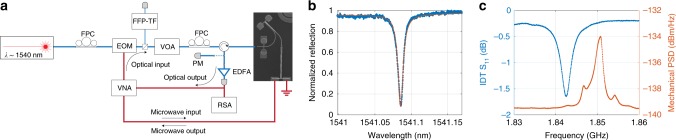
Efficient interconversion of both classical and quantum information between microwave and optical frequency is an important engineering challenge. The optomechanical approach with gigahertz-frequency mechanical devices has the potential to be extremely efficient due to the large optomechanical response of common materials, and the ability to localize mechanical energy into a micron-scale volume. However, existing demonstrations suffer from some combination of low optical quality factor, low electrical-to-mechanical transduction efficiency, and low optomechanical interaction rate. Here we demonstrate an on-chip piezo-optomechanical transducer that systematically addresses all these challenges to achieve nearly three orders of magnitude improvement in conversion efficiency over previous work. Our modulator demonstrates acousto-optic modulation with $${V}_{\pi }$$ V π = 0.02 V. We show bidirectional conversion efficiency of $$1{0}^{-5}$$ 1 0 − 5 with 3.3 μW red-detuned optical pump, and $$5.5 \%$$ 5.5 % with 323 μW blue-detuned pump. Further study of quantum transduction at millikelvin temperatures is required to understand how the efficiency and added noise are affected by reduced mechanical dissipation, thermal conductivity, and thermal capacity.
Overview
The claims and statistics of this paper haven’t been checked yet.
Free: it reads the open-access text and checks the first 5 claims that cite a source we can check. Create a free account to check every claim.
Integrity signals
Registry
Cites
Statistics
Figures



Verification
Claims the paper makes
The claims and statistics of this paper haven’t been checked yet.
Free: it reads the open-access text and checks the first 5 claims that cite a source we can check. Create a free account to check every claim.
Claims other papers make about this one
Each is checked against this paper’s own text: does it say what the citing paper says it does?
The cited source doesn’t support the claim as written.
In the citing paper
“By engineering the density of states of, and coupling between, optical modes in LNOI waveguides and ring-resonators, an EO frequency shifter that works with CW optical input and continuous sinusoidal microwave drive was demonstrated, featuring a shift efficiency of ~99% and an on-chip device insertion loss of 0.45 dB [177].”
From Integrated photonics on thin-film lithium niobate (2021) · cites this paper as [177]
Checked by a reasoning model — may be wrong.
Experimental — accuracy not yet measuredThe source backs part of the claim, not all of it — or backs it for a different population, condition or comparison.
In the citing paper
“Under the generalized critical coupling condition, light injected at one frequency can be efficiently coupled from one frequency mode to another without back conversion.”
From Integrated photonics on thin-film lithium niobate (2021) · cites this paper as [177]
Experimental — accuracy not yet measuredThe cited source says what the claim attributes to it.
In the citing paper
“Piezo-optomechanical frequency converters have been demonstrated with different piezoelectric materials, including GaAs [200], AlN [197,201,202], and LN [198].”
From 2022 Roadmap on integrated quantum photonics (2022) · cites this paper as [198]
In the citing paper
“In addition, extending the generalized critical coupling condition to multilevel system is also proposed [177], which can lead to cascaded frequency shifting beyond 100 GHz using only several tens of GHz microwave drive.”
From Integrated photonics on thin-film lithium niobate (2021) · cites this paper as [177]
Self-check
Percentages, sums and reported differences re-computed from the paper’s own numbers.
The self-check needs the paper’s full text.
Citations
Cites
Kimble, H. J. (2008) · Nature · doi:10.1038/nature07127 · Cited by 6,023
Aspelmeyer, M., Kippenberg, T. J., & Marquardt, F. (2014) · Reviews of Modern Physics · doi:10.1103/revmodphys.86.1391 · Cited by 5,501
(2016) · Optochemical Nanosensors · doi:10.1201/b13065-1 · Cited by 3,707
Long-distance quantum communication with atomic ensembles and linear optics
Duan, L.-M., Lukin, M. D., Cirac, J. I., & Zoller, P. (2001) · Nature · doi:10.1038/35106500 · Cited by 3,609
Microwave photonics combines two worlds
Capmany, J., & Novak, D. (2007) · Nature Photonics · doi:10.1038/nphoton.2007.89 · Cited by 2,983
Integrated lithium niobate electro-optic modulators operating at CMOS-compatible voltages
Wang, C., Zhang, M., Chen, X., Bertrand, M., Shams-Ansari, A., Chandrasekhar, S., Winzer, P., & Lončar, M. (2018) · Nature · doi:10.1038/s41586-018-0551-y · Cited by 2,593
Reed, G. T., Mashanovich, G., Gardes, F. Y., & Thomson, D. J. (2010) · Nature Photonics · doi:10.1038/nphoton.2010.179 · Cited by 2,470
Quantum Measurement and Control
Wiseman, H. M., & Milburn, G. J. (2009) · Cambridge University Press eBooks · doi:10.1017/cbo9780511813948 · Cited by 2,119
Lithium niobate: Summary of physical properties and crystal structure
Weis, R. S., & Gaylord, T. K. (1985) · Applied Physics A Solids and Surfaces · doi:10.1007/bf00614817 · Cited by 1,868
Quantum limits on noise in linear amplifiers
Caves, C. M. (1982) · Physical Review D · doi:10.1103/physrevd.26.1817 · Cited by 1,718
Cited by
Integrated photonics on thin-film lithium niobate
Zhu, D., Shao, L., Yu, M., Cheng, R., Desiatov, B., Xin, C. J., Hu, Y., Holzgrafe, J., Ghosh, S., Shams-Ansari, A., et al. (2021) · Advances in Optics and Photonics · doi:10.1364/aop.411024 · Cited by 1,516
Lithium niobate photonics: Unlocking the electromagnetic spectrum
Boes, A., Chang, L., Langrock, C., Yu, M., Zhang, M., Lin, Q., Lončar, M., Fejer, M., Bowers, J., & Mitchell, A. (2023) · Science · doi:10.1126/science.abj4396 · Cited by 666
Perspectives on quantum transduction
Lauk, N., Sinclair, N., Barzanjeh, S., Covey, J. P., Saffman, M., Spiropulu, M., & Simon, C. (2020) · Quantum Science and Technology · doi:10.1088/2058-9565/ab788a · Cited by 305
Integrated Electro-Optics on Thin-Film Lithium Niobate
Hu, Y., Zhu, D., Lu, S., Zhu, X., Song, Y., Renaud, D., Assumpcao, D., Cheng, R., Xin, C. J., Yeh, M., et al. (2025) · Nature Reviews Physics · doi:10.1038/s42254-025-00825-5 · Cited by 162
Cavity electro-optics in thin-film lithium niobate for efficient microwave-to-optical transduction
Holzgrafe, J., Sinclair, N., Zhu, D., Shams-Ansari, A., Colangelo, M., Hu, Y., Zhang, M., Berggren, K. K., & Lončar, M. (2020) · Optica · doi:10.1364/optica.397513 · Cited by 136
Metadata
- Authors
- Jiang, W., Sarabalis, C. J., Dahmani, Y. D., Patel, R. N., Mayor, F. M., McKenna, T. P., Van Laer, R., & Safavi-Naeini, A. H.
- Affiliations
- Stanford University (US)
- Corresponding author
- Jiang, Wentao
- Venue
- Nature Communications
- Published
- 2020-03-03
- Volume
- 11
- Issue
- 1
- Pages
- 1166-1166
- ISSN
- 2041-1723 (ISSN-L)
- PMC
- PMC7054291
- OpenAlex
- W2972901907
- Cited by
- 283
- References
- 47
- Citations by year
- 2026: 27 · 2025: 43 · 2024: 52 · 2023: 35 · 2022: 47 · 2021: 44 · 2020: 35
- FWCI
- 16.86
- Type
- journal article
- Language
- en
- Open access
- gold
- doi.org
- Licence
- cc-by
- creativecommons.org/licenses/by/4.0 (tdm)
- creativecommons.org/licenses/by/4.0 (vor)
- Locations
- Nature Communications (publishedVersion, cc-by)
- Europe PMC (PubMed Central) (publishedVersion, cc-by)
- PubMed Central (publishedVersion, cc-by)
- PubMed (publishedVersion)
- arXiv (Cornell University) (submittedVersion)
- RePEc: Research Papers in Economics (submittedVersion)
- DOAJ (DOAJ: Directory of Open Access Journals) (submittedVersion, cc-by-sa)
- arXiv (Cornell University)
- Funders
- National Science Foundation (1708734, 1808100, 1542152)
- City University of New York (ECCS-1542152)
- Schweizerischer Nationalfonds zur Förderung der Wissenschaftlichen Forschung (ECCS-1542152)
- Fonds Wetenschappelijk Onderzoek (No. 665501, 665501)
- Multidisciplinary University Research Initiative (FA9550-17-1-0002)
- Division of Electrical, Communications and Cyber Systems (ECCS-1542152, 1542152)
- Air Force Office of Scientific Research (FA9550-17, FA 9550-17-1-0002, FA9550-, FA9550-17-1, MURI No. FA9550-17-1-0002, ECCS-1542152)
- Army Research Office
- Topics
- Physical Sciences › Physics and Astronomy › Atomic and Molecular Physics, and Optics › Mechanical and Optical Resonators
- Physical Sciences › Engineering › Electrical and Electronic Engineering › Acoustic Wave Resonator Technologies
- Physical Sciences › Physics and Astronomy › Atomic and Molecular Physics, and Optics › Optical and Acousto-Optic Technologies
- Keywords
- microwave-to-optical conversion, optomechanical transducer, acousto-optic modulation, conversion efficiency, quantum transduction, mechanical energy dissipation, thermal conductivity, heat capacity
About these checks
Registry, retraction, Cites and statistics results are computed, not judged, with one exception: a printed reference that no index lists is read once by a model before it counts as a citation error. Claims are extracted by a model and kept only when their quote appears verbatim in the text; each cited source is then checked, with a model’s help, for whether it says what the claim relies on. Those verdicts can be wrong — read the claim’s quote and the cited source before relying on one.
Statistics and arithmetic are recomputed, not judged.
Confidence bands are shown only for fields calibrated on our annotated test set. None is calibrated yet, so no band is shown.
What counts as a claim ›How we measure confidence ›How we check this ›
Are you an author, or do you see a problem with this page? Request a review
How to cite
Cite CoChat for the checks on this page, and the paper for its own findings.
- This page
- CoChat. (2026). Citation check: Efficient bidirectional piezo-optomechanical transduction between microwave and optical frequency. https://app.cochat.ai/papers/10.1038/s41467-020-14863-3
- The paper
- Jiang, W., Sarabalis, C. J., Dahmani, Y. D., Patel, R. N., Mayor, F. M., McKenna, T. P., Van Laer, R., & Safavi-Naeini, A. H. (2020). Efficient bidirectional piezo-optomechanical transduction between microwave and optical frequency. Nature Communications. https://doi.org/10.1038/s41467-020-14863-3
Data sources
Bibliographic data: Semantic Scholar, OpenAlex, Crossref.
Contains information from the Semantic Scholar Academic Graph Datasets, made available under the ODC Attribution License (ODC-BY 1.0).
Semantic Scholar’s data is described in: Kinney, R., et al. (2023). The Semantic Scholar Open Data Platform. arXiv:2301.10140.
