

Ruthenium anchored on carbon nanotube electrocatalyst for hydrogen production with enhanced Faradaic efficiency
Open accessThe DOI matches its Crossref record; 57 of the 57 references it cites were found in a registry or an index.
Abstract
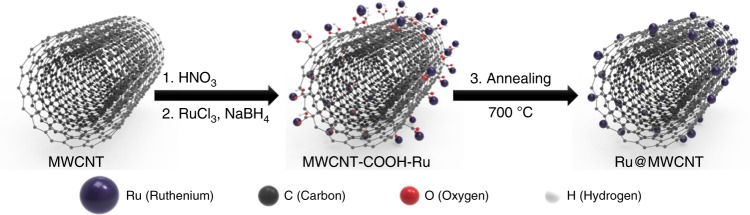
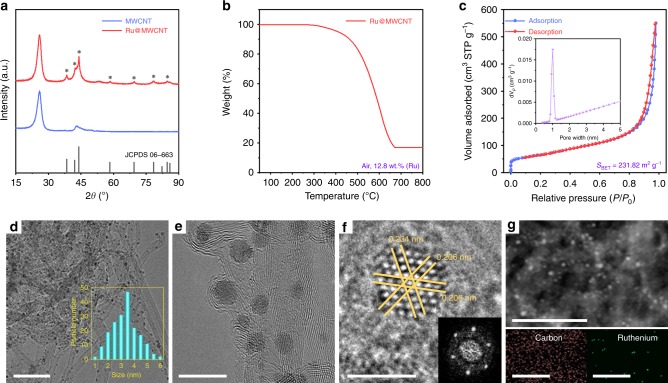
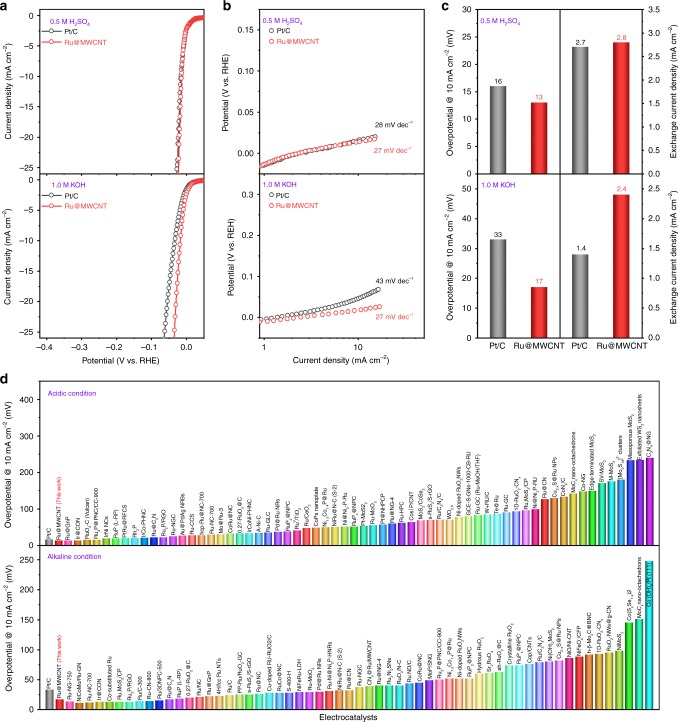
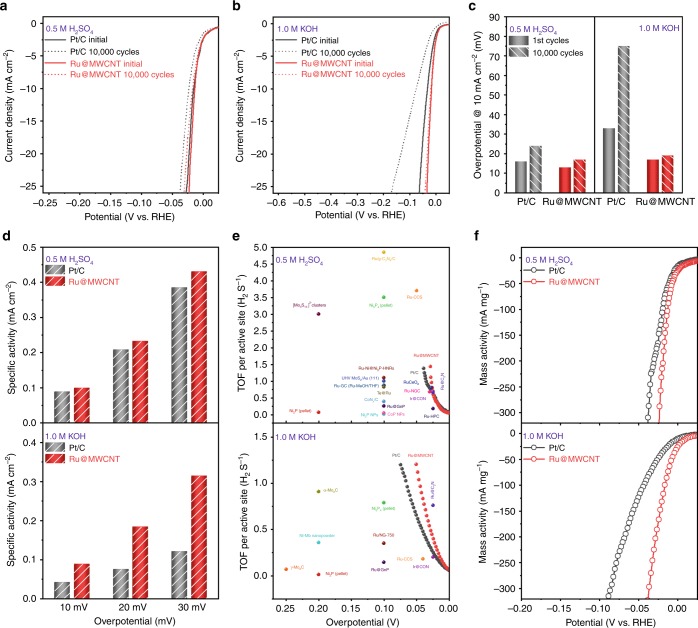
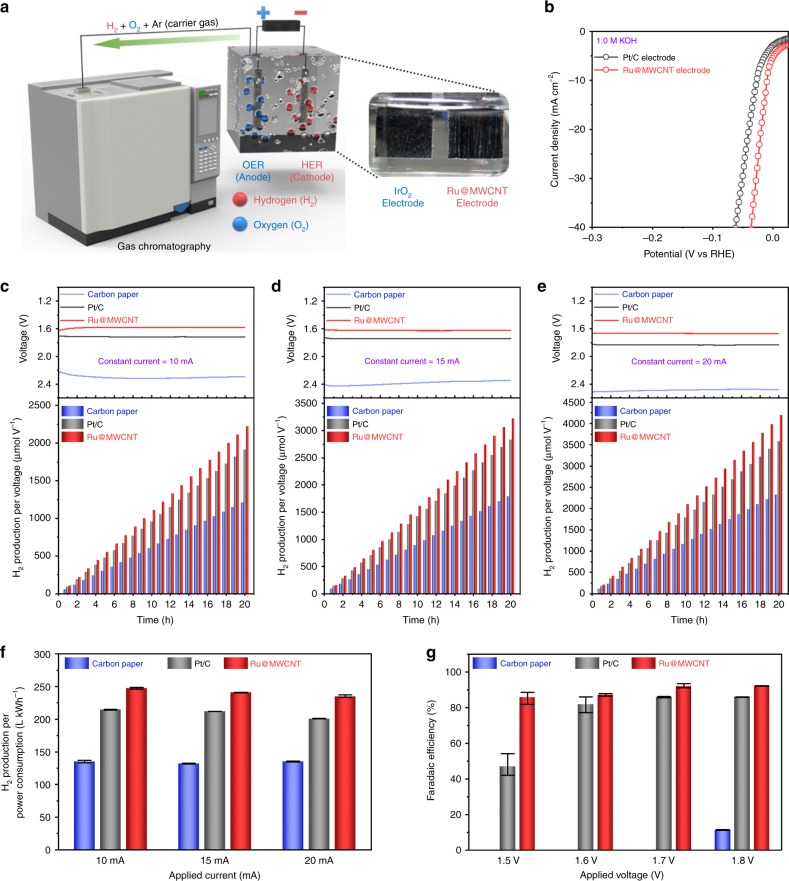
Developing efficient and stable electrocatalysts is crucial for the electrochemical production of pure and clean hydrogen. For practical applications, an economical and facile method of producing catalysts for the hydrogen evolution reaction (HER) is essential. Here, we report ruthenium (Ru) nanoparticles uniformly deposited on multi-walled carbon nanotubes (MWCNTs) as an efficient HER catalyst. The catalyst exhibits the small overpotentials of 13 and 17 mV at a current density of 10 mA cm –2 in 0.5 M aq. H 2 SO 4 and 1.0 M aq. KOH, respectively, surpassing the commercial Pt/C (16 mV and 33 mV). Moreover, the catalyst has excellent stability in both media, showing almost “zeroloss” during cycling. In a real device, the catalyst produces 15.4% more hydrogen per power consumed, and shows a higher Faradaic efficiency (92.28%) than the benchmark Pt/C (85.97%). Density functional theory calculations suggest that Ru–C bonding is the most plausible active site for the HER.
Overview
The claims and statistics of this paper haven’t been checked yet.
Free: it reads the open-access text and checks the first 5 claims that cite a source we can check. Create a free account to check every claim.
Integrity signals
Registry
Cites
Statistics
Figures
Verification
Claims the paper makes
The claims and statistics of this paper haven’t been checked yet.
Free: it reads the open-access text and checks the first 5 claims that cite a source we can check. Create a free account to check every claim.
Claims other papers make about this one
Each is checked against this paper’s own text: does it say what the citing paper says it does?
The source backs part of the claim, not all of it — or backs it for a different population, condition or comparison.
In the citing paper
“the suboptimum activity under alkaline and neutral conditions resulted from the slow dynamics of water dissolution step (H2O→H*+OH−)”
From Interstitial boron-triggered electron-deficient Os aerogels for enhanced pH-universal hydrogen evolution (2022) · cites this paper as [8]
Experimental — accuracy not yet measuredThe source backs part of the claim, not all of it — or backs it for a different population, condition or comparison.
In the citing paper
“the PdPtRhRuAu HEAAs exhibited admirable TOF values with a higher priority compared to reference catalysts, as well as higher than most published Pt-based electrocatalysts in acidic electrolyte.[50,51]”
From Constructing Novel High‐Entropy Alloy Aerogels Platform for pH‐Universal Hydrogen Evolution Reaction with High Electrocatalytic Activity and Stability (2026) · cites this paper as [50]
Experimental — accuracy not yet measuredThe source backs part of the claim, not all of it — or backs it for a different population, condition or comparison.
In the citing paper
“However, the high cost and scarcity of Pt, the poor stability induced by the detachment and irreversible aggregation of Pt nanoparticles in corrosive electrolytes, and the insufficient activity severely hamper its wide application.[12–14]”
From Tungsten Oxide/Reduced Graphene Oxide Aerogel with Low‐Content Platinum as High‐Performance Electrocatalyst for Hydrogen Evolution Reaction (2021) · cites this paper as [12]
Experimental — accuracy not yet measuredThe cited source says what the claim attributes to it.
In the citing paper
“apart from the high cost and low reserves”
From Interstitial boron-triggered electron-deficient Os aerogels for enhanced pH-universal hydrogen evolution (2022) · cites this paper as [8]
The cited source says what the claim attributes to it.
In the citing paper
“the poor stability induced by leaching in corrosive solution and unexpected aggregation of Pt nanoparticles (NPs)”
From Interstitial boron-triggered electron-deficient Os aerogels for enhanced pH-universal hydrogen evolution (2022) · cites this paper as [8]
Self-check
Percentages, sums and reported differences re-computed from the paper’s own numbers.
The self-check needs the paper’s full text.
Citations
Cites
Generalized Gradient Approximation Made Simple
Perdew, J. P., Burke, K., & Ernzerhof, M. (1996) · Physical Review Letters · doi:10.1103/physrevlett.77.3865 · Cited by 215,824
Efficient iterative schemes for ab initio total-energy calculations using a plane-wave basis set
Kresse, G., & Furthmüller, J. (1996) · Physical Review B · doi:10.1103/physrevb.54.11169 · Cited by 123,652
Kresse, G., & Furthmüller, J. (1996) · Computational Materials Science · doi:10.1016/0927-0256(96)00008-0 · Cited by 75,638
Self-Consistent Equations Including Exchange and Correlation Effects
Kohn, W., & Sham, L. J. (1965) · Physical Review · doi:10.1103/physrev.140.a1133 · Cited by 64,135
Combining theory and experiment in electrocatalysis: Insights into materials design
Seh, Z. W., Kibsgaard, J., Dickens, C. F., Chorkendorff, I., Nørskov, J. K., & Jaramillo, T. F. (2017) · Science · doi:10.1126/science.aad4998 · Cited by 12,114
Walter, M. G., Warren, E. L., McKone, J. R., Boettcher, S. W., Mi, Q., Santori, E. A., & Lewis, N. S. (2010) · Chemical Reviews · doi:10.1021/cr1002326 · Cited by 9,388
Sustainable Hydrogen Production
Turner, J. A. (2004) · Science · doi:10.1126/science.1103197 · Cited by 6,602
Noble metal-free hydrogen evolution catalysts for water splitting
Zou, X., & Zhang, Y. (2015) · Chemical Society Reviews · doi:10.1039/c4cs00448e · Cited by 5,955
Design of electrocatalysts for oxygen- and hydrogen-involving energy conversion reactions
Jiao, Y., Zheng, Y., Jaroniec, M., & Qiao, S. Z. (2015) · Chemical Society Reviews · doi:10.1039/c4cs00470a · Cited by 5,388
Computational high-throughput screening of electrocatalytic materials for hydrogen evolution
Greeley, J., Jaramillo, T. F., Bonde, J., Chorkendorff, I., & Nørskov, J. K. (2006) · Nature Materials · doi:10.1038/nmat1752 · Cited by 4,097
Research works printed but not linked: 1
- Conway, B. E. & Bockris, J. O. M. Heats of activation in electrode processes-the electrochemical desorption mechanism of the discharge of hydroxonium ions. Can. J. Chem. 35, 1124–1136 (1957).
Cited by
Items 201–300 of 552
Rapid and large-scale synthesis of ultra-small immiscible alloy supported catalysts
Zhao, H., Zhang, D., Yuan, Y., Wu, X., Li, S., Li, Z., Lai, J., & Wang, L. (2021) · Applied Catalysis B: Environmental · doi:10.1016/j.apcatb.2021.120916 · Cited by 34
Chen, J., Feng, S.-Y., Lu, C.-J., & Huang, J. (2023) · Chemical Engineering Journal · doi:10.1016/j.cej.2023.143761 · Cited by 34
Sun, J., Li, S., Zhao, Q., Huang, C., Wu, Q., Chen, W., Xu, Q., & Yao, W. (2021) · iScience · doi:10.1016/j.isci.2021.102728 · Cited by 33
Wan, Y., Chen, W., Wu, S., Gao, S. W., Xiong, F., Guo, W., Feng, L., Cai, K., Zheng, L., Wang, Y., et al. (2023) · Advanced Materials · doi:10.1002/adma.202308798 · Cited by 34
Rhenium redefined as electrocatalyst: Hydrogen evolution efficiency boost via Pt and Ni doping
Kim, J., Oh, J., Baskaran, S., Kim, T., Kim, S., Yang, J., Jung, J., & Yoon, S. M. (2024) · Applied Catalysis B: Environmental · doi:10.1016/j.apcatb.2024.123791 · Cited by 37
Self-citationZheng, X., Zhang, S., Zheng, X., Zhuang, Z., Gao, M., Liu, Y., Pan, H., & Sun, W. (2025) · Advanced Materials · doi:10.1002/adma.202502127 · Cited by 46
Metallic glasses and metallic glass nanostructures for functional electrocatalytic applications
Aneeshkumar, K. S., Tian, J., & Shen, J. (2021) · Chinese Chemical Letters · doi:10.1016/j.cclet.2021.12.013 · Cited by 32
Huang, Z., Yang, Z., Jia, Q., Wang, N., Zhu, Y., & Xia, Y. (2022) · Nanoscale · doi:10.1039/d1nr07913a · Cited by 34
Yu, J., Wang, X., Huang, X., Cao, J., Huo, Q., Mi, L., Yang, H., Hu, Q. L., & He, C. (2022) · Chemical Engineering Journal · doi:10.1016/j.cej.2022.137248 · Cited by 32
Veerakumar, P., Hung, S.-T., Hung, P., & Lin, K. (2022) · Journal of Agricultural and Food Chemistry · doi:10.1021/acs.jafc.2c01856 · Cited by 35
Wu, S., Chen, D., Li, S., Zeng, Y., Wang, T., Zhang, J., Yu, J., Mu, S. C., & Tang, H. (2023) · Advanced Science · doi:10.1002/advs.202304179 · Cited by 33
Li, T., Zhang, X., Chen, Y., Zhong, L., Li, S., Zhang, P., & Zhao, C. (2021) · Journal of Materials Chemistry A · doi:10.1039/d1ta04917h · Cited by 31
Ross, B. S., Haussener, S., & Brinkert, K. (2023) · Nature Communications · doi:10.1038/s41467-023-38676-2 · Cited by 37
Xie, Y., Luo, F., & Yang, Z. (2024) · Energy Reviews · doi:10.1016/j.enrev.2024.100103 · Cited by 33
Baek, J., Kweon, S. H., Noh, H., Kweon, D. H., Seo, J., Lee, S. J., Kwak, S. K., & Baek, J. (2025) · Advanced Science · doi:10.1002/advs.202414012 · Cited by 32
Self-citationAhn, H., Senthil, R. A., Jung, S., Kumar, A., Ubaidullah, M., & Choi, M. Y. (2025) · eScience · doi:10.1016/j.esci.2025.100408 · Cited by 33
Yang, Z., Chen, H., Xiang, M., Yu, C., Jia, H., & Dong, S. (2022) · International Journal of Hydrogen Energy · doi:10.1016/j.ijhydene.2022.07.090 · Cited by 31
Chen, X., Chen, C., Amjad, M. M., Sun, D., Sun, B., & Zhang, K. (2024) · Applied Catalysis B: Environment and Energy · doi:10.1016/j.apcatb.2023.123644 · Cited by 30
Zhu, Y., Guo, F., Zhang, S., Wang, Z., Chen, R., He, G., Sun, X. A., & Cheng, N. (2025) · Electrochemical Energy Reviews · doi:10.1007/s41918-025-00252-1 · Cited by 39
Jiang, E., Song, N., Hong, S., Xiao, M., Zhu, D., Zuo, Y., Sun, J., Chen, G., Li, C., & Dong, H. (2022) · Electrochimica Acta · doi:10.1016/j.electacta.2022.139895 · Cited by 30
Zhao, J., Wang, J., Zheng, X., Wang, H., Zhang, J., Ding, J., Han, X., Deng, Y., & Hu, W. (2023) · Small Methods · doi:10.1002/smtd.202201362 · Cited by 31
Meng, W., Wang, J., Zhang, D., Xu, J., Guo, F., Zhang, Y., Pang, R., Cao, A., & Shang, Y. (2023) · Small Structures · doi:10.1002/sstr.202300098 · Cited by 31
Wu, S., Wang, X., Bai, J., Zhu, Y., Yu, X., Qin, F., He, P., & Ren, L. (2022) · Langmuir · doi:10.1021/acs.langmuir.2c01225 · Cited by 30
Li, P., Wei, W., Li, J., Liu, Y., Fan, K., Zong, L., & Wang, L. (2023) · Journal of Alloys and Compounds · doi:10.1016/j.jallcom.2023.169630 · Cited by 30
Wang, C., Liu, K., Jin, Y., Huang, S., & Lam, J. C. (2023) · ChemSusChem · doi:10.1002/cssc.202300222 · Cited by 30
Sundaram, G. A., raj, M. G., Ethiraj, J., Vairavel, P., & Kumar, A. S. K. (2024) · ChemEngineering · doi:10.3390/chemengineering8020036 · Cited by 28
“Nanocrystals to Unleash Potential: to enhance TiO 2 ’s photocatalytic activity with visible light, noble metal (Pt, Pd, Rh, and Au)-doped and -modified TiO 2 photocatalysts have garnered attention for ability to enhance efficiency [220].”
BackgroundZhang, X., Li, J., Yan, L., Huang, S., Zhang, P., Peng, Z., Zheng, L., & Zhao, C. (2021) · Applied Surface Science · doi:10.1016/j.apsusc.2021.149978 · Cited by 28
Gao, G., Ding, Z., Li, F., Li, Y.-X., Wang, X. L., & Yao, Y. (2022) · International Journal of Hydrogen Energy · doi:10.1016/j.ijhydene.2022.02.227 · Cited by 29
Duan, M., Shu, T., Li, J., Zhang, D., Gan, L., Yao, K., & Yuan, Q. (2023) · Nano Research · doi:10.1007/s12274-023-5558-5 · Cited by 28
Xu, X., Su, L., Yu, X., Sun, J., & Miao, X. (2024) · Inorganic Chemistry Frontiers · doi:10.1039/d3qi02533k · Cited by 29
Sukhbaatar, B., Wang, Q., Seo, J., Yoon, S., & Yoo, B. (2024) · Scientific Reports · doi:10.1038/s41598-024-56510-7 · Cited by 29
Mishra, B., Biswal, S., & Tripathi, B. P. (2025) · Journal of Materials Chemistry A · doi:10.1039/d4ta08969c · Cited by 28
Zhang, X., Liu, Y., Dai, H., Xu, D., Yang, C., Pan, D., He, T., Zhang, Y., Chen, S. W., & Ouyang, X. (2025) · Applied Catalysis B: Environmental · doi:10.1016/j.apcatb.2025.125127 · Cited by 35
Jiang, Y., Huang, T.-W., Chou, H.-L., Zhou, L., Lee, S., Wang, K., & Dai, S. (2022) · Journal of Materials Chemistry A · doi:10.1039/d2ta04268a · Cited by 27
Deshmukh, M. A., Park, S., Thorat, H. N., Bodkhe, G. A., Ramanavičius, A., Ramanavičius, S., Shirsat, M. D., & Ha, T. (2022) · Journal of Industrial and Engineering Chemistry · doi:10.1016/j.jiec.2022.11.054 · Cited by 28
Ramzan, H., Nadeem, F., Usman, M., Shahzaib, M., Rahman, M. U., Shen, F., Zhang, Z., Singhania, R. R., Jabeen, F., Afzal, W., et al. (2024) · Journal of Cleaner Production · doi:10.1016/j.jclepro.2024.141738 · Cited by 30
Kokulnathan, T., Honnappa, B., Wang, T., Kumar, K. M. A., & Sekar, K. (2024) · Journal of Colloid and Interface Science · doi:10.1016/j.jcis.2024.09.038 · Cited by 31
Ding, R., Lin, L., Pei, C., Yu, X., Sun, Q., & Park, H. S. (2021) · Chemistry - A European Journal · doi:10.1002/chem.202101108 · Cited by 29
Xia, G., Habibullah, Xie, Q., Huang, Q., Ye, M., Gong, B., Du, R., Wang, Y., Yan, Y., Chen, Y., et al. (2024) · Chemical Engineering Journal · doi:10.1016/j.cej.2024.153405 · Cited by 28
Li, S., Ma, R., Yu, P., Mao, B., Lü, H.-L., Yang, M., Thomas, T., Liu, D., & Wang, J. (2020) · The Journal of Physical Chemistry Letters · doi:10.1021/acs.jpclett.0c00703 · Cited by 27
Chen, C. Q., Fu, Z., Qi, F., Chen, Y., Meng, G., Chang, Z., Kong, F., Zhu, L., Tian, H., Huang, H., et al. (2022) · Angewandte Chemie International Edition · doi:10.1002/anie.202207226 · Cited by 29
Luo, J., Zhou, Y., Wang, X., Gu, Y., Liu, W., Wang, S., & Zhang, J. (2023) · Journal of Colloid and Interface Science · doi:10.1016/j.jcis.2023.05.083 · Cited by 27
Xu, C., Ma, W., Wang, H., Shao, L., Li, W., Yu, P., & Mao, L. (2023) · Nano Research · doi:10.1007/s12274-023-5931-4 · Cited by 27
Ma, Y., Ha, Y., Chen, L., An, Z., Xing, L., Wang, Z., & Li, Z. (2024) · Small · doi:10.1002/smll.202311884 · Cited by 29
Zhang, J., Chen, G., Sun, D., Tang, Y., Xing, W., Sun, H., & Feng, X. (2024) · Chemical Science · doi:10.1039/d4sc05547k · Cited by 26
Wang, J., Jiang, Z., Xu, H., Li, X., Jian, Y., Xia, L., Su, P., Liu, Q., Chai, S., Ma, M., et al. (2024) · Angewandte Chemie International Edition · doi:10.1002/anie.202417618 · Cited by 27
Rahmani, E., Reyhani, A., Khanlary, M. R., Mortazavi, S. Z., Mohammadi, M. R., Dau, H., Gholami, M. F., Mohammadi, A. B., Rabe, J. P., Soleimani, M., et al. (2025) · Scientific Reports · doi:10.1038/s41598-025-90341-4 · Cited by 27
“Moreover, it would increase the rate of reaction with low overpotential and high energy efficiency 7,8 .”
Wei, W., Li, P., Lu, F., Fan, K., Li, B., Wei, Y., Zong, L., & Wang, L. (2022) · Journal of Alloys and Compounds · doi:10.1016/j.jallcom.2022.168349 · Cited by 25
Merging Platinum Single Atoms to Achieve Ultrahigh Mass Activity and Low Hydrogen Production Cost
Li, F., Kweon, D. H., Han, G., Noh, H., Che, W., Ahmad, I., Jeong, H. Y., Fu, Z., Lu, Y., & Baek, J. (2023) · ACS Nano · doi:10.1021/acsnano.2c11338 · Cited by 25
Self-citationXia, L., Wang, F., Pan, K., Zhang, B., Li, W., Ma, X., Yang, T., Xu, Y. X., Ren, Y., Yu, H., et al. (2023) · ACS Applied Materials & Interfaces · doi:10.1021/acsami.2c21998 · Cited by 27
Zhou, Y., Liang, Y., Liu, X., & Qi, X. (2023) · ACS Sustainable Chemistry & Engineering · doi:10.1021/acssuschemeng.3c02504 · Cited by 25
Feng, H., Wang, Y., Guo, D., Chai, D., Zhang, W., Zhang, Z., & Dong, G. (2023) · Journal of Alloys and Compounds · doi:10.1016/j.jallcom.2023.173092 · Cited by 25
Abedi, M., Rezaee, S., & Shahrokhian, S. (2024) · Journal of Colloid and Interface Science · doi:10.1016/j.jcis.2024.04.040 · Cited by 25
Ajmal, Z., Arif, M. R., Kumar, A., Haq, M. U., Du, Y., Zhang, Y., Abboud, M., Qian, J., Chen, Z., Ni, B., et al. (2024) · International Journal of Hydrogen Energy · doi:10.1016/j.ijhydene.2024.05.451 · Cited by 25
Active faceted nanoporous ruthenium for electrocatalytic hydrogen evolution
Najib, A. S. B. M., Iqbal, M., Zakaria, M. B., Shoji, S., Cho, Y., Peng, X., Ueda, S., Hashimoto, A., Fujita, T., Miyauchi, M., et al. (2020) · Journal of Materials Chemistry A · doi:10.1039/d0ta04223d · Cited by 25
The assembling principle and strategies of high-density atomically dispersed catalysts
Zhao, S., Hengbo, Y., Xia, H., Qu, G., Yi, S., Pang, H., Yan, W., Zhang, J., & Mu, S. C. (2020) · Chemical Engineering Journal · doi:10.1016/j.cej.2020.127917 · Cited by 26
Yang, W., Huang, Q., Yan, Y., Li, Y., Xu, T., Yu, A., Zhao, Y., Peng, P., Wang, Y., Echegoyen, L. A., et al. (2024) · Angewandte Chemie International Edition · doi:10.1002/anie.202414149 · Cited by 26
Zhang, X., Liu, Z., Guo, W., An, W., Song, Z., Du, Y., Shen, T., Qin, Q., Wang, C., Huang, G., et al. (2025) · Journal of Energy Chemistry · doi:10.1016/j.jechem.2025.05.038 · Cited by 26
Jian, X., Li, T., Guo, S., Gao, L., Fu, F., Tian, Y., & Wu, Y. (2022) · ACS Applied Energy Materials · doi:10.1021/acsaem.1c03708 · Cited by 26
Ru/graphene hybrid film catalyst for NaBH4 hydrolysis reaction
Megersa, D. D., Kim, Y., Kim, N., Lee, J.-Y., Bae, J., Choi, J., & Yu, H. K. (2022) · International Journal of Hydrogen Energy · doi:10.1016/j.ijhydene.2022.03.044 · Cited by 24
Tang, H., Gu, H., Li, Z., Chai, J., Qin, F., Lu, C., Yu, J., Zhai, H., Zhang, L., Li, X., et al. (2022) · ACS Applied Materials & Interfaces · doi:10.1021/acsami.2c09107 · Cited by 24
Rhenium anchored Ti 3 C 2 T x (MXene) nanosheets for electrocatalytic hydrogen production
Suragtkhuu, S., Sunderiya, S., Purevdorj, S., Bat‐Erdene, M., Sainbileg, B., Hayashi, M., Bati, A. S. R., Shapter, J. G., Davaasambuu, S., & Batmunkh, M. (2022) · Nanoscale Advances · doi:10.1039/d2na00782g · Cited by 24
Wang, S., Ning, X., Liu, X., Shakouri, M., Hu, Y., Yuan, H., Liu, P. F., Lu, X., Guo, Y. Q., & Wang, Y. (2023) · Carbon · doi:10.1016/j.carbon.2023.118611 · Cited by 24
Zhang, C., Wang, X., Zhao, R., Ndayisenga, F., & Yu, Z. (2024) · Chemical Science · doi:10.1039/d3sc06053e · Cited by 24
Bandal, H. A., Pawar, A. A., & Kim, H. (2022) · Electrochimica Acta · doi:10.1016/j.electacta.2022.140545 · Cited by 24
Wang, T., Zhang, D., Fei, J., Yu, W., Zhu, J., Zhang, Y., Shi, Y., Tian, M., Lai, J., & Wang, L. (2024) · Applied Catalysis B: Environmental · doi:10.1016/j.apcatb.2023.123546 · Cited by 26
Li, Z., Li, X., Ma, H., Ye, C., Yu, H., Nie, L., Zheng, M., & Wang, J. (2024) · Nano Research · doi:10.1007/s12274-024-6507-7 · Cited by 24
Chen, Z., Chen, X., Kang, W., Zheng, S., He, Q., Li, Q., Zhang, Y., Hou, Y., Tian, J., Dong, J., et al. (2025) · Angewandte Chemie International Edition · doi:10.1002/anie.202423301 · Cited by 27
Enhance Water Electrolysis for Green Hydrogen Production with Material Engineering: A Review
Liu, Y., Qin, Y., Yu, D., Zhuo, H., Ma, C., & Chen, K. (2025) · The Chemical Record · doi:10.1002/tcr.202400258 · Cited by 27
Wu, Y. J., Kou, Z., Liu, N., Chu, S., Yang, B., Li, Z., Shang, J., Song, F., Zhang, Q., Liao, P., et al. (2025) · Energy & Environmental Science · doi:10.1039/d5ee04506a · Cited by 23
Chen, Z., Deng, J., Zheng, Y., Zhang, W., Dong, L., & Chen, Z. (2024) · CHINESE JOURNAL OF CATALYSIS (CHINESE VERSION) · doi:10.1016/s1872-2067(24)60045-8 · Cited by 23
Ma, J., Wang, J., Liu, J., Li, X., Sun, Y., & Li, R. (2022) · Journal of Colloid and Interface Science · doi:10.1016/j.jcis.2022.03.149 · Cited by 23
Upcycling surplus acetone into long-chain chemicals using a tandem electro-biosystem
Liu, C., Zhao, J., Tang, H., Xue, J., Xue, W., Li, X., Li, H., Jiang, Q. M., Zheng, T., Yu, T., et al. (2025) · Nature Sustainability · doi:10.1038/s41893-025-01568-y · Cited by 27
“27) revealed that tensile strain shifts the d -band centre upwards and narrows the d -band of I-Ru compared with H-Ru, indicating strengthened acetone binding 38 , which is consistent with the free energy diagrams and in situ FTIRAS results.”
InfluentialWu, J., Lang, W., Li, H., Du, K.-J., Deng, J., Zhao, S., Zhang, W., Peng, Z., & Liu, Z. (2023) · ACS Sustainable Chemistry & Engineering · doi:10.1021/acssuschemeng.3c03383 · Cited by 22
Bahrami, M., Shahrabi, T., & Yaghoubinezhad, Y. (2023) · ACS Applied Energy Materials · doi:10.1021/acsaem.3c01944 · Cited by 22
Huynh, T. B. N., Song, J., Bae, H. E., Sung, Y., Kim, M. J., & Kwon, O. J. (2024) · Advanced Energy Materials · doi:10.1002/aenm.202402179 · Cited by 23
Jeong, Y.-B., & Hoon Ahn, S. (2022) · Chemical Engineering Journal · doi:10.1016/j.cej.2022.135322 · Cited by 21
Liu, R., Lv, Z., Wang, C., Tian, C., Dong, F., Feng, X., Wang, B., & Yang, W. (2025) · Advanced Energy Materials · doi:10.1002/aenm.202501331 · Cited by 29
Electrochemical Catalysts for Green Hydrogen Energy
Kweon, D. H., Jeon, I., & Baek, J. (2021) · Advanced Energy and Sustainability Research · doi:10.1002/aesr.202100019 · Cited by 25
Self-citationZhao, X., Yong, X., Ji, Q., Yang, Z., Yang, S., Sun, Y., Cai, Z., Xu, J., Li, L., Shi, S., et al. (2022) · Journal of Materials Chemistry A · doi:10.1039/d2ta06595a · Cited by 21
Self-citationZhao, H., Zhang, X., Zhang, Y., Song, Y., Li, C., Liu, K., & Ma, D. (2022) · Journal of Materials Chemistry A · doi:10.1039/d2ta08224a · Cited by 21
Boron doped nanomaterials for photocatalysis
Lin, M., Qi, W., Zhang, H., & Li, Y. (2024) · Journal of Photochemistry and Photobiology C Photochemistry Reviews · doi:10.1016/j.jphotochemrev.2024.100679 · Cited by 26
MacSwain, W., Ma, D., Li, Z. J., Lin, H., Bai, Y., Hu, X., & Zheng, W. (2025) · Coordination Chemistry Reviews · doi:10.1016/j.ccr.2025.217247 · Cited by 24
Shi, Q., & Liu, H. (2021) · International Journal of Hydrogen Energy · doi:10.1016/j.ijhydene.2021.08.215 · Cited by 20
Veerakumar, P., Vinothkumar, V., Chen, S., Sangili, A., & Lin, K. (2021) · Journal of Materials Chemistry C · doi:10.1039/d1tc02885e · Cited by 20
Li, P., Zhao, G., Cheng, N., Xia, L., Li, X., Chen, Y., Lao, M., Cheng, Z., Zhao, Y., Xu, X., et al. (2022) · CHINESE JOURNAL OF CATALYSIS (CHINESE VERSION) · doi:10.1016/s1872-2067(21)63935-9 · Cited by 21
Xie, S., Niu, M., Li, X., Yang, L., Zhang, H., Xu, S., Wang, D., Osman, S. M., Peng, Z. J., & Yamauchi, Y. (2024) · Journal of Materials Chemistry A · doi:10.1039/d4ta02442g · Cited by 20
Maheskumar, V., Min, A., Kumar, A., Senthil, R. A., Moon, C. J., & Choi, M. Y. (2024) · Small · doi:10.1002/smll.202403314 · Cited by 31
Guo, H., Shi, Q., Xu, Y., Yue, G., Zhao, L., Yue, C., Ye, S., Liu, Q., Wei, Q., Yang, D., et al. (2025) · Applied Catalysis B: Environmental · doi:10.1016/j.apcatb.2025.125774 · Cited by 19
Synergetic catalysis of p–d hybridized single-atom catalysts: first-principles investigations
Deng, M., Xia, M., Wang, Y., Ren, X., & Li, S. F. (2022) · Journal of Materials Chemistry A · doi:10.1039/d2ta03368b · Cited by 19
Zhang, J., Chen, G., Liu, Q., Fan, C., Sun, D., Tang, Y., Sun, H., & Feng, X. (2022) · Angewandte Chemie · doi:10.1002/ange.202209486 · Cited by 20
Yan, S., Zhong, M., Zhu, W., Li, W., Chen, X., Li, M., Wang, C., & Lu, X. (2022) · Inorganic Chemistry Frontiers · doi:10.1039/d2qi01494g · Cited by 19
Zhu, Q., Xie, F., Liu, J., Jian, X., Yu, Z., Gao, X., Li, H., Zhang, X., Wang, Y., Wang, Y., et al. (2023) · Journal of Alloys and Compounds · doi:10.1016/j.jallcom.2023.170764 · Cited by 19
Romero, N., Fenoll, D. A., Jiménez, L. G., Campos‐Jara, S., Creus, J., Martí, G., Heras‐Domingo, J., Collière, V., Mesa, C. A., Giménez, S., et al. (2023) · Inorganic Chemistry Frontiers · doi:10.1039/d3qi00698k · Cited by 20
Huang, M., Ma, Y., Yang, J., Xu, L., Yang, H., Wang, M., Ma, X., Xia, X., Yang, J., Wang, D., et al. (2023) · Applied Surface Science · doi:10.1016/j.apsusc.2023.158834 · Cited by 19
Monama, G. R., Ramoroka, M. E., Ramohlola, K. E., Seleka, W. M., Iwuoha, E. I., & Modibane, K. D. (2024) · Environmental Science and Pollution Research · doi:10.1007/s11356-024-34846-x · Cited by 19
“The results indicated that LTbZO and LSmZO catalysts were comparable to benchmark Pt/C and Ru@MWCNT electrodes with %FE of 46.99 and 85.88 at 1.5 V, respectively (Kweon et al. 2020).”
BackgroundInfluentialLyu, X., Zhang, Y., Wang, X., Chen, H., Li, S., Zhang, W., Hu, Y., Li, F., Li, D., & Yang, D. (2022) · Materials Today Sustainability · doi:10.1016/j.mtsust.2022.100295 · Cited by 21
Liu, Y., Qi, F., Wang, X., Zhang, Q., Liu, Y., Gao, Y., Wang, K., Cui, W., Gao, F., Li, Z., et al. (2025) · Applied Surface Science · doi:10.1016/j.apsusc.2025.163015 · Cited by 22
Zhang, C., Cui, Y., Jiang, C., Li, Y., Meng, Z., Wang, C., Du, Z., Yu, S., Tian, H., & Zheng, W. (2023) · Small · doi:10.1002/smll.202301721 · Cited by 21
Viyanni, P. M., Edison, T. N. J. I., & Sethuraman, M. G. (2023) · Materials Today Sustainability · doi:10.1016/j.mtsust.2023.100565 · Cited by 23
Metadata
- Authors
- Kweon, D. H., Okyay, M. S., Kim, S.-J., Jeon, J.-P., Noh, H.-J., Park, N., Mahmood, J., & Baek, J.-B.
- Affiliations
- Ulsan National Institute of Science and Technology (KR)
- Corresponding author
- Mahmood, Javeed
- Baek, Jong-Beom
- ORCID
- Venue
- Nature Communications
- Published
- 2020-03-09
- Volume
- 11
- Issue
- 1
- Pages
- 1278-1278
- ISSN
- 2041-1723 (ISSN-L)
- PMC
- PMC7062887
- OpenAlex
- W3010300906
- Semantic Scholar
- 880727917e64f908f147f5933667a91df77eff20
- Cited by
- 546
- References
- 57
- Citations by year
- 2026: 43 · 2025: 95 · 2024: 86 · 2023: 105 · 2022: 119 · 2021: 81 · 2020: 17
- FWCI
- 15.92
- Type
- journal article
- Language
- en
- Open access
- gold
- doi.org
- Licence
- cc-by
- creativecommons.org/licenses/by/4.0 (tdm)
- creativecommons.org/licenses/by/4.0 (vor)
- Locations
- Nature Communications (publishedVersion, cc-by)
- PubMed Central (publishedVersion, cc-by)
- PubMed (publishedVersion)
- RePEc: Research Papers in Economics (submittedVersion)
- DOAJ (DOAJ: Directory of Open Access Journals) (submittedVersion, cc-by-sa)
- Scholarworks@UNIST (Ulsan National Institute of Science and Technology) (submittedVersion)
- Nanoscience and technology
- Funders
- National Research Foundation of Korea (2019R1C1C1006650, 2014R1A2069102, 10Z20130011057, 2016R1A5A1009405)
- Topics
- Physical Sciences › Energy › Renewable Energy, Sustainability and the Environment › Electrocatalysts for Energy Conversion
- Physical Sciences › Energy › Renewable Energy, Sustainability and the Environment › CO2 Reduction Techniques and Catalysts
- Physical Sciences › Engineering › Electrical and Electronic Engineering › Fuel Cells and Related Materials
- Keywords
- ruthenium nanoparticles, multi-walled carbon nanotubes, hydrogen evolution reaction, electrocatalysts, hydrogen production, Faradaic efficiency, catalyst stability, active site, platinum-free catalysts, acidic and alkaline electrolytes
About these checks
Registry, retraction, Cites and statistics results are computed, not judged, with one exception: a printed reference that no index lists is read once by a model before it counts as a citation error. Claims are extracted by a model and kept only when their quote appears verbatim in the text; each cited source is then checked, with a model’s help, for whether it says what the claim relies on. Those verdicts can be wrong — read the claim’s quote and the cited source before relying on one.
Statistics and arithmetic are recomputed, not judged.
Confidence bands are shown only for fields calibrated on our annotated test set. None is calibrated yet, so no band is shown.
What counts as a claim ›How we measure confidence ›How we check this ›
Are you an author, or do you see a problem with this page? Request a review
Data sources
Bibliographic data: Semantic Scholar, OpenAlex, Crossref.
Contains information from the Semantic Scholar Academic Graph Datasets, made available under the ODC Attribution License (ODC-BY 1.0).
Semantic Scholar’s data is described in: Kinney, R., et al. (2023). The Semantic Scholar Open Data Platform. arXiv:2301.10140.
