

Ruthenium anchored on carbon nanotube electrocatalyst for hydrogen production with enhanced Faradaic efficiency
Open accessThe DOI matches its Crossref record; 57 of the 57 references it cites were found in a registry or an index.
Abstract
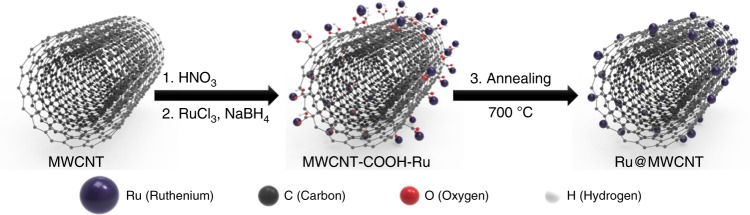
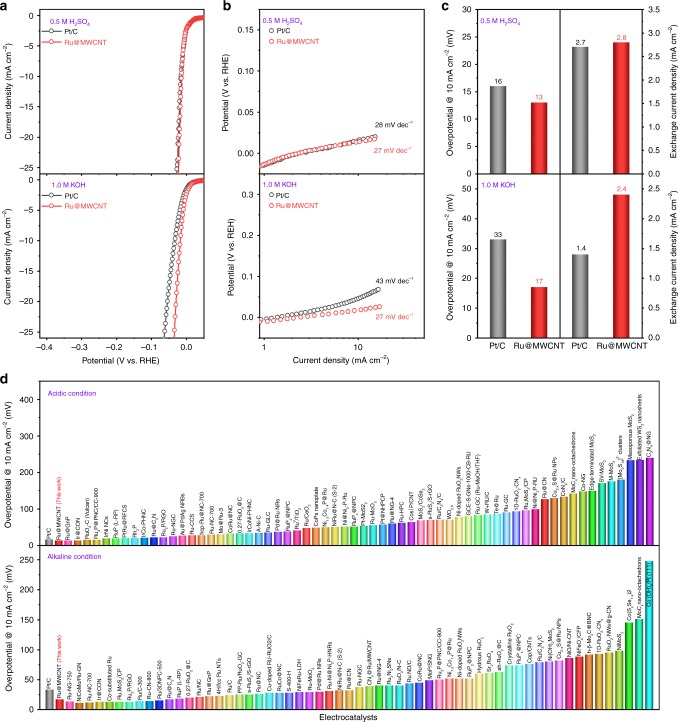
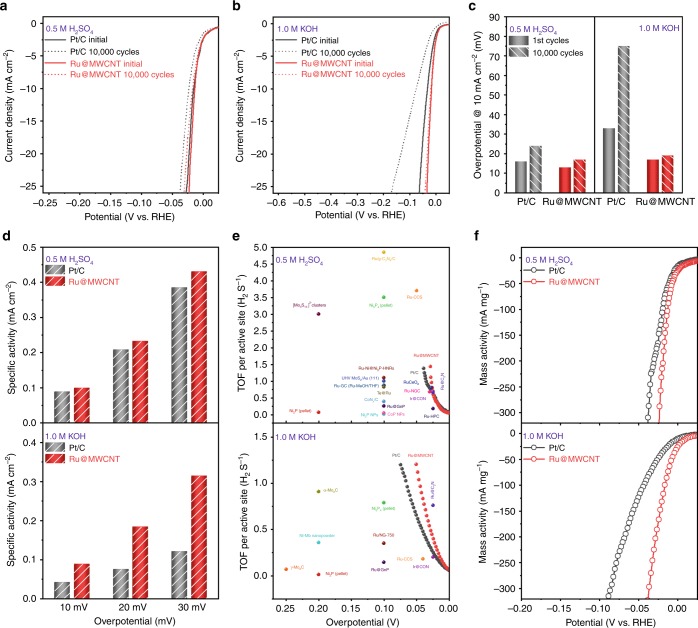
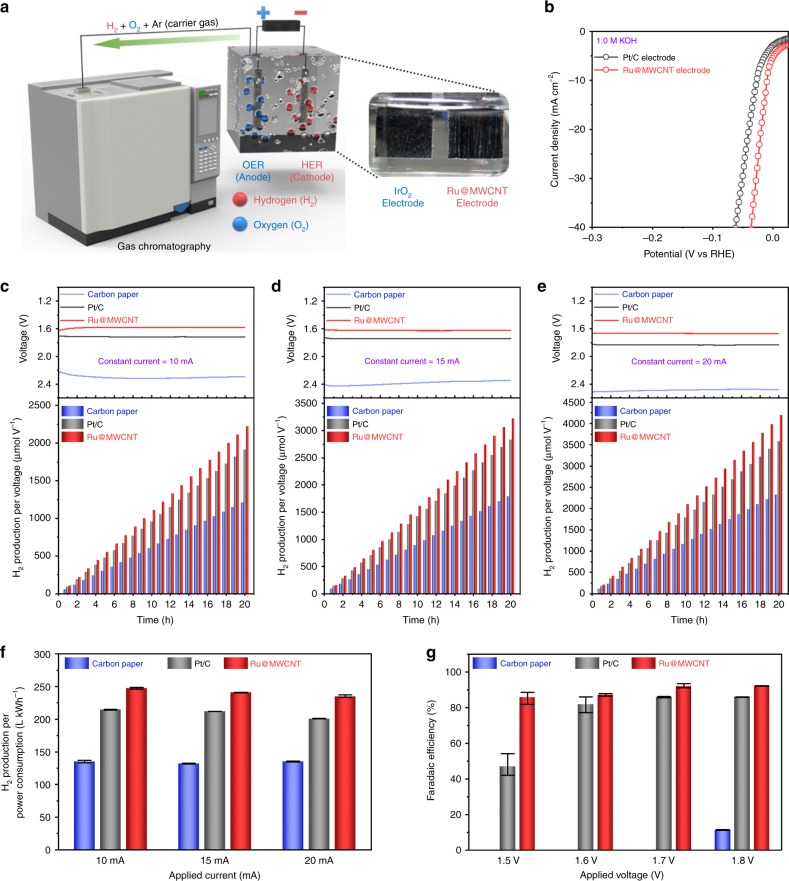
Developing efficient and stable electrocatalysts is crucial for the electrochemical production of pure and clean hydrogen. For practical applications, an economical and facile method of producing catalysts for the hydrogen evolution reaction (HER) is essential. Here, we report ruthenium (Ru) nanoparticles uniformly deposited on multi-walled carbon nanotubes (MWCNTs) as an efficient HER catalyst. The catalyst exhibits the small overpotentials of 13 and 17 mV at a current density of 10 mA cm –2 in 0.5 M aq. H 2 SO 4 and 1.0 M aq. KOH, respectively, surpassing the commercial Pt/C (16 mV and 33 mV). Moreover, the catalyst has excellent stability in both media, showing almost “zeroloss” during cycling. In a real device, the catalyst produces 15.4% more hydrogen per power consumed, and shows a higher Faradaic efficiency (92.28%) than the benchmark Pt/C (85.97%). Density functional theory calculations suggest that Ru–C bonding is the most plausible active site for the HER.
Overview
The claims and statistics of this paper haven’t been checked yet.
Free: it reads the open-access text and checks the first 5 claims that cite a source we can check. Create a free account to check every claim.
Integrity signals
Registry
Cites
Statistics
Figures
Verification
Claims the paper makes
The claims and statistics of this paper haven’t been checked yet.
Free: it reads the open-access text and checks the first 5 claims that cite a source we can check. Create a free account to check every claim.
Claims other papers make about this one
Each is checked against this paper’s own text: does it say what the citing paper says it does?
The source backs part of the claim, not all of it — or backs it for a different population, condition or comparison.
In the citing paper
“the suboptimum activity under alkaline and neutral conditions resulted from the slow dynamics of water dissolution step (H2O→H*+OH−)”
From Interstitial boron-triggered electron-deficient Os aerogels for enhanced pH-universal hydrogen evolution (2022) · cites this paper as [8]
Experimental — accuracy not yet measuredThe source backs part of the claim, not all of it — or backs it for a different population, condition or comparison.
In the citing paper
“the PdPtRhRuAu HEAAs exhibited admirable TOF values with a higher priority compared to reference catalysts, as well as higher than most published Pt-based electrocatalysts in acidic electrolyte.[50,51]”
From Constructing Novel High‐Entropy Alloy Aerogels Platform for pH‐Universal Hydrogen Evolution Reaction with High Electrocatalytic Activity and Stability (2026) · cites this paper as [50]
Experimental — accuracy not yet measuredThe source backs part of the claim, not all of it — or backs it for a different population, condition or comparison.
In the citing paper
“However, the high cost and scarcity of Pt, the poor stability induced by the detachment and irreversible aggregation of Pt nanoparticles in corrosive electrolytes, and the insufficient activity severely hamper its wide application.[12–14]”
From Tungsten Oxide/Reduced Graphene Oxide Aerogel with Low‐Content Platinum as High‐Performance Electrocatalyst for Hydrogen Evolution Reaction (2021) · cites this paper as [12]
Experimental — accuracy not yet measuredThe cited source says what the claim attributes to it.
In the citing paper
“apart from the high cost and low reserves”
From Interstitial boron-triggered electron-deficient Os aerogels for enhanced pH-universal hydrogen evolution (2022) · cites this paper as [8]
The cited source says what the claim attributes to it.
In the citing paper
“the poor stability induced by leaching in corrosive solution and unexpected aggregation of Pt nanoparticles (NPs)”
From Interstitial boron-triggered electron-deficient Os aerogels for enhanced pH-universal hydrogen evolution (2022) · cites this paper as [8]
Self-check
Percentages, sums and reported differences re-computed from the paper’s own numbers.
The self-check needs the paper’s full text.
Citations
Cites
Generalized Gradient Approximation Made Simple
Perdew, J. P., Burke, K., & Ernzerhof, M. (1996) · Physical Review Letters · doi:10.1103/physrevlett.77.3865 · Cited by 215,824
Efficient iterative schemes for ab initio total-energy calculations using a plane-wave basis set
Kresse, G., & Furthmüller, J. (1996) · Physical Review B · doi:10.1103/physrevb.54.11169 · Cited by 123,652
Kresse, G., & Furthmüller, J. (1996) · Computational Materials Science · doi:10.1016/0927-0256(96)00008-0 · Cited by 75,638
Self-Consistent Equations Including Exchange and Correlation Effects
Kohn, W., & Sham, L. J. (1965) · Physical Review · doi:10.1103/physrev.140.a1133 · Cited by 64,135
Combining theory and experiment in electrocatalysis: Insights into materials design
Seh, Z. W., Kibsgaard, J., Dickens, C. F., Chorkendorff, I., Nørskov, J. K., & Jaramillo, T. F. (2017) · Science · doi:10.1126/science.aad4998 · Cited by 12,114
Walter, M. G., Warren, E. L., McKone, J. R., Boettcher, S. W., Mi, Q., Santori, E. A., & Lewis, N. S. (2010) · Chemical Reviews · doi:10.1021/cr1002326 · Cited by 9,388
Sustainable Hydrogen Production
Turner, J. A. (2004) · Science · doi:10.1126/science.1103197 · Cited by 6,602
Noble metal-free hydrogen evolution catalysts for water splitting
Zou, X., & Zhang, Y. (2015) · Chemical Society Reviews · doi:10.1039/c4cs00448e · Cited by 5,955
Design of electrocatalysts for oxygen- and hydrogen-involving energy conversion reactions
Jiao, Y., Zheng, Y., Jaroniec, M., & Qiao, S. Z. (2015) · Chemical Society Reviews · doi:10.1039/c4cs00470a · Cited by 5,388
Computational high-throughput screening of electrocatalytic materials for hydrogen evolution
Greeley, J., Jaramillo, T. F., Bonde, J., Chorkendorff, I., & Nørskov, J. K. (2006) · Nature Materials · doi:10.1038/nmat1752 · Cited by 4,097
Research works printed but not linked: 1
- Conway BE Bockris JOM Heats of activation in electrode processes-the electrochemical desorption mechanism of the discharge of hydroxonium ions Can. J. Chem. 1957 35 1124 1136
Cited by
Items 501–552 of 552
Arshad, Z., & Tahir, M. (2026) · Coordination Chemistry Reviews · doi:10.1016/j.ccr.2026.218375 · Cited by 2
Zhao, H., Li, H., Lou, T., Ran, G., Song, H., & Cheng, X. (2026) · Chemical Engineering Journal · doi:10.1016/j.cej.2026.180682 · Cited by 1
Xu, G., Sun, M., Jia, X., Huang, C., Li, C., Huang, B., Xiao, M., Liu, C., Zhu, J., & Xing, W. (2026) · Advanced Materials · doi:10.1002/adma.74720 · Cited by 1
Hsiao, Y.-C., & Wu, F. (2020) · Coatings · doi:10.3390/coatings10080786 · Cited by 1
“The Ru element has been studied as a promising catalyst for hydrogen evolution reaction due to its small overpotential as compared to commercial Pt material [23].”
BackgroundCarbon-Based Nanomaterials for Hydrogen Evolution Reaction
Zhao, B., & Xu, S. (2022) · Springer series in materials science · doi:10.1007/978-981-19-4625-7_6 · Cited by 1
Role of nanocomposites in hydrogen production
Islam, S. K. E., Hang, D., Liang, C., Khan, M., & Shakoor, S. (2023) · Elsevier eBooks · doi:10.1016/b978-0-323-99704-1.00017-5 · Cited by 1
Design of Porous Carbon-Based Electro-Catalyst for Hydrogen Generation
Kamlesh, Prakash, S., Tavar, D., Raizda, P., Singh, P. K., Mudgal, M., Srivastava, A. K., & Singh, A. K. (2023) · Materials horizons · doi:10.1007/978-981-19-7188-4_11 · Cited by 1
Carbon-based micro- and nanomaterials for hydrogen production and storage
Pachaiappan, R., Cornejo‐Ponce, L., Saranya, P. E., Manavalan, K., & Nguyen, T. K. (2024) · Elsevier eBooks · doi:10.1016/b978-0-443-21456-1.00024-2 · Cited by 1
Jassal, A. K. (2024) · Energy, environment, and sustainability · doi:10.1007/978-981-97-1339-4_18 · Cited by 1
Nersisyan, H., Jeong, J., Suh, H., & Lee, J. (2025) · Materials Chemistry Frontiers · doi:10.1039/d4qm00814f · Cited by 1
Heterogenization of molecular chalcoxides for electro-& photochemical H 2 production
Gray, M., Song, Y., & Miras, H. N. (2025) · Chemical Communications · doi:10.1039/d4cc05605a · Cited by 1
Smart Nano-materials for Catalytic Hydrogen Evolution Reactions
Kumar, A., Mahana, S., Behera, P. K., & Pandey, D. S. (2025) · BENTHAM SCIENCE PUBLISHERS eBooks · doi:10.2174/9798898810603125010004 · Cited by 3
Li, Y. (2024) · DR-NTU (Nanyang Technological University) · doi:10.32657/10356/179769 · Cited by 4
Wang, Q. (2022) · DR-NTU (Nanyang Technological University) · doi:10.32657/10356/157018
Synthesis and HER Properties of Ru Nanoparticles Loaded with BCN
赵, 嘉. (2023) · Journal of Advances in Physical Chemistry · doi:10.12677/japc.2023.122017
Jin, D., Kim, J., Chitumalla, R. K., Kim, I. Y., Jang, J., & Kim, M. H. (2024) · SSRN Electronic Journal · doi:10.2139/ssrn.4777023
Chen, Z., Chen, J., Fu, J., Wang, Q., Chen, Y., & Liu, J. (2024) · Chemistry of Materials · doi:10.1021/acs.chemmater.4c01485
Wang, J., Jiang, Z., Xu, H., Li, X., Jian, Y., Xia, L., Su, P., Liu, Q., Chai, S., Ma, M., et al. (2024) · Angewandte Chemie · doi:10.1002/ange.202417618
Carbon-based Electrocatalysts for Hydrogen Production
Gopalakrishnan, V. N., Shet, S. M., Subudhi, S. K., Ravikumar, C. H., & Balakrishna, R. G. (2024) · Royal Society of Chemistry eBooks · doi:10.1039/9781837674664-00373
Qiu, X., Ma, G., Gao, S., Lang, X., Meng, X., Chen, F., & Song, X. (2025) · SSRN Electronic Journal · doi:10.2139/ssrn.5087328
Zhang, X., Jia, N., Xie, X. Y., Ding, J., Liu, Y., & Lu, S. (2025) · Journal of Alloys and Compounds · doi:10.1016/j.jallcom.2025.182389 · Cited by 3
Overview of Electrocatalytic Hydrogen Precipitation
郭, 妍. (2025) · Journal of Advances in Physical Chemistry · doi:10.12677/japc.2025.143043
Jiang, H., Zhang, Q., Zhu, X., Zhang, H., Zuo, X., Yang, Q., Tang, H., & Li, G. (2025) · New Journal of Chemistry · doi:10.1039/d5nj02628h · Cited by 1
PBA based nanomaterials as a rising star for electrocatalytic hydrogen evolution reaction
Li, Y., Yang, C., Wang, H., Ma, L., & Wang, Y. (2025) · Discover Electrochemistry. · doi:10.1007/s44373-025-00052-8 · Cited by 1
Hu, D., Liu, Y., Xue, L., Li, Y., Du, L., Zou, H., Sun, B., & Chen, J. (2025) · Industrial & Engineering Chemistry Research · doi:10.1021/acs.iecr.5c02621
Electrochemical hydrogen production technologies
Guerraf, A. E., Abbas, G., Aqil, M., Bazzaoui, M., Bazzaoui, E. A., Abdinejad, M., & Portoacă, A. I. (2025) · Elsevier eBooks · doi:10.1016/b978-0-443-33771-0.00013-7
H2 production at positive potentials with a stable and bifunctional Ru0-RuO2Cy electrocatalyst
Gonell, F., Tébar-Soler, C., Díaz-Coello, S., Pastor, E., Corma, A., & Concepción, P. (2025) · Journal of Catalysis · doi:10.1016/j.jcat.2025.116654
Bai, M., Wang, S. H., Zhao, J., Qin, C., Cao, D., Wang, L., Kang, Y., Yu, Z., & Zhao, Z. (2026) · Current Microwave Chemistry · doi:10.2174/0122133356410577251201060145
New porous functional materials for photo and electrochemical devices
Garcia, D. M. E. (2022) · theses.fr (ABES) · doi:10.70675/e5707b53z710cz4196z95e0zb8b29b47a694
Kumar, K. S. (2023) · theses.fr (ABES) · doi:10.70675/3bddb495z0180z4a62zbe50z4c5af9749e01
Han, J., Yu, Y., Bagliuk, G. A., Lai, J., & Wang, L. (2026) · National Science Review · doi:10.1093/nsr/nwag220
“Second, the SMSI between the nanoparticles and the carrier CNT prevents nanoparticle agglomeration, anchors particles to inhibit migration, and facilitates electron transfer [15 ,38 ].”
Hierarchical Hybrid Electrodes (HHE) for Enhancing the Performance of Water Electrolysis Systems
Shrestha, S., Peddamalla, S., Wang, W., & Mukhopadhyay, S. M. (2026) · Nanomaterials · doi:10.3390/nano16090500
“One study that used Ru nanoparticles supported on multiwalled CNTs and the CNT–catalyst complex drop-casted on an existing electrode [57] showed a lower slope of 27 mV/dec compared to Pd-CNT1-RVC electrode in both strongly acidic (0.5 M H 2 SO 4 ) and strongly alkaline (1 M KOH) environments.”
InfluentialHübsch, R., Schauermann, D., Škvára, J., Reindl, S., Škála, T., Tsud, N., Retzer, T., Mysliveček, J., Brummel, O., Lykhach, Y., et al. (2026) · Electrochimica Acta · doi:10.1016/j.electacta.2026.148959
Zhong, S., Li, R., Chen, H., Xiao, C., Lan, Y., Chen, Q.-A., Li, J., Feng, C., Li, S., Qi, H., et al. (2026) · Chemical Engineering Journal · doi:10.1016/j.cej.2026.177270
Xu, H.-X., Guo, D.-Y., Li, F., Shi, L., Zhang, H., Si, L., Xiao, X., & Liu, H. (2026) · Catalysis Letters · doi:10.1007/s10562-026-05423-3
“3 ) [55].”
Liu, S., Deng, J., & Liu, D. (2026) · Journal of Alloys and Compounds · doi:10.1016/j.jallcom.2026.189004
Wang, J., Wang, L., Liu, Z., Jin, L., Dai, X., Liu, Y., Zhang, X., & Liu, G. (2026) · Physical Review Materials · doi:10.1103/yzwx-zqgd
Single-atom cocatalysts engineer proton microenvironments for efficient alkaline hydrogen evolution
Yang, G., Yang, M., Meng, Z., & Cui, Y. (2026) · Chemical Science · doi:10.1039/d6sc01375a · Cited by 1
Wang, L., Bi, J., Xu, J., Liu, Z., Huang, K., Zhang, X., & Chen, Z. (2026) · Chemical Communications · doi:10.1039/d6cc02643e
Highly Dispersed Cu Promoters Enable Efficient Ru Catalysts for Alkaline Hydrogen Evolution
Li, W., Jiang, Z., Jiang, Y., Chang, T., Huang, T., Wang, J., Lee, S., Chen, T., Wang, K., & Dai, S. (2026) · Small · doi:10.1002/smll.75094
Yu, Z., Hu, M., Chen, Y., Song, X., Tang, Z., Yang, Y., Wang, C., Li, J., Zhang, Q., & 郎集会 (2026) · Journal of environmental chemical engineering · doi:10.1016/j.jece.2026.124510
Wang, J., Xia, L., Jian, Y., Liu, Q., Liu, Y., Wu, Y., Xu, H., Zhao, Y., Wang, J., Jiang, Z., et al. (2026) · Chemical Engineering Journal · doi:10.1016/j.cej.2026.180774
Huynh, T. B. N., & Kwon, O. J. (2026) · Journal of Power Sources · doi:10.1016/j.jpowsour.2026.241244
Wu, J., Wang, Y., Yang, K., Zhang, X., Wei, L., Jia, F., Gu, F., Zhu, H., Guo, Z., Quintana, M., et al. (2026) · Journal of Materials Chemistry A · doi:10.1039/d6ta04221j
先端3Dおよび極低温インターコネクト技術に向けたインジウム材料の機構解明
Ngoc, M. L. T., ゴック, マ. ラ. テ., & Ngoc, M. L. T. (2026) · Institutional Repositories DataBase (IRDB) · doi:10.18880/0002002738
Jia, M., Wang, Z., Li, W.-H., Ai, Y., Liu, Z., Chen, X., Zhang, C., Luo, S., Fu, Y., Hao, S., et al. (2026) · Nano Energy · doi:10.1016/j.nanoen.2026.112328
廖恩達, Zeng, K., Ji, B., Guan, S., Zhou, X., Tunmee, S., Chamchuang, T., Rittihong, U., Nakajima, H., Komatsu, K., et al. (2026) · Journal of Energy Storage · doi:10.1016/j.est.2026.124209
Liang, Z., Chen, D., Wu, J., Qiu, X., Lin, X., & Chen, L. (2026) · ACS Sustainable Chemistry & Engineering · doi:10.1021/acssuschemeng.6c07609
Lin, W., Yang, Z., Tao, J., Zhao, Q., Liu, F., Li, W., Feng, R., Zhang, Y., Fu, X., Luo, J., et al. (2026) · Inorganic Chemistry · doi:10.1021/acs.inorgchem.6c03703
Binod Raj, K. C., Iriawan, H., Soda, Y., Zheng, D. J., Shao‐Horn, Y., & Bastakoti, B. P. (2026) · ACS Nanoscience Au · doi:10.1021/acsnanoscienceau.6c00061
Monama, G. R. (2024) · University of the Western Cape Electronic Theses and Dissertations Repository (University of the Western Cape) · Cited by 1
Taziwa, R., & Ike, J. N. (2026) · Molecules · doi:10.3390/molecules31203696
“The remaining entries in this arm give no loading information at all, including Kweon et al., whose ruthenium on multi-walled carbon nanotube (Ru@MWCNT) paper’s Pt/C comparator (33 mV, 43 mV dec − 1 , 1 M KOH) is the low end of the arm’s spread [52].”
Influential
Metadata
- Authors
- Kweon, D. H., Okyay, M. S., Kim, S.-J., Jeon, J.-P., Noh, H.-J., Park, N., Mahmood, J., & Baek, J.-B.
- Affiliations
- Ulsan National Institute of Science and Technology (KR)
- Corresponding author
- Mahmood, Javeed
- Baek, Jong-Beom
- ORCID
- Venue
- Nature Communications
- Published
- 2020-03-09
- Volume
- 11
- Issue
- 1
- Pages
- 1278-1278
- ISSN
- 2041-1723 (ISSN-L)
- PMC
- PMC7062887
- OpenAlex
- W3010300906
- Semantic Scholar
- 880727917e64f908f147f5933667a91df77eff20
- Cited by
- 546
- References
- 57
- Citations by year
- 2026: 43 · 2025: 95 · 2024: 86 · 2023: 105 · 2022: 119 · 2021: 81 · 2020: 17
- FWCI
- 15.92
- Type
- journal article
- Language
- en
- Open access
- gold
- doi.org
- Licence
- cc-by
- creativecommons.org/licenses/by/4.0 (tdm)
- creativecommons.org/licenses/by/4.0 (vor)
- Locations
- Nature Communications (publishedVersion, cc-by)
- PubMed Central (publishedVersion, cc-by)
- PubMed (publishedVersion)
- RePEc: Research Papers in Economics (submittedVersion)
- DOAJ (DOAJ: Directory of Open Access Journals) (submittedVersion, cc-by-sa)
- Scholarworks@UNIST (Ulsan National Institute of Science and Technology) (submittedVersion)
- Nanoscience and technology
- Funders
- National Research Foundation of Korea (2019R1C1C1006650, 2014R1A2069102, 10Z20130011057, 2016R1A5A1009405)
- Topics
- Physical Sciences › Energy › Renewable Energy, Sustainability and the Environment › Electrocatalysts for Energy Conversion
- Physical Sciences › Energy › Renewable Energy, Sustainability and the Environment › CO2 Reduction Techniques and Catalysts
- Physical Sciences › Engineering › Electrical and Electronic Engineering › Fuel Cells and Related Materials
- Keywords
- ruthenium nanoparticles, multi-walled carbon nanotubes, hydrogen evolution reaction, electrocatalysts, hydrogen production, Faradaic efficiency, catalyst stability, active site, platinum-free catalysts, acidic and alkaline electrolytes
About these checks
Registry, retraction, Cites and statistics results are computed, not judged, with one exception: a printed reference that no index lists is read once by a model before it counts as a citation error. Claims are extracted by a model and kept only when their quote appears verbatim in the text; each cited source is then checked, with a model’s help, for whether it says what the claim relies on. Those verdicts can be wrong — read the claim’s quote and the cited source before relying on one.
Statistics and arithmetic are recomputed, not judged.
Confidence bands are shown only for fields calibrated on our annotated test set. None is calibrated yet, so no band is shown.
What counts as a claim ›How we measure confidence ›How we check this ›
Are you an author, or do you see a problem with this page? Request a review
Data sources
Bibliographic data: Semantic Scholar, OpenAlex, Crossref.
Contains information from the Semantic Scholar Academic Graph Datasets, made available under the ODC Attribution License (ODC-BY 1.0).
Semantic Scholar’s data is described in: Kinney, R., et al. (2023). The Semantic Scholar Open Data Platform. arXiv:2301.10140.
