

The DOI matches its Crossref record; 73 of the 73 references it cites were found in a registry or an index.
The circadian clock and darkness control natural competence in cyanobacteria
Open accessPublished version of a preprint
Abstract
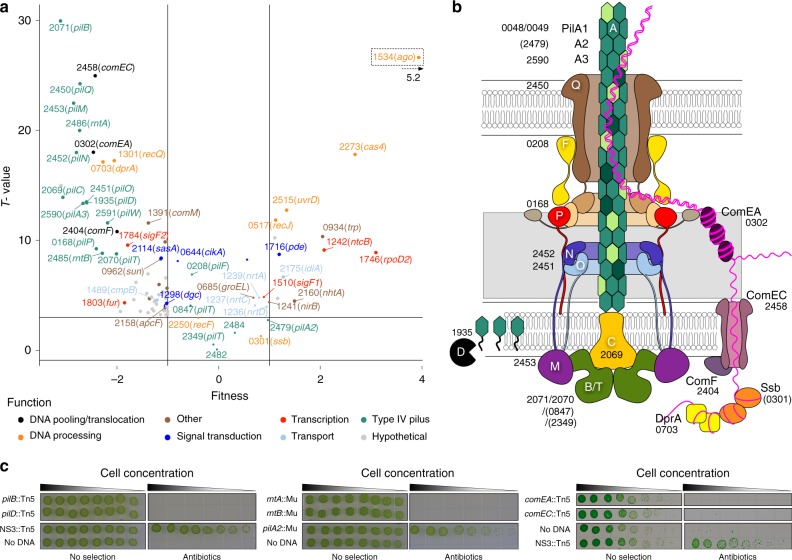
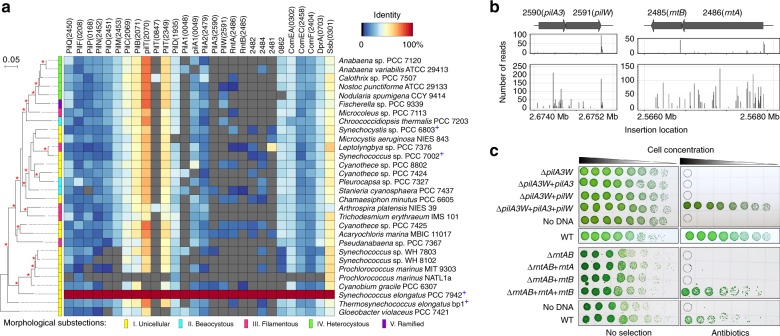
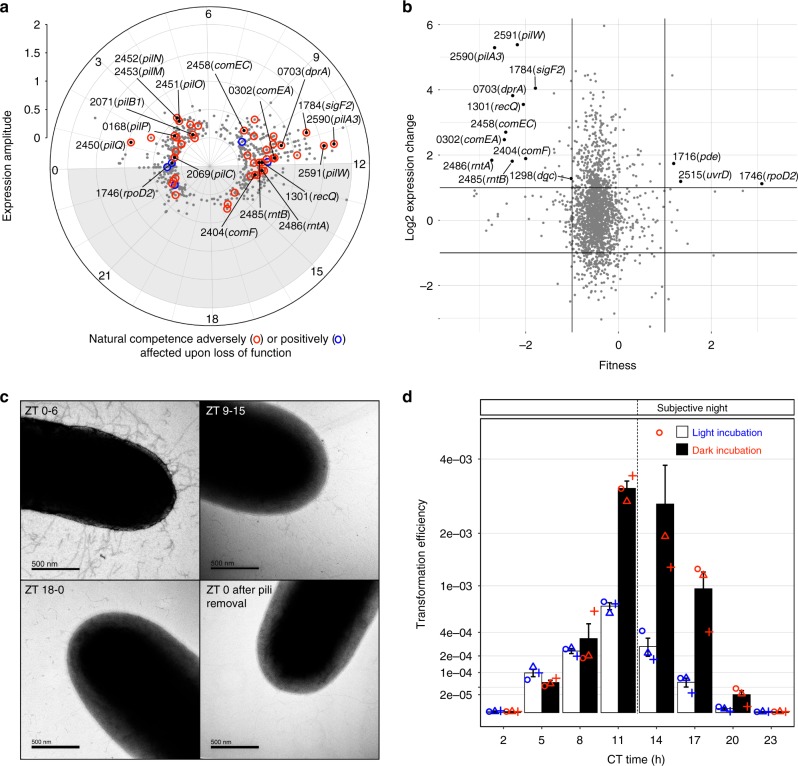
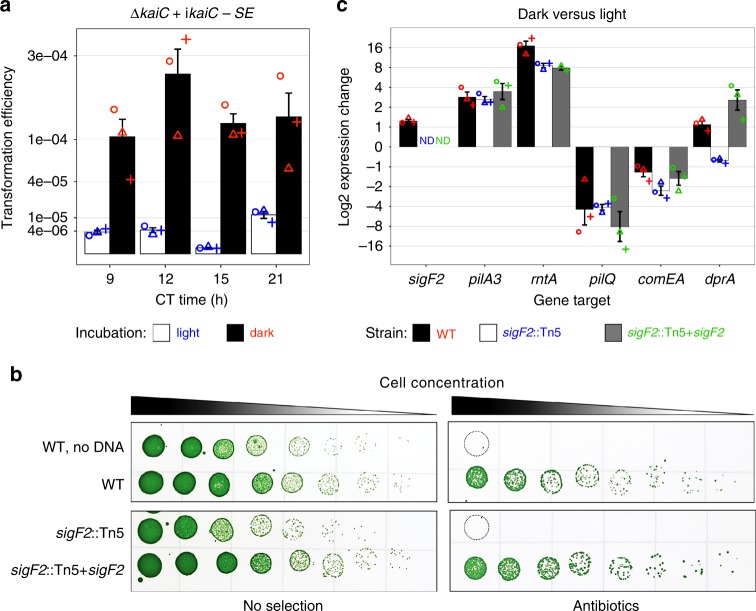
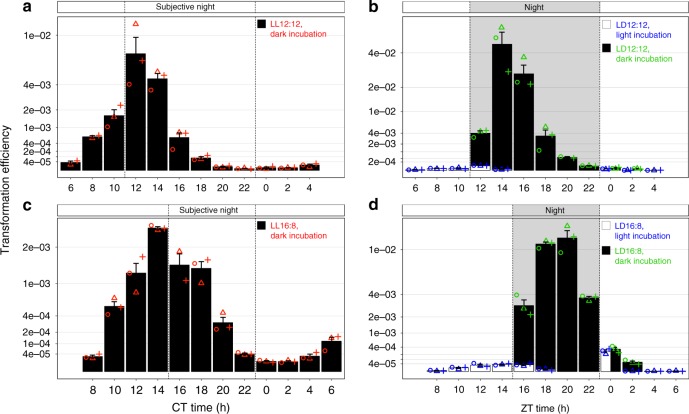
The cyanobacterium Synechococcus elongatus is a model organism for the study of circadian rhythms. It is naturally competent for transformation-that is, it takes up DNA from the environment, but the underlying mechanisms are unclear. Here, we use a genome-wide screen to identify genes required for natural transformation in S. elongatus, including genes encoding a conserved Type IV pilus, genes known to be associated with competence in other bacteria, and others. Pilus biogenesis occurs daily in the morning, while natural transformation is maximal when the onset of darkness coincides with the dusk circadian peak. Thus, the competence state in cyanobacteria is regulated by the circadian clock and can adapt to seasonal changes of day length.
Overview
The claims and statistics of this paper haven’t been checked yet.
Run the check — free, no account needed. It reads the open-access text and checks the sources it cites.
Integrity signals
Registry
Cites
Statistics
Figures
Verification
Claims the paper makes
The claims and statistics of this paper haven’t been checked yet.
Run the check — free, no account needed. It reads the open-access text and checks the sources it cites.
Claims other papers make about this one
Each is checked against this paper’s own text: does it say what the citing paper says it does?
The source backs part of the claim, not all of it — or backs it for a different population, condition or comparison.
In the citing paper
“Like Synechocystis sp. PCC 6803, Synechococcus elongatus PCC 7942 is naturally competent and can undergo natural transformation, whereby extracellular DNA is taken up directly from the surrounding medium. In this strain, DNA can be introduced as replicative plasmids, integrative plasmids, or linear PCR fragments; when the introduced DNA contains regions homologous to the chromosome, it can”
From Cyanobacteria as a Photosynthetic Chassis for Metabolic Pathway Engineering with Heterologous Gene Expression (2026) · cites this paper as [61]
Experimental — accuracy not yet measuredThe check wasn’t confident either way, so it gives no verdict — never disputed.
In the citing paper
“Conjugation from E. coli provides an additional route for delivering transferable or broad-host-range plasmids, while electroporation has been reported for cyanobacteria but is less routinely used for S. elongatus PCC 7942 [61].”
From Cyanobacteria as a Photosynthetic Chassis for Metabolic Pathway Engineering with Heterologous Gene Expression (2026) · cites this paper as [61]
Experimental — accuracy not yet measured
Self-check
Percentages, sums and reported differences re-computed from the paper’s own numbers.
The self-check needs the paper’s full text.
Citations
Cites
Analysis of Relative Gene Expression Data Using Real-Time Quantitative PCR and the 2−ΔΔCT Method
Livak, K. J., & Schmittgen, T. D. (2001) · Methods · doi:10.1006/meth.2001.1262 · Cited by 180,860
Controlling the False Discovery Rate: A Practical and Powerful Approach to Multiple Testing
Benjamini, Y., & Hochberg, Y. (1995) · Journal of the Royal Statistical Society Series B: Statistical Methodology · doi:10.1111/j.2517-6161.1995.tb02031.x · Cited by 109,482
MUSCLE: multiple sequence alignment with high accuracy and high throughput
Edgar, R. C. (2004) · Nucleic Acids Research · doi:10.1093/nar/gkh340 · Cited by 44,662
MEGA7: Molecular Evolutionary Genetics Analysis Version 7.0 for Bigger Datasets
Kumar, S., Stecher, G., & Tamura, K. (2016) · Molecular Biology and Evolution · doi:10.1093/molbev/msw054 · Cited by 44,609
Kimura, M. (1980) · Journal of Molecular Evolution · doi:10.1007/bf01731581 · Cited by 29,778
Generic Assignments, Strain Histories and Properties of Pure Cultures of Cyanobacteria
Rippka, R., Stanier, R. Y., Deruelles, J., Herdman, M., & Waterbury, J. B. (1979) · Microbiology · doi:10.1099/00221287-111-1-1 · Cited by 7,606
Talavera, G., & Castresana, J. (2007) · Systematic Biology · doi:10.1080/10635150701472164 · Cited by 5,725
Huisman, J., Codd, G. A., Paerl, H. W., Ibelings, B. W., Verspagen, J. M. H., & Visser, P. (2018) · Nature Reviews Microbiology · doi:10.1038/s41579-018-0040-1 · Cited by 2,935
Flombaum, P., Gallegos, J. L., Gordillo, R. A., Rincón, J., Zabala, L. L., Jiao, N., Karl, D. M., Li, W. K. W., Lomas, M. W., Veneziano, D., et al. (2013) · Proceedings of the National Academy of Sciences · doi:10.1073/pnas.1307701110 · Cited by 1,487
The Significance of Pneumococcal Types
Griffith, F. (1928) · Journal of Hygiene · doi:10.1017/s0022172400031879 · Cited by 1,346
Cited by
Sorted by citations
Items 101–110 of 110
Mondal, S., Alford, J. T., Kutzner, C., Forchhammer, K., & Doello, S. (2026) · Frontiers in Plant Science · doi:10.3389/fpls.2026.1812316
Liu, X., Zhang, W., Wang, L., Li, R., Zhao, C., & Lü, X. (2026) · Life · doi:10.3390/life16060885
Sun, T., Li, Z., Zhu, X., Wu, Z., & Tong, Y. (2026) · Environmental Research · doi:10.1016/j.envres.2026.124906
Llop, A., Bibak, S., Cantos, R., Salinas, P., Tremiño, L., & Contreras, A. (2026) · Frontiers in Microbiology · doi:10.3389/fmicb.2026.1860886
Rodríguez-Cruz, U. E., Moreno‐Hagelsieb, G., Abreu-Goodger, C., Martinez-Guerrero, C., & Delaye, L. (2026) · Genome Biology and Evolution · doi:10.64898/2026.06.24.733823
Cyanobacterial Circadian Clock: Molecular Mechanisms and Physiological Outputs
Hu, X., Ning, X., Zhang, J., & Zhu, D. (2026) · Plants · doi:10.3390/plants15152293
Environmental risk assessment for genetically modified microalgae
Gallego, I., Friedrich, A., Robbens, J., & Romeis, J. (2026) · Ecotoxicology and Environmental Safety · doi:10.1016/j.ecoenv.2026.120559
Johnson, Z., Sadler, N., Garcia, M., Gilliam, A., Hill, E. A., Li, X., Trejo, J. B., Qian, W., Cheung, M. S., & Bohutskyi, P. (2026) · iScience · doi:10.1016/j.isci.2026.117861
Distinct core minor pilin complexes prime specialized type IV filaments in cyanobacteria
Schuergers, N., Wittig, L., Enomoto, G., Herz, J., Sivabalasarma, S., Ruoff, K., Drepper, F., Albers, S., Huesgen, P. F., & Wilde, A. (2026) · PLoS Genetics · doi:10.1371/journal.pgen.1012337
Metadata
- Authors
- Taton, A., Erikson, C., Yang, Y., Rubin, B. E., Rifkin, S. A., Golden, J. W., & Golden, S. S.
- Affiliations
- University of California San Diego (US)
- Chinese Academy of Sciences (CN)
- Corresponding author
- Golden, Susan S.
- ORCID
- Venue
- Nature Communications
- Published
- 2020-04-03
- Volume
- 11
- Issue
- 1
- Pages
- 1688-1688
- ISSN
- 2041-1723 (ISSN-L)
- PMC
- PMC7125226
- OpenAlex
- W3014286189
- Cited by
- 110
- References
- 72
- Citations by year
- 2026: 18 · 2025: 17 · 2024: 13 · 2023: 16 · 2022: 21 · 2021: 14 · 2020: 11
- FWCI
- 7.96
- Type
- journal article
- Language
- en
- Open access
- gold
- doi.org
- Locations
- Nature Communications (publishedVersion, cc-by)
- bioRxiv (Cold Spring Harbor Laboratory) (acceptedVersion, cc-by-nc-nd)
- Europe PMC (PubMed Central) (publishedVersion, cc-by)
- PubMed Central (publishedVersion, cc-by)
- PubMed (publishedVersion)
- RePEc: Research Papers in Economics (submittedVersion)
- DOAJ (DOAJ: Directory of Open Access Journals) (submittedVersion, cc-by-sa)
- eScholarship (California Digital Library) (submittedVersion)
- Institute of Hydrobiology, CAS Institutional Repository (submittedVersion)
- Funders
- NSF | BIO | Division of Integrative Organismal Systems (IOS-1754894)
- U.S. Department of Health & Human Services | NIH | National Institute of General Medical Sciences (R01GM118815, R35GM118290)
- Topics
- Life Sciences › Neuroscience › Endocrine and Autonomic Systems › Circadian rhythm and melatonin
- Life Sciences › Biochemistry, Genetics and Molecular Biology › Genetics › Bacterial Genetics and Biotechnology
- Life Sciences › Agricultural and Biological Sciences › Plant Science › Light effects on plants
- Keywords
- circadian clock, natural competence, natural transformation, Anacystis nidulans, cyanobacteria, type IV pili, pilus biogenesis, darkness, dusk, day length, genome-wide screen, competence regulation
- MeSH terms
- Adaptation, Physiological, Bacterial Proteins, Darkness, DNA Transposable Elements, Models, Biological, Mutation, Fimbriae, Bacterial, Seasons, Transcription Factors, Transformation, Bacterial, Gene Expression Regulation, Bacterial, Gene Transfer, Horizontal, Synechococcus, Circadian Rhythm Signaling Peptides and Proteins, Circadian Clocks
About these checks
Registry, retraction, Cites and statistics results are computed, not judged, with one exception: a printed reference that no index lists is read once by a model before it counts as a citation error. Claims are extracted by a model and kept only when their quote appears verbatim in the text; each cited source is then checked, with a model’s help, for whether it says what the claim relies on. Those verdicts can be wrong — read the claim’s quote and the cited source before relying on one.
Statistics and arithmetic are recomputed, not judged.
Confidence bands are shown only for fields calibrated on our annotated test set. None is calibrated yet, so no band is shown.
What counts as a claim ›How we measure confidence ›How we check this ›
Are you an author, or do you see a problem with this page? Request a review
