

The DOI matches its Crossref record; 73 of the 73 references it cites were found in a registry or an index.
The circadian clock and darkness control natural competence in cyanobacteria
Open accessPublished version of a preprint
Abstract
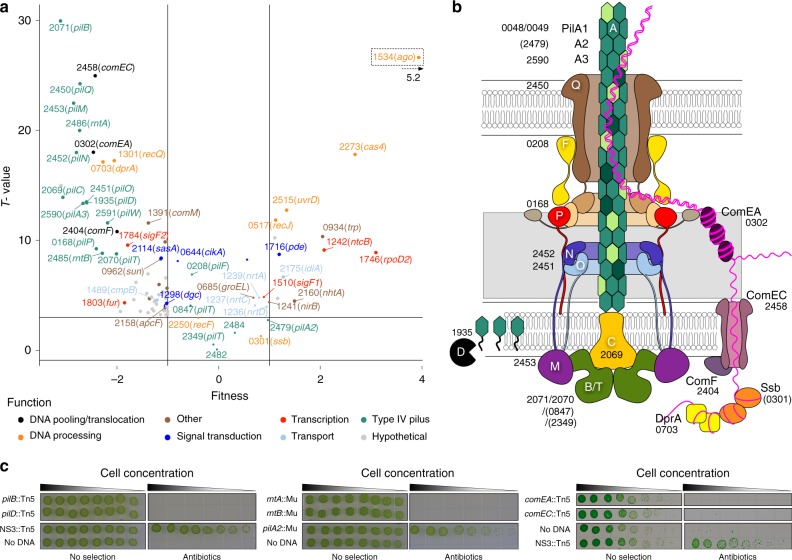
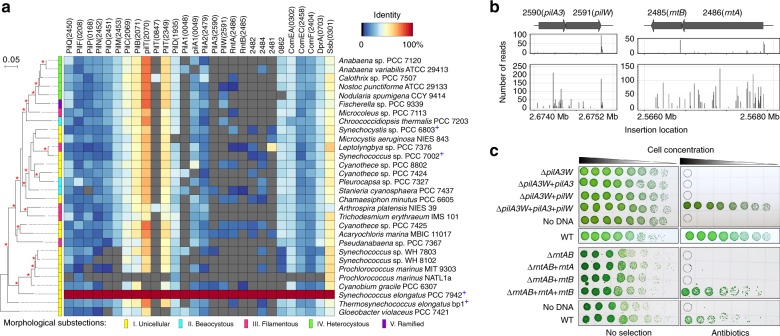
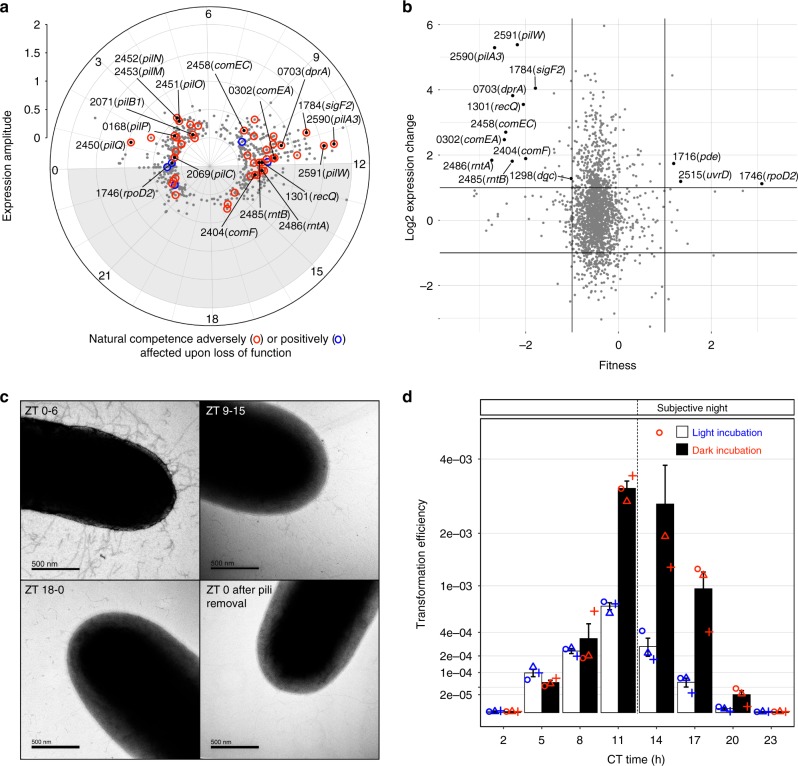
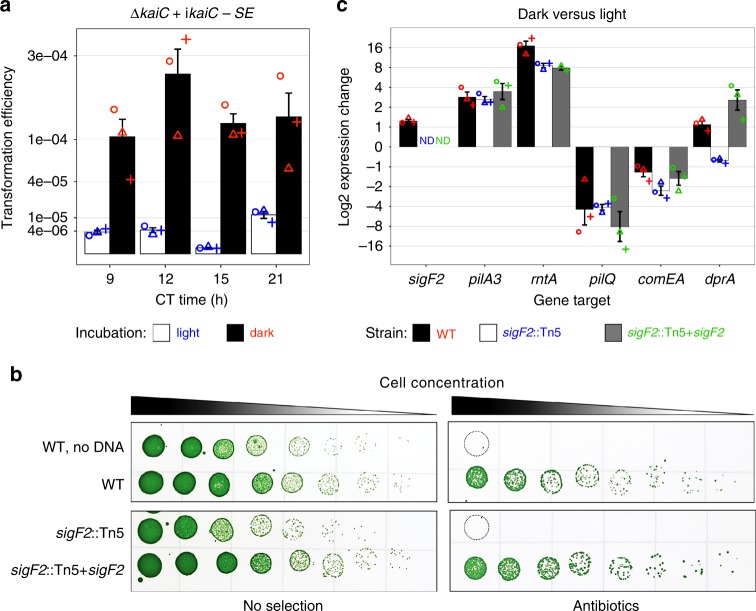
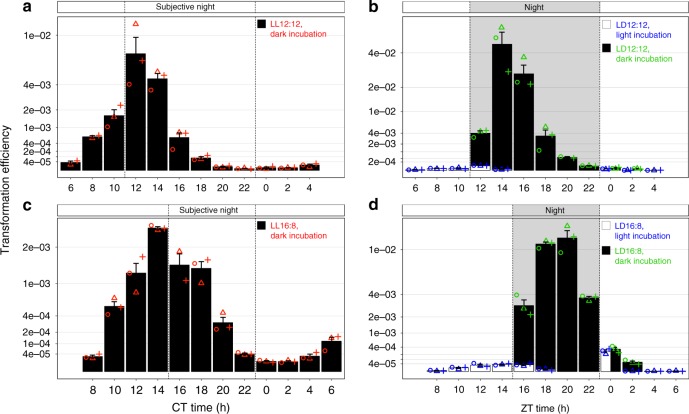
The cyanobacterium Synechococcus elongatus is a model organism for the study of circadian rhythms. It is naturally competent for transformation-that is, it takes up DNA from the environment, but the underlying mechanisms are unclear. Here, we use a genome-wide screen to identify genes required for natural transformation in S. elongatus, including genes encoding a conserved Type IV pilus, genes known to be associated with competence in other bacteria, and others. Pilus biogenesis occurs daily in the morning, while natural transformation is maximal when the onset of darkness coincides with the dusk circadian peak. Thus, the competence state in cyanobacteria is regulated by the circadian clock and can adapt to seasonal changes of day length.
Overview
The claims and statistics of this paper haven’t been checked yet.
Run the check — free, no account needed. It reads the open-access text and checks the sources it cites.
Integrity signals
Registry
Cites
Statistics
Figures
Verification
Claims the paper makes
The claims and statistics of this paper haven’t been checked yet.
Run the check — free, no account needed. It reads the open-access text and checks the sources it cites.
Claims other papers make about this one
Each is checked against this paper’s own text: does it say what the citing paper says it does?
The source backs part of the claim, not all of it — or backs it for a different population, condition or comparison.
In the citing paper
“Like Synechocystis sp. PCC 6803, Synechococcus elongatus PCC 7942 is naturally competent and can undergo natural transformation, whereby extracellular DNA is taken up directly from the surrounding medium. In this strain, DNA can be introduced as replicative plasmids, integrative plasmids, or linear PCR fragments; when the introduced DNA contains regions homologous to the chromosome, it can”
From Cyanobacteria as a Photosynthetic Chassis for Metabolic Pathway Engineering with Heterologous Gene Expression (2026) · cites this paper as [61]
Experimental — accuracy not yet measuredThe check wasn’t confident either way, so it gives no verdict — never disputed.
In the citing paper
“Conjugation from E. coli provides an additional route for delivering transferable or broad-host-range plasmids, while electroporation has been reported for cyanobacteria but is less routinely used for S. elongatus PCC 7942 [61].”
From Cyanobacteria as a Photosynthetic Chassis for Metabolic Pathway Engineering with Heterologous Gene Expression (2026) · cites this paper as [61]
Experimental — accuracy not yet measured
Self-check
Percentages, sums and reported differences re-computed from the paper’s own numbers.
The self-check needs the paper’s full text.
Citations
Cites
Analysis of Relative Gene Expression Data Using Real-Time Quantitative PCR and the 2−ΔΔCT Method
Livak, K. J., & Schmittgen, T. D. (2001) · Methods · doi:10.1006/meth.2001.1262 · Cited by 180,860
Controlling the False Discovery Rate: A Practical and Powerful Approach to Multiple Testing
Benjamini, Y., & Hochberg, Y. (1995) · Journal of the Royal Statistical Society Series B: Statistical Methodology · doi:10.1111/j.2517-6161.1995.tb02031.x · Cited by 109,482
MUSCLE: multiple sequence alignment with high accuracy and high throughput
Edgar, R. C. (2004) · Nucleic Acids Research · doi:10.1093/nar/gkh340 · Cited by 44,662
MEGA7: Molecular Evolutionary Genetics Analysis Version 7.0 for Bigger Datasets
Kumar, S., Stecher, G., & Tamura, K. (2016) · Molecular Biology and Evolution · doi:10.1093/molbev/msw054 · Cited by 44,609
Kimura, M. (1980) · Journal of Molecular Evolution · doi:10.1007/bf01731581 · Cited by 29,778
Generic Assignments, Strain Histories and Properties of Pure Cultures of Cyanobacteria
Rippka, R., Stanier, R. Y., Deruelles, J., Herdman, M., & Waterbury, J. B. (1979) · Microbiology · doi:10.1099/00221287-111-1-1 · Cited by 7,606
Talavera, G., & Castresana, J. (2007) · Systematic Biology · doi:10.1080/10635150701472164 · Cited by 5,725
Huisman, J., Codd, G. A., Paerl, H. W., Ibelings, B. W., Verspagen, J. M. H., & Visser, P. (2018) · Nature Reviews Microbiology · doi:10.1038/s41579-018-0040-1 · Cited by 2,935
Flombaum, P., Gallegos, J. L., Gordillo, R. A., Rincón, J., Zabala, L. L., Jiao, N., Karl, D. M., Li, W. K. W., Lomas, M. W., Veneziano, D., et al. (2013) · Proceedings of the National Academy of Sciences · doi:10.1073/pnas.1307701110 · Cited by 1,487
The Significance of Pneumococcal Types
Griffith, F. (1928) · Journal of Hygiene · doi:10.1017/s0022172400031879 · Cited by 1,346
Cited by
Sorted by citations
Development of spirulina for the manufacture and oral delivery of protein therapeutics
Jester, B. W., Zhao, H., Gewe, M., Adame, T., Perruzza, L., Bolick, D. T., Agosti, J., Khuong, N., Kuestner, R., Gamble, C., et al. (2022) · Nature Biotechnology · doi:10.1038/s41587-022-01249-7 · Cited by 130
Genetic, Genomics, and Responses to Stresses in Cyanobacteria: Biotechnological Implications
Cassier‐Chauvat, C., Blanc-Garin, V., & Chauvat, F. (2021) · Genes · doi:10.3390/genes12040500 · Cited by 50
Liu, H., Al-Dhabi, N. A., Jiang, H., Liu, B., Qing, T., Feng, B., Ma, T., Tang, W., & Zhang, P. (2024) · Water Research · doi:10.1016/j.watres.2024.121624 · Cited by 47
Time of day as a critical variable in biology
Nelson, R. J., Bumgarner, J. R., Liu, J. A., Love, J. A., Meléndez‐Fernández, O. H., Becker‐Krail, D. D., Walker, W. H., Walton, J. C., DeVries, A. C., & Prendergast, B. J. (2022) · BMC Biology · doi:10.1186/s12915-022-01333-z · Cited by 45
Heterologous Expression of Cryptomaldamide in a Cyanobacterial Host
Taton, A., Ecker, A. K., Diaz, B., Moss, N. A., Anderson, B., Reher, R., Leão, T., Simkovsky, R., Dorrestein, P. C., Gerwick, L. G., et al. (2020) · ACS Synthetic Biology · doi:10.1021/acssynbio.0c00431 · Cited by 42
Self-citationEllison, C. K., Dalia, T. N., Klancher, C. A., Shaevitz, J. W., Gitai, Z., & Dalia, A. B. (2021) · Nature Communications · doi:10.1038/s41467-021-24124-6 · Cited by 38
Microbial circadian clocks: host-microbe interplay in diel cycles
Wollmuth, E. M., & Angert, E. R. (2023) · BMC Microbiology · doi:10.1186/s12866-023-02839-4 · Cited by 40
Natural transformation of the filamentous cyanobacterium Phormidium lacuna
Nies, F., Mielke, M., Pochert, J., & Lamparter, T. (2020) · PLoS ONE · doi:10.1371/journal.pone.0234440 · Cited by 38
Pili allow dominant marine cyanobacteria to avoid sinking and evade predation
Aguiló‐Ferretjans, M. D. M., Bosch, R., Puxty, R. J., Latva, M., Zadjelovic, V., Chhun, A., Sousoni, D., Polin, M., Scanlan, D. J., & Christie‐Oleza, J. A. (2021) · Nature Communications · doi:10.1038/s41467-021-22152-w · Cited by 37
Bacteria can anticipate the seasons: Photoperiodism in cyanobacteria
Jabbur, M. L., Bratton, B. P., & Johnson, C. H. (2024) · Science · doi:10.1126/science.ado8588 · Cited by 36
Comparative Genomics of Synechococcus elongatus Explains the Phenotypic Diversity of the Strains
Adomako, M., Ernst, D. C., Simkovsky, R., Chao, Y.-Y., Wang, J., Fang, M., Bouchier, C., López‐Igual, R., Mazel, D., Gugger, M. F., et al. (2022) · mBio · doi:10.1128/mbio.00862-22 · Cited by 30
Self-citationBase editing for reprogramming cyanobacterium Synechococcus elongatus
Wang, S.-Y., Li, X., Wang, S.-G., & Xia, P.-F. (2023) · Metabolic Engineering · doi:10.1016/j.ymben.2022.11.005 · Cited by 31
A Cyanobacterial Component Required for Pilus Biogenesis Affects the Exoproteome
Yegorov, Y., Sendersky, E., Zilberman, S., Nagar, E., Ben‐Asher, H. W., Shimoni, E., Simkovsky, R., Golden, S. S., LiWang, A., & Schwarz, R. (2021) · mBio · doi:10.1128/mbio.03674-20 · Cited by 29
Self-citationLet's talk about sex: Why reproductive systems matter for understanding algae
Krueger‐Hadfield, S. A. (2024) · Journal of Phycology · doi:10.1111/jpy.13462 · Cited by 29
Conradi, F. D., Mullineaux, C. W., & Wilde, A. (2020) · Life · doi:10.3390/life10110252 · Cited by 29
Function and benefits of natural competence in cyanobacteria: from ecology to targeted manipulation
Schirmacher, A. M., Hanamghar, S. S., & Zedler, J. A. Z. (2020) · Life · doi:10.3390/life10110249 · Cited by 28
Synchronization of the circadian clock to the environment tracked in real time
Fang, M., Chavan, A. G., LiWang, A., & Golden, S. S. (2023) · Proceedings of the National Academy of Sciences · doi:10.1073/pnas.2221453120 · Cited by 28
Self-citationEco-evolutionary feedbacks mediated by bacterial membrane vesicles
Zlatkov, N., Nadeem, A., Uhlin, B. E., & Wai, S. N. (2020) · FEMS Microbiology Reviews · doi:10.1093/femsre/fuaa047 · Cited by 28
Sigma Factor Modulation for Cyanobacterial Metabolic Engineering
Srivastava, A., Varshney, R. K., & Shukla, P. (2020) · Trends in Microbiology · doi:10.1016/j.tim.2020.10.012 · Cited by 25
Orthogonal Degron System for Controlled Protein Degradation in Cyanobacteria
Sakkos, J. K., Hernandez-Ortiz, S., Osteryoung, K. W., & Ducat, D. C. (2021) · ACS Synthetic Biology · doi:10.1021/acssynbio.1c00035 · Cited by 21
Oeser, S., Wallner, T., Schuergers, N., Bučinská, L., Sivabalasarma, S., Bähre, H., Albers, S., & Wilde, A. (2021) · Molecular Microbiology · doi:10.1111/mmi.14768 · Cited by 20
Wendt, K. E., Walker, P. L., Sengupta, A., Ungerer, J., & Pakrasi, H. B. (2021) · Applied and Environmental Microbiology · doi:10.1128/aem.01882-21 · Cited by 22
Chen, M., Dhakal, D., Eckhardt, C. W., Luesch, H., & Ding, Y. (2025) · Natural Product Reports · doi:10.1039/d5np00009b · Cited by 21
Bartholomai, B. M., Gladfelter, A. S., Loros, J., & Dunlap, J. (2022) · Proceedings of the National Academy of Sciences · doi:10.1073/pnas.2203078119 · Cited by 21
Lamparter, T., Babian, J., Fröhlich, K., Mielke, M., Weber, N. F., Wunsch, N., Zais, F., Schulz, K., Aschmann, V., Spohrer, N., et al. (2022) · PLoS ONE · doi:10.1371/journal.pone.0249509 · Cited by 21
Microbial Sources of Exocellular DNA in the Ocean
Linney, M. D., Eppley, J. M., Romano, A. E., Luo, E., DeLong, E. F., & Karl, D. M. (2022) · Applied and Environmental Microbiology · doi:10.1128/aem.02093-21 · Cited by 19
Simkovsky, R., Parnasa, R., Wang, J., Nagar, E., Zecharia, E., Suban, S., Yegorov, Y., Veltman, B., Sendersky, E., Schwarz, R., et al. (2022) · Frontiers in Microbiology · doi:10.3389/fmicb.2022.899150 · Cited by 18
Self-citationRusso, D. A., Zedler, J. A. Z., Conradi, F. D., Schuergers, N., Jensen, P. E., Mullineaux, C. W., Wilde, A., & Pohnert, G. (2021) · Journal of Bacteriology · doi:10.1128/jb.00504-21 · Cited by 17
Frequency of mispackaging of Prochlorococcus DNA by cyanophage
Laurenceau, R., Raho, N., Forget, M., Arellano, A. A., & Chisholm, S. W. (2020) · The ISME Journal · doi:10.1038/s41396-020-00766-0 · Cited by 17
Olina, A., Agapov, A., Yudin, D., Sutormin, D. A., Galivondzhyan, A., Kuzmenko, A., Severinov, K., Aravin, A. A., & Kulbachinskiy, A. V. (2023) · Microbiology Spectrum · doi:10.1128/spectrum.04146-22 · Cited by 17
Liu, T.-S., Wu, K., Jiang, H.-W., Chen, K.-W., Nien, T.-S., Bryant, D. A., & Ho, M. (2023) · ACS Synthetic Biology · doi:10.1021/acssynbio.3c00066 · Cited by 14
Synthetic Biology in Cyanobacteria and Applications for Biotechnology
Hudson, E. P. (2021) · Wiley eBooks · doi:10.1002/9783527824908.ch5 · Cited by 18
The Circadian Clock—A Molecular Tool for Survival in Cyanobacteria
Kim, P., Kaur, M., Jang, H.-I., & Kim, Y.-I. (2020) · Life · doi:10.3390/life10120365 · Cited by 14
Beyond movement: the dynamic roles of Type IV pili in cyanobacterial life
Hammerl, J., Schuergers, N., Enomoto, G., Mullineaux, C. W., & Wilde, A. (2025) · Journal of Bacteriology · doi:10.1128/jb.00086-25 · Cited by 13
Suban, S., Sendersky, E., Golden, S. S., & Schwarz, R. (2022) · Environmental Microbiology Reports · doi:10.1111/1758-2229.13050 · Cited by 13
Self-citationSynechocystis: A model system for expanding the study of cyanobacterial circadian rhythms
Zhao, C., Xu, Y. Q., Wang, B., & Johnson, C. H. (2023) · Frontiers in Physiology · doi:10.3389/fphys.2022.1085959 · Cited by 13
Yuan, Y., Bulushi, T. A., Sastry, A. V., Sancar, C., Szubin, R., Golden, S. S., & Palsson, B. Ø. (2024) · Proceedings of the National Academy of Sciences · doi:10.1073/pnas.2410492121 · Cited by 13
Self-citationMadhu, S., Sengupta, A., Sarnaik, A. P., Sahasrabuddhe, D., & Wangikar, P. P. (2023) · ACS Synthetic Biology · doi:10.1021/acssynbio.3c00019 · Cited by 12
Nies, F., Springstein, B. L., Hanke, D. M., & Dagan, T. (2022) · mSphere · doi:10.1128/msphere.00997-21 · Cited by 12
Zedler, J. A. Z., Michel, M., Pohnert, G., & Russo, D. A. (2023) · Environmental Microbiology · doi:10.1111/1462-2920.16426 · Cited by 11
Zhang, J., Li, S., Sun, T., Zong, Y., Luo, Y., Wei, Y., Zhang, W., & Zhao, K. (2024) · Science Advances · doi:10.1126/sciadv.add9485 · Cited by 10
Influence of phytoplankton, bacteria and viruses on nutrient supply in tropical waters
Sim, Z. Y., Goh, K. C., Sukarji, N. H. B., Mao, F., He, Y., & Gin, K. Y. (2024) · Journal of Environmental Sciences · doi:10.1016/j.jes.2024.02.032 · Cited by 10
Effects of RuBisCO and CO 2 concentration on cyanobacterial growth and carbon isotope fractionation
Garcia, A. K., Kędzior, M., Taton, A., Li, M., Young, J. N., & Kaçar, B. (2023) · Geobiology · doi:10.1111/gbi.12543 · Cited by 11
Self-citationTaton, A., Gilderman, T. S., Ernst, D. C., Omaga, C. A., Cohen, L. A., Rey-Bedón, C., Golden, J. W., & Golden, S. S. (2023) · mBio · doi:10.1128/mbio.01843-23 · Cited by 10
Self-citationPhilmus, B. J., Avalon, N. E., Ding, Y., Doering, D. T., Eustáquio, A. S., Gerwick, W. H., Luesch, H., Orjala, J., Sutherland, S., Taton, A., et al. (2025) · Natural Product Reports · doi:10.1039/d5np00016e · Cited by 9
Self-citationRoles for the Synechococcus elongatus RNA-Binding Protein Rbp2 in Regulating the Circadian Clock
McKnight, B. M., Kang, S., Le, T. H., Fang, M., Carbonel, G., Rodriguez, E., Govindarajan, S., Albocher, N., Tran, A. L., Duncan, N. R., et al. (2023) · Journal of Biological Rhythms · doi:10.1177/07487304231188761 · Cited by 9
Self-citationZhang, N., Chang, Y., Tseng, R., Ovchinnikov, S., Schwarz, R., & LiWang, A. (2020) · Protein Science · doi:10.1002/pro.3952 · Cited by 9
Expression and manufacturing of protein therapeutics in spirulinaPreprint
Jester, B. W., Zhao, H., Gewe, M. M., Adame, T., Perruzza, L., Bolick, D. T., Agosti, J. M., Khuong, N., Kuestner, R. E., Gamble, C., et al. (2021) · bioRxiv (Cold Spring Harbor Laboratory) · doi:10.1101/2021.01.25.427910 · Cited by 9
Arbel‐Goren, R., Dassa, B., Zhitnitsky, A., Valladares, A., Antonia Herrero, B., Flores, E., & Stavans, J. (2023) · mSystems · doi:10.1128/msystems.00700-23 · Cited by 8
Santos‐Merino, M., Nikkanen, L., Kokarakis, E. J., Allahverdiyeva, Y., & Ducat, D. C. (2025) · The Plant Journal · doi:10.1111/tpj.70480 · Cited by 8
The Molecular Toolset and Techniques Required to Build Cyanobacterial Cell Factories
Opel, F., Axmann, I. M., & Klähn, S. (2022) · Advances in Biochemical Engineering/Biotechnology · doi:10.1007/10_2022_210 · Cited by 7
The second messenger c-di-AMP controls natural competence via ComFB signaling protein
Samir, S., Doello, S., Enkerlin, A. M., Zimmer, E., Haffner, M. C., Muller, T. A., Dengler, L., Lambidis, S. P., Sivabalasarma, S., Albers, S., et al. (2025) · Cell Discovery · doi:10.1038/s41421-025-00816-x · Cited by 7
Lee, J., Yang, J. H., Weber, A. P. M., Bhattacharya, D., Kim, W., & Yoon, H. S. (2024) · Molecular Biology and Evolution · doi:10.1093/molbev/msae012 · Cited by 7
Reprogramming Metabolic Networks and Manipulating Circadian Clocks for Biotechnological Applications
Wang, B., Young, J. D., & Xu, Y. Q. (2021) · Springer eBooks · doi:10.1007/978-3-030-72158-9_14 · Cited by 7
Jerez, C., Llop, A., Salinas, P., Bibak, S., Forchhammer, K., & Contreras, A. (2024) · International Journal of Molecular Sciences · doi:10.3390/ijms25094702 · Cited by 6
Metagenomic study to evaluate functional capacity of a cyanobacterial bloom during oxidation
Moradinejad, S., Trigui, H., Maldonado, J. F. G., Shapiro, B. J., Terrat, Y., Sauvé, S., Fortin, N. Y., Zamyadi, A., Dorner, S. M., & Prévost, M. (2021) · Chemical Engineering Journal Advances · doi:10.1016/j.ceja.2021.100151 · Cited by 7
Suban, S., Yemini, S., Shor, A., Ben‐Asher, H. W., Yaron, O., Karako‐Lampert, S., Sendersky, E., Golden, S. S., & Schwarz, R. (2024) · Biofilm · doi:10.1016/j.bioflm.2024.100217 · Cited by 6
Self-citationChen, S., Liu, C., Zhou, C., Zhihui, W., Li, Y., Xiong, L., Yan, L., Lv, J., Shen, L., & Xu, L. (2022) · Nucleic Acids Research · doi:10.1093/nar/gkac416 · Cited by 6
Mutations in the circadian cycle drive adaptive plasticity in cyanobacteria
Mendaña, A., Santos‐Merino, M., Gutiérrez-Lanza, R., Domínguez-Quintero, M., Medina, J. M., González-Guerra, A., Campa, V. M., Baez, M., Ducos‐Galand, M., López‐Igual, R., et al. (2025) · Proceedings of the National Academy of Sciences · doi:10.1073/pnas.2506928122 · Cited by 5
Core clock protein subcellular dynamics coordinate local and global circadian control in syncytia
Wang, Z., Bartholomai, B. M., Wang, B., Ritz, D., Schultz, D., Loros, J., & Dunlap, J. (2026) · The Journal of Cell Biology · doi:10.1083/jcb.202509044 · Cited by 5
Quantification of RuBisCO Expression and Photosynthetic Oxygen Evolution in Cyanobacteria
Kędzior, M., & Kaçar, B. (2021) · BIO-PROTOCOL · doi:10.21769/bioprotoc.4199 · Cited by 5
Daffert, C., Zerobin, A., Hummel, F., Slaninová, E., Kroupová, Z., Obruča, S., Mrázová, K., Hrubanová, K., Krzyžánek, V., Nebesářová, J., et al. (2024) · Life · doi:10.3390/life14070907 · Cited by 4
Winayu, B. N. R., Lin, Y.-T., Hsueh, H.-T., & Chu, H. (2023) · Biocatalysis and Agricultural Biotechnology · doi:10.1016/j.bcab.2023.103003 · Cited by 4
Two D-loop resolution systems enable natural genetic transformation in bacteria
Hardy, L., Morales, V., Rousseau, C. J., Bergé, M. A., Mazzamurro, F., Plantade, J., Dalia, T. N., Dalia, A. B., Rocha, E. P. C., Charpentier, X., et al. (2026) · Proceedings of the National Academy of Sciences · doi:10.1073/pnas.2610795123 · Cited by 3
Bishé, B., Golden, S. S., & Golden, J. W. (2022) · Life Sciences in Space Research · doi:10.1016/j.lssr.2022.11.001 · Cited by 4
Self-citationMurakami, H., Sano, K., Motomura, K., Kuroda, A., & Hirota, R. (2023) · Journal of Bioscience and Bioengineering · doi:10.1016/j.jbiosc.2022.12.002 · Cited by 4
Ahern, J., Chrobok, Ł., CHAMPNEYS, A. R., & Piggins, H. D. (2023) · Scientific Reports · doi:10.1038/s41598-023-32315-y · Cited by 4
Protocols for in vitro reconstitution of the cyanobacterial circadian clock
Chavan, A. G., Heisler, J. C., Chang, Y., Golden, S. S., Partch, C. L., & LiWang, A. (2023) · Biopolymers · doi:10.1002/bip.23559 · Cited by 2
Self-citationReyes, M. L. E., Hernández-López, I., Azevedo, R. D. S., Figueiredo, B. X., Flores, I. D. S., Cardoso, A. C. S., da Silveira, T. L. R., Anni, I. S. A., Varela, A. S., Nornberg, B. F. D. S., et al. (2025) · Comparative Biochemistry and Physiology Part B Biochemistry and Molecular Biology · doi:10.1016/j.cbpb.2025.111111 · Cited by 4
Natural competence in Chlorogloeopsis fritschii PCC 6912 and other ramified cyanobacteriaPreprint
Springstein, B. L., Nies, F., & Dagan, T. (2020) · bioRxiv (Cold Spring Harbor Laboratory) · doi:10.1101/2020.06.19.162503 · Cited by 3
Diel expression dynamics in filamentous cyanobacteria
Kennedy, S. J., Risser, D. D., & Paul, B. G. (2025) · mBio · doi:10.1128/mbio.03779-24 · Cited by 2
Temperature changes are signaled in cyanobacteria through the PipX interaction network
Llop, A., Bibak, S., Mata‐Balaguer, T., Tremiño, L., Fuertes-García, L., Neira, J. L., Dixon, R. A., & Contreras, A. (2025) · Frontiers in Microbiology · doi:10.3389/fmicb.2025.1688974 · Cited by 2
Unlocking the potential of unique genes in cyanobacterial alkane synthesis
Parveen, H., Garg, V., Pachauri, P., Khan, M. A., & Yazdani, S. S. (2025) · Metabolic Engineering · doi:10.1016/j.ymben.2025.11.016 · Cited by 2
Xu, X., Cui, J., Xu, H., Sun, J., Yuan, X., Jia, Y., Luan, G., & Lü, X. (2025) · Algal Research · doi:10.1016/j.algal.2025.104473 · Cited by 2
Mechanism and reconstitution of circadian transcription in cyanobacteria
Fang, M., Gu, Y., Leanca, M. A., Matyszewski, M., LiWang, A., Yuzenkova, Y., Corbett, K. D., & Golden, S. S. (2026) · Nature Structural & Molecular Biology · doi:10.1038/s41594-025-01740-0 · Cited by 2
Self-citationChronicles of time: Unveiling circadian clocks in non-flowering plants
Khakurel, D., Nguyen, C. C., Uddin, S., Alimzhan, A., Madhuwanthi, I., Ahn, G., Cha, J., Kim, M. G., & Kim, W. (2025) · Plant Physiology and Biochemistry · doi:10.1016/j.plaphy.2025.110092 · Cited by 2
Circadian clock in cyanobacteria
Terauchi, K., & Onoue, Y. (2022) · Elsevier eBooks · doi:10.1016/b978-0-323-96106-6.00018-6 · Cited by 2
Modular cyanobacterial regulatory architecture enables dynamic graded responses to oxidative stressPreprint
Johnson, Z., Sadler, N., García-Jiménez, M. G., Gilliam, A., Hill, E. A., Qian, W., Cheung, M. S., & Bohutskyi, P. (2025) · bioRxiv (Cold Spring Harbor Laboratory) · doi:10.1101/2025.07.21.665879 · Cited by 2
Walshe, J., & Saha, S. K. (2026) · Current Issues in Molecular Biology · doi:10.3390/cimb48060638 · Cited by 1
“Conjugation from E. coli provides an additional route for delivering transferable or broad-host-range plasmids, while electroporation has been reported for cyanobacteria but is less routinely used for S. elongatus PCC 7942 [61].”
Weber, N. F., Hofmeister, M., Wunsch, N., Köhler, A., Kaster, A., Vollmers, J., Kachel, B., Mack, M., & Lamparter, T. (2022) · Journal of Visualized Experiments · doi:10.3791/63470 · Cited by 1
Exploring genetic tools for cyanobacteria and their application for biofuels production
Kufryk, G. I. (2022) · Elsevier eBooks · doi:10.1016/b978-0-323-91202-0.00005-1 · Cited by 1
Bevir, H., Hooper, C. C., Saikley, P., Chaljian, T., Lin, Y., & Cohen, S. (2025) · Microbiology Spectrum · doi:10.1128/spectrum.01845-25 · Cited by 1
Cyanobacterial Biofertilizer Production by Guanidine-Producing Enzymes
Lee, H., Sebesta, J., Schaedig, E., Wu, C., Pakrasi, H. B., & Yu, J. (2026) · ACS Synthetic Biology · doi:10.1021/acssynbio.5c00801 · Cited by 1
Exploring the metabolic versatility of cyanobacteria for an emerging carbon-neutral bioeconomy
Shinde, S., Jiang, Z., & Wang, X. (2022) · Elsevier eBooks · doi:10.1016/b978-0-323-96106-6.00002-2 · Cited by 1
Boodaghian, N., Park, H., & Cohen, S. (2024) · Journal of Biological Rhythms · doi:10.1177/07487304241228333 · Cited by 1
Type IV Pili in Thermophilic Bacteria: Mechanisms and Ecological Implications
Uemura, N. A., & Nakane, D. (2025) · Biomolecules · doi:10.3390/biom15040459 · Cited by 1
Minor pilin genes are involved in motility and natural competence in Synechocystis sp. PCC 6803Preprint
Oeser, S., Wallner, T., Bučinská, L., Bähre, H., Schürgers, N., & Wilde, A. (2020) · bioRxiv (Cold Spring Harbor Laboratory) · doi:10.1101/2020.12.15.422378
Olina, A., Agapov, A., Yudin, D., Kuzmenko, A., Aravin, A. A., & Kulbachinskiy, A. V. (2022) · bioRxiv (Cold Spring Harbor Laboratory) · doi:10.1101/2022.09.13.507849
Zedler, J. A. Z., Michel, M., Pohnert, G., & Russo, D. A. (2022) · bioRxiv (Cold Spring Harbor Laboratory) · doi:10.1101/2022.12.21.521370
Spatio-temporal coherence of circadian clocks and gating of differentiation in Anabaena filamentsPreprint
Arbel‐Goren, R., Dassa, B., Zhitnitsky, A., Valladares, A., Antonia Herrero, B., Flores, E., & Stavans, J. (2023) · bioRxiv (Cold Spring Harbor Laboratory) · doi:10.1101/2023.02.15.528611
Luo, Y., Imamitsu, H., Tsurumaki, T., & Tanaka, K. (2024) · The Journal of General and Applied Microbiology · doi:10.2323/jgam.2024.05.002
Santos‐Merino, M., Nikkanen, L., Kokarakis, E. J., Allahverdiyeva, Y., & Ducat, D. C. (2025) · bioRxiv (Cold Spring Harbor Laboratory) · doi:10.1101/2025.01.24.634715
Sun, T., Li, Z., Zhu, X., Wu, Z., & Tong, Y. (2025) · SSRN Electronic Journal · doi:10.2139/ssrn.5385541
Additional file 1 of Time of day as a critical variable in biology
Nelson, R. J., Bumgarner, J. R., Liu, J. A., Love, J. A., Meléndez‐Fernández, O. H., Becker‐Krail, D. D., Walker, W. H., Walton, J. C., DeVries, A. C., & Prendergast, B. J. (2022) · Figshare · doi:10.6084/m9.figshare.20076774
Additional file 2 of Time of day as a critical variable in biology
Nelson, R. J., Bumgarner, J. R., Liu, J. A., Love, J. A., Meléndez‐Fernández, O. H., Becker‐Krail, D. D., Walker, W. H., Walton, J. C., DeVries, A. C., & Prendergast, B. J. (2022) · Figshare · doi:10.6084/m9.figshare.20076777
Diel transcriptional dynamics of a marine sponge and its microbiome in a natural environment
Ramírez, G. A., Bar‐Shalom, R., Perez, T., Epchtien, R. E., Furlan, A., Romeo, R., Gavagnin, M., Garber, A. I., Lalzar, M., & Steindler, L. (2026) · Animal Microbiome · doi:10.1186/s42523-025-00510-z
Distinct core minor pilin complexes prime specialized type IV filaments in cyanobacteriaPreprint
Schuergers, N., Wittig, L., Enomoto, G., Herz, J., Sivabalasarma, S., Ruoff, K., Drepper, F., Albers, S., Huesgen, P. F., & Wilde, A. (2026) · bioRxiv (Cold Spring Harbor Laboratory) · doi:10.64898/2026.02.12.705559
Calcium signals natural transformation in Acinetobacter baumanniiPreprint
Chirakadavil, J. B., Goldlust, K., Poiré, L., Nc, G., Chassard, A., Camilli, A., Bouvier, M., Laaberki, M.-H., & Charpentier, X. (2026) · bioRxiv (Cold Spring Harbor Laboratory) · doi:10.64898/2026.02.23.707608
Llop, A., Tremiño, L., & Contreras, A. (2026) · Scientific Reports · doi:10.1038/s41598-026-43837-6
Metadata
- Authors
- Taton, A., Erikson, C., Yang, Y., Rubin, B. E., Rifkin, S. A., Golden, J. W., & Golden, S. S.
- Affiliations
- University of California San Diego (US)
- Chinese Academy of Sciences (CN)
- Corresponding author
- Golden, Susan S.
- ORCID
- Venue
- Nature Communications
- Published
- 2020-04-03
- Volume
- 11
- Issue
- 1
- Pages
- 1688-1688
- ISSN
- 2041-1723 (ISSN-L)
- PMC
- PMC7125226
- OpenAlex
- W3014286189
- Cited by
- 110
- References
- 72
- Citations by year
- 2026: 18 · 2025: 17 · 2024: 13 · 2023: 16 · 2022: 21 · 2021: 14 · 2020: 11
- FWCI
- 7.96
- Type
- journal article
- Language
- en
- Open access
- gold
- doi.org
- Locations
- Nature Communications (publishedVersion, cc-by)
- bioRxiv (Cold Spring Harbor Laboratory) (acceptedVersion, cc-by-nc-nd)
- Europe PMC (PubMed Central) (publishedVersion, cc-by)
- PubMed Central (publishedVersion, cc-by)
- PubMed (publishedVersion)
- RePEc: Research Papers in Economics (submittedVersion)
- DOAJ (DOAJ: Directory of Open Access Journals) (submittedVersion, cc-by-sa)
- eScholarship (California Digital Library) (submittedVersion)
- Institute of Hydrobiology, CAS Institutional Repository (submittedVersion)
- Funders
- NSF | BIO | Division of Integrative Organismal Systems (IOS-1754894)
- U.S. Department of Health & Human Services | NIH | National Institute of General Medical Sciences (R01GM118815, R35GM118290)
- Topics
- Life Sciences › Neuroscience › Endocrine and Autonomic Systems › Circadian rhythm and melatonin
- Life Sciences › Biochemistry, Genetics and Molecular Biology › Genetics › Bacterial Genetics and Biotechnology
- Life Sciences › Agricultural and Biological Sciences › Plant Science › Light effects on plants
- Keywords
- circadian clock, natural competence, natural transformation, Anacystis nidulans, cyanobacteria, type IV pili, pilus biogenesis, darkness, dusk, day length, genome-wide screen, competence regulation
- MeSH terms
- Adaptation, Physiological, Bacterial Proteins, Darkness, DNA Transposable Elements, Models, Biological, Mutation, Fimbriae, Bacterial, Seasons, Transcription Factors, Transformation, Bacterial, Gene Expression Regulation, Bacterial, Gene Transfer, Horizontal, Synechococcus, Circadian Rhythm Signaling Peptides and Proteins, Circadian Clocks
About these checks
Registry, retraction, Cites and statistics results are computed, not judged, with one exception: a printed reference that no index lists is read once by a model before it counts as a citation error. Claims are extracted by a model and kept only when their quote appears verbatim in the text; each cited source is then checked, with a model’s help, for whether it says what the claim relies on. Those verdicts can be wrong — read the claim’s quote and the cited source before relying on one.
Statistics and arithmetic are recomputed, not judged.
Confidence bands are shown only for fields calibrated on our annotated test set. None is calibrated yet, so no band is shown.
What counts as a claim ›How we measure confidence ›How we check this ›
Are you an author, or do you see a problem with this page? Request a review
