

The DOI matches its Crossref record; 27 of the 27 references it cites were found in a registry or an index.
Estimating the size distribution of plastics ingested by animals
Open accessAbstract
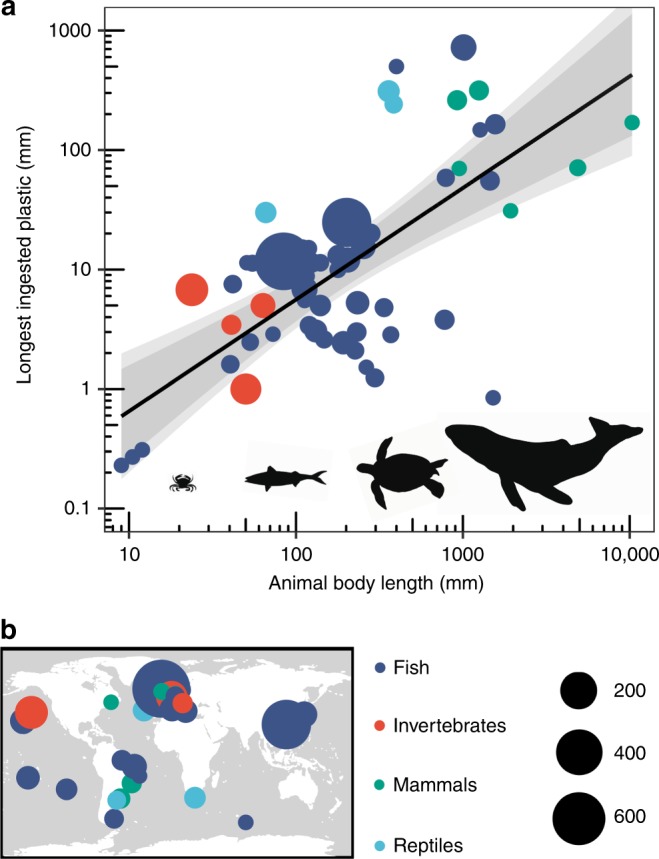
The ingestion of plastics appears to be widespread throughout the animal kingdom with risks to individuals, ecosystems and human health. Despite growing information on the location, abundance and size distribution of plastics in the environment, it cannot be assumed that any given animal will ingest all sizes of plastic encountered. Here, we use published data to develop an allometric relationship between plastic consumption and animal size to estimate the size distribution of plastics feasibly ingested by animals. Based on more than 2000 gut content analyses from animals ranging over three orders of magnitude in size (lengths 9 mm to 10 m), body length alone accounts for 42% of the variance in the length of plastic an animal may ingest and indicates a size ratio of roughly 20:1 between animal body length and the largest plastic the animal may ingest. We expect this work to improve global assessments of plastic pollution risk by introducing a quantifiable link between animals and the plastics they can ingest.
Overview
The claims and statistics of this paper haven’t been checked yet.
Run the check — free, no account needed. It reads the open-access text and checks the sources it cites.
Integrity signals
Registry
Cites
Statistics
Figures
Verification
Claims the paper makes
The claims and statistics of this paper haven’t been checked yet.
Run the check — free, no account needed. It reads the open-access text and checks the sources it cites.
Claims other papers make about this one
Each is checked against this paper’s own text: does it say what the citing paper says it does?
In the citing paper
“PMD is also ingested by several marine organisms, including commercially important species.18,19,[87][88][89][90]”
From The fate of plastic in the ocean environment – a minireview (2021) · cites this paper as [89]
Self-check
Percentages, sums and reported differences re-computed from the paper’s own numbers.
The self-check needs the paper’s full text.
Citations
Cites
IUCN Red List of Threatened Species
(2012) · Choice Reviews Online · doi:10.5860/choice.49-6872 · Cited by 12,829
TOWARD A METABOLIC THEORY OF ECOLOGY
Brown, J. H., Gillooly, J. F., Allen, A. P., Savage, V. M., & West, G. B. (2004) · Ecology · doi:10.1890/03-9000 · Cited by 7,779
The Ecological Implications of Body Size
Peters, R. H. (1983) · Cambridge University Press eBooks · doi:10.1017/cbo9780511608551 · Cited by 5,757
Eriksen, M., Lebreton, L. C. M., Carson, H. S., Thiel, M., Moore, C. J., Borerro, J. C., Galgani, F., Ryan, P. G., & Reisser, J. (2014) · PLoS ONE · doi:10.1371/journal.pone.0111913 · Cited by 4,710
River plastic emissions to the world’s oceans
Lebreton, L. C. M., van der Zwet, J., Damsteeg, J.-W., Slat, B., Andrady, A., & Reisser, J. (2017) · Nature Communications · doi:10.1038/ncomms15611 · Cited by 4,011
Plastic debris in the open ocean
Cózar, A., Echevarría, F., González-Gordillo, J. I., Irigoien, X., Úbeda, B., Hernández-León, S., Palma, Á. T., Navarro, S., García-de-Lomas, J., Ruiz, A., et al. (2014) · Proceedings of the National Academy of Sciences · doi:10.1073/pnas.1314705111 · Cited by 3,133
Microplastics as an emerging threat to terrestrial ecosystems
Machado, A. A. D. S., Kloas, W., Zarfl, C., Hempel, S., & Rillig, M. C. (2017) · Global Change Biology · doi:10.1111/gcb.14020 · Cited by 2,468
The impact of debris on marine life
Gall, S. C., & Thompson, R. C. (2015) · Marine Pollution Bulletin · doi:10.1016/j.marpolbul.2014.12.041 · Cited by 2,187
Classify plastic waste as hazardous
Rochman, C. M., Browne, M. A., Halpern, B. S., Hentschel, B. T., Hoh, E., Karapanagioti, H. K., Rios-Mendoza, L. M., Takada, H., Teh, S., & Thompson, R. C. (2013) · Nature · doi:10.1038/494169a · Cited by 1,752
A global inventory of small floating plastic debris
van Sebille, E., Wilcox, C., Lebreton, L., Maximenko, N., Hardesty, B. D., van Franeker, J. A., Eriksen, M., Siegel, D., Galgani, F., & Law, K. L. (2015) · Environmental Research Letters · doi:10.1088/1748-9326/10/12/124006 · Cited by 1,713
Cited by
Sorted by citations
Items 101–200 of 223
Salam, L. B. (2024) · World Journal of Microbiology and Biotechnology · doi:10.1007/s11274-024-03972-6 · Cited by 29
“Furthermore, they may translocate within living organisms' cell membranes and serve as a source for transporting toxic chemicals (Jâms et al. 2020; MacLeod et al. 2021).”
Sánchez-Guerrero-Hernández, M. J., González‐Fernández, D., Sendra, M., Ramos, F., Yeste, M. P., & González‐Ortegón, E. (2022) · The Science of The Total Environment · doi:10.1016/j.scitotenv.2022.160451 · Cited by 32
“Similarly, given the relationship studied by Jâms et al. (2020), it is possible that some of the smaller fi bres and fragments found correspond to indirect ingestion.”
Franceschini, S., Cau, A., D’Andrea, L., Follesa, M. C., & Russo, T. (2021) · Frontiers in Marine Science · doi:10.3389/fmars.2021.682616 · Cited by 26
Niu, Z., Curto, M., Gall, M. L., Demeyer, E., Asselman, J., Janssen, C., Dhakal, H. N., Davies, P., Catarino, A. I., & Everaert, G. (2024) · Ecotoxicology and Environmental Safety · doi:10.1016/j.ecoenv.2024.115981 · Cited by 28
Quadroni, S., Cesarini, G., Santis, V. D., & Galafassi, S. (2024) · Journal of Environmental Management · doi:10.1016/j.jenvman.2024.123363 · Cited by 28
Kim, D., Kim, S. A., Nam, S., Kwak, J. I., Kim, L., Lee, T.-Y., Kim, H., An, S., & An, Y. (2024) · Marine Pollution Bulletin · doi:10.1016/j.marpolbul.2024.116056 · Cited by 25
Chen, X., Zhao, S., Yuan, A., Chen, S., Liao, Y., Fu, X., Lei, J., & Jiang, L. (2023) · Macromolecules · doi:10.1021/acs.macromol.3c01688 · Cited by 26
Rapid detection of nanoplastic particles by a luminescent Tb-based coordination polymer
Sun, T., Min, H., Han, Z., Wang, L., Cheng, P., & Shi, W. (2023) · Chinese Chemical Letters · doi:10.1016/j.cclet.2023.108718 · Cited by 26
Zhang, X., Niu, Z., Zhang, Y., Guan, S., Jing, M., Wu, N., & Ma, Y. (2023) · Water Research · doi:10.1016/j.watres.2023.120832 · Cited by 24
Daphnia magna's Favorite Snack: Biofouled Plastics
Polhill, L., de Bruijn, R., Amaral‐Zettler, L., Praetorius, A., & van Wezel, A. P. (2022) · Environmental Toxicology and Chemistry · doi:10.1002/etc.5393 · Cited by 27
Mehmood, S., Ilyas, N., Akhtar, N., Chia, W. Y., Shati, A. A., Alfaifi, M. Y., Sayyed, R. Z., Pusparizkita, Y. M., Munawaroh, H. S. H., Quân, P. M., et al. (2022) · Environmental Research · doi:10.1016/j.envres.2022.114784 · Cited by 25
Huang, K., Xie, L., Gu, X., Xie, J., Li, J., Gao, S., Ji, R., & Zhou, D. (2025) · Water Research · doi:10.1016/j.watres.2025.123935 · Cited by 22
Scattered accumulation hotspots of macro-litter on the seafloor: Insights for mitigation actions
Cau, A., Franceschini, S., Moccia, D., Gorule, P. A., Agus, B., Bellodi, A., Cannas, R., Carugati, L., Cuccu, D., Dessì, C., et al. (2021) · Environmental Pollution · doi:10.1016/j.envpol.2021.118338 · Cited by 23
Mistaking Plastic for Zooplankton: Risk Assessment of Plastic Ingestion in the Mediterranean Sea
Fabri‐Ruiz, S., Baudena, A., Moullec, F., Lombard, F., Irisson, J., & Pedrotti, M. L. (2022) · The Science of The Total Environment · doi:10.1016/j.scitotenv.2022.159011 · Cited by 22
Plastic ingestion in Asian elephants in the forested landscapes of Uttarakhand, India
Katlam, G., Prasad, S., Pande, A., & Ramchiary, N. (2022) · Journal for Nature Conservation · doi:10.1016/j.jnc.2022.126196 · Cited by 21
Xu, J., & Li, D. (2020) · Environmental Pollution · doi:10.1016/j.envpol.2020.115648 · Cited by 21
Benhadji, N., Kurniawan, S. B., & Imron, M. F. (2024) · The Science of The Total Environment · doi:10.1016/j.scitotenv.2024.178057 · Cited by 20
Murphy, E. L., Baechler, B. R., Roman, L., Leonard, G. H., Mallos, N. J., Santos, R. G. D., & Rochman, C. M. (2025) · Proceedings of the National Academy of Sciences · doi:10.1073/pnas.2415492122 · Cited by 22
Cesarini, G., Corami, F., Rosso, B., & Scalici, M. (2023) · Water · doi:10.3390/w15142647 · Cited by 19
Entanglement of Daphnia magna by Fibrous Microplastics through “Hook and Loop” Action
Ma, C., Shi, H., & Slaveykova, V. I. (2024) · Environmental Science & Technology Letters · doi:10.1021/acs.estlett.4c00279 · Cited by 18
Burger, M., Bouwman, H., du Preez, L. H., & Landman, W. (2024) · Bulletin of Environmental Contamination and Toxicology · doi:10.1007/s00128-024-03852-7 · Cited by 17
“Although Jâms et al. ( 2020) concluded that larger animals ingest larger MPs, this was a large-scale assessment.”
BackgroundOccurrence of Microplastics in Freshwater
Cera, A., Gallitelli, L., Cesarini, G., & Scalici, M. (2022) · Emerging contaminants and associated treatment technologies · doi:10.1007/978-3-030-89220-3_10 · Cited by 16
Species-specific effects of microplastics on juvenile fishes
Zhang, C., Wang, F., Zuo, Z., Pan, Z., Wang, S., Xu, G., & Zou, J. (2023) · Frontiers in Physiology · doi:10.3389/fphys.2023.1256005 · Cited by 16
Chen, M., Zhang, Y., Cheng, L.-C., Zhao, F. J., & Wang, P. (2024) · Journal of Hazardous Materials · doi:10.1016/j.jhazmat.2024.134884 · Cited by 17
Campano, C., Rivero‐Buceta, V., Fabra, M. J., & Prieto, M. A. (2022) · International Journal of Biological Macromolecules · doi:10.1016/j.ijbiomac.2022.11.120 · Cited by 15
International trade and biodiversity: Is export a species killer?
Tian, H., & Cheng, C. (2024) · Ecological Economics · doi:10.1016/j.ecolecon.2024.108313 · Cited by 15
Li, M., Chen, W., & Chen, S. (2024) · Chemical Engineering Journal · doi:10.1016/j.cej.2024.157778 · Cited by 16
Devi, S. S., Saifudeen, N., Kumar, K. S., & Kumar, A. B. (2024) · Marine Pollution Bulletin · doi:10.1016/j.marpolbul.2024.116532 · Cited by 14
El-masry, S. M., Khedre, A. M., & Mustafa, A. N. (2025) · Scientific Reports · doi:10.1038/s41598-025-88715-9 · Cited by 14
“Moreover, a review of published results indicated that the size ratio between an organism’s body length and the highest number of MPs it can consume is approximately 20:1 61 .”
A comparative analysis of microplastics in feces of terrestrial mammalian wildlife around Hong Kong
Siña, M., Kunz, A., Not, C., & Liou, S. Y. H. (2025) · Scientific Reports · doi:10.1038/s41598-025-07672-5 · Cited by 17
Aslam, M., Ahmad, S. R., Imtiaz, Z., Aslam, H. M. U., Baqar, M., & Qadir, A. (2023) · Human and Ecological Risk Assessment An International Journal · doi:10.1080/10807039.2023.2239942 · Cited by 13
Thermal degradation kinetics of calcium stearate/PVC composite
Guangbao, W., Shangsuo, Y., & Jijun, X. (2020) · Results in Materials · doi:10.1016/j.rinma.2020.100123 · Cited by 13
Rashid, K., Ali, S., Chaudhry, A. H., Sial, N., Akram, M. R., & Aslam, M. (2026) · The Science of The Total Environment · doi:10.1016/j.scitotenv.2026.181547 · Cited by 12
Jawdhari, A., Mihailescu, D. F., Stan, M. S., Bălănescu, M.-V., Vlăsceanu, R.-I., Staicu, A. C., Crăciun, N., & Deák, G. (2023) · Sustainability · doi:10.3390/su15086494 · Cited by 13
Dobrzycka-Krahel, A., Skóra, M. E., & Pladzyk, A. (2024) · Water · doi:10.3390/w16060903 · Cited by 16
Exposure pathway derived accumulation of microplastics in freshwater fish: A critical review
Gao, J. Q., Shen, T., Wang, L., Yang, Q., Wang, J., & Zhang, D. (2025) · Journal of Hazardous Materials · doi:10.1016/j.jhazmat.2025.140270 · Cited by 11
Coffin, S., Bertrand, L., Ahmed, K. T., Leite, L. D. S., Cowger, W., Siña, M., Barrick, A., Kukkola, A. T., Almroth, B. C., Miller, E. L., et al. (2026) · Journal of Hazardous Materials · doi:10.1016/j.jhazmat.2025.141021 · Cited by 13
Rost-Roszkowska, M. M., Mermer, P., Chajec, Ł., Sosinka, A., Wilczek, G., Student, S., Wrońska, A. K., & Karnówka, O. (2024) · The European Zoological Journal · doi:10.1080/24750263.2024.2308529 · Cited by 11
“Plastics consumed by animals will cause numerous lethal effects, so cells in their tissues and organs will be damaged (Anguissola et al. 2014; Rodriguez-Seijo et al. 2017; Chae et al. 2018; Pitt et al. 2018; Jâms 2020).”
BackgroundCarreras-Colom, E., Follesa, M. C., Carugati, L., Mulas, A., Bellodi, A., & Cau, A. (2024) · Environmental Science and Pollution Research · doi:10.1007/s11356-024-33909-3 · Cited by 11
“Moreover, the interaction of marine litter with a wide array of organisms ranging from zooplankton to marine mammals (Jâms et al. 2020) has received great attention both in the scientific and popular media fields (MacLeod et al. 2021).”
BackgroundPresence of microplastic in the Patella caerulea from the northeastern Mediterranean Sea
Yücel, N., & Kılıç, E. (2023) · Marine Pollution Bulletin · doi:10.1016/j.marpolbul.2023.114684 · Cited by 13
Thermomechanically stable supramolecular elastomers inspired by heat shock proteins
Wu, Q., Liu, H., Xiong, H., Hou, Y., Peng, Y., Zhao, L., & Wu, J. (2023) · Materials Horizons · doi:10.1039/d3mh01737k · Cited by 11
Assuyuti, Y. M., Utomo, A., & Putri, L. S. E. (2022) · Journal of Ecological Engineering · doi:10.12911/22998993/145466 · Cited by 14
“According to Jâms et al. (2020), the smallest to largest size of MPs can be digested by all animals.”
BackgroundMethodPiperagkas, O., & Papageorgiou, N. (2021) · Marine Pollution Bulletin · doi:10.1016/j.marpolbul.2021.113014 · Cited by 12
Can the mass of plastic ingested by seabirds be predicted by the number of ingested items?
Bond, A. L., & Lavers, J. L. (2023) · Marine Pollution Bulletin · doi:10.1016/j.marpolbul.2023.114673 · Cited by 10
Recalculating national occurrence of microplastics in China’s freshwater
Xu, D., & Gao, B. (2025) · Cell Reports Sustainability · doi:10.1016/j.crsus.2024.100302 · Cited by 10
Uptake of Microplastics in the Wedge Clam Donax trunculus: First Evidence from the Mediterranean Sea
Olivieri, Z., Cesarini, G., Orsini, M., Santis, S. D., & Scalici, M. (2022) · Water · doi:10.3390/w14244095 · Cited by 14
Shoopman, C., & Pan, X. (2021) · Methods in molecular biology · doi:10.1007/978-1-0716-1514-0_25 · Cited by 10
Fu, C.-X., Chen, C., Xiang, Q., Wang, Y., Wang, L., Qi, F.-Y., Zhu, D., Li, H.-Z., Li, C., Hong, W., et al. (2024) · Journal of Hazardous Materials · doi:10.1016/j.jhazmat.2024.136160 · Cited by 9
Andrade, C., Sepúlveda, T., Pinto, B., Rivera, C. N., Aldea, C., & Urbina, M. A. (2025) · Environmental Science and Pollution Research · doi:10.1007/s11356-025-36144-6 · Cited by 12
“Studies have previously reported a positive correlation between body size and MP abundance in marine pelagic organisms (Jâms et al. 2020; Covernton et al. 2021), suggesting that body size may influence the size and abundance of ingested plastic particles (Hamilton et al. 2021; Jiang et al. 2022).”
Jeong, I.-Y., Seo, J.-H., & Yoo, J. (2023) · Marine Pollution Bulletin · doi:10.1016/j.marpolbul.2023.115592 · Cited by 9
Wang, Y., Fu, Z., Guan, D., Zhao, J., Zhang, Q., Liu, Q., Xie, J., Sun, Y., & Guo, L. (2023) · Applied Biochemistry and Biotechnology · doi:10.1007/s12010-023-04832-z · Cited by 9
“Once they enter soil environments, it becomes easier for MPs to be ingested by organisms, altering soil properties and affecting soil biological functions and diversity [64].”
Long, X., Zhang, S., Huang, D., Chang, C., Peng, C., Liu, K., Wang, K., Liu, X., Fu, T., Han, Y., et al. (2024) · Journal of Geophysical Research Atmospheres · doi:10.1029/2024jd041546 · Cited by 8
Plastic pollutants: From wastes to fuels and high-value chemicals
Poonia, K., Dinh, D. A., Singh, P., Ahamad, T., Thakur, S., Raizada, P., Quang, H. H. P., Khan, A. A. P., & Nguyen, V. (2025) · Journal of environmental chemical engineering · doi:10.1016/j.jece.2025.116562 · Cited by 8
Intranuwong, J., Nongyai, N., Shin, S. K., Kim, M., & Kwon, Y. K. (2025) · Journal of Applied Polymer Science · doi:10.1002/app.57401 · Cited by 8
Microplastics and ecosystem services: persistence, disruption mechanisms, and mitigation strategies
Gokila, B., Duraisamy, J., Guruanand, C., & Arumugam, R. D. (2025) · Environmental Reviews · doi:10.1139/er-2025-0080 · Cited by 8
Scientific knowledge gaps on the biology of non-fish marine species across European Seas
Abucay, L. R., Sorongon-Yap, P., Kesner‐Reyes, K., Capuli, E. C., Reyes, R. B., Daskalaki, E., Ferrà, C., Scarcella, G., Coro, G., Ordines, F., et al. (2023) · Frontiers in Marine Science · doi:10.3389/fmars.2023.1198137 · Cited by 8
James, B. D., Medvedev, A. V., Medvedeva, L. A., Martsen, E., Gorman, K. L., Lin, B., Makarov, S. S., Aluwihare, L. I., de Vos, A., Reddy, C. M., et al. (2024) · Environment & Health · doi:10.1021/envhealth.4c00172 · Cited by 8
Recycled PS and PET hybrid nanofiber filter media: enhancing mechanical strength for air filtration
Lima, F. D. A., Chagas, P. A. M., Vieira, A. C. C., Blanco, G. E. D. O., Aguiar, M. L., & Guerra, V. G. (2025) · Journal of Industrial and Engineering Chemistry · doi:10.1016/j.jiec.2025.07.033 · Cited by 7
Zheng, Y., Huang, S., Fan, H., Liu, H., Xu, J., Craig, N. J., Li, J., He, W., & Su, L. (2024) · Aquatic Toxicology · doi:10.1016/j.aquatox.2024.106943 · Cited by 8
From Plastic Waste to Green Hydrogen and Valuable Chemicals Using Sunlight and Water
Nguyen, T. K. A., Trần‐Phú, T., Daiyan, R., Ta, X. M. C., Amal, R., & Tricoli, A. (2024) · Angewandte Chemie · doi:10.1002/ange.202401746 · Cited by 7
Dickinson, H., & Johnson, E. (2022) · HoST - Journal of History of Science and Technology · doi:10.2478/host-2022-0015 · Cited by 6
Mejia, N., Termignoni‐García, F., Learned, J., Penniman, J. F., & Edwards, S. V. (2024) · PeerJ · doi:10.7717/peerj.18566 · Cited by 6
A Straightforward Approach for the Removal of Microplastics from Water: Utilization of SLIPS
Ebrahimi, M., Azizian, S., Eslamipanah, M., & Jaleh, B. (2025) · ACS Applied Materials & Interfaces · doi:10.1021/acsami.5c07177 · Cited by 6
Microplastic pollution in a small fishing port in Zonguldak/Turkey
Bayık, G. D., & AYDEMİR, E. (2023) · Environmental Research and Technology · doi:10.35208/ert.1204883 · Cited by 6
Kučera, J., Belišová, N., Mackuľak, T., Ryba, J., Douda, K., Bondarev, D., Slavík, O., Tamáš, M., Escobar‐Calderón, F., & Horký, P. (2022) · Fishes · doi:10.3390/fishes7060323 · Cited by 6
Yücel, N., & Kılıç, E. (2023) · Journal of Agricultural Production · doi:10.56430/japro.1232650 · Cited by 6
“Size of extracted MP was is usually limited with the size of the animal (Jâms et al., 2020).”
BackgroundMerga, L. B. (2021) · doi:10.18174/536456 · Cited by 6
Turner, A., Jones, K. L., & Filella, M. (2025) · The Science of The Total Environment · doi:10.1016/j.scitotenv.2025.179457 · Cited by 5
From a Global Archived Data Perspective: Larger Bivalves Mean More Microplastics?
Wang, X., Jabeen, K., Zhu, L., Liu, K., Chen, F., Wu, R., & Li, D. (2025) · Environmental Science & Technology · doi:10.1021/acs.est.5c00762 · Cited by 5
Impact of Microplastics on Flora and Fauna
Reshi, Q. M., Ahmed, I., Ahmad, I., & Fazio, F. (2023) · BENTHAM SCIENCE PUBLISHERS eBooks · doi:10.2174/9789815165104123010006 · Cited by 5
Mahapatra, A. D., Santra, V., Jana, S., & Ghorai, S. K. (2023) · Journal of Asia-Pacific Biodiversity · doi:10.1016/j.japb.2023.01.008 · Cited by 5
Predari, S. C., Gutiérrez, M. A., Ribas, C., Molinari, G., & Santoianni, J. E. (1991) · PubMed · Cited by 5
Ueda, K., Kameda, Y., Fujita, E., Fujimura, G., Fukazawa, E., Numazawa, Y., Iwasaki, Y., & Naito, W. (2025) · Microplastics and Nanoplastics · doi:10.1186/s43591-025-00168-z · Cited by 5
“Smaller MPs, especially those 100 μm, have garnered attention due to their higher bioavailability to plankton and other low-trophic-level organisms [6].”
The effects of plastic pollution on biodiversity
Savoca, M. S., Murphy, E. L., Brandon, A. M., Hampton, L. M. T., Roman, L., Kong, M., Fernandes, M. E., Abrokwah, S., Darter, C., Galgani, F., et al. (2026) · Nature Reviews Biodiversity · doi:10.1038/s44358-026-00170-0 · Cited by 5
“Plastic size, specifically as related to the organism’s gape size, is the most important determinant of ingestion and effect 35 .”
Bleszynski, M., & Clark, E. (2023) · Microplastics · doi:10.3390/microplastics2030018 · Cited by 4
Investigation of Microplastic Contamination in Diadema Setosum Obtained from a Fishing Barn
Kılıç, E., & Uğurlu, E. (2024) · Turkish Journal of Maritime and Marine Sciences · doi:10.52998/trjmms.1479819 · Cited by 5
A 6-year survey of plastic ingestion by aquatic birds in southern Portugal
Rao, S., Nicastro, K. R., Casero, M., McQuaid, C. D., & Zardi, G. I. (2021) · Marine and Freshwater Research · doi:10.1071/mf21221 · Cited by 4
Falahudin, D., Herandarudewi, S. M. C., Hukom, F. D., Arifin, Z., Wulandari, I., Sudaryanto, A., Hoang, A. Q., Watanabe, I., & Takahashi, S. I. (2023) · The Science of The Total Environment · doi:10.1016/j.scitotenv.2023.163008 · Cited by 4
Impact of Endocrine‐Disrupting Chemicals (EDCs) Used in the Food Industry on Endocrine Abnormalities
Serrano‐López, P. D., Ocampo‐Juárez, F. B., Magaña‐Rodríguez, A., & Téllez‐Morales, J. A. (2025) · Food Safety and Health · doi:10.1002/fsh3.70033 · Cited by 3
“The presence of plastic particles in the food chain could, therefore, pose a public health risk (Jâms et al. 2020).”
Marhoon, A., Murphy, E. L., Høiberg, M. A., Borgelt, J., Dorber, M., & Verones, F. (2025) · Marine Pollution Bulletin · doi:10.1016/j.marpolbul.2025.118968 · Cited by 3
Bobori, D. C., Dimitriadi, A., Feidantsis, K. G., Samiotaki, A., Fafouti, D., Sampsonidis, I., Kalogiannis, S., Kastrinaki, G., Lambropoulou, D. A., Kyzas, G. Z., et al. (2022) · Public Health Toxicology · doi:10.18332/pht/149614 · Cited by 3
Processes for the treatment of biomedical wastes: challenges and issues
Lade, V. G., Chavhan, S. K., Shirsat, S. P., & Bhanvase, B. A. (2023) · Elsevier eBooks · doi:10.1016/b978-0-323-90909-9.00007-1 · Cited by 3
First Report of Plastic and Artificial Cellulose Ingestion by Freshwater Turtles in the Amazon
Santos, A. L. P., de Oliveira, T. D. A. P., Sforzi, L., Pezzuti, J. C. B., Miorando, P. S., Rebelo, L. G. B., Bezerra, A. M., Martellini, T., Chelazzi, D., Cincinelli, A., et al. (2025) · Water Air & Soil Pollution · doi:10.1007/s11270-025-07877-4 · Cited by 4
“Once plastic enter aquatic environments, they pose a threat to the aquatic biota and habitats (Azevedo-Santos et al., 2019), and plastic ingestion by aquatic wildlife has been reported (Jâms et al., 2020).”
Effect assessment of nano- and microplastics in freshwater ecosystems
Redondo‐Hasselerharm, P. E. (2020) · doi:10.18174/533220 · Cited by 3
Su, P., Bu, N., Li, Z., Wang, J., Zhang, D., Chu, K., Yao, Y., Sun, Q., Luo, Y., Zhang, R., et al. (2022) · SSRN Electronic Journal · doi:10.2139/ssrn.4156269 · Cited by 3
Mortality from plastic ingestion and net entanglement in marine birds - description of three cases
Garcês, A., Soeiro, V., Lóio, S., & Pires, I. C. R. (2024) · Veterinarski glasnik · doi:10.2298/vetgl240509014g · Cited by 2
A best practice framework for assessing plastic ingestion in marine turtles
González‐Paredes, D., Duncan, E. M., Godley, B. J., Marsh, H., & Hamann, M. (2025) · Marine Pollution Bulletin · doi:10.1016/j.marpolbul.2025.117944 · Cited by 2
Recent advances in thermal oxidative upcycling strategy of waste plastics under mild conditions
Wang, B., Lou, L., Peng, C., Wu, Z., Zhang, Y., Liu, C., Liu, S., & Yu, K. (2025) · Chemical Engineering Journal · doi:10.1016/j.cej.2025.168475 · Cited by 3
Evidence on microplastic exposure and respiratory health outcomes: a systematic review
Chen, C., Luo, L., Zheng, Y., Ran, L., Li, Z., Zhongliang, G., Li, Q., Ji, Y., Hua, J., & Wang, N. (2026) · Therapeutic Advances in Respiratory Disease · doi:10.1177/17534666261465486 · Cited by 2
“40 MPs bioaccumulate in marine species, 41,42 with nearly half of 338 fish species containing MPs (3.5 ± 0.8 particles/ fish), 43 thereby enabling trophic transfer to humans.”
InfluentialMascarenhas, A. R. P., Scatolino, M. V., do Lago, R. C., de Medeiros, D. T., Batista, F. G., Setter, C., de Melo, R. R., Martins, M. A., & Tonoli, G. H. D. (2024) · CERNE · doi:10.1590/01047760202330013354 · Cited by 1
Micro- and Mesoplastic Consumption Tendency of Exaiptasia diaphana Sea Anemones
Kaliszewicz, A., Czyżewska, A., Karaban, K., Olejniczak, I., & Boniecki, P. (2025) · Animals · doi:10.3390/ani15030405 · Cited by 1
“For instance, Jâms et al. [40] estimated that a zooplankton animal 13.5 mm in length is able to ingest a piece of plastic 0.86 mm long.”
InfluentialSchönberg, J., Böhm‐Beck, M., Trdan, Š., Grego, M., Knoblauch, D., Hinzmann, M., Dittmann, S., Knickmeier, K., Robič, U., Thiel, M., et al. (2025) · Aquatic Conservation Marine and Freshwater Ecosystems · doi:10.1002/aqc.70192 · Cited by 1
Ao, S., Cowger, W., Resh, V. H., Chiu, M., Zhang, D., Xu, Y., Patil, A. J., Guo, Z., Sun, X., & Xu, Y. (2025) · Water Research · doi:10.1016/j.watres.2025.125115 · Cited by 2
The driver of oil fate in nearshore environments: MOPAs-mediated vertical transport and ecotoxicity
Sun, Y., Lu, D., Wang, X., Dong, R., Yin, J., Xie, G., Lu, J., Bao, M., & Li, H. (2025) · Water Research · doi:10.1016/j.watres.2025.125264 · Cited by 1
Ferrari, E., Barbieri, M. V., Russo, R., Balasch, A., Ferrari, V., Simonetti, S., Birarda, G., Vaccari, L., Bergami, E., Eljarrat, E., et al. (2026) · Environmental Research · doi:10.1016/j.envres.2026.124412 · Cited by 2
Early Life Microplastic Exposure Impairs Mouse Incisor Enamel Formation
Li, Y., Zheng, J., Yu, S., Shi, Q., Wan, M., & Zheng, L. (2026) · Calcified Tissue International · doi:10.1007/s00223-026-01535-5 · Cited by 2
Mai, H., Ngo, T. T. N., Nguyen, D. T., Bui, V. H., Dao, T. D., Dang, T. T., & Do, V. M. (2023) · Vietnam Journal of Science and Technology/Science and Technology · doi:10.15625/2525-2518/17926 · Cited by 1
Cau, A., Franceschini, S., Moccia, D., Gorule, P. A., Agus, B., Bellodi, A., Cannas, R., Carugati, L., Cuccu, D., Dessì, C., et al. (2021) · Environmental Pollution · doi:10.1016/j.envpol.2021.118232 · Cited by 1
RetractedREVIVING THE NATION'S PUBLIC WATER UTILITIES TO REDUCE PLASTIC POLLUTION IN THE UNITED STATES
Ahmed, S. A., Oldfield-Blanks, S., & Moore, B. (2022) · Performance Improvement Journal · doi:10.56811/pfi-20-0047
Rost-Roszkowska, M. M., Mermer, P., Chajec, Ł., Sosinka, A., Wilczek, G., Student, S., Wrońska, A. K., & Karnówka, O. (2023) · Research Square · doi:10.21203/rs.3.rs-2773415/v1
Metadata
- Authors
- Jâms, I. B., Windsor, F. M., Poudevigne-Durance, T., Ormerod, S. J., & Durance, I.
- Affiliations
- Cardiff University (GB)
- Corresponding author
- Durance, Isabelle
- Venue
- Nature Communications
- Published
- 2020-03-27
- Volume
- 11
- Issue
- 1
- Pages
- 1594-1594
- ISSN
- 2041-1723 (ISSN-L)
- PMC
- PMC7101383
- OpenAlex
- W3013106828
- Cited by
- 223
- References
- 27
- Citations by year
- 2026: 19 · 2025: 31 · 2024: 33 · 2023: 39 · 2022: 50 · 2021: 36 · 2020: 13
- FWCI
- 8.52
- Type
- journal article
- Language
- en
- Open access
- gold
- doi.org
- Locations
- Nature Communications (publishedVersion, cc-by)
- PubMed Central (publishedVersion, cc-by)
- PubMed (publishedVersion)
- ORCA Online Research @Cardiff (Cardiff University) (acceptedVersion)
- RePEc: Research Papers in Economics (submittedVersion)
- DOAJ (DOAJ: Directory of Open Access Journals) (submittedVersion, cc-by-sa)
- Newcastle University ePrints (Newcastle Univesity) (cc-by)
- Funders
- Natural Environment Research Council (1642617, NE/L002434/, L002434)
- Topics
- Physical Sciences › Environmental Science › Pollution › Microplastics and Plastic Pollution
- Physical Sciences › Environmental Science › Health, Toxicology and Mutagenesis › Environmental Toxicology and Ecotoxicology
- Physical Sciences › Environmental Science › Nature and Landscape Conservation › Turtle Biology and Conservation
- Keywords
- plastic ingestion, allometric relationships, animal body size, gut content analysis, marine fauna, microplastics
- MeSH terms
- Animals, Eating, Environmental Monitoring, Environmental Pollution, Fishes, Particle Size, Plastics, Zooplankton, Ecosystem, Body Size
About these checks
Registry, retraction, Cites and statistics results are computed, not judged, with one exception: a printed reference that no index lists is read once by a model before it counts as a citation error. Claims are extracted by a model and kept only when their quote appears verbatim in the text; each cited source is then checked, with a model’s help, for whether it says what the claim relies on. Those verdicts can be wrong — read the claim’s quote and the cited source before relying on one.
Statistics and arithmetic are recomputed, not judged.
Confidence bands are shown only for fields calibrated on our annotated test set. None is calibrated yet, so no band is shown.
What counts as a claim ›How we measure confidence ›How we check this ›
Are you an author, or do you see a problem with this page? Request a review
