

The DOI matches its Crossref record; 27 of the 27 references it cites were found in a registry or an index.
Estimating the size distribution of plastics ingested by animals
Open accessAbstract
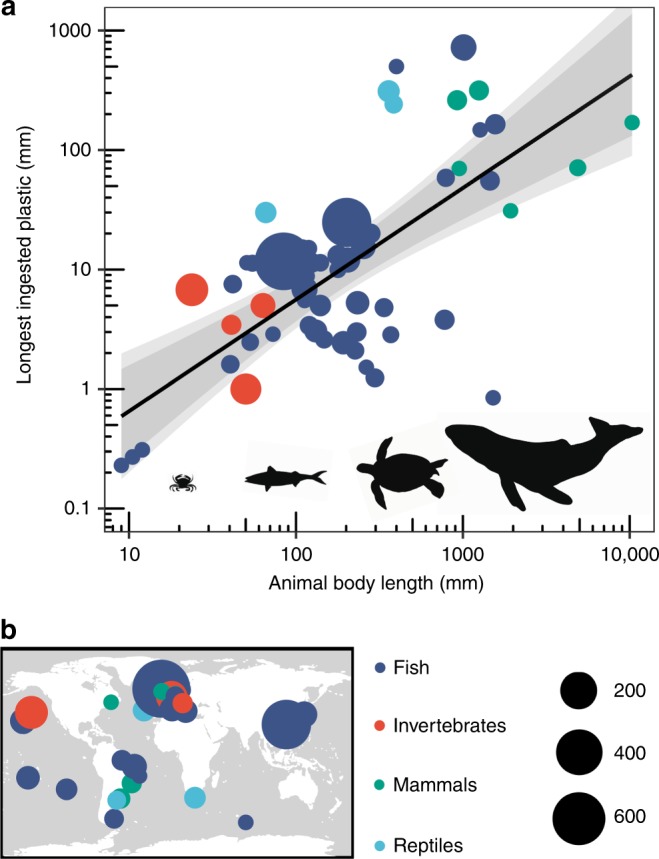
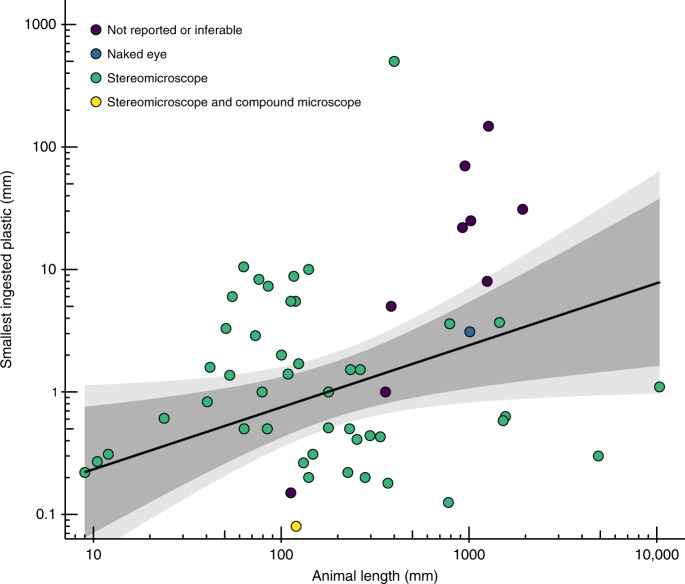
The ingestion of plastics appears to be widespread throughout the animal kingdom with risks to individuals, ecosystems and human health. Despite growing information on the location, abundance and size distribution of plastics in the environment, it cannot be assumed that any given animal will ingest all sizes of plastic encountered. Here, we use published data to develop an allometric relationship between plastic consumption and animal size to estimate the size distribution of plastics feasibly ingested by animals. Based on more than 2000 gut content analyses from animals ranging over three orders of magnitude in size (lengths 9 mm to 10 m), body length alone accounts for 42% of the variance in the length of plastic an animal may ingest and indicates a size ratio of roughly 20:1 between animal body length and the largest plastic the animal may ingest. We expect this work to improve global assessments of plastic pollution risk by introducing a quantifiable link between animals and the plastics they can ingest.
Overview
The claims and statistics of this paper haven’t been checked yet.
Run the check — free, no account needed. It reads the open-access text and checks the sources it cites.
Integrity signals
Registry
Cites
Statistics
Figures
Verification
Claims the paper makes
The claims and statistics of this paper haven’t been checked yet.
Run the check — free, no account needed. It reads the open-access text and checks the sources it cites.
Claims other papers make about this one
Each is checked against this paper’s own text: does it say what the citing paper says it does?
In the citing paper
“PMD is also ingested by several marine organisms, including commercially important species.18,19,[87][88][89][90]”
From The fate of plastic in the ocean environment – a minireview (2021) · cites this paper as [89]
Self-check
Percentages, sums and reported differences re-computed from the paper’s own numbers.
The self-check needs the paper’s full text.
Citations
Cites
IUCN Red List of Threatened Species
(2012) · Choice Reviews Online · doi:10.5860/choice.49-6872 · Cited by 12,829
TOWARD A METABOLIC THEORY OF ECOLOGY
Brown, J. H., Gillooly, J. F., Allen, A. P., Savage, V. M., & West, G. B. (2004) · Ecology · doi:10.1890/03-9000 · Cited by 7,779
The Ecological Implications of Body Size
Peters, R. H. (1983) · Cambridge University Press eBooks · doi:10.1017/cbo9780511608551 · Cited by 5,757
Eriksen, M., Lebreton, L. C. M., Carson, H. S., Thiel, M., Moore, C. J., Borerro, J. C., Galgani, F., Ryan, P. G., & Reisser, J. (2014) · PLoS ONE · doi:10.1371/journal.pone.0111913 · Cited by 4,710
River plastic emissions to the world’s oceans
Lebreton, L. C. M., van der Zwet, J., Damsteeg, J.-W., Slat, B., Andrady, A., & Reisser, J. (2017) · Nature Communications · doi:10.1038/ncomms15611 · Cited by 4,011
Plastic debris in the open ocean
Cózar, A., Echevarría, F., González-Gordillo, J. I., Irigoien, X., Úbeda, B., Hernández-León, S., Palma, Á. T., Navarro, S., García-de-Lomas, J., Ruiz, A., et al. (2014) · Proceedings of the National Academy of Sciences · doi:10.1073/pnas.1314705111 · Cited by 3,133
Microplastics as an emerging threat to terrestrial ecosystems
Machado, A. A. D. S., Kloas, W., Zarfl, C., Hempel, S., & Rillig, M. C. (2017) · Global Change Biology · doi:10.1111/gcb.14020 · Cited by 2,468
The impact of debris on marine life
Gall, S. C., & Thompson, R. C. (2015) · Marine Pollution Bulletin · doi:10.1016/j.marpolbul.2014.12.041 · Cited by 2,187
Classify plastic waste as hazardous
Rochman, C. M., Browne, M. A., Halpern, B. S., Hentschel, B. T., Hoh, E., Karapanagioti, H. K., Rios-Mendoza, L. M., Takada, H., Teh, S., & Thompson, R. C. (2013) · Nature · doi:10.1038/494169a · Cited by 1,752
A global inventory of small floating plastic debris
van Sebille, E., Wilcox, C., Lebreton, L., Maximenko, N., Hardesty, B. D., van Franeker, J. A., Eriksen, M., Siegel, D., Galgani, F., & Law, K. L. (2015) · Environmental Research Letters · doi:10.1088/1748-9326/10/12/124006 · Cited by 1,713
Cited by
Sorted by citations
Senathirajah, K., Attwood, S. J., Bhagwat, G., Carbery, M., Wilson, S. P., & Thavamani, P. (2020) · Journal of Hazardous Materials · doi:10.1016/j.jhazmat.2020.124004 · Cited by 1,179
The Minderoo-Monaco Commission on Plastics and Human Health
Landrigan, P. J., Raps, H., Cropper, M., Bald, C., Brunner, M., Canonizado, E. M., Charles, D., Chiles, T. C., Donohue, M. J., Enck, J., et al. (2023) · Annals of Global Health · doi:10.5334/aogh.4056 · Cited by 581
Plastic ingestion as an evolutionary trap: Toward a holistic understanding
Santos, R. G. D., Machovsky‐Capuska, G. E., & de Andrades, R. C. (2021) · Science · doi:10.1126/science.abh0945 · Cited by 501
Koelmans, A. A., Redondo‐Hasselerharm, P. E., Nor, N. H. M., & Kooi, M. (2020) · Environmental Science & Technology · doi:10.1021/acs.est.0c02982 · Cited by 365
The fate of plastic in the ocean environment – a minireview
Wayman, C., & Niemann, H. (2021) · Environmental Science: Processes & Impacts · doi:10.1039/d0em00446d · Cited by 325
Metadata
- Authors
- Jâms, I. B., Windsor, F. M., Poudevigne-Durance, T., Ormerod, S. J., & Durance, I.
- Affiliations
- Cardiff University (GB)
- Corresponding author
- Durance, Isabelle
- Venue
- Nature Communications
- Published
- 2020-03-27
- Volume
- 11
- Issue
- 1
- Pages
- 1594-1594
- ISSN
- 2041-1723 (ISSN-L)
- PMC
- PMC7101383
- OpenAlex
- W3013106828
- Cited by
- 223
- References
- 27
- Citations by year
- 2026: 19 · 2025: 31 · 2024: 33 · 2023: 39 · 2022: 50 · 2021: 36 · 2020: 13
- FWCI
- 8.52
- Type
- journal article
- Language
- en
- Open access
- gold
- doi.org
- Locations
- Nature Communications (publishedVersion, cc-by)
- PubMed Central (publishedVersion, cc-by)
- PubMed (publishedVersion)
- ORCA Online Research @Cardiff (Cardiff University) (acceptedVersion)
- RePEc: Research Papers in Economics (submittedVersion)
- DOAJ (DOAJ: Directory of Open Access Journals) (submittedVersion, cc-by-sa)
- Newcastle University ePrints (Newcastle Univesity) (cc-by)
- Funders
- Natural Environment Research Council (1642617, NE/L002434/, L002434)
- Topics
- Physical Sciences › Environmental Science › Pollution › Microplastics and Plastic Pollution
- Physical Sciences › Environmental Science › Health, Toxicology and Mutagenesis › Environmental Toxicology and Ecotoxicology
- Physical Sciences › Environmental Science › Nature and Landscape Conservation › Turtle Biology and Conservation
- Keywords
- plastic ingestion, allometric relationships, animal body size, gut content analysis, marine fauna, microplastics
- MeSH terms
- Animals, Eating, Environmental Monitoring, Environmental Pollution, Fishes, Particle Size, Plastics, Zooplankton, Ecosystem, Body Size
About these checks
Registry, retraction, Cites and statistics results are computed, not judged, with one exception: a printed reference that no index lists is read once by a model before it counts as a citation error. Claims are extracted by a model and kept only when their quote appears verbatim in the text; each cited source is then checked, with a model’s help, for whether it says what the claim relies on. Those verdicts can be wrong — read the claim’s quote and the cited source before relying on one.
Statistics and arithmetic are recomputed, not judged.
Confidence bands are shown only for fields calibrated on our annotated test set. None is calibrated yet, so no band is shown.
What counts as a claim ›How we measure confidence ›How we check this ›
Are you an author, or do you see a problem with this page? Request a review
