

The DOI matches its Crossref record; 27 of the 27 references it cites were found in a registry or an index.
Estimating the size distribution of plastics ingested by animals
Open accessAbstract
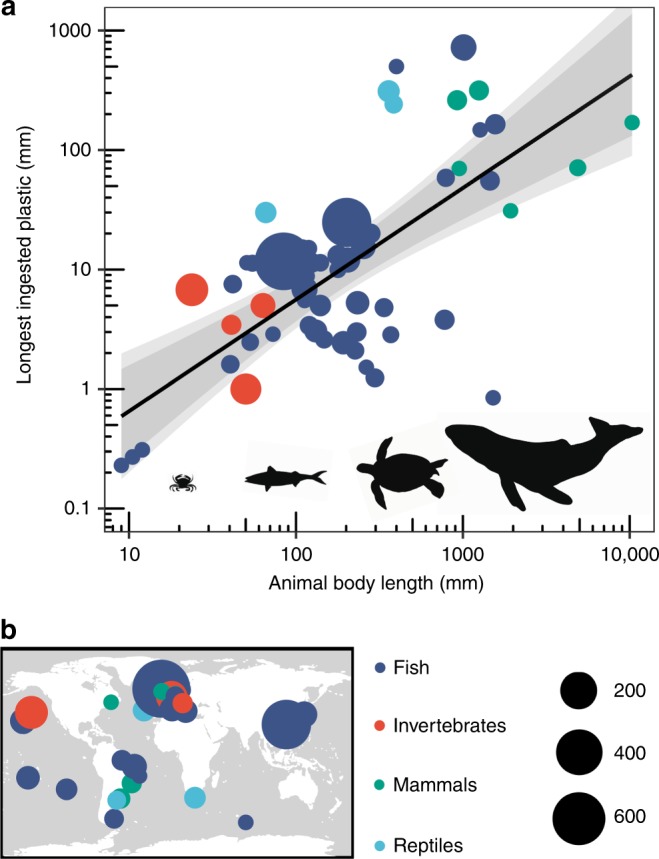
The ingestion of plastics appears to be widespread throughout the animal kingdom with risks to individuals, ecosystems and human health. Despite growing information on the location, abundance and size distribution of plastics in the environment, it cannot be assumed that any given animal will ingest all sizes of plastic encountered. Here, we use published data to develop an allometric relationship between plastic consumption and animal size to estimate the size distribution of plastics feasibly ingested by animals. Based on more than 2000 gut content analyses from animals ranging over three orders of magnitude in size (lengths 9 mm to 10 m), body length alone accounts for 42% of the variance in the length of plastic an animal may ingest and indicates a size ratio of roughly 20:1 between animal body length and the largest plastic the animal may ingest. We expect this work to improve global assessments of plastic pollution risk by introducing a quantifiable link between animals and the plastics they can ingest.
Overview
The claims and statistics of this paper haven’t been checked yet.
Run the check — free, no account needed. It reads the open-access text and checks the sources it cites.
Integrity signals
Registry
Cites
Statistics
Figures
Verification
Claims the paper makes
The claims and statistics of this paper haven’t been checked yet.
Run the check — free, no account needed. It reads the open-access text and checks the sources it cites.
Claims other papers make about this one
Each is checked against this paper’s own text: does it say what the citing paper says it does?
In the citing paper
“PMD is also ingested by several marine organisms, including commercially important species.18,19,[87][88][89][90]”
From The fate of plastic in the ocean environment – a minireview (2021) · cites this paper as [89]
Self-check
Percentages, sums and reported differences re-computed from the paper’s own numbers.
The self-check needs the paper’s full text.
Citations
Cites
IUCN Red List of Threatened Species
(2012) · Choice Reviews Online · doi:10.5860/choice.49-6872 · Cited by 12,829
TOWARD A METABOLIC THEORY OF ECOLOGY
Brown, J. H., Gillooly, J. F., Allen, A. P., Savage, V. M., & West, G. B. (2004) · Ecology · doi:10.1890/03-9000 · Cited by 7,779
The Ecological Implications of Body Size
Peters, R. H. (1983) · Cambridge University Press eBooks · doi:10.1017/cbo9780511608551 · Cited by 5,757
Eriksen, M., Lebreton, L. C. M., Carson, H. S., Thiel, M., Moore, C. J., Borerro, J. C., Galgani, F., Ryan, P. G., & Reisser, J. (2014) · PLoS ONE · doi:10.1371/journal.pone.0111913 · Cited by 4,710
River plastic emissions to the world’s oceans
Lebreton, L. C. M., van der Zwet, J., Damsteeg, J.-W., Slat, B., Andrady, A., & Reisser, J. (2017) · Nature Communications · doi:10.1038/ncomms15611 · Cited by 4,011
Plastic debris in the open ocean
Cózar, A., Echevarría, F., González-Gordillo, J. I., Irigoien, X., Úbeda, B., Hernández-León, S., Palma, Á. T., Navarro, S., García-de-Lomas, J., Ruiz, A., et al. (2014) · Proceedings of the National Academy of Sciences · doi:10.1073/pnas.1314705111 · Cited by 3,133
Microplastics as an emerging threat to terrestrial ecosystems
Machado, A. A. D. S., Kloas, W., Zarfl, C., Hempel, S., & Rillig, M. C. (2017) · Global Change Biology · doi:10.1111/gcb.14020 · Cited by 2,468
The impact of debris on marine life
Gall, S. C., & Thompson, R. C. (2015) · Marine Pollution Bulletin · doi:10.1016/j.marpolbul.2014.12.041 · Cited by 2,187
Classify plastic waste as hazardous
Rochman, C. M., Browne, M. A., Halpern, B. S., Hentschel, B. T., Hoh, E., Karapanagioti, H. K., Rios-Mendoza, L. M., Takada, H., Teh, S., & Thompson, R. C. (2013) · Nature · doi:10.1038/494169a · Cited by 1,752
A global inventory of small floating plastic debris
van Sebille, E., Wilcox, C., Lebreton, L., Maximenko, N., Hardesty, B. D., van Franeker, J. A., Eriksen, M., Siegel, D., Galgani, F., & Law, K. L. (2015) · Environmental Research Letters · doi:10.1088/1748-9326/10/12/124006 · Cited by 1,713
Cited by
Sorted by citations
Senathirajah, K., Attwood, S. J., Bhagwat, G., Carbery, M., Wilson, S. P., & Thavamani, P. (2020) · Journal of Hazardous Materials · doi:10.1016/j.jhazmat.2020.124004 · Cited by 1,179
The Minderoo-Monaco Commission on Plastics and Human Health
Landrigan, P. J., Raps, H., Cropper, M., Bald, C., Brunner, M., Canonizado, E. M., Charles, D., Chiles, T. C., Donohue, M. J., Enck, J., et al. (2023) · Annals of Global Health · doi:10.5334/aogh.4056 · Cited by 581
Plastic ingestion as an evolutionary trap: Toward a holistic understanding
Santos, R. G. D., Machovsky‐Capuska, G. E., & de Andrades, R. C. (2021) · Science · doi:10.1126/science.abh0945 · Cited by 501
Koelmans, A. A., Redondo‐Hasselerharm, P. E., Nor, N. H. M., & Kooi, M. (2020) · Environmental Science & Technology · doi:10.1021/acs.est.0c02982 · Cited by 365
The fate of plastic in the ocean environment – a minireview
Wayman, C., & Niemann, H. (2021) · Environmental Science: Processes & Impacts · doi:10.1039/d0em00446d · Cited by 325
Feng, Y., Tu, C., Li, R., Wu, D., Yang, J., Xia, Y., Peijnenburg, W. J. G. M., & Luo, Y. (2023) · Eco-Environment & Health · doi:10.1016/j.eehl.2023.08.002 · Cited by 290
Biodegradation of Biodegradable Polymers in Mesophilic Aerobic Environments
Bher, A., Mayekar, P. C., Auras, R. A., & Schvezov, C. E. (2022) · International Journal of Molecular Sciences · doi:10.3390/ijms232012165 · Cited by 278
Microplastics accumulate fungal pathogens in terrestrial ecosystems
Gkoutselis, G., Rohrbach, S., Harjes, J., Obst, M., Brachmann, A., Horn, M. A., & Rambold, G. (2021) · Scientific Reports · doi:10.1038/s41598-021-92405-7 · Cited by 263
Characterizing the multidimensionality of microplastics across environmental compartments
Kooi, M., Primpke, S., Mintenig, S. M., Lorenz, C., Gerdts, G., & Koelmans, A. A. (2021) · Water Research · doi:10.1016/j.watres.2021.117429 · Cited by 264
Biodegradation and disintegration of expanded polystyrene by land snails Achatina fulica
Song, Y., Qiu, R., Hu, J., Li, X., Zhang, X., Chen, Y., Wu, W., & He, D. (2020) · The Science of The Total Environment · doi:10.1016/j.scitotenv.2020.141289 · Cited by 246
Global meta-analysis of microplastic contamination in reservoirs with a novel framework
Guo, Z., Boeing, W. J., Xu, Y., Borgomeo, E., Mason, S. A., & Zhu, Y. (2021) · Water Research · doi:10.1016/j.watres.2021.117828 · Cited by 212
Waste Refinery: The Valorization of Waste Plastics and End-of-Life Tires in Refinery Units. A Review
Palos, R., Gutiérrez, A., Vela, F. J., Olazar, M., Arandes, J. M., & Bilbao, J. (2021) · Energy & Fuels · doi:10.1021/acs.energyfuels.0c03918 · Cited by 217
Microplastics in Freshwater: What Is the News from the World?
Cera, A., Cesarini, G., & Scalici, M. (2020) · Diversity · doi:10.3390/d12070276 · Cited by 212
“, macroinvertebrates can ingest smaller MPs [79]).”
Merga, L. B., Redondo‐Hasselerharm, P. E., den Brink, P. J. V., & Koelmans, A. A. (2020) · The Science of The Total Environment · doi:10.1016/j.scitotenv.2020.140527 · Cited by 225
Hamed, I., Jakobsen, A. N., & Lerfall, J. (2021) · Comprehensive Reviews in Food Science and Food Safety · doi:10.1111/1541-4337.12870 · Cited by 200
Skariyachan, S., Taskeen, N., Kishore, A. P., Krishna, B. V., & Naidu, G. (2021) · Journal of Environmental Management · doi:10.1016/j.jenvman.2021.112030 · Cited by 181
Microplastics in freshwater fishes: Occurrence, impacts and future perspectives
Parker, B., Andreou, D., Green, I. D., & Britton, J. R. (2021) · Fish and Fisheries · doi:10.1111/faf.12528 · Cited by 197
“A general review of plastic ingestion in animals suggests that body size alone can explain as much as 42% of variations in plastics consumed by animals and that the ratio of the maximum ingestible plastic size for an animal relative to its body size is approximately 1:20 (Jâms et al., 2020).”
BackgroundDzierżyński, E., Gawlik, P. J., Puźniak, D., Flieger, W., Jóźwik, K., Teresiński, G., Forma, A., Wdowiak, P., Baj, J., & Flieger, J. (2024) · Cancers · doi:10.3390/cancers16213703 · Cited by 200
Thornton Hampton, L. M., Brander, S. M., Coffin, S., Cole, M., Hermabessiere, L., Koelmans, A. A., & Rochman, C. M. (2022) · Microplastics and Nanoplastics · doi:10.1186/s43591-022-00040-4 · Cited by 166
“It is well known that particle size also affects the ingestibility of microplastics based on the development stage and mouth size opening of the organism [31, 50], as well as the ability for particles to translocate into tissue [51] and cross the blood–brain barrier [52].”
BackgroundDuan, Z., Cheng, H., Duan, X., Zhang, H., Wang, Y., Gong, Z., Zhang, H., Sun, H., & Wang, L. (2022) · Journal of Hazardous Materials · doi:10.1016/j.jhazmat.2022.128332 · Cited by 163
Su, Z., Yu, L., Cui, L., Zhou, G., Zhang, X., Qiu, X., Chen, C., & Wang, X. (2023) · ACS Nano · doi:10.1021/acsnano.3c06175 · Cited by 140
Cheng, H., Duan, Z., Wu, Y., Wang, Y., Zhang, H., Shi, Y., Zhang, H., Wei, Y., & Sun, H. (2022) · Environment International · doi:10.1016/j.envint.2022.107128 · Cited by 139
Carbery, M., Sathish, C., Lakshmi, D. S., O’Connor, W. A., & Thavamani, P. (2023) · npj Materials Degradation · doi:10.1038/s41529-023-00377-y · Cited by 138
Efficient Atmospheric Transport of Microplastics over Asia and Adjacent Oceans
Long, X., Fu, T., Yang, X., Tang, Y., Zheng, Y., Zhu, L., Shen, H., Ye, J., Wang, C., Wang, T., et al. (2022) · Environmental Science & Technology · doi:10.1021/acs.est.1c07825 · Cited by 123
Hampton, L. M. T., Bouwmeester, H., Brander, S. M., Coffin, S., Cole, M., Hermabessière, L., Mehinto, A. C., Miller, E. L., Rochman, C. M., & Weisberg, S. B. (2022) · Microplastics and Nanoplastics · doi:10.1186/s43591-022-00038-y · Cited by 128
“In aquatic organisms, smaller microplastics may be taken up via the gills and ingested, while larger plastics may interfere with motility through entanglement [40, 58].”
BackgroundJayanth, B. V., Poures, M. V. D., Kaliyaperumal, G., Dillikannan, D., Jawahar, D., Palani, K., & Shivappa, G. P. M. (2021) · Energy Sources Part A Recovery Utilization and Environmental Effects · doi:10.1080/15567036.2021.1924313 · Cited by 114
“An estimate shows that more than 690 marine species account for ingesting plastic with antagonistic impacts hypothesized through physical harm, direct harmfulness, or physiological effects from added substances and adsorbed contaminations (Jâms et al. 2020).”
Bobori, D., Dimitriadi, A., Feidantsis, K. G., Samiotaki, A., Fafouti, D., Sampsonidis, I., Kalogiannis, S., Kastrinaki, G., Lambropoulou, D. A., Kyzas, G. Z., et al. (2022) · The Science of The Total Environment · doi:10.1016/j.scitotenv.2022.154603 · Cited by 114
Microplastics in global bivalve mollusks: A call for protocol standardization
Ding, J., Sun, C., Li, J., Shi, H., Xu, X., Ju, P., Jiang, F., & Li, F. (2022) · Journal of Hazardous Materials · doi:10.1016/j.jhazmat.2022.129490 · Cited by 118
Process analysis of microplastic degradation using activated PMS and Fenton reagents
Liu, B., Jiang, Q., Qiu, Z., Liu, L., Wei, R., Zhang, X., & Xu, H. (2022) · Chemosphere · doi:10.1016/j.chemosphere.2022.134220 · Cited by 109
Liu, K., Courtene‐Jones, W., Wang, X., Song, Z., Wei, N., & Li, D. (2020) · Water Research · doi:10.1016/j.watres.2020.116403 · Cited by 101
Yang, X., An, C., Qi, F., Boufadel, M. C., & Ji, W. (2022) · Water Research · doi:10.1016/j.watres.2022.119077 · Cited by 103
Time-dependent effects of microplastics on soil bacteriome
Zhang, X., Li, Y., Lei, J., Li, Z., Tan, Q., Xie, L., Xiao, Y., Liu, T., Chen, X., Wen, Y., et al. (2023) · Journal of Hazardous Materials · doi:10.1016/j.jhazmat.2023.130762 · Cited by 102
Riverbank macrolitter in the Dutch Rhine–Meuse delta
van Emmerik, T. H. M., Roebroek, C. T. J., de Winter, W., Vriend, P., Boonstra, M., & Hougee, M. (2020) · Environmental Research Letters · doi:10.1088/1748-9326/abb2c6 · Cited by 91
Vázquez, O. A., & Rahman, M. S. (2021) · Environmental Toxicology and Pharmacology · doi:10.1016/j.etap.2021.103615 · Cited by 92
A Flexible and Degradable Hybrid Mineral as a Plastic Substitute
Yu, Y., Guo, Z., Zhao, Y., Kong, K., Pan, H., Xu, X., Tang, R., & Liu, Z. (2021) · Advanced Materials · doi:10.1002/adma.202107523 · Cited by 88
Transgenerational impacts of micro(nano)plastics in the aquatic and terrestrial environment
Junaid, M., Liu, S., Chen, G., Liao, H., & Wang, J. (2022) · Journal of Hazardous Materials · doi:10.1016/j.jhazmat.2022.130274 · Cited by 91
Stable Isotope Insights into Microplastic Contamination within Freshwater Food Webs
Garcia, F., de Carvalho, A. R., Riem-Galliano, L., Tudesque, L., Albignac, M., ter Halle, A., & Cucherousset, J. (2021) · Environmental Science & Technology · doi:10.1021/acs.est.0c06221 · Cited by 92
From Plastic Waste to Green Hydrogen and Valuable Chemicals Using Sunlight and Water
Nguyen, T. K. A., Trần‐Phú, T., Daiyan, R., Ta, X. M. C., Amal, R., & Tricoli, A. (2024) · Angewandte Chemie International Edition · doi:10.1002/anie.202401746 · Cited by 85
Debrah, J. K., Vidal, D. G., & Dinis, M. A. P. (2021) · Urban Science · doi:10.3390/urbansci5010012 · Cited by 86
“Plastics can also suffocate ruminant animals when they graze or eat the grass that contains plastics [64].”
BackgroundRana, A. K., Thakur, M. K., Saini, A. K., Mokhta, S. K., Moradi, O., Rydzkowski, T., Alsanie, W. F., Wang, Q., Grammatikos, S., & Thakur, V. K. (2022) · The Science of The Total Environment · doi:10.1016/j.scitotenv.2022.154056 · Cited by 85
A review on value-addition to plastic waste towards achieving a circular economy
Kumar, M., Bhujbal, S. K., Kohli, K., Prajapati, R., Sharma, B. K., Sawarkar, A. D., Abhishek, K., Bolan, S. S., Ghosh, P., Kirkham, M. B., et al. (2024) · The Science of The Total Environment · doi:10.1016/j.scitotenv.2024.171106 · Cited by 85
Jiang, L., Lei, Y., Xiao, Y., Fu, X., Kong, W., Wang, Y., & Lei, J. (2020) · Journal of Materials Chemistry A · doi:10.1039/d0ta07088b · Cited by 76
Elder fish means more microplastics? Alaska pollock microplastic story in the Bering Sea
Ding, J., Ju, P., Ran, Q., Li, J., Jiang, F., Cao, W., Zhang, J., & Sun, C. (2023) · Science Advances · doi:10.1126/sciadv.adf5897 · Cited by 79
Hazardous state lifetimes of biodegradable plastics in natural environments
Colwell, J. M., Pratt, S., Lant, P. A., & Laycock, B. G. (2023) · The Science of The Total Environment · doi:10.1016/j.scitotenv.2023.165025 · Cited by 72
Jones, J. I., Vdovchenko, A., Cooling, D. A., Murphy, J. F., Arnold, A., Pretty, J. L., Spencer, K. L., Markus, A. A., Vethaak, A. D., & Resmini, M. (2020) · International Journal of Environmental Research and Public Health · doi:10.3390/ijerph17249304 · Cited by 76
“In addition, as with all particles moving through the environment, various physically, chemically and biologically related processes may influence the degradation and transport of plastic particles [11,12], resulting in a substantial variation in the concentration profiles of microplastics, both in time and space.”
BackgroundHaloarchaea as Cell Factories to Produce Bioplastics
Simó-Cabrera, L., García-Chumillas, S., Hagagy, N., Saddiq, A. A., Tag, H. M., Selim, S., AbdElgawad, H., Arribas, A., Monzó, F., Cánovas, V., et al. (2021) · Marine Drugs · doi:10.3390/md19030159 · Cited by 71
Bio-Based Plastics Production, Impact and End of Life: A Literature Review and Content Analysis
Abrha, H., Cabrera, J., Dai, Y., Irfan, M. H., Toma, A., Jiao, S., & Liu, X. (2022) · Sustainability · doi:10.3390/su14084855 · Cited by 75
“Plastic use and littering are at an all-time high, exposing an increasing number of living species, including humans, to plastic ingestion and its hazardous effects [6,7].”
BackgroundA living tool for the continued exploration of microplastic toxicity
Hampton, L. M. T., Lowman, H. E., Coffin, S., Darin, E., Frond, H. D., Hermabessière, L., Miller, E. L., de Ruijter, V. N., Faltynkova, A., Kotar, S., et al. (2022) · Microplastics and Nanoplastics · doi:10.1186/s43591-022-00032-4 · Cited by 72
Flocs as vectors for microplastics in the aquatic environment
Wu, N., Grieve, S., Manning, A. J., & Spencer, K. L. (2024) · Nature Water · doi:10.1038/s44221-024-00332-4 · Cited by 71
“The redistribution of MPs through floc settling increases the bioavailability to subsurface and bottom-dwelling organisms 11,15 and MP can be preferentially ingested by sediment-and detritus-feeding organisms 35,44,45 .”
Yamashita, R., Hiki, N., Kashiwada, F., Takada, H., Mizukawa, K., Hardesty, B. D., Roman, L., Hyrenbach, D., Ryan, P. G., Dilley, B. J., et al. (2021) · Environmental Monitoring and Contaminants Research · doi:10.5985/emcr.20210009 · Cited by 66
Edwards, S., León-Zayas, R., Ditter, R., Laster, H., Sheehan, G., Anderson, O., Beattie, T., & Mellies, J. L. (2022) · International Journal of Molecular Sciences · doi:10.3390/ijms23105612 · Cited by 67
“They have been found within humans [6] and many other organisms [7], in virtually all the environmental locations that have been tested [8–10], and even dispersed in rainwater [11].”
BackgroundAmariei, G., Rosal, R., Fernández-Piñas, F., & Koelmans, A. A. (2022) · Environmental Pollution · doi:10.1016/j.envpol.2021.118622 · Cited by 65
Pastorino, P., Prearo, M., Blasio, A. D., Barceló, ., Anselmi, S., Colussi, S., Alberti, S., Tedde, G., Dondo, A., Ottino, M., et al. (2022) · Diversity · doi:10.3390/d14020066 · Cited by 60
“[32] found a positive relationship between the animal size and length of ingested plastic, and that body length describes over 40% of the variance in the size of the largest plastic item an animal can ingest.”
BackgroundMethodLiro, M., Mikuś, P., & Wyżga, B. (2022) · The Science of The Total Environment · doi:10.1016/j.scitotenv.2022.156354 · Cited by 61
Plastic Pollution and Small Juvenile Marine Turtles: A Potential Evolutionary Trap
Duncan, E., Broderick, A., Critchell, K., Galloway, T., Hamann, M., Limpus, C., Lindeque, P., Santillo, D., Tucker, A. D., Whiting, S., et al. (2021) · Frontiers in Marine Science · doi:10.3389/fmars.2021.699521 · Cited by 50
Makhdoumi, P., Hossini, H., Nazmara, Z., Mansouri, K., & Pirsaheb, M. (2021) · Marine Pollution Bulletin · doi:10.1016/j.marpolbul.2021.112915 · Cited by 59
Weight of Evidence for the Microplastic Vector Effect in the Context of Chemical Risk Assessment
Koelmans, A. A., Diepens, N. J., & Nor, N. H. M. (2021) · Environmental contamination remediation and management · doi:10.1007/978-3-030-78627-4_6 · Cited by 59
Natural Solar Irradiation Produces Fluorescent and Biodegradable Nanoplastics
Wang, C., Gu, X., Dong, R., Chen, Z., Jin, X., Gao, J., Ok, Y. S., & Gu, C. (2023) · Environmental Science & Technology · doi:10.1021/acs.est.2c07537 · Cited by 57
Li, J., Yu, Y., Craig, N. J., He, W., & Su, L. (2023) · Journal of Hazardous Materials · doi:10.1016/j.jhazmat.2023.132783 · Cited by 58
Qin, L. H., Duan, Z., Cheng, H., Wang, Y., Zhang, H., Zhu, Z., & Wang, L. (2021) · Environmental Pollution · doi:10.1016/j.envpol.2021.118169 · Cited by 55
Micro- and Nanoplastics’ Effects on Protein Folding and Amyloidosis
Windheim, J., Colombo, L., Battajni, N. C., Russo, L., Cagnotto, A., Diomede, L., Bigini, P., Vismara, E., Fiumara, F., Gabbrielli, S., et al. (2022) · International Journal of Molecular Sciences · doi:10.3390/ijms231810329 · Cited by 56
“More recent work has found that gastrointestinal absorption of MNPs also occurs in wild animals [29].”
BackgroundBeyond Microbial Biodegradation: Plastic Degradation by Galleria mellonella
Boschi, A., Scieuzo, C., Salvia, R., Arias, C. F., Pérez, R. P., Bertocchini, F., & Falabella, P. (2023) · Journal of Polymers and the Environment · doi:10.1007/s10924-023-03084-6 · Cited by 59
Density and composition of surface and buried plastic debris in beaches of Senegal
Tavares, D. C., de Moura, J. F., Ceesay, A., & Merico, A. (2020) · The Science of The Total Environment · doi:10.1016/j.scitotenv.2020.139633 · Cited by 50
Microplastic bioaccumulation in estuary-caught fishery resource
Li, Z., Chao, M., He, X., Lan, X., Tian, C., Feng, C., & Shen, Z. (2022) · Environmental Pollution · doi:10.1016/j.envpol.2022.119392 · Cited by 53
The extended avian urban phenotype: anthropogenic solid waste pollution, nest design, and fitness
Jagiello, Z. A., Corsini, M., Dylewski, Ł., Ibáñez‐Álamo, J. D., & Szulkin, M. (2022) · The Science of The Total Environment · doi:10.1016/j.scitotenv.2022.156034 · Cited by 64
“In this context, while a growing number of studies investigated the impact of plastic pollution on marine ecosystems, little is known about the effects of plastic pollution inland, where it is mainly produced (Jâms et al., 2020; MacLeod et al., 2021).”
BackgroundA Review of Sources, Hazards, and Removal Methods of Microplastics in the Environment
Meng, X., Yuan, J., Huang, Q., Liu, R., Yang, Y., Yang, X., & Wang, K. (2025) · Water · doi:10.3390/w17010102 · Cited by 54
“The contamination of drinking water source areas by microplastics represents a signi fi cant global environmental issue [115,116].”
Pan, C., Mintenig, S. M., Redondo‐Hasselerharm, P. E., Neijenhuis, P. H. M. W., Yu, K., Wang, Y., & Koelmans, A. A. (2021) · Environmental Science & Technology · doi:10.1021/acs.est.1c03119 · Cited by 55
“Because of its ubiquity and potential adverse effects on organisms, pollution with microplastic (MP, particles with a size between 1 μm and 5 mm) has been recognized as an issue of global concern.1−5 Investigation of MP has mainly focused on the qualification and quantification of MP in water, sediment, and fish sampl…”
BackgroundMethodResultInfluentialAssociation between blood microplastic levels and severity of extracranial artery stenosis
Yu, H., Li, H., Cui, C., Han, Y., Xiao, Y., Zhang, B., & Li, G. (2024) · Journal of Hazardous Materials · doi:10.1016/j.jhazmat.2024.136211 · Cited by 55
Freshwater wild biota exposure to microplastics: A global perspective
Cera, A., & Scalici, M. (2021) · Ecology and Evolution · doi:10.1002/ece3.7844 · Cited by 47
Pinheiro, L. M., Britz, L. M. K., Agostini, V. O., Parada, A. P., García‐Rodríguez, F., Galloway, T. S., & Pinho, G. L. L. (2022) · The Science of The Total Environment · doi:10.1016/j.scitotenv.2022.156077 · Cited by 53
Riverine microplastics and their interaction with freshwater fish
Sulaiman, B., Woodward, J. C., & Shiels, H. A. (2023) · Water Biology and Security · doi:10.1016/j.watbs.2023.100192 · Cited by 50
Exploring the ecotoxicological impacts of microplastics on freshwater fish: A critical review
Ghosh, S., Dey, S., Mandal, A. H., Sadhu, A., Saha, N. C., Barceló, ., Pastorino, P., & Saha, S. (2025) · Journal of Contaminant Hydrology · doi:10.1016/j.jconhyd.2025.104514 · Cited by 49
Prevalence of microplastics and anthropogenic debris within a deep-sea food web
Hamilton, B. M., Rochman, C. M., Hoellein, T., Robison, B. H., Houtan, K. S. V., & Choy, C. A. (2021) · Marine Ecology Progress Series · doi:10.3354/meps13846 · Cited by 55
“This general trend for increasing body size and microplastic ingestion is not yet well examined in the literature, but large-scale meta-analyses suggest that body length accounts for much of the variance in the length of plastic particles that animals ingest (Jâms et al. 2020).”
ResultFirst record of microplastic occurence at the commercial fish from Orontes River
Kılıç, E., Yücel, N., & Şahutoğlu, S. M. (2022) · Environmental Pollution · doi:10.1016/j.envpol.2022.119576 · Cited by 45
Eisfeld-Pierantonio, S., Pierantonio, N., & Simmonds, M. P. (2022) · Environmental Pollution · doi:10.1016/j.envpol.2022.118967 · Cited by 44
Roman, L., Hardesty, B. D., & Schuyler, Q. A. (2022) · The Science of The Total Environment · doi:10.1016/j.scitotenv.2022.156858 · Cited by 50
Lofty, J., Ouro, P., & Wilson, C. (2022) · The Science of The Total Environment · doi:10.1016/j.scitotenv.2022.160893 · Cited by 51
Tuttle, E. E., Wiman, C., Muñoz, S. E., Law, K. L., & Stubbins, A. (2024) · Environmental Science & Technology · doi:10.1021/acs.est.3c07161 · Cited by 41
Microplastics in freshwater: Unveiling sources, fate, and removal strategies
Upadhyay, S., Sharma, P. K., Dogra, K., Bhattacharya, P., Kumar, M., Tripathi, V. S., & Karmakar, R. (2024) · Groundwater for Sustainable Development · doi:10.1016/j.gsd.2024.101185 · Cited by 45
Ingestion of Microplastics by Marine Animals
Courtene‐Jones, W., Clark, N. J., Fischer, A. C., Smith, N. S., & Thompson, R. C. (2022) · Wiley eBooks · doi:10.1002/9781119768432.ch12 · Cited by 43
Caldwell, A., Brander, S., Wiedenmann, J., Clucas, G., & Craig, E. (2022) · Marine Pollution Bulletin · doi:10.1016/j.marpolbul.2022.113560 · Cited by 33
Seasonal pulse effect of microplastics in the river catchment-From tributary catchment to mainstream
Xia, F., Wang, Y., Wang, D., Cai, Y., & Zhang, J. (2023) · Journal of Environmental Management · doi:10.1016/j.jenvman.2023.118316 · Cited by 41
Gallitelli, L., Battisti, C., Pietrelli, L., & Scalici, M. (2022) · Environmental Science and Pollution Research · doi:10.1007/s11356-022-21032-0 · Cited by 41
Su, P., Wang, J., Zhang, D., Chu, K., Yao, Y., Sun, Q., Luo, Y., Zhang, R., Su, X., Wang, Z., et al. (2022) · Journal of Hazardous Materials · doi:10.1016/j.jhazmat.2022.129854 · Cited by 37
Behaviour, ecological impacts of microplastics and cadmium on soil systems: A systematic review
Li, F., Yang, X., Zhang, Z., Jiang, Y., & Gong, Y. (2024) · Environmental Technology & Innovation · doi:10.1016/j.eti.2024.103637 · Cited by 38
Feng, J., Zhao, H., Gong, X., Xia, M.-C., Cai, L., Yao, H., Zhao, X., Yan, Z., Li, Z., Nie, H., et al. (2021) · Analytical Chemistry · doi:10.1021/acs.analchem.0c05383 · Cited by 37
Occurrence and characterization of microplastic content in the digestive system of riverine fishes
Heshmati, S., Makhdoumi, P., Pirsaheb, M., Hossini, H., Ahmadi, S., & Fattahi, H. (2021) · Journal of Environmental Management · doi:10.1016/j.jenvman.2021.113620 · Cited by 35
Buwono, N. R., Risjani, Y., & Soegianto, A. (2022) · Environmental Pollution · doi:10.1016/j.envpol.2022.119958 · Cited by 34
Lu, X., Zhang, L., Zhang, J., Wang, C., & Zhang, A. (2022) · ACS Applied Materials & Interfaces · doi:10.1021/acsami.2c11875 · Cited by 33
Galli, M., Tepsich, P., Baini, M., Panti, C., Rosso, M., Vafeiadou, A., Pantelidou, M., Moulins, A., & Fossi, M. C. (2022) · Marine Pollution Bulletin · doi:10.1016/j.marpolbul.2022.113550 · Cited by 36
Yu, C., Takhistov, P., Alocilja, E. C., Reyes-De-Corcuera, J. I., Frey, M. W., Gomes, C. L., Mao, Y., McLamore, E. S., Lin, M., Tsyusko, O. V., et al. (2022) · Analytical and Bioanalytical Chemistry · doi:10.1007/s00216-022-04069-5 · Cited by 34
“The size distribution of plastics ingested by animals was modeled based on more than 2000 gut content analyses [102].”
MethodGiani, D., Andolina, C., Baini, M., Panti, C., Sciandra, M., Vizzini, S., & Fossi, M. C. (2023) · Environmental Pollution · doi:10.1016/j.envpol.2023.121632 · Cited by 33
Ojeda, M., Cossi, P. F., Rimondino, G. N., Chiesa, I. L., Boy, C. C., & Pérez, A. F. (2021) · The Science of The Total Environment · doi:10.1016/j.scitotenv.2021.148866 · Cited by 32
Life on bottles: Colonisation of macroplastics by freshwater biota
Gallitelli, L., Cesarini, G., Sodo, A., Cera, A., & Scalici, M. (2023) · The Science of The Total Environment · doi:10.1016/j.scitotenv.2023.162349 · Cited by 31
Microplastic ingestion by coral as a function of the interaction between calyx and microplastic size
Hankins, C., Raimondo, S., & Lasseigne, D. (2021) · The Science of The Total Environment · doi:10.1016/j.scitotenv.2021.152333 · Cited by 30
Do flushed biodegradable wet wipes really degrade?
Allison, T., Ward, B. D., Harbottle, M., & Durance, I. (2023) · The Science of The Total Environment · doi:10.1016/j.scitotenv.2023.164912 · Cited by 32
“Moreover, additive contaminants can also adsorb onto cellulose fi bres in the environment, resulting in similar issues (Jâms et al., 2020; Adams et al., 2021).”
Self-citationKharraz, J. A., Jia, M., Farid, M. U., Khanzada, N. K., Hilal, N., Hasan, S. W., & An, A. K. (2023) · Journal of Water Process Engineering · doi:10.1016/j.jwpe.2023.104637 · Cited by 29
Niu, P., Zhao, Z., Zhu, J., Zhang, Z., Sun, A., Wei, L., & Li, Y. (2024) · Journal of Colloid and Interface Science · doi:10.1016/j.jcis.2024.08.243 · Cited by 29
Ecological risk assessment of marine plastic pollution
Zhang, Z., Wu, P., Wang, X., Pang, Q., Wang, Y., Zhang, X., Kvale, K., Zeng, E. Y., Lei, L., & Zhang, Y. (2025) · Nature Sustainability · doi:10.1038/s41893-025-01620-x · Cited by 32
“An approximate 20:1 ratio exists between the body length of an organism and the maximum ingestible plastic diameter 11 .”
InfluentialCurrent efforts on microplastic monitoring in Arctic fish and how to proceed
Kögel, T., Hamilton, B. M., Granberg, M., Provencher, J. F., Hammer, S., Gomiero, A., Magnusson, K., & Lusher, A. (2022) · Arctic Science · doi:10.1139/as-2021-0057 · Cited by 31
Metadata
- Authors
- Jâms, I. B., Windsor, F. M., Poudevigne-Durance, T., Ormerod, S. J., & Durance, I.
- Affiliations
- Cardiff University (GB)
- Corresponding author
- Durance, Isabelle
- Venue
- Nature Communications
- Published
- 2020-03-27
- Volume
- 11
- Issue
- 1
- Pages
- 1594-1594
- ISSN
- 2041-1723 (ISSN-L)
- PMC
- PMC7101383
- OpenAlex
- W3013106828
- Cited by
- 223
- References
- 27
- Citations by year
- 2026: 19 · 2025: 31 · 2024: 33 · 2023: 39 · 2022: 50 · 2021: 36 · 2020: 13
- FWCI
- 8.52
- Type
- journal article
- Language
- en
- Open access
- gold
- doi.org
- Locations
- Nature Communications (publishedVersion, cc-by)
- PubMed Central (publishedVersion, cc-by)
- PubMed (publishedVersion)
- ORCA Online Research @Cardiff (Cardiff University) (acceptedVersion)
- RePEc: Research Papers in Economics (submittedVersion)
- DOAJ (DOAJ: Directory of Open Access Journals) (submittedVersion, cc-by-sa)
- Newcastle University ePrints (Newcastle Univesity) (cc-by)
- Funders
- Natural Environment Research Council (1642617, NE/L002434/, L002434)
- Topics
- Physical Sciences › Environmental Science › Pollution › Microplastics and Plastic Pollution
- Physical Sciences › Environmental Science › Health, Toxicology and Mutagenesis › Environmental Toxicology and Ecotoxicology
- Physical Sciences › Environmental Science › Nature and Landscape Conservation › Turtle Biology and Conservation
- Keywords
- plastic ingestion, allometric relationships, animal body size, gut content analysis, marine fauna, microplastics
- MeSH terms
- Animals, Eating, Environmental Monitoring, Environmental Pollution, Fishes, Particle Size, Plastics, Zooplankton, Ecosystem, Body Size
About these checks
Registry, retraction, Cites and statistics results are computed, not judged, with one exception: a printed reference that no index lists is read once by a model before it counts as a citation error. Claims are extracted by a model and kept only when their quote appears verbatim in the text; each cited source is then checked, with a model’s help, for whether it says what the claim relies on. Those verdicts can be wrong — read the claim’s quote and the cited source before relying on one.
Statistics and arithmetic are recomputed, not judged.
Confidence bands are shown only for fields calibrated on our annotated test set. None is calibrated yet, so no band is shown.
What counts as a claim ›How we measure confidence ›How we check this ›
Are you an author, or do you see a problem with this page? Request a review
