

α-Synuclein-specific T cell reactivity is associated with preclinical and early Parkinson’s disease
Open accessThe DOI matches its Crossref record; 39 of the 40 references it cites were found in a registry or an index.
Abstract
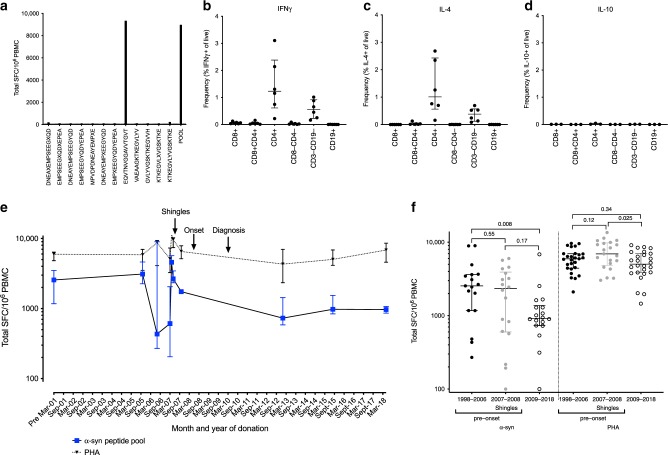
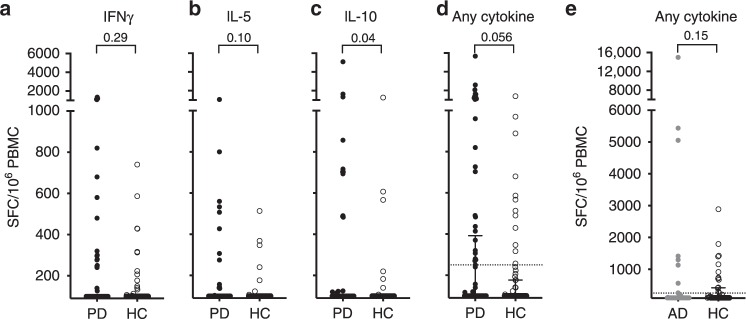
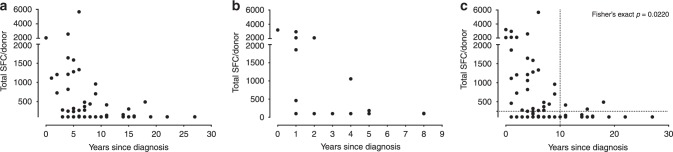
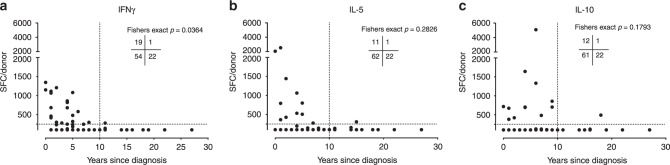
A diagnosis of motor Parkinson’s disease (PD) is preceded by a prolonged premotor phase with accumulating neuronal damage. Here we examined the temporal relation between α-synuclein (α-syn) T cell reactivity and PD. A longitudinal case study revealed that elevated α-syn-specific T cell responses were detected prior to the diagnosis of motor PD, and declined after. The relationship between T cell reactivity and early PD in two independent cohorts showed that α-syn-specific T cell responses were highest shortly after diagnosis of motor PD and then decreased. Additional analysis revealed significant association of α-syn-specific T cell responses with age and lower levodopa equivalent dose. These results confirm the presence of α-syn-reactive T cells in PD and show that they are most abundant immediately after diagnosis of motor PD. These cells may be present years before the diagnosis of motor PD, suggesting avenues of investigation into PD pathogenesis and potential early diagnosis.
Overview
The claims and statistics of this paper haven’t been checked yet.
Free: it reads the open-access text and checks the first 5 claims that cite a source we can check. Create a free account to check every claim.
Integrity signals
Registry
Cites
Statistics
Figures
Verification
Claims the paper makes
The claims and statistics of this paper haven’t been checked yet.
Free: it reads the open-access text and checks the first 5 claims that cite a source we can check. Create a free account to check every claim.
Claims other papers make about this one
Each is checked against this paper’s own text: does it say what the citing paper says it does?
The source backs part of the claim, not all of it — or backs it for a different population, condition or comparison.
In the citing paper
“Microglia activation by α-synuclein aggregates or other factors can increase the expression of MHC I expression on neurons, enhance the presentation of α-synuclein antigens by neurons, which were subsequently killed by α-synuclein reactive T cells.74–76”
From Role of neuroinflammation in neurodegeneration development (2023) · cites this paper as [75]
Experimental — accuracy not yet measuredThe source backs part of the claim, not all of it — or backs it for a different population, condition or comparison.
In the citing paper
“A high number of T cells response to α-synuclein were found in the brain of PD patients and mouse model.”
From Role of neuroinflammation in neurodegeneration development (2023) · cites this paper as [75]
Experimental — accuracy not yet measuredThe source backs part of the claim, not all of it — or backs it for a different population, condition or comparison.
In the citing paper
“Recently, numerous evidences suggest that adaptive immune system plays important role in approximately 40% PD.”
From Role of neuroinflammation in neurodegeneration development (2023) · cites this paper as [75]
Experimental — accuracy not yet measuredThe cited source says what the claim attributes to it.
In the citing paper
“A strong CD4 + T cell response to a-synuclein epitopes can be detected before the onset and diagnosis of Parkinson's disease.95”
From The role of gut dysbiosis in Parkinson’s disease: mechanistic insights and therapeutic options (2021) · cites this paper as [95]
Self-check
Percentages, sums and reported differences re-computed from the paper’s own numbers.
The self-check needs the paper’s full text.
Citations
Cites
McKhann, G., Drachman, D., Folstein, M., Katzman, R., Price, D., & Stadlan, E. M. (1984) · Neurology · doi:10.1212/wnl.34.7.939 · Cited by 27,915
The Montreal Cognitive Assessment, MoCA: a brief screening tool for mild cognitive impairment
Nasreddine, Z. S., Phillips, N. A., Bédirian, V., Charbonneau, S., Whitehead, V., Collin, I., Cummings, J. L., & Chertkow, H. (2005) · Journal of the American Geriatrics Society · doi:10.1111/j.1532-5415.2005.53221.x · Cited by 25,553
McKhann, G. M., Knopman, D. S., Chertkow, H., Hyman, B. T., Jack, C. R., Kawas, C. H., Klunk, W. E., Koroshetz, W. J., Manly, J. J., Mayeux, R., et al. (2011) · Alzheimer's & Dementia · doi:10.1016/j.jalz.2011.03.005 · Cited by 18,657
Systematic review of levodopa dose equivalency reporting in Parkinson's disease
Tomlinson, C. L., Stowe, R., Patel, S., Rick, C., Gray, R., & Clarke, C. E. (2010) · Movement Disorders · doi:10.1002/mds.23429 · Cited by 4,219
Evolution of the immune system in humans from infancy to old age
Simon, A. K., Hollander, G. A., & McMichael, A. (2015) · Proceedings of the Royal Society B: Biological Sciences · doi:10.1098/rspb.2014.3085 · Cited by 1,796
Incidence of Parkinson's Disease: Variation by Age, Gender, and Race/Ethnicity
Van Den Eeden, S. K. (2003) · American Journal of Epidemiology · doi:10.1093/aje/kwg068 · Cited by 1,747
Disease duration and the integrity of the nigrostriatal system in Parkinson’s disease
Kordower, J. H., Olanow, C. W., Dodiya, H. B., Chu, Y., Beach, T. G., Adler, C. H., Halliday, G. M., & Bartus, R. T. (2013) · Brain · doi:10.1093/brain/awt192 · Cited by 1,286
Accuracy of clinical diagnosis of Parkinson disease: A systematic review and meta-analysis
Rizzo, G., Copetti, M., Arcuti, S., Martino, D., Fontana, A., & Logroscino, G. (2016) · Neurology · doi:10.1212/wnl.0000000000002350 · Cited by 870
T cells from patients with Parkinson’s disease recognize α-synuclein peptides
Sulzer, D., Alcalay, R. N., Garretti, F., Cote, L., Kanter, E., Agin-Liebes, J., Liong, C., McMurtrey, C., Hildebrand, W. H., Mao, X., et al. (2017) · Nature · doi:10.1038/nature22815 · Cited by 866
Self-citationThe who's who of T ‐cell differentiation: Human memory T ‐cell subsets
Mahnke, Y. D., Brodie, T. M., Sallusto, F., Roederer, M., & Lugli, E. (2013) · European Journal of Immunology · doi:10.1002/eji.201343751 · Cited by 817
Self-citationSystematic evaluation of rating scales for impairment and disability in Parkinson's disease
Ramaker, C., Marinus, J., Stiggelbout, A. M., & van Hilten, B. J. (2002) · Movement Disorders · doi:10.1002/mds.10248 · Cited by 666
Role of the innate and adaptive immune responses in the course of multiple sclerosis
Hemmer, B., Kerschensteiner, M., & Korn, T. (2015) · The Lancet Neurology · doi:10.1016/s1474-4422(14)70305-9 · Cited by 584
Advances in markers of prodromal Parkinson disease
Postuma, R. B., & Berg, D. (2016) · Nature Reviews Neurology · doi:10.1038/nrneurol.2016.152 · Cited by 405
Peter, I., Dubinsky, M., Bressman, S., Park, A., Lu, C., Chen, N., & Wang, A. (2018) · JAMA Neurology · doi:10.1001/jamaneurol.2018.0605 · Cited by 386
Autoreactive T cells in type 1 diabetes
Pugliese, A. (2017) · Journal of Clinical Investigation · doi:10.1172/jci94549 · Cited by 358
T cells in patients with narcolepsy target self-antigens of hypocretin neurons
Latorre, D., Kallweit, U., Armentani, E., Foglierini, M., Mele, F., Cassotta, A., Jovic, S., Jarrossay, D., Mathis, J., Zellini, F., et al. (2018) · Nature · doi:10.1038/s41586-018-0540-1 · Cited by 332
Neuronal vulnerability, pathogenesis, and Parkinson's disease
Sulzer, D., & Surmeier, D. J. (2013) · Movement Disorders · doi:10.1002/mds.25095 · Cited by 315
Self-citationSulzer, D., Cassidy, C., Horga, G., Kang, U. J., Fahn, S., Casella, L., Pezzoli, G., Langley, J., Hu, X. P., Zucca, F. A., et al. (2018) · npj Parkinson's Disease · doi:10.1038/s41531-018-0047-3 · Cited by 270
Self-citationNeurodegeneration and neuroprotection in Parkinson disease
Fahn, S., & Sulzer, D. (2004) · NeuroRX · doi:10.1602/neurorx.1.1.139 · Cited by 257
Self-citationTregs: Where We Are and What Comes Next?
Zhao, H., Liao, X., & Kang, Y. (2017) · Frontiers in Immunology · doi:10.3389/fimmu.2017.01578 · Cited by 196
Weihofen, A., Liu, Y., Arndt, J. W., Huy, C., Quan, C., Smith, B. A., Baeriswyl, J.-L., Cavegn, N., Senn, L., Su, L., et al. (2019) · Neurobiology of Disease · doi:10.1016/j.nbd.2018.10.016 · Cited by 195
Longitudinal follow-up of SWEDD subjects in the PRECEPT Study
Marek, K., Seibyl, J., Eberly, S., Oakes, D., Shoulson, I., Lang, A. E., Hyson, C., Jennings, D., & For The Parkinson Study Group PRECEPT Investigators (2014) · Neurology · doi:10.1212/wnl.0000000000000424 · Cited by 168
Gendelman, H. E., Zhang, Y., Santamaria, P., Olson, K. E., Schutt, C. R., Bhatti, D., Shetty, B. L. D., Lu, Y., Estes, K. A., Standaert, D. G., et al. (2017) · npj Parkinson's Disease · doi:10.1038/s41531-017-0013-5 · Cited by 145
Self-citationβ-Synuclein-reactive T cells induce autoimmune CNS grey matter degeneration
Lodygin, D., Hermann, M., Schweingruber, N., Flügel-Koch, C., Watanabe, T., Schlosser, C., Merlini, A., Körner, H., Chang, H.-F., Fischer, H. J., et al. (2019) · Nature · doi:10.1038/s41586-019-0964-2 · Cited by 140
Cebrián, C., Loike, J. D., & Sulzer, D. (2014) · Frontiers in Neuroanatomy · doi:10.3389/fnana.2014.00114 · Cited by 117
Self-citationAccuracy of clinical diagnosis of Parkinson disease: A systematic review and meta-analysis
Jellinger, K. A. (2016) · Neurology · doi:10.1212/wnl.0000000000002876 · Cited by 104
Pilotto, A., Heinzel, S., Suenkel, U., Lerche, S., Brockmann, K., Roeben, B., Schaeffer, E., Wurster, I., Yilmaz, R., Liepelt‐Scarfone, I., et al. (2017) · Movement Disorders · doi:10.1002/mds.27035 · Cited by 95
Hepatitis C virus infection: a risk factor for Parkinson's disease
Wu, W. Y. ‐., Kang, K. ‐., Chen, S. L. ‐., Chiu, S. Y. ‐., Yen, A. M. ‐., Fann, J. C. ‐., Su, C. ‐., Liu, H. ‐., Lee, C. ‐., Fu, W. ‐., et al. (2015) · Journal of Viral Hepatitis · doi:10.1111/jvh.12392 · Cited by 88
Immunotherapy in Parkinson’s Disease: Micromanaging Alpha-Synuclein Aggregation
George, S., & Brundin, P. (2015) · Journal of Parkinson's Disease · doi:10.3233/jpd-150630 · Cited by 86
Expanding Role of T Cells in Human Autoimmune Diseases of the Central Nervous System
Pilli, D., Zou, A., Tea, F., Dale, R. C., & Brilot, F. (2017) · Frontiers in Immunology · doi:10.3389/fimmu.2017.00652 · Cited by 78
Hollenbach, J. A., Norman, P. J., Creary, L. E., Damotte, V., Montero-Martin, G., Caillier, S., Anderson, K. M., Misra, M. K., Nemat-Gorgani, N., Osoegawa, K., et al. (2019) · Proceedings of the National Academy of Sciences · doi:10.1073/pnas.1821778116 · Cited by 76
Cebrián, C., Loike, J. D., & Sulzer, D. (2014) · Current Topics in Behavioral Neurosciences · doi:10.1007/7854_2014_356 · Cited by 65
Self-citationA Population Response Analysis Approach To Assign Class II HLA-Epitope Restrictions
Paul, S., Dillon, M. B. C., Lindestam Arlehamn, C. S., Huang, H., Davis, M. M., McKinney, D. M., Scriba, T. J., Sidney, J., Peters, B., & Sette, A. (2015) · The Journal of Immunology · doi:10.4049/jimmunol.1403074 · Cited by 41
Self-citationWidespread Tau-Specific CD4 T Cell Reactivity in the General Population
Lindestam Arlehamn, C. S., Pham, J., Alcalay, R. N., Frazier, A., Shorr, E., Carpenter, C., Sidney, J., Dhanwani, R., Agin-Liebes, J., Garretti, F., et al. (2019) · The Journal of Immunology · doi:10.4049/jimmunol.1801506 · Cited by 41
Self-citationAssociation of T-cell reactivity with β-cell function in recent onset type 1 diabetes patients
Pfleger, C., Meierhoff, G., Kolb, H., & Schloot, N. C. (2009) · Journal of Autoimmunity · doi:10.1016/j.jaut.2009.08.004 · Cited by 40
Association between hepatitis C virus infection and Parkinson's disease
Kim, J., Jang, E. S., Ok, K. S., Oh, E., Kim, K. J., Jeon, B., Jo, H. J., Ki, M., & Jeong, S. (2016) · Movement Disorders · doi:10.1002/mds.26755 · Cited by 28
Deep Profiling Human T Cell Heterogeneity by Mass Cytometry
Cheng, Y., & Newell, E. W. (2016) · Advances in immunology · doi:10.1016/bs.ai.2016.02.002 · Cited by 23
Hepatitis C virus infection: a risk factor for Parkinson's disease
Wangensteen, K. J., Krawitt, E. L., Hamill, R. W., & Boyd, J. T. (2016) · Journal of Viral Hepatitis · doi:10.1111/jvh.12517 · Cited by 18
Maletto, B. A., Gruppi, A., & Pistoresi-Palencia, M. C. (1994) · Immunology Letters · doi:10.1016/0165-2478(93)00051-e · Cited by 12
Cited by
Role of neuroinflammation in neurodegeneration development
Zhang, W., Xiao, D., Mao, Q., & Xia, H. (2023) · Signal Transduction and Targeted Therapy · doi:10.1038/s41392-023-01486-5 · Cited by 1,668
Inflammation and immune dysfunction in Parkinson disease
Tansey, M. G., Wallings, R. L., Houser, M. C., Herrick, M. K., Keating, C. E., & Joers, V. (2022) · Nature Reviews Immunology · doi:10.1038/s41577-022-00684-6 · Cited by 1,382
The pathogenesis of Parkinson's disease
Morris, H. R., Spillantini, M. G., Sue, C. M., & Williams-Gray, C. H. (2024) · The Lancet · doi:10.1016/s0140-6736(23)01478-2 · Cited by 1,019
Calabresi, P., Mechelli, A., Natale, G., Volpicelli-Daley, L., Di Lazzaro, G., & Ghiglieri, V. (2023) · Cell Death & Disease · doi:10.1038/s41419-023-05672-9 · Cited by 817
Transforming the understanding of brain immunity
Castellani, G., Croese, T., Peralta Ramos, J. M., & Schwartz, M. (2023) · Science · doi:10.1126/science.abo7649 · Cited by 386
Metadata
- Authors
- Lindestam Arlehamn, C. S., Dhanwani, R., Pham, J., Kuan, R., Frazier, A., Rezende Dutra, J., Phillips, E., Mallal, S., Roederer, M., Marder, K. S., Amara, A. W., Standaert, D. G., Goldman, J. G., Litvan, I., Peters, B., Sulzer, D., & Sette, A.
- Affiliations
- La Jolla Institute for Immunology (US)
- Murdoch University (AU)
- National Institutes of Health (US)
- Columbia University Irving Medical Center (US)
- University of Alabama at Birmingham (US)
- Northwestern University (US)
- University of California San Diego (US)
- Corresponding author
- Sulzer, David
- Sette, Alessandro
- ORCID
- Venue
- Nature Communications
- Published
- 2020-04-20
- Volume
- 11
- Issue
- 1
- Pages
- 1875-1875
- ISSN
- 2041-1723 (ISSN-L)
- PMC
- PMC7171193
- OpenAlex
- W3016458340
- Semantic Scholar
- 4892a025b9032bb745aa0ad742988ec589d462e5
- Cited by
- 386
- References
- 40
- Citations by year
- 2026: 33 · 2025: 59 · 2024: 72 · 2023: 70 · 2022: 82 · 2021: 54 · 2020: 15
- FWCI
- 23.92
- Type
- journal article
- Language
- en
- Open access
- gold
- doi.org
- Licence
- cc-by
- creativecommons.org/licenses/by/4.0 (tdm)
- creativecommons.org/licenses/by/4.0 (vor)
- Locations
- Nature Communications (publishedVersion, cc-by)
- PubMed Central (publishedVersion, cc-by)
- PubMed (publishedVersion)
- Murdoch University Research Portal (submittedVersion)
- DOAJ (DOAJ: Directory of Open Access Journals) (submittedVersion, cc-by-sa)
- eScholarship (California Digital Library) (submittedVersion)
- Funders
- U.S. Department of Health & Human Services | NIH | National Institute of Neurological Disorders and Stroke (R01NS095435, P50NS108675)
- U.S. Department of Health & Human Services | NIH | National Institute on Aging (P50AG08702)
- Parkinson's Foundation
- Michael J. Fox Foundation for Parkinson's Research
- UCSD-LJI Program in Immunology
- Topics
- Health Sciences › Medicine › Clinical Neurology › Parkinson's Disease Mechanisms and Treatments
- Life Sciences › Neuroscience › Neurology › Neuroinflammation and Neurodegeneration Mechanisms
- Life Sciences › Biochemistry, Genetics and Molecular Biology › Molecular Biology › Nuclear Receptors and Signaling
- Keywords
- alpha-synuclein, T cell response, Parkinson's disease, early diagnosis, autoimmunity, levodopa equivalent daily dose, pathogenesis
- MeSH terms
- Aged, Aged, 80 and over, Female, Humans, Levodopa, Longitudinal Studies, Male, Middle Aged, Neurons, Parkinson Disease, T-Lymphocytes, Cytokines, alpha-Synuclein
About these checks
Registry, retraction, Cites and statistics results are computed, not judged, with one exception: a printed reference that no index lists is read once by a model before it counts as a citation error. Claims are extracted by a model and kept only when their quote appears verbatim in the text; each cited source is then checked, with a model’s help, for whether it says what the claim relies on. Those verdicts can be wrong — read the claim’s quote and the cited source before relying on one.
Statistics and arithmetic are recomputed, not judged.
Confidence bands are shown only for fields calibrated on our annotated test set. None is calibrated yet, so no band is shown.
What counts as a claim ›How we measure confidence ›How we check this ›
Are you an author, or do you see a problem with this page? Request a review
Data sources
Bibliographic data: Semantic Scholar, OpenAlex, Crossref.
Contains information from the Semantic Scholar Academic Graph Datasets, made available under the ODC Attribution License (ODC-BY 1.0).
Semantic Scholar’s data is described in: Kinney, R., et al. (2023). The Semantic Scholar Open Data Platform. arXiv:2301.10140.
