

Spin-controlled generation of indistinguishable and distinguishable photons from silicon vacancy centres in silicon carbide
Open accessThe DOI matches its Crossref record; 64 of the 64 references it cites were found in a registry or an index.
Abstract
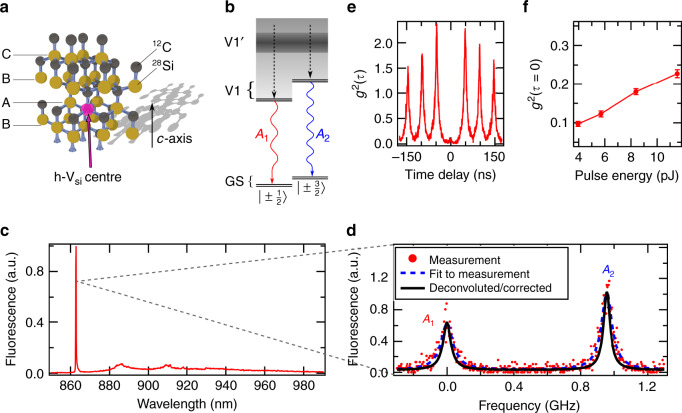
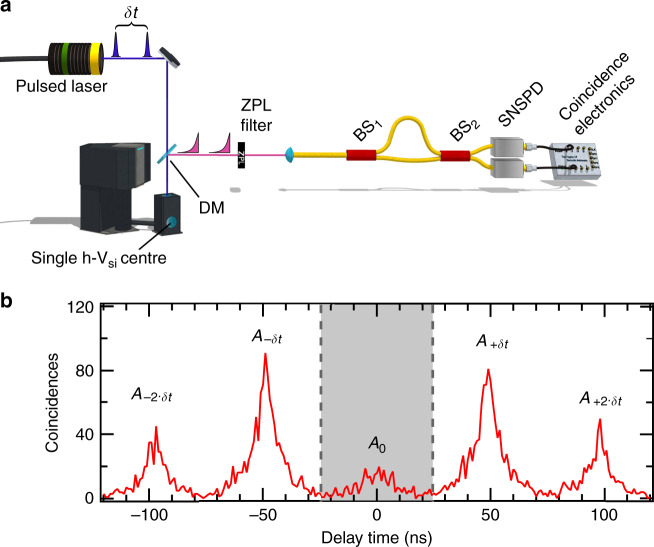
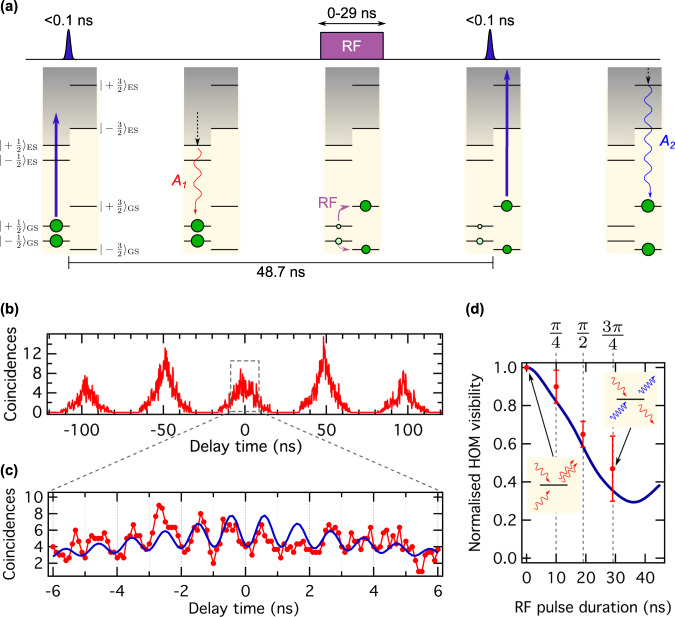
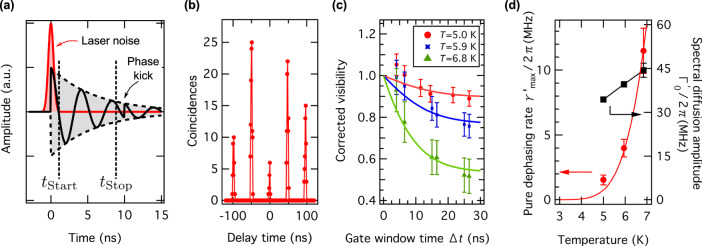
Quantum systems combining indistinguishable photon generation and spin-based quantum information processing are essential for remote quantum applications and networking. However, identification of suitable systems in scalable platforms remains a challenge. Here, we investigate the silicon vacancy centre in silicon carbide and demonstrate controlled emission of indistinguishable and distinguishable photons via coherent spin manipulation. Using strong off-resonant excitation and collecting zero-phonon line photons, we show a two-photon interference contrast close to 90% in Hong-Ou-Mandel type experiments. Further, we exploit the system’s intimate spin-photon relation to spin-control the colour and indistinguishability of consecutively emitted photons. Our results provide a deep insight into the system’s spin-phonon-photon physics and underline the potential of the industrially compatible silicon carbide platform for measurement-based entanglement distribution and photonic cluster state generation. Additional coupling to quantum registers based on individual nuclear spins would further allow for high-level network-relevant quantum information processing, such as error correction and entanglement purification.
Overview
The claims and statistics of this paper haven’t been checked yet.
Free: it reads the open-access text and checks the first 5 claims that cite a source we can check. Create a free account to check every claim.
Integrity signals
Registry
Cites
Statistics
Figures
Verification
Claims the paper makes
The claims and statistics of this paper haven’t been checked yet.
Free: it reads the open-access text and checks the first 5 claims that cite a source we can check. Create a free account to check every claim.
Claims other papers make about this one
Each is checked against this paper’s own text: does it say what the citing paper says it does?
The cited source says what the claim attributes to it.
In the citing paper
“Demonstration of indistinguishable photon emission from a single SiV [133] represents an excellent steppingstone toward both multi-emitter entanglement and cluster-entangled state generation.”
From 2022 Roadmap on integrated quantum photonics (2022) · cites this paper as [133]
Self-check
Percentages, sums and reported differences re-computed from the paper’s own numbers.
The self-check needs the paper’s full text.
Citations
Cites
Kimble, H. J. (2008) · Nature · doi:10.1038/nature07127 · Cited by 6,023
Measurement of subpicosecond time intervals between two photons by interference
Hong, C. K., Ou, Z. Y., & Mandel, L. (1987) · Physical Review Letters · doi:10.1103/physrevlett.59.2044 · Cited by 4,369
Long-distance quantum communication with atomic ensembles and linear optics
Duan, L.-M., Lukin, M. D., Cirac, J. I., & Zoller, P. (2001) · Nature · doi:10.1038/35106500 · Cited by 3,609
Loophole-free Bell inequality violation using electron spins separated by 1.3 kilometres
Hensen, B., Bernien, H., Dréau, A. E., Reiserer, A., Kalb, N., Blok, M. S., Ruitenberg, J., Vermeulen, R. F. L., Schouten, R. N., Abellán, C., et al. (2015) · Nature · doi:10.1038/nature15759 · Cited by 2,852
Indistinguishable photons from a single-photon device
Santori, C., Fattal, D., Vučković, J., Solomon, G. S., & Yamamoto, Y. (2002) · Nature · doi:10.1038/nature01086 · Cited by 1,559
A Test of a New Type of Stellar Interferometer on Sirius
HANBURY BROWN, R., & TWISS, R. Q. (1956) · Nature · doi:10.1038/1781046a0 · Cited by 1,559
High-performance semiconductor quantum-dot single-photon sources
Senellart, P., Solomon, G., & White, A. (2017) · Nature Nanotechnology · doi:10.1038/nnano.2017.218 · Cited by 1,237
Near-optimal single-photon sources in the solid state
Somaschi, N., Giesz, V., De Santis, L., Loredo, J. C., Almeida, M. P., Hornecker, G., Portalupi, S. L., Grange, T., Antón, C., Demory, J., et al. (2016) · Nature Photonics · doi:10.1038/nphoton.2016.23 · Cited by 1,229
Fundamentals of Silicon Carbide Technology: Growth, Characterization, Devices, and Applications
Kimoto, T., & Cooper, J. A. (2014) · Wiley eBooks · doi:10.1002/9781118313534 · Cited by 1,219
Heralded entanglement between solid-state qubits separated by three metres
Bernien, H., Hensen, B., Pfaff, W., Koolstra, G., Blok, M. S., Robledo, L., Taminiau, T. H., Markham, M., Twitchen, D. J., Childress, L., et al. (2013) · Nature · doi:10.1038/nature12016 · Cited by 1,187
Cited by
Integrated Quantum Photonics with Silicon Carbide: Challenges and Prospects
Lukin, D. M., Guidry, M. A., & Vučković, J. (2020) · PRX Quantum · doi:10.1103/prxquantum.1.020102 · Cited by 219
“SiC has emerged as a promising platform for realizing this technology, with demonstrations of wafer-scale integration of high-quality emitters into semiconductor junctions [63], isotopic engineering for nuclear spin registers [88], indistinguishable single-photon emission [52], and a quantum-grade SiC-on-insulator pla…”
BackgroundInfluentialMaterial platforms for defect qubits and single-photon emitters
Zhang, G., Cheng, Y., Chou, J.-P., & Gali, A. (2020) · Applied Physics Reviews · doi:10.1063/5.0006075 · Cited by 207
Developing silicon carbide for quantum spintronics
Son, N. T., Anderson, C. P., Bourassa, A., Miao, K. C., Babin, C., Widmann, M., Niethammer, M., Ul Hassan, J., Morioka, N., Ivanov, I. G., et al. (2020) · Applied Physics Letters · doi:10.1063/5.0004454 · Cited by 190
Self-citationBabin, C., Stöhr, R., Morioka, N., Linkewitz, T., Steidl, T., Wörnle, R., Liu, D., Hesselmeier, E., Vorobyov, V., Denisenko, A., et al. (2022) · Nature Materials · doi:10.1038/s41563-021-01148-3 · Cited by 189
Self-citationOptical parametric oscillation in silicon carbide nanophotonics
Guidry, M. A., Yang, K. Y., Lukin, D. M., Markosyan, A., Yang, J., Fejer, M. M., & Vučković, J. (2020) · Optica · doi:10.1364/optica.394138 · Cited by 153
Silicon Carbide Photonics Bridging Quantum Technology
Castelletto, S., Peruzzo, A., Bonato, C., Johnson, B. C., Radulaski, M., Ou, H., Kaiser, F., & Wrachtrup, J. (2022) · ACS Photonics · doi:10.1021/acsphotonics.1c01775 · Cited by 146
Self-citationGeneralized scaling of spin qubit coherence in over 12,000 host materials
Kanai, S., Heremans, F. J., Seo, H., Wolfowicz, G., Anderson, C. P., Sullivan, S. E., Onizhuk, M., Galli, G., Awschalom, D. D., & Ohno, H. (2022) · Proceedings of the National Academy of Sciences · doi:10.1073/pnas.2121808119 · Cited by 150
Li, Q., Wang, J.-F., Yan, F.-F., Zhou, J.-Y., Wang, H., Liu, H., Guo, L.-P., Zhou, X., Gali, Á., Liu, Z.-H., et al. (2021) · National Science Review · doi:10.1093/nsr/nwab122 · Cited by 134
“T2 can be dramatically improved by using SiC samples with lower nitrogen concentrations and isotopic purification [44, 45], as well as by optimizing the conditions of implantation and annealing, similar to the strategies usually adopted for NV centres in diamond [46, 47].”
MethodColloquium : Cavity-enhanced quantum network nodes
Reiserer, A. (2022) · Reviews of Modern Physics · doi:10.1103/revmodphys.94.041003 · Cited by 116
“In particular, silicon vacancy centers (Nagy et al., 2019; Riedel et al., 2012) have demonstrated the generation of indistinguishable photons (Morioka et al., 2020) with high efficiency (Babin et al., 2021; Lukin et al., 2020), making SiC a promising candidate for the scaling of quantum networks.”
BackgroundUdvarhelyi, P., Thiering, G., Morioka, N., Babin, C., Kaiser, F., Lukin, D. M., Ohshima, T., Ul-Hassan, J., Són, N. T., Vučković, J., et al. (2020) · Physical Review Applied · doi:10.1103/physrevapplied.13.054017 · Cited by 106
Self-citationTwo-Emitter Multimode Cavity Quantum Electrodynamics in Thin-Film Silicon Carbide Photonics
Lukin, D. M., Guidry, M. A., Yang, J. S., Ghezellou, M., Mishra, S. D., Abe, H., Ohshima, T., Ul‐Hassan, J., & Vučković, J. (2023) · Physical Review X · doi:10.1103/physrevx.13.011005 · Cited by 108
“We note that while above-resonant excitation in bulk crystal has been used to obtain nearly transform-limited photon emission from the VSi [27], we observe that in nanostructures it induces rapid spectral diffusion due to disturbance of the surface charge environment, broadening the optical linewidths to approximately…”
MethodSelf-citationSilicon carbide single-photon sources: challenges and prospects
Castelletto, S. (2021) · Materials for Quantum Technology · doi:10.1088/2633-4356/abe04a · Cited by 87
Spectrally reconfigurable quantum emitters enabled by optimized fast modulation
Lukin, D. M., White, A. D., Trivedi, R., Guidry, M. A., Morioka, N., Babin, C., Soykal, Ö. O., Ul-Hassan, J., Són, N. T., Ohshima, T., et al. (2020) · npj Quantum Information · doi:10.1038/s41534-020-00310-0 · Cited by 87
Self-citationManipulating Single‐Photon Emission from Point Defects in Diamond and Silicon Carbide
Bathen, M. E., & Vines, L. (2021) · Advanced Quantum Technologies · doi:10.1002/qute.202100003 · Cited by 79
Two-Photon Interference from a Quantum Emitter in Hexagonal Boron Nitride
Fournier, C., Roux, S., Watanabe, K., Taniguchi, T., Buil, S., Barjon, J., Hermier, J., & Delteil, A. (2023) · Physical Review Applied · doi:10.1103/physrevapplied.19.l041003 · Cited by 83
Photonic Indistinguishability of the Tin-Vacancy Center in Nanostructured Diamond
Martínez, J. A., Parker, R. A., Chen, K. C., Purser, C. M., Li, L., Michaels, C. P., Stramma, A. M., Debroux, R., Harris, I., Appel, M. H., et al. (2022) · Physical Review Letters · doi:10.1103/physrevlett.129.173603 · Cited by 80
“This effect has been observed across multiple solid-state emitters such as the nitrogen, silicon, and germanium vacancies in diamond [14 – 16], defects in silicon carbide [17], and semiconductor quantum dots [18].”
BackgroundCharacterization methods for defects and devices in silicon carbide
Bathen, M. E., Lew, C. T.-K., Woerle, J., Dorfer, C., Großner, U., Castelletto, S., & Johnson, B. C. (2022) · Journal of Applied Physics · doi:10.1063/5.0077299 · Cited by 63
“102 Indistinguishable photon emission from the V Si defect has successfully been demonstrated to a contrast close to 90% 103 .”
BackgroundQuantum systems in silicon carbide for sensing applications
Castelletto, S., Lew, C. T.-K., Lin, W.-X., & Xu, J. (2023) · Reports on Progress in Physics · doi:10.1088/1361-6633/ad10b3 · Cited by 65
Wang, J., Liu, Z., Yan, F.-F., Li, Q., Yang, X., Guo, L., Zhou, X., Huang, W., Xu, J., Li, C., et al. (2020) · ACS Photonics · doi:10.1021/acsphotonics.0c00218 · Cited by 50
Quantum information processing with integrated silicon carbide photonics
Majety, S., Saha, P., Norman, V. A., & Radulaski, M. (2022) · Journal of Applied Physics · doi:10.1063/5.0077045 · Cited by 50
“In a recent experiment with silicon vacancy in 4H-SiC [28], the measured visibility was V = 0 .”
BackgroundMethodInfluentialLiu, D., Kaiser, F., Bushmakin, V., Hesselmeier, E., Steidl, T., Ohshima, T., Són, N. T., Ul‐Hassan, J., Soykal, Ö. O., & Wrachtrup, J. (2024) · npj Quantum Information · doi:10.1038/s41534-024-00861-6 · Cited by 52
“The lower fi delity in the latter case is caused by a small residual magnetic fi eld originating from the magnetization fi ciently large external magnetic fi eld 10,11 .”
Self-citationExperimental Generation of Spin-Photon Entanglement in Silicon Carbide
Fang, R.-Z., Lai, X.-Y., Li, T., Su, R.-Z., Lu, B.-W., Yang, C.-W., Liu, R., Qiao, Y.-K., Li, C., He, Z., et al. (2024) · Physical Review Letters · doi:10.1103/physrevlett.132.160801 · Cited by 48
“…stable optical transitions [20, 21], initiated and manipulated electron spins and nuclear spins [20, 22, 23], generated indistinguishable photons [24], and demonstrated the feasibility of integration with nanophotonics [25–28], long-lived storage and single-shot readout via charge state control…”
BackgroundPhoton-Emission-Correlation Spectroscopy as an Analytical Tool for Solid-State Quantum Defects
Fishman, R. E. K., Patel, R. N., Hopper, D. A., Huang, T., & Bassett, L. C. (2023) · PRX Quantum · doi:10.1103/prxquantum.4.010202 · Cited by 40
“kex (MHz) [25,50,100] [25,50,100] [25,50,100] [13.”
BackgroundQuantum Interference of Resonance Fluorescence from Germanium-Vacancy Color Centers in Diamond
Chen, D., Fröch, J. E., Ru, S., Cai, H., Wang, N., Adamo, G., Scott, J. A., Fu-li, L., Zheludev, N. I., Aharonovich, I., et al. (2022) · Nano Letters · doi:10.1021/acs.nanolett.2c01959 · Cited by 38
Isothermal annealing study of the EH1 and EH3 levels in n-type 4H-SiC
Alfieri, G., & Mihăilă, A. (2020) · Journal of Physics Condensed Matter · doi:10.1088/1361-648x/abaeaf · Cited by 35
Robust coherent control of solid-state spin qubits using anti-Stokes excitation
Wang, J., Yan, F.-F., Li, Q., Liu, Z., Cui, J., Liu, Z., Gali, Á., Xu, J., Li, C., & Guo, G. (2021) · Nature Communications · doi:10.1038/s41467-021-23471-8 · Cited by 37
Fluorescent Silicon Carbide Nanoparticles
de Vries, M., Sato, S., Ohshima, T., Gibson, B. C., Bluet, J., Castelletto, S., Johnson, B. C., & Reineck, P. (2021) · Advanced Optical Materials · doi:10.1002/adom.202100311 · Cited by 32
Self-citationTemperature dependence of divacancy spin coherence in implanted silicon carbide
Lin, W.-X., Yan, F.-F., Li, Q., Wang, J., Hao, Z.-H., Zhou, J.-Y., Li, H., You, L., Xu, J., Li, C., et al. (2021) · Physical review. B./Physical review. B · doi:10.1103/physrevb.104.125305 · Cited by 29
Astner, T., Koller, P., Gilardoni, C. M., Hendriks, J., Són, N. T., Ivanov, I. G., Ul‐Hassan, J., van der Wal, C. H., & Trupke, M. (2024) · Quantum Science and Technology · doi:10.1088/2058-9565/ad48b1 · Cited by 32
Self-citationScalable Quantum Memory Nodes Using Nuclear Spins in Silicon Carbide
Parthasarathy, S. K., Kallinger, B., Kaiser, F., Berwian, P., Dasari, D. B. R., Friedrich, J., & Nagy, R. (2023) · Physical Review Applied · doi:10.1103/physrevapplied.19.034026 · Cited by 29
Self-citationTransform-Limited Photon Emission from a Lead-Vacancy Center in Diamond above 10 K
Wang, P., Kazak, L., Senkalla, K., Siyushev, P., Abe, R., Taniguchi, T., Onoda, S., Kato, H., Makino, T., Hatano, M., et al. (2024) · Physical Review Letters · doi:10.1103/physrevlett.132.073601 · Cited by 40
Advances and challenges in 4H silicon carbide: defects and impurities
Yang, Y., Tong, Z., Pi, X., Yang, D., & Huang, Y. (2024) · Physica Scripta · doi:10.1088/1402-4896/ad6697 · Cited by 28
Single-Shot Readout of a Nuclear Spin in Silicon Carbide
Lai, X.-Y., Fang, R.-Z., Li, T., Su, R.-Z., Huang, J., Li, H., You, L., Bao, X., & Pan, J.-W. (2024) · Physical Review Letters · doi:10.1103/physrevlett.132.180803 · Cited by 31
Chandrasekaran, V., Titze, M., Flores, A. R., Campbell, D., Henshaw, J., Jones, A. C., Bielejec, E. S., & Htoon, H. (2023) · Advanced Science · doi:10.1002/advs.202300190 · Cited by 26
Spectral stability of V2 centres in sub-micron 4H-SiC membranes
Heiler, J., Körber, J., Hesselmeier, E., Kuna, P., Stöhr, R., Fuchs, P., Ghezellou, M., Ul‐Hassan, J., Knolle, W., Becher, C., et al. (2024) · npj Quantum Materials · doi:10.1038/s41535-024-00644-4 · Cited by 27
“Additionally, colour centres in SiC have demonstrated nearly lifetime limited optical transitions, which enabled high-fidelity spin-photon interfaces that are suitable for quantum communication [13].”
BackgroundSelf-citationTowards quantum light-emitting devices based on van der Waals materials
Loh, L., Wang, J., Grzeszczyk, M., Koperski, M., & Eda, G. (2024) · Nature Reviews Electrical Engineering · doi:10.1038/s44287-024-00108-8 · Cited by 29
“Materials are arranged from high to low dimensions, starting from diamonds 184–188 , SiC 11,189,190 , ZnO 191,192 , yttrium aluminium garnet/yttrium orthosilicate (YAG/YSO) 193,194 , group III nitrides 195 and silicon 196–199 (3D), via quantum wells 200,201 (quasi-2D), transition metal…”
Maskless Generation of Single Silicon Vacancy Arrays in Silicon Carbide by a Focused He+ Ion Beam
He, Z.-X., Li, Q., Wen, X., Zhou, J.-Y., Lin, W.-X., Hao, Z.-H., Xu, J., Li, C., & Guo, G. (2022) · ACS Photonics · doi:10.1021/acsphotonics.2c01209 · Cited by 28
Strain Modulation of Si Vacancy Emission from SiC Micro- and Nanoparticles
Vásquez, G. C., Bathen, M. E., Galeckas, A., Bazioti, C., Johansen, K. M., Maestre, D., Cremades, A., Prytz, Ø., Moe, A. M., Kuznetsov, A. Y., et al. (2020) · Nano Letters · doi:10.1021/acs.nanolett.0c03472 · Cited by 23
“To generate indistinguishable photons, the wavelength emission should be identical for various VSi centers [26].”
Narrow inhomogeneous distribution of spin-active emitters in silicon carbide
Nagy, R., Dasari, D. B. R., Babin, C., Liu, D., Vorobyov, V., Niethammer, M., Widmann, M., Linkewitz, T., Gediz, I., Stöhr, R., et al. (2021) · Applied Physics Letters · doi:10.1063/5.0046563 · Cited by 25
“We also compare our results to previous results obtained in 4H-SiC with ≈ 10× lower h-VSi center densities [33, 36].”
BackgroundResultSelf-citationSilicon carbide: A promising platform for scalable quantum networks
Zhou, Y., Tan, J., Hu, H., Hua, S., Jiang, C., Liang, B., Bao, T., Nie, X., Xiao, S., Lu, D., et al. (2025) · Applied Physics Reviews · doi:10.1063/5.0262377 · Cited by 27
Spin-Optical Dynamics and Quantum Efficiency of a Single V1 Center in Silicon Carbide
Morioka, N., Liu, D., Soykal, Ö. O., Gediz, I., Babin, C., Stöhr, R., Ohshima, T., Són, N. T., Ul‐Hassan, J., Kaiser, F., et al. (2022) · Physical Review Applied · doi:10.1103/physrevapplied.17.054005 · Cited by 23
“Single silicon vacancy centers at hexagonal sites in 4H polytype (V1) exhibit excellent spin and optical properties [14, 15] functioning at around liquid helium temperature [15, 16].”
BackgroundMethodInfluentialSelf-citationGao, Y., Lai, J., Sun, Y., Liu, X., Lin, C., Tan, P., Shan, C., & Zhang, J. (2022) · ACS Photonics · doi:10.1021/acsphotonics.1c01928 · Cited by 26
Quantum electrometer for time-resolved material science at the atomic lattice scale
Pieplow, G., Torun, C. G., Gurr, C., Munns, J. H. D., Herrmann, F. M., Thies, A., Pregnolato, T., & Schröder, T. (2025) · Nature Communications · doi:10.1038/s41467-025-61839-2 · Cited by 21
“…motional heating 20 ; super-conducting qubits suffer from defect-induced charge-noise 21,22 ; in atom-like spin qubits in wide-bandgap semiconductors, charge-noise leads to optical and spin decoherence 5,13,23 – 25 , signi fi cantly limiting the development of quantum networking and sensing 26,27 .”
Coherent photoelectrical readout of single spins in silicon carbide at room temperature
Nishikawa, T., Morioka, N., Abe, H., Murata, K., Okajima, K., Ohshima, T., Tsuchida, H., & Mizuochi, N. (2025) · Nature Communications · doi:10.1038/s41467-025-58629-1 · Cited by 24
“Finally if the second step, i.i. photoionization is 50 times smaller than the first step, it means that 50 x more photons are needed for this step.”
Self-citationSub-second spin and lifetime-limited optical coherences in 171Yb3+:CaWO4
Tiranov, A., Green, E., Hermans, S., Liu, E., Chiossi, F., Serrano, D., Loiseau, P., Kumar, A. M., Bertaina, S., Faraon, A., et al. (2026) · Nature Communications · doi:10.1038/s41467-026-70534-9 · Cited by 23
Perspective on Solid‐State Single‐Photon Sources in the Infrared for Quantum Technology
Castelletto, S., & Boretti, A. A. (2023) · Advanced Quantum Technologies · doi:10.1002/qute.202300145 · Cited by 22
Precise Characterization of a Waveguide Fiber Interface in Silicon Carbide
Krumrein, M., Nold, R., Davidson-Marquis, F., Bouamra, A. D., Niechziol, L., Steidl, T., Peng, R., Körber, J., Stöhr, R., Gross, N., et al. (2024) · ACS Photonics · doi:10.1021/acsphotonics.4c00538 · Cited by 27
Self-citationStress-controlled zero-field spin splitting in silicon carbide
Breev, I. D., Poshakinskiy, A. V., Yakovleva, V. V., Nagalyuk, S. S., Mokhov, E. N., Hübner, R., Astakhov, G. V., Baranov, P. G., & Anisimov, A. N. (2021) · Applied Physics Letters · doi:10.1063/5.0040936 · Cited by 19
Stress distribution at the AlN/SiC heterointerface probed by Raman spectroscopy
Breev, I. D., Likhachev, K. V., Yakovleva, V. V., Hübner, R., Astakhov, G. V., Baranov, P. G., Mokhov, E. N., & Anisimov, A. N. (2021) · Journal of Applied Physics · doi:10.1063/5.0029682 · Cited by 18
Pioneering the future with silicon carbide integrated photonics
Boretti, A. A., Li, Q., & Castelletto, S. (2024) · Optics & Laser Technology · doi:10.1016/j.optlastec.2024.111910 · Cited by 17
Laser Writing and Spin Control of Near-Infrared Emitters in Silicon Carbide
Hao, Z.-H., He, Z.-X., Maksimovic, J., Katkus, T. A., Xu, J., Juodkazis, S., Li, C., Guo, G.-C., & Castelletto, S. (2025) · ACS Photonics · doi:10.1021/acsphotonics.4c02270 · Cited by 18
Silicon carbide based quantum networking
Xu, J., Li, C., & Guo, G. (2021) · Fundamental Research · doi:10.1016/j.fmre.2020.11.004 · Cited by 19
Inverted fine structure of a 6H-SiC qubit enabling robust spin-photon interface
Breev, I. D., Shang, Z., Poshakinskiy, A. V., Singh, H., Berencén, Y., Hollenbach, M., Nagalyuk, S. S., Mokhov, E. N., Babunts, R. A., Baranov, P. G., et al. (2022) · npj Quantum Information · doi:10.1038/s41534-022-00534-2 · Cited by 19
“ZPLV3 1⁄4 PLatZPLV3 bZPLV1 cZPLV2 : (22)”
Qudit-Based Spectroscopy for Measurement and Control of Nuclear-Spin Qubits in Silicon Carbide
Hesselmeier, E., Kuna, P., Takács, I., Ivády, V., Knolle, W., Són, N. T., Ghezellou, M., Ul‐Hassan, J., Dasari, D. B. R., Kaiser, F., et al. (2024) · Physical Review Letters · doi:10.1103/physrevlett.132.090601 · Cited by 17
“Its electronic spin properties and inter-system crossings have been investigated in detail [23] and two-photon interference has been shown [24].”
BackgroundSelf-citationBader, J., Arianfard, H., Peruzzo, A., & Castelletto, S. (2024) · npj Nanophotonics · doi:10.1038/s44310-024-00031-8 · Cited by 14
“…spin quantum control 63 , electron-spin mediated nuclear spins control 19 , quantum operations 14 as well as indistinguishable single photons 16 have been identi fi ed in SiC so far, which could lead to further technological development in integrated quantum circuits as well as spin-photon…”
InfluentialQuantum-enhanced electric field mapping within semiconductor devices
Scheller, D., Hrunski, F. D., Schwarberg, J. H., Knolle, W., Soykal, Ö. O., Udvarhelyi, P., Narang, P., Weber, H. B., Hollendonner, M., & Nagy, R. (2025) · Physical Review Applied · doi:10.1103/pv13-vgcw · Cited by 14
“Especially color centers inside the crystal lattice show excellent optical and spin properties [13–17], establishing them as an ideal platform for quantum communication [18,19], quantum computing [20–22], and quantum sensing [23–26].”
Self-citationOpportunities and Challenges of Solid-State Quantum Nonlinear Optics
Kala, A., Sharp, D., Choi, M., Manna, A., Deshmukh, P., Veetil, V. K., Menon, V. M., Pelton, M. A., Waks, E., & Majumdar, A. (2025) · ACS Nano · doi:10.1021/acsnano.4c14992 · Cited by 17
Electrical detection of nuclear spins via silicon vacancies in silicon carbide at room temperature
Nishikawa, T., Morioka, N., Abe, H., Morishita, H., Ohshima, T., & Mizuochi, N. (2022) · Applied Physics Letters · doi:10.1063/5.0115928 · Cited by 14
Self-citationSilicon Carbide Pillar Lattice for Controlling the Spontaneous Emission of Embedded Color Centers
Ahamad, M. A., Ahmed, N., Castelletto, S., & Inam, F. A. (2023) · Journal of Lightwave Technology · doi:10.1109/jlt.2023.3319398 · Cited by 14
“The V Si in SiC is a promising single photon source (SPS) for spin-photon interface in the near infrared region around 917 nm. [12], [13].”
Selective Generation of V2 Silicon Vacancy Centers in 4H-Silicon Carbide
Xue, Y., Titze, M., Mack, J. P., Yang, Z., Zhang, L., Su, S. S., Zhang, Z., & Fan, L. (2024) · Nano Letters · doi:10.1021/acs.nanolett.3c03905 · Cited by 11
Anti-Stokes excitation of optically active point defects in semiconductor materials
Lin, W.-X., Wang, J., Li, Q., Zhou, J.-Y., Xu, J., Li, C., & Guo, G. (2022) · Materials for Quantum Technology · doi:10.1088/2633-4356/ac989a · Cited by 10
Isotope-Purification-Induced Reduction of Spin-Relaxation and Spin-Coherence Times in Semiconductors
Bulancea-Lindvall, O., Eiles, M. T., Són, N. T., Abrikosov, I. A., & Ivády, V. (2023) · Physical Review Applied · doi:10.1103/physrevapplied.19.064046 · Cited by 10
“[31] Naoya Morioka, Charles Babin, Roland Nagy, Izel Gediz, Erik Hesselmeier, Di Liu, Matthew Joliffe, Matthias Niethammer, Durga Dasari, Vadim Vorobyov, Roman Kolesov, Rainer Stöhr, Jawad Ul-Hassan, Nguyen Tien Son, Takeshi Ohshima, Péter Udvarhelyi, Gergő Thiering, Adam Gali, Jörg Wrachtrup, and Florian Kaiser, “Spi…”
BackgroundDefects in Silicon Carbide as Quantum Qubits: Recent Advances in Defect Engineering
Capan, I. (2025) · Applied Sciences · doi:10.3390/app15105606 · Cited by 9
“Various techniques have been developed to create and stabilize these defects, including ion implantation, neutron irradiation, and femtosecond laser processing [14,15,16,17,18].”
InfluentialZero-Field ODMR and relaxation of Si-vacancy centers in 6H-SiC
Singh, H., Anisimov, A. N., Baranov, P. G., & Suter, D. (2023) · Materials Research Express · doi:10.1088/2053-1591/ad0935 · Cited by 9
Inam, F. A., & Castelletto, S. (2023) · Nanomaterials · doi:10.3390/nano13010195 · Cited by 8
“Both V2 and V1 (V1’) lines have been studied for optical coherent spin control and qubit [32,33], single photon source [34] spin photon interface [35] and a source of indistiguishable single photon sources [36,37] and magnetic field sensing [38].”
BackgroundEnigmatic color centers in microdiamonds with bright, stable, and narrow-band fluorescence
Neliubov, A. Y., Eremchev, I. Y., Drachev, V. P., Kosolobov, S. S., Екимов, Е. А., Arzhanov, A. I., Tarasevich, A. O., & Наумов, А. В. (2023) · Physical review. B./Physical review. B · doi:10.1103/physrevb.107.l081406 · Cited by 8
Microwave-Assisted Spectroscopy of Vacancy-Related Spin Centers in Hexagonal SiC
Shang, Z., Berencén, Y., Hollenbach, M., Zhou, S., Kraus, H., Ohshima, T., & Astakhov, G. V. (2021) · Physical Review Applied · doi:10.1103/physrevapplied.15.034059 · Cited by 7
Self-citationSi, M., Zhou, L., Peng, W., Zhang, X., Yi, A., Wang, C., Zhou, H., Wang, Z., Ou, X., & You, L. (2023) · Applied Physics Letters · doi:10.1063/5.0164368 · Cited by 8
2022 Roadmap on integrated quantum photonics
Moody, G., Sorger, V. J., Blumenthal, D. J., Juodawlkis, P. W., Loh, W., Sorace-Agaskar, C., Jones, A. E., Balram, K. C., Matthews, J. C. F., Laing, A., et al. (2022) · Journal of Physics: Photonics · doi:10.1088/2515-7647/ac1ef4 · Cited by 6
“Other group IV color centers such as the germanium- (GeV) and tin- (SnV) vacancy centers share the structure of the SiV, making them promising candidates for further study [10]. a) and b) are reproduced with permission from [1]. unity quantum efficiency, long spin coherence times with optical addressability at elevate…”
BackgroundInfluentialQuantum defects in carbon nanotubes as single-photon sources
Chang, Y., Fortner, J., Chandrasekaran, V., Gifford, B. J., Weight, B. M., Doorn, S. K., Htoon, H., Kato, Y. K., Tretiak, S., & Wang, Y. (2026) · Communications Materials · doi:10.1038/s43246-026-01085-1 · Cited by 8
Raj, A., Sahu, S., Narayani, P. L., Sharma, L., Banerjee, S., & Tripathi, L. N. (2025) · Advanced Quantum Technologies · doi:10.1002/qute.202400648 · Cited by 6
Femtosecond laser-induced microstructuring and color centers in silicon carbide
Cunha, R. S., Paula, K. T., Andrade, M. B., Pimenta, A. C. S., Misoguti, L., & Mendonça, C. R. (2025) · Ceramics International · doi:10.1016/j.ceramint.2025.07.381 · Cited by 6
Silicon carbide incorporates quantum gates
Castelletto, S. (2021) · Nature Materials · doi:10.1038/s41563-021-01143-8 · Cited by 5
Chip-scale quantum sensors based on an integrated silicon carbide photonic platform
Castelletto, S., & Boretti, A. A. (2025) · Journal of Physics Photonics · doi:10.1088/2515-7647/ae0bd4 · Cited by 7
Zhao, X., Liu, M., Zhang, Q., & Duan, C. (2025) · Advanced Functional Materials · doi:10.1002/adfm.202526154 · Cited by 5
Park, J., Paik, S., Hwang, S.-J., Liu, D., Soykal, Ö. O., Wrachtrup, J., & Lee, S. (2024) · Physical Review Applied · doi:10.1103/physrevapplied.21.054005 · Cited by 4
Self-citationUnraveling the Electronic Structure of Silicon Vacancy Centers in 4H‐SiC
Younesi, A. T., Luu, M. T., Linderälv, C., Žalandauskas, V., Bathen, M. E., Són, N. T., Ohshima, T., Thiering, G., Razinkovas, L., & Ulbricht, R. (2026) · Advanced Functional Materials · doi:10.1002/adfm.76183 · Cited by 5
Self-citationEffect of Mechanical Stress on the Splitting of Spin Sublevels in 4H-SiC
Breev, I. D., Likhachev, K. V., Yakovleva, V. V., Veyshtort, I. P., Skomorokhov, A. M., Nagalyuk, S. S., Mokhov, E. N., Astakhov, G. V., Baranov, P. G., & Anisimov, A. N. (2021) · Journal of Experimental and Theoretical Physics Letters · doi:10.1134/s0021364021170057 · Cited by 3
Bright, narrow-linewidth color centers in Silicon Carbide-on-Insulator microresonators
Lukin, D. M., Guidry, M. A., Yang, J. S., Mishra, S. D., Ghezellou, M., Abe, H., Ohshima, T., Ul‐Hassan, J., & Vučković, J. (2022) · Conference on Lasers and Electro-Optics · doi:10.1364/cleo_qels.2022.fs4b.2 · Cited by 3
Self-citationNarrow magneto-optical transitions of erbium implanted into silicon carbide-on-insulator
Lyasota, A., Bader, J., Lim, S. Q., Johnson, B. C., McCallum, J. C., Li, Q., Rogge, S. M. J., & Castelletto, S. (2026) · Communications Materials · doi:10.1038/s43246-026-01154-5 · Cited by 4
“Assessing the optical properties of candidate spin-photon emitters in this platform is therefore a crucial step towards SiC-based scalable quantum networks.”
Photoionization Current Spectroscopy of Individual Silicon Vacancies in Silicon Carbide
Okajima, K., Nishikawa, T., Abe, H., Murata, K., Ohshima, T., Tsuchida, H., Morioka, N., & Mizuochi, N. (2026) · Nano Letters · doi:10.1021/acs.nanolett.5c05964 · Cited by 2
“Their excellent spin–photon properties, including long spin coherence 6,7,9,10 access to nuclear-spin memory 9,11 , spectral stability 7,9,12,13 , and recently demonstrated spin–photon entanglement 14 and nuclear-spin single-shot readout 15,16 , make them strong candidates for quantum networking…”
Self-citationSiC photonics with integrated color centers: Challenges and prospects
Cui, S., Lipton, J., & Huang, B. (2026) · MRS Bulletin · doi:10.1557/s43577-026-01061-7 · Cited by 3
Quantum networks using color defects in diamond: principles, progress, and perspectives
Majumder, A., Torun, C. G., Schröder, T., Pieplow, G., Kumar, P., & Saha, K. (2026) · Optica · doi:10.1364/optica.607038 · Cited by 2
Babin, C., Stöhr, R., Morioka, N., Linkewitz, T., Steidl, T., Wörnle, R., Liu, D., Vorobyov, V., Denisenko, A., Hentschel, M., et al. (2021) · Frontiers in Optics · doi:10.1364/fio.2021.fm6d.2 · Cited by 2
Self-citationQuantum Optics with Solid‐State Color Centers
Munns, J. H. D., Orphal‐Kobin, L., Pieplow, G., & Schröder, T. (2023) · Wiley eBooks · doi:10.1002/9783527837427.ch19 · Cited by 4
Quantum light sources based on color centers in diamond and silicon carbide
Mizuochi, N., & Morioka, N. (2024) · Elsevier eBooks · doi:10.1016/b978-0-323-98378-5.00009-x · Cited by 4
Self-citationA Concise Primer on Solid-State Quantum Emitters
Yu, S., Zhang, X., Lei, X., & Zhai, L. (2025) · IEEE Journal of Selected Topics in Quantum Electronics · doi:10.1109/jstqe.2025.3573986 · Cited by 4
“With a narrow spectral filter of 29 MHz and temporal gating, an indistinguishability value of nearly 90% was recorded[183] for photons separated by a ∼ 50 ns interval.”
Multi-emitter solid state quantum optics
Grim, J. Q., Bracker, A. S., Reinecke, T. L., Lekavicius, I., & Yeats, A. L. (2025) · Materials for Quantum Technology · doi:10.1088/2633-4356/ae0dd9 · Cited by 1
Advancements and Challenges in Color Center‐Based Quantum Computing Architectures
Boretti, A., & Castelletto, S. (2025) · Applied Research · doi:10.1002/appl.70058 · Cited by 1
Engineering and materials design for robust optically active spin qubits
Anderson, C. P., & Castelletto, S. (2026) · MRS Bulletin · doi:10.1557/s43577-026-01060-8 · Cited by 1
Bello, F., Asgarnezhad-Zorgabad, S., Jalali-Mola, Z., Donegan, J. F., & Hess, O. G. (2026) · APL Quantum · doi:10.1063/5.0292425 · Cited by 1
Schwarberg, J. H., Magerl, F., Beuer, S., May, A., Gobert, C., Siebert, M., Miersch, C., Möller, H., Knolle, W., Luo, C., et al. (2026) · Nano Letters · doi:10.1021/acs.nanolett.6c00646 · Cited by 2
Photon emission correlation spectroscopy as an analytical tool for quantum defectsPreprint
Fishman, R. E. K., Patel, R. N., Hopper, D. A., Huang, T., & Bassett, L. C. (2021) · arXiv (Cornell University) · doi:10.48550/arxiv.2111.01252 · Cited by 2
“kex (MHz) [25,50,100] [25,50,100] [25,50,100] [13.”
BackgroundAb initio study of solid state quantum bits for quantum application and sensing
Udvarhelyi, P. (2020) · Eötvös Loránd Tudományegyetem · doi:10.15476/elte.2020.059
Self-citationSpin-photon interfaces in diamond and SIC systems
Mu, Z. (2022) · DR-NTU (Nanyang Technological University) · doi:10.32657/10356/156199
Efficient Spin-Photon Interfaces for Quantum Networks
Wrachtrup, J. (2022) · Conference on Lasers and Electro-Optics Pacific Rim (CLEO-PR) · doi:10.1364/cleopr.2022.ctha7d_01
Self-citationEfficient Spin-Photon Interfaces for Quantum Networks
Wrachtrup, J. (2022) · Conference on Lasers and Electro-Optics Pacific Rim (CLEO-PR) · doi:10.1109/cleo-pr62338.2022.10432714
Self-citationColor centers in silicon carbide
Bathen, M. E., Linderälv, C., Großner, U., & Vines, L. (2025) · Elsevier eBooks · doi:10.1016/b978-0-443-13717-4.00014-1 · Cited by 1
Silicon carbide spin–photon interface
Kaiser, F., Davidson-Marquis, F., Heiler, J., Kucera, S., Kuna, P., & Hesselmeier, E. (2025) · Elsevier eBooks · doi:10.1016/b978-0-443-13717-4.00016-5
Self-citationDefect engineering and charge state control of color centers in silicon carbide
Són, N. T., & Ivanov, I. G. (2025) · Elsevier eBooks · doi:10.1016/b978-0-443-13717-4.00015-3 · Cited by 1
Metadata
- Authors
- Morioka, N., Babin, C., Nagy, R., Gediz, I., Hesselmeier, E., Liu, D., Joliffe, M., Niethammer, M., Dasari, D., Vorobyov, V., Kolesov, R., Stöhr, R., Ul-Hassan, J., Son, N. T., Ohshima, T., Udvarhelyi, P., Thiering, G., Gali, A., Wrachtrup, J., & Kaiser, F.
- Affiliations
- University of Stuttgart (DE)
- National Institutes for Quantum Science and Technology (JP)
- Eötvös Loránd University (HU)
- HUN-REN Wigner Research Centre for Physics (HU)
- Corresponding author
- Morioka, Naoya
- Kaiser, Florian
- ORCID
- Venue
- Nature Communications
- Published
- 2020-05-20
- Volume
- 11
- Issue
- 1
- Pages
- 2516-2516
- ISSN
- 2041-1723 (ISSN-L)
- PMC
- PMC7239935
- OpenAlex
- W3027508559
- Semantic Scholar
- e118eaeaddd074213ccd1164e707765bac353dde
- Cited by
- 108
- References
- 64
- Citations by year
- 2026: 13 · 2025: 18 · 2024: 15 · 2023: 17 · 2022: 19 · 2021: 18 · 2020: 8
- FWCI
- 6.03
- Type
- journal article
- Language
- en
- Update notices
- correction (2021-10-07)
- Open access
- gold
- doi.org
- Licence
- cc-by
- creativecommons.org/licenses/by/4.0 (tdm)
- creativecommons.org/licenses/by/4.0 (vor)
- Locations
- Nature Communications (publishedVersion, cc-by)
- PubMed Central (publishedVersion, cc-by)
- PubMed (publishedVersion)
- arXiv (Cornell University) (submittedVersion)
- RePEc: Research Papers in Economics (submittedVersion)
- DOAJ (DOAJ: Directory of Open Access Journals) (submittedVersion, cc-by-sa)
- Institutional Repositories DataBase (IRDB) (submittedVersion, cc-by-nc-nd)
- arXiv (Cornell University)
- Funders
- Energimyndigheten (43611-1)
- Knut och Alice Wallenbergs Stiftelse (KAW 2018.0071)
- European Commission (QuanTELCO 862721, QuantERA Q-Magine 127889, QuantERA Nanospin 127902, ASTERIQS 820394, 765267, QIA 820445)
- Vetenskapsrådet (VR 2016-04068)
- MEXT | Japan Society for the Promotion of Science (JSPS KAKENHI 17H01056, JSPS KAKENHI 18H03770)
- Nemzeti Kutatási, Fejlesztési és Innovációs Hivatal (KKP129866, 2017-1.2.1-NKP-2017- 00001)
- Max-Planck-Gesellschaft
- Alexander von Humboldt-Stiftung
- Deutsche Forschungsgemeinschaft (SPP 1601)
- Topics
- Physical Sciences › Materials Science › Materials Chemistry › Diamond and Carbon-based Materials Research
- Physical Sciences › Physics and Astronomy › Atomic and Molecular Physics, and Optics › Quantum optics and atomic interactions
- Physical Sciences › Physics and Astronomy › Atomic and Molecular Physics, and Optics › Quantum Information and Cryptography
- Keywords
- silicon-vacancy centers, silicon carbide, photon indistinguishability, spin control, two-photon interference, Hong-Ou-Mandel interference, zero-phonon line, spin-photon coupling, photonic cluster states, entanglement distribution, quantum networking
About these checks
Registry, retraction, Cites and statistics results are computed, not judged, with one exception: a printed reference that no index lists is read once by a model before it counts as a citation error. Claims are extracted by a model and kept only when their quote appears verbatim in the text; each cited source is then checked, with a model’s help, for whether it says what the claim relies on. Those verdicts can be wrong — read the claim’s quote and the cited source before relying on one.
Statistics and arithmetic are recomputed, not judged.
Confidence bands are shown only for fields calibrated on our annotated test set. None is calibrated yet, so no band is shown.
What counts as a claim ›How we measure confidence ›How we check this ›
Are you an author, or do you see a problem with this page? Request a review
Data sources
Bibliographic data: Semantic Scholar, OpenAlex, Crossref.
Contains information from the Semantic Scholar Academic Graph Datasets, made available under the ODC Attribution License (ODC-BY 1.0).
Semantic Scholar’s data is described in: Kinney, R., et al. (2023). The Semantic Scholar Open Data Platform. arXiv:2301.10140.
