

Quantum effect-based flexible and transparent pressure sensors with ultrahigh sensitivity and sensing density
Open accessThe DOI matches its Crossref record; 36 of the 37 references it cites were found in a registry or an index.
Abstract
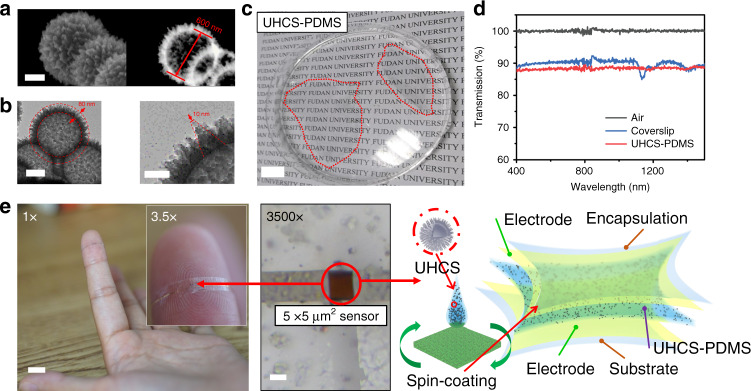
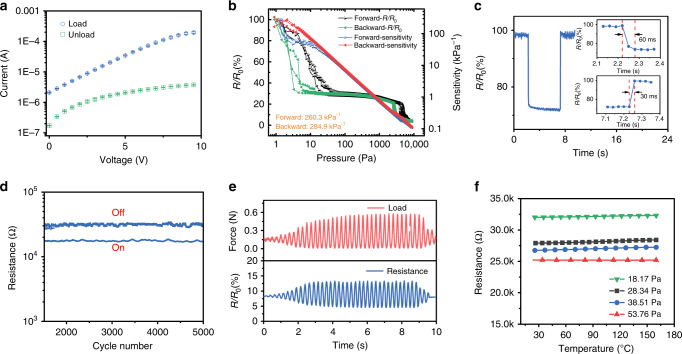
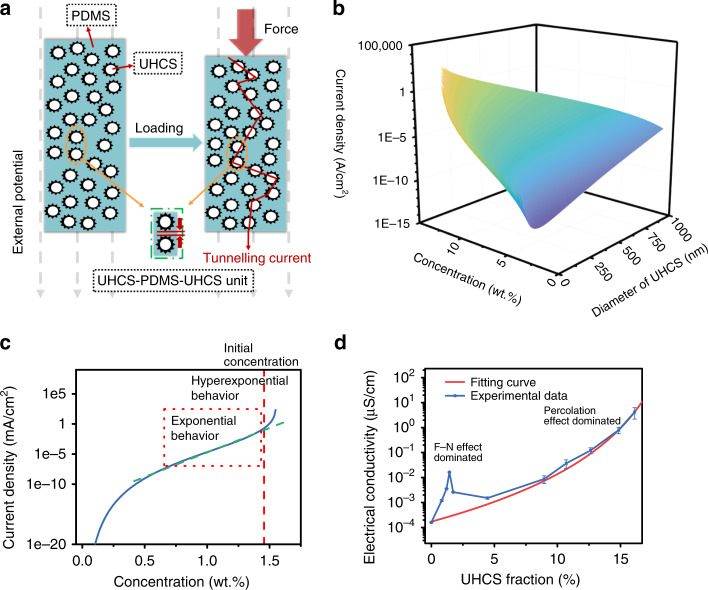
Although high-performance flexible pressure sensors have been extensively investigated in recent years owing to their diverse applications in biomedical and information technologies, fabricating ultrasensitive sensors with high pixel density based on current transduction mechanisms still remains great challenging. Herein, we demonstrate a design idea based on Fowler-Nordheim tunnelling effect for fabrication of pressure sensors with ultrahigh sensitivity and sensing density by spin-coating extremely low urchin-like hollow carbon spheres (less than 1.5 wt.%) dispersed in polydimethylsiloxane, which is distinct from the current transduction mechanisms. This sensor exhibits an ultrahigh sensitivity of 260.3 kPa−1 at 1 Pa, a proof-of-concept demonstration of a high sensing density of 400 cm−2, high transparency and temperature noninterference. In addition, it can be fabricated by an industrially viable and scalable spin-coating method, providing an efficient avenue for realizing large-scale production and application of ultrahigh sensitivity flexible pressure sensors on various surfaces and in in vivo environments.
Overview
The claims and statistics of this paper haven’t been checked yet.
Free: it reads the open-access text and checks the first 5 claims that cite a source we can check. Create a free account to check every claim.
Integrity signals
Registry
Cites
Statistics
Figures
Verification
Claims the paper makes
The claims and statistics of this paper haven’t been checked yet.
Free: it reads the open-access text and checks the first 5 claims that cite a source we can check. Create a free account to check every claim.
Claims other papers make about this one
Each is checked against this paper’s own text: does it say what the citing paper says it does?
The cited source doesn’t support the claim as written.
In the citing paper
“Meanwhile, another resistive sensor may analyze the changes in the contact resistance, like the quantum tunneling effect (Figure 4A).[114,115]”
From Flexible Electronics and Devices as Human–Machine Interfaces for Medical Robotics (2022) · cites this paper as [114]
Checked by a reasoning model — may be wrong.
Experimental — accuracy not yet measured
Self-check
Percentages, sums and reported differences re-computed from the paper’s own numbers.
The self-check needs the paper’s full text.
Citations
Cites
Electron emission in intense electric fields
Fowler, R. H., & Nordheim, L. (1928) · Proceedings of the Royal Society of London. Series A, Containing Papers of a Mathematical and Physical Character · doi:10.1098/rspa.1928.0091 · Cited by 5,752
The work function of the elements and its periodicity
Michaelson, H. B. (1977) · Journal of Applied Physics · doi:10.1063/1.323539 · Cited by 4,289
Hammock, M. L., Chortos, A., Tee, B. C. ‐., Tok, J. B. ‐., & Bao, Z. (2013) · Advanced Materials · doi:10.1002/adma.201302240 · Cited by 2,396
Skin electronics from scalable fabrication of an intrinsically stretchable transistor array
Wang, S., Xu, J., Wang, W., Wang, G.-J. N., Rastak, R., Molina-Lopez, F., Chung, J. W., Niu, S., Feig, V. R., Lopez, J., et al. (2018) · Nature · doi:10.1038/nature25494 · Cited by 2,198
Magnetic Properties of Nanostructured Materials
Leslie-Pelecky, D. L., & Rieke, R. D. (1996) · Chemistry of Materials · doi:10.1021/cm960077f · Cited by 1,721
A flexible and highly sensitive strain-gauge sensor using reversible interlocking of nanofibres
Pang, C., Lee, G.-Y., Kim, T.-I., Kim, S. M., Kim, H. N., Ahn, S.-H., & Suh, K.-Y. (2012) · Nature Materials · doi:10.1038/nmat3380 · Cited by 1,695
Soft robotic glove for combined assistance and at-home rehabilitation
Polygerinos, P., Wang, Z., Galloway, K. C., Wood, R. J., & Walsh, C. J. (2015) · Robotics and Autonomous Systems · doi:10.1016/j.robot.2014.08.014 · Cited by 1,617
Pan, L., Chortos, A., Yu, G., Wang, Y., Isaacson, S., Allen, R., Shi, Y., Dauskardt, R., & Bao, Z. (2014) · Nature Communications · doi:10.1038/ncomms4002 · Cited by 1,519
Johansson, R. S., & Vallbo, A. B. (1979) · The Journal of Physiology · doi:10.1113/jphysiol.1979.sp012619 · Cited by 1,291
Advances of flexible pressure sensors toward artificial intelligence and health care applications
Zang, Y., Zhang, F., Di, C.-A., & Zhu, D. (2015) · Materials Horizons · doi:10.1039/c4mh00147h · Cited by 1,272
User-interactive electronic skin for instantaneous pressure visualization
Wang, C., Hwang, D., Yu, Z., Takei, K., Park, J., Chen, T., Ma, B., & Javey, A. (2013) · Nature Materials · doi:10.1038/nmat3711 · Cited by 1,182
Learning the signatures of the human grasp using a scalable tactile glove
Sundaram, S., Kellnhofer, P., Li, Y., Zhu, J.-Y., Torralba, A., & Matusik, W. (2019) · Nature · doi:10.1038/s41586-019-1234-z · Cited by 1,162
Son, D., Kang, J., Vardoulis, O., Kim, Y., Matsuhisa, N., Oh, J. Y., To, J. W., Mun, J., Katsumata, T., Liu, Y., et al. (2018) · Nature Nanotechnology · doi:10.1038/s41565-018-0244-6 · Cited by 942
Park, J., Kim, M., Lee, Y., Lee, H. S., & Ko, H. (2015) · Science Advances · doi:10.1126/sciadv.1500661 · Cited by 939
Wu, W., Wen, X., & Wang, Z. L. (2013) · Science · doi:10.1126/science.1234855 · Cited by 931
Efros, A. L., & Shklovskii, B. I. (1976) · physica status solidi (b) · doi:10.1002/pssb.2220760205 · Cited by 889
A transparent bending-insensitive pressure sensor
Lee, S., Reuveny, A., Reeder, J., Lee, S., Jin, H., Liu, Q., Yokota, T., Sekitani, T., Isoyama, T., Abe, Y., et al. (2016) · Nature Nanotechnology · doi:10.1038/nnano.2015.324 · Cited by 833
MXenes stretch hydrogel sensor performance to new limits
Zhang, Y.-Z., Lee, K. H., Anjum, D. H., Sougrat, R., Jiang, Q., Kim, H., & Alshareef, H. N. (2018) · Science Advances · doi:10.1126/sciadv.aat0098 · Cited by 783
Syringe-injectable electronics
Liu, J., Fu, T.-M., Cheng, Z., Hong, G., Zhou, T., Jin, L., Duvvuri, M., Jiang, Z., Kruskal, P., Xie, C., et al. (2015) · Nature Nanotechnology · doi:10.1038/nnano.2015.115 · Cited by 687
Flexible and Highly Sensitive Pressure Sensors Based on Bionic Hierarchical Structures
Jian, M., Xia, K., Wang, Q., Yin, Z., Wang, H., Wang, C., Xie, H., Zhang, M., & Zhang, Y. (2017) · Advanced Functional Materials · doi:10.1002/adfm.201606066 · Cited by 657
Zou, Z., Zhu, C., Li, Y., Lei, X., Zhang, W., & Xiao, J. (2018) · Science Advances · doi:10.1126/sciadv.aaq0508 · Cited by 507
Bend, stretch, and touch: Locating a finger on an actively deformed transparent sensor array
Sarwar, M. S., Dobashi, Y., Preston, C., Wyss, J. K. M., Mirabbasi, S., & Madden, J. D. W. (2017) · Science Advances · doi:10.1126/sciadv.1602200 · Cited by 370
Hou, C., Wang, H., Zhang, Q., Li, Y., & Zhu, M. (2014) · Advanced Materials · doi:10.1002/adma.201401367 · Cited by 301
How to tailor flexible silicone elastomers with mechanical integrity: a tutorial review
Mazurek, P., Vudayagiri, S., & Skov, A. L. (2019) · Chemical Society Reviews · doi:10.1039/c8cs00963e · Cited by 292
Bioinspired and bristled microparticles for ultrasensitive pressure and strain sensors
Yin, B., Liu, X., Gao, H., Fu, T., & Yao, J. (2018) · Nature Communications · doi:10.1038/s41467-018-07672-2 · Cited by 184
High power efficiency in Si-nc/SiO2 multilayer light emitting devices by bipolar direct tunneling
MARCONI, A., Anopchenko, A., Wang, M., Pucker, G., Bellutti, P., & Pavesi, L. (2009) · Applied Physics Letters · doi:10.1063/1.3147164 · Cited by 122
Piezoresistive flexible composite for robotic tactile applications
Canavese, G., Stassi, S., Fallauto, C., Corbellini, S., Cauda, V., Camarchia, V., Pirola, M., & Pirri, C. F. (2013) · Sensors and Actuators A Physical · doi:10.1016/j.sna.2013.11.018 · Cited by 121
Metal–polymer composite with nanostructured filler particles and amplified physical properties
Bloor, D., Graham, A., Williams, E. J., Laughlin, P. J., & Lussey, D. (2006) · Applied Physics Letters · doi:10.1063/1.2183359 · Cited by 86
Stassi, S., & Canavese, G. (2012) · Journal of Polymer Science Part B: Polymer Physics · doi:10.1002/polb.23091 · Cited by 80
Strain and temperature discrimination by using temperature-independent FPI and FBG
Zhang, X., Peng, W. B., Shao, L., Pan, W., & Yan, L. (2018) · Sensors and Actuators A Physical · doi:10.1016/j.sna.2018.01.060 · Cited by 64
Bilayer insulator tunnel barriers for graphene-based vertical hot-electron transistors
Vaziri, S., Belete, M., Litta, E. D., Smith, A. D., Łupina, G., Lemme, M. C., & Östling, M. (2015) · Nanoscale · doi:10.1039/c5nr03002a · Cited by 62
Stassi, S., Cauda, V., Canavese, G., Manfredi, D., & Pirri, C. F. (2012) · European Journal of Inorganic Chemistry · doi:10.1002/ejic.201101058 · Cited by 52
Yang, M. R., Cao, L., & Tan, L. (2013) · Colloids and Surfaces A Physicochemical and Engineering Aspects · doi:10.1016/j.colsurfa.2013.10.034 · Cited by 31
Temperature-independent fiber-Bragg-grating-based atmospheric pressure sensor
Zhang, Z., Shen, C., & Li, L. (2017) · Optics Communications · doi:10.1016/j.optcom.2017.10.036 · Cited by 30
Interactive partial video decoding for viewing resolution adaptation
Liu, C., Jin, X., Zhang, T., & Goto, S. (2010) · International SoC Design Conference · doi:10.1109/socdc.2010.5682925 · Cited by 2
The electric-field characteristics on the point of a conical conductor
Rong-yi, Y. (2003) · College Physics · Cited by 1
Research works printed but not linked: 1
- 22. XU, J. & LI, K. The research on resistance of electrical contact. Electr. Eng. Mater. 1, 10-13 (2011).
Cited by
Wearable Sensors‐Enabled Human–Machine Interaction Systems: From Design to Application
Yin, R., Wang, D., Zhao, S., Lou, Z., & Shen, G. (2021) · Advanced Functional Materials · doi:10.1002/adfm.202008936 · Cited by 769
Flexible Electronics and Devices as Human–Machine Interfaces for Medical Robotics
Heng, W., Solomon, S., & Gao, W. (2022) · Advanced Materials · doi:10.1002/adma.202107902 · Cited by 609
Wang, H., Zhou, R., Li, D., Zhang, L., Ren, G., Wang, L., Liu, J., Wang, D., Tang, Z., Lu, G., et al. (2021) · ACS Nano · doi:10.1021/acsnano.1c00259 · Cited by 364
Recent Progress in Flexible Pressure Sensors Based Electronic Skin
Pierre Claver, U., & Zhao, G. (2021) · Advanced Engineering Materials · doi:10.1002/adem.202001187 · Cited by 291
Shi, Z., Meng, L., Shi, X., Li, H., Zhang, J., Sun, Q., Liu, X., Chen, J., & Liu, S. (2022) · Nano-Micro Letters · doi:10.1007/s40820-022-00874-w · Cited by 282
“11c-d) [83].”
BackgroundInfluential
Metadata
- Authors
- Shi, L., Li, Z., Chen, M., Qin, Y., Jiang, Y., & Wu, L.
- Affiliations
- Fudan University (CN)
- Corresponding author
- Wu, Limin
- Venue
- Nature Communications
- Published
- 2020-07-15
- Volume
- 11
- Issue
- 1
- Pages
- 3529-3529
- ISSN
- 2041-1723 (ISSN-L)
- PMC
- PMC7363923
- OpenAlex
- W3042916504
- Semantic Scholar
- 89aa7f68f055fa6c196d9d666b08cc357dd57a6a
- Cited by
- 180
- References
- 37
- Citations by year
- 2026: 24 · 2025: 38 · 2024: 35 · 2023: 30 · 2022: 33 · 2021: 18 · 2020: 2
- FWCI
- 6.52
- Type
- journal article
- Language
- en
- Open access
- gold
- doi.org
- Licence
- cc-by
- creativecommons.org/licenses/by/4.0 (tdm)
- creativecommons.org/licenses/by/4.0 (vor)
- Locations
- Nature Communications (publishedVersion, cc-by)
- PubMed Central (publishedVersion, cc-by)
- PubMed (publishedVersion)
- RePEc: Research Papers in Economics (submittedVersion)
- DOAJ (DOAJ: Directory of Open Access Journals) (submittedVersion, cc-by-sa)
- Funders
- National Science Foundation of China | National Natural Science Foundation of China-Yunnan Joint Fund (51721002)
- Topics
- Physical Sciences › Engineering › Biomedical Engineering › Advanced Sensor and Energy Harvesting Materials
- Physical Sciences › Engineering › Electrical and Electronic Engineering › Nanomaterials and Printing Technologies
- Physical Sciences › Materials Science › Materials Chemistry › Graphene research and applications
- Keywords
- flexible pressure sensors, polydimethylsiloxane, spin coating, ultrahigh sensitivity, high pixel density, in vivo sensing
About these checks
Registry, retraction, Cites and statistics results are computed, not judged, with one exception: a printed reference that no index lists is read once by a model before it counts as a citation error. Claims are extracted by a model and kept only when their quote appears verbatim in the text; each cited source is then checked, with a model’s help, for whether it says what the claim relies on. Those verdicts can be wrong — read the claim’s quote and the cited source before relying on one.
Statistics and arithmetic are recomputed, not judged.
Confidence bands are shown only for fields calibrated on our annotated test set. None is calibrated yet, so no band is shown.
What counts as a claim ›How we measure confidence ›How we check this ›
Are you an author, or do you see a problem with this page? Request a review
Data sources
Bibliographic data: Semantic Scholar, OpenAlex, Crossref.
Contains information from the Semantic Scholar Academic Graph Datasets, made available under the ODC Attribution License (ODC-BY 1.0).
Semantic Scholar’s data is described in: Kinney, R., et al. (2023). The Semantic Scholar Open Data Platform. arXiv:2301.10140.
