

Ultra-conformal drawn-on-skin electronics for multifunctional motion artifact-free sensing and point-of-care treatment
Open accessThe DOI matches its Crossref record; 53 of the 53 references it cites were found in a registry or an index.
Abstract
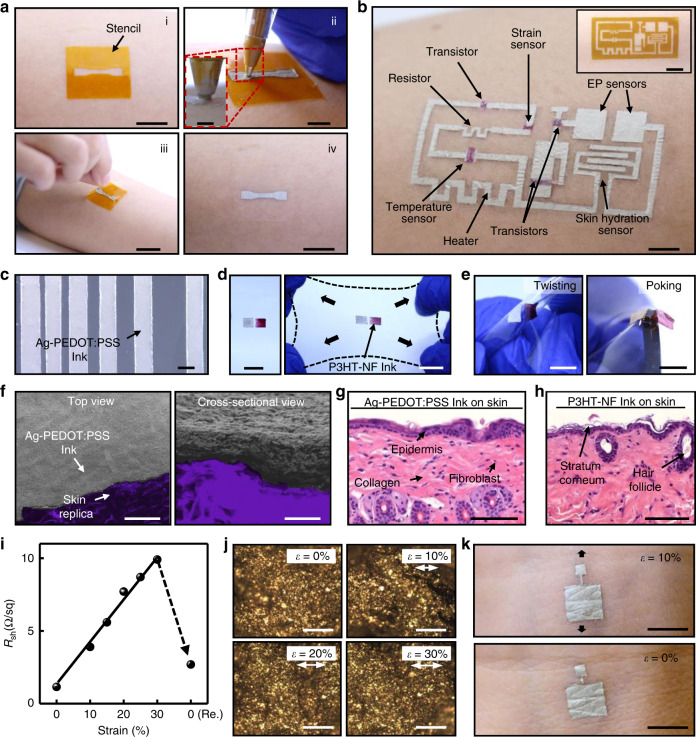
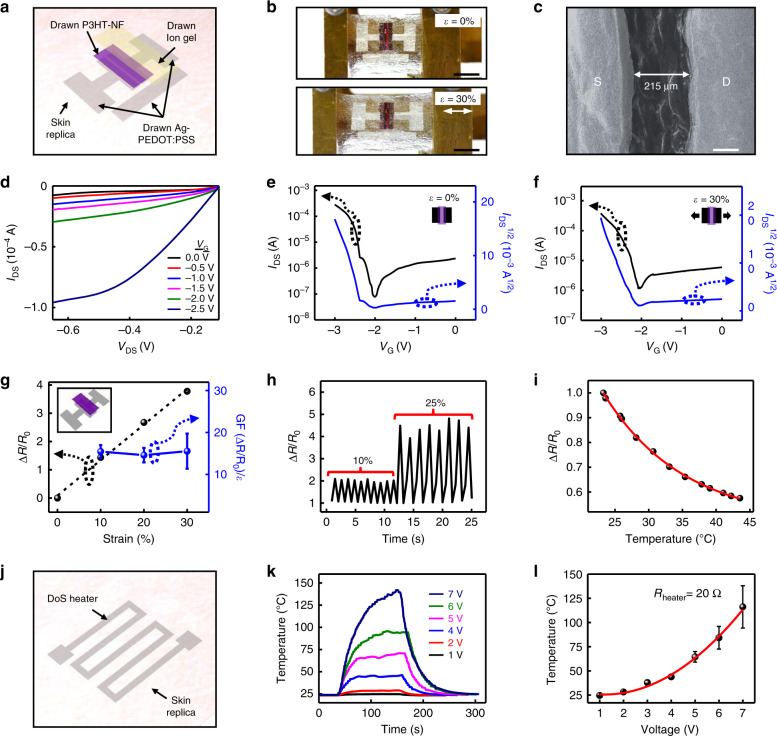
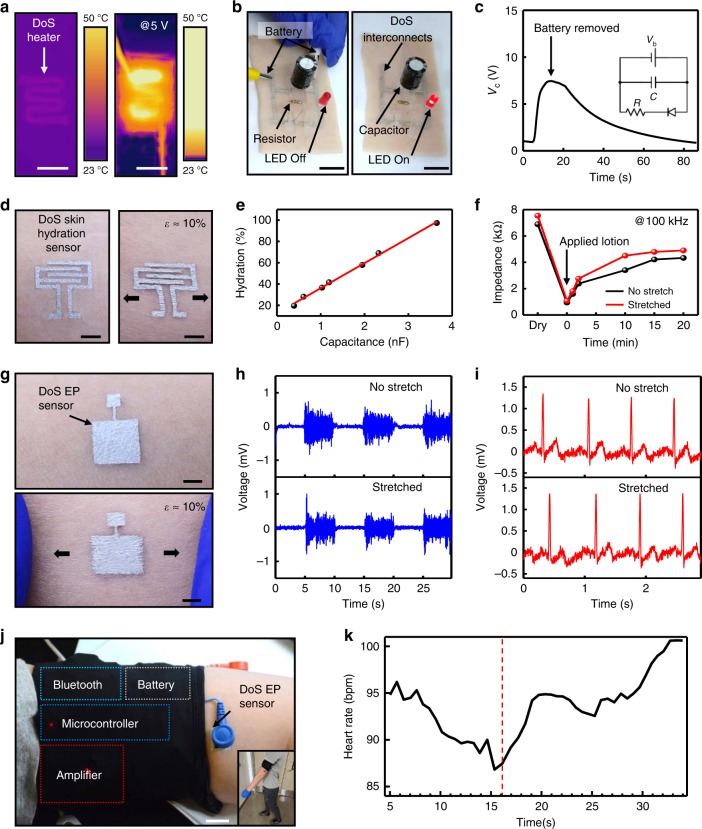
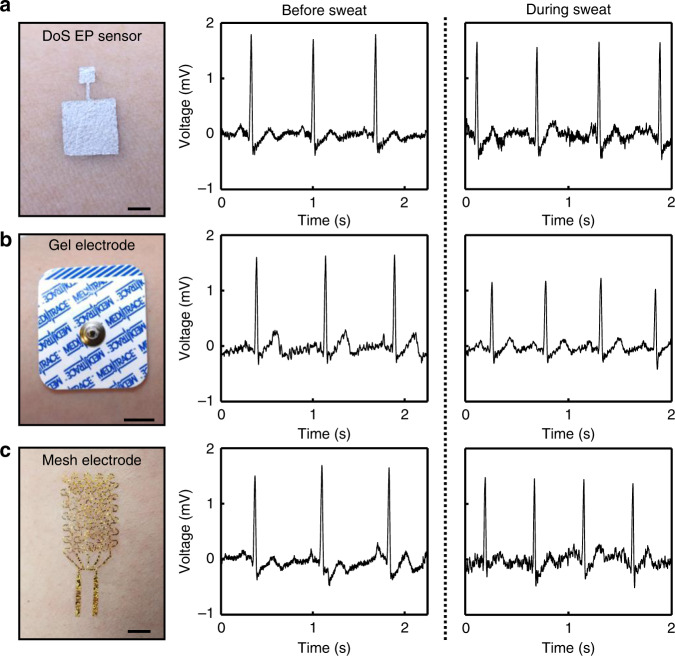
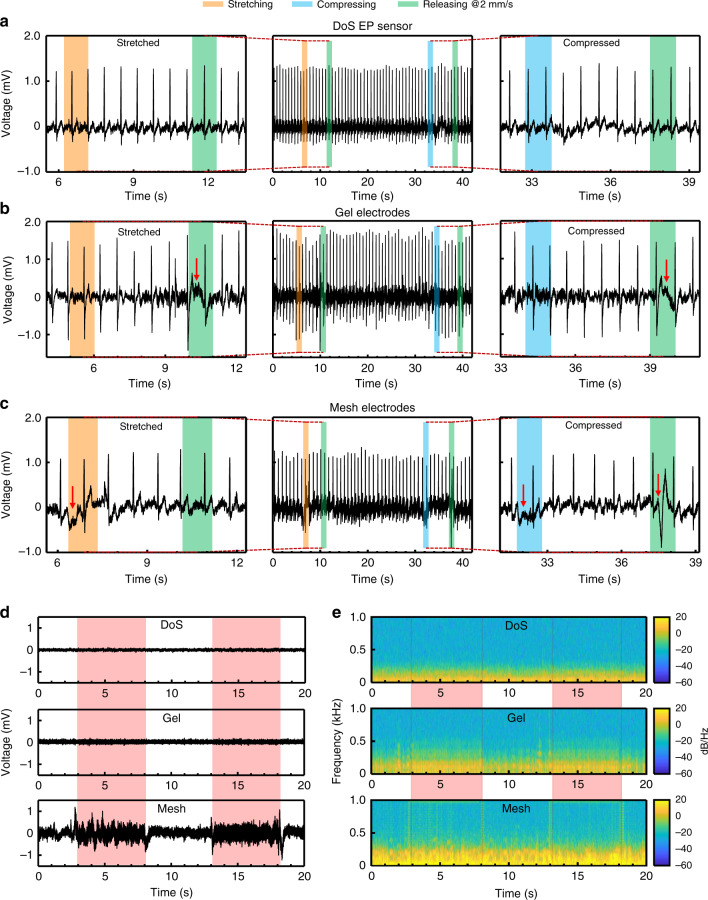
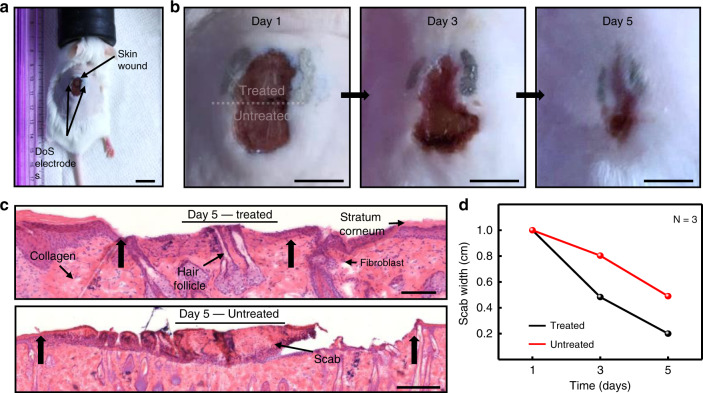
An accurate extraction of physiological and physical signals from human skin is crucial for health monitoring, disease prevention, and treatment. Recent advances in wearable bioelectronics directly embedded to the epidermal surface are a promising solution for future epidermal sensing. However, the existing wearable bioelectronics are susceptible to motion artifacts as they lack proper adhesion and conformal interfacing with the skin during motion. Here, we present ultra-conformal, customizable, and deformable drawn-on-skin electronics, which is robust to motion due to strong adhesion and ultra-conformality of the electronic inks drawn directly on skin. Electronic inks, including conductors, semiconductors, and dielectrics, are drawn on-demand in a freeform manner to develop devices, such as transistors, strain sensors, temperature sensors, heaters, skin hydration sensors, and electrophysiological sensors. Electrophysiological signal monitoring during motion shows drawn-on-skin electronics’ immunity to motion artifacts. Additionally, electrical stimulation based on drawn-on-skin electronics demonstrates accelerated healing of skin wounds.
Overview
The claims and statistics of this paper haven’t been checked yet.
Free: it reads the open-access text and checks the first 5 claims that cite a source we can check. Create a free account to check every claim.
Integrity signals
Registry
Cites
Statistics
Figures
Verification
Claims the paper makes
The claims and statistics of this paper haven’t been checked yet.
Free: it reads the open-access text and checks the first 5 claims that cite a source we can check. Create a free account to check every claim.
Claims other papers make about this one
Each is checked against this paper’s own text: does it say what the citing paper says it does?
The cited source says what the claim attributes to it.
In the citing paper
“Conductive metal–synthetic polymer blends as inks have even been used to assemble highly conformal ultrathin devices directly on the skin59.”
From End-to-end design of wearable sensors (2022) · cites this paper as [59]
In the citing paper
“Initially withdrawn because of skin irritation, noise propensity and high impedance that masked signals, improved combinations of conductive and biocompatible electrode materials (such as poly(3,4-ethylenedioxythiophene):polystyrene sulfonate (PEDOT:PSS) or polyurethane131) and circuit designs59 have made dry electrodes a viable alternative to gel electrodes.”
From End-to-end design of wearable sensors (2022) · cites this paper as [59]
Self-check
Percentages, sums and reported differences re-computed from the paper’s own numbers.
The self-check needs the paper’s full text.
Citations
Cites
Lab-on-Skin: A Review of Flexible and Stretchable Electronics for Wearable Health Monitoring
Liu, Y., Pharr, M., & Salvatore, G. A. (2017) · ACS Nano · doi:10.1021/acsnano.7b04898 · Cited by 1,725
Multifunctional wearable devices for diagnosis and therapy of movement disorders
Son, D., Lee, J., Qiao, S., Ghaffari, R., Kim, J., Lee, J. E., Song, C., Kim, S. J., Lee, D. J., Jun, S. W., et al. (2014) · Nature Nanotechnology · doi:10.1038/nnano.2014.38 · Cited by 1,462
Stretchable silicon nanoribbon electronics for skin prosthesis
Kim, J., Lee, M., Shim, H. J., Ghaffari, R., Cho, H. R., Son, D., Jung, Y. H., Soh, M., Choi, C., Jung, S., et al. (2014) · Nature Communications · doi:10.1038/ncomms6747 · Cited by 1,435
Self-citationInflammation-free, gas-permeable, lightweight, stretchable on-skin electronics with nanomeshes
Miyamoto, A., Lee, S., Cooray, N. F., Lee, S., Mori, M., Matsuhisa, N., Jin, H., Yoda, L., Yokota, T., Itoh, A., et al. (2017) · Nature Nanotechnology · doi:10.1038/nnano.2017.125 · Cited by 1,181
Xu, S., Yan, Z., Jang, K.-I., Huang, W., Fu, H., Kim, J., Wei, Z., Flavin, M., McCracken, J., Wang, R., et al. (2015) · Science · doi:10.1126/science.1260960 · Cited by 931
Self-citationTrung, T. Q., Ramasundaram, S., Hwang, B., & Lee, N. (2016) · Advanced Materials · doi:10.1002/adma.201504441 · Cited by 870
Materials and Optimized Designs for Human‐Machine Interfaces Via Epidermal Electronics
Jeong, J., Yeo, W., Akhtar, A., Norton, J. J. S., Kwack, Y., Li, S., Jung, S., Su, Y., Lee, W., Xia, J., et al. (2013) · Advanced Materials · doi:10.1002/adma.201301921 · Cited by 827
A direct comparison of wet, dry and insulating bioelectric recording electrodes
Searle, A., & Kirkup, L. (2000) · Physiological Measurement · doi:10.1088/0967-3334/21/2/307 · Cited by 725
A mechanically driven form of Kirigami as a route to 3D mesostructures in micro/nanomembranes
Zhang, Y., Yan, Z., Nan, K., Xiao, D., Liu, Y., Luan, H., Fu, H., Wang, X., Yang, Q., Wang, J., et al. (2015) · Proceedings of the National Academy of Sciences · doi:10.1073/pnas.1515602112 · Cited by 535
Self-citationAll-printed thin-film transistors from networks of liquid-exfoliated nanosheets
Kelly, A. G., Hallam, T., Backes, C., Harvey, A., Esmaeily, A. S., Godwin, I., Coelho, J., Nicolosi, V., Lauth, J., Kulkarni, A., et al. (2017) · Science · doi:10.1126/science.aal4062 · Cited by 501
Cited by
Technology Roadmap for Flexible Sensors
Luo, Y., Abidian, M. R., Ahn, J.-H., Akinwande, D., Andrews, A. M., Antonietti, M., Bao, Z., Berggren, M., Berkey, C. A., Bettinger, C. J., et al. (2023) · ACS Nano · doi:10.1021/acsnano.2c12606 · Cited by 1,383
End-to-end design of wearable sensors
Ates, H. C., Nguyen, P. Q., Gonzalez-Macia, L., Morales-Narváez, E., Güder, F., Collins, J. J., & Dincer, C. (2022) · Nature Reviews Materials · doi:10.1038/s41578-022-00460-x · Cited by 1,306
High‐Stretchability, Ultralow‐Hysteresis ConductingPolymer Hydrogel Strain Sensors for Soft Machines
Shen, Z., Zhang, Z., Zhang, N., Li, J., Zhou, P., Hu, F., Rong, Y., Lu, B., & Gu, G. (2022) · Advanced Materials · doi:10.1002/adma.202203650 · Cited by 574
Materials-Driven Soft Wearable Bioelectronics for Connected Healthcare
Gong, S., Lu, Y., Yin, J., Levin, A., & Cheng, W. (2024) · Chemical Reviews · doi:10.1021/acs.chemrev.3c00502 · Cited by 411
Age of Flexible Electronics: Emerging Trends in Soft Multifunctional Sensors
Lee, J., Cho, K., & Kim, J. (2024) · Advanced Materials · doi:10.1002/adma.202310505 · Cited by 355
Metadata
- Authors
- Ershad, F., Thukral, A., Yue, J., Comeaux, P., Lu, Y., Shim, H., Sim, K., Kim, N.-I., Rao, Z., Guevara, R., Contreras, L., Pan, F., Zhang, Y., Guan, Y.-S., Yang, P., Wang, X., Wang, P., Wu, X., & Yu, C.
- Venue
- Nature Communications
- Published
- 2020-07-30
- Volume
- 11
- Issue
- 1
- Pages
- 3823-3823
- ISSN
- 2041-1723 (ISSN-L)
- PMC
- PMC7393123
- OpenAlex
- W3046860577
- Cited by
- 355
- References
- 53
- FWCI
- 13.20
- Type
- journal article
- Language
- en
- Open access
- gold
- Licence
- creativecommons.org/licenses/by/4.0 (tdm)
- creativecommons.org/licenses/by/4.0 (vor)
- Funders
- United States Department of Defense | United States Navy | Office of Naval Research (N00014-18-1-2338)
- U.S. Department of Health & Human Services | NIH | National Institute of Biomedical Imaging and Bioengineering (R21EB026175)
About these checks
Registry, retraction, Cites and statistics results are computed, not judged, with one exception: a printed reference that no index lists is read once by a model before it counts as a citation error. Claims are extracted by a model and kept only when their quote appears verbatim in the text; each cited source is then checked, with a model’s help, for whether it says what the claim relies on. Those verdicts can be wrong — read the claim’s quote and the cited source before relying on one.
Statistics and arithmetic are recomputed, not judged.
Confidence bands are shown only for fields calibrated on our annotated test set. None is calibrated yet, so no band is shown.
What counts as a claim ›How we measure confidence ›How we check this ›
Are you an author, or do you see a problem with this page? Request a review
Data sources
Bibliographic data: Semantic Scholar, OpenAlex, Crossref.
Contains information from the Semantic Scholar Academic Graph Datasets, made available under the ODC Attribution License (ODC-BY 1.0).
Semantic Scholar’s data is described in: Kinney, R., et al. (2023). The Semantic Scholar Open Data Platform. arXiv:2301.10140.
