

The DOI matches its Crossref record; 64 of the 65 references it cites were found in a registry or an index.
GWAS of thyroid stimulating hormone highlights pleiotropic effects and inverse association with thyroid cancer
Open accessAbstract
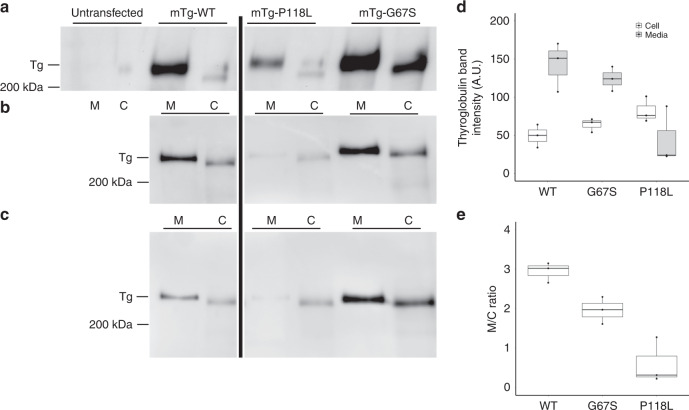
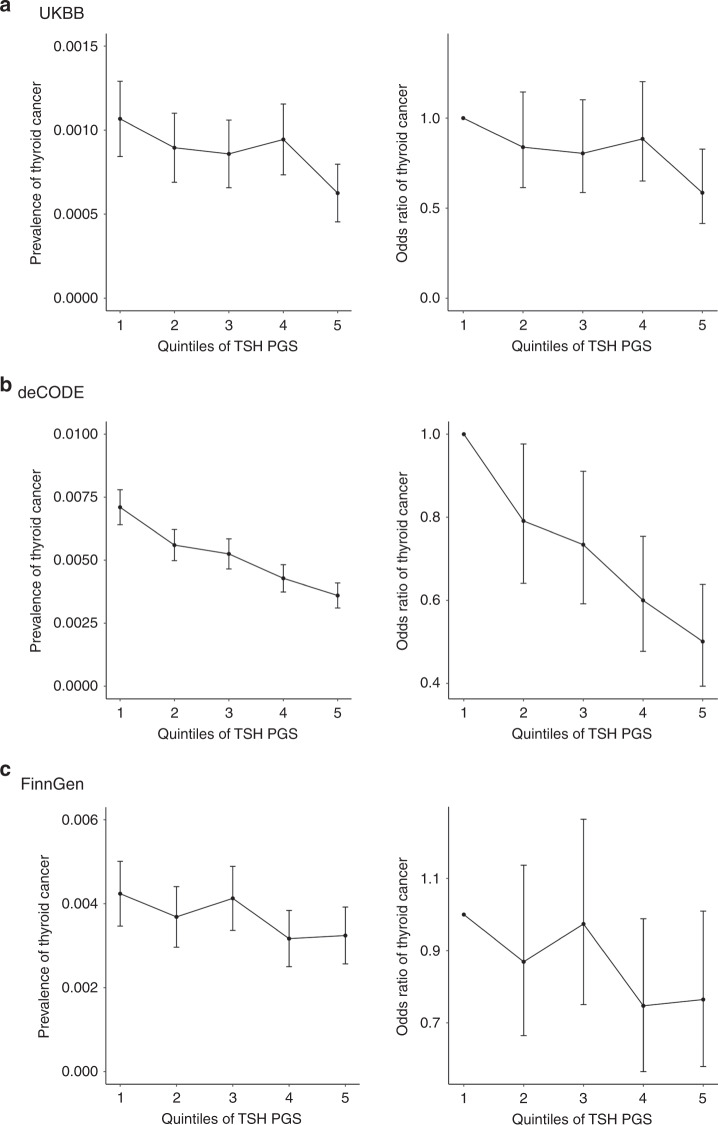
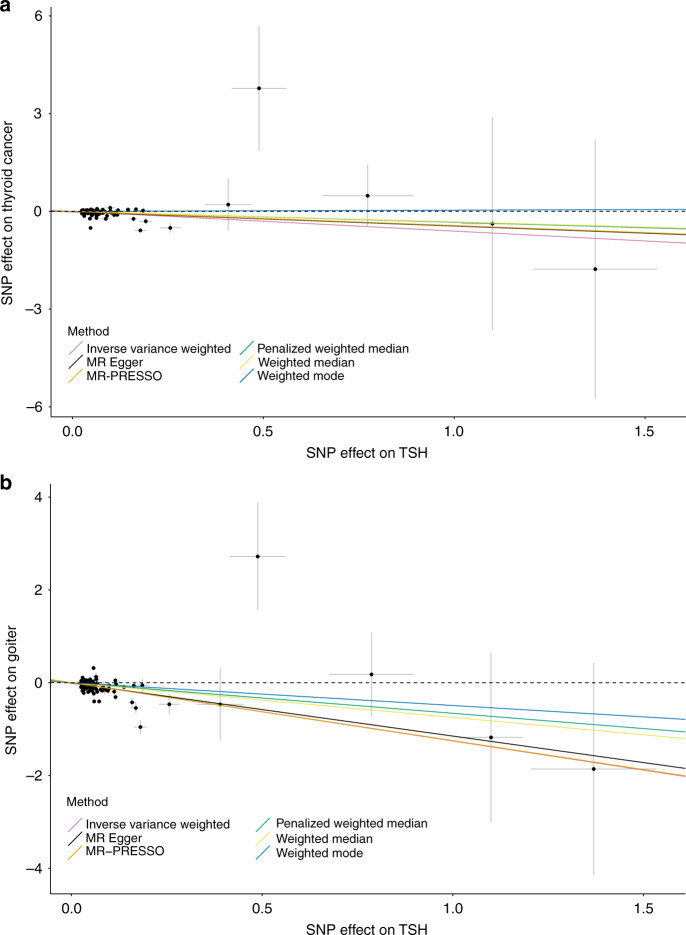
Thyroid stimulating hormone (TSH) is critical for normal development and metabolism. To better understand the genetic contribution to TSH levels, we conduct a GWAS meta-analysis at 22.4 million genetic markers in up to 119,715 individuals and identify 74 genome-wide significant loci for TSH, of which 28 are previously unreported. Functional experiments show that the thyroglobulin protein-altering variants P118L and G67S impact thyroglobulin secretion. Phenome-wide association analysis in the UK Biobank demonstrates the pleiotropic effects of TSH-associated variants and a polygenic score for higher TSH levels is associated with a reduced risk of thyroid cancer in the UK Biobank and three other independent studies. Two-sample Mendelian randomization using TSH index variants as instrumental variables suggests a protective effect of higher TSH levels (indicating lower thyroid function) on risk of thyroid cancer and goiter. Our findings highlight the pleiotropic effects of TSH-associated variants on thyroid function and growth of malignant and benign thyroid tumors.
Overview
The claims and statistics of this paper haven’t been checked yet.
Run the check — free, no account needed. It reads the open-access text and checks the sources it cites.
Integrity signals
Registry
Cites
Statistics
Figures
Verification
Claims the paper makes
The claims and statistics of this paper haven’t been checked yet.
Run the check — free, no account needed. It reads the open-access text and checks the sources it cites.
Claims other papers make about this one
Each is checked against this paper’s own text: does it say what the citing paper says it does?
The source backs part of the claim, not all of it — or backs it for a different population, condition or comparison.
In the citing paper
“The largest thyroid GWASs have focused on variations in thyroid hormone concentrations in the general population, identifying over 100 genetic variants associated with TSH or FT4 concentrations, or both.[45][46][47]”
From Hypothyroidism (2024) · cites this paper as [46]
Experimental — accuracy not yet measured
Self-check
Percentages, sums and reported differences re-computed from the paper’s own numbers.
The self-check needs the paper’s full text.
Citations
Cites
A global reference for human genetic variation
The 1000 Genomes Project Consortium, authors, C., Auton, A., Abecasis, G. R., Steering committee, Altshuler, D. M., Durbin, R. M., Abecasis, G. R., Bentley, D. R., Chakravarti, A., et al. (2015) · Nature · doi:10.1038/nature15393 · Cited by 18,247
ANNOVAR: functional annotation of genetic variants from high-throughput sequencing data
Wang, K., Li, M., & Hakonarson, H. H. (2010) · Nucleic Acids Research · doi:10.1093/nar/gkq603 · Cited by 14,724
Analysis of protein-coding genetic variation in 60,706 humans
Exome Aggregation Consortium, Lek, M., Karczewski, K. J., Minikel, E. V., Samocha, K. E., Banks, E., Fennell, T., O’Donnell-Luria, A. H., Ware, J. S., Hill, A. J., et al. (2016) · Nature · doi:10.1038/nature19057 · Cited by 9,587
Self-citationThe UK Biobank resource with deep phenotyping and genomic data
Bycroft, C., Freeman, C., Petkova, D., Band, G., Elliott, L. T., Sharp, K., Motyer, A., Vukcevic, D., Delaneau, O., O’Connell, J., et al. (2018) · Nature · doi:10.1038/s41586-018-0579-z · Cited by 8,876
Verbanck, M., Chen, C.-Y., Neale, B., & Do, R. (2018) · Nature Genetics · doi:10.1038/s41588-018-0099-7 · Cited by 8,591
The MR-Base platform supports systematic causal inference across the human phenome
Hemani, G., Zheng, J., Elsworth, B., Wade, K. H., Haberland, V., Baird, D., Laurin, C., Burgess, S., Bowden, J., Langdon, R., et al. (2018) · eLife · doi:10.7554/elife.34408 · Cited by 7,959
A note on a general definition of the coefficient of determination
NAGELKERKE, N. J. D. (1991) · Biometrika · doi:10.1093/biomet/78.3.691 · Cited by 5,927
The combination of estimates from different experiments
Cochran, W. G. (1954) · Biometrics · doi:10.2307/3001666 · Cited by 5,380
METAL: fast and efficient meta-analysis of genomewide association scans
Willer, C. J., Li, Y., & Abecasis, G. R. (2010) · Bioinformatics · doi:10.1093/bioinformatics/btq340 · Cited by 5,205
Self-citationIntegrated Genomic Characterization of Papillary Thyroid Carcinoma
Agrawal, N., Akbani, R., Aksoy, B. A., Ally, A., Arachchi, H., Asa, S. L., Auman, J. T., Balasundaram, M., Balu, S., Baylin, S. B., et al. (2014) · Cell · doi:10.1016/j.cell.2014.09.050 · Cited by 3,132
Research works printed but not linked: 1
- National Academies Press. Medicare Coverage of Routine Screening for Thyroid Dysfunction (National Academies Press, USA, 2003).
Cited by
Sorted by citations
Items 101–132 of 132
Xu, J., & Gao, C. (2025) · Discover Oncology · doi:10.1007/s12672-025-02550-y · Cited by 1
Park, Y. J., Kim, H.-J., Son, H., Kim, J., Yun, J. M., Kwon, H., Cho, B., Park, J.-H., & Kim, J.-I. (2026) · Genes and Environment · doi:10.1186/s41021-026-00357-z · Cited by 1
Ejiyi, C. J., Eze, F. O., Hossin, M. A., Aggrey, E. S. E. B., Ejiyi, M. B., Cai, D., Ejiyi, T. U., Bamisile, O. O., Nnani, A. O., Eya, F. A., et al. (2026) · Journal Of Big Data · doi:10.1186/s40537-025-01332-1 · Cited by 1
Thyroid Hormones Enhance the Growth of Estrogen Receptor–Positive Breast Cancers
Kłubo-Gwieździńska, J. (2022) · Clinical Thyroidology · doi:10.1089/ct.2022;34.286-289 · Cited by 1
Huang, H., Wang, S., Jin, M., Cheng, B., Liu, Y., Liu, X., Yu, Q., & Yang, X. (2022) · Clinical Endocrinology · doi:10.1111/cen.14867 · Cited by 1
Gu, Y., Song, Z., Li, Q., Wang, J., Song, Y., Meng, G., Wu, H., Zhang, S., Wang, X., Zhang, J., et al. (2023) · The Journal of Clinical Endocrinology & Metabolism · doi:10.1210/clinem/dgad025 · Cited by 2
Ruan, X., Liu, Y., Wu, S., Fu, G., Tao, M., Huang, Y., Li, D., Wei, S., Gao, M., Guo, S., et al. (2024) · Aging · doi:10.18632/aging.205718 · Cited by 1
Wang, X., Wang, X., Zhao, M., Lin, L., Li, Y., Xie, N., Wang, Y., Wang, A., Xu, X., Ju, C., et al. (2025) · Journal of Biomedical Research · doi:10.7555/jbr.38.20240421 · Cited by 1
Genetic drivers of etiologic heterogeneity in thyroid cancer
Jee, Y. H., Pozdeyev, N. V., Gignoux, C. R., White, S., Haugen, B. R., Verma, A., Pečulis, R., Rovīte, V., Mulford, A. J., Sanders, A. R., et al. (2026) · Nature Communications · doi:10.1038/s41467-026-75111-8 · Cited by 1
NETMAGE: a humaN-disEase phenoType MAp GEnerator for the Visualization of PheWASPreprint
Sriram, V., Shivakumar, M., Jung, S., Bang, L., Verma, A., Lee, S., Choe, E. K., & Kim, D. (2020) · bioRxiv (Cold Spring Harbor Laboratory) · doi:10.1101/2020.10.27.357103 · Cited by 1
Mendelian randomization to investigate the link between TSH and thyroid cancer
Fussey, J. M., Beaumont, R. N., Wood, A. R., Vaidya, B., Smith, J. A., & Tyrrell, J. (2021) · Endocrine Related Cancer · doi:10.1530/erc-21-0156
Jeong, S., Lee, S. G., Kim, H., Lee, G., Park, S., Kim, I., Lee, J., & Jo, Y. S. (2021) · International Journal of Thyroidology · doi:10.11106/ijt.2021.14.2.152
Lin, L., Wang, X., Pan, Z., Huang, H., Yue, J., Chen, J., Shen, S., Zhao, Y., Wei, Y., Zhang, R., et al. (2022) · SSRN Electronic Journal · doi:10.2139/ssrn.4184813
The Etiology of Hypothyroidism Is Revealed by Alternative Genetics Association Study MethodologiesPreprint
Stern, A., Zucker, R., & Linial, M. (2022) · medRxiv · doi:10.1101/2022.10.04.22280703
Modification of TSH-related genetic effects by indicators of socioeconomic position
Drogge, S.-C., Frank, M., Girschik, C., Jöckel, K., Führer‐Sakel, D., & Schmidt, B. (2022) · Endocrine Connections · doi:10.1530/ec-22-0127
Williams, A. T., Chen, J., Coley, K., Batini, C., Izquierdo, A. G., Packer, R. J., Abner, E., Shepherd, D. J., Free, R. C., Hollox, E. J., et al. (2022) · medRxiv · doi:10.1101/2022.12.22.22283779
Editorial: Genetics of thyroid gland
Zemunik, T., Leko, M. B., & Gunjača, I. (2023) · Frontiers in Genetics · doi:10.3389/fgene.2023.1219472
Mendelian Randomisation Analysis Suggests that Hypothyroidism Reduces Endometrial Cancer RiskPreprint
Glubb, D. M., Wang, X. M., & O’Mara, T. A. (2023) · medRxiv · doi:10.1101/2023.07.30.23293405
Mansour, S., Elgebaly, F., & Habba, E. (2023) · Afro-Egyptian Journal of Infectious and Endemic Diseases · doi:10.21608/aeji.2023.223013.1302
Uncovering the genetic drivers of cutaneous melanoma and its risk factors
Ingold, N. (2024) · Queensland University of Technology · doi:10.5204/thesis.eprints.247498
Cross-tissue transcriptome-wide analysis reveals novel insights into thyroid cancer etiology
Zhu, Y., Luo, Y., Zhang, Y., Wang, Y., Gu, Z., Liu, J., Qin, A., & Qian, W. (2025) · Discover Oncology · doi:10.1007/s12672-025-03194-8
Chen, X., Xu, J., Cheng, Z., Wang, Q., Zhao, Z., & Jiang, Q. (2024) · Figshare · doi:10.6084/m9.figshare.25239405
Chen, X., Xu, J., Cheng, Z., Wang, Q., Zhao, Z., & Jiang, Q. (2024) · Figshare · doi:10.6084/m9.figshare.25239445
Babajide, O., Kjaergaard, A. D., Deng, W., Kuś, A., Sterenborg, R. B. T. M., Åsvold, B. O., Burgess, S., Teumer, A., Medici, M., Ellervik, C., et al. (2024) · Figshare · doi:10.6084/m9.figshare.26679962
Self-citationBabajide, O., Kjaergaard, A. D., Deng, W., Kuś, A., Sterenborg, R. B. T. M., Åsvold, B. O., Burgess, S., Teumer, A., Medici, M., Ellervik, C., et al. (2024) · Figshare · doi:10.6084/m9.figshare.26679959
Self-citationBabajide, O., Kjaergaard, A. D., Deng, W., Kuś, A., Sterenborg, R. B. T. M., Åsvold, B. O., Burgess, S., Teumer, A., Medici, M., Ellervik, C., et al. (2024) · Figshare · doi:10.6084/m9.figshare.26679965
Self-citationShen, Z., Sun, Y., & Niu, G. (2024) · Figshare · doi:10.6084/m9.figshare.26566220
Shinoda, G., Ohseto, H., Obara, T., Orui, M., Murakami, K., Ishikuro, M., Noda, A., Naoki, N., Kogure, M., Nakaya, K., et al. (2026) · Research Square · doi:10.21203/rs.3.rs-8692327/v1
GWAS of amiodarone-induced thyroid dysfunction: Applications for genotype-guided risk stratificationPreprint
Rand, S. A., Bundgaard, J. S., Tragante, V., Rögnvaldsson, S., Ahlberg, G., Small, A., Hornsby, W., Koyama, S., Schwinn, M., Kals, M., et al. (2026) · medRxiv · doi:10.64898/2026.03.02.26347413
Self-citationZhang, W., Gao, Y., Zeng, S., Li, J., Wang, S., Huang, Y., & Dou, J. (2026) · Scientific Reports · doi:10.1038/s41598-026-44229-6
She, C., Lin, Y., Xie, Y., Zhou, S., Luo, F., Chen, R., Jin, L., Li, L., Chen, L., Shao, X., et al. (2026) · Kidney Medicine · doi:10.1016/j.xkme.2026.101414
Астапова, А. С., Остроухова, О. Н., & Лущик, М. В. (2026) · Вестник науки · doi:10.68367/33360
Metadata
- Authors
- Zhou, W., Brumpton, B., Kabil, O., Gudmundsson, J., Thorleifsson, G., Weinstock, J., Zawistowski, M., Nielsen, J. B., Chaker, L., Medici, M., Teumer, A., Naitza, S., Sanna, S., Schultheiss, U. T., Cappola, A., Karjalainen, J., Kurki, M., Oneka, M., Taylor, P., Fritsche, L. G., Graham, S. E., Wolford, B. N., Overton, W., Rasheed, H., Haug, E. B., Gabrielsen, M. E., Skogholt, A. H., Surakka, I., Davey Smith, G., Pandit, A., Roychowdhury, T., Hornsby, W. E., Jonasson, J. G., Senter, L., Liyanarachchi, S., Ringel, M. D., Xu, L., Kiemeney, L. A., He, H., Netea-Maier, R. T., Mayordomo, J. I., Plantinga, T. S., Hrafnkelsson, J., Hjartarson, H., Sturgis, E. M., Palotie, A., Daly, M., Citterio, C. E., Arvan, P., Brummett, C. M., Boehnke, M., de la Chapelle, A., Stefansson, K., Hveem, K., Willer, C. J., & Åsvold, B. O.
- Affiliations
- Broad Institute (US)
- Norwegian University of Science and Technology (NO)
- University of Michigan (US)
- Statens Serum Institut (DK)
- Erasmus MC (NL)
- Universitätsmedizin Greifswald (DE)
- Institute of Genetic and Biomedical Research (IT)
- University Medical Center Groningen (NL)
- University of Freiburg (DE)
- University of Pennsylvania (US)
- Cardiff University (GB)
- University of Iceland (IS)
- The Ohio State University Comprehensive Cancer Center – Arthur G. James Cancer Hospital and Richard J. Solove Research Institute (US)
- The Ohio State University (US)
- The University of Texas MD Anderson Cancer Center (US)
- Radboud University Medical Center (NL)
- University of Colorado Hospital (US)
- Radboud University Nijmegen (NL)
- National University Hospital of Iceland (IS)
- Consejo Nacional de Investigaciones Científicas y Técnicas (AR)
- Corresponding author
- Zhou, Wei
- Åsvold, Bjørn Olav
- ORCID
- Zhou, Wei
- Brumpton, Ben
- Weinstock, Josh
- Zawistowski, Matthew
- Nielsen, Jonas B.
- Chaker, Layal
- Medici, Marco
- Teumer, Alexander
- Naitza, Silvia
- Sanna, Serena
- Schultheiss, Ulla T.
- Cappola, Anne
- Karjalainen, Juha
- Kurki, Mitja
- Oneka, Morgan
- Taylor, Peter
- Fritsche, Lars G.
- Graham, Sarah E.
- Wolford, Brooke N.
- Rasheed, Humaira
- Haug, Eirin B.
- Gabrielsen, Maiken E.
- Skogholt, Anne Heidi
- Surakka, Ida
- Davey Smith, George
- Pandit, Anita
- Roychowdhury, Tanmoy
- Hornsby, Whitney E.
- Jonasson, Jon G.
- Senter, Leigha
- Liyanarachchi, Sandya
- Ringel, Matthew D.
- Xu, Li
- Kiemeney, Lambertus A.
- He, Huiling
- Netea-Maier, Romana T.
- Mayordomo, Jose I.
- Plantinga, Theo S.
- Palotie, Aarno
- Daly, Mark
- Citterio, Cintia E.
- Arvan, Peter
- Brummett, Chad M.
- Boehnke, Michael
- de la Chapelle, Albert
- Stefansson, Kari
- Hveem, Kristian
- Willer, Cristen J.
- Åsvold, Bjørn Olav
- Venue
- Nature Communications
- Published
- 2020-08-07
- Volume
- 11
- Issue
- 1
- Pages
- 3981-3981
- ISSN
- 2041-1723 (ISSN-L)
- PMC
- PMC7414135
- OpenAlex
- W3042855021
- Cited by
- 129
- References
- 65
- Citations by year
- 2026: 9 · 2025: 17 · 2024: 26 · 2023: 29 · 2022: 29 · 2021: 16 · 2020: 3
- FWCI
- 11.29
- Type
- journal article
- Language
- en
- Update notices
- correction (2021-12-16)
- Open access
- gold
- doi.org
- Locations
- Nature Communications (publishedVersion, cc-by)
- PubMed Central (publishedVersion, cc-by)
- PubMed (publishedVersion)
- EUR Research Repository (Erasmus University Rotterdam) (publishedVersion, other-oa)
- Explore Bristol Research (acceptedVersion, cc-by)
- Opin vísindi (Opin vísindi) (acceptedVersion, other-oa)
- ORCA Online Research @Cardiff (Cardiff University) (submittedVersion)
- Radboud Repository (Radboud University) (submittedVersion, cc-by)
- EUR Research Repository (Erasmus University Rotterdam) (submittedVersion, other-oa)
- RePub (Erasmus University Rotterdam) (submittedVersion, other-oa)
- RePEc: Research Papers in Economics (submittedVersion)
- Chapman University Digital Commons (Chapman University) (submittedVersion, cc-by)
- DOAJ (DOAJ: Directory of Open Access Journals) (submittedVersion, cc-by-sa)
- Työväentutkimus Vuosikirja (submittedVersion)
- NORA - Norwegian Open Research Archives (submittedVersion, cc-by)
- University of Birmingham Research Portal (University of Birmingham) (submittedVersion, other-oa)
- University of Groningen research database (University of Groningen / Centre for Information Technology) (submittedVersion, cc-by)
- CONICET Digital (CONICET) (submittedVersion, cc-by)
- Hirsla (Landspítali University Hospital) (submittedVersion, other-oa)
- Funders
- Ohio State University
- University of Michigan
- Norges Teknisk-Naturvitenskapelige Universitet
- University of Bristol (MC_UU_00011/1)
- Helse Midt-Norge
- Norges Forskningsråd
- National Institutes of Health (24460, NIH-R01, DK062370)
- Fakultet for medisin og helsevitenskap, Norges Teknisk-Naturvitenskapelige Universitet
- Medical Research Council (MC_PC_17228, MC_UU_00011/1, MC_UU_00011)
- Faculty of Medicine and Health, University of Sydney
- Norwegian Institute of Public Health
- National Institute on Aging (K24AG042765)
- National Heart, Lung, and Blood Institute (R35HL135824, R01HL105756, R01HL109946)
- National Human Genome Research Institute (T32HG000040, T32HG010464)
- National Cancer Institute (P50CA168505, P30CA016058)
- National Institute of General Medical Sciences (T32GM070449)
- National Institute of Diabetes and Digestive and Kidney Diseases (U01DK062370, R56DK062370, R01DK040344, P30DK020572, R01DK062370)
- Topics
- Life Sciences › Biochemistry, Genetics and Molecular Biology › Genetics › Genetic Associations and Epidemiology
- Health Sciences › Medicine › Endocrinology, Diabetes and Metabolism › Thyroid Disorders and Treatments
- Health Sciences › Medicine › Endocrinology, Diabetes and Metabolism › Thyroid Cancer Diagnosis and Treatment
- Keywords
- thyroid-stimulating hormone, TSH levels, thyroid cancer, goiter, pleiotropy, thyroglobulin, thyroglobulin secretion, genetic loci, polygenic risk score, Mendelian randomization, thyroid function, thyroid tumors, phenome-wide association study
- MeSH terms
- Goiter, Humans, Phenotype, Risk Factors, Thyroglobulin, Thyroid Neoplasms, Thyrotropin, Prevalence, Genetic Predisposition to Disease, Mutation, Missense, Physical Chromosome Mapping, Multifactorial Inheritance, Genome-Wide Association Study, Genetic Loci, Mendelian Randomization Analysis, Genetic Pleiotropy
About these checks
Registry, retraction, Cites and statistics results are computed, not judged, with one exception: a printed reference that no index lists is read once by a model before it counts as a citation error. Claims are extracted by a model and kept only when their quote appears verbatim in the text; each cited source is then checked, with a model’s help, for whether it says what the claim relies on. Those verdicts can be wrong — read the claim’s quote and the cited source before relying on one.
Statistics and arithmetic are recomputed, not judged.
Confidence bands are shown only for fields calibrated on our annotated test set. None is calibrated yet, so no band is shown.
What counts as a claim ›How we measure confidence ›How we check this ›
Are you an author, or do you see a problem with this page? Request a review
