

Biomineral armor in leaf-cutter ants
Open accessPublished version of a preprint
The DOI matches its Crossref record; 62 of the 62 references it cites were found in a registry or an index.
Abstract
Although calcareous anatomical structures have evolved in diverse animal groups, such structures have been unknown in insects. Here, we report the discovery of high-magnesium calcite [CaMg(CO 3 ) 2 ] armor overlaying the exoskeletons of major workers of the leaf-cutter ant Acromyrmex echinatior . Live-rearing and in vitro synthesis experiments indicate that the biomineral layer accumulates rapidly as ant workers mature, that the layer is continuously distributed, covering nearly the entire integument, and that the ant epicuticle catalyzes biomineral nucleation and growth. In situ nanoindentation demonstrates that the biomineral layer significantly hardens the exoskeleton. Increased survival of ant workers with biomineralized exoskeletons during aggressive encounters with other ants and reduced infection by entomopathogenic fungi demonstrate the protective role of the biomineral layer. The discovery of biogenic high-magnesium calcite in the relatively well-studied leaf-cutting ants suggests that calcareous biominerals enriched in magnesium may be more common in metazoans than previously recognized.
Overview
The claims and statistics of this paper haven’t been checked yet.
Free: it reads the open-access text and checks the first 5 claims that cite a source we can check. Create a free account to check every claim.
Integrity signals
Registry
Cites
Statistics
Figures
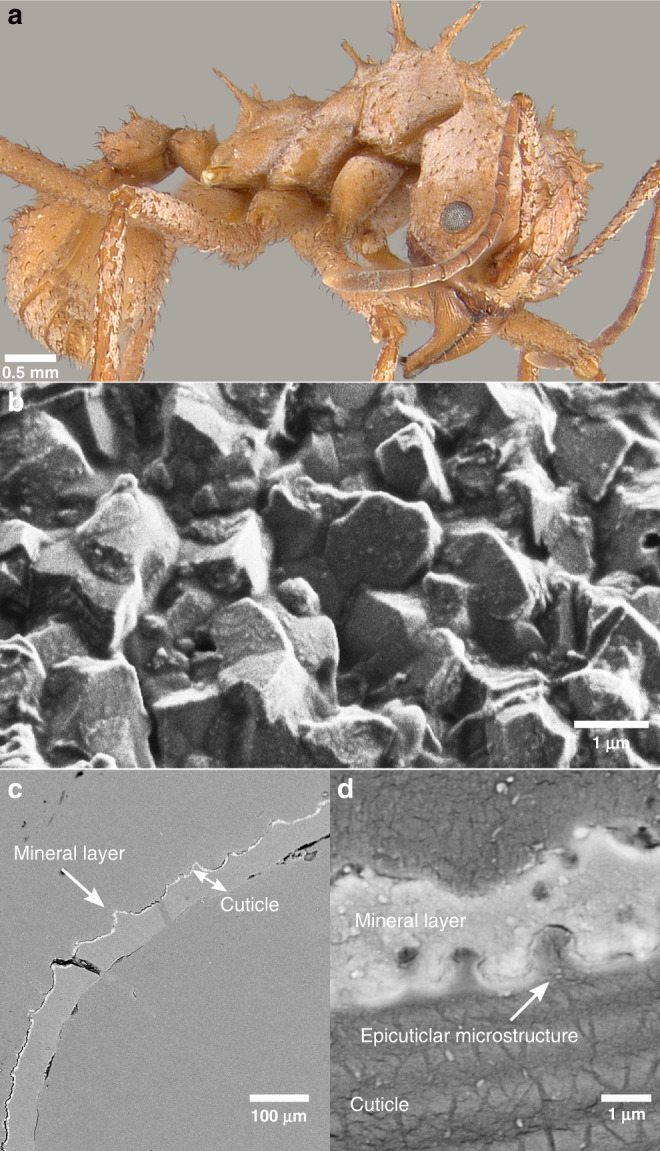
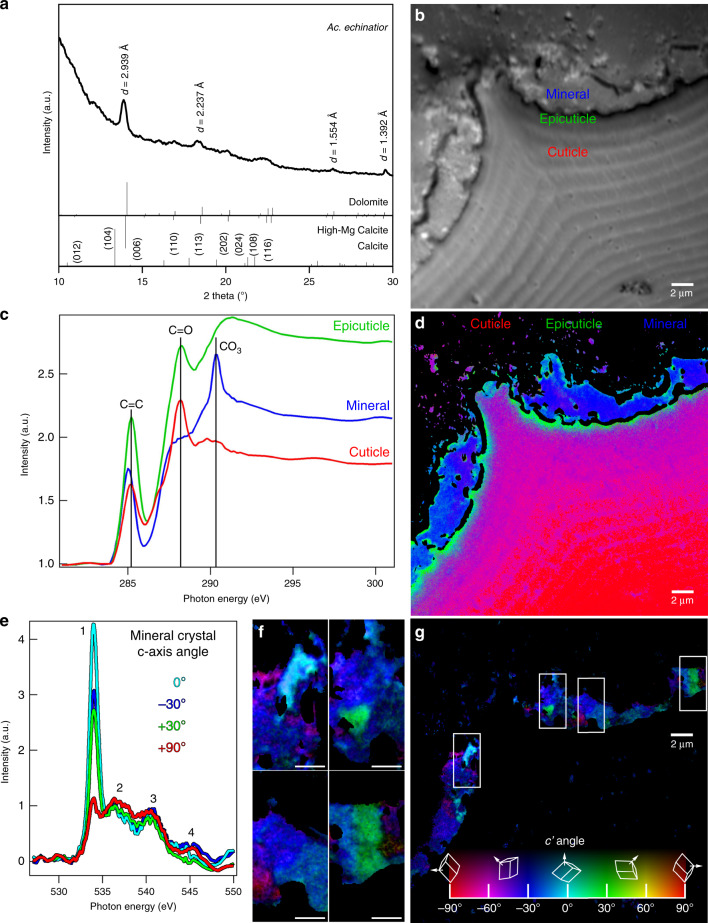
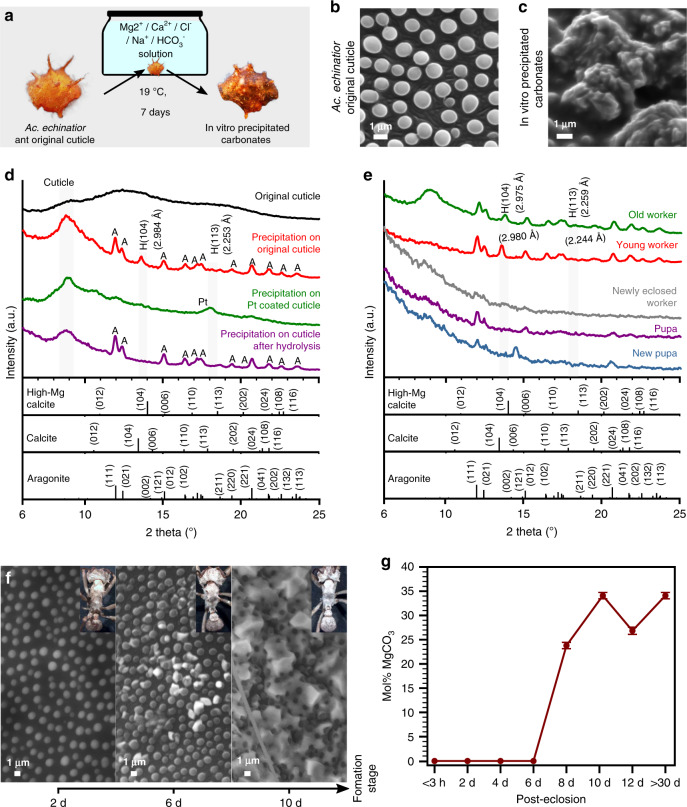
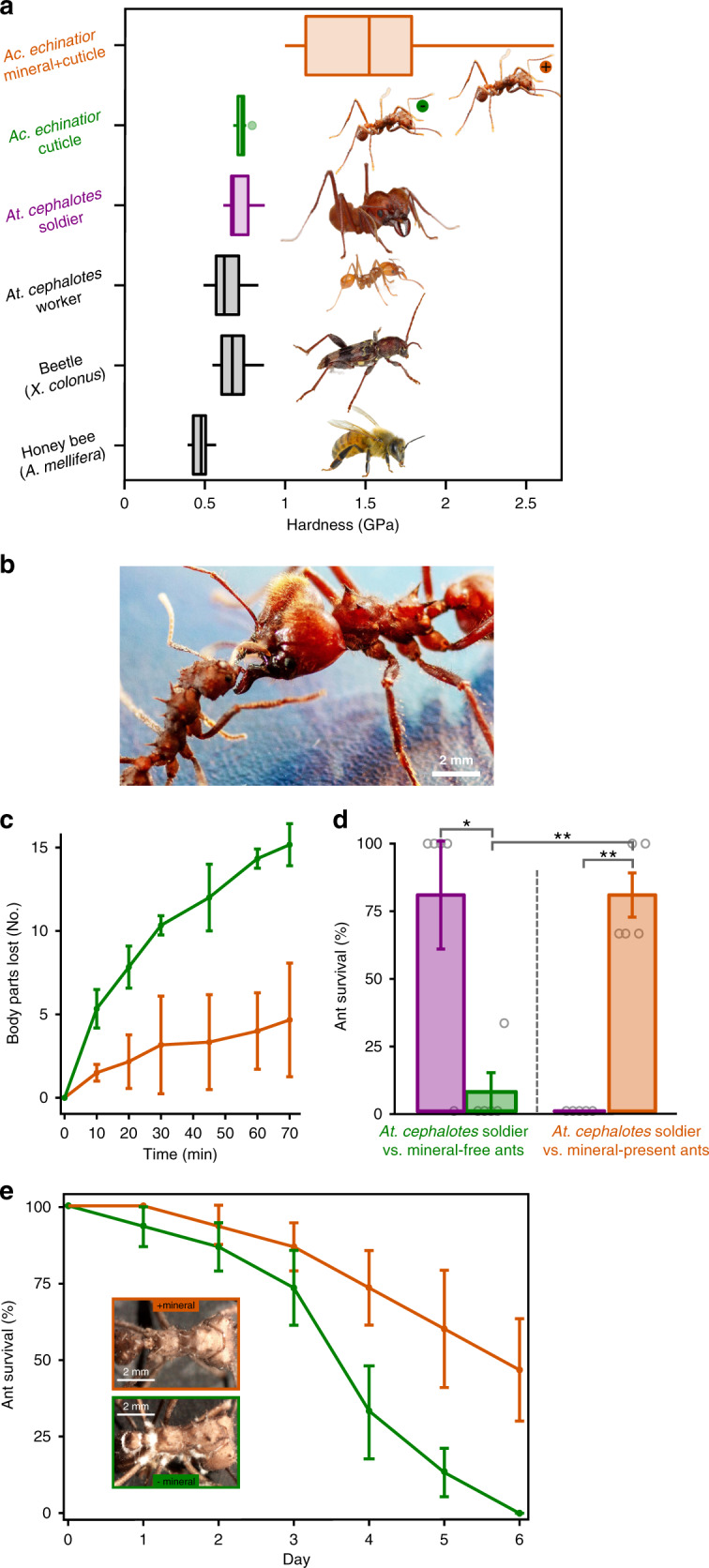
Verification
Claims the paper makes
The claims and statistics of this paper haven’t been checked yet.
Free: it reads the open-access text and checks the first 5 claims that cite a source we can check. Create a free account to check every claim.
Claims other papers make about this one
Each is checked against this paper’s own text: does it say what the citing paper says it does?
The source backs part of the claim, not all of it — or backs it for a different population, condition or comparison.
In the citing paper
“HMC is also formed on the exoskeletons of leaf-cutter ants, which are also abundant in chitin and polar hydrophilic and amphipathic amino acids.76”
From Low-Temperature Synthesis of Disordered Dolomite and High-Magnesium Calcite in Ethanol–Water Solutions: The Solvation Effect and Implications (2022) · cites this paper as [76]
Experimental — accuracy not yet measuredThe source backs part of the claim, not all of it — or backs it for a different population, condition or comparison.
In the citing paper
“In this study, HMC grown on GCGS surfaces with chitin substrates has similar euhedral morphologies, preferred crystal orientations, and Mg compositions to Ca–Mg carbonates formed on the chitin-rich exoskeletons of leaf-cutter ants7 (Figure S2).”
From Organic Controls over Biomineral Ca-Mg Carbonate Compositions and Morphologies (2023) · cites this paper as [7]
Experimental — accuracy not yet measuredThe check wasn’t confident either way, so it gives no verdict — never disputed.
In the citing paper
“Previous works have demonstrated how various amino acids and chitin have direct effects on CaCO3 precipitation in mollusks,5 chitons,7,23 foraminifera,24 and corals.25”
From Organic Controls over Biomineral Ca-Mg Carbonate Compositions and Morphologies (2023) · cites this paper as [7]
Experimental — accuracy not yet measuredIn the citing paper
“Within the attine ants, it appears to be absent in the genera Atta , Kalathomyrmex and Mycocepurus , which is consistent with an inferred secondary loss of biomineral armor 41 .”
From High-throughput phenomics of global ant biodiversity (2026) · cites this paper as [41]
In the citing paper
“Here this is shown on the example of biomineral armor, an unusual insect trait first described for Acromyrmex echinatior 41 and previously unknown in other ants.”
From High-throughput phenomics of global ant biodiversity (2026) · cites this paper as [41]
Self-check
Percentages, sums and reported differences re-computed from the paper’s own numbers.
The self-check needs the paper’s full text.
Citations
Cites
Oliver, W. C., & Pharr, G. M. (1992) · Journal of Materials Research · doi:10.1557/jmr.1992.1564 · Cited by 26,961
Hölldobler, B., & Wilson, E. O. (1990) · Springer eBooks · doi:10.1007/978-3-662-10306-7 · Cited by 5,438
SMARCAD1 ATPase activity is required to silence endogenous retroviruses in embryonic stem cells
Sachs, P., Ding, D., Bergmaier, P., Lamp, B., Schlagheck, C., Finkernagel, F., Nist, A., Stiewe, T., & Mermoud, J. E. (2019) · Nature Communications · doi:10.1038/s41467-019-09078-0 · Cited by 2,384
Stöhr, J. (1992) · Springer Series in Surface Sciences · doi:10.1007/978-3-662-02853-7 · Cited by 2,307
The Superorganism: the beauty, elegance, and strangeness of insect societies
(2009) · Choice Reviews Online · doi:10.5860/choice.46-6805 · Cited by 1,205
Yang, B.-J., Han, X.-X., Yin, L.-L., Xing, M.-Q., Xu, Z.-H., & Xue, H.-W. (2016) · Nature Communications · doi:10.1038/ncomms11388 · Cited by 1,202
Sea Urchin Spine Calcite Forms via a Transient Amorphous Calcium Carbonate Phase
Politi, Y., Arad, T., Klein, E., Weiner, S., & Addadi, L. (2004) · Science · doi:10.1126/science.1102289 · Cited by 963
The Stomatopod Dactyl Club: A Formidable Damage-Tolerant Biological Hammer
Weaver, J. C., Milliron, G. W., Miserez, A., Evans-Lutterodt, K., Herrera, S., Gallana, I., Mershon, W. J., Swanson, B., Zavattieri, P., DiMasi, E., et al. (2012) · Science · doi:10.1126/science.1218764 · Cited by 938
Fungus-growing ants use antibiotic-producing bacteria to control garden parasites
Currie, C. R., Scott, J. A., Summerbell, R. C., & Malloch, D. (1999) · Nature · doi:10.1038/19519 · Cited by 853
Self-citationWeber, N. A. (1972) · Medical Entomology and Zoology · Cited by 689
Research works printed but not linked: 3
- 6. Bengtson, S. Early Life on Earth. Nobel Symposium No. 84. (ed. Bengtson, S.) 412-425 (Columbia University Press, New York, 1994).
- 32. Vilela, E. F. & Howse, P. E. Fire Ants and Leaf-Cutting Ants. Biology and Management (eds Lofgren, C. S. & Vander Meer, R. K.) 159-171 (Westview Press. Boulder, CO, 1986).
- 34. Weber, N. A. Gardening Ants: The Attines (American Philosophical Society, Philadelphia, 1972).
Cited by
Calcium carbonate: controlled synthesis, surface functionalization, and nanostructured materials
Niu, Y.-Q., Liu, J.-H., Aymonier, C., Fermani, S., Kralj, D., Falini, G., & Zhou, C.-H. (2022) · Chemical Society Reviews · doi:10.1039/d1cs00519g · Cited by 410
Biomineralization: Integrating mechanism and evolutionary history
Gilbert, P. U. P. A., Bergmann, K. D., Boekelheide, N., Tambutté, S., Mass, T., Marin, F., Adkins, J. F., Erez, J., Gilbert, B., Knutson, V., et al. (2022) · Science Advances · doi:10.1126/sciadv.abl9653 · Cited by 327
“Biominerals may even have multiple functions at once, such as calcium carbonate (CaCO 3 ) armors that also serve as lenses in chitons ( 5 ), microbial shields in ants ( 6 ), or detoxification in most phyla ( 7 ).”
BackgroundSelf-citationEleftherianos, I., Heryanto, C., Bassal, T., Zhang, W., Tettamanti, G., & Mohamed, A. (2021) · Immunology · doi:10.1111/imm.13390 · Cited by 225
Robles-Fernández, A., Areias, C., Daffonchio, D. G., Vahrenkamp, V., & Sánchez‐Román, M. (2022) · Minerals · doi:10.3390/min12121562 · Cited by 101
Wysokowski, M., Luu, R. K., Arevalo, S. E., Khare, E., Stachowiak, W., Niemczak, M., Jesionowski, T., & Buehler, M. J. (2023) · Chemistry of Materials · doi:10.1021/acs.chemmater.3c00847 · Cited by 67
Vangelatos, Z., Yildizdag, M. E., & Grigoropoulos, C. P. (2023) · Extreme Mechanics Letters · doi:10.1016/j.eml.2023.102013 · Cited by 62
The armoured cuticle of the black soldier fly Hermetia illucens
Rebora, M., Salerno, G., Piersanti, S., Saitta, V., Venturi, D. M., Li, C., & Gorb, S. N. (2023) · Scientific Reports · doi:10.1038/s41598-023-49549-5 · Cited by 62
“In spite of the widespread presence of calcium carbonate in the crustacean cuticle, biomineralisation in insects, deriving from Crustacea 56 , has so far remained unknown 31 .”
BackgroundInfluentialFang, Y., Zhang, F., Farfan, G. A., & Xu, H. (2022) · ACS Omega · doi:10.1021/acsomega.1c04624 · Cited by 37
Self-citationLiquid-Liquid Phase Separation in Nucleation Process of Biomineralization
Qin, D., He, Z., Li, P., & Zhang, S. (2022) · Frontiers in Chemistry · doi:10.3389/fchem.2022.834503 · Cited by 36
“Biomineralization refers to a charming process describing the formation of various biominerals participated by complex interactions of organic and inorganic molecules (Berendsen and Olsen, 2015; Kim et al., 2016; Grünewald et al., 2020; Li et al., 2020; Schoeppler et al., 2021; Wu et al., 2021).”
BackgroundOrganic Controls over Biomineral Ca-Mg Carbonate Compositions and Morphologies
Fang, Y., Lee, S., Xu, H., & Farfan, G. A. (2023) · Crystal Growth & Design · doi:10.1021/acs.cgd.3c00102 · Cited by 32
Self-citationKrings, W., & Gorb, S. N. (2023) · Zoomorphology · doi:10.1007/s00435-023-00609-4 · Cited by 31
“Additionally, the E and H values correlate strongly to very strongly with Ca ( r = 0.70–0.71) and Mg content (r = 0.77–0.86), which indicates that they are involved in the harden-and stiffening of the jaws, similar to the exoskeletons of ants (Li et al. 2020).”
BackgroundInfluentialCalcite Nanotuned Chitinous Skeletons of Giant Ianthella basta Marine Demosponge
Kertmen, A., Petrenko, I., Schimpf, C., Rafaja, D., Petrova, O., Sivkov, V. N., Nekipelov, S. V., Fursov, A., Stelling, A. L., Heimler, K., et al. (2021) · International Journal of Molecular Sciences · doi:10.3390/ijms222212588 · Cited by 30
“These methods have been recognized as absolutely appropriate for the identification of diverse calcium carbonates of biomineral origin [2,3,32,33].”
BackgroundReiter, K. E., Perkovich, C., Smith, K. N., Feng, J., Kritsky, G. R., & Lehnert, M. S. (2023) · Biology · doi:10.3390/biology12020207 · Cited by 27
“The hard material high-magnesium calcite ((CaMg(CO3)2) was previously reported in the exoskeletons of the leaf-cutter ant, Acromyrmex echinatior [69].”
BackgroundKrings, W., Below, P., & Gorb, S. N. (2024) · Scientific Reports · doi:10.1038/s41598-024-55211-5 · Cited by 26
Impact of misinformation in the evolution of collective cooperation on networks
Meng, Y., Broom, M., & Li, A. (2023) · Journal of The Royal Society Interface · doi:10.1098/rsif.2023.0295 · Cited by 25
Widespread mineralization of soft‐bodied insects in Cretaceous amber
Jiang, H., Tomaschek, F., Muscente, A. D., Niu, C., Nyunt, T. T., Fang, Y., Schmidt, U., Chen, J., Lönartz, M. I., Mähler, B., et al. (2022) · Geobiology · doi:10.1111/gbi.12488 · Cited by 25
“Insects generally do not have biomineralized tissues made of silica or calcium carbonate (Li et al., 2020 ); ergo, the silicification and calcification of the Kachin insects must have been caused by precipitation of chemical species from two sources: (1) decomposition of their tissues in response…”
BackgroundSelf-citationExceptional properties of hyper-resistant armor of a hydrothermal vent crab
Cho, B., Kim, D., & Kim, T. (2022) · Scientific Reports · doi:10.1038/s41598-022-15982-1 · Cited by 19
From Telson to Attack in Mantis Shrimp: Bridging Biomechanics and Behavior in Crustacean Contests
deVries, M. S., Lowder, K. B., & Taylor, J. R. A. (2021) · Integrative and Comparative Biology · doi:10.1093/icb/icab064 · Cited by 19
“For example, damage resistance is an important factor in contest outcomes, where it can increase the likelihood of winning a contest for mesquite bugs (Emberts and Wiens 2021) and the hardened (calcified) armor of leaf-cutter ants increases their survival during aggressive interactions (Li et al. 2020).”
BackgroundMechanical and elemental characterization of ant mandibles: consequences for bite mechanics
Klunk, C. L., Heethoff, M., Hammel, J. U., Gorb, S. N., & Krings, W. (2024) · Interface Focus · doi:10.1098/rsfs.2023.0056 · Cited by 19
“Along with these cross-links, it is known that ant species can incorporate minerals into their cuticle [72], similar to the cuticles of crustaceans.”
BackgroundXu, D., Zhou, P., Ma, J., Xiang, G., Wu, J., Guo, H., Li, Q., Wang, H., Xia, Y., Zhang, X., et al. (2026) · Small · doi:10.1002/smll.73163 · Cited by 18
Developmental biomechanics and age polyethism in leaf-cutter ants
Püffel, F., Meyer, L., Imirzian, N., Roces, F., Johnston, R. E., & Labonte, D. (2023) · Proceedings of the Royal Society B Biological Sciences · doi:10.1098/rspb.2023.0355 · Cited by 16
Battles between ants (Hymenoptera: Formicidae): a review
Champer, J., & Schlenoff, D. H. (2024) · Journal of Insect Science · doi:10.1093/jisesa/ieae064 · Cited by 14
Mandible composition and properties in two selected praying mantises (Insecta, Mantodea)
Roze, M., Gorb, S. N., Zeimet, T., & Krings, W. (2024) · The Anatomical Record · doi:10.1002/ar.25602 · Cited by 13
“…Wang et al., 2019) in addition to inorganic compounds that enhance H and E values (Birkenfeld et al., 2024; Cribb et al., 2008a, 2008b; Dieterich & Betz, 2009; Hillerton & Vincent, 1982; Klunk et al., 2024; Krings & Gorb, 2023; Kundanati & Gundiah, 2014; Li et al., 2020; Schofield et al., 2002).”
Tan, Q., Li, X., Sun, P., Zhao, J., Yang, Q., Wang, L., Deng, Y., & Shen, G. (2022) · Analytical Methods · doi:10.1039/d2ay01182d · Cited by 13
Qi, H., Ma, Z., Xu, Z., Wang, S., Ma, Y., Wu, S., & Guo, M. (2023) · Biomimetics · doi:10.3390/biomimetics8070555 · Cited by 12
“Researchers have conducted numerous studies on these ants and obtained significant findings [25–27].”
BackgroundGilbert, P. U. P. A. (2023) · MRS Bulletin · doi:10.1557/s43577-023-00479-7 · Cited by 9
“…mechanisms are frequently discovered in natural biominerals, such as the recent dual scale, single-crystalline calcite in a sea star revealed by Li et al.20 and the latest installments of the ongoing debate on the fiendishly complicated structure of pteropod shells.21–28 Biominerals also…”
BackgroundSelf-citationSevarika, M., & Romani, R. (2024) · Insects · doi:10.3390/insects15060403 · Cited by 9
Valencia‐Giraldo, S. M., Niño‐Castro, A., Peña, A. L., Trejos-Vidal, D., Bueno, O. C., & Montoya‐Lerma, J. (2021) · PLoS ONE · doi:10.1371/journal.pone.0247545 · Cited by 9
“Additionally, workers have a biomineral armor covering their exoskeleton that contributes to protecting them from the invasion of agents that penetrate the cuticle [18].”
BackgroundCrumière, A., James, A., Lannes, P., Mallett, S., Michelsen, A., Rinnan, R., & Shik, J. Z. (2021) · Ecology Letters · doi:10.1111/ele.13865 · Cited by 10
Yamamoto, Y., & Fujiwara, Y. (2023) · Journal of Insect Physiology · doi:10.1016/j.jinsphys.2023.104534 · Cited by 8
Lehnert, M. S. (2024) · Biologically-inspired systems · doi:10.1007/978-3-031-68486-9_1 · Cited by 8
Asano, T. (2022) · Advances in insect physiology · doi:10.1016/bs.aiip.2022.03.004 · Cited by 8
Chavarría‐Pizarro, L., Núñez-Montero, K., Gutiérrez-Araya, M., Watson-Guido, W., Rivera-Méndez, W., & Pizarro‐Cerdá, J. (2024) · FEMS Microbes · doi:10.1093/femsmc/xtae005 · Cited by 7
“T he pr otection offer ed by Actinobacteria against the Escovopsis pathogen is so effective (Poulsen et al. 2011 ) that ants e volv e specialized exocrine glands to host them (Poulsen et al. 2003 , Currie et al. 2006 ), among other possible functions (Li et al. 2020 ).”
BackgroundHigh-throughput phenomics of global ant biodiversity
Katzke, J., Hita Garcia, F., Lösel, P. D., Azuma, F., Faragó, T., Aibekova, L., Casadei-Ferreira, A., Gautam, S., Richter, A., Toulkeridou, E., et al. (2026) · Nature Methods · doi:10.1038/s41592-026-03005-0 · Cited by 6
“Within the attine ants, it appears to be absent in the genera Atta , Kalathomyrmex and Mycocepurus , which is consistent with an inferred secondary loss of biomineral armor 41 .”
Self-citationZeimet, T., Gorb, S. N., & Krings, W. (2025) · Scientific Reports · doi:10.1038/s41598-025-06427-6 · Cited by 6
“The (I) morphology, (II) autofluorescence, (III) elemental composition, and (iv) mechanical properties were investigated.”
Nalini, E., & Polidori, C. (2024) · The European Zoological Journal · doi:10.1080/24750263.2024.2355308 · Cited by 6
“Arthropod exoskeleton has been widely studied and highly appreciated for its mechanical properties (Vincent & Wegst 2004; Dirks & Taylor 2012; Parle et al. 2016; Li et al. 2020).”
BackgroundPolidori, C., Romano, M., & Ronchetti, F. (2024) · Biologically-inspired systems · doi:10.1007/978-3-031-68486-9_2 · Cited by 5
Polidori, C., Gabrieli, P., Arnoldi, I., Negri, A., Soresinetti, L., Faggiana, S., Ferrari, A., Ronchetti, F., Brilli, M., Bandi, C., et al. (2023) · Current Research in Parasitology and Vector-Borne Diseases · doi:10.1016/j.crpvbd.2023.100142 · Cited by 5
“These metals were proved, through a combination of EDS and nanoindentation, to effectively increase cuticle hardness in these structures (Cribb et al., 2008; Li et al., 2020).”
Evolution and functional implications of stinger shape in ants
Casadei‐Ferreira, A., Camacho, G. P., van de Kamp, T., Lattke, J. E., Feitosa, R. M., & Economo, E. P. (2024) · Evolution · doi:10.1093/evolut/qpae142 · Cited by 5
Matushkina, N. A., Gorb, S. N., & Krings, W. (2025) · Journal of Insect Physiology · doi:10.1016/j.jinsphys.2025.104813 · Cited by 3
Perkovich, C., Haynes, B. R., Reiter, K. E., Kritsky, G. R., & Lehnert, M. S. (2024) · Biologically-inspired systems · doi:10.1007/978-3-031-68486-9_3 · Cited by 3
Algorithmic construction of topologically complex biomineral lattices via cellular syncytiaPreprint
Vyas, P., Brannon, C. M., Formery, L., Lowe, C. J., & Prakash, M. (2024) · bioRxiv (Cold Spring Harbor Laboratory) · doi:10.1101/2024.02.20.580924 · Cited by 3
“The study of biomineralized structures across numerous systems has enabled discovery of diverse functions including magnetotaxis [10, 11], gravity sensing [12, 13], vision [14, 15], predator defense [16, 17], mineral regulation and detoxification [18, 19] and structural support [1, 20, 21, 2].”
BackgroundAndresen, J. L., Birkemoe, T., Jensen, K. A., Морозова, В. С., & Oughton, D. H. (2025) · The Science of The Total Environment · doi:10.1016/j.scitotenv.2025.178422 · Cited by 2
Morphological and biomechanical adaptations of larval mandibles in Trichoptera (Insecta)
Below, P., Gorb, S. N., Friedrich, F., & Krings, W. (2025) · Physiological Entomology · doi:10.1111/phen.70009 · Cited by 2
“…al., 2006; Birkenfeld et al., 2024; Degtyar et al., 2014; Jorge et al., 2017; Klunk et al., 2024; Krings, Birkenfeld, & Gorb, 2025; Lehnert, 2024; Li et al., 2020; Lichtenegger et al., 2003; Martínez et al., 2020; Matsumura et al., 2024; Perkovich et al., 2024; Polidori et al., 2024; Schofield,…”
Zúñiga-Estrada, M. A., Zúñiga-Estrada, E. A., & Cuéllar‐Cruz, M. (2023) · Progress in Crystal Growth and Characterization of Materials · doi:10.1016/j.pcrysgrow.2023.100594 · Cited by 2
Gómez-Díaz, J. S., Niño‐Castro, A., Valencia‐Giraldo, S. M., & Cotazo-Calambas, K. M. (2022) · Journal of Hymenoptera Research · doi:10.3897/jhr.91.82381 · Cited by 2
“The first barrier of individual immunity in leaf-cutting ants is a hard exoskeleton reinforced with a biomineral armor that protects workers from invaders in most cases (Siva-Jothy et al. 2005; Li et al. 2020).”
BackgroundLonghorn Beetles Form Structural Colour Using Calcium Phosphate BiomineralsPreprint
Chang, Y., Tseng, H.-H., Tanahashi, M., Pohl, D., Rellinghaus, B., Bertinetti, L., & Politi, Y. (2024) · bioRxiv (Cold Spring Harbor Laboratory) · doi:10.1101/2024.10.01.616160 · Cited by 2
“However, among insects, biomineralization is rare 8,9 and primarily observed in the cuticles of larval and pupal dipterans 11-14 , some tenebrionid beetles 15 , and fungus-farming ants 16 .”
BackgroundNatural leaf inspired extraordinary mechanical properties
Wijerathne, P. (2021) · Queensland University of Technology · doi:10.5204/thesis.eprints.226357 · Cited by 1
Carbon dioxide sequestration into biomineral armor by antsPreprint
Li, H., Fang, Y., Li, W., Liu, J., Sun, C.-Y., Kang, X., Bruner-Montero, G., Sardina, J. A., Mo, X., Hao, J.-L., et al. (2026) · bioRxiv (Cold Spring Harbor Laboratory) · doi:10.64898/2026.01.21.700952 · Cited by 1
Self-citationWar as a System in NaturePreprint
MacQueen, G., & Slee, T. (2022) · SSRN Electronic Journal · doi:10.2139/ssrn.4262518
Geochemical and Evolutionary Prerequisites for the Cambrian Skeletal Revolution
Наймарк, Е. Б. (2022) · Biology Bulletin · doi:10.1134/s1062359022070111
“I cannot resist the temptation to mention in this connection an interesting example of the appearance of biomineralization in the leaf-cutting ants Acromyrmex echinatior Forel 1899 (Li et al., 2020).”
BackgroundZweiter Gipfel – das Kerbtier und die Individuelle Persönlichkeit
Lehmann, K. (2024) · Springer eBooks · doi:10.1007/978-3-662-69274-5_5
Huang, P., Sardina, J. A., Lu, H., Bruner-Montero, G., Currie, C. R., & Li, L. (2025) · Analytical Chemistry · doi:10.1021/acs.analchem.5c05220
Self-citationDesign and Fabrication of Solar-Powered Sustainable Cutting Solution for Tea Leaves Harvesting
Kothari, D., Shetty, V., Davanagere, M. B., Fernandes, J., Navyashree, H. B., Pallavi, P., & Sandeep, D. J. (2025) · Lecture notes in mechanical engineering · doi:10.1007/978-981-96-8167-9_29
The Evolution of Biomineral Armor in Fungus-farming AntsPreprint
Sardina, J. A., Bruner-Montero, G., Sosa‐Calvo, J., Schultz, T. R., Li, H., & Currie, C. R. (2026) · bioRxiv (Cold Spring Harbor Laboratory) · doi:10.64898/2026.02.07.704540
“Nanoindentation analysis demonstrated that the Mg calcite covered exoskeleton of A. echinatior ants was nearly two times as hard as the exoskeleton of mineral-free A. echinatior ants, despite only adding ~7% to cuticle thickness (13).”
InfluentialSelf-citationPorras, E. A. M. (2024) · Investigative News in Education (Universidad de Costa Rica)
Beyond morphology: Material alterations as inducible defenses in Daphnia longicephala
Krings, W., Becker, S., Huttegger, G., Gorb, S. N., & Horstmann, M. (2026) · Journal of Biosciences · doi:10.1007/s12038-026-00591-1
Brodoline, I. (2023) · theses.fr (ABES) · doi:10.70675/7b1fd535zd809z4b91zbd1fz104cb4311833
Carbon dioxide sequestration into biomineral armor by antsPreprint
Currie, C. R., Li, H., Fang, Y., Li, W., Liu, J., Sun, C.-Y., Kang, X., Bruner-Montero, G., Sardina, J. A., Mo, X., et al. (2026) · Research Square · doi:10.21203/rs.3.rs-8770661/v1
Self-citationKrings, W., Bernardi, D., Gorb, S. N., Huttegger, G., Lucena, W., Pasqualotto, L., & Silva‐Brandão, K. L. (2026) · Biointerphases · doi:10.1116/6.0005706
Metadata
- Authors
- Li, H., Sun, C.-Y., Fang, Y., Carlson, C. M., Xu, H., Ješovnik, A., Sosa-Calvo, J., Zarnowski, R., Bechtel, H. A., Fournelle, J. H., Andes, D. R., Schultz, T. R., Gilbert, P. U. P. A., & Currie, C. R.
- Affiliations
- Ningbo University (CN)
- University of Wisconsin–Madison (US)
- Smithsonian Institution (US)
- Lawrence Berkeley National Laboratory (US)
- Corresponding author
- Gilbert, Pupa U. P. A.
- Currie, Cameron R.
- ORCID
- Venue
- Nature Communications
- Published
- 2020-11-24
- Volume
- 11
- Issue
- 1
- Pages
- 5792-5792
- ISSN
- 2041-1723 (ISSN-L)
- PMC
- PMC7686325
- OpenAlex
- W3109629107
- Semantic Scholar
- a71b992d90b48ae4c0d70849b1d6dfd5436de883
- Cited by
- 58
- References
- 62
- Citations by year
- 2026: 3 · 2025: 6 · 2024: 14 · 2023: 16 · 2022: 12 · 2021: 7
- FWCI
- 2.28
- Type
- journal article
- Language
- en
- Open access
- gold
- doi.org
- Licence
- cc-by
- creativecommons.org/licenses/by/4.0 (tdm)
- creativecommons.org/licenses/by/4.0 (vor)
- Locations
- Nature Communications (publishedVersion, cc-by)
- bioRxiv (Cold Spring Harbor Laboratory) (acceptedVersion)
- PubMed Central (publishedVersion, cc-by)
- PubMed (publishedVersion)
- OSTI OAI (U.S. Department of Energy Office of Scientific and Technical Information) (submittedVersion)
- RePEc: Research Papers in Economics (submittedVersion)
- DOAJ (DOAJ: Directory of Open Access Journals) (submittedVersion, cc-by-sa)
- eScholarship (California Digital Library) (submittedVersion)
- eScholarship (California Digital Library) (submittedVersion, cc-by)
- Funders
- U.S. Department of Health & Human Services | NIH | Center for Information Technology (U19 AI109673)
- Topics
- Physical Sciences › Materials Science › Biomaterials › Calcium Carbonate Crystallization and Inhibition
- Life Sciences › Agricultural and Biological Sciences › Insect Science › Insect and Arachnid Ecology and Behavior
- Physical Sciences › Environmental Science › Environmental Engineering › Microbial Applications in Construction Materials
- Keywords
- high-Mg calcite, leaf-cutting ants, Acromyrmex echinatior, insect exoskeleton, epicuticle, ant aggression, entomopathogenic fungi, fungal infection resistance
- MeSH terms
- Animals, Ants, Calcium Carbonate, Magnesium, Animal Shells
About these checks
Registry, retraction, Cites and statistics results are computed, not judged, with one exception: a printed reference that no index lists is read once by a model before it counts as a citation error. Claims are extracted by a model and kept only when their quote appears verbatim in the text; each cited source is then checked, with a model’s help, for whether it says what the claim relies on. Those verdicts can be wrong — read the claim’s quote and the cited source before relying on one.
Statistics and arithmetic are recomputed, not judged.
Confidence bands are shown only for fields calibrated on our annotated test set. None is calibrated yet, so no band is shown.
What counts as a claim ›How we measure confidence ›How we check this ›
Are you an author, or do you see a problem with this page? Request a review
Data sources
Bibliographic data: Semantic Scholar, OpenAlex, Crossref.
Contains information from the Semantic Scholar Academic Graph Datasets, made available under the ODC Attribution License (ODC-BY 1.0).
Semantic Scholar’s data is described in: Kinney, R., et al. (2023). The Semantic Scholar Open Data Platform. arXiv:2301.10140.
