

Biomineral armor in leaf-cutter ants
Open accessPublished version of a preprint
The DOI matches its Crossref record; 62 of the 62 references it cites were found in a registry or an index.
Abstract
Although calcareous anatomical structures have evolved in diverse animal groups, such structures have been unknown in insects. Here, we report the discovery of high-magnesium calcite [CaMg(CO 3 ) 2 ] armor overlaying the exoskeletons of major workers of the leaf-cutter ant Acromyrmex echinatior . Live-rearing and in vitro synthesis experiments indicate that the biomineral layer accumulates rapidly as ant workers mature, that the layer is continuously distributed, covering nearly the entire integument, and that the ant epicuticle catalyzes biomineral nucleation and growth. In situ nanoindentation demonstrates that the biomineral layer significantly hardens the exoskeleton. Increased survival of ant workers with biomineralized exoskeletons during aggressive encounters with other ants and reduced infection by entomopathogenic fungi demonstrate the protective role of the biomineral layer. The discovery of biogenic high-magnesium calcite in the relatively well-studied leaf-cutting ants suggests that calcareous biominerals enriched in magnesium may be more common in metazoans than previously recognized.
Overview
The claims and statistics of this paper haven’t been checked yet.
Free: it reads the open-access text and checks the first 5 claims that cite a source we can check. Create a free account to check every claim.
Integrity signals
Registry
Cites
Statistics
Figures
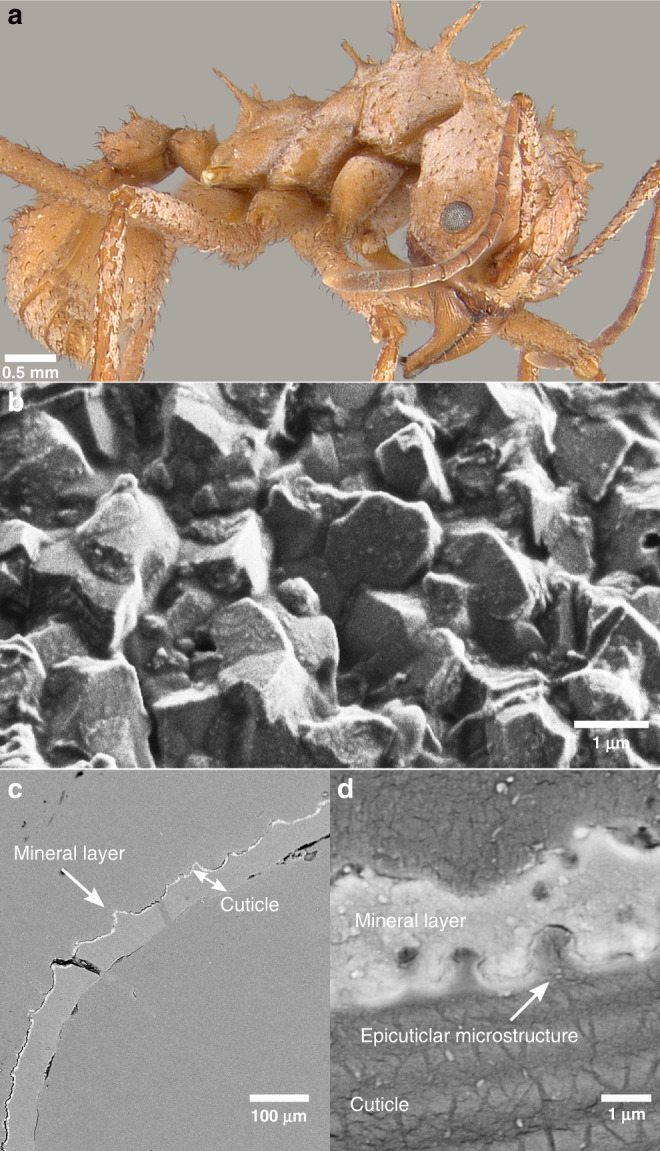
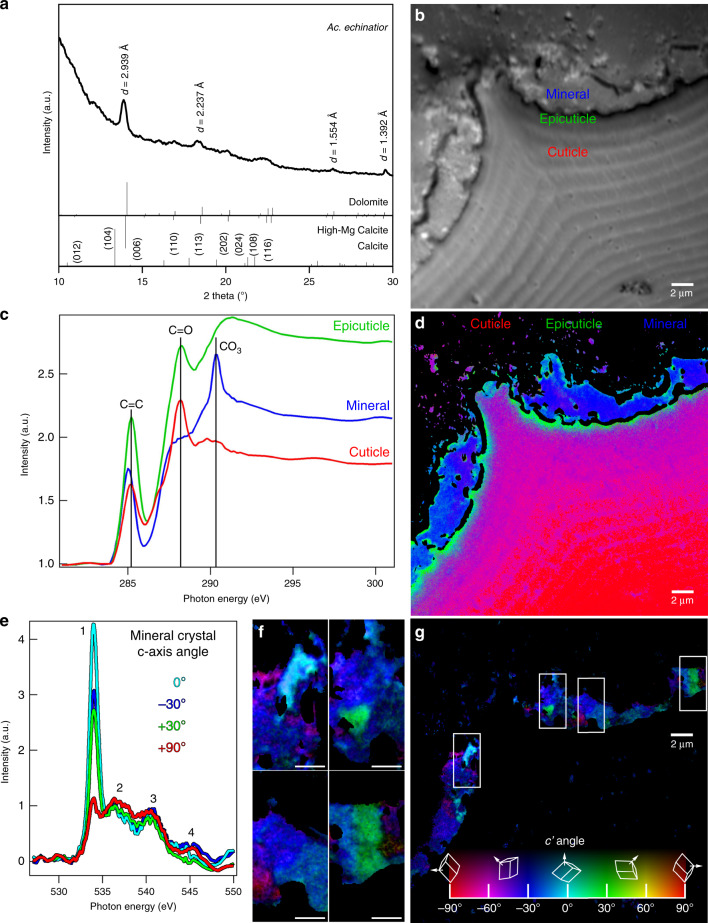
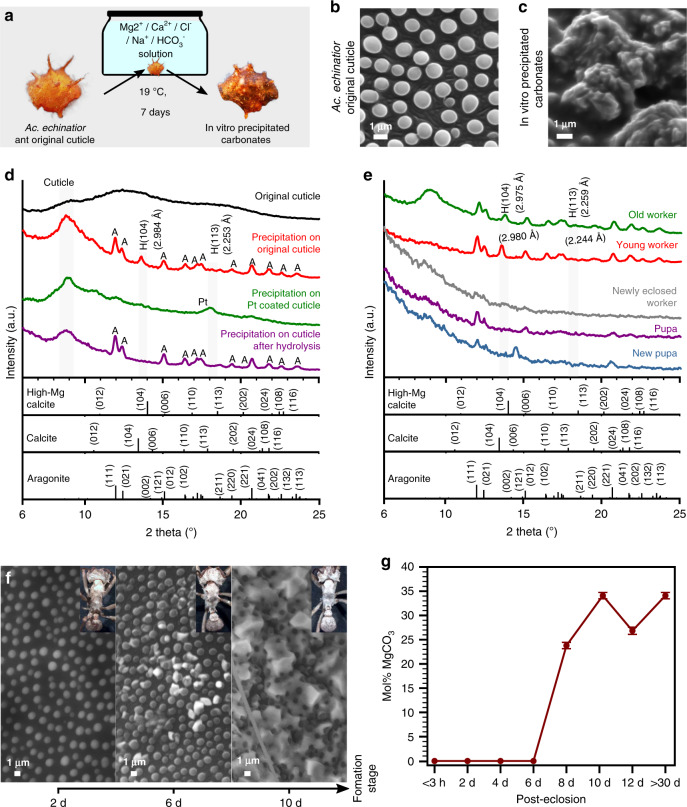
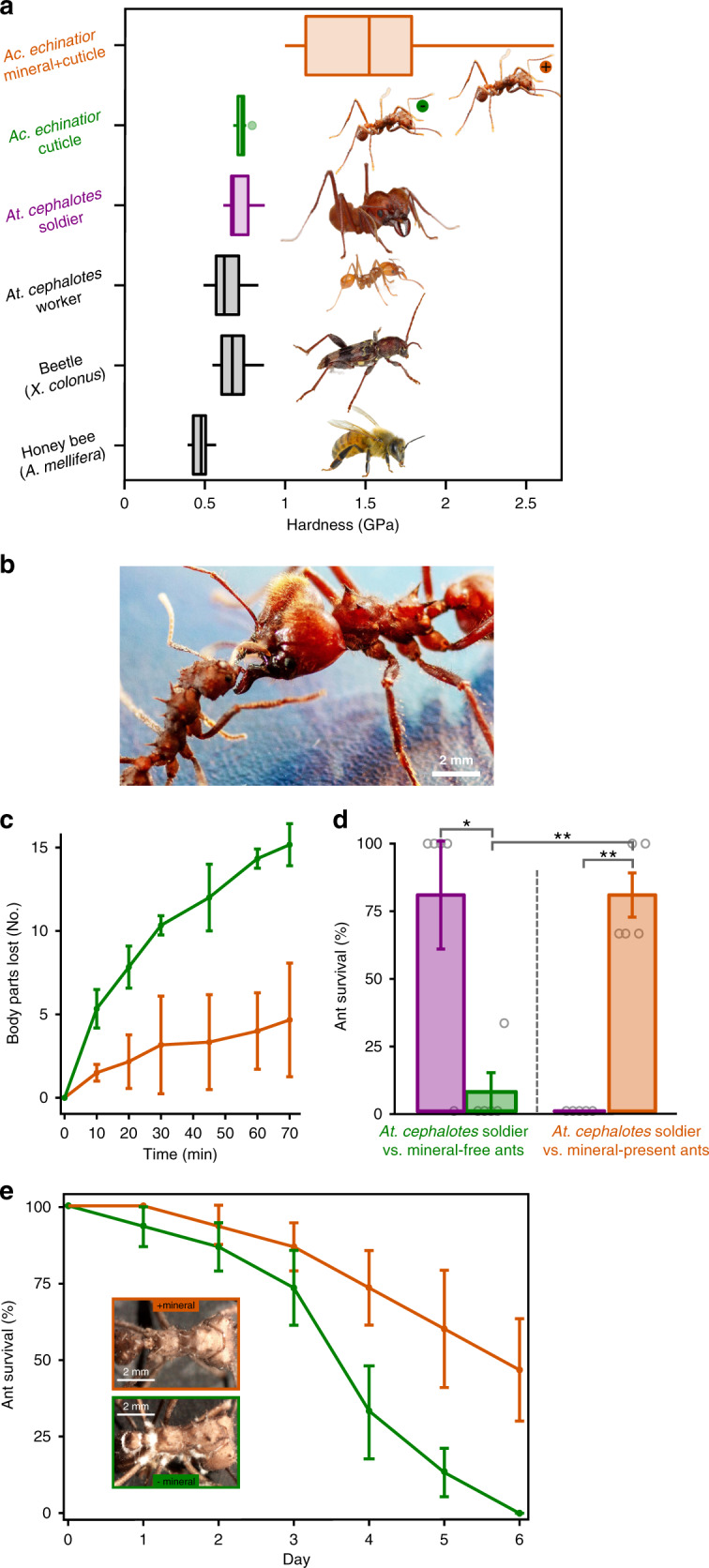
Verification
Claims the paper makes
The claims and statistics of this paper haven’t been checked yet.
Free: it reads the open-access text and checks the first 5 claims that cite a source we can check. Create a free account to check every claim.
Claims other papers make about this one
Each is checked against this paper’s own text: does it say what the citing paper says it does?
The source backs part of the claim, not all of it — or backs it for a different population, condition or comparison.
In the citing paper
“HMC is also formed on the exoskeletons of leaf-cutter ants, which are also abundant in chitin and polar hydrophilic and amphipathic amino acids.76”
From Low-Temperature Synthesis of Disordered Dolomite and High-Magnesium Calcite in Ethanol–Water Solutions: The Solvation Effect and Implications (2022) · cites this paper as [76]
Experimental — accuracy not yet measuredThe source backs part of the claim, not all of it — or backs it for a different population, condition or comparison.
In the citing paper
“In this study, HMC grown on GCGS surfaces with chitin substrates has similar euhedral morphologies, preferred crystal orientations, and Mg compositions to Ca–Mg carbonates formed on the chitin-rich exoskeletons of leaf-cutter ants7 (Figure S2).”
From Organic Controls over Biomineral Ca-Mg Carbonate Compositions and Morphologies (2023) · cites this paper as [7]
Experimental — accuracy not yet measuredThe check wasn’t confident either way, so it gives no verdict — never disputed.
In the citing paper
“Previous works have demonstrated how various amino acids and chitin have direct effects on CaCO3 precipitation in mollusks,5 chitons,7,23 foraminifera,24 and corals.25”
From Organic Controls over Biomineral Ca-Mg Carbonate Compositions and Morphologies (2023) · cites this paper as [7]
Experimental — accuracy not yet measuredIn the citing paper
“Within the attine ants, it appears to be absent in the genera Atta , Kalathomyrmex and Mycocepurus , which is consistent with an inferred secondary loss of biomineral armor 41 .”
From High-throughput phenomics of global ant biodiversity (2026) · cites this paper as [41]
In the citing paper
“Here this is shown on the example of biomineral armor, an unusual insect trait first described for Acromyrmex echinatior 41 and previously unknown in other ants.”
From High-throughput phenomics of global ant biodiversity (2026) · cites this paper as [41]
Self-check
Percentages, sums and reported differences re-computed from the paper’s own numbers.
The self-check needs the paper’s full text.
Citations
Cites
Oliver, W. C., & Pharr, G. M. (1992) · Journal of Materials Research · doi:10.1557/jmr.1992.1564 · Cited by 26,961
Hölldobler, B., & Wilson, E. O. (1990) · Springer eBooks · doi:10.1007/978-3-662-10306-7 · Cited by 5,438
SMARCAD1 ATPase activity is required to silence endogenous retroviruses in embryonic stem cells
Sachs, P., Ding, D., Bergmaier, P., Lamp, B., Schlagheck, C., Finkernagel, F., Nist, A., Stiewe, T., & Mermoud, J. E. (2019) · Nature Communications · doi:10.1038/s41467-019-09078-0 · Cited by 2,384
Stöhr, J. (1992) · Springer Series in Surface Sciences · doi:10.1007/978-3-662-02853-7 · Cited by 2,307
The Superorganism: the beauty, elegance, and strangeness of insect societies
(2009) · Choice Reviews Online · doi:10.5860/choice.46-6805 · Cited by 1,205
Yang, B.-J., Han, X.-X., Yin, L.-L., Xing, M.-Q., Xu, Z.-H., & Xue, H.-W. (2016) · Nature Communications · doi:10.1038/ncomms11388 · Cited by 1,202
Sea Urchin Spine Calcite Forms via a Transient Amorphous Calcium Carbonate Phase
Politi, Y., Arad, T., Klein, E., Weiner, S., & Addadi, L. (2004) · Science · doi:10.1126/science.1102289 · Cited by 963
The Stomatopod Dactyl Club: A Formidable Damage-Tolerant Biological Hammer
Weaver, J. C., Milliron, G. W., Miserez, A., Evans-Lutterodt, K., Herrera, S., Gallana, I., Mershon, W. J., Swanson, B., Zavattieri, P., DiMasi, E., et al. (2012) · Science · doi:10.1126/science.1218764 · Cited by 938
Fungus-growing ants use antibiotic-producing bacteria to control garden parasites
Currie, C. R., Scott, J. A., Summerbell, R. C., & Malloch, D. (1999) · Nature · doi:10.1038/19519 · Cited by 853
Self-citationWeber, N. A. (1972) · Medical Entomology and Zoology · Cited by 689
Calcitic microlenses as part of the photoreceptor system in brittlestars
Aizenberg, J., Tkachenko, A., Weiner, S., Addadi, L., & Hendler, G. (2001) · Nature · doi:10.1038/35090573 · Cited by 656
Major evolutionary transitions in ant agriculture
Schultz, T. R., & Brady, S. G. (2008) · Proceedings of the National Academy of Sciences · doi:10.1073/pnas.0711024105 · Cited by 647
Self-citationSedimentary carbonate minerals
(1973) · Earth-Science Reviews · doi:10.1016/0012-8252(73)90031-7 · Cited by 553
Sedimentary Carbonate Minerals
Lippmann, F. (1973) · doi:10.1007/978-3-642-65474-9 · Cited by 545
Biomineralization and Evolutionary History
Knoll, A. H. (2003) · Reviews in Mineralogy and Geochemistry · doi:10.2113/0540329 · Cited by 494
Insect Pathogenic Fungi: Genomics, Molecular Interactions, and Genetic Improvements
Wang, C., & Wang, S. (2017) · Annual Review of Entomology · doi:10.1146/annurev-ento-031616-035509 · Cited by 453
Biological composites—complex structures for functional diversity
Eder, M., Amini, S., & Fratzl, P. (2018) · Science · doi:10.1126/science.aat8297 · Cited by 426
The agricultural pathology of ant fungus gardens
Currie, C. R., Mueller, U. G., & Malloch, D. (1999) · Proceedings of the National Academy of Sciences · doi:10.1073/pnas.96.14.7998 · Cited by 389
Self-citationSymbiotic Nitrogen Fixation in the Fungus Gardens of Leaf-Cutter Ants
Pinto-Tomás, A. A., Anderson, M. A., Suen, G., Stevenson, D. M., Chu, F. S. T., Cleland, W. W., Weimer, P. J., & Currie, C. R. (2009) · Science · doi:10.1126/science.1173036 · Cited by 376
Self-citationOxygen, ecology, and the Cambrian radiation of animals
Sperling, E. A., Frieder, C. A., Raman, A. V., Girguis, P. R., Levin, L. A., & Knoll, A. H. (2013) · Proceedings of the National Academy of Sciences · doi:10.1073/pnas.1312778110 · Cited by 367
Coevolved Crypts and Exocrine Glands Support Mutualistic Bacteria in Fungus-Growing Ants
Currie, C. R., Poulsen, M., Mendenhall, J., Boomsma, J. J., & Billen, J. (2006) · Science · doi:10.1126/science.1119744 · Cited by 356
Self-citationAmorphous calcium carbonate particles form coral skeletons
Mass, T., Giuffre, A. J., Sun, C.-Y., Stifler, C. A., Frazier, M. J., Neder, M., Tamura, N., Stan, C. V., Marcus, M. A., & Gilbert, P. U. P. A. (2017) · Proceedings of the National Academy of Sciences · doi:10.1073/pnas.1707890114 · Cited by 327
Self-citationPhase transitions in biogenic amorphous calcium carbonate
Gong, Y. U. T., Killian, C. E., Olson, I. C., Appathurai, N. P., Amasino, A. L., Martin, M. C., Holt, L. J., Wilt, F. H., & Gilbert, P. U. P. A. (2012) · Proceedings of the National Academy of Sciences · doi:10.1073/pnas.1118085109 · Cited by 304
Self-citationOakley, T. H., Wolfe, J. M., Lindgren, A. R., & Zaharoff, A. K. (2013) · Molecular Biology and Evolution · doi:10.1093/molbev/mss216 · Cited by 263
Unveiling the biosynthetic puzzle of destruxins in Metarhizium species
Wang, B., Kang, Q., Lu, Y., Bai, L., & Wang, C. (2012) · Proceedings of the National Academy of Sciences · doi:10.1073/pnas.1115983109 · Cited by 261
A hydrated crystalline calcium carbonate phase: Calcium carbonate hemihydrate
Zou, Z., Habraken, W. J. E. M., Matveeva, G., Jensen, A. C. S., Bertinetti, L., Hood, M. A., Sun, C.-Y., Gilbert, P. U. P. A., Polishchuk, I., Pokroy, B., et al. (2019) · Science · doi:10.1126/science.aav0210 · Cited by 255
Self-citationInnershell Absorption Spectroscopy of Amino Acids
Kaznacheyev, K., Osanna, A., Jacobsen, C., Plashkevych, O., Vahtras, O., Ågren, Carravetta, V., & Hitchcock, A. P. (2002) · The Journal of Physical Chemistry A · doi:10.1021/jp013385w · Cited by 226
Some hydrothermal syntheses of dolomite and protodolomite
Graf, D. L., & Goldsmith, J. R. (1956) · The Journal of Geology · doi:10.1086/626332 · Cited by 225
Tooth hardness increases with zinc-content in mandibles of young adult leaf-cutter ants
Schofield, R. M. S., Nesson, M. H., & Richardson, K. A. (2002) · Naturwissenschaften · doi:10.1007/s00114-002-0381-4 · Cited by 190
Nanoscale Transforming Mineral Phases in Fresh Nacre
DeVol, R. T., Sun, C.-Y., Marcus, M. A., Coppersmith, S. N., Myneni, S. C. B., & Gilbert, P. U. P. A. (2015) · Journal of the American Chemical Society · doi:10.1021/jacs.5b07931 · Cited by 175
Self-citationMa, Y., Aichmayer, B., Paris, O., Fratzl, P., Meibom, A., Metzler, R. A., Politi, Y., Addadi, L., Gilbert, P. U. P. A., & Weiner, S. (2009) · Proceedings of the National Academy of Sciences · doi:10.1073/pnas.0810300106 · Cited by 171
Self-citationThe role of quasi-plasticity in the extreme contact damage tolerance of the stomatopod dactyl club
Amini, S., Tadayon, M., Idapalapati, S., & Miserez, A. (2015) · Nature Materials · doi:10.1038/nmat4309 · Cited by 171
Zhang, F., Xu, H., Konishi, H., Shelobolina, E. S., & Roden, E. E. (2012) · American Mineralogist · doi:10.2138/am.2012.3979 · Cited by 170
Self-citationWang, R. Z., Addadi, L., & Weiner, S. (1997) · Philosophical Transactions of the Royal Society of London. Series B: Biological Sciences · doi:10.1098/rstb.1997.0034 · Cited by 167
Reciprocal genomic evolution in the ant–fungus agricultural symbiosis
Nygaard, S., Hu, H., Li, C., Schiøtt, M., Chen, Z., Yang, Z., Xie, Q., Ma, C., Deng, Y., Dikow, R. B., et al. (2016) · Nature Communications · doi:10.1038/ncomms12233 · Cited by 159
Self-citationThe Organic-Mineral Interface in Biominerals
Gilbert, P. U. P. A. (2005) · Reviews in Mineralogy and Geochemistry · doi:10.2138/rmg.2005.59.7 · Cited by 157
Self-citationPolishchuk, I., Bracha, A. A., Bloch, L., Levy, D., Kozachkevich, S., Etinger-Geller, Y., Kauffmann, Y., Burghammer, M., Giacobbe, C., Villanova, J., et al. (2017) · Science · doi:10.1126/science.aaj2156 · Cited by 143
Self-citationBiomineralization by particle attachment in early animals
Gilbert, P. U. P. A., Porter, S. M., Sun, C.-Y., Xiao, S., Gibson, B. M., Shenkar, N., & Knoll, A. H. (2019) · Proceedings of the National Academy of Sciences · doi:10.1073/pnas.1902273116 · Cited by 124
Self-citationColony size predicts division of labour in attine ants
Ferguson-Gow, H., Sumner, S., Bourke, A. F. G., & Jones, K. E. (2014) · Proceedings of the Royal Society B: Biological Sciences · doi:10.1098/rspb.2014.1411 · Cited by 115
Yang, Q., Dixon, T. H., Myers, P. G., Bonin, J. A., Chambers, D. P., van den Broeke, M. R., Ribergaard, M. H., & Mortensen, J. (2016) · Nature Communications · doi:10.1038/ncomms13545 · Cited by 112
Li, H., Sosa‐Calvo, J., Horn, H. A., Pupo, M. T., Clardy, J., Rabeling, C., Schultz, T. R., & Currie, C. R. (2018) · Proceedings of the National Academy of Sciences · doi:10.1073/pnas.1809332115 · Cited by 102
Self-citationMultifunctionality of chiton biomineralized armor with an integrated visual system
Li, L., Connors, M. J., Kolle, M., England, G. T., Speiser, D. I., Xiao, X., Aizenberg, J., & Ortiz, C. (2015) · Science · doi:10.1126/science.aad1246 · Cited by 97
Gilbert, P. U. P. A., Young, A., & Coppersmith, S. N. (2011) · Proceedings of the National Academy of Sciences · doi:10.1073/pnas.1107917108 · Cited by 96
Self-citationMolecular signature of chitin-protein complex in Paleozoic arthropods
Cody, G. D., Gupta, N. S., Briggs, D. E. G., Kilcoyne, A. L. D., Summons, R. E., Kenig, F., Plotnick, R. E., & Scott, A. C. (2011) · Geology · doi:10.1130/g31648.1 · Cited by 95
Self‐Sharpening Mechanism of the Sea Urchin Tooth
Killian, C. E., Metzler, R. A., Gong, Y. U. T., Churchill, T. H., Olson, I. C., Trubetskoy, V., Christensen, M. B., Fournelle, J., Carlo, F. D., Cohen, S., et al. (2010) · Advanced Functional Materials · doi:10.1002/adfm.201001546 · Cited by 91
Self-citationThe orientation of the carbonate anion on Ag(110)
Madix, R. J., Solomon, J. L., & Stohr, J. (1988) · Surface Science · doi:10.1016/0039-6028(88)90624-3 · Cited by 90
Spherulitic Growth of Coral Skeletons and Synthetic Aragonite: Nature’s Three-Dimensional Printing
Sun, C., Marcus, M. A., Frazier, M. J., Giuffre, A. J., Mass, T., & Gilbert, P. U. P. A. (2017) · ACS Nano · doi:10.1021/acsnano.7b00127 · Cited by 80
Self-citationDeVol, R. T., Metzler, R. A., Kabalah-Amitai, L., Pokroy, B., Politi, Y., Gal, A., Addadi, L., Weiner, S., Fernández-Martínez, A., Demichelis, R., et al. (2014) · The Journal of Physical Chemistry B · doi:10.1021/jp503700g · Cited by 72
Self-citationCompensation of charging in X-PEEM: a successful test on mineral inclusions in 4.4Ga old zircon
Stasió, G. D., Frazer, B. H., Gilbert, B., Richter, K. L., & Valley, J. W. (2003) · Ultramicroscopy · doi:10.1016/s0304-3991(03)00088-3 · Cited by 70
Multiple mating and facultative polygyny in the Panamanian leafcutter ant Acromyrmex echinatior
Bekkevold, D., Frydenberg, J., & Boomsma, J. J. (1999) · Behavioral Ecology and Sociobiology · doi:10.1007/s002650050598 · Cited by 68
Biomineral nanoparticles are space-filling
Yang, L., Killian, C. E., Kunz, M., Tamura, N., & Gilbert, P. U. P. A. (2011) · Nanoscale · doi:10.1039/c0nr00697a · Cited by 68
Self-citationFirst macrobiota biomineralization was environmentally triggered
Wood, R., Ivantsov, A. Y., & Zhuravlev, A. Y. (2017) · Proceedings of the Royal Society B: Biological Sciences · doi:10.1098/rspb.2017.0059 · Cited by 65
Agro-predation: usurpation of attine fungus gardens by Megalomyrmex ants
Adams, R. M. M., Norden, B., Mueller, U. G., & Schultz, T. R. (2000) · Die Naturwissenschaften · doi:10.1007/s001140050777 · Cited by 60
Self-citationPolarization-dependent imaging contrast in abalone shells
Metzler, R. A., Zhou, D., Abrecht, M., Chiou, J.-W., Guo, J., Ariosa, D., Coppersmith, S. N., & Gilbert, P. U. P. A. (2008) · Physical Review B · doi:10.1103/physrevb.77.064110 · Cited by 57
Self-citationEvolution of cheaper workers in ants: a comparative study of exoskeleton thickness
Peeters, C., Molet, M., Lin, C.-C., & BILLEN, J. P. J. (2017) · Biological Journal of the Linnean Society · doi:10.1093/biolinnean/blx011 · Cited by 52
Forager size and ecology of Acromyrmex coronatus and other leaf-cutting ants in Costa Rica
Wetterer, J. K. (1995) · Oecologia · doi:10.1007/bf00341337 · Cited by 40
The stimulating and inhibiting effects of weapons on Aggressive behavior
Turner, C. W., Simons, L. S., Berkowitz, L. J., & FRODI, A. M. (1977) · Aggressive Behavior · doi:10.1002/1098-2337(1977)3:4<385::aid-ab2480030407>3.0.co;2-7 · Cited by 36
Narrowly Distributed Crystal Orientation in Biomineral Vaterite
Pokroy, B., Kabalah-Amitai, L., Polishchuk, I., DeVol, R. T., Blonsky, A. Z., Sun, C., Marcus, M. A., Schöll, A., & Gilbert, P. U. P. A. (2015) · Chemistry of Materials · doi:10.1021/acs.chemmater.5b01542 · Cited by 29
Self-citationDijkstra, M. B., & Boomsma, J. J. (2003) · Die Naturwissenschaften · doi:10.1007/s00114-003-0478-4 · Cited by 25
Sanderson, K. M. (2015) · Nature · doi:10.1038/519s14a · Cited by 23
Myers, C., Bergmann, K., Sun, C.-Y., Boekelheide, N., Knoll, A. H., & Gilbert, P. U. P. A. (2018) · Geology · doi:10.1130/g45271.1 · Cited by 14
Self-citationEdiacarian sponge spicule clusters from southwestern Mongolia and the origins of the Cambrian fauna
(1997) · doi:10.1130/0091-7613(1997)025
Research works printed but not linked: 3
- 6. Bengtson, S. Early Life on Earth. Nobel Symposium No. 84. (ed. Bengtson, S.) 412-425 (Columbia University Press, New York, 1994).
- 32. Vilela, E. F. & Howse, P. E. Fire Ants and Leaf-Cutting Ants. Biology and Management (eds Lofgren, C. S. & Vander Meer, R. K.) 159-171 (Westview Press. Boulder, CO, 1986).
- 34. Weber, N. A. Gardening Ants: The Attines (American Philosophical Society, Philadelphia, 1972).
Cited by
Calcium carbonate: controlled synthesis, surface functionalization, and nanostructured materials
Niu, Y.-Q., Liu, J.-H., Aymonier, C., Fermani, S., Kralj, D., Falini, G., & Zhou, C.-H. (2022) · Chemical Society Reviews · doi:10.1039/d1cs00519g · Cited by 410
Biomineralization: Integrating mechanism and evolutionary history
Gilbert, P. U. P. A., Bergmann, K. D., Boekelheide, N., Tambutté, S., Mass, T., Marin, F., Adkins, J. F., Erez, J., Gilbert, B., Knutson, V., et al. (2022) · Science Advances · doi:10.1126/sciadv.abl9653 · Cited by 327
“Biominerals may even have multiple functions at once, such as calcium carbonate (CaCO 3 ) armors that also serve as lenses in chitons ( 5 ), microbial shields in ants ( 6 ), or detoxification in most phyla ( 7 ).”
BackgroundSelf-citationEleftherianos, I., Heryanto, C., Bassal, T., Zhang, W., Tettamanti, G., & Mohamed, A. (2021) · Immunology · doi:10.1111/imm.13390 · Cited by 225
Robles-Fernández, A., Areias, C., Daffonchio, D. G., Vahrenkamp, V., & Sánchez‐Román, M. (2022) · Minerals · doi:10.3390/min12121562 · Cited by 101
Wysokowski, M., Luu, R. K., Arevalo, S. E., Khare, E., Stachowiak, W., Niemczak, M., Jesionowski, T., & Buehler, M. J. (2023) · Chemistry of Materials · doi:10.1021/acs.chemmater.3c00847 · Cited by 67
Metadata
- Authors
- Li, H., Sun, C.-Y., Fang, Y., Carlson, C. M., Xu, H., Ješovnik, A., Sosa-Calvo, J., Zarnowski, R., Bechtel, H. A., Fournelle, J. H., Andes, D. R., Schultz, T. R., Gilbert, P. U. P. A., & Currie, C. R.
- Affiliations
- Ningbo University (CN)
- University of Wisconsin–Madison (US)
- Smithsonian Institution (US)
- Lawrence Berkeley National Laboratory (US)
- Corresponding author
- Gilbert, Pupa U. P. A.
- Currie, Cameron R.
- ORCID
- Venue
- Nature Communications
- Published
- 2020-11-24
- Volume
- 11
- Issue
- 1
- Pages
- 5792-5792
- ISSN
- 2041-1723 (ISSN-L)
- PMC
- PMC7686325
- OpenAlex
- W3109629107
- Semantic Scholar
- a71b992d90b48ae4c0d70849b1d6dfd5436de883
- Cited by
- 58
- References
- 62
- Citations by year
- 2026: 3 · 2025: 6 · 2024: 14 · 2023: 16 · 2022: 12 · 2021: 7
- FWCI
- 2.28
- Type
- journal article
- Language
- en
- Open access
- gold
- doi.org
- Licence
- cc-by
- creativecommons.org/licenses/by/4.0 (tdm)
- creativecommons.org/licenses/by/4.0 (vor)
- Locations
- Nature Communications (publishedVersion, cc-by)
- bioRxiv (Cold Spring Harbor Laboratory) (acceptedVersion)
- PubMed Central (publishedVersion, cc-by)
- PubMed (publishedVersion)
- OSTI OAI (U.S. Department of Energy Office of Scientific and Technical Information) (submittedVersion)
- RePEc: Research Papers in Economics (submittedVersion)
- DOAJ (DOAJ: Directory of Open Access Journals) (submittedVersion, cc-by-sa)
- eScholarship (California Digital Library) (submittedVersion)
- eScholarship (California Digital Library) (submittedVersion, cc-by)
- Funders
- U.S. Department of Health & Human Services | NIH | Center for Information Technology (U19 AI109673)
- Topics
- Physical Sciences › Materials Science › Biomaterials › Calcium Carbonate Crystallization and Inhibition
- Life Sciences › Agricultural and Biological Sciences › Insect Science › Insect and Arachnid Ecology and Behavior
- Physical Sciences › Environmental Science › Environmental Engineering › Microbial Applications in Construction Materials
- Keywords
- high-Mg calcite, leaf-cutting ants, Acromyrmex echinatior, insect exoskeleton, epicuticle, ant aggression, entomopathogenic fungi, fungal infection resistance
- MeSH terms
- Animals, Ants, Calcium Carbonate, Magnesium, Animal Shells
About these checks
Registry, retraction, Cites and statistics results are computed, not judged, with one exception: a printed reference that no index lists is read once by a model before it counts as a citation error. Claims are extracted by a model and kept only when their quote appears verbatim in the text; each cited source is then checked, with a model’s help, for whether it says what the claim relies on. Those verdicts can be wrong — read the claim’s quote and the cited source before relying on one.
Statistics and arithmetic are recomputed, not judged.
Confidence bands are shown only for fields calibrated on our annotated test set. None is calibrated yet, so no band is shown.
What counts as a claim ›How we measure confidence ›How we check this ›
Are you an author, or do you see a problem with this page? Request a review
Data sources
Bibliographic data: Semantic Scholar, OpenAlex, Crossref.
Contains information from the Semantic Scholar Academic Graph Datasets, made available under the ODC Attribution License (ODC-BY 1.0).
Semantic Scholar’s data is described in: Kinney, R., et al. (2023). The Semantic Scholar Open Data Platform. arXiv:2301.10140.
