

Distributed control of motor circuits for backward walking in Drosophila
Open accessPublished version of a preprint
The DOI matches its Crossref record; 72 of the 72 references it cites were found in a registry or an index.
Abstract
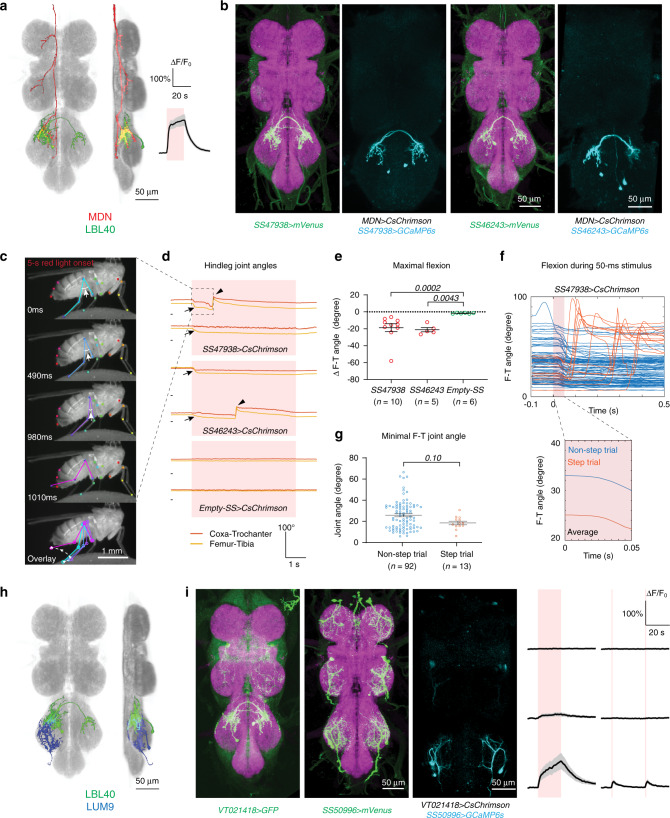
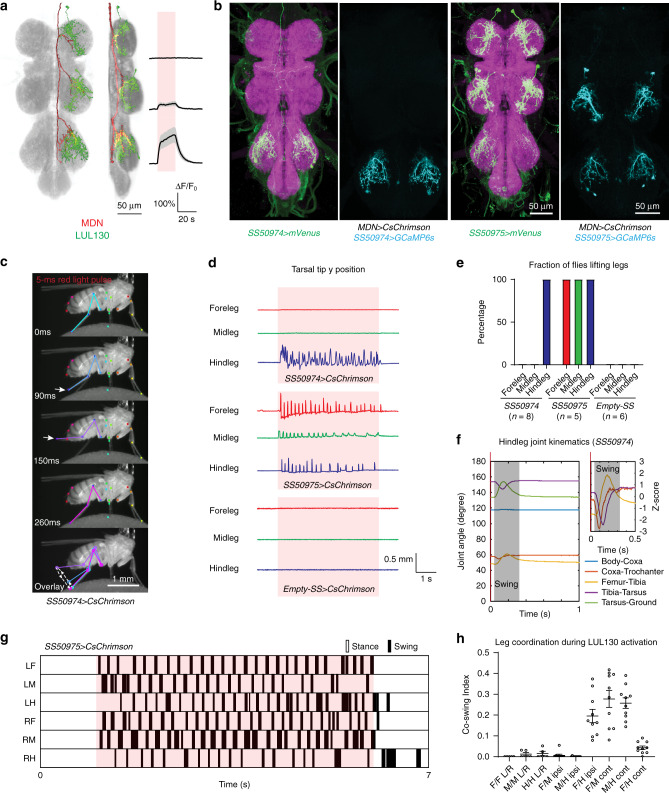
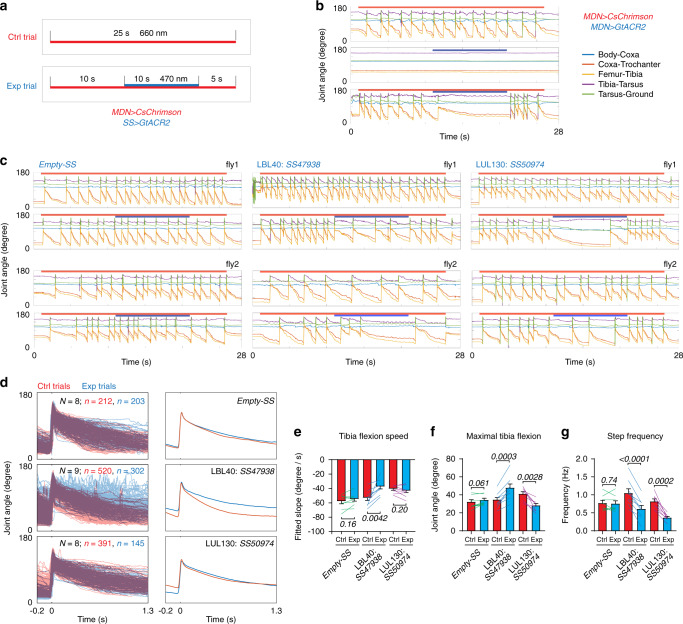
How do descending inputs from the brain control leg motor circuits to change how an animal walks? Conceptually, descending neurons are thought to function either as command-type neurons, in which a single type of descending neuron exerts a high-level control to elicit a coordinated change in motor output, or through a population coding mechanism, whereby a group of neurons, each with local effects, act in combination to elicit a global motor response. The Drosophila Moonwalker Descending Neurons (MDNs), which alter leg motor circuit dynamics so that the fly walks backwards, exemplify the command-type mechanism. Here, we identify several dozen MDN target neurons within the leg motor circuits, and show that two of them mediate distinct and highly-specific changes in leg muscle activity during backward walking: LBL40 neurons provide the hindleg power stroke during stance phase; LUL130 neurons lift the legs at the end of stance to initiate swing. Through these two effector neurons, MDN directly controls both the stance and swing phases of the backward stepping cycle. These findings suggest that command-type descending neurons can also operate through the distributed control of local motor circuits.
Overview
The claims and statistics of this paper haven’t been checked yet.
Free: it reads the open-access text and checks the first 5 claims that cite a source we can check. Create a free account to check every claim.
Integrity signals
Registry
Cites
Statistics
Figures
Verification
Claims the paper makes
The claims and statistics of this paper haven’t been checked yet.
Free: it reads the open-access text and checks the first 5 claims that cite a source we can check. Create a free account to check every claim.
Claims other papers make about this one
Each is checked against this paper’s own text: does it say what the citing paper says it does?
The cited source doesn’t support the claim as written.
In the citing paper
“This neuron is sufficient to elicit backward walking (Feng et al., 2020; Rayshubskiy et al., 2020)”
From Organization of circuits linking descending input to motor output in the Drosophila Male Adult Nerve Cord connectome (2026) · cites this paper as Feng et al., 2020
Checked by a reasoning model — may be wrong.
Experimental — accuracy not yet measuredThe source backs part of the claim, not all of it — or backs it for a different population, condition or comparison.
In the citing paper
“MDN-driven backwards walking only depends on active movements of the two hindlegs57 (Extended Data Fig. 10b and Supplementary Video 6)”
From Descending networks transform command signals into population motor control (2024) · cites this paper as [57]
Experimental — accuracy not yet measuredThe cited source says what the claim attributes to it.
In the citing paper
“Decapitated MDN flies, in which these SEZ collaterals are eliminated, show backward walking on optogenetic stimulation32 indicating that the VNC circuit recruited by MDNs is sufficient for driving the phenotype.”
From Neural circuit mechanisms underlying context-specific halting in Drosophila (2024) · cites this paper as [32]
In the citing paper
“Moonwalker’s postsynaptic targets showed that the precise sequence of muscle and joint movements needed to step backward are elicited by separate premotor neurons [35].”
From Descending control of motor sequences in Drosophila (2024) · cites this paper as [35]
In the citing paper
“and activates the tibia and trochanter flexor muscles in the hind legs.”
From Organization of circuits linking descending input to motor output in the Drosophila Male Adult Nerve Cord connectome (2026) · cites this paper as Feng et al., 2020
1 more claim about this paper
Create a free account to see every claim other papers make about this one.
Self-check
Percentages, sums and reported differences re-computed from the paper’s own numbers.
The self-check needs the paper’s full text.
Citations
Cites
Fiji: an open-source platform for biological-image analysis
Schindelin, J., Arganda-Carreras, I., Frise, E., Kaynig, V., Longair, M., Pietzsch, T., Preibisch, S., Rueden, C., Saalfeld, S., Schmid, B., et al. (2012) · Nature Methods · doi:10.1038/nmeth.2019 · Cited by 66,890
Ultrasensitive fluorescent proteins for imaging neuronal activity
Chen, T.-W., Wardill, T. J., Sun, Y., Pulver, S. R., Renninger, S. L., Baohan, A., Schreiter, E. R., Kerr, R. A., Orger, M. B., Jayaraman, V., et al. (2013) · Nature · doi:10.1038/nature12354 · Cited by 6,474
DeepLabCut: markerless pose estimation of user-defined body parts with deep learning
Mathis, A., Mamidanna, P., Cury, K. M., Abe, T., Murthy, V. N., Mathis, M. W., & Bethge, M. (2018) · Nature Neuroscience · doi:10.1038/s41593-018-0209-y · Cited by 5,187
Independent optical excitation of distinct neural populations
Klapoetke, N. C., Murata, Y., Kim, S. S., Pulver, S. R., Birdsey-Benson, A., Cho, Y. K., Morimoto, T. K., Chuong, A. S., Carpenter, E. J., Tian, Z., et al. (2014) · Nature Methods · doi:10.1038/nmeth.2836 · Cited by 2,344
Descending Pathways in Motor Control
Lemon, R. N. (2008) · Annual Review of Neuroscience · doi:10.1146/annurev.neuro.31.060407.125547 · Cited by 1,599
Using DeepLabCut for 3D markerless pose estimation across species and behaviors
Nath, T., Mathis, A., Chen, A. C., Patel, A., Bethge, M., & Mathis, M. W. (2019) · Nature Protocols · doi:10.1038/s41596-019-0176-0 · Cited by 1,505
A GAL4-Driver Line Resource for Drosophila Neurobiology
Jenett, A., Rubin, G. M., Ngo, T.-T. B., Shepherd, D., Murphy, C., Dionne, H., Pfeiffer, B. D., Cavallaro, A., Hall, D., Jeter, J., et al. (2012) · Cell Reports · doi:10.1016/j.celrep.2012.09.011 · Cited by 1,449
Refinement of Tools for Targeted Gene Expression in Drosophila
Pfeiffer, B. D., Ngo, T.-T. B., Hibbard, K. L., Murphy, C., Jenett, A., Truman, J. W., & Rubin, G. M. (2010) · Genetics · doi:10.1534/genetics.110.119917 · Cited by 1,153
The neuronal architecture of the mushroom body provides a logic for associative learning
Aso, Y., Hattori, D., Yu, Y., Johnston, R. M., Iyer, N. A., Ngo, T.-T., Dionne, H., Abbott, L., Axel, R., Tanimoto, H., et al. (2014) · eLife · doi:10.7554/elife.04577 · Cited by 1,051
NoRMCorre: An online algorithm for piecewise rigid motion correction of calcium imaging data
Pnevmatikakis, E. A., & Giovannucci, A. (2017) · Journal of Neuroscience Methods · doi:10.1016/j.jneumeth.2017.07.031 · Cited by 1,007
Research works printed but not linked: 3
- Le Gal, J.-P., Dubuc, R. & Smarandache-Wellmann, C. in Neurobiology of Motor Control: Fundamental Concepts and New Directions (eds S. L. Hooper & A. Büschges) Ch. 10, (Wiley, 2017).
- Pflüger, H.-J. & Grillner, S. in Neurobiology of Motor Control: Fundamental Concepts and New Directions (eds S. L. Hooper & A. Büschges) Ch. 7, (Wiley, 2017).
- Ritzmann, R. E. & Zill, S. N. Control of Locomotion in Hexapods (Oxford University Press, 2019).
Cited by
Hulse, B. K., Haberkern, H., Franconville, R., Turner-Evans, D. B., Takemura, S., Wolff, T., Noorman, M., Dreher, M., Dan, C., Parekh, R., et al. (2020) · doi:10.1101/2020.12.08.413955 · Cited by 392
“PFL2 and PFL3 neurons also reach the moonwalker neuron MDN (Bidaye et al., 2014; Feng et al., 2020), which has a bilateral innervation pattern and is known to drive backward walking.”
BackgroundHulse, B. K., Haberkern, H., Franconville, R., Turner-Evans, D., Takemura, S.-Y., Wolff, T., Noorman, M., Dreher, M., Dan, C., Parekh, R., et al. (2021) · eLife · doi:10.7554/elife.66039 · Cited by 392
Gosztolai, A., Günel, S., Ríos, V. L., Abrate, M. P., Morales, D., Rhodin, H., Fua, P., & Ramdya, P. P. (2021) · Nature Methods · doi:10.1038/s41592-021-01226-z · Cited by 114
NeuronBridge: an intuitive web application for neuronal morphology search across large data sets
Clements, J., Goina, C., Hubbard, P. M., Kawase, T., Olbris, D. J., Otsuna, H., Svirskas, R., & Rokicki, K. (2024) · BMC Bioinformatics · doi:10.1186/s12859-024-05732-7 · Cited by 77
“…Dickinson, et al. 2017; Wolff and Rubin 2018; Dolan et al. 2019; Bidaye et al. 2020; Davis et al. 2020; Morimoto et al. 2020; Schretter et al. 2020; Feng et al. 2020; Wang et al. 2021; Sterne et al. 2021; Nojima et al. 2021; Tanaka and Clark 2022; Namiki, Ros, et al. 2022; Israel et al. 2022).”
BackgroundSynaptic architecture of leg and wing premotor control networks in Drosophila
Lesser, E., Azevedo, A. W., Phelps, J. S., Elabbady, L., Cook, A., Syed, D. S., Mark, B., Kuroda, S., Sustar, A., Moussa, A., et al. (2023) · doi:10.1101/2023.05.30.542725 · Cited by 71
“…work in the fly has focused on the contributions of descending neurons (DNs) to fly motor control (Bidaye et al., 2014; Cheong et al., 2024; Feng et al., 2020; Namiki et al., 2018; Schnell et al., 2017), we find that less than 10% of synapses to each leg and wing MN comes from DNs (mean =…”
Synaptic architecture of leg and wing premotor control networks in Drosophila
Lesser, E., Azevedo, A. W., Phelps, J. S., Elabbady, L., Cook, A., Syed, D. S., Mark, B., Kuroda, S., Sustar, A., Moussa, A., et al. (2024) · Nature · doi:10.1038/s41586-024-07600-z · Cited by 71
Descending neurons coordinate anterior grooming behavior in Drosophila
Guo, L., Zhang, N., & Simpson, J. H. (2022) · Current Biology · doi:10.1016/j.cub.2021.12.055 · Cited by 63
“This organization can produce more flexible behavior responding to context or state.(17,18) In vertebrates, different corticospinal neuronswere reported to control distinct sets of muscles to orchestrate goal-directed forelimb reach.”
Cheong, H. S., Eichler, K., Stürner, T., Asinof, S. K., Champion, A. S., Marin, E. C., Oram, T. B., Sumathipala, M., Venkatasubramanian, L., Namiki, S., et al. (2026) · eLife · doi:10.7554/elife.96084 · Cited by 54
Neural circuit mechanisms underlying context-specific halting in Drosophila
Sapkal, N., Mancini, N., Kumar, D. S., Spiller, N., Murakami, K., Vitelli, G., Bargeron, B., Maier, K., Eichler, K., Jefferis, G. S. X. E., et al. (2024) · Nature · doi:10.1038/s41586-024-07854-7 · Cited by 54
“…have collaterals in the SEZ through which they recruit other neurons including DNs. Decapitated MDN flies, in which these SEZ collaterals are eliminated, show backward walking on optogenetic stimulation 32 indicating that the VNC circuit recruited by MDNs is sufficient for driving the phenotype.”
Neural circuit mechanisms underlying context-specific halting in Drosophila
Sapkal, N., Mancini, N., Kumar, D. S., Spiller, N., Murakami, K., Vitelli, G., Bargeron, B., Maier, K., Eichler, K., Jefferis, G. S. X. E., et al. (2023) · doi:10.1101/2023.09.25.559438 · Cited by 54
Cheong, H. S., Eichler, K., Stürner, T., Asinof, S. K., Champion, A. S., Marin, E. C., Oram, T. B., Sumathipala, M., Venkatasubramanian, L., Namiki, S., et al. (2024) · doi:10.7554/elife.96084.1 · Cited by 51
Descending networks transform command signals into population motor control
Braun, J., Hurtak, F., Wang-Chen, S., & Ramdya, P. (2024) · Nature · doi:10.1038/s41586-024-07523-9 · Cited by 51
“We found that MDN-driven backwards walking only depends on active movements of the two hindlegs 57 (Extended Data Fig.”
A locomotor neural circuit persists and functions similarly in larvae and adult Drosophila
Lee, K., & Doe, C. Q. (2021) · eLife · doi:10.7554/elife.69767 · Cited by 49
Motor control on the move: from insights in insects to general mechanisms
Büschges, A., & Ache, J. M. (2024) · Physiological Reviews · doi:10.1152/physrev.00009.2024 · Cited by 58
Behavioral state-dependent modulation of insulin-producing cells in Drosophila
Liessem, S., Held, M., Bisen, R. S., Haberkern, H., Lacin, H., Bockemühl, T., & Ache, J. M. (2022) · Current Biology · doi:10.1016/j.cub.2022.12.005 · Cited by 43
Descending control of motor sequences in Drosophila
Simpson, J. H. (2024) · Current Opinion in Neurobiology · doi:10.1016/j.conb.2023.102822 · Cited by 33
“Thus, Moonwalker DNs are command-like, activated by the integration of sensory cues in the brain, and transmitting a signal to perform a motor program whose details are executed by distributed motor control circuits located in the VNC.”
A split-GAL4 driver line resource for Drosophila neuron types
Meissner, G. W., Vannan, A., Jeter, J., Close, K., DePasquale, G. M., Dorman, Z., Forster, K., Beringer, J. A., Gibney, T. V., Hausenfluck, J. H., et al. (2025) · eLife · doi:10.7554/elife.98405.3 · Cited by 65
Control for multifunctionality: bioinspired control based on feeding in Aplysia californica
Webster‐Wood, V. A., Gill, J. P., Thomas, P. J., & Chiel, H. J. (2020) · Biological Cybernetics · doi:10.1007/s00422-020-00851-9 · Cited by 29
“Such switching mechanisms are important not only in Aplysia, but also in locomotion when switching from forward to backwards walking [48], switching from standing to walking [12], and transitioning through speed-dependent gaits [38].”
BackgroundSchilling, M., Melnik, A., Ohl, F. W., Ritter, H. J., & Hammer, B. (2021) · Neural Networks · doi:10.1016/j.neunet.2021.09.017 · Cited by 33
From Photons to Behaviors: Neural Implementations of Visual Behaviors in Drosophila
Ryu, L., Kim, S. Y., & Kim, A. J. (2022) · Frontiers in Neuroscience · doi:10.3389/fnins.2022.883640 · Cited by 31
Olfactory stimuli and moonwalker SEZ neurons can drive backward locomotion in Drosophila
Israel, S., Rozenfeld, E., Weber, D., Huetteroth, W., & Parnas, M. (2022) · Current Biology · doi:10.1016/j.cub.2022.01.035 · Cited by 26
Behavioral evidence for nested central pattern generator control of Drosophila grooming
Ravbar, P., Zhang, N., & Simpson, J. H. (2021) · eLife · doi:10.7554/elife.71508 · Cited by 27
The evolutionary trajectory of drosophilid walking
York, R. A., Brezovec, L. E., Coughlan, J. M., Herbst, S., Krieger, A., Lee, S.-Y. J., Pratt, B. G., Smart, A. D., Song, E., Suvorov, A., et al. (2022) · Current Biology · doi:10.1016/j.cub.2022.05.039 · Cited by 24
The processing of proprioceptive signals in distributed networks: insights from insect motor control
Gebehart, C., & Büschges, A. (2024) · Journal of Experimental Biology · doi:10.1242/jeb.246182 · Cited by 20
Activity of nested neural circuits drives different courtship songs in Drosophila
Shiozaki, H. M., Wang, K., Lillvis, J. L., Xu, M., Dickson, B. J., & Stern, D. L. (2024) · Nature Neuroscience · doi:10.1038/s41593-024-01738-9 · Cited by 20
Feng (2024) · doi:10.1101/2024.06.27.601106 · Cited by 18
Mangan, M., Floreano, D., Yasui, K., Trimmer, B. A., Gravish, N., Hauert, S., Webb, B. H., Manoonpong, P., & Szczecinski, N. S. (2023) · Bioinspiration & Biomimetics · doi:10.1088/1748-3190/acc223 · Cited by 18
Mechanosensory and command contributions to the Drosophila grooming sequence
Yoshikawa, S., Tang, P., & Simpson, J. H. (2024) · Current Biology · doi:10.1016/j.cub.2024.04.003 · Cited by 18
neuroWalknet, a controller for hexapod walking allowing for context dependent behavior
Schilling, M., & Cruse, H. (2023) · PLoS Computational Biology · doi:10.1371/journal.pcbi.1010136 · Cited by 16
Leung, B., Billeschou, P., & Manoonpong, P. (2023) · IEEE Transactions on Cybernetics · doi:10.1109/tcyb.2023.3249467 · Cited by 13
“Our neural control method utilizes and integrates different components, inspired by the neural control of insects [36], [37], [38], [39], [40], [41], [42].”
BackgroundMethodInfluentialMedeiros, A. M., Hobbiss, A. F., Borges, G., Moita, M. A. P., & Mendes, C. S. (2024) · Current Biology · doi:10.1016/j.cub.2024.05.021 · Cited by 14
Genetic Transsynaptic Techniques for Mapping Neural Circuits in Drosophila
Ni, L. (2021) · Frontiers in Neural Circuits · doi:10.3389/fncir.2021.749586 · Cited by 11
Tokutake, K., Takeuchi, M., Kurimoto, S., Saeki, S., Asami, Y., Onaka, K., Saeki, M., Aoyama, T., Hasegawa, Y., & Hirata, H. (2022) · International Journal of Molecular Sciences · doi:10.3390/ijms23158760 · Cited by 11
Investigating the role of low level reinforcement reflex loops in insect locomotion
Goldsmith, C., Quinn, R. D., & Szczecinski, N. S. (2021) · Bioinspiration & Biomimetics · doi:10.1088/1748-3190/ac28ea · Cited by 8
Neuronal mechanisms regulating locomotion in adult Drosophila
Gowda, S. B. M., Banu, A., Hussain, S., & Mohammad, F. (2024) · Journal of Neuroscience Research · doi:10.1002/jnr.25332 · Cited by 9
“Another study uses high-speed video recordings to capture a tethered fly walking on a floating ball and employs advanced neural network training software to auto-detect the positions of leg joints and study the alterations of leg joint kinematics during backward walking (Feng et al., 2020).”
BackgroundMethodInfluentialHaustein, M., Blanke, A., Bockemühl, T., & Büschges, A. (2024) · Frontiers in Bioengineering and Biotechnology · doi:10.3389/fbioe.2024.1357598 · Cited by 12
“Although the TrFe is moveable in many insects (Frantsevich and Wang, 2009), its functional role in Drosophila is debated, with opinions ranging from it being fused and immobile (Sink, 2006; Lobato-Rios et al., 2022) to at least limited mobility (Feng et al., 2020).”
BackgroundTross, J., Wolf, H., Stemme, T., & Pfeffer, S. E. (2022) · Journal of Experimental Biology · doi:10.1242/jeb.243930 · Cited by 6
Spatial and temporal control of expression with light-gated LOV-LexA
Ribeiro, I., Eßbauer, W., Kutlesa, R., & Borst, A. (2022) · G3 Genes Genomes Genetics · doi:10.1093/g3journal/jkac178 · Cited by 6
“…Riabinina et al. 2015) systems both rely on exogenous transcription factors and DNA binding sequences, and can be combined with GAL4-UAS, allowing for independent access to multiple cell types in the same organism (e.g. Feng et al. 2014; Sen et al. 2017; Ribeiro et al. 2018; Feng et al. 2020).”
BackgroundCombinatorial circuit dynamics orchestrate flexible motor patterns in DrosophilaPreprint
Shiozaki, H. M., Wang, K., Lillvis, J. L., Xu, M., Dickson, B. J., & Stern, D. L. (2022) · bioRxiv (Cold Spring Harbor Laboratory) · doi:10.1101/2022.12.14.520499 · Cited by 8
A behavioral architecture for realistic simulations of Drosophila larva locomotion and foraging
Sakagiannis, P., Jürgensen, A.-M., & Nawrot, M. P. (2026) · eLife · doi:10.7554/elife.104262 · Cited by 12
Evans, C. G., Barry, M. A., Perkins, M. H., Jing, J., Weiss, K. R., & Cropper, E. C. (2023) · Journal of Neurophysiology · doi:10.1152/jn.00190.2023 · Cited by 5
A biomimetic fruit fly robot for studying the neuromechanics of legged locomotion
Goldsmith, C., Haustein, M., Büschges, A., & Szczecinski, N. S. (2024) · Bioinspiration & Biomimetics · doi:10.1088/1748-3190/ad80ec · Cited by 9
“The ever-growing genetic toolboxes available for Drosophila (for review: [15, 37, 53, 62, 101]) also enable recording neuronal activity in behaving animals [39] and to manipulate the activity of specific neurons in a straight-forward manner (e.g. [7, 8, 16, 27]).”
Neurons with names: Descending control and sensorimotor processing in insect motor control
Büschges, A., & Gorostiza, E. A. (2023) · Current Opinion in Neurobiology · doi:10.1016/j.conb.2023.102766 · Cited by 6
eLife Assessment: A split-GAL4 driver line resource for Drosophila CNS cell types
Reis, T. (2024) · eLife · doi:10.7554/elife.98405.1.sa4 · Cited by 5
A split-GAL4 driver line resource for Drosophila CNS cell typesPreprint
Meissner, G. W., Vannan, A., Jeter, J., Close, K., DePasquale, G. M., Dorman, Z., Forster, K., Beringer, J. A., Gibney, T. V., Hausenfluck, J. H., et al. (2024) · eLife · doi:10.7554/elife.98405.1 · Cited by 9
Multiple Locomotion Gaits in the Mole Cricket
Yuval, O., Amir, A., & Ayali, A. (2026) · Journal of Bionic Engineering · doi:10.1007/s42235-025-00838-x · Cited by 4
Neural development: Bicoid not as a morphogen
Feng, K. (2022) · Current Biology · doi:10.1016/j.cub.2022.05.017 · Cited by 2
Soyam, G., & Kannan, N. N. (2024) · Biology Open · doi:10.1242/bio.060609 · Cited by 4
A behavioral architecture for realistic simulations of Drosophila larva locomotion and foragingPreprint
Sakagiannis, P., Jürgensen, A.-M., & Nawrot, M. P. (2025) · eLife · doi:10.7554/elife.104262.1 · Cited by 3
Castaneda, A. N., Huda, A., Whitaker, I. B. M., Reilly, J. E., Shelby, G. S., Bai, H., & Ni, L. (2024) · PLoS Genetics · doi:10.1371/journal.pgen.1011190 · Cited by 3
Goldammer, J., Büschges, A., & Dürr, V. (2023) · PLoS ONE · doi:10.1371/journal.pone.0290359 · Cited by 2
“A discovered population of DNs in Drosophila triggers the initiation of backward directed walking (MDM neurons [56, 57]).”
BackgroundNeural Sequences Underlying Directed Turning in C. elegansPreprint
Kramer, T. S., Wan, F. K., Pugliese, S. M., Atanas, A. A., Hiser, A. W., Luo, J., Bueno, E., & Flavell, S. W. (2024) · bioRxiv (Cold Spring Harbor Laboratory) · doi:10.1101/2024.08.11.607076 · Cited by 2
Control of walking direction by descending and dopaminergic neurons in DrosophilaPreprint
Dahlhoff, S., Liessem, S., Iqbal, F. M., Palacios-Muñoz, A., Cascino-Milani, F., Erginkaya, M., Diniz, A. M., Gorostiza, E. A., Büschges, A., Clemens, J., et al. (2025) · bioRxiv (Cold Spring Harbor Laboratory) · doi:10.1101/2025.07.22.666129 · Cited by 2
Control of walking direction by descending and dopaminergic neurons in Drosophila
Liessem, S., Dahlhoff, S., Iqbal, F. M., Palacios-Muñoz, A., Cascino-Milani, F., Volk, H., Erginkaya, M., Diniz, A. M., Gorostiza, E. A., Büschges, A., et al. (2026) · Current Biology · doi:10.1016/j.cub.2026.06.045 · Cited by 5
Author response: A split-GAL4 driver line resource for Drosophila CNS cell types
Meissner, G. W., Vannan, A., Jeter, J., Close, K., DePasquale, G. M., Dorman, Z., Forster, K., Beringer, J. A., Gibney, T. V., Hausenfluck, J. H., et al. (2024) · eLife · doi:10.7554/elife.98405.1.sa0 · Cited by 2
Cheong, H. S., Eichler, K., Stürner, T., Asinof, S. K., Champion, A. S., Marin, E. C., Oram, T. B., Sumathipala, M. G., Venkatasubramanian, L., Namiki, S., et al. (2025) · eLife · doi:10.7554/elife.96084.2 · Cited by 10
Behavioral aspects of insect walking
Haustein, M., Ruthe, A., Ache, J. M., & Büschges, A. (2026) · Elsevier eBooks · doi:10.1016/b978-0-443-29068-8.00209-9 · Cited by 1
Reviewer #2 (Public Review): A split-GAL4 driver line resource for Drosophila CNS cell types
Meissner, G. W., Vannan, A., Jeter, J., et al. (2024) · eLife · doi:10.7554/elife.98405.1.sa2
Reviewer #1 (Public Review): A split-GAL4 driver line resource for Drosophila CNS cell types
Meissner, G. W., Vannan, A., Jeter, J., et al. (2024) · eLife · doi:10.7554/elife.98405.1.sa3
Reviewer #3 (Public Review): A split-GAL4 driver line resource for Drosophila CNS cell types
Meissner, G. W., Vannan, A., Jeter, J., et al. (2024) · eLife · doi:10.7554/elife.98405.1.sa1
Study of Optimal Stimulation Parameters in Drosophila Based on a Baseline Control Model
Wang, Y. (2024) · Learning and analytics in intelligent systems · doi:10.1007/978-3-031-69457-8_62
Convergent olfactory circuits for courtship in Drosophila revealed by ds -TangoPreprint
Fisher, J. D., Crown, A. M., Sorkaç, A., Martinez-Machado, S., Snell, N. J., Vishwanath, N., Monje, S. J., Vo, A., Wu, A. H., Moșneanu, R. A., et al. (2024) · bioRxiv (Cold Spring Harbor Laboratory) · doi:10.1101/2024.10.23.619891
“…enabled the implementation of various configurations of the precursor of ds -Tango, trans-Tango, for calcium imaging 46,64 as well as optogenetic 64,65 and chemogenetic 66 manipulations. ds-Tango ds-Tango is, therefore, not limited to tracing experiments and can be extended to enable the recording…”
BackgroundA split-GAL4 driver line resource for Drosophila neuron typesPreprint
Meissner, G. W., Vannan, A., Jeter, J., Close, K., DePasquale, G. M., Dorman, Z., Forster, K., Beringer, J. A., Gibney, T. V., Hausenfluck, J. H., et al. (2025) · eLife · doi:10.7554/elife.98405.2 · Cited by 1
Neural control of coordinated wing and leg movements during a terrestrial threat displayPreprint
Cao, S., & Anderson, D. J. (2025) · bioRxiv (Cold Spring Harbor Laboratory) · doi:10.1101/2025.10.25.684556
Cell body clustering drives gap junction-mediated synchronous activity in command neuronsPreprint
Lee, K. M., Graciani, J., Carvajal, N. R., Zhu, Z., Clark, M. Q., & Doe, C. Q. (2026) · bioRxiv (Cold Spring Harbor Laboratory) · doi:10.64898/2026.02.26.708359
“Within this neuropil, MDNs major output is onto the pre-motor neurons LBL40 and LUI130 that drive backward walking ( 8 ).”
Ruthe, A., Özyer, A., Morozova, A., Akay, T., & Büschges, A. (2026) · Journal of Neurophysiology · doi:10.1152/jn.00321.2025 · Cited by 2
A behavioral architecture for realistic simulations of Drosophila larva locomotion and foragingPreprint
Sakagiannis, P., Jürgensen, A.-M., & Nawrot, M. P. (2026) · eLife · doi:10.7554/elife.104262.2 · Cited by 2
Fisher, J. D., Crown, A. M., Sorkaç, A., Moșneanu, R. A., Martinez-Machado, S., Snell, N. J., Vishwanath, N., Monje, S. J., Vo, A., Wu, A. H., et al. (2026) · Current Biology · doi:10.1016/j.cub.2026.08.003
Cell body position of Drosophila Moonwalker Descending Neurons regulates locomotor circuit function
Lee, K., Graciani, J., Carvajal, N. R., Zhu, Z., Clark, M. Q., & Doe, C. Q. (2026) · Proceedings of the National Academy of Sciences · doi:10.1073/pnas.2618114123
Neural coordination of wing and leg movements during a terrestrial threat display
Cao, S., & Anderson, D. J. (2026) · Current Biology · doi:10.1016/j.cub.2026.09.056 · Cited by 3
A brainstem module for backward locomotion reveals direction-selective premotor circuits
Liu, Z., Lu, L., Di, R., Cui, Y., Liu, Y., Ren, Q., Dai, R., Wu, W., Wang, R., & Luo, M. (2026) · Neuron · doi:10.1016/j.neuron.2026.09.027
Metadata
- Authors
- Feng, K., Sen, R., Minegishi, R., Dübbert, M., Bockemühl, T., Büschges, A., & Dickson, B. J.
- Affiliations
- The University of Queensland (AU)
- Howard Hughes Medical Institute (US)
- University of Cologne (DE)
- Corresponding author
- Feng, Kai
- Dickson, Barry J.
- ORCID
- Venue
- Nature Communications
- Published
- 2020-12-02
- Volume
- 11
- Issue
- 1
- Pages
- 6166-6166
- ISSN
- 2041-1723 (ISSN-L)
- PMC
- PMC7710706
- OpenAlex
- W3108286875
- Semantic Scholar
- c5e1287127de93350a0e7f63330f8745b8213b50
- Cited by
- 69
- References
- 70
- Citations by year
- 2026: 10 · 2025: 7 · 2024: 27 · 2023: 7 · 2022: 10 · 2021: 7 · 2020: 1
- FWCI
- 2.87
- Type
- journal article
- Language
- en
- Open access
- gold
- doi.org
- Licence
- cc-by
- creativecommons.org/licenses/by/4.0 (tdm)
- creativecommons.org/licenses/by/4.0 (vor)
- Locations
- Nature Communications (publishedVersion, cc-by)
- bioRxiv (Cold Spring Harbor Laboratory) (acceptedVersion, cc-by-nc-nd)
- PubMed Central (publishedVersion, cc-by)
- PubMed (publishedVersion)
- Kölner Universitäts PublikationsServer (Universität zu Köln) (publishedVersion)
- RePEc: Research Papers in Economics (submittedVersion)
- DOAJ (DOAJ: Directory of Open Access Journals) (submittedVersion, cc-by-sa)
- Funders
- Howard Hughes Medical Institute
- National Health and Medical Research Council
- Topics
- Life Sciences › Neuroscience › Cellular and Molecular Neuroscience › Neurobiology and Insect Physiology Research
- Life Sciences › Neuroscience › Cognitive Neuroscience › Motor Control and Adaptation
- Physical Sciences › Engineering › Control and Systems Engineering › Robotic Locomotion and Control
- Keywords
- backward walking, Drosophila, descending motor control, population coding, leg muscle activity, stance and swing phases, locomotion control
- MeSH terms
- Animals, Biomechanical Phenomena, Brain, Drosophila melanogaster, Female, Motor Neurons, Muscles, Nerve Net, Walking
About these checks
Registry, retraction, Cites and statistics results are computed, not judged, with one exception: a printed reference that no index lists is read once by a model before it counts as a citation error. Claims are extracted by a model and kept only when their quote appears verbatim in the text; each cited source is then checked, with a model’s help, for whether it says what the claim relies on. Those verdicts can be wrong — read the claim’s quote and the cited source before relying on one.
Statistics and arithmetic are recomputed, not judged.
Confidence bands are shown only for fields calibrated on our annotated test set. None is calibrated yet, so no band is shown.
What counts as a claim ›How we measure confidence ›How we check this ›
Are you an author, or do you see a problem with this page? Request a review
Data sources
Bibliographic data: Semantic Scholar, OpenAlex, Crossref.
Contains information from the Semantic Scholar Academic Graph Datasets, made available under the ODC Attribution License (ODC-BY 1.0).
Semantic Scholar’s data is described in: Kinney, R., et al. (2023). The Semantic Scholar Open Data Platform. arXiv:2301.10140.
