

Cost function dependent barren plateaus in shallow parametrized quantum circuits
Open accessThe DOI matches its Crossref record; 72 of the 72 references it cites were found in a registry or an index.
Abstract
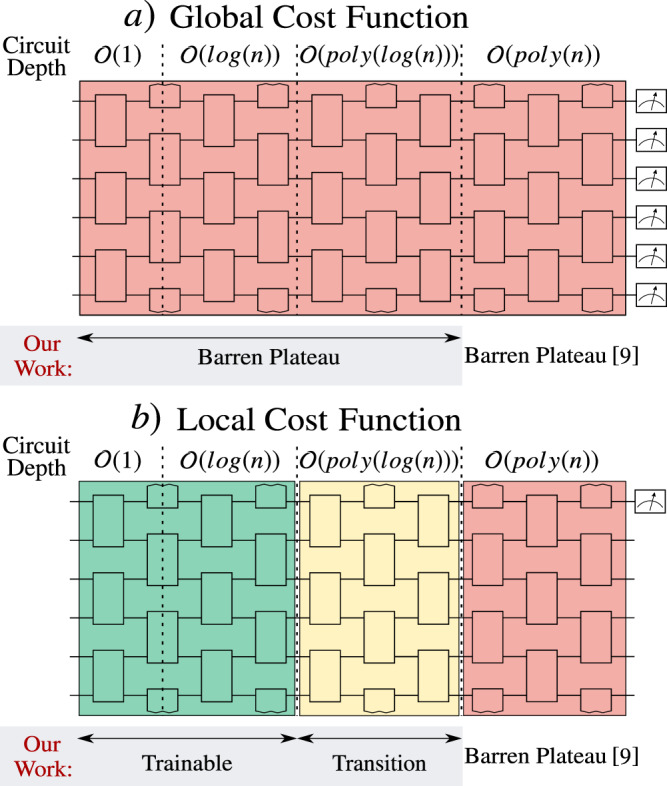
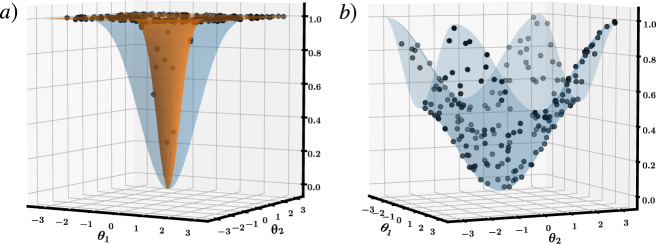
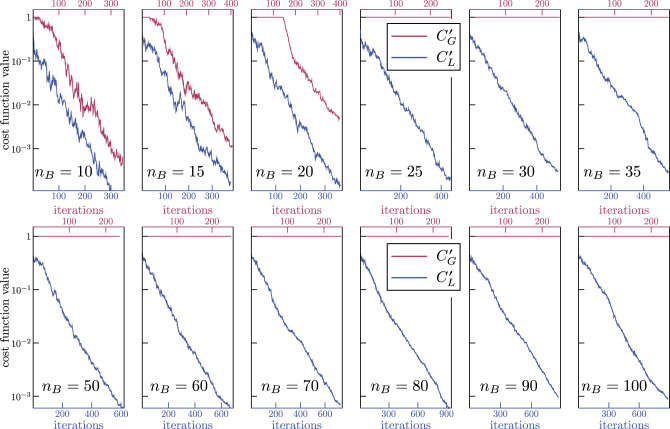
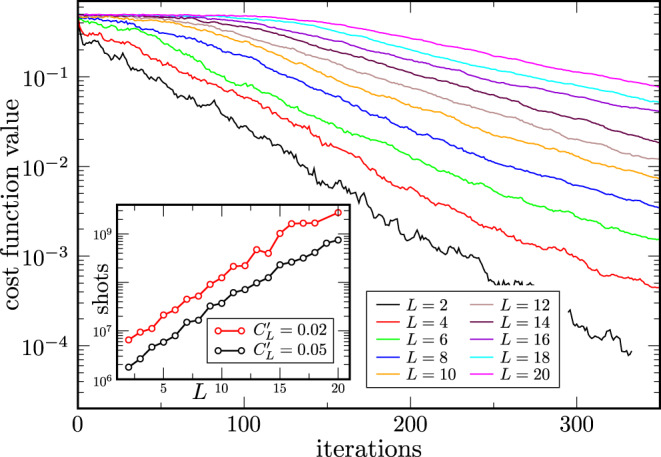
Variational quantum algorithms (VQAs) optimize the parameters θ of a parametrized quantum circuit V ( θ ) to minimize a cost function C . While VQAs may enable practical applications of noisy quantum computers, they are nevertheless heuristic methods with unproven scaling. Here, we rigorously prove two results, assuming V ( θ ) is an alternating layered ansatz composed of blocks forming local 2-designs. Our first result states that defining C in terms of global observables leads to exponentially vanishing gradients (i.e., barren plateaus) even when V ( θ ) is shallow. Hence, several VQAs in the literature must revise their proposed costs. On the other hand, our second result states that defining C with local observables leads to at worst a polynomially vanishing gradient, so long as the depth of V ( θ ) is $${\mathcal{O}}(\mathrm{log}\,n)$$ O ( log n ) . Our results establish a connection between locality and trainability. We illustrate these ideas with large-scale simulations, up to 100 qubits, of a quantum autoencoder implementation.
Overview
The claims and statistics of this paper haven’t been checked yet.
Free: it reads the open-access text and checks the first 5 claims that cite a source we can check. Create a free account to check every claim.
Integrity signals
Registry
Cites
Statistics
Figures
Verification
Claims the paper makes
The claims and statistics of this paper haven’t been checked yet.
Free: it reads the open-access text and checks the first 5 claims that cite a source we can check. Create a free account to check every claim.
Claims other papers make about this one
Each is checked against this paper’s own text: does it say what the citing paper says it does?
The source backs part of the claim, not all of it — or backs it for a different population, condition or comparison.
In the citing paper
“As shown in the seminal work of Ref. [19], deep random unstructured circuits which form 2-designs on n qubits will exhibit barren plateaus.”
From Effect of barren plateaus on gradient-free optimization (2021) · cites this paper as [19]
Experimental — accuracy not yet measuredThe cited source says what the claim attributes to it.
In the citing paper
“Barren plateau landscapes correspond to gradients that vanish exponentially in the number of qubits.”
From Effect of barren plateaus on gradient-free optimization (2021) · cites this paper as [19]
The cited source says what the claim attributes to it.
In the citing paper
“This corresponds to the barren plateau scenario in Ref. [19].”
From Effect of barren plateaus on gradient-free optimization (2021) · cites this paper as [19]
The cited source says what the claim attributes to it.
In the citing paper
“As noted in ref. 43, the phenomenon of barren plateaus is closely associated with the variance of the gradient of the loss function in parameterized quantum circuits.”
From Evidence of scaling advantage on an NP-complete problem with enhanced quantum solvers (2026) · cites this paper as [43]
The cited source says what the claim attributes to it.
In the citing paper
“Vanishing gradient issues during the optimization, known as barren plateaus, are dependent on the cost function (Cerezo et al. , 2021)”
From Noisy intermediate-scale quantum algorithms (2022) · cites this paper as Cerezo et al., 2021
5 more claims about this paper
Create a free account to see every claim other papers make about this one.
Self-check
Percentages, sums and reported differences re-computed from the paper’s own numbers.
The self-check needs the paper’s full text.
Citations
Cites
A Simplex Method for Function Minimization
Nelder, J. A., & Mead, R. (1965) · The Computer Journal · doi:10.1093/comjnl/7.4.308 · Cited by 28,905
Quantum Computing in the NISQ era and beyond
Preskill, J. (2018) · Quantum · doi:10.22331/q-2018-08-06-79 · Cited by 8,830
Quantum Computation and Quantum Information: 10th Anniversary Edition
Nielsen, M. A., & Chuang, I. L. (2012) · doi:10.1017/cbo9780511976667 · Cited by 8,436
Quantum supremacy using a programmable superconducting processor
Arute, F., Arya, K., Babbush, R., Bacon, D., Bardin, J. C., Barends, R., Biswas, R., Boixo, S., Brandao, F. G. S. L., Buell, D. A., et al. (2019) · Nature · doi:10.1038/s41586-019-1666-5 · Cited by 7,720
A variational eigenvalue solver on a photonic quantum processor
Peruzzo, A., McClean, J., Shadbolt, P., Yung, M.-H., Zhou, X.-Q., Love, P. J., Aspuru-Guzik, A., & O’Brien, J. L. (2014) · Nature Communications · doi:10.1038/ncomms5213 · Cited by 4,552
Coupled-cluster theory in quantum chemistry
Bartlett, R. J., & Musiał, M. (2007) · Reviews of Modern Physics · doi:10.1103/revmodphys.79.291 · Cited by 3,343
Hardware-efficient variational quantum eigensolver for small molecules and quantum magnets
Kandala, A., Mezzacapo, A., Temme, K., Takita, M., Brink, M., Chow, J. M., & Gambetta, J. M. (2017) · Nature · doi:10.1038/nature23879 · Cited by 2,982
Quantum Computation and Quantum Information: 10th Anniversary Edition
Nielsen, M. A., & Chuang, I. L. (2011) · Cited by 2,724
Barren plateaus in quantum neural network training landscapes
McClean, J. R., Boixo, S., Smelyanskiy, V. N., Babbush, R., & Neven, H. (2018) · Nature Communications · doi:10.1038/s41467-018-07090-4 · Cited by 2,329
The theory of variational hybrid quantum-classical algorithms
McClean, J. R., Romero, J., Babbush, R., & Aspuru-Guzik, A. (2016) · New Journal of Physics · doi:10.1088/1367-2630/18/2/023023 · Cited by 2,227
Research works printed but not linked: 1
- Li Y Benjamin SC Efficient variational quantum simulator incorporating active error minimization Phys. Rev. X 2017 7 021050
Cited by
Items 401–500 of 1,016
Liu, Z., Shen, P.-X., Li, W., Duan, L.-M., & Deng, D.-L. (2022) · Quantum Science and Technology · doi:10.1088/2058-9565/aca55d · Cited by 34
Dynamic adaptive quantum approximate optimization algorithm for shallow, noise-resilient circuits
Yanakiev, N., Mertig, N., Long, C. K., & Arvidsson-Shukur, D. R. M. (2024) · Physical Review A · doi:10.1103/physreva.109.032420 · Cited by 34
Symmetry Breaking in Geometric Quantum Machine Learning in the Presence of Noise
Tüysüz, C., Chang, S. Y., Demidik, M., Jansen, K., Vallecorsa, S., & Grossi, M. (2024) · PRX Quantum · doi:10.1103/prxquantum.5.030314 · Cited by 34
A brief review of quantum machine learning techniques for financial services
Doosti, M., Wallden, P., Hamill, C. B., Hankache, R., Brown, O. T., & Heunen, C. (2026) · Machine Learning Science and Technology · doi:10.1088/2632-2153/ae51df · Cited by 35
Potential of quantum scientific machine learning applied to weather modeling
Jaderberg, B., Gentile, A. A., Ghosh, A., Elfving, V. E., Jones, C. R., Vodola, D., Manobianco, J., & Weiß, H. (2024) · Physical Review A · doi:10.1103/physreva.110.052423 · Cited by 34
Unitary block optimization for variational quantum algorithms
Slattery, L., Villalonga, B., & Clark, B. K. (2022) · Physical Review Research · doi:10.1103/physrevresearch.4.023072 · Cited by 34
The Cost of Improving the Precision of the Variational Quantum Eigensolver for Quantum Chemistry
Miháliková, I., Pivoluska, M., Plesch, M., Friák, M., Nagaj, D., & Šob, M. (2022) · Nanomaterials · doi:10.3390/nano12020243 · Cited by 35
Variational quantum optimization with multibasis encodings
Patti, T. L., Kossaifi, J., Anandkumar, A., & Yelin, S. F. (2022) · Physical Review Research · doi:10.1103/physrevresearch.4.033142 · Cited by 34
Haidar, M., Rančić, M. J., Ayral, T., Maday, Y., & Piquemal, J. (2023) · Wiley Interdisciplinary Reviews Computational Molecular Science · doi:10.1002/wcms.1664 · Cited by 35
On Exploring the Potential of Quantum Auto-Encoder for Learning Quantum Systems
Du, Y., & Tao, D. (2024) · IEEE Transactions on Neural Networks and Learning Systems · doi:10.1109/tnnls.2024.3474793 · Cited by 34
Solving quantum master equations with deep quantum neural networks
Liu, Z., Duan, L., & Deng, D.-L. (2022) · Physical Review Research · doi:10.1103/physrevresearch.4.013097 · Cited by 34
Variational quantum policies for reinforcement learning.Preprint
Jerbi, S., Gyurik, C., Marshall, S., Briegel, H. J., & Dunjko, V. (2021) · arXiv (Cornell University) · Cited by 34
Neural-network-encoded variational quantum algorithms
Miao, J., Hsieh, C., & Zhang, S. (2024) · Physical Review Applied · doi:10.1103/physrevapplied.21.014053 · Cited by 34
Computing exact moments of local random quantum circuits via tensor networks
Braccia, P., Bermejo, P., Cincio, Ł., & Cerezo, M. (2024) · Quantum Machine Intelligence · doi:10.1007/s42484-024-00187-8 · Cited by 33
Self-citationA novel image classification framework based on variational quantum algorithms
Chen, Y. (2024) · Quantum Information Processing · doi:10.1007/s11128-024-04566-9 · Cited by 34
Ivashkov, P., Huang, P., Koor, K., Pira, L., & Rebentrost, P. (2026) · npj Quantum Information · doi:10.1038/s41534-026-01202-5 · Cited by 33
Wang, S., Wang, P., Li, G., Zhao, S., Zhao, D., Wang, J., Yuan, F., Dou, M., Gu, Y., Wu, Y.-C., et al. (2025) · Science China Information Sciences · doi:10.1007/s11432-024-4185-1 · Cited by 34
Optimization strategies for variational quantum algorithms in noisy landscapes
Novák, V., Zelinka, I., & Snåšel, V. (2026) · Evolutionary Intelligence · doi:10.1007/s12065-026-01248-6 · Cited by 34
Quantum machine learning for quantitative finance
Mironowicz, P., Akshata Shenoy, H., Mandarino, A., Yilmaz, A. E., & Ankenbrand, T. (2026) · Quantum Science and Technology · doi:10.1088/2058-9565/aeb8ed · Cited by 33
Error-mitigated photonic variational quantum eigensolver using a single-photon ququart
Lee, D., Lee, J., Hong, S., Lim, H., Cho, Y., Han, S.-W., Shin, H., Rehman, J. U., & Kim, Y. (2022) · Optica · doi:10.1364/optica.441163 · Cited by 33
Quantum approximate optimization for combinatorial problems with constraints
Ruan, Y., Yuan, Z., Xue, X., & Liu, Z. (2022) · Information Sciences · doi:10.1016/j.ins.2022.11.020 · Cited by 33
What can we Learn from Quantum Convolutional Neural Networks?
Umeano, C., Paine, A. E., Elfving, V. E., & Kyriienko, O. (2024) · Advanced Quantum Technologies · doi:10.1002/qute.202400325 · Cited by 33
Beer, K. (2022) · Institutional Repository of Leibniz Universität Hannover (Leibniz Universität Hannover) · doi:10.15488/11896 · Cited by 33
Symmetric Pruning in Quantum Neural NetworksPreprint
Wang, X., Liu, J., Liu, T., Luo, Y., Du, Y., & Tao, D. (2022) · arXiv (Cornell University) · doi:10.48550/arxiv.2208.14057 · Cited by 33
Peptide conformational sampling using the Quantum Approximate Optimization Algorithm
Boulebnane, S., Lucas, X., Meyder, A., Adaszewski, S., & Montanaro, A. (2023) · npj Quantum Information · doi:10.1038/s41534-023-00733-5 · Cited by 32
“This distinguishes this study from [51] which uses a problem-independent ansatz; such variational circuits are known to pose several challenges, including barren plateaus [19] and the existence of many spurious local minima [5], making them less well-adapted to large-scale problems.”
BackgroundVariational Quantum Algorithms for the Allocation of Resources in a Cloud/Edge Architecture
Mastroianni, C., Plastina, F., Settino, J., & Vinci, A. (2024) · IEEE Transactions on Quantum Engineering · doi:10.1109/tqe.2024.3398410 · Cited by 32
Hamiltonian quantum generative adversarial networks
Kim, L., Lloyd, S., & Marvian, M. (2024) · Physical Review Research · doi:10.1103/physrevresearch.6.033019 · Cited by 32
Survey of Quantum Generative Adversarial Networks (QGAN) to Generate Images
Pajuhanfard, M., Kiani, R., & Sheng, V. S. (2024) · Mathematics · doi:10.3390/math12233852 · Cited by 32
Quantum Quantile Mechanics: Solving Stochastic Differential Equations for Generating Time‐Series
Paine, A. E., Elfving, V. E., & Kyriienko, O. (2023) · Advanced Quantum Technologies · doi:10.1002/qute.202300065 · Cited by 32
State preparation and evolution in quantum computing: A perspective from Hamiltonian moments
Aulicino, J. C., Keen, T., & Peng, B. (2021) · International Journal of Quantum Chemistry · doi:10.1002/qua.26853 · Cited by 32
Assessment of Ecological Cumulative Effect due to Mining Disturbance Using Google Earth Engine
Yang, W., Mu, Y., Zhang, W., Wang, W., Liu, J., Peng, J., Liu, X., & He, T. (2022) · Remote Sensing · doi:10.3390/rs14174381 · Cited by 32
Evaluation of Parameterized Quantum Circuits With Cross-Resonance Pulse-Driven Entanglers
Ibrahim, M. M. A., Mohammadbagherpoor, H., Rios, C., Bronn, N. T., & Byrd, G. T. (2022) · IEEE Transactions on Quantum Engineering · doi:10.1109/tqe.2022.3231124 · Cited by 32
Sequential optimal selections of single-qubit gates in parameterized quantum circuits
Wada, K., Raymond, R., Sato, Y., & Watanabe, H. C. (2024) · Quantum Science and Technology · doi:10.1088/2058-9565/ad4583 · Cited by 32
Pre-optimizing variational quantum eigensolvers with tensor networksPreprint
Khan, A., Clark, B. K., & Tubman, N. M. (2023) · arXiv (Cornell University) · doi:10.48550/arxiv.2310.12965 · Cited by 33
Non-trivial symmetries in quantum landscapes and their resilience to quantum noise
Fontana, E., Cerezo, M., Arrasmith, A., Rungger, I., & Coles, P. J. (2020) · arXiv · doi:10.48550/arxiv.2011.08763 · Cited by 32
Self-citationEarly Fault-Tolerant Quantum Algorithms in Practice: Application to Ground-State Energy Estimation
Kiss, O., Azad, U., Requena, B., Roggero, A., Wakeham, D., & Arrazola, J. M. (2025) · Quantum · doi:10.22331/q-2025-04-01-1682 · Cited by 31
Calculating nonadiabatic couplings and Berry's phase by variational quantum eigensolvers
Tamiya, S., Koh, S., & Nakagawa, Y. O. (2021) · Physical Review Research · doi:10.1103/physrevresearch.3.023244 · Cited by 31
Demonstrating Quantum Advantage in Hybrid Quantum Neural Networks for Model Capacity
Kashif, M., & Al-Kuwari, S. M. (2022) · IEEE International Conference on Rebooting Computing (ICRC) · doi:10.1109/icrc57508.2022.00011 · Cited by 31
Randomness-Enhanced Expressivity of Quantum Neural Networks
Wu, Y., Yao, J., Zhang, P., & Li, X. (2024) · Physical Review Letters · doi:10.1103/physrevlett.132.010602 · Cited by 31
Atomic Quantum Technologies for Quantum Matter and Fundamental Physics Applications
Malo, J. Y., Lepori, L., Gentini, L., & Chiofalo, M. L. (2024) · Technologies · doi:10.3390/technologies12050064 · Cited by 32
Enhancing the expressivity of quantum neural networks with residual connections
Wen, J., Huang, Z., Cai, D., & Qian, L. (2024) · Communications Physics · doi:10.1038/s42005-024-01719-1 · Cited by 31
Maciejewski, F. B., Hadfield, S., Hall, B., Hodson, M. J., Dupont, M., Evert, B., Sud, J., Alam, M. S., Wang, Z., Jeffrey, S., et al. (2024) · Physical Review Applied · doi:10.1103/physrevapplied.22.044074 · Cited by 32
Barthel, T., & Miao, Q. (2025) · Communications in Mathematical Physics · doi:10.1007/s00220-024-05217-x · Cited by 31
Towards Efficient Ansatz Architecture for Variational Quantum AlgorithmsPreprint
Wu, A., Li, G., Wang, Y., Feng, B., Ding, Y., & Xie, Y. (2021) · arXiv (Cornell University) · doi:10.48550/arxiv.2111.13730 · Cited by 31
Quantum Chebyshev Transform: Mapping, Embedding, Learning and Sampling DistributionsPreprint
Williams, C. A., Paine, A. E., Wu, H., Elfving, V. E., & Kyriienko, O. (2023) · arXiv (Cornell University) · doi:10.48550/arxiv.2306.17026 · Cited by 31
A Primer on Quantum Machine LearningPreprint
Chang, S. Y., & Cerezo, M. (2025) · arXiv · doi:10.48550/arxiv.2511.15969 · Cited by 33
Self-citationLiu, Y., Liu, J., Raney, J. R., & Wang, P. (2023) · Extreme Mechanics Letters · doi:10.1016/j.eml.2023.102117 · Cited by 30
Buonaiuto, G., Gargiulo, F., Pietro, G. D., Esposito, M., & Pota, M. (2024) · Quantum Machine Intelligence · doi:10.1007/s42484-024-00144-5 · Cited by 30
Exploiting many-body localization for scalable variational quantum simulation
Cao, C., Zhou, Y., Tannu, S., Shannon, N., & Joynt, R. (2025) · Quantum · doi:10.22331/q-2025-12-12-1942 · Cited by 31
Avoiding barren plateaus via Gaussian mixture model
Shi, X., & Shang, Y. (2025) · New Journal of Physics · doi:10.1088/1367-2630/ae0823 · Cited by 31
Measurement-induced entanglement phase transitions in variational quantum circuits
Wiersema, R., Zhou, C., Carrasquilla, J., & Kim, Y. B. (2023) · SciPost Physics · doi:10.21468/scipostphys.14.6.147 · Cited by 30
Unsupervised quantum circuit learning in high energy physics
Delgado, A., & Hamilton, K. E. (2022) · Physical review. D/Physical review. D. · doi:10.1103/physrevd.106.096006 · Cited by 30
Retrieving information from a black hole using quantum machine learning
Leone, L., Oliviero, S. F. E., Piemontese, S., True, S., & Hamma, A. (2022) · Physical Review A · doi:10.1103/physreva.106.062434 · Cited by 30
A duplication-free quantum neural network for universal approximation
Hou, X., Zhou, G., Li, Q., Jin, S., & Wang, X. (2023) · Science China Physics Mechanics and Astronomy · doi:10.1007/s11433-023-2098-8 · Cited by 30
Quantum Kernel Alignment with Stochastic Gradient Descent
Gentinetta, G., Sutter, D., Zoufal, C., Fuller, B., & Woerner, S. (2023) · IEEE International Conference on Quantum Computing and Engineering (QCE) · doi:10.1109/qce57702.2023.00036 · Cited by 30
On the universality of Sn-equivariant k-body gates
Kazi, S., Larocca, M., & Cerezo, M. (2024) · New Journal of Physics · doi:10.1088/1367-2630/ad4819 · Cited by 30
Self-citationSreedhar, R., Vikstål, P., Svensson, M., Ask, A., Johansson, G., & García-Álvarez, L. (2022) · arXiv · doi:10.48550/arxiv.2207.03404 · Cited by 30
Paine, A. E., Elfving, V. E., & Kyriienko, O. (2023) · arXiv (Cornell University) · doi:10.48550/arxiv.2308.01827 · Cited by 31
Abedi, E., Beigi, S., & Taghavi, L. (2023) · Quantum · doi:10.22331/q-2023-04-27-989 · Cited by 29
Automatically differentiable quantum circuit for many-qubit state preparation
Zhou, P.-F., Hong, R., & Ran, S.-J. (2021) · Physical Review A · doi:10.1103/physreva.104.042601 · Cited by 29
Unsupervised detection of decoupled subspaces: Many-body scars and beyond
Szołdra, T., Sierant, P., Lewenstein, M., & Zakrzewski, J. (2022) · Physical review. B./Physical review. B · doi:10.1103/physrevb.105.224205 · Cited by 30
Inference-Based Quantum Sensing
Alderete, C. H., Gordon, M. H., Sauvage, F., Sone, A., Sornborger, A. T., Coles, P. J., & Cerezo, M. (2022) · Physical Review Letters · doi:10.1103/physrevlett.129.190501 · Cited by 29
Self-citationThe battle of clean and dirty qubits in the era of partial error correction
Bultrini, D., Wang, S., Czarnik, P., Gordon, M. H., Cerezo, M., Coles, P. J., & Cincio, Ł. (2023) · Quantum · doi:10.22331/q-2023-07-13-1060 · Cited by 29
Self-citationKashif, M., & Al-Kuwari, S. M. (2023) · International Journal of Parallel Emergent and Distributed Systems · doi:10.1080/17445760.2023.2231163 · Cited by 29
Randomized adaptive quantum state preparation
Magann, A. B., Economou, S. E., & Arenz, C. (2023) · Physical Review Research · doi:10.1103/physrevresearch.5.033227 · Cited by 29
Variational quantum algorithm for ergotropy estimation in quantum many-body batteries
Hoang, D. T., Metz, F., Thomasen, A. M. D., Anh-Tai, T. D., Busch, T., & Fogarty, T. (2024) · Physical Review Research · doi:10.1103/physrevresearch.6.013038 · Cited by 29
Digital–analog quantum learning on Rydberg atom arrays
Lu, J. Z., Jiao, L., Wolinski, K., Kornjača, M., Hu, H.-Y., Cantu, S., Liu, F., Yelin, S. F., & Wang, S.-T. (2024) · Quantum Science and Technology · doi:10.1088/2058-9565/ad9177 · Cited by 29
Cappelletti, W., Erbanni, R., & Keller, J. (2020) · IEEE International Conference on Quantum Computing and Engineering (QCE) · doi:10.1109/qce49297.2020.00013 · Cited by 29
Rosenberg, E. N., Ginsparg, P., & McMahon, P. L. (2022) · Quantum Science and Technology · doi:10.1088/2058-9565/ac3b37 · Cited by 29
Quantum Machine Learning using Gaussian Processes with Performant Quantum KernelsPreprint
Otten, M., Goumiri, I. R., Priest, B. W., Chapline, G., & Schneider, M. D. (2020) · arXiv (Cornell University) · doi:10.48550/arxiv.2004.11280 · Cited by 29
Quantum simulation and ground state preparation for the honeycomb Kitaev modelPreprint
Bespalova, T. A., & Kyriienko, O. (2021) · arXiv (Cornell University) · doi:10.48550/arxiv.2109.13883 · Cited by 29
Long-time simulations with high fidelity on quantum hardware
Gibbs, J., Gili, K., Holmes, Z., Commeau, B., Arrasmith, A., Cincio, L., Coles, P. J., & Sornborger, A. (2021) · arXiv · doi:10.48550/arxiv.2102.04313 · Cited by 28
“While C fsVFF was motivated as a natural choice of cost function to learn the evolution induced by a target unitary on a fixed initial state, it is a global cost [36] and hence it encounters what is known as a barren plateau for large simulation sizes [33, 36–46].”
BackgroundSelf-citationFitzek, D., Jonsson, R., Dobrautz, W., & Schäfer, C. (2024) · Quantum · doi:10.22331/q-2024-04-09-1313 · Cited by 29
Solving an industrially relevant quantum chemistry problem on quantum hardware
Nützel, L., Gresch, A., Hehn, L., Marti, L., Freund, R., Steiner, A., Marciniak, C. D., Eckstein, T., Stockinger, N., Wolf, S., et al. (2025) · Quantum Science and Technology · doi:10.1088/2058-9565/ad9ed3 · Cited by 33
Mixed-state quantum denoising diffusion probabilistic model
Kwun, G., Zhang, B., & Zhuang, Q. (2025) · Physical Review A · doi:10.1103/physreva.111.032610 · Cited by 28
Fellner, T., Kreplin, D. A., Tovey, S., & Holm, C. (2026) · Machine Learning Science and Technology · doi:10.1088/2632-2153/ae365f · Cited by 28
Power and limitations of learning quantum dynamics incoherently
Jerbi, S., Gibbs, J., Rudolph, M. S., Caro, M. C., Coles, P. J., Huang, H.-Y., & Holmes, Z. (2026) · Physical Review Research · doi:10.1103/s5xy-lk91 · Cited by 29
Self-citationQuantum computing Floquet energy spectra
Fauseweh, B., & Zhu, J. (2023) · Quantum · doi:10.22331/q-2023-07-20-1063 · Cited by 30
QNEAT: Natural Evolution of Variational Quantum Circuit Architecture
Giovagnoli, A., Tresp, V., Ma, Y., & Schubert, M. (2023) · Genetic and Evolutionary Computation Conference Companion (GECCO Companion) · doi:10.1145/3583133.3590675 · Cited by 28
Quantum Algorithm for Estimating Largest Eigenvalues
Nghiem, N. A., & Wei, T.-C. (2023) · Physics Letters A · doi:10.1016/j.physleta.2023.129138 · Cited by 28
Approximately Equivariant Quantum Neural Network for p4m Group Symmetries in Images
Chang, S. Y., Grossi, M., Saux, B. L., & Vallecorsa, S. (2023) · IEEE International Conference on Quantum Computing and Engineering (QCE) · doi:10.1109/qce57702.2023.00033 · Cited by 28
Wu, J., Fu, H., Zhu, M., Zhang, H. Y., Xie, W., & Li, X. (2024) · Physical Review A · doi:10.1103/physreva.109.032623 · Cited by 29
Kanno, S., Nakamura, H., Kobayashi, T., Gocho, S., Hatanaka, M., Yamamoto, N., & Gao, Q. (2024) · npj Quantum Information · doi:10.1038/s41534-024-00851-8 · Cited by 28
A Hybrid Quantum-Classical Generative Adversarial Network for Near-Term Quantum Processors
Boyle, A. O., & Nikandish, G. (2024) · IEEE Access · doi:10.1109/access.2024.3433383 · Cited by 27
An implementation of the finite element method in hybrid classical/quantum computers
Arora, A., Ward, B. M., & Oskay, C. (2025) · Finite Elements in Analysis and Design · doi:10.1016/j.finel.2025.104354 · Cited by 27
Efficient learning for linear properties of bounded-gate quantum circuits
Du, Y., Hsieh, M.-H., & Tao, D. (2025) · Nature Communications · doi:10.1038/s41467-025-59198-z · Cited by 27
A systematic variational approach to band theory in a quantum computer
Sherbert, K., Cerasoli, F., & Nardelli, M. B. (2021) · RSC Advances · doi:10.1039/d1ra07451b · Cited by 28
Conditional Born machine for Monte Carlo event generation
Kiss, O., Grossi, M., Kajomovitz, E., & Vallecorsa, S. (2022) · Physical Review A · doi:10.1103/physreva.106.022612 · Cited by 28
GSQAS: Graph Self-supervised Quantum Architecture Search
He, Z., Deng, M., Zheng, S., Li, L., & Situ, H. (2023) · Physica A Statistical Mechanics and its Applications · doi:10.1016/j.physa.2023.129286 · Cited by 27
Isometric tensor network optimization for extensive Hamiltonians is free of barren plateaus
Miao, Q., & Barthel, T. (2024) · Physical Review A · doi:10.1103/physreva.109.l050402 · Cited by 27
Certifying Almost All Quantum States with Few Single-Qubit Measurements
Huang, H.-Y., Preskill, J. P., & Soleimanifar, M. (2024) · Annual Symposium on Foundations of Computer Science · doi:10.1109/focs61266.2024.00079 · Cited by 27
Optimizing Parameterized Quantum Circuits with Free-Axis Selection
Watanabe, H. C., Raymond, R., Ohnishi, Y., Kaminishi, E., & Sugawara, M. (2021) · IEEE International Conference on Quantum Computing and Engineering (QCE) · doi:10.1109/qce52317.2021.00026 · Cited by 27
Variational quantum algorithms for machine learning: theory and applicationsPreprint
Mangini, S. (2023) · arXiv (Cornell University) · doi:10.48550/arxiv.2306.09984 · Cited by 27
A Unified Theory of Quantum Neural Network Loss Landscapes
Anschuetz, E. R. (2025) · International Conference on Learning Representations · doi:10.48550/arxiv.2408.11901 · Cited by 27
A review of Quantum Neural Networks: Methods, Models, Dilemma
Zhao, R., & Wang, S. (2021) · arXiv · doi:10.48550/arxiv.2109.01840 · Cited by 26
“Considering the connection between it and the barren plateau, [72] points out that even if V ( θ ) is very shallow, defining C with a globally observable value will result in a barren plateau.”
BackgroundTrade-off between gradient measurement efficiency and expressivity in deep quantum neural networks
Chinzei, K., Yamano, S., Tran, Q. H., Endo, Y., & Oshima, H. (2025) · npj Quantum Information · doi:10.1038/s41534-025-01036-7 · Cited by 26
AutoQML: Automated Quantum Machine Learning for Wi-Fi Integrated Sensing and Communications
Koike–Akino, T., Wang, P. P., & Wang, Y. (2022) · IEEE Sensor Array and Multichannel Signal Processing Workshop (SAM) · doi:10.1109/sam53842.2022.9827846 · Cited by 26
Mitigating algorithmic errors in quantum optimization through energy extrapolation
Cao, C., Yu, Y., Wu, Z., Shannon, N., Zeng, B., & Joynt, R. (2022) · Quantum Science and Technology · doi:10.1088/2058-9565/ac969c · Cited by 26
Improved Variational Quantum Eigensolver Via Quasidynamical Evolution
Jattana, M. S., Jin, F., Raedt, H. A. D., & Michielsen, K. F. L. (2023) · Physical Review Applied · doi:10.1103/physrevapplied.19.024047 · Cited by 26
The Quantum Path Kernel: A Generalized Neural Tangent Kernel for Deep Quantum Machine Learning
Incudini, M., Grossi, M., Mandarino, A., Vallecorsa, S., Pierro, A. D., & Windridge, D. (2023) · IEEE Transactions on Quantum Engineering · doi:10.1109/tqe.2023.3287736 · Cited by 26
Metadata
- Authors
- Cerezo, M., Sone, A., Volkoff, T., Cincio, L., & Coles, P. J.
- Affiliations
- Los Alamos National Laboratory (US)
- Corresponding author
- Cerezo, M.
- Coles, Patrick J.
- Venue
- Nature Communications
- Published
- 2021-03-19
- Volume
- 12
- Issue
- 1
- Pages
- 1791-1791
- ISSN
- 2041-1723 (ISSN-L)
- PMC
- PMC7979934
- OpenAlex
- W3136233239
- Semantic Scholar
- ff744c5fd2628eea16654da81c5b1e5080e51d35
- Cited by
- 1,047
- References
- 70
- Citations by year
- 2026: 201 · 2025: 205 · 2024: 216 · 2023: 174 · 2022: 152 · 2021: 95
- FWCI
- 56.06
- Type
- journal article
- Language
- en
- Open access
- gold
- doi.org
- Licence
- cc-by
- creativecommons.org/licenses/by/4.0 (tdm)
- creativecommons.org/licenses/by/4.0 (vor)
- Locations
- Nature Communications (publishedVersion, cc-by)
- arXiv (Cornell University) (publishedVersion)
- PubMed Central (publishedVersion, cc-by)
- PubMed (publishedVersion)
- RePEc: Research Papers in Economics (submittedVersion)
- DOAJ (DOAJ: Directory of Open Access Journals) (submittedVersion, cc-by-sa)
- OSTI OAI (U.S. Department of Energy Office of Scientific and Technical Information) (submittedVersion)
- arXiv (Cornell University)
- Funders
- U.S. Department of Energy (20190065DR)
- Office of Science
- Advanced Scientific Computing Research
- Laboratory Directed Research and Development (20190065DR, 20180628ECR, 20200677PRD1)
- Los Alamos National Laboratory (20180628ECR, 20190065DR)
- Topics
- Physical Sciences › Computer Science › Artificial Intelligence › Quantum Computing Algorithms and Architecture
- Physical Sciences › Physics and Astronomy › Atomic and Molecular Physics, and Optics › Quantum many-body systems
- Physical Sciences › Physics and Astronomy › Atomic and Molecular Physics, and Optics › Quantum Information and Cryptography
- Keywords
- barren plateaus, variational quantum algorithms, variational quantum circuits, shallow quantum circuits, gradient vanishing, cost function design, quantum autoencoders, quantum machine learning
About these checks
Registry, retraction, Cites and statistics results are computed, not judged, with one exception: a printed reference that no index lists is read once by a model before it counts as a citation error. Claims are extracted by a model and kept only when their quote appears verbatim in the text; each cited source is then checked, with a model’s help, for whether it says what the claim relies on. Those verdicts can be wrong — read the claim’s quote and the cited source before relying on one.
Statistics and arithmetic are recomputed, not judged.
Confidence bands are shown only for fields calibrated on our annotated test set. None is calibrated yet, so no band is shown.
What counts as a claim ›How we measure confidence ›How we check this ›
Are you an author, or do you see a problem with this page? Request a review
Data sources
Bibliographic data: Semantic Scholar, OpenAlex, Crossref.
Contains information from the Semantic Scholar Academic Graph Datasets, made available under the ODC Attribution License (ODC-BY 1.0).
Semantic Scholar’s data is described in: Kinney, R., et al. (2023). The Semantic Scholar Open Data Platform. arXiv:2301.10140.
