

Cost function dependent barren plateaus in shallow parametrized quantum circuits
Open accessThe DOI matches its Crossref record; 72 of the 72 references it cites were found in a registry or an index.
Abstract
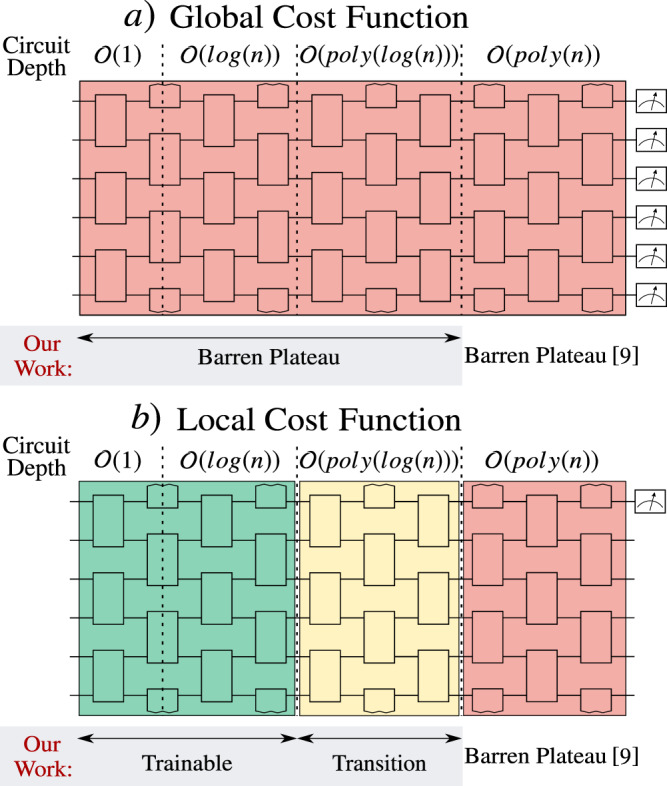
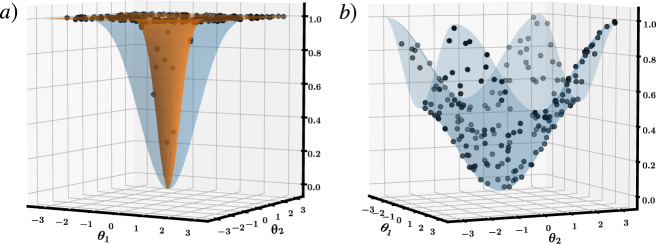
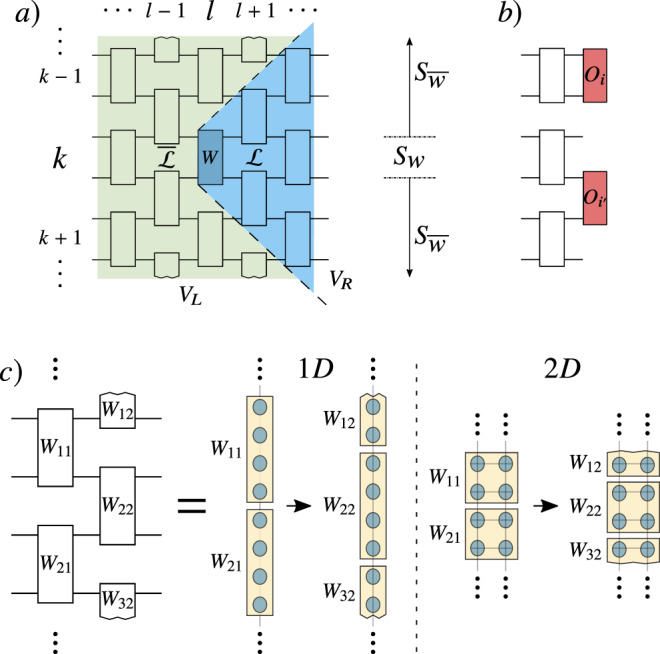
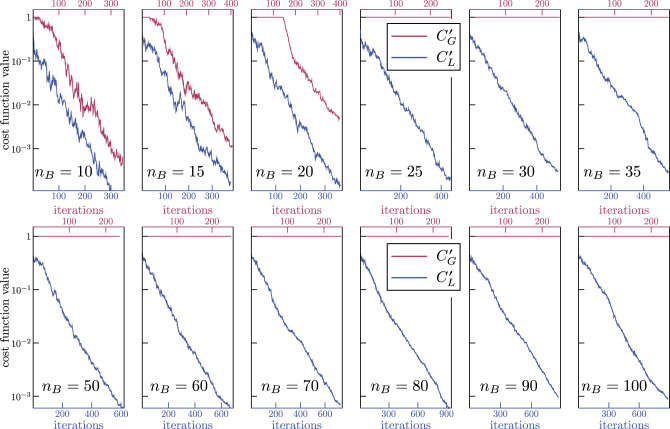
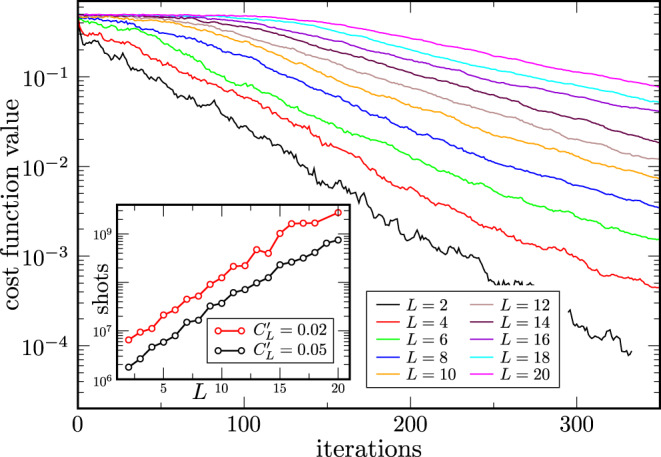
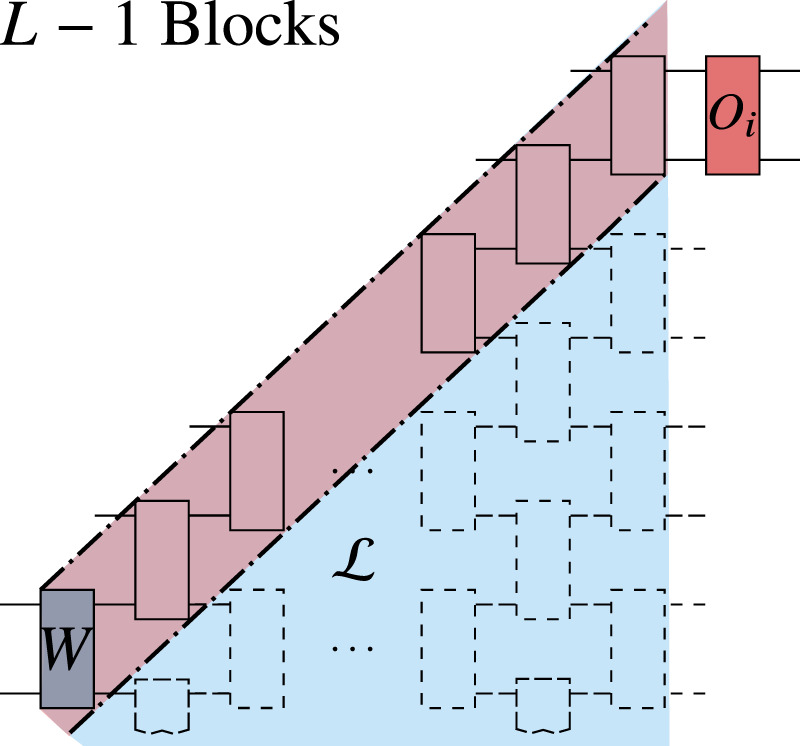
Variational quantum algorithms (VQAs) optimize the parameters θ of a parametrized quantum circuit V ( θ ) to minimize a cost function C . While VQAs may enable practical applications of noisy quantum computers, they are nevertheless heuristic methods with unproven scaling. Here, we rigorously prove two results, assuming V ( θ ) is an alternating layered ansatz composed of blocks forming local 2-designs. Our first result states that defining C in terms of global observables leads to exponentially vanishing gradients (i.e., barren plateaus) even when V ( θ ) is shallow. Hence, several VQAs in the literature must revise their proposed costs. On the other hand, our second result states that defining C with local observables leads to at worst a polynomially vanishing gradient, so long as the depth of V ( θ ) is $${\mathcal{O}}(\mathrm{log}\,n)$$ O ( log n ) . Our results establish a connection between locality and trainability. We illustrate these ideas with large-scale simulations, up to 100 qubits, of a quantum autoencoder implementation.
Overview
The claims and statistics of this paper haven’t been checked yet.
Free: it reads the open-access text and checks the first 5 claims that cite a source we can check. Create a free account to check every claim.
Integrity signals
Registry
Cites
Statistics
Figures
Verification
Claims the paper makes
The claims and statistics of this paper haven’t been checked yet.
Free: it reads the open-access text and checks the first 5 claims that cite a source we can check. Create a free account to check every claim.
Claims other papers make about this one
Each is checked against this paper’s own text: does it say what the citing paper says it does?
The source backs part of the claim, not all of it — or backs it for a different population, condition or comparison.
In the citing paper
“As shown in the seminal work of Ref. [19], deep random unstructured circuits which form 2-designs on n qubits will exhibit barren plateaus.”
From Effect of barren plateaus on gradient-free optimization (2021) · cites this paper as [19]
Experimental — accuracy not yet measuredThe cited source says what the claim attributes to it.
In the citing paper
“Barren plateau landscapes correspond to gradients that vanish exponentially in the number of qubits.”
From Effect of barren plateaus on gradient-free optimization (2021) · cites this paper as [19]
The cited source says what the claim attributes to it.
In the citing paper
“This corresponds to the barren plateau scenario in Ref. [19].”
From Effect of barren plateaus on gradient-free optimization (2021) · cites this paper as [19]
The cited source says what the claim attributes to it.
In the citing paper
“As noted in ref. 43, the phenomenon of barren plateaus is closely associated with the variance of the gradient of the loss function in parameterized quantum circuits.”
From Evidence of scaling advantage on an NP-complete problem with enhanced quantum solvers (2026) · cites this paper as [43]
The cited source says what the claim attributes to it.
In the citing paper
“Vanishing gradient issues during the optimization, known as barren plateaus, are dependent on the cost function (Cerezo et al. , 2021)”
From Noisy intermediate-scale quantum algorithms (2022) · cites this paper as Cerezo et al., 2021
5 more claims about this paper
Create a free account to see every claim other papers make about this one.
Self-check
Percentages, sums and reported differences re-computed from the paper’s own numbers.
The self-check needs the paper’s full text.
Citations
Cites
A Simplex Method for Function Minimization
Nelder, J. A., & Mead, R. (1965) · The Computer Journal · doi:10.1093/comjnl/7.4.308 · Cited by 28,905
Quantum Computing in the NISQ era and beyond
Preskill, J. (2018) · Quantum · doi:10.22331/q-2018-08-06-79 · Cited by 8,830
Quantum Computation and Quantum Information: 10th Anniversary Edition
Nielsen, M. A., & Chuang, I. L. (2012) · doi:10.1017/cbo9780511976667 · Cited by 8,436
Quantum supremacy using a programmable superconducting processor
Arute, F., Arya, K., Babbush, R., Bacon, D., Bardin, J. C., Barends, R., Biswas, R., Boixo, S., Brandao, F. G. S. L., Buell, D. A., et al. (2019) · Nature · doi:10.1038/s41586-019-1666-5 · Cited by 7,720
A variational eigenvalue solver on a photonic quantum processor
Peruzzo, A., McClean, J., Shadbolt, P., Yung, M.-H., Zhou, X.-Q., Love, P. J., Aspuru-Guzik, A., & O’Brien, J. L. (2014) · Nature Communications · doi:10.1038/ncomms5213 · Cited by 4,552
Coupled-cluster theory in quantum chemistry
Bartlett, R. J., & Musiał, M. (2007) · Reviews of Modern Physics · doi:10.1103/revmodphys.79.291 · Cited by 3,343
Hardware-efficient variational quantum eigensolver for small molecules and quantum magnets
Kandala, A., Mezzacapo, A., Temme, K., Takita, M., Brink, M., Chow, J. M., & Gambetta, J. M. (2017) · Nature · doi:10.1038/nature23879 · Cited by 2,982
Quantum Computation and Quantum Information: 10th Anniversary Edition
Nielsen, M. A., & Chuang, I. L. (2011) · Cited by 2,724
Barren plateaus in quantum neural network training landscapes
McClean, J. R., Boixo, S., Smelyanskiy, V. N., Babbush, R., & Neven, H. (2018) · Nature Communications · doi:10.1038/s41467-018-07090-4 · Cited by 2,329
The theory of variational hybrid quantum-classical algorithms
McClean, J. R., Romero, J., Babbush, R., & Aspuru-Guzik, A. (2016) · New Journal of Physics · doi:10.1088/1367-2630/18/2/023023 · Cited by 2,227
Research works printed but not linked: 1
- Li Y Benjamin SC Efficient variational quantum simulator incorporating active error minimization Phys. Rev. X 2017 7 021050
Cited by
Variational quantum algorithms
Cerezo, M., Arrasmith, A., Babbush, R., Benjamin, S. C., Endo, S., Fujii, K., McClean, J. R., Mitarai, K., Yuan, X., Cincio, L., et al. (2021) · Nature Reviews Physics · doi:10.1038/s42254-021-00348-9 · Cited by 3,385
Self-citationNoisy intermediate-scale quantum algorithms
Bharti, K., Cervera-Lierta, A., Kyaw, T. H., Haug, T., Alperin-Lea, S., Anand, A., Degroote, M., Heimonen, H., Kottmann, J. S., Menke, T., et al. (2022) · Reviews of Modern Physics · doi:10.1103/revmodphys.94.015004 · Cited by 2,231
The power of quantum neural networks
Abbas, A., Sutter, D., Zoufal, C., Lucchi, A., Figalli, A., & Woerner, S. (2021) · Nature Computational Science · doi:10.1038/s43588-021-00084-1 · Cited by 1,082
The Variational Quantum Eigensolver: A review of methods and best practices
Tilly, J., Chen, H., Cao, S., Picozzi, D., Setia, K., Li, Y., Grant, E., Wossnig, L., Rungger, I., Booth, G. H., et al. (2022) · Physics Reports · doi:10.1016/j.physrep.2022.08.003 · Cited by 1,031
Noise-Induced Barren Plateaus in Variational Quantum Algorithms
Wang, S., Fontana, E., Cerezo, M., Sharma, K., Sone, A., Cincio, L., & Coles, P. J. (2020) · arXiv · doi:10.48550/arxiv.2007.14384 · Cited by 791
Self-citationNoise-induced barren plateaus in variational quantum algorithms
Wang, S., Fontana, E., Cerezo, M., Sharma, K., Sone, A., Cincio, L., & Coles, P. J. (2021) · Nature Communications · doi:10.1038/s41467-021-27045-6 · Cited by 773
Self-citationEffect of data encoding on the expressive power of variational quantum-machine-learning models
Schuld, M., Sweke, R., & Meyer, J. J. (2021) · Physical Review A · doi:10.1103/physreva.103.032430 · Cited by 739
Challenges and opportunities in quantum machine learning
Cerezo, M., Verdon, G., Huang, H.-Y., Cincio, L., & Coles, P. J. (2022) · Nature Computational Science · doi:10.1038/s43588-022-00311-3 · Cited by 689
Self-citationConnecting Ansatz Expressibility to Gradient Magnitudes and Barren Plateaus
Holmes, Z., Sharma, K., Cerezo, M., & Coles, P. J. (2022) · PRX Quantum · doi:10.1103/prxquantum.3.010313 · Cited by 570
Self-citationHybrid Quantum-Classical Algorithms and Quantum Error Mitigation
Endo, S., Cai, Z., Benjamin, S. C., & Yuan, X. (2021) · Journal of the Physical Society of Japan · doi:10.7566/jpsj.90.032001 · Cited by 566
Generalization in quantum machine learning from few training data
Caro, M. C., Huang, H.-Y., Cerezo, M., Sharma, K., Sornborger, A., Cincio, L., & Coles, P. J. (2022) · Nature Communications · doi:10.1038/s41467-022-32550-3 · Cited by 476
Self-citationDoes provable absence of barren plateaus imply classical simulability?
Cerezo, M., Larocca, M., García-Martín, D., Diaz, N. L., Braccia, P., Fontana, E., Rudolph, M. S., Bermejo, P., Ijaz, A., Thanasilp, S., et al. (2025) · Nature Communications · doi:10.1038/s41467-025-63099-6 · Cited by 110
Self-citationTraining Variational Quantum Algorithms Is NP-Hard
Bittel, L., & Kliesch, M. (2021) · Physical Review Letters · doi:10.1103/physrevlett.127.120502 · Cited by 398
Quantum Algorithms: A Survey of Applications and End-to-end Complexities
Dalzell, A. M., McArdle, S., Berta, M., Bienias, P., Chen, C.-F., Gilyén, A., Hann, C. T., Kastoryano, M. J., Khabiboulline, E. T., Kubica, A., et al. (2023) · RWTH Publications (RWTH Aachen) · doi:10.18154/rwth-2026-02888 · Cited by 363
Absence of Barren Plateaus in Quantum Convolutional Neural Networks
Pesah, A., Cerezo, M., Wang, S., Volkoff, T., Sornborger, A. T., & Coles, P. J. (2021) · Physical Review X · doi:10.1103/physrevx.11.041011 · Cited by 343
Self-citationAbsence of Barren Plateaus in Quantum Convolutional Neural Networks
Pesah, A., Cerezo, M., Wang, S., Volkoff, T., Sornborger, A. T., & Coles, P. J. (2020) · arXiv · doi:10.48550/arxiv.2011.02966 · Cited by 343
Self-citationRobust data encodings for quantum classifiers
LaRose, R., & Coyle, B. (2020) · Physical Review A · doi:10.1103/physreva.102.032420 · Cited by 326
Layerwise learning for quantum neural networks
Skolik, A., McClean, J. R., Mohseni, M., van der Smagt, P., & Leib, M. (2021) · Quantum Machine Intelligence · doi:10.1007/s42484-020-00036-4 · Cited by 324
TensorFlow Quantum: A Software Framework for Quantum Machine Learning
Broughton, M., Verdon, G., McCourt, T., Martinez, A. J., Yoo, J. H., Isakov, S. V., Massey, P., Halavati, R., Niu, M. Y., Zlokapa, A., et al. (2020) · arXiv · doi:10.48550/arxiv.2003.02989 · Cited by 308
Random unitaries in extremely low depth
Schuster, T., Haferkamp, J., & Huang, H.-Y. (2025) · Science · doi:10.1126/science.adv8590 · Cited by 303
Variational Quantum Linear Solver
Bravo-Prieto, C., LaRose, R., Cerezo, M., Subasi, Y., Cincio, L., & Coles, P. J. (2019) · arXiv · doi:10.48550/arxiv.1909.05820 · Cited by 284
Self-citationExperimental Quantum Generative Adversarial Networks for Image Generation
Huang, H.-L., Du, Y., Gong, M., Zhao, Y., Wu, Y., Wang, C., Li, S., Liang, F., Lin, J., Xu, Y., et al. (2021) · Physical Review Applied · doi:10.1103/physrevapplied.16.024051 · Cited by 277
Variational Quantum Linear Solver
Bravo-Prieto, C., LaRose, R., Cerezo, M., Subasi, Y., Cincio, L., & Coles, P. J. (2023) · Quantum · doi:10.22331/q-2023-11-22-1188 · Cited by 260
Self-citationBarren plateaus in variational quantum computing
Larocca, M., Thanasilp, S., Wang, S., Sharma, K., Biamonte, J., Coles, P. J., Cincio, L., McClean, J. R., Holmes, Z., & Cerezo, M. (2025) · Nature Reviews Physics · doi:10.1038/s42254-025-00813-9 · Cited by 257
Self-citationQuantum annealing initialization of the quantum approximate optimization algorithm
Sack, S. H., & Serbyn, M. (2021) · Quantum · doi:10.22331/q-2021-07-01-491 · Cited by 146
Equivalence of quantum barren plateaus to cost concentration and narrow gorges
Arrasmith, A., Holmes, Z., Cerezo, M., & Coles, P. J. (2022) · Quantum Science and Technology · doi:10.1088/2058-9565/ac7d06 · Cited by 137
Self-citationHarrow, A. W., & Mehraban, S. (2023) · Communications in Mathematical Physics · doi:10.1007/s00220-023-04675-z · Cited by 126
Effect of barren plateaus on gradient-free optimization
Arrasmith, A., Cerezo, M., Czarnik, P., Cincio, L., & Coles, P. J. (2021) · Quantum · doi:10.22331/q-2021-10-05-558 · Cited by 248
“This is currently a topic of debate [20, 28].”
BackgroundMethodInfluentialSelf-citationGroup-Invariant Quantum Machine Learning
Larocca, M., Sauvage, F., Sbahi, F. M., Verdon, G., Coles, P. J., & Cerezo, M. (2022) · PRX Quantum · doi:10.1103/prxquantum.3.030341 · Cited by 248
Self-citationExploring Entanglement and Optimization within the Hamiltonian Variational Ansatz
Wiersema, R., Zhou, C., de Sereville, Y., Carrasquilla, J. F., Kim, Y. B., & Yuen, H. (2020) · PRX Quantum · doi:10.1103/prxquantum.1.020319 · Cited by 235
Variational fast forwarding for quantum simulation beyond the coherence time
Cîrstoiu, C., Holmes, Z., Iosue, J., Cincio, L., Coles, P. J., & Sornborger, A. (2020) · npj Quantum Information · doi:10.1038/s41534-020-00302-0 · Cited by 232
Self-citationCharacterizing barren plateaus in quantum ansätze with the adjoint representation
Fontana, E., Herman, D., Chakrabarti, S., Kumar, N., Yalovetzky, R., Heredge, J., Sureshbabu, S. H., & Pistoia, M. (2024) · Nature Communications · doi:10.1038/s41467-024-49910-w · Cited by 239
Quantum machine learning beyond kernel methods
Jerbi, S., Fiderer, L. J., Poulsen Nautrup, H., Kübler, J. M., Briegel, H. J., & Dunjko, V. (2023) · Nature Communications · doi:10.1038/s41467-023-36159-y · Cited by 229
“Explicit models can suffer from barren plateaus in their loss landscapes [38, 42], which manifest in exponentially vanishing gradients in the number of qubits used, while implicit models can suffer from exponentially vanishing kernel values [27, 43].”
BackgroundVariational quantum state eigensolver
Cerezo, M., Sharma, K., Arrasmith, A., & Coles, P. J. (2022) · npj Quantum Information · doi:10.1038/s41534-022-00611-6 · Cited by 136
Self-citationTheory for Equivariant Quantum Neural Networks
Nguyen, Q. T., Schatzki, L., Braccia, P., Ragone, M., Coles, P. J., Sauvage, F., Larocca, M., & Cerezo, M. (2024) · PRX Quantum · doi:10.1103/prxquantum.5.020328 · Cited by 233
Self-citationEntanglement devised barren plateau mitigation
Patti, T. L., Najafi, K., Gao, X., & Yelin, S. F. (2021) · Physical Review Research · doi:10.1103/physrevresearch.3.033090 · Cited by 148
Quantum variational algorithms are swamped with traps
Anschuetz, E. R., & Kiani, B. T. (2022) · Nature Communications · doi:10.1038/s41467-022-35364-5 · Cited by 226
“For one, VQAs tend to exhibit barren plataeus when they are deep; namely, gradients of deep variational quantum circuits vanish exponentially with the problem size in many settings 7,8,10 .”
Training quantum embedding kernels on near-term quantum computers
Hubregtsen, T., Wierichs, D., Gil-Fuster, E., Derks, P.-J. H. S., Faehrmann, P. K., & Meyer, J. J. (2022) · Physical Review A · doi:10.1103/physreva.106.042431 · Cited by 227
Quantum Computing for High-Energy Physics: State of the Art and Challenges
Di Meglio, A., Jansen, K., Tavernelli, I., Alexandrou, C., Arunachalam, S., Bauer, C. W., Borras, K., Carrazza, S., Crippa, A., Croft, V., et al. (2024) · PRX Quantum · doi:10.1103/prxquantum.5.037001 · Cited by 215
“However, even inexpressive and low-entangling Quantum Neural Network (QNN)s may exhibit barren plateaus if the cost function is ‘global’ [312], i.”
BackgroundDiagnosing Barren Plateaus with Tools from Quantum Optimal Control
Larocca, M., Czarnik, P., Sharma, K., Muraleedharan, G., Coles, P. J., & Cerezo, M. (2022) · Quantum · doi:10.22331/q-2022-09-29-824 · Cited by 214
“For instance, if the cost function is global, the system can still exhibit barren plateaus even with trivial ansatzes that do not a have exponentially growing dimension of the DLA [49].”
BackgroundMethodInfluentialSelf-citationQuantum machine learning for chemistry and physics
Sajjan, M., Li, J., Selvarajan, R., Sureshbabu, S. H., Kale, S. S., Gupta, R., Singh, V., & Kais, S. (2022) · Chemical Society Reviews · doi:10.1039/d2cs00203e · Cited by 215
Challenges and opportunities in quantum optimization
Abbas, A., Ambainis, A., Augustino, B., Bärtschi, A., Buhrman, H., Coffrin, C., Cortiana, G., Dunjko, V., Egger, D. J., Elmegreen, B. G., et al. (2024) · Nature Reviews Physics · doi:10.1038/s42254-024-00770-9 · Cited by 201
Noise resilience of variational quantum compiling
Sharma, K., Khatri, S., Cerezo, M., & Coles, P. J. (2020) · New Journal of Physics · doi:10.1088/1367-2630/ab784c · Cited by 196
Self-citationTheoretical guarantees for permutation-equivariant quantum neural networks
Schatzki, L., Larocca, M., Nguyen, Q. T., Sauvage, F., & Cerezo, M. (2024) · npj Quantum Information · doi:10.1038/s41534-024-00804-1 · Cited by 199
Self-citationAvoiding Barren Plateaus Using Classical Shadows
Sack, S. H., Medina, R. A., Michailidis, A. A., Kueng, R., & Serbyn, M. (2022) · PRX Quantum · doi:10.1103/prxquantum.3.020365 · Cited by 195
A quantum convolutional neural network on NISQ devices
Wei, S., Chen, Y., Zhou, Z., & Long, G. (2022) · AAPPS Bulletin · doi:10.1007/s43673-021-00030-3 · Cited by 192
Quantum agents in the Gym: a variational quantum algorithm for deep Q-learning
Skolik, A., Jerbi, S., & Dunjko, V. (2022) · Quantum · doi:10.22331/q-2022-05-24-720 · Cited by 191
“[41] M Cerezo, Akira Sone, Tyler Volkoff, Lukasz Cincio, and”
BackgroundEfficient Measure for the Expressivity of Variational Quantum Algorithms
Du, Y., Tu, Z., Yuan, X., & Tao, D. (2022) · Physical Review Letters · doi:10.1103/physrevlett.128.080506 · Cited by 194
Exponential concentration in quantum kernel methods
Thanasilp, S., Wang, S., Cerezo, M., & Holmes, Z. (2024) · Nature Communications · doi:10.1038/s41467-024-49287-w · Cited by 189
“We study the variance of the kernel target alignment TA( θ ) (which determines the fl atness of the training landscape 20,21 ) for 500 random initialization of the parameters θ .”
Self-citationCovariant quantum kernels for data with group structure
Glick, J. R., Gujarati, T. P., Corcoles, A. D., Kim, Y., Kandala, A., Gambetta, J., & Temme, K. (2024) · Nature Physics · doi:10.1038/s41567-023-02340-9 · Cited by 193
Recent Advances for Quantum Neural Networks in Generative Learning
Tian, J., Sun, X., Du, Y., Zhao, S., Liu, Q., Zhang, K., Yi, W., Huang, W., Wang, C., Wu, X., et al. (2023) · IEEE Transactions on Pattern Analysis and Machine Intelligence · doi:10.1109/tpami.2023.3272029 · Cited by 111
A comprehensive review of quantum machine learning: from NISQ to fault tolerance
Wang, Y., & Liu, J. (2024) · Reports on Progress in Physics · doi:10.1088/1361-6633/ad7f69 · Cited by 192
Solving nonlinear differential equations with differentiable quantum circuits
Kyriienko, O., Paine, A. E., & Elfving, V. E. (2021) · Physical Review A · doi:10.1103/physreva.103.052416 · Cited by 185
Solving nonlinear differential equations with differentiable quantum circuits
Kyriienko, O., Paine, A. E., & Elfving, V. E. (2020) · arXiv · doi:10.48550/arxiv.2011.10395 · Cited by 185
On the practical usefulness of the Hardware Efficient Ansatz
Leone, L., Oliviero, S. F. E., Cincio, Ł., & Cerezo, M. (2024) · Quantum · doi:10.22331/q-2024-07-03-1395 · Cited by 189
Self-citationQuantum circuit architecture search for variational quantum algorithms
Du, Y., Huang, T., You, S., Hsieh, M.-H., & Tao, D. (2022) · npj Quantum Information · doi:10.1038/s41534-022-00570-y · Cited by 184
“Last, in Step 4, QAS utilizes the searched ansatz and the parameters θ ( T ) to retrain the quantum solver with few iterations. with other quantum error mitigation methods [25–27] and solutions of resolving barren plateaus [21, 34–36].”
MethodModern applications of machine learning in quantum sciencesPreprint
Dawid, A., Arnold, J., Requena, B., Gresch, A., Płodzień, M., Donatella, K., Nicoli, K. A., Stornati, P., Koch, R., Büttner, M., et al. (2022) · arXiv (Cornell University) · doi:10.48550/arxiv.2204.04198 · Cited by 181
Quantum machine learning: from physics to software engineering
Melnikov, A. A., Kordzanganeh, M., Alodjants, A. P., & Lee, R. (2023) · Advances in Physics X · doi:10.1080/23746149.2023.2165452 · Cited by 182
Theory of overparametrization in quantum neural networks
Larocca, M., Ju, N., García-Martín, D., Coles, P. J., & Cerezo, M. (2023) · Nature Computational Science · doi:10.1038/s43588-023-00467-6 · Cited by 176
“Replacing equation (18) by equation (3), we find that the elements of the QFIM can be written as”
BackgroundSelf-citationSimulating 2D Effects in Lattice Gauge Theories on a Quantum Computer
Paulson, D., Dellantonio, L., Haase, J. F., Celi, A., Kan, A., Jena, A., Kokail, C., van Bijnen, R., Jansen, K., Zoller, P., et al. (2021) · PRX Quantum · doi:10.1103/prxquantum.2.030334 · Cited by 178
Synergistic pretraining of parametrized quantum circuits via tensor networks
Rudolph, M. S., Miller, J., Motlagh, D., Chen, J., Acharya, A., & Perdomo‐Ortiz, A. (2023) · Nature Communications · doi:10.1038/s41467-023-43908-6 · Cited by 174
Filtering variational quantum algorithms for combinatorial optimization
Amaro, D., Modica, C., Rosenkranz, M., Fiorentini, M., Benedetti, M., & Lubasch, M. (2022) · Quantum Science and Technology · doi:10.1088/2058-9565/ac3e54 · Cited by 174
Quantum Krylov subspace algorithms for ground- and excited-state energy estimation
Cortes, C. L., & Gray, S. K. (2022) · Physical Review A · doi:10.1103/physreva.105.022417 · Cited by 175
Escaping from the Barren Plateau Via Gaussian Initializations in Deep Variational Quantum Circuits
Zhang, K., Liu, L., Hsieh, M.-H., & Tao, D. (2022) · neural information processing systems · doi:10.52202/068431-1352 · Cited by 173
Liu, Y., Singh, S., Smith, K. C., Crane, E., Martyn, J. M., Eickbusch, A., Schuckert, A., Li, R. D., Sinanan-Singh, J., Soley, M. B., et al. (2026) · PRX Quantum · doi:10.1103/4rf7-9tfx · Cited by 171
A Lie algebraic theory of barren plateaus for deep parameterized quantum circuits
Ragone, M., Bakalov, B. N., Sauvage, F., Kemper, A. F., Ortiz Marrero, C., Larocca, M., & Cerezo, M. (2024) · Nature Communications · doi:10.1038/s41467-024-49909-3 · Cited by 167
“A second potential source of BPs is the measurement operator 26 – 32 .”
InfluentialSelf-citationUnderstanding quantum machine learning also requires rethinking generalization
Gil-Fuster, E., Eisert, J., & Bravo-Prieto, C. (2024) · Nature Communications · doi:10.1038/s41467-024-45882-z · Cited by 169
Trainability of Dissipative Perceptron-Based Quantum Neural Networks
Sharma, K., Cerezo, M., Cincio, L., & Coles, P. J. (2022) · Physical Review Letters · doi:10.1103/physrevlett.128.180505 · Cited by 159
“…function exhibits barren plateaus as On the other hand, for a local cost function with O x given by (4), if the number of layers is in O (log( n )) , then there is no barren plateau [19] as Here we remark that (12) was obtained following the same assumptions as those used in Corollary 2 of [19].”
BackgroundMethodInfluentialSelf-citationNearest centroid classification on a trapped ion quantum computer
Johri, S., Debnath, S., Mocherla, A., Singh, A., Prakash, A., Kim, J., & Kerenidis, I. (2021) · npj Quantum Information · doi:10.1038/s41534-021-00456-5 · Cited by 160
Out-of-distribution generalization for learning quantum dynamics
Caro, M. C., Huang, H.-Y., Ezzell, N., Gibbs, J., Sornborger, A. T., Cincio, Ł., Coles, P. J., & Holmes, Z. (2023) · Nature Communications · doi:10.1038/s41467-023-39381-w · Cited by 159
Self-citationRepresentation Theory for Geometric Quantum Machine LearningPreprint
Ragone, M., Braccia, P., Nguyen, Q. T., Schatzki, L., Coles, P. J., Sauvage, F., Larocca, M., & Cerezo, M. (2022) · arXiv (Cornell University) · doi:10.48550/arxiv.2210.07980 · Cited by 161
Self-citationQuantum computing models for artificial neural networks
Mangini, S., Tacchino, F., Gerace, D., Bajoni, D., & Macchiavello, C. (2021) · Europhysics Letters (EPL) · doi:10.1209/0295-5075/134/10002 · Cited by 159
Quantum Convolutional Neural Networks are Effectively Classically Simulable
Bermejo, P., Braccia, P., Rudolph, M. S., Holmes, Z., Cincio, Ł., & Cerezo, M. (2026) · PRX Quantum · doi:10.1103/8qt9-72ts · Cited by 158
Self-citationDigitized-counterdiabatic quantum approximate optimization algorithm
Chandarana, P., Hegade, N. N., Paul, K., Albarrán-Arriagada, F., Solano, E., del Campo, A., & Chen, X. (2022) · Physical Review Research · doi:10.1103/physrevresearch.4.013141 · Cited by 159
Quantum Methods for Neural Networks and Application to Medical Image Classification
Landman, J., Mathur, N., Li, Y. Y., Strahm, M., Kazdaghli, S., Prakash, A., & Kerenidis, I. (2022) · Quantum · doi:10.22331/q-2022-12-22-881 · Cited by 160
Classical Surrogates for Quantum Learning Models
Schreiber, F. J., Eisert, J., & Meyer, J. J. (2023) · Physical Review Letters · doi:10.1103/physrevlett.131.100803 · Cited by 160
Quantum many-body simulations on digital quantum computers: State-of-the-art and future challenges
Fauseweh, B. (2024) · Nature Communications · doi:10.1038/s41467-024-46402-9 · Cited by 152
“…at the cost of solving a high-dimensional optimization problem, which can exhibit the “ barren plateau" phenomenon, where an exponentially vanishing gradient makes it dif fi cult for classical optimizers to fi nd directions for parameter updates, hindering algorithm convergence and ef fi cacy 55,56 .”
Nakaji, K., Uno, S., Suzuki, Y., Raymond, R., Onodera, T., Tanaka, T., Tezuka, H., Mitsuda, N., & Yamamoto, N. (2022) · Physical Review Research · doi:10.1103/physrevresearch.4.023136 · Cited by 151
Learnability of Quantum Neural Networks
Du, Y., Hsieh, M.-H., Liu, T., You, S., & Tao, D. (2021) · PRX Quantum · doi:10.1103/prxquantum.2.040337 · Cited by 147
Quantum Algorithms: A Survey of Applications and End-to-end Complexities
Dalzell, A. M., McArdle, S., Berta, M., Bienias, P., Chen, C.-F., Gilyén, A., Hann, C. T., Kastoryano, M. J., Khabiboulline, E. T., Kubica, A., et al. (2025) · Cambridge University Press eBooks · doi:10.1017/9781009639651 · Cited by 147
Qubit-excitation-based adaptive variational quantum eigensolver
(2021) · doi:10.1038/s42005-021-00730-0 · Cited by 145
Iterative qubit-excitation based variational quantum eigensolver
Yordanov, Y., Armaos, V., Barnes, C., & Arvidsson-Shukur, D. (2021) · doi:10.21203/rs.3.rs-404173/v1 · Cited by 145
Hybrid Quantum–Classical Generative Adversarial Network for High-Resolution Image Generation
Tsang, S. L., West, M. T., Erfani, S., & Usman, M. (2023) · IEEE Transactions on Quantum Engineering · doi:10.1109/tqe.2023.3319319 · Cited by 148
Large gradients via correlation in random parameterized quantum circuits
Volkoff, T., & Coles, P. J. (2021) · Quantum Science and Technology · doi:10.1088/2058-9565/abd891 · Cited by 143
Self-citationLie-algebraic classical simulations for quantum computing
Goh, M. L., Larocca, M., Cincio, Ł., Cerezo, M., & Sauvage, F. (2025) · Physical Review Research · doi:10.1103/3y65-f5w6 · Cited by 147
Self-citationSubtleties in the trainability of quantum machine learning models
Thanasilp, S., Wang, S., Nghiem, N. A., Coles, P. J., & Cerezo, M. (2023) · Quantum Machine Intelligence · doi:10.1007/s42484-023-00103-6 · Cited by 143
Self-citationDecomposition of matrix product states into shallow quantum circuits
Rudolph, M. S., Chen, J., Miller, J. A., Acharya, A., & Perdomo‐Ortiz, A. (2023) · Quantum Science and Technology · doi:10.1088/2058-9565/ad04e6 · Cited by 144
Huang, H.-L., Xu, X., Guo, C., Tian, G., Wei, S.-J., Sun, X., Bao, W., & Long, G. (2023) · Science China Physics Mechanics and Astronomy · doi:10.1007/s11433-022-2057-y · Cited by 145
Hamiltonian variational ansatz without barren plateaus
Park, C.-Y., & Killoran, N. (2024) · Quantum · doi:10.22331/q-2024-02-01-1239 · Cited by 141
Enhancing Generative Models via Quantum Correlations
Gao, X., Anschuetz, E. R., Wang, S.-T., Cirac, J. I., & Lukin, M. D. (2022) · Physical Review X · doi:10.1103/physrevx.12.021037 · Cited by 137
Machine learning for anomaly detection in particle physics
Belis, V., Odagiu, P., & Aarrestad, T. K. (2024) · Reviews in Physics · doi:10.1016/j.revip.2024.100091 · Cited by 138
A Survey on Quantum Machine Learning: Current Trends, Challenges, Opportunities, and the Road AheadPreprint
Zaman, K., Marchisio, A., Hanif, M. A., & Shafique, M. (2023) · arXiv (Cornell University) · doi:10.48550/arxiv.2310.10315 · Cited by 138
Recent advances for quantum classifiers
Li, W., & Deng, D.-L. (2021) · Science China Physics Mechanics and Astronomy · doi:10.1007/s11433-021-1793-6 · Cited by 135
García-Pérez, G., Rossi, M. A. C., Sokolov, B., Tacchino, F., Barkoutsos, P. K., Mazzola, G., Tavernelli, I., & Maniscalco, S. (2021) · PRX Quantum · doi:10.1103/prxquantum.2.040342 · Cited by 139
Gujju, Y., Matsuo, A., & Raymond, R. (2024) · Physical Review Applied · doi:10.1103/physrevapplied.21.067001 · Cited by 140
The complexity of quantum support vector machines
Gentinetta, G., Thomsen, A., Sutter, D., & Woerner, S. (2024) · Quantum · doi:10.22331/q-2024-01-11-1225 · Cited by 132
MoG-VQE: Multiobjective genetic variational quantum eigensolver
Сергеевич, Ч. Д., Samarin, A., Игоревич, У. В., Iorsh, I. V., Оганов, А. Р., & Kyriienko, O. (2020) · arXiv (Cornell University) · doi:10.48550/arxiv.2007.04424 · Cited by 40
Matrix product state pre-training for quantum machine learning
Dborin, J., Barratt, F., Wimalaweera, V., Wright, L., & Green, A. G. (2022) · Quantum Science and Technology · doi:10.1088/2058-9565/ac7073 · Cited by 130
Analyzing the barren plateau phenomenon in training quantum neural networks with the ZX-calculus
Zhao, C., & Gao, X.-S. (2021) · Quantum · doi:10.22331/q-2021-06-04-466 · Cited by 130
Can Error Mitigation Improve Trainability of Noisy Variational Quantum Algorithms?
Wang, S., Czarnik, P., Arrasmith, A., Cerezo, M., Cincio, Ł., & Coles, P. J. (2024) · Quantum · doi:10.22331/q-2024-03-14-1287 · Cited by 133
Self-citation
Metadata
- Authors
- Cerezo, M., Sone, A., Volkoff, T., Cincio, L., & Coles, P. J.
- Affiliations
- Los Alamos National Laboratory (US)
- Corresponding author
- Cerezo, M.
- Coles, Patrick J.
- Venue
- Nature Communications
- Published
- 2021-03-19
- Volume
- 12
- Issue
- 1
- Pages
- 1791-1791
- ISSN
- 2041-1723 (ISSN-L)
- PMC
- PMC7979934
- OpenAlex
- W3136233239
- Semantic Scholar
- ff744c5fd2628eea16654da81c5b1e5080e51d35
- Cited by
- 1,047
- References
- 70
- Citations by year
- 2026: 201 · 2025: 205 · 2024: 216 · 2023: 174 · 2022: 152 · 2021: 95
- FWCI
- 56.06
- Type
- journal article
- Language
- en
- Open access
- gold
- doi.org
- Licence
- cc-by
- creativecommons.org/licenses/by/4.0 (tdm)
- creativecommons.org/licenses/by/4.0 (vor)
- Locations
- Nature Communications (publishedVersion, cc-by)
- arXiv (Cornell University) (publishedVersion)
- PubMed Central (publishedVersion, cc-by)
- PubMed (publishedVersion)
- RePEc: Research Papers in Economics (submittedVersion)
- DOAJ (DOAJ: Directory of Open Access Journals) (submittedVersion, cc-by-sa)
- OSTI OAI (U.S. Department of Energy Office of Scientific and Technical Information) (submittedVersion)
- arXiv (Cornell University)
- Funders
- U.S. Department of Energy (20190065DR)
- Office of Science
- Advanced Scientific Computing Research
- Laboratory Directed Research and Development (20190065DR, 20180628ECR, 20200677PRD1)
- Los Alamos National Laboratory (20180628ECR, 20190065DR)
- Topics
- Physical Sciences › Computer Science › Artificial Intelligence › Quantum Computing Algorithms and Architecture
- Physical Sciences › Physics and Astronomy › Atomic and Molecular Physics, and Optics › Quantum many-body systems
- Physical Sciences › Physics and Astronomy › Atomic and Molecular Physics, and Optics › Quantum Information and Cryptography
- Keywords
- barren plateaus, variational quantum algorithms, variational quantum circuits, shallow quantum circuits, gradient vanishing, cost function design, quantum autoencoders, quantum machine learning
About these checks
Registry, retraction, Cites and statistics results are computed, not judged, with one exception: a printed reference that no index lists is read once by a model before it counts as a citation error. Claims are extracted by a model and kept only when their quote appears verbatim in the text; each cited source is then checked, with a model’s help, for whether it says what the claim relies on. Those verdicts can be wrong — read the claim’s quote and the cited source before relying on one.
Statistics and arithmetic are recomputed, not judged.
Confidence bands are shown only for fields calibrated on our annotated test set. None is calibrated yet, so no band is shown.
What counts as a claim ›How we measure confidence ›How we check this ›
Are you an author, or do you see a problem with this page? Request a review
Data sources
Bibliographic data: Semantic Scholar, OpenAlex, Crossref.
Contains information from the Semantic Scholar Academic Graph Datasets, made available under the ODC Attribution License (ODC-BY 1.0).
Semantic Scholar’s data is described in: Kinney, R., et al. (2023). The Semantic Scholar Open Data Platform. arXiv:2301.10140.
