

Cost function dependent barren plateaus in shallow parametrized quantum circuits
Open accessThe DOI matches its Crossref record; 72 of the 72 references it cites were found in a registry or an index.
Abstract
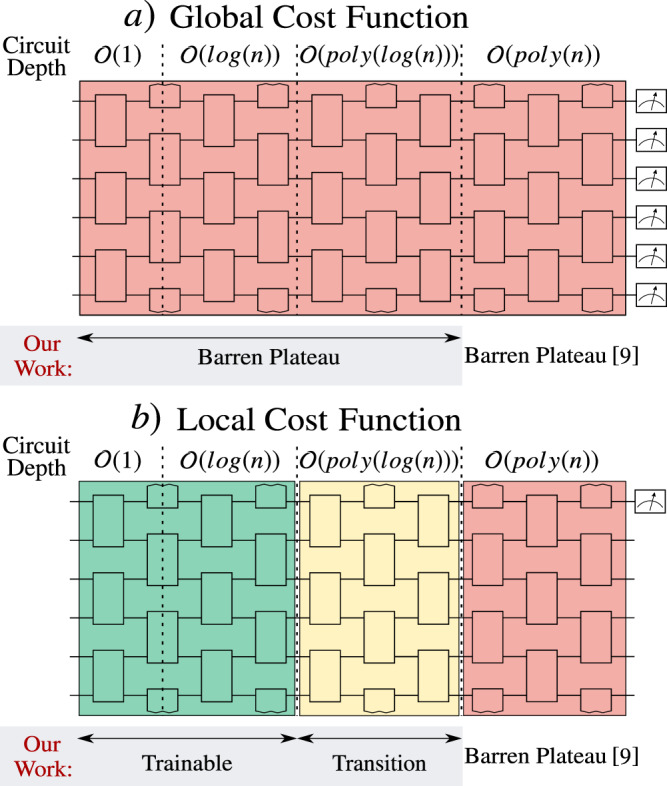
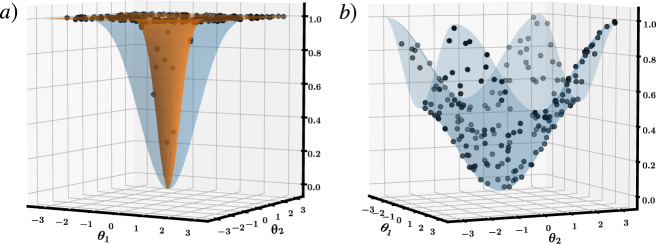
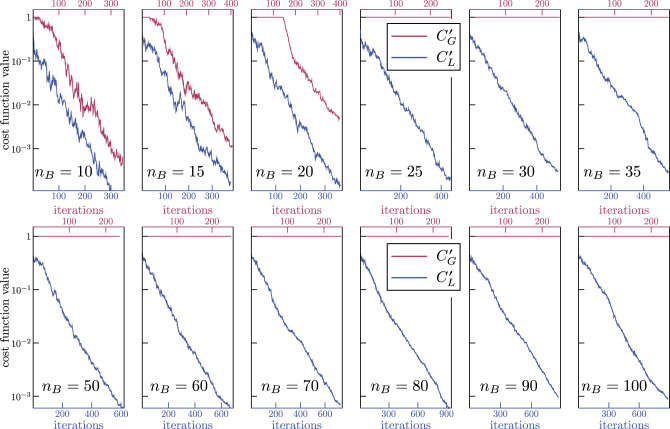
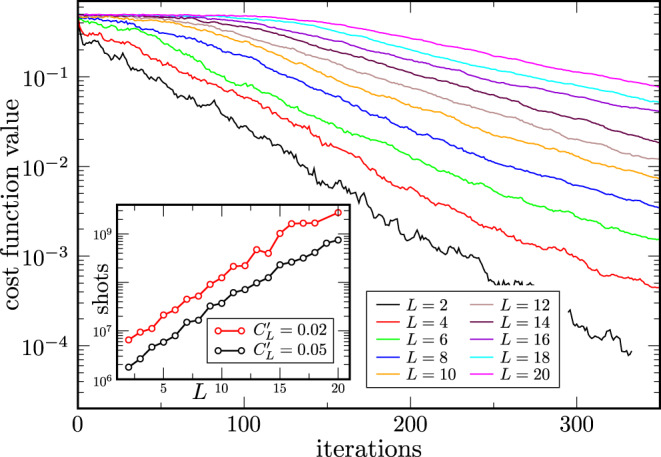
Variational quantum algorithms (VQAs) optimize the parameters θ of a parametrized quantum circuit V ( θ ) to minimize a cost function C . While VQAs may enable practical applications of noisy quantum computers, they are nevertheless heuristic methods with unproven scaling. Here, we rigorously prove two results, assuming V ( θ ) is an alternating layered ansatz composed of blocks forming local 2-designs. Our first result states that defining C in terms of global observables leads to exponentially vanishing gradients (i.e., barren plateaus) even when V ( θ ) is shallow. Hence, several VQAs in the literature must revise their proposed costs. On the other hand, our second result states that defining C with local observables leads to at worst a polynomially vanishing gradient, so long as the depth of V ( θ ) is $${\mathcal{O}}(\mathrm{log}\,n)$$ O ( log n ) . Our results establish a connection between locality and trainability. We illustrate these ideas with large-scale simulations, up to 100 qubits, of a quantum autoencoder implementation.
Overview
The claims and statistics of this paper haven’t been checked yet.
Free: it reads the open-access text and checks the first 5 claims that cite a source we can check. Create a free account to check every claim.
Integrity signals
Registry
Cites
Statistics
Figures
Verification
Claims the paper makes
The claims and statistics of this paper haven’t been checked yet.
Free: it reads the open-access text and checks the first 5 claims that cite a source we can check. Create a free account to check every claim.
Claims other papers make about this one
Each is checked against this paper’s own text: does it say what the citing paper says it does?
The source backs part of the claim, not all of it — or backs it for a different population, condition or comparison.
In the citing paper
“As shown in the seminal work of Ref. [19], deep random unstructured circuits which form 2-designs on n qubits will exhibit barren plateaus.”
From Effect of barren plateaus on gradient-free optimization (2021) · cites this paper as [19]
Experimental — accuracy not yet measuredThe cited source says what the claim attributes to it.
In the citing paper
“Barren plateau landscapes correspond to gradients that vanish exponentially in the number of qubits.”
From Effect of barren plateaus on gradient-free optimization (2021) · cites this paper as [19]
The cited source says what the claim attributes to it.
In the citing paper
“This corresponds to the barren plateau scenario in Ref. [19].”
From Effect of barren plateaus on gradient-free optimization (2021) · cites this paper as [19]
The cited source says what the claim attributes to it.
In the citing paper
“As noted in ref. 43, the phenomenon of barren plateaus is closely associated with the variance of the gradient of the loss function in parameterized quantum circuits.”
From Evidence of scaling advantage on an NP-complete problem with enhanced quantum solvers (2026) · cites this paper as [43]
The cited source says what the claim attributes to it.
In the citing paper
“Vanishing gradient issues during the optimization, known as barren plateaus, are dependent on the cost function (Cerezo et al. , 2021)”
From Noisy intermediate-scale quantum algorithms (2022) · cites this paper as Cerezo et al., 2021
5 more claims about this paper
Create a free account to see every claim other papers make about this one.
Self-check
Percentages, sums and reported differences re-computed from the paper’s own numbers.
The self-check needs the paper’s full text.
Citations
Cites
A Simplex Method for Function Minimization
Nelder, J. A., & Mead, R. (1965) · The Computer Journal · doi:10.1093/comjnl/7.4.308 · Cited by 28,905
Quantum Computing in the NISQ era and beyond
Preskill, J. (2018) · Quantum · doi:10.22331/q-2018-08-06-79 · Cited by 8,830
Quantum Computation and Quantum Information: 10th Anniversary Edition
Nielsen, M. A., & Chuang, I. L. (2012) · doi:10.1017/cbo9780511976667 · Cited by 8,436
Quantum supremacy using a programmable superconducting processor
Arute, F., Arya, K., Babbush, R., Bacon, D., Bardin, J. C., Barends, R., Biswas, R., Boixo, S., Brandao, F. G. S. L., Buell, D. A., et al. (2019) · Nature · doi:10.1038/s41586-019-1666-5 · Cited by 7,720
A variational eigenvalue solver on a photonic quantum processor
Peruzzo, A., McClean, J., Shadbolt, P., Yung, M.-H., Zhou, X.-Q., Love, P. J., Aspuru-Guzik, A., & O’Brien, J. L. (2014) · Nature Communications · doi:10.1038/ncomms5213 · Cited by 4,552
Coupled-cluster theory in quantum chemistry
Bartlett, R. J., & Musiał, M. (2007) · Reviews of Modern Physics · doi:10.1103/revmodphys.79.291 · Cited by 3,343
Hardware-efficient variational quantum eigensolver for small molecules and quantum magnets
Kandala, A., Mezzacapo, A., Temme, K., Takita, M., Brink, M., Chow, J. M., & Gambetta, J. M. (2017) · Nature · doi:10.1038/nature23879 · Cited by 2,982
Quantum Computation and Quantum Information: 10th Anniversary Edition
Nielsen, M. A., & Chuang, I. L. (2011) · Cited by 2,724
Barren plateaus in quantum neural network training landscapes
McClean, J. R., Boixo, S., Smelyanskiy, V. N., Babbush, R., & Neven, H. (2018) · Nature Communications · doi:10.1038/s41467-018-07090-4 · Cited by 2,329
The theory of variational hybrid quantum-classical algorithms
McClean, J. R., Romero, J., Babbush, R., & Aspuru-Guzik, A. (2016) · New Journal of Physics · doi:10.1088/1367-2630/18/2/023023 · Cited by 2,227
Research works printed but not linked: 1
- Li Y Benjamin SC Efficient variational quantum simulator incorporating active error minimization Phys. Rev. X 2017 7 021050
Cited by
Items 801–900 of 1,016
Javanmard, Y., Liaubaitė, U., Osborne, T. J., Xu, X., & Yung, M. (2024) · APL Quantum · doi:10.1063/5.0215573 · Cited by 10
Hamiltonian-based graph-state ansatz for variational quantum algorithms
Anand, A., & Brown, K. R. (2025) · Physical Review A · doi:10.1103/physreva.111.012437 · Cited by 10
Large Language Models Can Help Mitigate Barren Plateaus in Quantum Neural Networks
Zhuang, J., & Guan, C. (2026) · Findings of the Association for Computational Linguistics: ACL (Findings of ACL) · doi:10.18653/v1/2026.findings-acl.522 · Cited by 10
Leveraging commuting groups for an efficient variational Hamiltonian ansatz
Anand, A., & Brown, K. R. (2025) · Quantum Science and Technology · doi:10.1088/2058-9565/adf507 · Cited by 10
Sagingalieva, A., Lusnig, L., Cavalli, F., & Melnikov, A. A. (2025) · Informatics in Medicine Unlocked · doi:10.1016/j.imu.2025.101682 · Cited by 10
A practically scalable approach to the closest vector problem for sieving via QAOA with fixed angles
Priestley, B., & Wallden, P. (2026) · Quantum Science and Technology · doi:10.1088/2058-9565/ae4cc6 · Cited by 10
The Dilemma of Random Parameter Initialization and Barren Plateaus in Variational Quantum Algorithms
Kashif, M., & Shafique, M. (2024) · IEEE International Conference on Rebooting Computing (ICRC) · doi:10.1109/icrc64395.2024.10937003 · Cited by 10
Efficient depth selection for the implementation of noisy quantum approximate optimization algorithm
Pan, Y., Tong, Y., Xue, S., & Zhang, G. (2022) · Journal of the Franklin Institute · doi:10.1016/j.jfranklin.2022.10.027 · Cited by 10
Cichy, S., Faehrmann, P. K., Khatri, S., & Eisert, J. (2024) · Physical Review A · doi:10.1103/physreva.109.052624 · Cited by 10
Orthogonal-ansatz VQE: Locating excited states without modifying a cost-functionPreprint
Sherbert, K., & Nardelli, M. B. (2022) · arXiv (Cornell University) · doi:10.48550/arxiv.2204.04361 · Cited by 11
Qubit seriation: Improving data-model alignment using spectral orderingPreprint
Acharya, A., Rudolph, M., Chen, J., Miller, J. A., & Perdomo‐Ortiz, A. (2022) · arXiv (Cornell University) · doi:10.48550/arxiv.2211.15978 · Cited by 10
Ground state preparation with shallow variational warm-startPreprint
Wang, Y., Zhu, C., Jing, M., & Wang, X. (2023) · arXiv (Cornell University) · doi:10.48550/arxiv.2303.11204 · Cited by 10
QSlack: A slack-variable approach for variational quantum semi-definite programmingPreprint
Chen, J., Westerheim, H., Holmes, Z., Luo, I., Nuradha, T., Patel, D., Rethinasamy, S., Wang, K., & Wilde, M. M. (2023) · arXiv (Cornell University) · doi:10.48550/arxiv.2312.03830 · Cited by 10
Gyawali, G., Rappaport, S., Sereno, T., & Lawler, M. J. (2023) · arXiv (Cornell University) · doi:10.48550/arxiv.2312.09135 · Cited by 10
Quantum automated learning with provable and explainable trainabilityPreprint
Ye, Q., Geng, S., Han, Z., Li, W., Duan, L. M., & Deng, D.-L. (2025) · arXiv · doi:10.48550/arxiv.2502.05264 · Cited by 10
Quantum-Enhanced Channel Mixing in RWKV Models for Time Series ForecastingPreprint
Chen, C.-S., & Kuo, E.-J. (2025) · arXiv (Cornell University) · doi:10.48550/arxiv.2505.13524 · Cited by 10
Solving MNIST with a globally trained Mixture of Quantum ExpertsPreprint
Tognini, P. A. X., Banchi, L., & Palma, G. D. (2025) · arXiv (Cornell University) · doi:10.48550/arxiv.2505.14789 · Cited by 10
Simulating Condensed Matter Physics on Quantum HardwarePreprint
Shen, R., Chen, T., Tai, T., Koh, J. M., Ghaemi, P., & Lee, C. H. (2026) · arXiv (Cornell University) · doi:10.48550/arxiv.2606.02721 · Cited by 12
AQEA-QAS: An Adaptive Quantum Evolutionary Algorithm for Quantum Architecture Search
Li, Y., Zhang, J., Zhou, R., Qu, Y., & Xu, R. (2025) · Entropy · doi:10.3390/e27070733 · Cited by 9
Quantum architecture search with neural predictor based on ZX-calculus
Li, S., Tsukayama, D., Shirakashi, J., Shibuya, T., & Imai, H. (2025) · EPJ Quantum Technology · doi:10.1140/epjqt/s40507-025-00410-w · Cited by 10
Chen, M., Cheng, J., Li, P., Wang, H., Chen, T., & Liu, J. (2026) · npj Quantum Information · doi:10.1038/s41534-026-01195-1 · Cited by 10
Noisy monitored quantum circuits
Liu, S., Jian, S.-K., & Zhang, S. (2026) · Journal of Physics Condensed Matter · doi:10.1088/1361-648x/ae6a58 · Cited by 10
Optimized numerical gradient and Hessian estimation for variational quantum algorithms
Teo, Y. S. (2023) · Physical Review A · doi:10.1103/physreva.107.042421 · Cited by 10
Channel attention for quantum convolutional neural networks
Budiutama, G., Daimon, S., Nishi, H., Kaneko, R., Ohtsuki, T., & Matsushita, Y. (2024) · Physical Review A · doi:10.1103/physreva.110.012447 · Cited by 9
Tiled unitary product states for strongly correlated Hamiltonians
Burton, H. G. A. (2024) · Faraday Discussions · doi:10.1039/d4fd00064a · Cited by 9
Classical shadows meet quantum optimal mass transport
Palma, G. D., Klein, T., & Pastorello, D. (2024) · Journal of Mathematical Physics · doi:10.1063/5.0178897 · Cited by 9
Permutation-equivariant quantum convolutional neural networks
Das, S., & Caruso, F. (2024) · Quantum Science and Technology · doi:10.1088/2058-9565/ad8e80 · Cited by 10
Tsukayama, D., Shirakashi, J., Shibuya, T., & Imai, H. (2025) · AIP Advances · doi:10.1063/5.0236028 · Cited by 9
Pomarico, D., Monaco, A., Amoroso, N., Bellantuono, L., Lacalamita, A., Rocca, M. L., Maggipinto, T., Pantaleo, E., Tangaro, S., Stramaglia, S., et al. (2025) · Discover Applied Sciences · doi:10.1007/s42452-025-06638-6 · Cited by 9
Design of an efficient fault-tolerant quantum-computing circuit with quantum neural network learning
Lin, C., Xu, R., & Li, Y. (2025) · Engineering Applications of Artificial Intelligence · doi:10.1016/j.engappai.2025.110808 · Cited by 9
A study on quantum graph neural networks applied to molecular physics
Piperno, S., Ceschini, A., Chang, S. Y., Grossi, M., Vallecorsa, S., & Panella, M. (2025) · Physica Scripta · doi:10.1088/1402-4896/add8e9 · Cited by 9
Wang, Y., Avdic, I., & Mazziotti, D. A. (2025) · Physical Review A · doi:10.1103/1nml-xjqw · Cited by 9
Hardness of measuring magic resource
Garcia, R. J., Bhole, G., Bu, K., Chen, L., Arthanari, H., & Jaffe, A. (2025) · Physical Review Research · doi:10.1103/qcqv-3ym8 · Cited by 9
Quantum Computing for Chemical Applications: Variational Algorithms and Beyond
Kumar, S., Ghosh, K., Lee, S., & Yamijala, S. S. R. K. C. (2025) · Journal of the Indian Institute of Science · doi:10.1007/s41745-025-00488-2 · Cited by 9
Pitfalls when tackling the exponential concentration of parameterized quantum models
Saem, R. A., Tafreshi, B., Holmes, Z., & Thanasilp, S. (2026) · Quantum Science and Technology · doi:10.1088/2058-9565/ae2202 · Cited by 9
Hybrid quantum-classical approach for combinatorial problems at hadron colliders
Dong, Z., Kim, T., Kong, K., Park, M., Scott, J. L., Yi, H., Aboumrad, W., Kaushik, A., & Roetteler, M. (2026) · Scientific Reports · doi:10.1038/s41598-026-69946-w · Cited by 9
Improved Iterative Quantum Algorithm for Ground‐State Preparation
Liang, J., Lv, Q.-Q., Shen, S., Li, M., Wang, Z., & Fei, S.-M. (2022) · Advanced Quantum Technologies · doi:10.1002/qute.202200090 · Cited by 9
Quantum Machine Learning Applications in High-Energy Physics
Delgado, A., & Hamilton, K. E. (2022) · International Conference on Computer Aided Design · doi:10.1145/3508352.3561114 · Cited by 9
Distributed Coordinate Descent Algorithm for Variational Quantum Classification
Koyasu, I., Raymond, R., & Imai, H. (2023) · IEEE International Conference on Quantum Computing and Engineering (QCE) · doi:10.1109/qce57702.2023.00059 · Cited by 9
Learning from Physics Experiments with Quantum Computers: Applications in Muon Spectroscopy
McArdle, S. (2021) · PRX Quantum · doi:10.1103/prxquantum.2.020349 · Cited by 9
Fundamental limitations on optimization in variational quantum algorithmsPreprint
Zhang, H.-K., Zhu, C., Liu, G., & Wang, X. (2022) · arXiv (Cornell University) · doi:10.48550/arxiv.2205.05056 · Cited by 9
Escaping barren plateaus in approximate quantum compilingPreprint
Robertson, N., Akhriev, A., Vala, J., & Zhuk, S. M. (2022) · arXiv (Cornell University) · doi:10.48550/arxiv.2210.09191 · Cited by 9
Ansätze for Noisy Variational Quantum EigensolversPreprint
Ramôa, M. (2022) · arXiv (Cornell University) · doi:10.48550/arxiv.2212.04323 · Cited by 9
Gharibyan, H., Su, V., & Tepanyan, H. (2023) · arXiv (Cornell University) · doi:10.48550/arxiv.2311.12929 · Cited by 9
Scalable Quantum Algorithms for Noisy Quantum Computers
Gacon, J. (2024) · arXiv (Cornell University) · doi:10.5075/epfl-thesis-11132 · Cited by 9
Wang, X., Du, Y., Liu, K., Luo, Y., Du, B., & Tao, D. (2024) · arXiv (Cornell University) · doi:10.48550/arxiv.2405.07226 · Cited by 9
Quantum Geometric Machine LearningPreprint
Perrier, E. (2024) · arXiv (Cornell University) · doi:10.48550/arxiv.2409.04955 · Cited by 9
Quantum advantage without exponential concentration: Trainable kernels for symmetry-structured dataPreprint
Henderson, L. J., Beer, K., Karuvade, S., Gupta, R. S., White, A., & Shrapnel, S. (2025) · arXiv (Cornell University) · doi:10.48550/arxiv.2509.14337 · Cited by 9
(2021) · arXiv (Cornell University) · Cited by 8
A repetitive amplitude encoding method for enhancing the mapping ability of quantum neural networks
Li, Z., Fu, X., Meng, L., & Du, R. (2025) · Scientific Reports · doi:10.1038/s41598-025-17651-5 · Cited by 8
Almost fault-tolerant quantum machine learning with drastic overhead reduction
Kang, H., Kim, Y., Adermann, E., Sevior, M. E., & Usman, M. (2025) · Quantum Science and Technology · doi:10.1088/2058-9565/ae2157 · Cited by 8
Adaptive Non-Local Observable on Quantum Neural Networks
Lin, H.-Y., Tseng, H.-H., Chen, S. Y.-C., & Yoo, S. (2025) · IEEE International Conference on Quantum Computing and Engineering (QCE) · doi:10.1109/qce65121.2025.00206 · Cited by 8
TITAN: A Trajectory-Informed Technique for Adaptive Parameter Freezing in Large-Scale VQE
Peng, Y., Li, X., Chen, S. Y.-C., Zhang, K., Liang, Z., Wang, Y., & Du, Y. (2025) · neural information processing systems · doi:10.52202/085713-1576 · Cited by 9
Hybrid Classical-Quantum Transfer Learning with Noisy Quantum Circuits
Martín-Pérez, D., Rodríguez-Díaz, F., Gutiérrez‐Avilés, D., Troncoso, A., & Alvarez, F. M. (2026) · Computer Modeling in Engineering & Sciences · doi:10.32604/cmes.2026.082712 · Cited by 8
A progressive predictor-based quantum architecture search with active learning
Deng, M., He, Z., Zheng, S., Zhou, Y., Zhang, F., & Situ, H. (2023) · The European Physical Journal Plus · doi:10.1140/epjp/s13360-023-04537-6 · Cited by 8
Random projection using random quantum circuits
Kumaran, K., Sajjan, M., Oh, S., & Kais, S. (2024) · Physical Review Research · doi:10.1103/physrevresearch.6.013010 · Cited by 8
Uttarkar, A., & Niranjan, V. (2024) · Quantum Information Processing · doi:10.1007/s11128-024-04261-9 · Cited by 8
Estimating many properties of a quantum state via quantum reservoir processing
Li, Y., Ghosh, S., Shang, J., Xiong, Q., & Zhang, X. (2024) · Physical Review Research · doi:10.1103/physrevresearch.6.013211 · Cited by 8
Hierarchical Multigrid Ansatz for Variational Quantum Algorithms
Keller, C. M., Eidenbenz, S., Bärtschi, A., O’Malley, D., Golden, J. K., & Misra, S. (2024) · ISC High Performance (ISC) · doi:10.23919/isc.2024.10528934 · Cited by 8
Quantum Circuit for Imputation of Missing Data
Sanavio, C., Tibaldi, S., Tignone, E., & Ercolessi, E. (2024) · IEEE Transactions on Quantum Engineering · doi:10.1109/tqe.2024.3447875 · Cited by 8
Resource-efficient equivariant quantum convolutional neural networks
Chinzei, K., Tran, Q. H., Endo, Y., & Oshima, H. (2026) · Quantum Machine Intelligence · doi:10.1007/s42484-026-00397-2 · Cited by 8
Barren plateaus are amplified by the dimension of qudits
Friedrich, L., Farias, T. D. S., & Maziero, J. (2025) · Quantum Machine Intelligence · doi:10.1007/s42484-025-00282-4 · Cited by 8
Kanasugi, S., Hidaka, Y., Nakagawa, Y. O., Tsutsui, S., Matsumoto, N., Maruyama, K., Oshima, H., & Sato, S. (2025) · Physical Review Research · doi:10.1103/kb94-tf7t · Cited by 8
Investigating parameter trainability in the SNAP-displacement protocol of a qudit system
Ogunkoya, O., Morris, K., & Kürkçüog̃lu, D. M. (2025) · Physica Scripta · doi:10.1088/1402-4896/ade206 · Cited by 8
Learning encodings by maximizing state distinguishability: variational quantum error correction
Meyer, N., Mutschler, C., Maier, A., & Scherer, D. D. (2026) · Quantum Science and Technology · doi:10.1088/2058-9565/ae98b1 · Cited by 8
Convergence and efficiency proof of quantum imaginary time evolution for bounded order systems
Hartung, T., & Jansen, K. (2026) · Communications Physics · doi:10.1038/s42005-026-02836-9 · Cited by 8
Ground-state reachability for variational quantum eigensolvers: a Rydberg-atom case study
Singh, J., Kruckenhauser, A., van Bijnen, R., & Zeier, R. (2026) · Quantum Science and Technology · doi:10.1088/2058-9565/ae7b7b · Cited by 8
Advancing quantum imaging through learning theory
Wang, Y., Oh, C., Liu, J., Jiang, L., & Zhou, S. (2025) · Nature Communications · doi:10.1038/s41467-025-67884-1 · Cited by 8
Efficient and quantum-adaptive machine learning with fermion neural networks
Zheng, P.-L., Wang, J., & Zhang, Y. (2023) · Physical Review Applied · doi:10.1103/physrevapplied.20.044002 · Cited by 8
Trainability issues in quantum policy gradients
Sequeira, A., Santos, L. P., & Barbosa, L. S. (2024) · Machine Learning Science and Technology · doi:10.1088/2632-2153/ad6830 · Cited by 9
Learning to learn with an evolutionary strategy applied to variational quantum algorithms
Friedrich, L., & Maziero, J. (2025) · Physical Review A · doi:10.1103/physreva.111.022630 · Cited by 9
Chemically Accurate Potential Curves for H2 Molecules Using Explicitly Correlated Qubit-ADAPT
Volkmann, H., Sathyanarayanan, R., Sáenz, A., Jansen, K., & Kühn, S. (2024) · Journal of Chemical Theory and Computation · doi:10.1021/acs.jctc.3c01281 · Cited by 8
From Barren Plateaus Through Fertile Valleys: Conic Extensions of Parameterised Quantum Circuits
Binkowski, L., Koßmann, G., Osborne, T. J., Schwonnek, R., & Ziegler, T. (2025) · IEEE International Conference on Quantum Computing and Engineering (QCE) · doi:10.1109/qce65121.2025.00022 · Cited by 8
Mitigating Noise-Induced Gradient Vanishing in Variational Quantum Algorithm TrainingPreprint
Wu, A., Li, G., Ding, Y., & Xie, Y. (2021) · arXiv (Cornell University) · doi:10.48550/arxiv.2111.13209 · Cited by 8
Identifying overparameterization in Quantum Circuit Born MachinesPreprint
Delgado, A., Rios, F., & Hamilton, K. E. (2023) · arXiv (Cornell University) · doi:10.48550/arxiv.2307.03292 · Cited by 9
Variational Quantum Search with Shallow Depth for Unstructured Database SearchPreprint
Zhan, J. (2023) · Research Square · doi:10.21203/rs.3.rs-3769828/v1 · Cited by 8
Efficient Gradient Estimation for Parameterized Quantum Systems with Lie Algebraic SymmetriesPreprint
Heidari, M., Mozakka, M., & Szpankowski, W. (2024) · arXiv (Cornell University) · doi:10.48550/arxiv.2404.05108 · Cited by 8
Classical Algorithms for Hamiltonian Dynamics Mean Value and Guided Local Hamiltonian ProblemPreprint
Wu, Y., Zhang, Y., Wang, C., & Yuan, X. (2024) · arXiv (Cornell University) · doi:10.48550/arxiv.2409.04161 · Cited by 8
Quantum encoding of functions and images with matrix product states
Green, J., & Wang, J. B. (2026) · Physical Review A · doi:10.48550/arxiv.2502.16464 · Cited by 10
Quantum Recurrent Embedding Neural NetworkPreprint
Jing, M., Huang, E., Shi, X., Zhang, S., & Wang, X. (2025) · arXiv (Cornell University) · doi:10.48550/arxiv.2506.13185 · Cited by 8
From Promise to Practice: Benchmarking Quantum Chemistry on Quantum HardwarePreprint
Raisuddin, O. M., Zhang, H., Motta, M., & Faulstich, F. M. (2025) · arXiv (Cornell University) · doi:10.48550/arxiv.2512.01012 · Cited by 9
Quantum Algorithm Software for Condensed Matter PhysicsPreprint
Farajollahpour, T. (2025) · arXiv (Cornell University) · doi:10.48550/arxiv.2506.09308 · Cited by 8
Concentration-Free Quantum Kernel Learning in the Rydberg BlockadePreprint
Sarkar, A., Schnee, M., Kallullathil, S. D., Radgohar, R., Fadaie, M., Drouin-Touchette, V., & Kourtis, S. (2025) · arXiv (Cornell University) · doi:10.48550/arxiv.2508.10819 · Cited by 8
Strategies for Overcoming Gradient Troughs in the ADAPT-VQE AlgorithmPreprint
Stadelmann, J., Übelher, J., Ramôa, M., Sambasivam, B., Barnes, E., & Economou, S. E. (2025) · arXiv (Cornell University) · doi:10.48550/arxiv.2512.25004 · Cited by 9
Singh, H., Majumder, S., & Mishra, S. (2025) · The Journal of Chemical Physics · doi:10.1063/5.0249447 · Cited by 7
“…is mainly linked to the size of the system, that is, the number of qubits, it can be linked to other hyperparameters of the quantum circuit, such as, the entanglement of the wave-function [63] or its non-locality [64] and the quantum noise [65], making the current NISQ hardware highly susceptible.”
BackgroundQuantum-Classical physics-informed neural networks for solving reservoir seepage equations
Rao, X., Liu, Y., & Shen, Y. (2026) · Journal of Computational Physics · doi:10.1016/j.jcp.2026.115480 · Cited by 7
Quantum kernel methods for marketing analytics with convergence theory and separation bounds
Sáez‐Ortuño, L., Forgas‐Coll, S., & Феррара, М. (2026) · Scientific Reports · doi:10.1038/s41598-026-35793-y · Cited by 7
Symmetry-Organised Complexity in Quantum Neural Networks
Ugail, H., & Howard, N. (2026) · Symmetry · doi:10.3390/sym18060912 · Cited by 7
A review of variational quantum algorithms: Insights into fault-tolerant quantum computing
Wang, Z., Huang, J., Ye, R., Li, Q., Ding, Q.-M., Huang, Y., Zhang, T., Zeng, Y., Gao, J., Yuan, X., et al. (2026) · Frontiers of Physics · doi:10.15302/frontphys.2027.023301 · Cited by 7
Noise-Aware Variational Eigensolvers: A Dissipative Route for Lattice Gauge Theories
Cobos, J., Locher, D. F., Bermúdez, A., Müller, M., & Rico, E. (2024) · PRX Quantum · doi:10.1103/prxquantum.5.030340 · Cited by 7
Shallow-depth variational quantum hypothesis testing
Subramanian, M., & Vinjanampathy, S. (2024) · Physical Review A · doi:10.1103/physreva.110.032424 · Cited by 7
Simulating adiabatic quantum computing with parameterized quantum circuits
Kolotouros, I., Petrongonas, I., Prokop, M., & Wallden, P. (2024) · Quantum Science and Technology · doi:10.1088/2058-9565/ad80c0 · Cited by 7
Enhanced quantum long short-term memory by using bidirectional ring variational quantum circuit
Qi, H., Lv, X., Gong, C., & Gani, A. (2024) · The Journal of Supercomputing · doi:10.1007/s11227-024-06636-2 · Cited by 7
Variational Shadow Quantum Circuits Assisted Quantum Convolutional Neural Network
Feng, Y., Li, Y., Li, J., Zhou, J., & Shi, J. (2025) · Advanced Quantum Technologies · doi:10.1002/qute.202400510 · Cited by 7
Efficient particle-conserving symmetric quantum circuits
Ayeni, B. M. (2025) · Physical Review A · doi:10.1103/physreva.111.022629 · Cited by 7
Learning equivariant maps with variational quantum circuits
Bradshaw, Z. P., Evans, E. N., Cook, M., & LaBorde, M. L. (2025) · Physical Review Applied · doi:10.1103/physrevapplied.23.044007 · Cited by 7
Finding Key Nodes in Complex Networks Through Quantum Deep Reinforcement Learning
Xiong, J., Ren, X.-L., & Lü, L. (2025) · Entropy · doi:10.3390/e27040382 · Cited by 7
Surrogate optimization of variational quantum circuits
Gustafson, E., Tiihonen, J., Chamaki, D., Sorourifar, F., Mullinax, J. W., Li, A. C. Y., Maciejewski, F. B., Sawaya, N. P. D., Krogel, J. T., Bernal, D. E., et al. (2025) · Proceedings of the National Academy of Sciences · doi:10.1073/pnas.2408530122 · Cited by 7
Heuristic Time Complexity of NISQ Shortest-Vector-Problem Solvers
Prokop, M., & Wallden, P. (2025) · IEEE Transactions on Quantum Engineering · doi:10.1109/tqe.2025.3620104 · Cited by 7
LCQNN: linear combination of quantum neural networks
Yao, H., Liu, X., Jing, M., Li, G., & Wang, X. (2026) · Quantum Machine Intelligence · doi:10.1007/s42484-026-00364-x · Cited by 7
Metadata
- Authors
- Cerezo, M., Sone, A., Volkoff, T., Cincio, L., & Coles, P. J.
- Affiliations
- Los Alamos National Laboratory (US)
- Corresponding author
- Cerezo, M.
- Coles, Patrick J.
- Venue
- Nature Communications
- Published
- 2021-03-19
- Volume
- 12
- Issue
- 1
- Pages
- 1791-1791
- ISSN
- 2041-1723 (ISSN-L)
- PMC
- PMC7979934
- OpenAlex
- W3136233239
- Semantic Scholar
- ff744c5fd2628eea16654da81c5b1e5080e51d35
- Cited by
- 1,047
- References
- 70
- Citations by year
- 2026: 201 · 2025: 205 · 2024: 216 · 2023: 174 · 2022: 152 · 2021: 95
- FWCI
- 56.06
- Type
- journal article
- Language
- en
- Open access
- gold
- doi.org
- Licence
- cc-by
- creativecommons.org/licenses/by/4.0 (tdm)
- creativecommons.org/licenses/by/4.0 (vor)
- Locations
- Nature Communications (publishedVersion, cc-by)
- arXiv (Cornell University) (publishedVersion)
- PubMed Central (publishedVersion, cc-by)
- PubMed (publishedVersion)
- RePEc: Research Papers in Economics (submittedVersion)
- DOAJ (DOAJ: Directory of Open Access Journals) (submittedVersion, cc-by-sa)
- OSTI OAI (U.S. Department of Energy Office of Scientific and Technical Information) (submittedVersion)
- arXiv (Cornell University)
- Funders
- U.S. Department of Energy (20190065DR)
- Office of Science
- Advanced Scientific Computing Research
- Laboratory Directed Research and Development (20190065DR, 20180628ECR, 20200677PRD1)
- Los Alamos National Laboratory (20180628ECR, 20190065DR)
- Topics
- Physical Sciences › Computer Science › Artificial Intelligence › Quantum Computing Algorithms and Architecture
- Physical Sciences › Physics and Astronomy › Atomic and Molecular Physics, and Optics › Quantum many-body systems
- Physical Sciences › Physics and Astronomy › Atomic and Molecular Physics, and Optics › Quantum Information and Cryptography
- Keywords
- barren plateaus, variational quantum algorithms, variational quantum circuits, shallow quantum circuits, gradient vanishing, cost function design, quantum autoencoders, quantum machine learning
About these checks
Registry, retraction, Cites and statistics results are computed, not judged, with one exception: a printed reference that no index lists is read once by a model before it counts as a citation error. Claims are extracted by a model and kept only when their quote appears verbatim in the text; each cited source is then checked, with a model’s help, for whether it says what the claim relies on. Those verdicts can be wrong — read the claim’s quote and the cited source before relying on one.
Statistics and arithmetic are recomputed, not judged.
Confidence bands are shown only for fields calibrated on our annotated test set. None is calibrated yet, so no band is shown.
What counts as a claim ›How we measure confidence ›How we check this ›
Are you an author, or do you see a problem with this page? Request a review
Data sources
Bibliographic data: Semantic Scholar, OpenAlex, Crossref.
Contains information from the Semantic Scholar Academic Graph Datasets, made available under the ODC Attribution License (ODC-BY 1.0).
Semantic Scholar’s data is described in: Kinney, R., et al. (2023). The Semantic Scholar Open Data Platform. arXiv:2301.10140.
