

CRISPR-Cas9 cytidine and adenosine base editing of splice-sites mediates highly-efficient disruption of proteins in primary and immortalized cells
Open accessPublished version of a preprint
The DOI matches its Crossref record; 86 of the 86 references it cites were found in a registry or an index.
Abstract
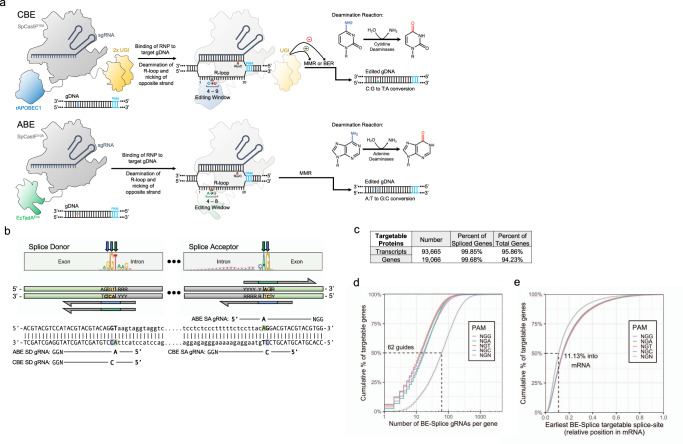
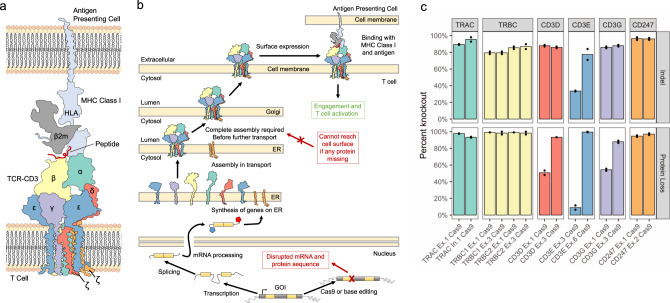
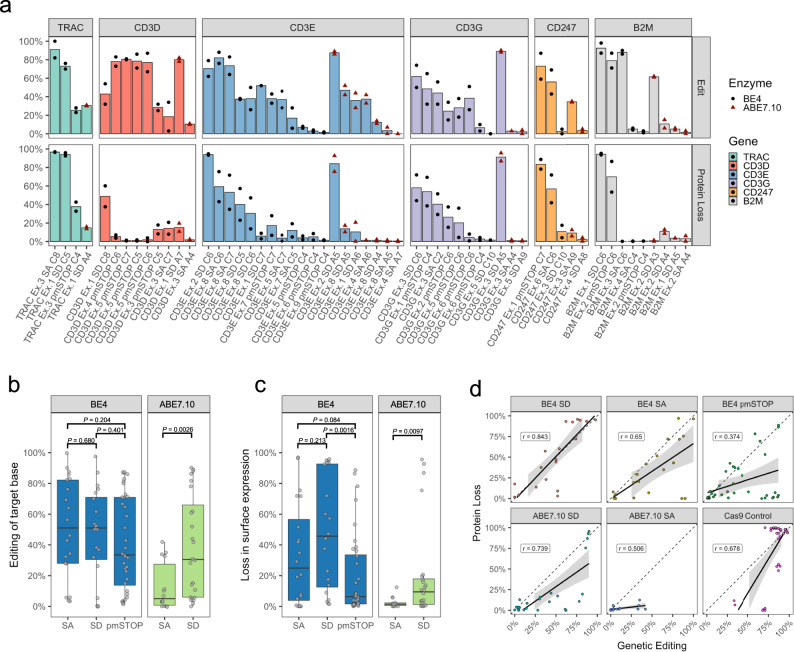
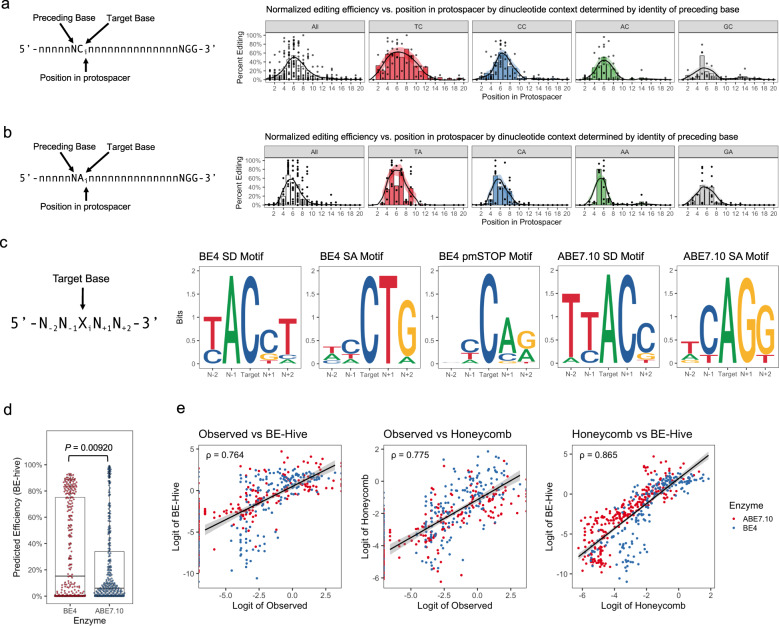
CRISPR-Cas9 cytidine and adenosine base editors (CBEs and ABEs) can disrupt genes without introducing double-stranded breaks by inactivating splice sites (BE-splice) or by introducing premature stop (pmSTOP) codons. However, no in-depth comparison of these methods or a modular tool for designing BE-splice sgRNAs exists. To address these needs, we develop SpliceR ( http://z.umn.edu/spliceR ) to design and rank BE-splice sgRNAs for any Ensembl annotated genome, and compared disruption approaches in T cells using a screen against the TCR-CD3 MHC Class I immune synapse. Among the targeted genes, we find that targeting splice-donors is the most reliable disruption method, followed by targeting splice-acceptors, and introducing pmSTOPs. Further, the CBE BE4 is more effective for disruption than the ABE ABE7.10, however this disparity is eliminated by employing ABE8e. Collectively, we demonstrate a robust method for gene disruption, accompanied by a modular design tool that is of use to basic and translational researchers alike.
Overview
The claims and statistics of this paper haven’t been checked yet.
Free: it reads the open-access text and checks the first 5 claims that cite a source we can check. Create a free account to check every claim.
Integrity signals
Registry
Cites
Statistics
Figures
Verification
Claims the paper makes
The claims and statistics of this paper haven’t been checked yet.
Free: it reads the open-access text and checks the first 5 claims that cite a source we can check. Create a free account to check every claim.
Claims other papers make about this one
Each is checked against this paper’s own text: does it say what the citing paper says it does?
The cited source says what the claim attributes to it.
In the citing paper
“This work found that splice donors were generally more effective than splice acceptors.”
From Adenine base editor for knockout of proteins: A practical guide from design to analysis with updated MultiEditRbatch (2026) · cites this paper as [31]
The cited source says what the claim attributes to it.
In the citing paper
“SpliceR (https://moriaritylab.shinyapps.io/splicer/) is a program developed by our group that identifies and scores potential gRNA sequences for gene knockout by splice site disruption.31”
From Adenine base editor for knockout of proteins: A practical guide from design to analysis with updated MultiEditRbatch (2026) · cites this paper as [31]
The check wasn’t confident either way, so it gives no verdict — never disputed.
In the citing paper
“The 14 validated guides use NGG base editors, which may have slightly stronger binding to the genomic DNA that could be the reason for the advantage over their NG counterparts as shown by the Granzyme A candidate gRNAs (Table S1).18,31”
From Adenine base editor for knockout of proteins: A practical guide from design to analysis with updated MultiEditRbatch (2026) · cites this paper as [31]
Experimental — accuracy not yet measured
Self-check
Percentages, sums and reported differences re-computed from the paper’s own numbers.
The self-check needs the paper’s full text.
Citations
Cites
A Programmable Dual-RNA–Guided DNA Endonuclease in Adaptive Bacterial Immunity
Jinek, M., Chylinski, K., Fonfara, I., Hauer, M., Doudna, J. A., & Charpentier, E. (2012) · Science · doi:10.1126/science.1225829 · Cited by 17,116
Multiplex Genome Engineering Using CRISPR/Cas Systems
Cong, L., Ran, F. A., Cox, D., Lin, S., Barretto, R., Habib, N., Hsu, P. D., Wu, X., Jiang, W., Marraffini, L. A., et al. (2013) · Science · doi:10.1126/science.1231143 · Cited by 15,339 · cited 4×
“splice acceptors, and (3) disrupting splicing with BE-splice vs.”
BackgroundMethodResultInfluentialGenome engineering using the CRISPR-Cas9 system
Ran, F. A., Hsu, P. D., Wright, J., Agarwala, V., Scott, D. A., & Zhang, F. (2013) · Nature Protocols · doi:10.1038/nprot.2013.143 · Cited by 11,133
RNA-Guided Human Genome Engineering via Cas9
Mali, P., Yang, L., Esvelt, K. M., Aach, J., Guell, M., DiCarlo, J. E., Norville, J. E., & Church, G. M. (2013) · Science · doi:10.1126/science.1232033 · Cited by 9,210 · cited 7×
“Despite the array of reports demonstrating the various ways base editors can be used to disrupt genes and modulate splicing, here we address three main gaps in the field, namely (1) a modular tool for designing both CBE and ABE sgRNAs to target both splice donor (SD) and splice acceptor (SA) sites, (2) a head-to-head…”
MethodResultInfluentialProgrammable editing of a target base in genomic DNA without double-stranded DNA cleavage
Komor, A. C., Kim, Y. B., Packer, M. S., Zuris, J. A., & Liu, D. R. (2016) · Nature · doi:10.1038/nature17946 · Cited by 5,437
Search-and-replace genome editing without double-strand breaks or donor DNA
Anzalone, A. V., Randolph, P. B., Davis, J. R., Sousa, A. A., Koblan, L. W., Levy, J. M., Chen, P. J., Wilson, C., Newby, G. A., Raguram, A., et al. (2019) · Nature · doi:10.1038/s41586-019-1711-4 · Cited by 4,767
Optimized sgRNA design to maximize activity and minimize off-target effects of CRISPR-Cas9
Doench, J. G., Fusi, N., Sullender, M., Hegde, M., Vaimberg, E. W., Donovan, K. F., Smith, I., Tothova, Z., Wilen, C., Orchard, R., et al. (2016) · Nature Biotechnology · doi:10.1038/nbt.3437 · Cited by 4,637
Programmable base editing of A•T to G•C in genomic DNA without DNA cleavage
Gaudelli, N. M., Komor, A. C., Rees, H. A., Packer, M. S., Badran, A. H., Bryson, D. I., & Liu, D. R. (2017) · Nature · doi:10.1038/nature24644 · Cited by 4,184
RNA-programmed genome editing in human cells
Jinek, M., East, A., Cheng, A., Lin, S., Ma, E., & Doudna, J. (2013) · eLife · doi:10.7554/elife.00471 · Cited by 2,098
Kosicki, M., Tomberg, K., & Bradley, A. (2018) · Nature Biotechnology · doi:10.1038/nbt.4192 · Cited by 1,883
Cited by
In vivo adenine base editing of PCSK9 in macaques reduces LDL cholesterol levels
Rothgangl, T., Dennis, M. K., Lin, P. J. C., Oka, R., Witzigmann, D., Villiger, L., Qi, W., Hruzova, M., Kissling, L., Lenggenhager, D., et al. (2021) · Nature Biotechnology · doi:10.1038/s41587-021-00933-4 · Cited by 378
Massively parallel assessment of human variants with base editor screens
Hanna, R. E., Hegde, M., Fagre, C. R., DeWeirdt, P. C., Sangree, A. K., Szegletes, Z., Griffith, A., Feeley, M. N., Sanson, K. R., Baidi, Y., et al. (2021) · Cell · doi:10.1016/j.cell.2021.01.012 · Cited by 316
CRISPR-based genome editing through the lens of DNA repair
Nambiar, T. S., Baudrier, L., Billon, P., & Ciccia, A. (2022) · Molecular Cell · doi:10.1016/j.molcel.2021.12.026 · Cited by 208
Discovery of target genes and pathways at GWAS loci by pooled single-cell CRISPR screens
Morris, J. A., Caragine, C., Daniloski, Z., Domingo, J., Barry, T., Lu, L., Davis, K., Ziosi, M., Glinos, D. A., Hao, S., et al. (2023) · Science · doi:10.1126/science.adh7699 · Cited by 208
Davis, J. R., Wang, X., Witte, I. P., Huang, T. P., Levy, J. M., Raguram, A., Banskota, S., Seidah, N. G., Musunuru, K., & Liu, D. R. (2022) · Nature Biomedical Engineering · doi:10.1038/s41551-022-00911-4 · Cited by 192
Metadata
- Authors
- Kluesner, M. G., Lahr, W. S., Lonetree, C.-L., Smeester, B. A., Qiu, X., Slipek, N. J., Claudio Vázquez, P. N., Pitzen, S. P., Pomeroy, E. J., Vignes, M. J., Lee, S. C., Bingea, S. P., Andrew, A. A., Webber, B. R., & Moriarity, B. S.
- Affiliations
- University of Minnesota (US)
- Corresponding author
- Webber, Beau R.
- Moriarity, Branden S.
- ORCID
- Venue
- Nature Communications
- Published
- 2021-04-23
- Volume
- 12
- Issue
- 1
- Pages
- 2437-2437
- ISSN
- 2041-1723 (ISSN-L)
- PMC
- PMC8065034
- OpenAlex
- W3156773862
- Cited by
- 121
- References
- 83
- Citations by year
- 2026: 21 · 2025: 25 · 2024: 26 · 2023: 25 · 2022: 18 · 2021: 6
- FWCI
- 5.96
- Type
- journal article
- Language
- en
- Open access
- gold
- doi.org
- Licence
- cc-by
- creativecommons.org/licenses/by/4.0 (tdm)
- creativecommons.org/licenses/by/4.0 (vor)
- Locations
- Nature Communications (publishedVersion, cc-by)
- bioRxiv (Cold Spring Harbor Laboratory) (acceptedVersion, cc-by-nc-nd)
- PubMed Central (publishedVersion, cc-by)
- PubMed (publishedVersion)
- RePEc: Research Papers in Economics (submittedVersion)
- DOAJ (DOAJ: Directory of Open Access Journals) (submittedVersion, cc-by-sa)
- Funders
- Children’s Cancer Research Fund
- Topics
- Life Sciences › Biochemistry, Genetics and Molecular Biology › Molecular Biology › CRISPR and Genetic Engineering
- Life Sciences › Biochemistry, Genetics and Molecular Biology › Molecular Biology › RNA regulation and disease
- Health Sciences › Medicine › Oncology › CAR-T cell therapy research
- Keywords
- CRISPR/Cas9 base editing, premature stop codon, Splicer, sgRNA design, T cells, ABE8e
- MeSH terms
- Gene Editing, Adenosine, Base Sequence, Cells, Cultured, Cytidine, Humans, T-Lymphocytes, Reproducibility of Results, Computational Biology, K562 Cells, Internet, CRISPR-Cas Systems
About these checks
Registry, retraction, Cites and statistics results are computed, not judged, with one exception: a printed reference that no index lists is read once by a model before it counts as a citation error. Claims are extracted by a model and kept only when their quote appears verbatim in the text; each cited source is then checked, with a model’s help, for whether it says what the claim relies on. Those verdicts can be wrong — read the claim’s quote and the cited source before relying on one.
Statistics and arithmetic are recomputed, not judged.
Confidence bands are shown only for fields calibrated on our annotated test set. None is calibrated yet, so no band is shown.
What counts as a claim ›How we measure confidence ›How we check this ›
Are you an author, or do you see a problem with this page? Request a review
How to cite
Cite CoChat for the checks on this page, and the paper for its own findings.
- This page
- CoChat. (2026). Citation check: CRISPR-Cas9 cytidine and adenosine base editing of splice-sites mediates highly-efficient disruption of proteins in primary and immortalized cells. https://app.cochat.ai/papers/10.1038/s41467-021-22009-2
- The paper
- Kluesner, M. G., Lahr, W. S., Lonetree, C.-L., Smeester, B. A., Qiu, X., Slipek, N. J., Claudio Vázquez, P. N., Pitzen, S. P., Pomeroy, E. J., Vignes, M. J., Lee, S. C., Bingea, S. P., Andrew, A. A., Webber, B. R., & Moriarity, B. S. (2021). CRISPR-Cas9 cytidine and adenosine base editing of splice-sites mediates highly-efficient disruption of proteins in primary and immortalized cells. Nature Communications. https://doi.org/10.1038/s41467-021-22009-2
Data sources
Bibliographic data: Semantic Scholar, OpenAlex, Crossref.
Contains information from the Semantic Scholar Academic Graph Datasets, made available under the ODC Attribution License (ODC-BY 1.0).
Semantic Scholar’s data is described in: Kinney, R., et al. (2023). The Semantic Scholar Open Data Platform. arXiv:2301.10140.
