

Evidence for sponges as sister to all other animals from partitioned phylogenomics with mixture models and recoding
Open accessThe DOI matches its Crossref record; 101 of the 101 references it cites were found in a registry or an index; 67 of the 86 sources its claims cite were checked for support.
Abstract
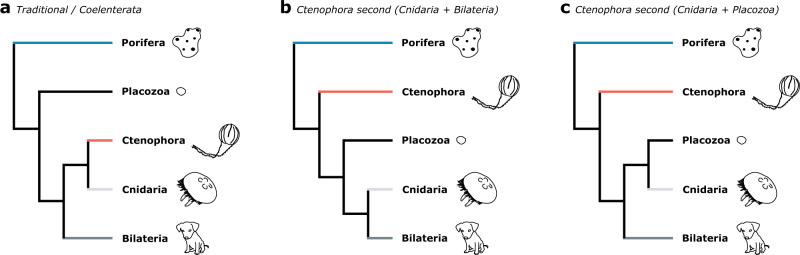
Resolving the relationships between the major lineages in the animal tree of life is necessary to understand the origin and evolution of key animal traits. Sponges, characterized by their simple body plan, were traditionally considered the sister group of all other animal lineages, implying a gradual increase in animal complexity from unicellularity to complex multicellularity. However, the availability of genomic data has sparked tremendous controversy as some phylogenomic studies support comb jellies taking this position, requiring secondary loss or independent origins of complex traits. Here we show that incorporating site-heterogeneous mixture models and recoding into partitioned phylogenomics alleviates systematic errors that hamper commonly-applied phylogenetic models. Testing on real datasets, we show a great improvement in model-fit that attenuates branching artefacts induced by systematic error. We reanalyse key datasets and show that partitioned phylogenomics does not support comb jellies as sister to other animals at either the supermatrix or partition-specific level.
Overview
CoChat Summary
## TL;DR
This paper argues that once partitioned phylogenomics is analyzed with better-fitting site-heterogeneous mixture models and amino-acid recoding, the apparent support for comb jellies (Ctenophora) as sister to all other animals disappears. Across reanalysed datasets, the results instead support sponges (Porifera) as sister to all other animals, with the authors concluding that prior Ctenophora-sister support was driven by long-branch attraction and model misspecification.
## Key findings
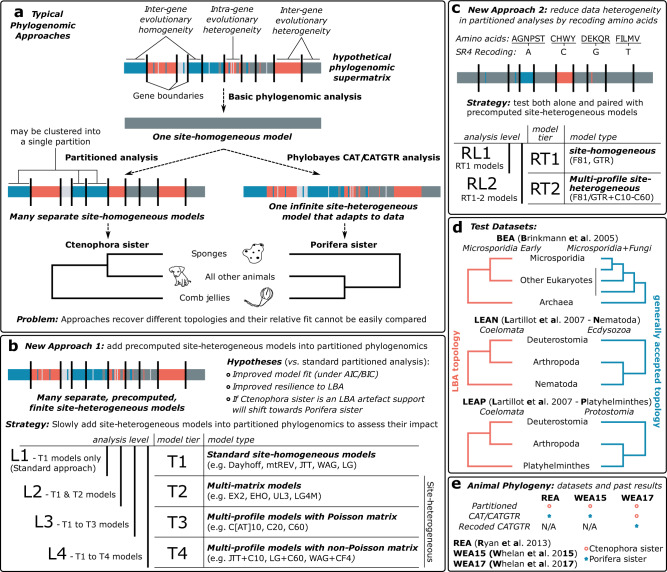
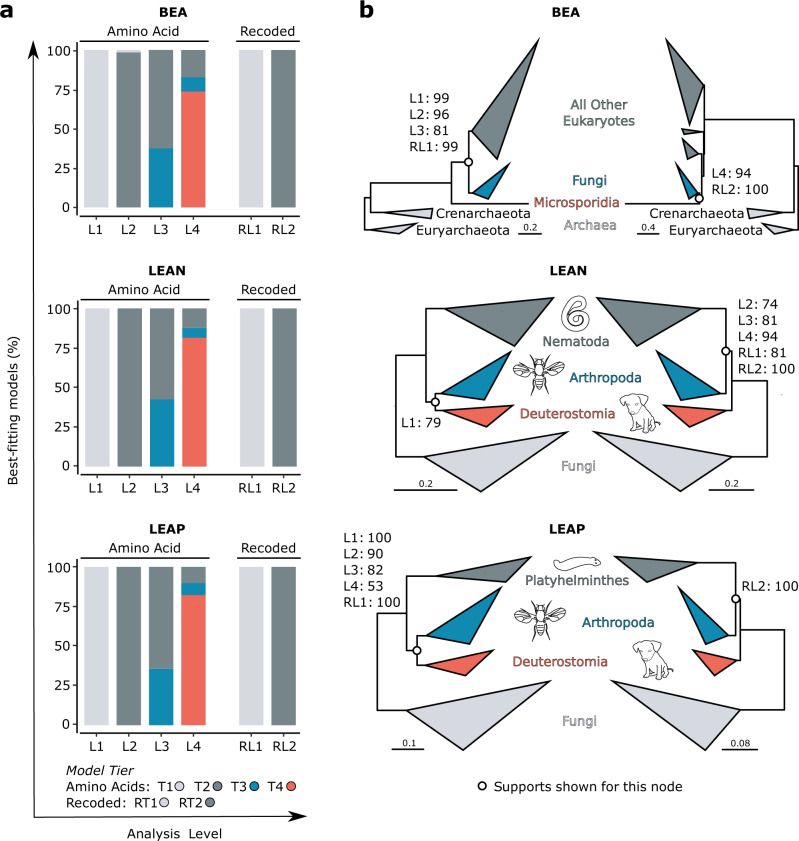
- In the three test datasets, site-heterogeneous models fit the data much better than standard site-homogeneous models: by L2, 131/133 BEA gene partitions and all 146 gene partitions in both LEAN and LEAP were better fit by site-heterogeneous models; by L4, complex T4 models were best fitting for 83% (BEA), 88% (LEAN), and 90% (LEAP) of partitions.
- For the BEA dataset, support for the long-branch-attraction topology declined as models improved (UFBOOT: 99% → 96% → 81% from L1 to L3), and at L4 the LBA topology was not recovered; instead Microsporidia were placed within eukaryotes as sister to fungi, with UFBOOT = 94%.
- In the bilaterian test datasets, better-fitting models reduced LBA: for LEAN, the LBA topology was recovered only at L1 (79%) and the accepted topology rose to 94% at L4; for LEAP, LBA support fell from 100% at L1 to 53% at L4.
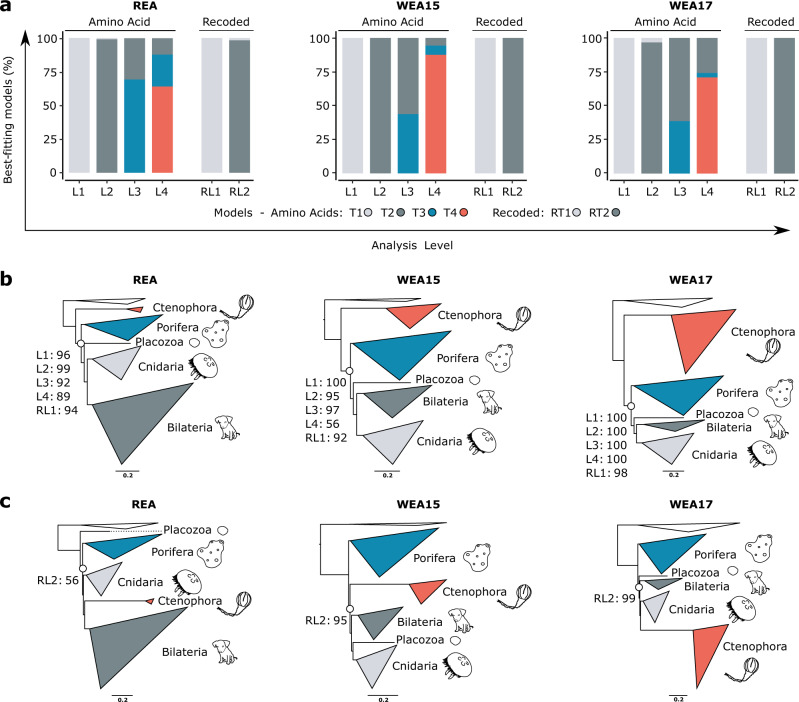
- Reanalysis of the animal datasets showed that the authors’ best-fitting analyses no longer support Ctenophora as sister to all other animals: under recoding plus site-heterogeneous models, REA recovered Placozoa sister weakly (UFBOOT = 52%), while WEA15 and WEA17 recovered Porifera sister with strong support (95% and 99%, respectively).
## Methods
- The study reanalysed three test datasets designed to expose long-branch attraction (BEA, LEAN, LEAP) and three animal phylogeny datasets (REA, WEA15, WEA17), using partitioned phylogenomics and amino-acid recoding.
- Datasets were partitioned by gene; for LEAP and LEAN, gene boundaries were manually inferred and verified with BLAST, while BEA already had gene partition information. Analyses were run in IQ-TREE (v1.5.4-omp and v1.6.12).
- Model comparison used BIC across four analysis levels (L1–L4) and recoded levels (RL1–RL2), incorporating standard site-homogeneous models, multi-matrix models, CAT-like site-heterogeneous mixture models, and SR4 recoding; support was assessed with 1000 ultrafast bootstrap replicates.
## Limitations
- The paper states that WEA17 appears to have poor ctenophore occupancy and a high level of orthology errors, and notes that these issues may contribute to its stronger signal for Ctenophora sister; it also mentions orthology errors reported previously for REA and WEA15.
- The authors note that recoding can reduce information and may have detrimental effects on shallower nodes, though they argue this is acceptable when supported by complementary analyses. This is stated in the paper.
- The study did not analyse the more gene-rich dataset of Simion et al. (2017) because higher analysis levels were estimated to require >1000 GB of RAM; this is a computational limitation stated in the paper.
Model-written summary. Check it against the paper before relying on it.
Integrity signals
Registry
Cites
Statistics
Figures
Verification
Claims the paper makes
29 Valid · 1 Not valid · 6 Not checked · 75 Own results and interpretations
Some cited sources support this claim and some don’t — read each source’s verdict below.
In the paper
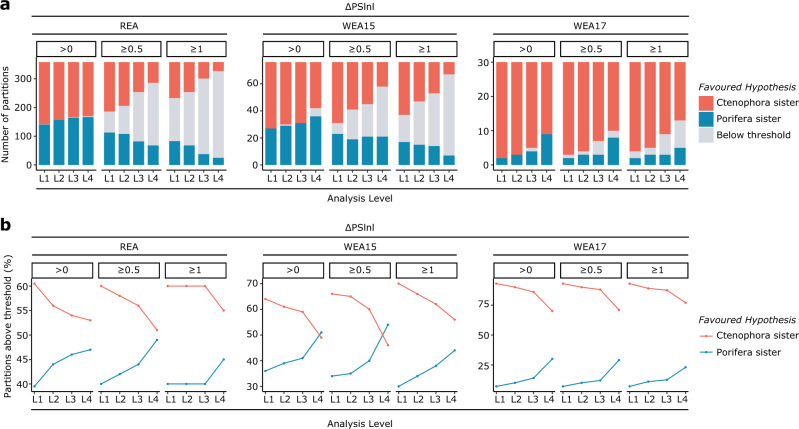
“Here, we have consolidated these findings by directly showing that the primary remaining lines of evidence supporting Ctenophora sister, partitioned phylogenomics4,7 and measures of underlying support (such as ΔPSlnl values)4,40, do not do so when better-fitting site-heterogeneous models are incorporated into the analysis.”
§ Evidence for sponges as sister to all other animals from partitioned phylogenomics with mixture models and recoding > Discussion
What the sources say
- Partly supportedcites [4] Whelan NV Ctenophore relationships and their placement as the sister group to all other animals Nat. Ecol. Evol. 2017 1 1737 1746 28993654 PMC5664179 sourceExperimental — accuracy not yet measured
Split into 2 atoms — 1 confirmed, 1 partially supported, 0 disputed, 0 misattributed, 0 unverifiable. Expand the claim to see per-atom verdicts.
- Disputedcites [7] Whelan, N. V., Kocot, K. M., Moroz, L. L. & Halanych, K. M. Error, signal, and the placement of Ctenophora sister to all other animals. Proc. Natl. Acad. Sci. USA112, 5773–5778 (2015). PMC4426464 25902535 sourceExperimental — accuracy not yet measured
Split into 2 atoms — 0 confirmed, 1 partially supported, 1 disputed, 0 misattributed, 0 unverifiable. Expand the claim to see per-atom verdicts.
Checked by a reasoning model — may be wrong.
- Supportedcites [40] Shen X-X Hittinger CT Rokas A Contentious relationships in phylogenomic studies can be driven by a handful of genes Nat. Ecol. Evol. 2017 1 0126 PMC5560076 28812701 source
Split into 2 atoms — 2 confirmed, 0 partially supported, 0 disputed, 0 misattributed, 0 unverifiable. Expand the claim to see per-atom verdicts.
boostedstates a cause- Asserted: passes — The authors put it forward as true.
- Checkable: passes — It can be checked against evidence.
- Load-bearing: passes — The paper’s conclusions depend on it.
- Based: passes — The paper gives a reason why it holds.
- Partly supported
Every source the paper cites for this claim was checked and supports it.
In the paper
“While phylogenomics has revolutionized our understanding of the tree of life, commonly applied phylogenetic models do not account for a wide array of factors that are known to cause positively misleading phylogenetic estimates when overlooked18,19.”
§ Evidence for sponges as sister to all other animals from partitioned phylogenomics with mixture models and recoding > Introduction
What the sources say
- Supportedcites [18] Gouy R Baurain D Philippe H Rooting the tree of life: the phylogenetic jury is still out Philos. Trans. R. Soc. B Biol. Sci. 2015 370 20140329 PMC4571568 26323760 source
Section 2 says that model violations can cause phylogenetic inference to converge on an incorrect solution as more data are added, and that even sophisticated models remain oversimplified. Section 3 says that current models do not jointly incorporate all the discussed improvements and that unaddressed evolutionary complexity continues to produce phylogenetic artefacts. Page numbers are not provided in the supplied passages. (LLM, conf=0.93)
- Supportedcites [19] Philippe, H. et al. Pitfalls in supermatrix phylogenomics. Eur. J. Taxon. 10.5852/ejt.2017.283 (2017). source
The 'Limiting systematic error' section (p. 14) states that in a probabilistic framework systematic error stems from violations of the model of sequence evolution, and that such violations can drive inference towards incorrect solutions (statistical inconsistency, LBA). The '2WR matrix' passage (p. 12) makes the causal link explicit — model violations lead to an incorrect interpretation of multiple substitutions, potentially yielding tree reconstruction artefacts — and the p. 16 passage shows standard models are over-simplistic (e.g., assuming stationarity mispositions compositionally biased taxa; site-homogeneous WAG+F+Γ4 vs CAT, p. 14) and that accounting for the overlooked processes (heteropecillous positions, compositional bias) overcame artefacts and recovered different topologies. Together these support the paraphrase that commonly applied models omit several factors whose neglect produces misleading estimates. (LLM, conf=0.85)
boostedstates a cause- Asserted: passes — The authors put it forward as true.
- Checkable: passes — It can be checked against evidence.
- Load-bearing: passes — The paper’s conclusions depend on it.
- Based: passes — The paper gives a reason why it holds.
- Supported
The cited sources support only part of this claim — read each source’s verdict below.
In the paper
“The RL2 findings also support recent efforts pairing recoding and site-heterogeneous models to resolve difficult, ancient nodes in animal phylogeny5,9,24,33, despite the erosion of data relevant to more shallow nodes.”
§ Evidence for sponges as sister to all other animals from partitioned phylogenomics with mixture models and recoding > Results > Site-heterogeneous mixture models and recoding attenuate LBA in partitioned phylogenomics
What the sources say
- Supportedcites [5] Laumer, C. E. et al. Revisiting metazoan phylogeny with genomic sampling of all phyla. Proc. R. Soc. B Biol. Sci.10.1098/rspb.2019.0831 (2019). PMC6650721 31288696 source
In Results and discussion (Pan-metazoan matrix M), the paper reports that Dayhoff-6 recoding under the site-heterogeneous CAT + GTR model increased support for an ancient animal split, while reducing support for several ecdysozoan clades. Its Conclusion cautions that such analyses can yield conflicting phylogenies, so the support is for the approach as an effort to investigate difficult nodes, not a claim that those nodes are conclusively resolved. Page numbers are unavailable in our copy. (LLM, conf=0.85)
- Partly supportedcites [9] Feuda R Improved modeling of compositional heterogeneity supports sponges as sister to all other animals Curr. Biol. 2017 27 3864 3870.e4 29199080 sourceExperimental — accuracy not yet measured
In Weighing the Evidence (p. 6), the paper reports that Dayhoff-6 recoding paired with the site-heterogeneous CAT-GTR+G model strongly supported Porifera as sister to other animals, an ancient node. A discussion of alternative evolutionary models (p. 12) says recoding can cause signal erosion and collapsed nodes, but does not identify shallower nodes as particularly affected. (LLM, conf=0.83)
- Partly supportedcites [24] Philippe H Mitigating anticipated effects of systematic errors supports sister-group relationship between xenacoelomorpha and ambulacraria Curr. Biol. 2019 29 1818 1826.e6 31104936 sourceExperimental — accuracy not yet measured
Our copy clearly instantiates the paired approach the citing sentence credits: in 'Addressing the Effects of Compositional Bias Reduces Support for Nephrozoa' the authors recode amino acids into 6 Dayhoff groups and rerun PhyloBayes CATGTR (site-heterogeneous) jackknifes, raising support for the ancient Xenambulacraria node from 61% to 90% (98% bootstrap), and Figure 3 is titled 'Dayhoff Recoding to Reduce Compositional Bias and Saturation Increases Support for Xenambulacraria'. However, no passage in our copy states that such recoding erodes data or signal relevant to more shallow/recent nodes — the paper only notes recoding reduces model violations and saturation, and its analyses target deep metazoan relationships. The erosion qualifier in the citing sentence is therefore not supported by this source. (LLM, conf=0.70)
- Supportedcites [33] Laumer CE Support for a clade of Placozoa and Cnidaria in genes with minimal compositional bias elife 2018 7 e36278 30373720 PMC6277202 source
The Results and discussion (page unavailable) report Dayhoff-6 recoding paired with the site-heterogeneous CAT + GTR model to examine deep animal relationships, including full support for Cnidaria + Placozoa in one recoded matrix. The citation follows the statement about efforts to resolve ancient nodes; the RL2 findings and the clause about shallow nodes are not specifically attributed to this source. (LLM, conf=0.90)
plainstates an association- Asserted: passes — The authors put it forward as true.
- Checkable: passes — It can be checked against evidence.
- Load-bearing: passes — The paper’s conclusions depend on it.
- Based: passes — The paper gives a reason why it holds.
- Supported
The sources with a verdict support this claim; the rest weren’t checked yet, have no full text we could read, or their verdicts aren’t rated yet.
In the paper
“Previous studies analysing the test datasets used here, but without partitioning, have found support for the accepted topology under a variety of site-heterogeneous models22,56,60.”
§ Evidence for sponges as sister to all other animals from partitioned phylogenomics with mixture models and recoding > Results > Standard partitioning approaches may be problematic in phylogenomics
What the sources say
- Supportedcites [22] Lartillot N Brinkmann H Philippe H Suppression of long-branch attraction artefacts in the animal phylogeny using a site-heterogeneous model BMC Evol. Biol. 2007 7 S4 PMC1796613 17288577 source
The Methods (Data: gene and taxon subsampling; page unavailable) describe analyses of gene-sequence alignments rather than a partitioned model; splitting the data into two halves was for cross-validation and parallel analyses. The Results and Discussion (Robustness of CAT against LBA; Impact of the effective size on the LBA artefacts; pages unavailable) report the expected topology with the site-heterogeneous CAT model and the small-orbit pseudo-model. This paper supports the claim as one of the cited previous studies, without needing to establish the variety of models across all three citations. (LLM, conf=0.86)
- Not checked — no full text of the sourcecites [56] Wang HC Minh BQ Susko E Roger AJ Modeling site heterogeneity with posterior mean site frequency profiles accelerates accurate phylogenomic estimation Syst. Biol. 2018 67 216 235 28950365 source
- Supportedcites [60] Susko, E., Lincker, L. & Roger, A. J. Accelerated estimation of frequency classes in site-heterogeneous profile mixture models. Mol. Biol. Evol. 10.1093/molbev/msy026 (2018). 29688541 source
The Empirical Data section states the five test data sets (Amborella, Microsporidia, Nematode, Platyhelminths, Obazoa; Table 7) each carry a topology controversy in which 'conventional site-homogeneous models differ from frequency profile mixtures', and that the analyses are of the mixture (unpartitioned) kind — the Introduction says 'We focus attention on the mixture approach here'. The Results ('Large Likelihood Increases Are Obtained with Empirical Data') report that site-heterogeneous mixtures favour the accepted topologies: mixture trees gave the largest likelihood for Microsporidia/Nematode/Obazoa, 'the correct Protostomia position is favored' with multinomial/updated mixture frequencies for Platyhelminths where C-series alone gave the incorrect Coelomata tree, and for Amborella 'the C20+F+C and CAT+GTR trees tend to be favored'. So our copy does treat these data sets as supporting the accepted topology under a variety of site-heterogeneous models fitted without partitioning; note it also credits some of that support to other works (Lartillot et al. 2007; Wang et al. 2017; Brown et al. 2013) while reporting its own. (LLM, conf=0.80)
plainstates an association- Asserted: passes — The authors put it forward as true.
- Checkable: passes — It can be checked against evidence.
- Load-bearing: passes — The paper’s conclusions depend on it.
- Based: passes — The paper gives a reason why it holds.
- Supported
The cited sources support only part of this claim — read each source’s verdict below.
In the paper
“Studies using partitioned site-homogeneous models have always recovered comb jellies as sister to other animals3,4,6,7.”
§ Evidence for sponges as sister to all other animals from partitioned phylogenomics with mixture models and recoding > Introduction
What the sources say
- Partly supportedcites [3] Ryan JF The genome of the ctenophore Mnemiopsis leidyi and its implications for cell type evolution Science 2013 342 1242592 24337300 PMC3920664 sourceExperimental — accuracy not yet measured
The Methods (page unavailable) describe maximum-likelihood analyses using GTR+Γ, and the Phylogenetic position section reports substantial support for ctenophores as sister to other animals. The copy does not identify those analyses as partitioned or establish that studies using partitioned site-homogeneous models have *always* recovered that placement; it also reports an alternative result from a Bayesian analysis. (LLM, conf=0.85)
- Partly supportedcites [4] Whelan NV Ctenophore relationships and their placement as the sister group to all other animals Nat. Ecol. Evol. 2017 1 1737 1746 28993654 PMC5664179 sourceExperimental — accuracy not yet measured
The Phylogenetic reconstructions section says this study used partitioned site-homogeneous models, and the Ctenophora is the sister lineage section reports that its analyses recovered comb jellies as sister to other animals. Our copy does not establish the claim that studies using those models have *always* reached that result. (LLM, conf=0.84)
- Partly supportedcites [6] Moroz LL The ctenophore genome and the evolutionary origins of neural systems Nature 2014 510 109 114 24847885 PMC4337882 sourceExperimental — accuracy not yet measured
The Ctenophore phylogeny section (page unavailable) says the paper’s main analyses placed comb jellies as the earliest animal lineage, and Methods identifies the maximum-likelihood model used. But the copy does not identify those analyses as partitioned or establish what studies using partitioned site-homogeneous models have *always* recovered. It also reports an unresolved topology for the most conserved gene set. (LLM, conf=0.84)
- Partly supportedcites [7] Whelan, N. V., Kocot, K. M., Moroz, L. L. & Halanych, K. M. Error, signal, and the placement of Ctenophora sister to all other animals. Proc. Natl. Acad. Sci. USA112, 5773–5778 (2015). PMC4426464 25902535 sourceExperimental — accuracy not yet measured
The Abstract and ‘Placement of Ctenophores Sister to all Remaining Animals Is Not Sensitive to Systematic Errors’ section report that all partitioned maximum-likelihood analyses in this paper recovered ctenophores as sister to other animals. They do not establish that studies using partitioned site-homogeneous models have always done so; the paper notes conflicting results among earlier analyses. Page numbers are unavailable in our copy. (LLM, conf=0.84)
boostedstates a cause- Asserted: passes — The authors put it forward as true.
- Checkable: passes — It can be checked against evidence.
- Load-bearing: passes — The paper’s conclusions depend on it.
- Based: passes — The paper gives a reason why it holds.
- Partly supported
58 more claims · 5 with their cited sources checked
Create a free account to see all 111 claims and to verify the 6 references still open.
- It may state two separate claims as one. 28
- Probably not a substantial claim. 23
Claims other papers make about this one
Each is checked against this paper’s own text: does it say what the citing paper says it does?
The source backs part of the claim, not all of it — or backs it for a different population, condition or comparison.
In the citing paper
“non-recoded partitioning with linked branches and site-heterogeneous models recovered the Ctenophora-sister hypothesis 1 (Fig. 1).”
From Available data do not rule out Ctenophora as the sister group to all other Metazoa (2023) · doi:10.1038/s41467-023-36151-6 · cites this paper as [1]
Experimental — accuracy not yet measured
Citations
Cites
Basic local alignment search tool
Altschul, S. F., Gish, W., Miller, W., Myers, E. W., & Lipman, D. J. (1990) · Journal of Molecular Biology · doi:10.1006/jmbi.1990.9999 · Cited by 98,669
IQ-TREE: A Fast and Effective Stochastic Algorithm for Estimating Maximum-Likelihood Phylogenies
Nguyen, L.-T., Schmidt, H. A., von Haeseler, A., & Minh, B. Q. (2015) · Molecular Biology and Evolution · doi:10.1093/molbev/msu300 · Cited by 26,046
ModelFinder: fast model selection for accurate phylogenetic estimates
Kalyaanamoorthy, S., Minh, B. Q., Wong, T. K. F., von Haeseler, A., & Jermiin, L. S. (2017) · Nature Methods · doi:10.1038/nmeth.4285 · Cited by 18,449
Guindon, S., Dufayard, J.-F., Lefort, V., Anisimova, M., Hordijk, W., & Gascuel, O. (2010) · Systematic Biology · doi:10.1093/sysbio/syq010 · Cited by 18,376
The rapid generation of mutation data matrices from protein sequences
Jones, D. T., Taylor, W. R., & Thornton, J. M. (1992) · Bioinformatics · doi:10.1093/bioinformatics/8.3.275 · Cited by 6,947
Lanfear, R., Calcott, B., Ho, S. Y. W., & Guindon, S. (2012) · Molecular Biology and Evolution · doi:10.1093/molbev/mss020 · Cited by 5,732
Ultrafast Approximation for Phylogenetic Bootstrap
Minh, B. Q., Nguyen, M. A. T., & von Haeseler, A. (2013) · Molecular Biology and Evolution · doi:10.1093/molbev/mst024 · Cited by 4,844
An Improved General Amino Acid Replacement Matrix
Le, S. Q., & Gascuel, O. (2008) · Molecular Biology and Evolution · doi:10.1093/molbev/msn067 · Cited by 3,127
Whelan, S., & Goldman, N. (2001) · Molecular Biology and Evolution · doi:10.1093/oxfordjournals.molbev.a003851 · Cited by 2,849
Approximate likelihood-ratio test for branches: A fast, accurate, and powerful alternative
Anisimova, M., & Gascuel, O. (2006) · Systematic Biology · doi:10.1080/10635150600755453 · Cited by 2,693
Cited by
Incongruence in the phylogenomics era
Steenwyk, J. L., Li, Y., Zhou, X., Shen, X.-X., & Rokas, A. (2023) · Nature Reviews Genetics · doi:10.1038/s41576-023-00620-x · Cited by 259
The evolution of insect biodiversity
Tihelka, E., Cai, C., Giacomelli, M., Lozano-Fernández, J., Rota‐Stabelli, O., Huang, D., Engel, M. S., Donoghue, P. C. J., & Pisani, D. (2021) · Current Biology · doi:10.1016/j.cub.2021.08.057 · Cited by 160
Ballesteros, J. A., Santibáñez‐López, C. E., Baker, C. M., Benavides, L. R., Cunha, T. J., Gainett, G., Ontano, A. Z., Setton, E. V. W., Arango, C. P., Gavish‐Regev, E., et al. (2022) · Molecular Biology and Evolution · doi:10.1093/molbev/msac021 · Cited by 125
The origin and evolution of Wnt signalling
Holzem, M., Boutros, M., & Holstein, T. W. (2024) · Nature Reviews Genetics · doi:10.1038/s41576-024-00699-w · Cited by 121
Evolution of glutamatergic signaling and synapses
Moroz, L. L., Nikitin, M. A., Poličar, P. G., Kohn, A. B., & Romanova, D. Y. (2021) · Neuropharmacology · doi:10.1016/j.neuropharm.2021.108740 · Cited by 86
Redmond, A. K., Casey, D., Gundappa, M. K., Macqueen, D. J., & McLysaght, A. (2023) · Nature Communications · doi:10.1038/s41467-023-38714-z · Cited by 80
Self-citationA broad‐taxa approach as an important concept in ecotoxicological studies and pollution monitoring
Rosner, A., Ballarin, L., Barnay‐Verdier, S., Borisenko, I., Drago, L., Drobne, D., Eliso, M. C., Harbuzov, Z., Grimaldi, A., Guy‐Haim, T., et al. (2023) · Biological reviews/Biological reviews of the Cambridge Philosophical Society · doi:10.1111/brv.13015 · Cited by 74
MRTF specifies a muscle-like contractile module in Porifera
Colgren, J. J., & Nichols, S. (2022) · Nature Communications · doi:10.1038/s41467-022-31756-9 · Cited by 47
Ediacaran origin and Ediacaran-Cambrian diversification of Metazoa
Carlisle, E., Yin, Z., Pisani, D., & Donoghue, P. C. J. (2024) · Science Advances · doi:10.1126/sciadv.adp7161 · Cited by 60
A late-Ediacaran crown-group sponge animal
Wang, X., Liu, A. G., Chen, Z., Wu, C., Liu, Y., Wan, B., Pang, K., Zhou, C., Yuan, X., & Xiao, S. (2024) · Nature · doi:10.1038/s41586-024-07520-y · Cited by 43
Identifying and addressing methodological incongruence in phylogenomics: A review
Fleming, J. F., Valero‐Gracia, A., & Struck, T. H. (2023) · Evolutionary Applications · doi:10.1111/eva.13565 · Cited by 47
Juravel, K., Porras, L., Höhna, S., Pisani, D., & Wörheide, G. (2023) · PLoS ONE · doi:10.1371/journal.pone.0282444 · Cited by 39
Polyzoa is back: The effect of complete gene sets on the placement of Ectoprocta and Entoprocta
Khalturin, K., Shunatova, N., Shchenkov, S. V., Sasakura, Y., Kawamitsu, M., & Satoh, N. (2022) · Science Advances · doi:10.1126/sciadv.abo4400 · Cited by 32
Ctenophores are direct developers that reproduce continuously beginning very early after hatching
Edgar, A., Ponciano, J. M., & Martindale, M. Q. (2022) · Proceedings of the National Academy of Sciences · doi:10.1073/pnas.2122052119 · Cited by 30
MixtureFinder: Estimating DNA Mixture Models for Phylogenetic Analyses
Ren, H., Wong, T. K. F., Minh, B. Q., & Lanfear, R. (2024) · Molecular Biology and Evolution · doi:10.1093/molbev/msae264 · Cited by 41
The compact genome of the sponge Oopsacas minuta (Hexactinellida) is lacking key metazoan core genes
Santini, S., Schenkelaars, Q., Jourda, C., Duschene, M., Belahbib, H., Rocher, C., Selva, M., Riesgo, A., Vervoort, M., Leys, S. P., et al. (2023) · BMC Biology · doi:10.1186/s12915-023-01619-w · Cited by 27
Nitric oxide signaling in ctenophores
Moroz, L. L., Mukherjee, K., & Romanova, D. Y. (2023) · Frontiers in Neuroscience · doi:10.3389/fnins.2023.1125433 · Cited by 25
Selective Advantages of Synapses in Evolution
Moroz, L. L., & Romanova, D. Y. (2021) · Frontiers in Cell and Developmental Biology · doi:10.3389/fcell.2021.726563 · Cited by 32
Whole genome sequence of the deep-sea sponge Geodia barretti (Metazoa, Porifera, Demospongiae)
Steffen, K., Proux‐Wéra, E., Solér, L., Churcher, A. M., Sundh, J., & Cárdenas, P. (2023) · G3 Genes Genomes Genetics · doi:10.1093/g3journal/jkad192 · Cited by 26
la Hoz, C. J. P., Magain, N., Piatkowski, B. T., Cornet, L., Forno, M. D., Carbone, I., Miądlikowska, J., & Lutzoni, F. M. (2023) · Systematic Biology · doi:10.1093/sysbio/syad008 · Cited by 28
Phylomitogenomics bolsters the high-level classification of Demospongiae (phylum Porifera)
Lavrov, D. V., Díaz, M. C., Maldonado, M., Morrow, C. C., Pérez, T., Pomponi, S. A., & THACKER, R. W. (2023) · PLoS ONE · doi:10.1371/journal.pone.0287281 · Cited by 30
Evolution of non-genomic nuclear receptor function
Taylor, E., & Heyland, A. (2021) · Molecular and Cellular Endocrinology · doi:10.1016/j.mce.2021.111468 · Cited by 23
Phototransduction in a Marine Sponge Provides Insights into the Origin of Animal Vision
Wong, E., Anggono, V., Williams, S. R., Degnan, S. M., & Degnan, B. M. (2021) · iScience · doi:10.1016/j.isci.2022.104436 · Cited by 25
Evolution and Diversity of TGF-β Pathways are Linked with Novel Developmental and Behavioral Traits
Lo, W., Roca, M., Dardiry, M., Mackie, M., Eberhardt, G., Witte, H., Hong, R. L., Sommer, R. J., & Lightfoot, J. W. (2022) · Molecular Biology and Evolution · doi:10.1093/molbev/msac252 · Cited by 18
Extracellular DNA traps in a ctenophore demonstrate immune cell behaviors in a non-bilaterian
Vandepas, L. E., Stefani, C., Domeier, P. P., Traylor‐Knowles, N., Goetz, F. W., Browne, W. E., & Lacy‐Hulbert, A. (2024) · Nature Communications · doi:10.1038/s41467-024-46807-6 · Cited by 19
Gainett, G., Klementz, B. C., Setton, E. V. W., Simian, C., Iuri, H. A., Edgecombe, G. D., Peretti, A. V., & Sharma, P. P. (2023) · Evolution & Development · doi:10.1111/ede.12467 · Cited by 17
Development of the nervous system in the early hatching larvae of the ctenophore Mnemiopsis leidyi
Norekian, T. P., & Moroz, L. L. (2021) · Journal of Morphology · doi:10.1002/jmor.21398 · Cited by 18
Archaeocytes in sponges: simple cells of complicated fate
Ereskovsky, A. V., Melnikov, N. P., & Lavrov, A. (2024) · Biological reviews/Biological reviews of the Cambridge Philosophical Society · doi:10.1111/brv.13162 · Cited by 19
Evolution of the Major Components of Innate Immunity in Animals
Silva, R. C. M. C., & Gomes, F. M. (2024) · Journal of Molecular Evolution · doi:10.1007/s00239-024-10155-2 · Cited by 19
The premetazoan ancestry of the synaptic toolkit and appearance of first neurons
Colgren, J. J., & Burkhardt, P. (2022) · Essays in Biochemistry · doi:10.1042/ebc20220042 · Cited by 19
Koch, N. M., Ekin, T., Miller, A. K., Stiller, J., & Rouse, G. W. (2023) · Proceedings of the Royal Society B Biological Sciences · doi:10.1098/rspb.2023.0988 · Cited by 20
Transposon-derived transcription factors across metazoans
Mukherjee, K., & Moroz, L. L. (2023) · Frontiers in Cell and Developmental Biology · doi:10.3389/fcell.2023.1113046 · Cited by 22
Ontogeny, Phylotypic Periods, Paedomorphosis, and Ontogenetic Systematics
Martynov, A. V., Lundin, K., & Korshunova, T. (2022) · Frontiers in Ecology and Evolution · doi:10.3389/fevo.2022.806414 · Cited by 21
Improving Orthologous Signal and Model Fit in Datasets Addressing the Root of the Animal Phylogeny
McCarthy, C. G. P., Mulhair, P. O., Siu-Ting, K., Creevey, C. J., & O’Connell, M. J. (2023) · Molecular Biology and Evolution · doi:10.1093/molbev/msac276 · Cited by 20
A critical analysis of the current state of virus taxonomy
Caetano‐Anollés, G., Claverie, J., & Nasir, A. (2023) · Frontiers in Microbiology · doi:10.3389/fmicb.2023.1240993 · Cited by 16
Riesgo, A., Santodomingo, N., Koutsouveli, V., Kumala, L., Leger, M. M., Leys, S. P., & Funch, P. (2022) · BMC Genomics · doi:10.1186/s12864-022-09035-0 · Cited by 14
Hox, homology, and parsimony: An organismal perspective
Wanninger, A. (2023) · Seminars in Cell and Developmental Biology · doi:10.1016/j.semcdb.2023.01.007 · Cited by 15
Hydrodynamics in early animal evolution
Nielsen, C. (2022) · Biological reviews/Biological reviews of the Cambridge Philosophical Society · doi:10.1111/brv.12909 · Cited by 16
Accurate Detection of Incomplete Lineage Sorting via Supervised Machine LearningPreprint
Rosenzweig, B. K., Kern, A. D., & Hahn, M. W. (2022) · bioRxiv (Cold Spring Harbor Laboratory) · doi:10.1101/2022.11.09.515828 · Cited by 11
The Porifera microeukaryome: Addressing the neglected associations between sponges and protists
Nascimento-Silva, G., Hardoim, C. C. P., & Custódio, M. R. (2022) · Microbiological Research · doi:10.1016/j.micres.2022.127210 · Cited by 15
Assembling animals: trees, genomes, cells, and contrast to plants
Paps, J., Rossi, M. E., Bowles, A. M. C., & Álvarez‐Presas, M. (2023) · Frontiers in Ecology and Evolution · doi:10.3389/fevo.2023.1185566 · Cited by 13
Redmond, A. K. (2024) · Proceedings of the Royal Society B Biological Sciences · doi:10.1098/rspb.2024.0329 · Cited by 15
Self-citationAvailable data do not rule out Ctenophora as the sister group to all other Metazoa
(2023) · doi:10.1038/s41467-023-36151-6 · Cited by 10
Bujaki, T., & Rodrigue, N. (2022) · Journal of Molecular Evolution · doi:10.1007/s00239-022-10076-y · Cited by 14
RETRACTED: Integrative phylogenomics positions sponges at the root of the animal tree
Steenwyk, J. L., & King, N. (2025) · Science · doi:10.1126/science.adw9456 · Cited by 20
RetractedDiscovering Fragile Clades and Causal Sequences in Phylogenomics by Evolutionary Sparse Learning
Sharma, S., & Kumar, S. (2024) · Molecular Biology and Evolution · doi:10.1093/molbev/msae131 · Cited by 11
Convergent genome evolution shaped the emergence of terrestrial animals
Wei, J., Pisani, D., Donoghue, P. C. J., Álvarez‐Presas, M., & Paps, J. (2025) · Nature · doi:10.1038/s41586-025-09722-4 · Cited by 17
Tihelka, E., Engel, M. S., Lozano-Fernández, J., Giacomelli, M., Yin, Z., Rota‐Stabelli, O., Huang, D., Pisani, D., Donoghue, P. C. J., & Cai, C. (2021) · bioRxiv (Cold Spring Harbor Laboratory) · doi:10.1101/2021.09.23.461539 · Cited by 12
Relationships Among the Bryophytes and Vascular Plants: A Case Study in Deep-Time Reconstruction
Qiu, Y., & Mishler, B. D. (2024) · Diversity · doi:10.3390/d16070426 · Cited by 11
Thines, M., Mishra, B., & Ploch, S. (2023) · Mycological Progress · doi:10.1007/s11557-023-01932-2 · Cited by 11
Renewed perspectives on the sedentary-pelagic last common bilaterian ancestor
Martynov, A. V., & Korshunova, T. (2022) · Bijdragen tot de Dierkunde · doi:10.1163/18759866-bja10034 · Cited by 7
Rheology of marine sponges reveals anisotropic mechanics and tuned dynamics
Kraus, E., Mellenthin, L. E., Siwiecki, S. A., Song, D., Yan, J. Q., Janmey, P. A., & Sweeney, A. (2022) · Journal of The Royal Society Interface · doi:10.1098/rsif.2022.0476 · Cited by 6
Bursts of novel composite gene families at major nodes in animal evolutionPreprint
Mulhair, P. O., Moran, R. J., Pathmanathan, J. S., Sussfeld, D., Creevey, C. J., Siu-Ting, K., Whelan, F., Pisani, D., Constantinides, B., Pelletier, É., et al. (2023) · bioRxiv (Cold Spring Harbor Laboratory) · doi:10.1101/2023.07.10.548381 · Cited by 7
Compositional shifts associated with major evolutionary transitions in plants
Smith, S. A., Walker‐Hale, N., & Parins-Fukuchi, C. T. (2023) · New Phytologist · doi:10.1111/nph.19099 · Cited by 8
Blaxter, M., Collective, D. T. O. L. B., & collective, T. O. L. C. I. (2023) · Wellcome Open Research · doi:10.12688/wellcomeopenres.18669.1 · Cited by 5
Revealing the rise of a living fossil menagerie
Lidgard, S., & Kitchen, E. (2023) · Frontiers in Ecology and Evolution · doi:10.3389/fevo.2023.1112764 · Cited by 6
Han, T., Liao, X., Zhu, Y., Liu, Y., Lü, N., Li, Y., Guo, Z., Chen, J.-Y., He, C., & Lu, Z. (2022) · International Journal of Molecular Sciences · doi:10.3390/ijms231911135 · Cited by 7
Goff, E. L., Martinand‐Mari, C., Belkhir, K., Vacelet, J., Nidelet, S., Godefroy, N., & Baghdiguian, S. (2022) · Cell and Tissue Research · doi:10.1007/s00441-022-03610-3 · Cited by 6
Phosphatic stromatoporoid sponges formed reefs ~480 Mya
Jeon, J., Roda, M. D. M. S., Chen, Z., Luo, C., Kershaw, S., Kim, D., Ma, J., Lee, J., & Zhang, Y. (2025) · Proceedings of the National Academy of Sciences · doi:10.1073/pnas.2426105122 · Cited by 10
A new sponge genus from the Chengjiang biota with an intriguing combination of skeletal characters
Chen, A., Porras, L., Ma, H., Hou, X., & Wörheide, G. (2023) · Paläontologische Zeitschrift · doi:10.1007/s12542-023-00652-y · Cited by 5
Highly Dynamic Gene Family Evolution Suggests Changing Roles for PON Genes Within Metazoa
Lucas, S. A. M., Graham, A. M., Presnell, J. S., & Clark, N. L. (2023) · Genome Biology and Evolution · doi:10.1093/gbe/evad011 · Cited by 6
The architecture of sponge choanocyte chambers is well adapted to mechanical pumping functions
Ogawa, T., Koyama, S., Omori, T., Kikuchi, K., de Maleprade, H., Goldstein, R. E., & Ishikawa, T. (2025) · Proceedings of the National Academy of Sciences · doi:10.1073/pnas.2421296122 · Cited by 10
Advances in aquatic invertebrate stem cell research
Ballarin, L., Rinkevich, B., & Hobmayer, B. (2022) · MDPI eBooks · doi:10.3390/books978-3-0365-1635-6 · Cited by 11
Romanova, D. Y., & Moroz, L. L. (2024) · Methods in molecular biology · doi:10.1007/978-1-0716-3642-8_3 · Cited by 5
Reply to: Available data do not rule out Ctenophora as the sister group to all other Metazoa
Redmond, A. K., & McLysaght, A. (2023) · Nature Communications · doi:10.1038/s41467-023-36152-5 · Cited by 4
Self-citationParallel Evolution of Transcription Factors in Basal Metazoans
Mukherjee, K., & Moroz, L. L. (2024) · Methods in molecular biology · doi:10.1007/978-1-0716-3642-8_20 · Cited by 5
Redmond, A. K., Gundappa, M. K., Macqueen, D. J., & McLysaght, A. (2022) · bioRxiv (Cold Spring Harbor Laboratory) · doi:10.1101/2022.05.16.492067 · Cited by 3
Self-citationScanning Electron Microscopy of Ctenophores: Illustrative Atlas
Norekian, T. P., & Moroz, L. L. (2024) · Methods in molecular biology · doi:10.1007/978-1-0716-3642-8_6 · Cited by 5
Beyond synapses: cytoplasmic connections in brain function and evolution
Rakotobé, M., & Zurzolo, C. (2025) · Biological reviews/Biological reviews of the Cambridge Philosophical Society · doi:10.1111/brv.70034 · Cited by 4
Transcriptomic responses of Mediterranean sponges upon encounter with symbiont microbial consortia
Marulanda-Gómez, Á. M., Ribes, M., Franzenburg, S., Hentschel, U., & Pita, L. (2024) · BMC Genomics · doi:10.1186/s12864-024-10548-z · Cited by 9
Horizontal transfer of vertebrate vision gene IRBP into the chordate ancestor
(2023) · doi:10.1073/pnas.2310390120 · Cited by 4
Self-citationFerraioli, A., Digel, L., Sturm, D., Colgren, J. J., Goff, C. L., Jan, A., Soto-Angel, J. J., Naumann, B. T., Kittelmann, M., & Burkhardt, P. (2026) · Science Advances · doi:10.1126/sciadv.aea8399 · Cited by 13
The genomes of the aquarium sponges Tethya wilhelma and Tethya minuta (Porifera: Demospongiae)
Wörheide, G., Francis, W. R., Deister, F., Krebs, S., Erpenbeck, D., & Vargas, S. (2024) · F1000Research · doi:10.12688/f1000research.150836.2 · Cited by 4
Asexual Reproduction in Sponges: A Review
Ereskovsky, A. V., & Lavrov, A. (2026) · Molecular Reproduction and Development · doi:10.1002/mrd.70083 · Cited by 5
Illustrated Neuroanatomy of Ctenophores: Immunohistochemistry
Norekian, T. P., & Moroz, L. L. (2024) · Methods in molecular biology · doi:10.1007/978-1-0716-3642-8_5 · Cited by 4
Klementz, B. C., Kulkarni, S., Abshire, K. M., & Sharma, P. P. (2025) · Molecular Phylogenetics and Evolution · doi:10.1016/j.ympev.2025.108380 · Cited by 7
Hu, Y., Topper, T. P., Strotz, L. C., Pan, B., Wang, Z., Fu, R., Liu, F., Liang, Y., Wang, J., Li, G., et al. (2025) · Geology · doi:10.1130/g53623.1 · Cited by 2
The compact genome of the sponge Oopsacas minuta (Hexactinellida) is lacking key metazoan core genesPreprint
Santini, S., Schenkelaars, Q., Jourda, C., Duschene, M., Belahbib, H., Rocher, C., Selva, M., Riesgo, A., Vervoort, M., Leys, S. P., et al. (2022) · bioRxiv (Cold Spring Harbor Laboratory) · doi:10.1101/2022.07.26.501511 · Cited by 2
(2023) · doi:10.1101/2023.08.27.555014 · Cited by 2
Self-citationEvolution of the Metazoan Protein Domain Repertoire Revealed by a Birth-Death-Gain Model
Xiao, Y., Stolzer, M., Wasserman, L., & Durand, D. (2025) · Journal of Molecular Evolution · doi:10.1007/s00239-025-10286-0 · Cited by 4
Roots and early routes of neuroendocrinology
Rodríguez, E. M., Guerra, M., & Blázquez, J. L. (2025) · Cell and Tissue Research · doi:10.1007/s00441-024-03928-0 · Cited by 2
The Architecture of Sponge Choanocyte Chambers Maximizes Mechanical Pumping EfficiencyPreprint
Ogawa, T., Koyama, S., Omori, T., Kikuchi, K., de Maleprade, H., Goldstein, R. E., & Ishikawa, T. (2024) · bioRxiv (Cold Spring Harbor Laboratory) · doi:10.1101/2024.02.22.581376 · Cited by 2
An attempt to search for the common cellular mechanism of ovulation across all metazoans
Takahashi, T., & Ogiwara, K. (2024) · Reproduction · doi:10.1530/rep-24-0184 · Cited by 5
Transposon-derived transcription factors across metazoans
(2022) · doi:10.1101/2022.12.18.520930 · Cited by 1
Scibelli, S. (2026) · Research Square · doi:10.21203/rs.3.rs-10829400/v1 · Cited by 1
Vandepas, L. E., Stefani, C., Domeier, P. P., Traylor‐Knowles, N., Goetz, F. W., Browne, W. E., & Lacy‐Hulbert, A. (2020) · bioRxiv (Cold Spring Harbor Laboratory) · doi:10.1101/2020.06.09.141010 · Cited by 1
Résolution d’une énigme dans l’arbre du vivant, aux origines des poissons téléostéens
Parey, E., Berthelot, C., Crollius, H. R., & Guiguen, Y. (2024) · Comptes Rendus Biologies · doi:10.5802/crbiol.150 · Cited by 1
Evolution of the ribbon-like organization of the Golgi apparatus in animal cells
Benvenuto, G., Leone, S., Astoricchio, E., Bormke, S., Jasek, S., D’Aniello, E., Kittelmann, M., McDonald, K., Hartenstein, V., Baena, V., et al. (2023) · doi:10.1101/2023.02.16.528797 · Cited by 1
Reassessing viral origins and evolutionary placement in the tree of life
Jit, S., Kaur, J., Jain, A., Raina, D., Lal, R., & Verma, M. (2026) · Antonie van Leeuwenhoek · doi:10.1007/s10482-026-02258-1 · Cited by 2
Gene Expression Patterns in the Ctenophore Pleurobrachia bachei: In Situ Hybridization
Kohn, A. B., Bobkova, Y. V., & Moroz, L. L. (2024) · Methods in molecular biology · doi:10.1007/978-1-0716-3642-8_9 · Cited by 1
Garg, P., Frey, C., Browne, W. E., & Plotkin, S. S. (2025) · Heliyon · doi:10.1016/j.heliyon.2025.e42542 · Cited by 1
Metadata
- Authors
- Redmond, A. K., & McLysaght, A.
- Affiliations
- Trinity College Dublin (IE)
- Corresponding author
- McLysaght, Aoife
- Venue
- Nature Communications
- Published
- 2021-03-19
- Volume
- 12
- Issue
- 1
- Pages
- 1783-1783
- ISSN
- 2041-1723 (ISSN-L)
- PMC
- PMC7979703
- OpenAlex
- W3136068442
- Cited by
- 139
- References
- 100
- Citations by year
- 2026: 19 · 2025: 30 · 2024: 28 · 2023: 29 · 2022: 25 · 2021: 7
- FWCI
- 17.42
- Type
- journal article
- Language
- en
- Update notices
- correction (2022-11-04)
- Open access
- gold
- doi.org
- Licence
- cc-by
- creativecommons.org/licenses/by/4.0 (tdm)
- creativecommons.org/licenses/by/4.0 (vor)
- Locations
- Nature Communications (publishedVersion, cc-by)
- PubMed Central (publishedVersion, cc-by)
- PubMed (publishedVersion)
- RePEc: Research Papers in Economics (submittedVersion)
- DOAJ (DOAJ: Directory of Open Access Journals) (submittedVersion, cc-by-sa)
- Trinity's Access to Research Output (TARA) (Trinity College Dublin) (submittedVersion)
- Funders
- H2020 European Research Council (771419)
- Topics
- Life Sciences › Agricultural and Biological Sciences › Animal Science and Zoology › Marine Invertebrate Physiology and Ecology
- Life Sciences › Biochemistry, Genetics and Molecular Biology › Molecular Biology › Genomics and Phylogenetic Studies
- Life Sciences › Agricultural and Biological Sciences › Ecology, Evolution, Behavior and Systematics › Protist diversity and phylogeny
- Keywords
- sponge phylogeny, comb jellies, sister group relationships, recoding, systematic errors, model fit, evolution of multicellularity, animal origins
- MeSH terms
- Animals, Biological Evolution, Models, Genetic, Phylogeny, Porifera, Species Specificity, Genome, Genomics, Ctenophora
About these checks
Registry, retraction, Cites and statistics results are computed, not judged, with one exception: a printed reference that no index lists is read once by a model before it counts as a citation error. Claims are extracted by a model and kept only when their quote appears verbatim in the text; each cited source is then checked, with a model’s help, for whether it says what the claim relies on. Those verdicts can be wrong — read the claim’s quote and the cited source before relying on one.
The claim verdicts this report counts are experimental: their accuracy is not yet measured.
A language model drew the claims from the paper on 2026-10-10, under version 3 of the claim definition (model deepseek-v4.1-flash, prompt extract-v3).
A second model labelled each claim on 2026-10-10 (model jev-1.13-20260917, definition revision gold-guideline-v0.2).
Cited sources are checked with a language model’s help (gpt-6-sol and qwen3.8-omni-flash).
Statistics and arithmetic are recomputed, not judged.
Confidence bands are shown only for fields calibrated on our annotated test set. None is calibrated yet, so no band is shown.
What counts as a claim ›How we measure confidence ›How we check this ›
Are you an author, or do you see a problem with this page? Request a review
Data sources
Bibliographic data: Semantic Scholar, OpenAlex, Crossref.
Contains information from the Semantic Scholar Academic Graph Datasets, made available under the ODC Attribution License (ODC-BY 1.0).
Semantic Scholar’s data is described in: Kinney, R., et al. (2023). The Semantic Scholar Open Data Platform. arXiv:2301.10140.
