

Atlas of breast cancer infiltrated B-lymphocytes revealed by paired single-cell RNA-sequencing and antigen receptor profiling
Open accessPublished version of a preprint
The DOI matches its Crossref record; 91 of the 91 references it cites were found in a registry or an index.
Abstract
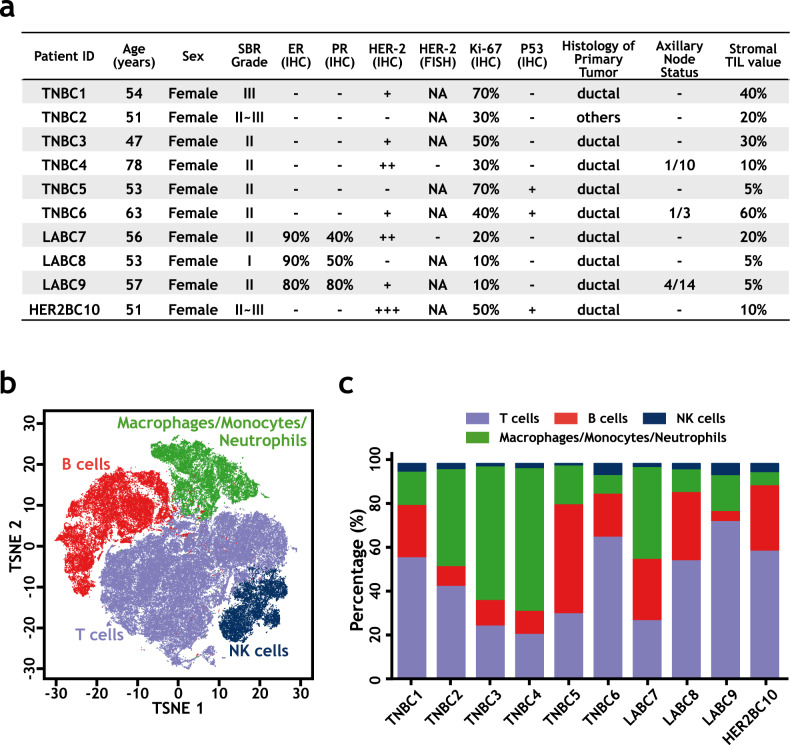
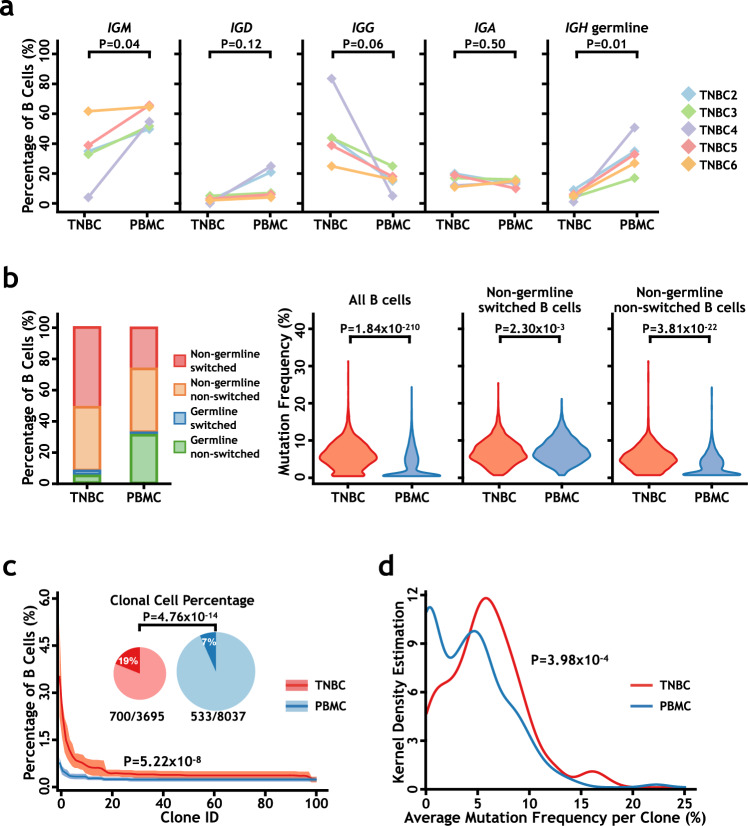
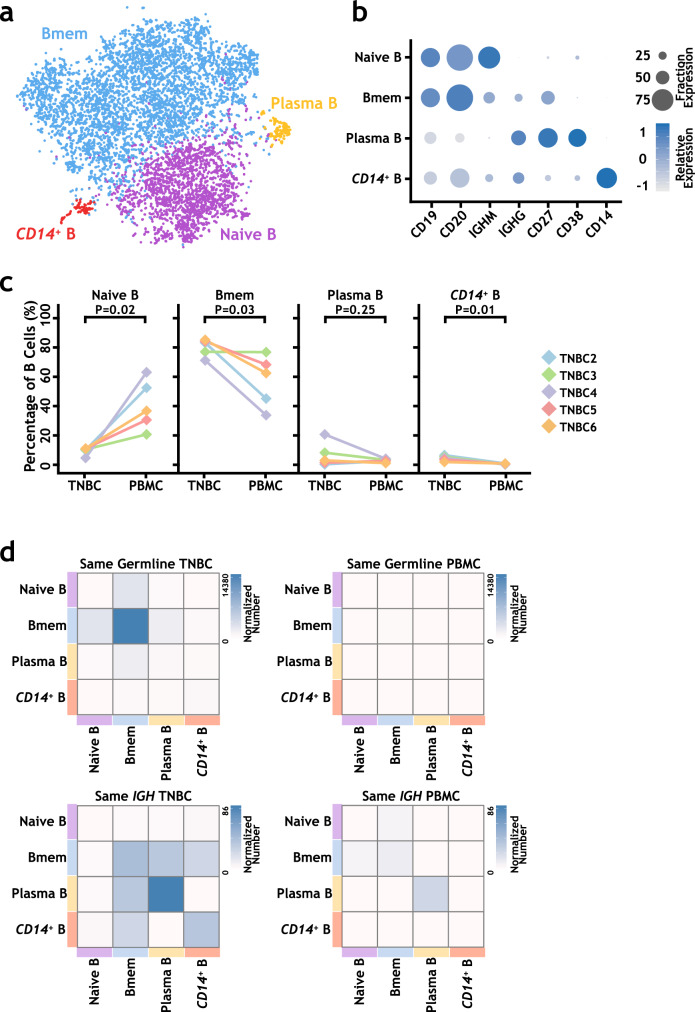
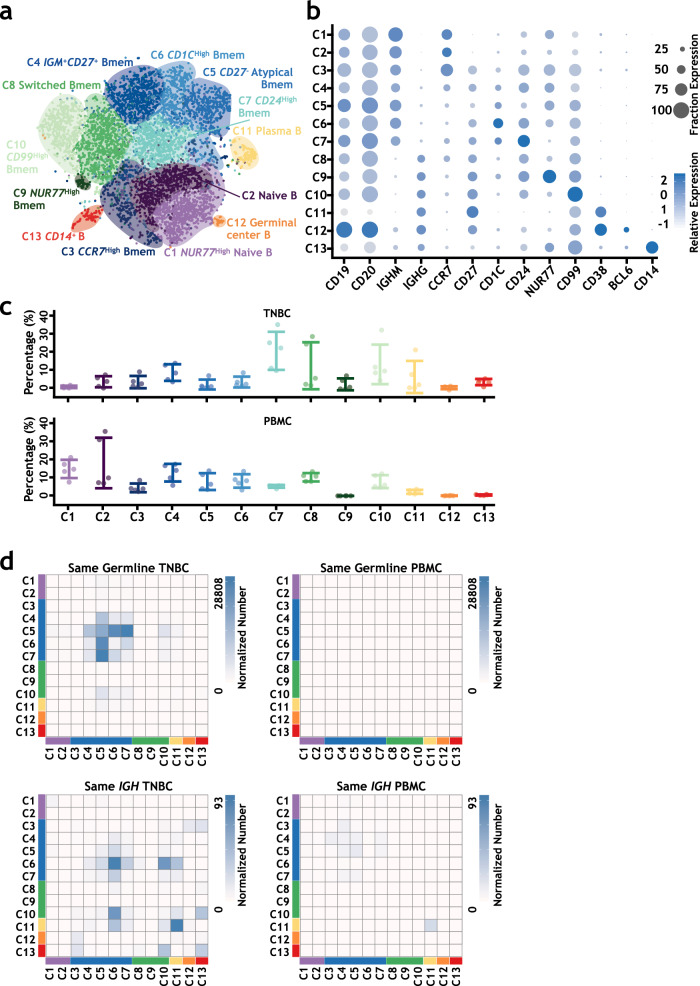
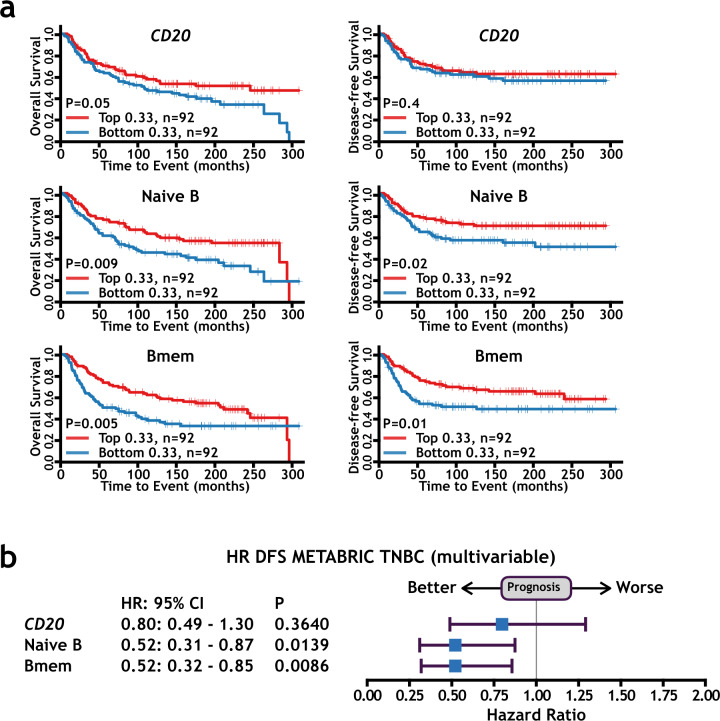
To gain mechanistic insights into the functions and developmental dynamics of tumor-infiltrated immune cells, especially B-lymphocytes, here we combine single-cell RNA-sequencing and antigen receptor lineage analysis to characterize a large number of triple-negative breast cancer infiltrated immune cells and report a comprehensive atlas of tumor-infiltrated B-lymphocytes. The single-cell transcriptional profiles reveal significant heterogeneity in tumor-infiltrated B-cell subgroups. The single-cell antigen receptor analyses demonstrate that compared with those in peripheral blood, tumor-infiltrated B-cells have more mature and memory B-cell characteristics, higher clonality, more class switching recombination and somatic hypermutations. Combined analyses suggest local differentiation of infiltrated memory B-cells within breast tumors. The B-cell signatures based on the single-cell RNA-sequencing results are significantly associated with improved survival in breast tumor patients. Functional analyses of tumor-infiltrated B-cell populations suggest that mechanistically, B-cell subgroups may contribute to immunosurveillance through various pathways. Further dissection of tumor-infiltrated B-cell populations will provide valuable clues for tumor immunotherapy.
Overview
The claims and statistics of this paper haven’t been checked yet.
Free: it reads the open-access text and checks the first 5 claims that cite a source we can check. Create a free account to check every claim.
Integrity signals
Registry
Cites
Statistics
Figures
Verification
Claims the paper makes
The claims and statistics of this paper haven’t been checked yet.
Free: it reads the open-access text and checks the first 5 claims that cite a source we can check. Create a free account to check every claim.
Claims other papers make about this one
Each is checked against this paper’s own text: does it say what the citing paper says it does?
The cited source says what the claim attributes to it.
In the citing paper
“Combined with scRNA-seq, scBCR-seq was applied for producing cell atlas [144], identifying different neutralizing antibodies [145], conducting vaccine studies [146], etc., and proved invaluable in studies investigating the dynamics of the immune system.”
From Single-cell sequencing to multi-omics: technologies and applications (2024) · cites this paper as [144]
Self-check
Percentages, sums and reported differences re-computed from the paper’s own numbers.
The self-check needs the paper’s full text.
Citations
Cites
Hallmarks of Cancer: The Next Generation
Hanahan, D., & Weinberg, R. A. (2011) · Cell · doi:10.1016/j.cell.2011.02.013 · Cited by 66,590 · cited 1×
“The sample exclusion criteria were as follows: (1) patients treated with any chemotherapy before surgery were excluded; (2) samples with a small number of B cells by FACS analysis were excluded; and (3) samples that failed the quality control during single-cell RNA-seq library construction were excluded from further a…”
MethodPHYLIP-Phylogeny inference package (Version 3.2)
Felsenstein, J. (1989) · Cladistics · Cited by 18,906
Molecular portraits of human breast tumours
Perou, C. M., Sørlie, T., Eisen, M. B., van de Rijn, M., Jeffrey, S. S., Rees, C. A., Pollack, J. R., Ross, D. T., Johnsen, H., Akslen, L. A., et al. (2000) · Nature · doi:10.1038/35021093 · Cited by 16,261
ANNOVAR: functional annotation of genetic variants from high-throughput sequencing data
Wang, K., Li, M., & Hakonarson, H. (2010) · Nucleic Acids Research · doi:10.1093/nar/gkq603 · Cited by 14,621
Integrating single-cell transcriptomic data across different conditions, technologies, and species
Butler, A., Hoffman, P., Smibert, P., Papalexi, E., & Satija, R. (2018) · Nature Biotechnology · doi:10.1038/nbt.4096 · Cited by 13,174
Fast and accurate long-read alignment with Burrows-Wheeler transform.
Li, H., & Durbin, R. (2010) · Bioinformatics · doi:10.1093/bioinformatics/btp698 · Cited by 12,063
Modeling Survival Data: Extending the Cox Model
Therneau, T. M., & Grambsch, P. M. (2000) · Statistics for Biology and Health · doi:10.1007/978-1-4757-3294-8 · Cited by 8,674
Massively parallel digital transcriptional profiling of single cells
Zheng, G. X. Y., Terry, J. M., Belgrader, P., Ryvkin, P., Bent, Z. W., Wilson, R., Ziraldo, S. B., Wheeler, T. D., McDermott, G. P., Zhu, J., et al. (2017) · Nature Communications · doi:10.1038/ncomms14049 · Cited by 7,353
Repeated observation of breast tumor subtypes in independent gene expression data sets
Sørlie, T., Tibshirani, R., Parker, J., Hastie, T., Marron, J. S., Nobel, A., Deng, S., Johnsen, H., Pesich, R., Geisler, S., et al. (2003) · Proceedings of the National Academy of Sciences · doi:10.1073/pnas.0932692100 · Cited by 5,429
Dissecting the multicellular ecosystem of metastatic melanoma by single-cell RNA-seq
Tirosh, I., Izar, B., Prakadan, S. M., Wadsworth, M. H., Treacy, D., Trombetta, J. J., Rotem, A., Rodman, C., Lian, C., Murphy, G., et al. (2016) · Science · doi:10.1126/science.aad0501 · Cited by 4,944
Cited by
Long, Y., Ang, K. S., Li, M., Chong, K. L. K., Sethi, R., Zhong, C., Xu, H., Ong, Z., Sachaphibulkij, K., Chen, A., et al. (2023) · Nature Communications · doi:10.1038/s41467-023-36796-3 · Cited by 700
Fridman, W. H., Meylan, M., Petitprez, F., Sun, C.-M., Italiano, A., & Sautès-Fridman, C. (2022) · Nature Reviews Clinical Oncology · doi:10.1038/s41571-022-00619-z · Cited by 657
Applications of single-cell sequencing in cancer research: progress and perspectives
Lei, Y., Tang, R., Xu, J., Wang, W., Zhang, B., Liu, J., Yu, X., & Shi, S. (2021) · Journal of Hematology & Oncology · doi:10.1186/s13045-021-01105-2 · Cited by 592
Cancer stem cells: advances in knowledge and implications for cancer therapy
Chu, X., Tian, W., Ning, J., Xiao, G., Zhou, Y., Wang, Z., Zhai, Z., Tanzhu, G., Yang, J., & Zhou, R. (2024) · Signal Transduction and Targeted Therapy · doi:10.1038/s41392-024-01851-y · Cited by 553
Tumour-infiltrating B cells: immunological mechanisms, clinical impact and therapeutic opportunities
Laumont, C. M., Banville, A. C., Gilardi, M., Hollern, D. P., & Nelson, B. H. (2022) · Nature Reviews Cancer · doi:10.1038/s41568-022-00466-1 · Cited by 524
Breast cancer heterogeneity and its implication in personalized precision therapy
Guo, L., Kong, D., Liu, J., Zhan, L., Luo, L., Zheng, W., Zheng, Q., Chen, C., & Sun, S. (2023) · Experimental Hematology & Oncology · doi:10.1186/s40164-022-00363-1 · Cited by 327
“High-resolution atlas of breast cancer has been well established, such as the atlas of CAFs [220], immune ecosystem [221, 222], and the interaction of these components with spatial information [223].”
BackgroundFerroptosis in the tumor microenvironment: perspectives for immunotherapy
Xu, H., Ye, D., Ren, M., Zhang, H., & Bi, F. (2021) · Trends in Molecular Medicine · doi:10.1016/j.molmed.2021.06.014 · Cited by 294
B Cell Function in the Tumor Microenvironment
Downs-Canner, S. M., Meier, J., Vincent, B. G., & Serody, J. S. (2022) · Annual Review of Immunology · doi:10.1146/annurev-immunol-101220-015603 · Cited by 287
A blueprint for tumor-infiltrating B cells across human cancers
Ma, J., Wu, Y., Ma, L., Yang, X., Zhang, T., Song, G., Li, T., Gao, K., Shen, X., Lin, J., et al. (2024) · Science · doi:10.1126/science.adj4857 · Cited by 255
“Thedevelopmental trajectories of TIBs have focused on the canonical GC pathway, with Bm or GC B cells acting as progenitors of ASCs ( 17 , 101 , 102 ).”
BackgroundSingle-cell technologies in hepatology: new insights into liver biology and disease pathogenesis
Ramachandran, P., Matchett, K. P., Dobie, R., Wilson-Kanamori, J. R., & Henderson, N. C. (2020) · Nature Reviews Gastroenterology & Hepatology · doi:10.1038/s41575-020-0304-x · Cited by 253
Laumont, C. M., & Nelson, B. H. (2023) · Cancer Cell · doi:10.1016/j.ccell.2023.02.017 · Cited by 250
A spatially resolved single-cell genomic atlas of the adult human breast
Kumar, T., Nee, K., Wei, R., He, S., Nguyen, Q. H., Bai, S., Blake, K., Pein, M., Gong, Y., Sei, E., et al. (2023) · Nature · doi:10.1038/s41586-023-06252-9 · Cited by 245
Tertiary lymphoid structures in diseases: immune mechanisms and therapeutic advances
Zhao, L., Jin, S., Wang, S., Zhang, Z., Wang, X., Chen, Z., Wang, X., Huang, S., Zhang, D., & Wu, H. (2024) · Signal Transduction and Targeted Therapy · doi:10.1038/s41392-024-01947-5 · Cited by 218
Zhang, Y., Liu, G., Zeng, Q., Wu, W., Lei, K., Zhang, C., Tang, M., Zhang, Y., Xiang, X., Tan, L., et al. (2024) · Cancer Cell · doi:10.1016/j.ccell.2024.07.006 · Cited by 213
Self-citationPan-cancer single-cell dissection reveals phenotypically distinct B cell subtypes
Yang, Y., Chen, X., Pan, J., Ning, H., Zhang, Y., Bo, Y., Ren, X., Li, J., Qin, S., Wang, D., et al. (2024) · Cell · doi:10.1016/j.cell.2024.06.038 · Cited by 208
“20,21 For example, an FCRL4 + Bm subset has been identified to be associated with improved patient survival in nasopharyngeal carcinoma (NPC), 22,23 and linked with immunotherapy response in non-small cell lung cancer (NSCLC).”
Self-citationAdvances in single-cell RNA sequencing and its applications in cancer research
Huang, D., Ma, N., Li, X., Gou, Y., Duan, Y., Liu, B., Xia, J., Zhao, X., Wang, X., Li, Q., et al. (2023) · Journal of Hematology & Oncology · doi:10.1186/s13045-023-01494-6 · Cited by 201
“Combined analyses suggested local differentiation of infiltrating memory B cells within breast tumors, and B-cell subgroups might contribute to immunosurveillance through various pathways [97].”
BackgroundSingle-cell sequencing to multi-omics: technologies and applications
Wu, X., Yang, X., Dai, Y., Zhao, Z., Zhu, J., Guo, H., & Yang, R. (2024) · Biomarker Research · doi:10.1186/s40364-024-00643-4 · Cited by 222
“From a clinical perspective, it helps diagnose and monitor tumor immunology [144], infectious diseases [145, 147], autoimmune diseases, and immunodeficiencies.”
BackgroundMethodZhou, M., Zhang, Z., Bao, S., Hou, P., Yan, C., Su, J., & Sun, J. (2021) · Briefings in Bioinformatics · doi:10.1093/bib/bbaa047 · Cited by 178
B Cell Orchestration of Anti-tumor Immune Responses: A Matter of Cell Localization and Communication
Kinker, G. S., Vitiello, G. A. F., Ferreira, W. A. S., Chaves, A. S., de Lima, V. C. C., & Medina, T. D. S. (2021) · Frontiers in Cell and Developmental Biology · doi:10.3389/fcell.2021.678127 · Cited by 177
B Cells and Tertiary Lymphoid Structures: Friends or Foes in Cancer Immunotherapy?
Lauss, M., Donia, M., Svane, I. M., & Jönsson, G. B. (2021) · Clinical Cancer Research · doi:10.1158/1078-0432.ccr-21-1130 · Cited by 157
Spatial landscapes of cancers: insights and opportunities
Chen, J., Larsson, L., Swarbrick, A., & Lundeberg, J. (2024) · Nature Reviews Clinical Oncology · doi:10.1038/s41571-024-00926-7 · Cited by 184
“Single-cell analysis has enabled researchers to classify immune cells into subpopulations at a higher resolution, revealing a remarkable diversity of cell states and unveiling novel clusters with well-defined functions 64–67 .”
Liu, Y., Ye, S., He, S., Chi, D., Wang, X., Wen, Y., Ma, D., Nie, R., Xiang, P., Zhou, Y., et al. (2024) · Nature Communications · doi:10.1038/s41467-024-52153-4 · Cited by 165
Anuraga, G., Wang, W., Phan, N. N., Ton, N. T. A., Ta, H. D. K., Prayugo, F. B., Xuan, D. T. M., Ku, S., Wu, Y.-F., Andriani, V., et al. (2021) · Journal of Personalized Medicine · doi:10.3390/jpm11111089 · Cited by 100
“These findings are consistent with current research, revealing that B cells provide a potential target for cancer intervention [139,140].”
ResultA pan-cancer single-cell RNA-seq atlas of intratumoral B cells
Fitzsimons, E., Qian, D., Enica, A., Thakkar, K., Augustine, M., Gamble, S., Reading, J. L., & Litchfield, K. (2024) · Cancer Cell · doi:10.1016/j.ccell.2024.09.011 · Cited by 97
Ding, S., Qiao, N., Zhu, Q., Tong, Y., Wang, S., Chen, X., Tian, Q., Xiao, Y., & Shen, K. (2023) · 癌症:英文版 · doi:10.1002/cac2.12429 · Cited by 74
“The immunosuppressive signature score was defined as the average expression of a series of immune checkpoint inhibitors [25] and immunosuppressive molecules [16], while the dysfunctional signature score [26] was defined as the average expression of a set of genes related to T cell dysfunction.”
BackgroundTertiary lymphoid structures and cancer immunotherapy: From bench to bedside
Peyraud, F., Guégan, J., Vanhersecke, L., Brunet, M., Teyssonneau, D., Palmieri, L., Bessede, A., & Italiano, A. (2025) · Med · doi:10.1016/j.medj.2024.10.023 · Cited by 81
The role of B cells in cancer development
Tan, R., Nie, M., & Wang, L. (2022) · Frontiers in Oncology · doi:10.3389/fonc.2022.958756 · Cited by 69
Omics Technologies Improving Breast Cancer Research and Diagnostics
Orsini, A., Diquigiovanni, C., & Bonora, E. (2023) · International Journal of Molecular Sciences · doi:10.3390/ijms241612690 · Cited by 52
“Equally, H3K4 acetylation is one of the most critical epigenetic modifications, and its dysregulation has been linked to BC progression, estrogen responsiveness and the epithelial–mesenchymal transition oncogenic pathway [74].”
BackgroundJin, W., Yang, Q., Peng, Y., Yan, C., Li, Y., Luo, Z., Xiao, B., Xu, L., & Yang, H. (2021) · Cell Discovery · doi:10.1038/s41421-021-00314-w · Cited by 65
Mapping Breast Cancer Microenvironment Through Single-Cell Omics
Tan, Z., Chen, K., Sun, M., Yang, F., Wong, M., Wang, S., & Zheng, H. (2022) · Frontiers in Immunology · doi:10.3389/fimmu.2022.868813 · Cited by 63
Yan, Z., Dong, Y., Qiao, N., Zhang, Y., Wu, W., Zhu, Y., Wang, L., Cheng, S., Xu, P.-P., Zhou, Z., et al. (2024) · Nature Communications · doi:10.1038/s41467-024-49495-4 · Cited by 59
Self-citationInfiltrating plasma cells maintain glioblastoma stem cells through IgG-Tumor binding
Gao, J., Gu, D., Yang, K., Zhang, J., Lin, Q., Yuan, W., Xu, Z., Dixit, D., Gimple, R. C., You, H., et al. (2025) · Cancer Cell · doi:10.1016/j.ccell.2024.12.006 · Cited by 50
Immunotherapy in breast cancer: current landscape and emerging trends
Ran, R., Chen, X., Yang, J., & Xu, B. (2025) · Experimental Hematology and Oncology · doi:10.1186/s40164-025-00667-y · Cited by 68
“Hu et al. revealed the heterogeneity and developmental dynamics of infiltrating B-cell subgroups in TNBC by single-cell transcriptional profiling and found that B-cell signaling was significantly associated with improved survival in patients [257].”
Playoust, E., Remark, R., Vivier, É., & Milpied, P. (2023) · Cellular and Molecular Immunology · doi:10.1038/s41423-023-01060-7 · Cited by 50
The Tumor Immune Microenvironment in Breast Cancer Progression
Fjørtoft, M. O., Huse, K., & Rye, I. H. (2024) · Acta Oncologica · doi:10.2340/1651-226x.2024.33008 · Cited by 61
“B cells [14] and NK cells [24] are also increased in TNBC compared to other subtypes, and the main B cell subpopulation in TNBC is memory B cells, with lower amounts of naïve B cells and plasma cells [26].”
BackgroundMature tertiary lymphoid structures: important contributors to anti-tumor immune efficacy
Bao, X., Lin, X., Xie, M., Yao, J., Song, J., Ma, X., Zhang, X., Zhang, Y., Liu, Y., Han, W., et al. (2024) · Frontiers in Immunology · doi:10.3389/fimmu.2024.1413067 · Cited by 48
Self-citationGenomic instability as a driver and suppressor of anti-tumor immunity
Requesens, M., Foijer, F., Nijman, H. W., & de Bruyn, M. (2024) · Frontiers in Immunology · doi:10.3389/fimmu.2024.1462496 · Cited by 51
Tertiary lymphoid structures and B lymphocytes: a promising therapeutic strategy to fight cancer
Esparcia-Pinedo, L., Romero-Laorden, N., & Alfranca, A. (2023) · Frontiers in Immunology · doi:10.3389/fimmu.2023.1231315 · Cited by 46
Peng, W.-S., Zhou, X., Yan, W.-B., Li, Y.-J., Du, C.-R., Wang, X.-S., Shen, C.-Y., Wang, Q.-F., Ying, H.-M., Lu, X.-G., et al. (2022) · OncoImmunology · doi:10.1080/2162402x.2022.2026583 · Cited by 41
Yuan, H., Mao, X., Yan, Y., Huang, R., Zhang, Q., Zeng, Y., Bao, M., Dai, Y., Fang, B., Mi, J., et al. (2024) · Journal of Translational Medicine · doi:10.1186/s12967-024-04860-1 · Cited by 44
“Naïve B cells have been identified in human tumors [15, 40], and have shown an association with improved overall survival and disease-free in triple-negative breast cancer [41].”
BackgroundImmunometabolic reprogramming, another cancer hallmark
Kumar, V., & Stewart, J. H. (2023) · Frontiers in Immunology · doi:10.3389/fimmu.2023.1125874 · Cited by 37
Immune Cell Migration to Cancer
Ryan, A. T., Kim, M., & Lim, K. (2024) · Cells · doi:10.3390/cells13100844 · Cited by 38
Gu, S., Qian, L. M., Zhang, Y., Chen, K., Li, Y., Wang, J., & Wang, P. (2021) · Biochimica et Biophysica Acta (BBA) - Reviews on Cancer · doi:10.1016/j.bbcan.2021.188632 · Cited by 41
Self-citationBao, J., Betzler, A. C., Heß, J., & Brunner, C. (2023) · Frontiers in Immunology · doi:10.3389/fimmu.2023.1233085 · Cited by 46
“The innovative strategy of employing single-cell RNA-sequencing to identify the Breg cell cluster is often unsuccessful (28, 29).”
BackgroundB Cells in Breast Cancer Pathology
Li, M., Quintana, Á., Alberts, E., Hung, M. S., Boulat, V., Martí, M., & Grigoriadis, A. E. (2023) · Cancers · doi:10.3390/cancers15051517 · Cited by 36
Bermejo-Haro, M. Y., Camacho‐Pacheco, R. T., Brito‐Pérez, Y., & Mancilla‐Herrera, I. (2023) · Molecular and Cellular Endocrinology · doi:10.1016/j.mce.2023.111956 · Cited by 41
Furukawa, N., Stearns, V., Santa-Maria, C. A., & Popel, A. S. (2022) · Expert Opinion on Therapeutic Targets · doi:10.1080/14728222.2022.2170779 · Cited by 37
“TNBC had significantly more tumor-infiltrating B cells compared to other breast cancer subtypes [74].”
ResultSPP1+ macrophages in HR+ breast cancer are associated with tumor-infiltrating lymphocytes
Cha, S. M., Park, J.-W., Lee, Y. J., Lee, H. J., Lee, H., Lee, I. W., Gong, G., Park, S. H., Lee, H. J., & Jeong, B.-K. (2024) · npj Breast Cancer · doi:10.1038/s41523-024-00695-7 · Cited by 43
“Toincreasethesamplesizeandanalyzeindependentdatasets,weperformed jointanalysisofourdatasetwithapublicdataset(GSA,HRA000477 18 ), which was a single-cell RNA sequencing dataset where TIL values were measured and human CD45 + cells were sorted from breast cancer tissue.”
Carpen, L., Falvo, P., Orecchioni, S., Mitola, G., Hillje, R., Mazzara, S., Mancuso, P., Pileri, S. A., Raveane, A., & Bertolini, F. (2022) · Cell Death Discovery · doi:10.1038/s41420-022-00893-x · Cited by 37
“Notably, one cluster on the 4T1 (cluster 3) displayed a gene signature typical of plasma B cells (high expression of Cd27, Cd38, Xbp1) [39, 40] that was not observed in the EMT6 counterpart despite the higher number of subpopulations retrieved.”
BackgroundNajaflou, M., Shahgolzari, M., Khosroushahi, A. Y., & Fiering, S. (2022) · Cancers · doi:10.3390/cancers15010082 · Cited by 34
Insight into the Crosstalk between Photodynamic Therapy and Immunotherapy in Breast Cancer
Jin, H., Liao, S., Yao, F., Li, J., Xu, Z., Zhao, K., Xu, X., & Sun, S. (2023) · Cancers · doi:10.3390/cancers15051532 · Cited by 35
Unravelling immune microenvironment features underlying tumor progression in the single-cell era
Du, Q., An, Q., Zhang, J., Liu, C., & Hu, Q. (2024) · Cancer Cell International · doi:10.1186/s12935-024-03335-z · Cited by 30
“Meanwhile, naive B-cells were enriched in peripheral blood, mutated into memory B-cells under the induction of immune editing and recruited into tumor tissue [77].”
BackgroundSelf-citationPredictability of B cell clonal persistence and immunosurveillance in breast cancer
Sammut, S., Galson, J. D., Minter, R., Sun, B., Chin, S., Mattos‐Arruda, L. D., Finch, D. K., Schätzle, S., Dias, J., Rueda, O. M., et al. (2024) · Nature Immunology · doi:10.1038/s41590-024-01821-0 · Cited by 32
Zhu, H., Xu, J., Wang, W., Zhang, B., Liu, J., Liang, C., Hua, J., Meng, Q., Yu, X., & Shi, S. (2024) · EBioMedicine · doi:10.1016/j.ebiom.2024.105098 · Cited by 33
“7 Emerging evidence suggests tumor-in fi ltrating B cells and plasma cells, collectively referred to as tumor-in fi ltrating B lymphocytes (TIL-Bs), 8 as potent and multifaceted participants in antitumor immune responses.”
BackgroundImmune Checkpoints in B Cells: Unlocking New Potentials in Cancer Treatment
Shi, X., Cheng, X., Jiang, A., Shi, W., Zhu, L., Mou, W., Glaviano, A., Liu, Z., Cheng, Q., Lin, A., et al. (2024) · Advanced Science · doi:10.1002/advs.202403423 · Cited by 31
Yan, W., Cao, Y., Xu, S., Yu, H., Wu, T., Yuan, W., Yin, Q., & Li, Y. (2024) · Advanced Materials · doi:10.1002/adma.202411361 · Cited by 28
Self-citationFranzén, A. S., Raftery, M. J., & Pecher, G. (2022) · Cancers · doi:10.3390/cancers14133178 · Cited by 27
“Recently, a high intertumoral plasma cell density was associated with longer disease-free survival and longer time to relapse in TNBC suggesting a humoral response in TNBC [45,47].”
BackgroundB cells in tumor metastasis: friend or foe?
Xu, Y., Mao, Y., Lv, Y., Tang, W., & Xu, J. (2023) · International Journal of Biological Sciences · doi:10.7150/ijbs.79482 · Cited by 25
“Single-cell RNA sequencing has revealed that the TIL-Bs cover entire phenotypes throughout the developmental stages from naïve B cells to plasma cells, including IL10-expressing TIL-Bs [8, 9].”
BackgroundConte, B., Brasó‐Maristany, F., Hernández, A. R., Pascual, T., Villacampa, G. J., Schettini, F., Vidal, M. J., Seguí, E., Angelats, L., García-Fructuoso, I., et al. (2024) · EBioMedicine · doi:10.1016/j.ebiom.2024.105043 · Cited by 28
“22,23 For instance, the oligoclonal expansion of type G immunoglobulins (IgG) in the tumor stroma of patients with early-stage TNBC was strongly associated with long-term survival in the CALGB-40603 neoadjuvant trial.”
BackgroundThe Role of B Cells in Head and Neck Cancer
Gavrielatou, N., Vathiotis, I. A., Economopoulou, P., & Psyrri, A. K. (2021) · Cancers · doi:10.3390/cancers13215383 · Cited by 23
“B-cells have been reported to account for one-fourth of all infiltrating cells in some malignancies [18], and most importantly, to exhibit surface expression of PD-1, PD-L1, CTLA-4 and B-7 molecules at various levels, suggesting that their activity could also be modified by currently approved immunotherapy agents [19–…”
BackgroundCalcium-based biomaterials: Unveiling features and expanding applications in osteosarcoma treatment
Wu, Y., Cheng, M., Jiang, Y., Zhang, X., Li, J., Zhu, Y., & Yao, Q. (2023) · Bioactive Materials · doi:10.1016/j.bioactmat.2023.10.008 · Cited by 30
Natural Barcodes for Longitudinal Single Cell Tracking of Leukemic and Immune Cell Dynamics
Penter, L., Gohil, S. H., & Wu, C. J. (2022) · Frontiers in Immunology · doi:10.3389/fimmu.2021.788891 · Cited by 21
Analysis of single-cell and spatial transcriptomics in TNBC cell-cell interactions
Xin, Y., Ma, Q., Deng, Q., Wang, T., Wang, D., & Wang, G. (2025) · Frontiers in Immunology · doi:10.3389/fimmu.2025.1521388 · Cited by 23
Combination Therapies to Improve the Efficacy of Immunotherapy in Triple-negative Breast Cancer
Alečković, M., Li, Z., Zhou, N., Qiu, X., Lulseged, B. A., Foidart, P., Huang, X.-Y., Garza, K., Shu, S., Kesten, N., et al. (2023) · Molecular Cancer Therapeutics · doi:10.1158/1535-7163.mct-23-0303 · Cited by 24
AI-powered spatial cell phenomics enhances risk stratification in non-small cell lung cancer
Schallenberg, S., Dernbach, G., Ruane, S., Jurmeister, P. S., Böhm, C., Standvoss, K., Ghosh, S., Frentsch, M., Dragomir, M. P., Keyl, P., et al. (2025) · Nature Communications · doi:10.1038/s41467-025-65783-z · Cited by 25
Hub gene of disulfidptosis-related immune checkpoints in breast cancer
Wang, Y., Deng, Y., Xie, H., & Cao, S. (2023) · Medical Oncology · doi:10.1007/s12032-023-02073-y · Cited by 20
“Additionally, research has indicated that transcriptional signatures of both naive and memory B cells are significantly linked to enhanced overall survival and disease-free survival in patients with triple-negative breast cancer (TNBC) [23].”
BackgroundB cells in non-lymphoid tissues
Samiea, A., Celis, G., Yadav, R., Rodda, L. B., & Moreau, J. M. (2025) · Nature reviews. Immunology · doi:10.1038/s41577-025-01137-6 · Cited by 24
“Single-cell RNA sequencing and BCR repertoire analysis of immune cells from over 30 different human cancers have begun to fill in the picture of B cell populations within the tumour microenvironment 4,24,123,127,128,130,131,134–145 .”
Han, Y., Diao, J., Wang, X., Zhang, S., Yuan, L., Ping, Y., Gao, G., Zhang, Y., & Luo, H. (2024) · Biology of Reproduction · doi:10.1093/biolre/ioae157 · Cited by 17
“…signature score was defined as the average expression of a series of immune checkpoint inhibitors [18] and immunosuppressive molecules [19], including CD244 , CD160 , cytotoxic T-lymphocyte associated protein 4 (CTLA4) , programmed cell death 1 (PDCD1) , T cell immunoreceptor with Ig…”
Self-citationCD84 as a therapeutic target for breaking immune tolerance in triple-negative breast cancer
Rabani, S., Gunes, E. G., Gunes, M., Pellegrino, B., Lampert, B., David, K., Pillai, R. K., Li, A., Becker-Herman, S., Rosen, S. T., et al. (2024) · Cell Reports · doi:10.1016/j.celrep.2024.114920 · Cited by 19
Tartaro, D. L., Aramini, B., Masciale, V., Paschalidis, N., Lofaro, F. D., Neroni, A., Borella, R., Santacroce, E., Ciobanu, A. L., Samarelli, A. V., et al. (2025) · Molecular Cancer · doi:10.1186/s12943-024-02209-2 · Cited by 19
Xu, S., Han, C., Zhou, J., Yang, D., Dong, H. F., Zhang, Y., Zhao, T., Tian, Y., & Wu, Y. (2025) · Cancer Immunology Immunotherapy · doi:10.1007/s00262-025-03952-1 · Cited by 26
“Studies have shown that B cells from non-small cell lung cancers (NSCLCs) [29] and breast cancers [30] can produce antibodies that target cancer antigens ex vivo.”
Self-citationImmune Cells in Head-and-Neck Tumor Microenvironments
Jumaniyazova, E. D., Lokhonina, А. V., Dzhalilova, D. S., Kosyreva, A. M., & Fatkhudinov, T. (2022) · Journal of Personalized Medicine · doi:10.3390/jpm12091521 · Cited by 16
“B cells constitute about 25% of all immune cells infiltrating the tumor nodules [37].”
BackgroundMassa, D., Tosi, A., Rosato, A., Guarneri, V., & Dieci, M. V. (2022) · Cancers · doi:10.3390/cancers14194885 · Cited by 18
Lam, B. M., & Verrill, C. L. (2023) · Cancers · doi:10.3390/cancers15041164 · Cited by 18
CBX3 promotes clear cell renal carcinoma through PI3K/AKT activation and aberrant immunity
Chen, J., Lin, Y., Zheng, S., Chen, Q., Tang, S., & Zhong, X. (2023) · Journal of Translational Medicine · doi:10.1186/s12967-023-04478-9 · Cited by 18
“Recent research has revealed that the presence of increased mature and memory B cell populations in the TME is associated with better clinical outcomes [49–51].”
BackgroundZhang, Y., Zhou, X., Zhong, Y., Chen, X. X., Li, Z., Li, R., Qin, P., Wang, S., Yin, J., Liu, S., et al. (2023) · Human Molecular Genetics · doi:10.1093/hmg/ddad187 · Cited by 21
Self-citationBenchmarking computational methods for B-cell receptor reconstruction from single-cell RNA-seq data
Andreani, T., Slot, L. M., Gabillard, S., Strübing, C., Reimertz, C., Veeranagouda, Y., Bakker, A. M., Olfati-Saber, R., Toes, R. E. M., Scherer, H. U., et al. (2022) · NAR Genomics and Bioinformatics · doi:10.1093/nargab/lqac049 · Cited by 16
“In addition, we directed our attention to understanding the performance of each method on highly mutated BCRs that are common in autoimmune diseases (7,10), cancers (6,11) and in neutralizing anti-HIV antibodies (31–33).”
BackgroundImpact of single‐cell RNA sequencing on understanding immune regulation
Hu, X., & Zhou, X. (2022) · Journal of Cellular and Molecular Medicine · doi:10.1111/jcmm.17493 · Cited by 17
Huang, Y., Bao, T.-Y., Huang, X.-Q., Lan, Q.-W., Huang, Z.-M., Chen, Y., Hu, Z.-D., & Guo, X. (2023) · World Journal of Gastrointestinal Oncology · doi:10.4251/wjgo.v15.i3.372 · Cited by 13
The new era of lung cancer therapy: Combining immunotherapy with ferroptosis
Li, Y., Tuerxun, H., Zhao, Y., Liu, X., Li, X., Wen, S., & Zhao, Y. (2024) · Critical Reviews in Oncology/Hematology · doi:10.1016/j.critrevonc.2024.104359 · Cited by 17
Back to the Future: Spatiotemporal Determinants of NK Cell Antitumor Function
Li, J. H., & O’Sullivan, T. E. (2022) · Frontiers in Immunology · doi:10.3389/fimmu.2021.816658 · Cited by 12
“Combined antigen receptor and scRNA-seq analysis of B cells isolated from triple-negative breast cancer compared to peripheral blood revealed that intra-tumoral B cells exhibit greater clonal diversity and more differentiated memory and plasma B cells with higher rates of somatic hypermutation (SHM) (139).”
BackgroundLuo, L., Wei, Q., Xu, C., Dong, M., & Zhao, W. (2022) · Frontiers in Immunology · doi:10.3389/fimmu.2022.933703 · Cited by 13
Liu, R., Huang, B., Shao, Y., Cai, Y., Liu, X., & Ren, Z. (2023) · Journal of Translational Medicine · doi:10.1186/s12967-023-04366-2 · Cited by 14
“…example, compared with that in peripheral blood, the number of memory B cells and antibody-secreting B cells in the tumour microenvironment (TME) is increased, and the expression of B-cell surface markers is also different, e.g., CD23 is downregulate and CD86 is upregulated in breast cancer [17].”
BackgroundFoldi, J., Blenman, K., Marczyk, M., Gunasekharan, V. K., Polanska, A., Gee, R. J., Davis, M., Kahn, A. M., Silber, A. L. M., & Pusztai, L. (2024) · Breast Cancer Research and Treatment · doi:10.1007/s10549-024-07426-3 · Cited by 12
“Immune cells in the tumor microenvironment likely exhibit different phenotypes and may show higher clonality as suggested by prior studies [27–29] that showed tumor-infiltrating T cells undergo more clonal expansion in response to ICI therapy than circulating T cells [30].”
Domenico, P. D., Gagliardi, F., Roncelli, F., Snider, S., & Mortini, P. (2025) · Journal of Neuro-Oncology · doi:10.1007/s11060-025-04989-z · Cited by 14
“Further analyses associated specific phenotypic signatures of infiltrating B cells with improved survival in breast cancer [19].”
Immunosenescence: Molecular Mechanisms, Diseases, and Therapeutic Innovations
Gong, N., Pan, X., Deng, Y., Che, J., Bao, J., Wang, M., Xu, C., Liu, X., & Shi, Y. (2025) · MedComm · doi:10.1002/mco2.70515 · Cited by 18
“As for B lymphocytes infiltrated inside tumor-associated tertiary lymphoid structures (TLS), CD27 dull /CD27 bright B cell ratios demonstrate significant reduction, which is correlated with unfavorable clinical outcomes in head and neck squamous cell carcinoma (HNSCC) and TNBC [54, 65].”
Ma, L., Luan, Y., & Lü, L. (2025) · Cancer Medicine · doi:10.1002/cam4.70622 · Cited by 11
“…of breast cancer-infiltrating B lymphocytes showed that these cells exhibit mature and memory-like characteristics, high clonality, enhanced class switching recombination, and somatic hypermutation, suggesting that B cell subsets may promote immune surveillance through multiple pathways [56].”
Unraveling Heterogeneity in Epithelial Cell Fates of the Mammary Gland and Breast Cancer
Samocha, A. J., Doh, H. M., Kessenbrock, K., & Roose, J. P. (2019) · Cancers · doi:10.3390/cancers11101423 · Cited by 13
Dynamic changes in B cell subpopulations in response to triple-negative breast cancer development
Gonçalves, I. V., Pinheiro-Rosa, N., Torres, L., Oliveira, M. D. A., Guimarães, G. R., Leite, C. D. S., Ortega, J. M., Lopes, M. T. P., Faria, A. M. C., Boroni, M., et al. (2024) · Scientific Reports · doi:10.1038/s41598-024-60243-y · Cited by 11
“Additionally, in transcriptome data analysis, B-cell signatures in breast tumor samples have been associated with improved survival 19 .”
BackgroundResultSanjaya, A., Ratnawati, H., Adhika, O. A., & Rahmatilah, F. R. (2024) · Breast Cancer Research and Treatment · doi:10.1007/s10549-024-07428-1 · Cited by 11
“[11] Next-generation sequencing of metastatic tissue revealed that it is a subclone of the primary tumor.”
Tumor heterogeneity: development, mechanisms, and therapeutic implications
Zhang, J., Li, H., Ru, S., Feng, H., Guo, J., Sun, D., Xiang, T., Xu, D., & Luo, Y. (2026) · Signal Transduction and Targeted Therapy · doi:10.1038/s41392-026-02749-7 · Cited by 21
“200 Research has found that TIL-Bs can be clustered into ten distinct subpopulations, across multiple cancer types.”
Zhao, X., Zhang, H., Han, Y., Fang, C., & Liu, J. (2023) · International Immunopharmacology · doi:10.1016/j.intimp.2023.110257 · Cited by 12
Bacteria‐instructed B cells cross‐prime naïve CD8+ T cells triggering effective cytotoxic responses
García‐Ferreras, R., Osuna‐Pérez, J., Ramírez‐Santiago, G., Méndez‐Pérez, A., Acosta-Moreno, A. M., del Campo, L., Gómez-Sánchez, M. J., Iborra-Pernichi, M., Herrero‐Fernández, B., González, J. M., et al. (2023) · EMBO Reports · doi:10.15252/embr.202256131 · Cited by 8
“In this regard, recent studies have shown that B cells infiltration in tumors is correlated with good prognosis and it has been suggested that this could be related to the antigen presentation ability of B cells (Garnelo et al , 2017; Edin et al , 2019; Lu et al , 2020; Hu et al , 2021).”
Thai, A. A., Young, R. J., Bressel, M., Angel, C. M., McDowell, L. J., Tiong, A., Bucknell, N. W., FELLOWES, A. P., Xu, H., Trigos, A., et al. (2023) · British Journal of Dermatology · doi:10.1093/bjd/ljad250 · Cited by 10
Zhang, X., Li, S., Zhu, Y., Zhai, C., Zeng, H., Liu, X., & Tao, J. (2023) · Frontiers in Endocrinology · doi:10.3389/fendo.2023.1166939 · Cited by 12
Zhao, F., Zhao, C., Xu, T., Lan, Y., Lin, H., Wu, X., & Li, X. (2023) · Frontiers in Immunology · doi:10.3389/fimmu.2023.1245514 · Cited by 12
Wennink, R. A. W., Pandit, A., Haasnoot, A. J. W., Hiddingh, S., Ayuso, V. K., Wulffraat, N. M., Vastert, S. J., Radstake, T. R. D. J., de Boer, J. H., & Kuiper, J. J. W. (2020) · Frontiers in Immunology · doi:10.3389/fimmu.2020.02170 · Cited by 11
Wang, X., Li, L., Zhang, X., Zhang, M., Sun, Z., Yang, Y., Zhang, X., Yuan, Y., Zhang, Y., Chen, H., et al. (2024) · Frontiers in Immunology · doi:10.3389/fimmu.2024.1501009 · Cited by 10
Self-citationDynamic roles of tumor-infiltrating B lymphocytes in cancer immunotherapy
Song, S., Wang, C., Chen, Y., Zhou, X., Han, Y., & Zhang, H. (2025) · Cancer Immunology Immunotherapy · doi:10.1007/s00262-024-03936-7 · Cited by 11
“…CD19 + CD20 + IgD − CD10 + CD38 + BCL-6 + AID + MHC-II + germinal center B cell phenotype [11], and CD1d + CD19 + IL-10 + IL-35 + TGF-β + regulatory B cells (Bregs) phenotype [12], etc. TIL-B are enriched in memory B cells and PCs compared to B cells in peripheral blood or healthy tissues [13, 14].”
The effect of physical activity on anti-infection immunity: a review
Wang, J., Zhao, W. L., Ding, J., & Li, Y. (2025) · Health Information Science and Systems · doi:10.1007/s13755-025-00360-8 · Cited by 13
“This temporary wave of B cell numbers increases immune surveillance to detect and respond to potential threats [93].”
Self-citation
Metadata
- Authors
- Hu, Q., Hong, Y., Qi, P., Lu, G., Mai, X., Xu, S., He, X., Guo, Y., Gao, L., Jing, Z., Wang, J., Cai, T., & Zhang, Y.
- Affiliations
- National Institute of Biological Sciences, Beijing (CN)
- Xinxiang Central Hospital (CN)
- Peking University (CN)
- Corresponding author
- Zhang, Yu
- ORCID
- Venue
- Nature Communications
- Published
- 2021-04-12
- Volume
- 12
- Issue
- 1
- Pages
- 2186-2186
- ISSN
- 2041-1723 (ISSN-L)
- PMC
- PMC8042001
- OpenAlex
- W3153020115
- Semantic Scholar
- 31943bc76214cb258ba3b4eae2337b2184327d01
- Cited by
- 201
- References
- 91
- Citations by year
- 2026: 19 · 2025: 40 · 2024: 52 · 2023: 53 · 2022: 24 · 2021: 8
- FWCI
- 10.90
- Type
- journal article
- Language
- en
- Open access
- gold
- doi.org
- Licence
- cc-by
- creativecommons.org/licenses/by/4.0 (tdm)
- creativecommons.org/licenses/by/4.0 (vor)
- Locations
- Nature Communications (publishedVersion, cc-by)
- bioRxiv (Cold Spring Harbor Laboratory) (acceptedVersion)
- PubMed Central (publishedVersion, cc-by)
- PubMed (publishedVersion)
- RePEc: Research Papers in Economics (submittedVersion)
- DOAJ (DOAJ: Directory of Open Access Journals) (submittedVersion, cc-by-sa)
- Funders
- National Natural Science Foundation of China (81572795, 81773304)
- Topics
- Life Sciences › Biochemistry, Genetics and Molecular Biology › Molecular Biology › Single-cell and spatial transcriptomics
- Health Sciences › Medicine › Oncology › Cancer Immunotherapy and Biomarkers
- Life Sciences › Immunology and Microbiology › Immunology › T-cell and B-cell Immunology
- Keywords
- breast cancer, tumor-infiltrating B cells, triple-negative breast cancer, B cell heterogeneity, memory B cells, B cell differentiation, somatic hypermutation, clonality, tumor surveillance, cancer immunotherapy
- MeSH terms
- Aged, Breast Neoplasms, Female, Humans, Immunoglobulin Heavy Chains, Middle Aged, Receptors, Antigen, Gene Expression Regulation, Neoplastic, Lymphocytes, Tumor-Infiltrating, Sequence Analysis, RNA, Gene Expression Profiling, Kaplan-Meier Estimate, Single-Cell Analysis, Transcriptome
About these checks
Registry, retraction, Cites and statistics results are computed, not judged, with one exception: a printed reference that no index lists is read once by a model before it counts as a citation error. Claims are extracted by a model and kept only when their quote appears verbatim in the text; each cited source is then checked, with a model’s help, for whether it says what the claim relies on. Those verdicts can be wrong — read the claim’s quote and the cited source before relying on one.
Statistics and arithmetic are recomputed, not judged.
Confidence bands are shown only for fields calibrated on our annotated test set. None is calibrated yet, so no band is shown.
What counts as a claim ›How we measure confidence ›How we check this ›
Are you an author, or do you see a problem with this page? Request a review
Data sources
Bibliographic data: Semantic Scholar, OpenAlex, Crossref.
Contains information from the Semantic Scholar Academic Graph Datasets, made available under the ODC Attribution License (ODC-BY 1.0).
Semantic Scholar’s data is described in: Kinney, R., et al. (2023). The Semantic Scholar Open Data Platform. arXiv:2301.10140.
