

The DOI matches its Crossref record; 249 of the 251 references it cites were found in a registry or an index; 125 of the 175 sources its claims cite were checked for support.
Single-cell sequencing to multi-omics: technologies and applications
Open accessAbstract
Cells, as the fundamental units of life, contain multidimensional spatiotemporal information. Single-cell RNA sequencing (scRNA-seq) is revolutionizing biomedical science by analyzing cellular state and intercellular heterogeneity. Undoubtedly, single-cell transcriptomics has emerged as one of the most vibrant research fields today. With the optimization and innovation of single-cell sequencing technologies, the intricate multidimensional details concealed within cells are gradually unveiled. The combination of scRNA-seq and other multi-omics is at the forefront of the single-cell field. This involves simultaneously measuring various omics data within individual cells, expanding our understanding across a broader spectrum of dimensions. Single-cell multi-omics precisely captures the multidimensional aspects of single-cell transcriptomes, immune repertoire, spatial information, temporal information, epitopes, and other omics in diverse spatiotemporal contexts. In addition to depicting the cell atlas of normal or diseased tissues, it also provides a cornerstone for studying cell differentiation and development patterns, disease heterogeneity, drug resistance mechanisms, and treatment strategies. Herein, we review traditional single-cell sequencing technologies and outline the latest advancements in single-cell multi-omics. We summarize the current status and challenges of applying single-cell multi-omics technologies to biological research and clinical applications. Finally, we discuss the limitations and challenges of single-cell multi-omics and potential strategies to address them.
Overview
CoChat Summary
TL;DR
This review summarizes single-cell sequencing and single-cell multi-omics technologies across temporal, spatial, genome, epigenome, proteome, immune repertoire, microbiome, and metabolome dimensions, and their biological and clinical applications. It also outlines current challenges, including high cost, strict sample requirements, computational integration, missing or mismatched information, and doublets.
Key findings
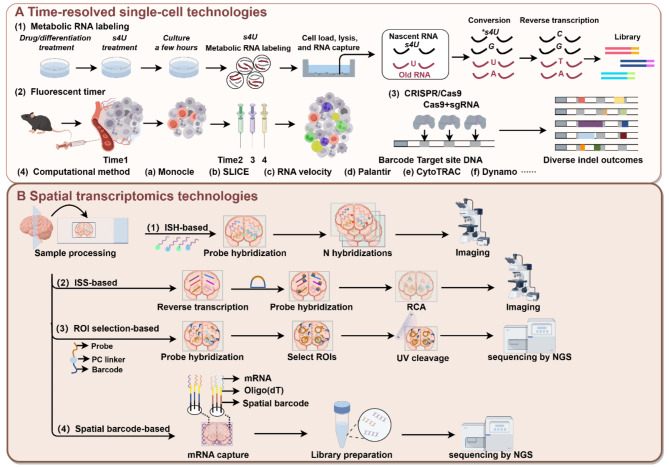
- Single-cell multi-omics extends scRNA-seq by simultaneously measuring multiple modalities in the same cell, with the review cataloging technologies for time (metabolic RNA labeling, fluorescent timers, CRISPR/Cas9 lineage tracing), space (ISH/ISS, ROI selection, spatial barcoding), genome, epigenome, protein/epitope, immune repertoire, microbiome, and metabolome.
- Reported cell/feature numbers include scSLAM-seq at 110 cells, scNT-seq at ∼55,000 cells, Well-TEMP-seq at 16,000 cells, TrackerSci at ∼800,000 cells, Zmen-seq at 8,976 cells, microSPLiT detecting subpopulations down to 0.142%, Microbe-seq with most single-amplified genomes over 95% purity, and mass spectrometry-based single-cell proteomics at about 1,500–2,500 proteins.
- Applications span cell atlas construction, developmental biology, pathway identification, and novel target discovery, as well as clinical areas such as tumor immunology, host-microbe interactions, infectious diseases, cardiovascular disease, and neurological/brain disease. For example, scTrio-seq was applied to 25 cancer cells and identified two distinct subsets, and an integrated human single-cell eQTL database comprises ∼16 million SNPs and ∼0.69 million sceQTLs.
- The review highlights that single-cell multi-omics can reveal cell states and targets not captured by transcriptomics alone, but also notes persistent challenges in cost, sample quality, data integration, sequencing depth, immune repertoire chain matching, and doublet removal.
Methods
- Narrative review; no original experiments or new primary data are reported. It synthesizes published single-cell sequencing and single-cell multi-omics technologies and their biological/clinical applications.
- Tables summarize time-resolved single-cell technologies (e.g., scSLAM-seq, NASC-seq, Sci-fate, scNT-seq, Well-TEMP-seq, scEU-seq, TrackerSci, Zmen-seq, CARLIN) and spatial transcriptomics/multi-omics technologies (e.g., smFISH, seqFISH+, MERFISH, STARmap PLUS, Geo-seq, DSP, 10× Visium, Slide-seq, Stereo-seq, DBiT-seq, spatial CITE-seq, Slide-tags) with resolution, data type, sample type, and genes/transcripts detected.
- The review also discusses computational analysis tools and workflows, including Seurat, Scanpy, Monocle, RNA velocity, Palantir, CytoTRACE, SCENIC, CellChat, CellPhoneDB, and batch-correction methods such as CCA, MNN, and Harmony.
Limitations
- The paper states that high cost and strict sample requirements discourage many researchers and restrict large-scale cohorts and clinical application; fresh tissue is generally preferred, freeze-thaw samples are usually recommended for snRNA-seq, and cell suspension quantity and viability affect data quality.
- The paper states that robust computational methods for integrating multi-dimensional single-cell data are still needed, that inconsistencies can occur among omics measured simultaneously in the same cells, and that sequencing depth, missing or incorrectly matched TCR chains, and doublets can confound downstream analyses.
- Evident from the text: as a narrative review, it does not perform a systematic search or quantitative synthesis and reports no primary validation data.
Model-written summary. Check it against the paper before relying on it.
Integrity signals
Registry
Cites
Statistics
Figures



Verification
Claims the paper makes
98 Valid · 9 Not valid · 33 Not checked · 20 Own results and interpretations
Every source the paper cites for this claim was checked and supports it.
In the paper
“The emergence of CRISPR/Cas9 technology facilitates the deliberate introduction of mutations using guide RNAs (gRNAs) [40].”
§ Single-cell sequencing to multi-omics: technologies and applications > New advances in single-cell sequencing > CRISPR/Cas9
What the sources say
- Supportedcites [40] McKenna A, Findlay GM, Gagnon JA, Horwitz MS, Schier AF, Shendure J. Whole-organism lineage tracing by combinatorial and cumulative genome editing. Science. 2016;353:aaf7907. source
In the Results section on barcode editing in cultured cells, the authors describe deliberately editing a CRISPR/Cas9 target array by introducing Cas9 and a single guide RNA. They then report mutations in the edited barcodes. The supplied passage does not specify a page number. (LLM, conf=0.94)
plainstates a cause- Asserted: passes — The authors put it forward as true.
- Checkable: passes — It can be checked against evidence.
- Load-bearing: unclear — It is unclear whether the paper’s conclusions depend on it.
- Based: passes — The paper gives a reason why it holds.
- Supported
The cited sources support only part of this claim — read each source’s verdict below.
In the paper
“Sample multiplexed scRNA-seq is another solution, establishing an efficient method for massively parallel species-mixing experiments [18–22].”
§ Single-cell sequencing to multi-omics: technologies and applications > Conventional single-cell sequencing
What the sources say
- Supportedcites [18] Cao J, Packer JS, Ramani V, Cusanovich DA, Huynh C, Daza R, Qiu X, Lee C, Furlan SN, Steemers FJ, et al. Comprehensive single-cell transcriptional profiling of a multicellular organism. Science. 2017;357:661–7. source
The Overview of sci-RNA-seq says multiple samples can be processed concurrently. The Scalability section reports a human–mouse mixing experiment that recovered 15,997 single-cell transcriptomes, and the Discussion describes the method as scalable and low-cost. These passages support the characterization of an efficient, massively parallel method for species-mixing experiments; page numbers were not provided. (LLM, conf=0.90)
- Not checked — no full text of the sourcecites [19] Gehring J, Hwee Park J, Chen S, Thomson M, Pachter L. Highly multiplexed single-cell RNA-seq by DNA oligonucleotide tagging of cellular proteins. Nat Biotechnol. 2020;38:35–8. source
- Partly supportedcites [20] Shin D, Lee W, Lee JH, Bang D. Multiplexed single-cell RNA-seq via transient barcoding for simultaneous expression profiling of various drug perturbations. Sci Adv. 2019;5:eaav2249. sourceExperimental — accuracy not yet measured
The Results section (page unavailable) reports a six-sample human–mouse species-mixing experiment that validated the multiplexing method. The Discussion describes cost advantages and high multiplexing capacity, but the paper does not establish massively parallel species-mixing experiments: the species-mixing demonstration was six-plex. (LLM, conf=0.82)
- Partly supportedcites [21] McGinnis CS, Patterson DM, Winkler J, Conrad DN, Hein MY, Srivastava V, Hu JL, Murrow LM, Weissman JS, Werb Z, et al. MULTI-seq: sample multiplexing for single-cell RNA sequencing using lipid-tagged indices. Nat Methods. 2019;16:619–26. sourceExperimental — accuracy not yet measured
The Results section on demultiplexing reports species-specific classification of mixed human and mouse nuclei. The Results section on doublets demonstrates efficient, large-scale multiplexing of 96 human mammary epithelial cell samples, but our copy does not demonstrate a massively parallel species-mixing experiment; the claim combines features shown in separate experiments. Page numbers are unavailable in our copy. (LLM, conf=0.82)
- Supportedcites [22] Zhao X, Sun S, Yu W, Zhu W, Zhao Z, Zhou Y, Ding X, Fang N, Yang R, Li JP. Improved ClickTags enable live-cell barcoding for highly multiplexed single cell sequencing. RSC Chem Biol. 2022;3:1052–60. source
The paper describes sample multiplexing as a way to achieve massively parallel analysis in a single experiment (passage 6, indexed under Abstract). It also reports pooling 16 barcoded human and mouse cell samples for scRNA-seq and accurately assigning cells to their samples (passage 3). No page numbers are provided in our copy. (LLM, conf=0.88)
boostedstates a cause- Asserted: passes — The authors put it forward as true.
- Checkable: passes — It can be checked against evidence.
- Load-bearing: unclear — It is unclear whether the paper’s conclusions depend on it.
- Based: passes — The paper gives a reason why it holds.
- Supported
The sources with a verdict support this claim; the rest weren’t checked yet, have no full text we could read, or their verdicts aren’t rated yet.
In the paper
“Integrating data from multiple experiments requires the use of employ algorithms such as Seurat’s canonical correlation analysis (CCA), mutual nearest neighbors (MNN), or Harmony to batch correction [16, 17].”
§ Single-cell sequencing to multi-omics: technologies and applications > Conventional single-cell sequencing
What the sources say
- Supportedcites [16] Korsunsky I, Millard N, Fan J, Slowikowski K, Zhang F, Wei K, Baglaenko Y, Brenner M, Loh PR, Raychaudhuri S. Fast, sensitive and accurate integration of single-cell data with Harmony. Nat Methods. 2019;16:1289–96. source
The Online Methods (Harmony) describe Harmony as producing a batch-corrected embedding. The Online Methods (Analysis Details) identify MNN Correct and Seurat MultiCCA as comparison integration algorithms, supporting the cited examples of methods for integrating data across experiments. (LLM, conf=0.89)
- Not checked — no full text of the sourcecites [17] Buttner M, Miao Z, Wolf FA, Teichmann SA, Theis FJ. A test metric for assessing single-cell RNA-seq batch correction. Nat Methods. 2019;16:43–9. source
plainstates a cause- Asserted: passes — The authors put it forward as true.
- Checkable: passes — It can be checked against evidence.
- Load-bearing: unclear — It is unclear whether the paper’s conclusions depend on it.
- Based: passes — The paper gives a reason why it holds.
- Supported
Every source the paper cites for this claim was checked and supports it.
In the paper
“Integration with single-cell proteomics (CITE-seq) enriches the information with proteomics that is both similarities and discrepancies with the transcriptome [7].”
§ Single-cell sequencing to multi-omics: technologies and applications > Introduction
What the sources say
- Supportedcites [7] Hao Y, Hao S, Andersen-Nissen E, Mauck WM 3rd, Zheng S, Butler A, Lee MJ, Wilk AJ, Darby C, Zager M, et al. Integrated analysis of multimodal single-cell data. Cell. 2021;184:3573–e35873529. source
The Results section reports that RNA and protein data from a CITE-seq dataset produced largely consistent cell classifications but also revealed differences: protein measurements distinguished CD4+ from CD8+ T cells more clearly, while RNA distinguished some other cell types more clearly. This supports the claim that integrating protein measurements adds information while revealing both similarities and discrepancies with the transcriptome. (LLM, conf=0.93)
plainstates a cause- Asserted: passes — The authors put it forward as true.
- Checkable: passes — It can be checked against evidence.
- Load-bearing: unclear — It is unclear whether the paper’s conclusions depend on it.
- Based: passes — The paper gives a reason why it holds.
- Supported
Every source the paper cites for this claim was checked and supports it.
In the paper
“The study highlighted a critical insight: most DEGs are primarily detectable in new RNA, eluding detection in analyses of old or total RNA.”
§ Single-cell sequencing to multi-omics: technologies and applications > New advances in single-cell sequencing > Metabolic RNA labeling
What the sources say
- Supportedcites [32] Erhard F, Baptista MAP, Krammer T, Hennig T, Lange M, Arampatzi P, Jurges CS, Theis FJ, Saliba AE, Dolken L. scSLAM-seq reveals core features of transcription dynamics in single cells. Nature. 2019;571:419–23. source
In “CMV transcriptional regulation” (p. 5), the paper reports that more than 60% of both upregulated and downregulated genes in CMV-infected versus mock-infected single cells could only be uncovered using new RNA. This supports the claim as a description of that study’s findings; the result is specific to that comparison. (LLM, conf=0.94)
plainstates an association- Asserted: passes — The authors put it forward as true.
- Checkable: passes — It can be checked against evidence.
- Load-bearing: passes — The paper’s conclusions depend on it.
- Based: passes — The paper gives a reason why it holds.
- Supported
53 more claims · 32 with their cited sources checked
Create a free account to see all 160 claims and every source verdict.
- It may state two separate claims as one. 65
- Probably not a substantial claim. 50
- The quote only partly states this claim. 3
Citations
Cites
Integrated analysis of multimodal single-cell data
Hao, Y., Hao, S., Andersen-Nissen, E., Mauck, W. M., Zheng, S., Butler, A., Lee, M. J., Wilk, A. J., Darby, C., Zagar, M., et al. (2020) · doi:10.1101/2020.10.12.335331 · Cited by 15,508 · cited 4×
“( B ) Overview of the single-cell multi-omics scheme proteomics that is both similarities and discrepancies with the transcriptome [7].”
BackgroundMethodInfluentialFast, sensitive and accurate integration of single-cell data with Harmony
Korsunsky, I., Millard, N., Fan, J., Slowikowski, K., Zhang, F., Wei, K., Baglaenko, Y., Brenner, M., Loh, P.-R., & Raychaudhuri, S. (2019) · Nature Methods · doi:10.1038/s41592-019-0619-0 · Cited by 10,488 · cited 1×
“Integrating data from multiple experiments requires the use of employ algorithms such as Seurat’s canonical correlation analysis (CCA), mutual nearest neighbors (MNN), or Harmony to batch correction [16, 17].”
MethodInference and analysis of cell-cell communication using CellChat
Jin, S., Guerrero-Juarez, C. F., Zhang, L., Chang, I., Ramos, R., Kuan, C.-H., Myung, P., Plikus, M. V., & Nie, Q. (2021) · Nature Communications · doi:10.1038/s41467-021-21246-9 · Cited by 8,409 · cited 1×
“With the advancement of bioinformatic analysis, tools developed based on scRNA-seq for inferring cell-cell communications, such as CellChat [168], CellPhoneDB [13], NicheNet [169], and CellCall [170], have become mainstreams.”
MethodTrapnell, C., Cacchiarelli, D., Grimsby, J., Pokharel, P., Li, S., Morse, M., Lennon, N. J., Livak, K. J., Mikkelsen, T. S., & Rinn, J. L. (2014) · Nature Biotechnology · doi:10.1038/nbt.2859 · Cited by 7,314 · cited 3×
“The latest version, Monocle3, utilizes UMAP for trajectory inference [14].”
MethodScenic: single-cell regulatory network inference and clustering.
Aibar, S., González-Blas, C. B., Moerman, T., Huynh-Thu, V. A., Imrichova, H., Hulselmans, G., Rambow, F., Marine, J.-C., Geurts, P., Aerts, J., et al. (2017) · Nature Methods · doi:10.1038/nmeth.4463 · Cited by 6,520 · cited 1×
“Inferring TFs by single-cell regulatory network inference and clustering (SCENIC) provides the essential gene regulatory network [12].”
BackgroundBuenrostro, J. D., Giresi, P. G., Zaba, L. C., Chang, H. Y., & Greenleaf, W. J. (2013) · Nature Methods · doi:10.1038/nmeth.2688 · Cited by 6,422 · cited 1×
“Recently a variety of technologies have been developed to interrogate chromatin accessibility [107–109], whereas ATAC-seq barges to the forefront as a landmark break-through that utilizes the Tn5 transposase to fragment open chromatin and labels the genome with sequencing adaptors [110].”
BackgroundGut microbiome influences efficacy of PD-1-based immunotherapy against epithelial tumors
Routy, B., Le Chatelier, E., Derosa, L., Duong, C. P. M., Alou, M. T., Daillère, R., Fluckiger, A., Messaoudene, M., Rauber, C., Roberti, M. P., et al. (2018) · Science · doi:10.1126/science.aan3706 · Cited by 5,671 · cited 1×
“The intratumor microbiome has emerged as a novel and rapidly evolving research frontier, with the discovery of microorganisms in various cancer types, including in some organs traditionally considered to be sterile, primarily in gastrointestinal cancers [155–157].”
BackgroundSingle-cell RNA-seq highlights intratumoral heterogeneity in primary glioblastoma
Patel, A. P., Tirosh, I., Trombetta, J. J., Shalek, A. K., Gillespie, S. M., Wakimoto, H., Cahill, D. P., Nahed, B. V., Curry, W. T., Martuza, R. L., et al. (2014) · Science · doi:10.1126/science.1254257 · Cited by 5,063 · cited 1×
“Furthermore, inferring copy number variations (CNVs) with inferCNV analysis by comparing gene expression levels in cells with those in a reference genome is particularly crucial in cancer biology [15].”
BackgroundKraken: ultrafast metagenomic sequence classification using exact alignments
Wood, D. E., & Salzberg, S. L. (2014) · Genome Biology · doi:10.1186/gb-2014-15-3-r46 · Cited by 4,521 · cited 1×
“It is worth mentioning that Chai et al. employed the Kraken method [217, 218] to process scRNA-seq to obtain the bacterial population corresponding to specific cell types [214].”
MethodLa Manno, G., Soldatov, R., Zeisel, A., Braun, E., Hochgerner, H., Petukhov, V., Lidschreiber, K., Kastriti, M. E., Lönnerberg, P., Furlan, A., et al. (2018) · Nature · doi:10.1038/s41586-018-0414-6 · Cited by 4,118 · cited 2×
“RNA velocity is a prevalent technology in scRNA-seq analysis [26].”
BackgroundMethod
Research works printed but not linked: 1
- Galeano Nino JL, Wu H, LaCourse KD, Kempchinsky AG, Baryiames A, Barber B, Futran N, Houlton J, Sather C, Sicinska E, et al. Effect of the intratumoral microbiota on spatial and cellular heterogeneity in cancer. Nature. 2022;611:810–7. · DOI · Paper page
Cited by
Tumor-Associated Macrophages: Polarization, Immunoregulation, and Immunotherapy
Saeed, A. F. U. H. (2025) · Cells · doi:10.3390/cells14100741 · Cited by 105
“This approach is applied to study lung adenocarcinoma and pancreatic ductal adenocarcinoma [37].”
Advances in single-cell omics: Transformative applications in basic and clinical research
Inayatullah, M., Dwivedi, A. K., & Tiwari, V. K. (2025) · Current Opinion in Cell Biology · doi:10.1016/j.ceb.2025.102548 · Cited by 46
Artificial Intelligence Drives Advances in Multi-Omics Analysis and Precision Medicine for Sepsis
Shen, Y., Zhang, P., Luo, J., Chen, S., Gu, S., Lin, Z., & Tang, Z. (2026) · Biomedicines · doi:10.3390/biomedicines14020261 · Cited by 38
Navigating Cancer Complexity: Integrative Multi-Omics Methodologies for Clinical Insights
Catalano, M., D’Angelo, A., Logu, F. D., Nassini, R., Generali, D., & Roviello, G. (2025) · Clinical Medicine Insights Oncology · doi:10.1177/11795549251384582 · Cited by 34
“38 The resulting data reveal cell states and intercellular dynamics that are obscured in bulk analyses.”
Ebrahim, N. A. A., Soliman, S. M. A., Othman, M. O., & Tahoun, N. S. (2025) · Medical Oncology · doi:10.1007/s12032-025-02729-x · Cited by 31
“Computational platforms capable of integrating these datasets are being developed to generate predictive models that guide therapeutic decisions in real time [90, 91].”
Metadata
- Authors
- Wu, X., Yang, X., Dai, Y., Zhao, Z., Zhu, J., Guo, H., & Yang, R.
- Affiliations
- Nanjing Drum Tower Hospital (CN)
- Nanjing University (CN)
- Corresponding author
- Guo, Hongqian
- Yang, Rong
- Venue
- Biomarker Research
- Published
- 2024-09-27
- Volume
- 12
- Issue
- 1
- Pages
- 110-110
- ISSN
- 2050-7771 (ISSN-L)
- PMC
- PMC11438019
- OpenAlex
- W4402912319
- Semantic Scholar
- ef71354c45a6936e7d8f317b730e595e6695f5e0
- Cited by
- 222
- References
- 251
- Citations by year
- 2026: 115 · 2025: 102 · 2024: 5
- FWCI
- 8.22
- Type
- journal article
- Language
- en
- Open access
- gold
- doi.org
- Licence
- cc-by
- creativecommons.org/licenses/by/4.0 (tdm)
- creativecommons.org/licenses/by/4.0 (vor)
- Locations
- Biomarker Research (publishedVersion, cc-by)
- PubMed Central (publishedVersion, cc-by)
- PubMed (publishedVersion)
- DOAJ (DOAJ: Directory of Open Access Journals) (submittedVersion)
- Funders
- National Natural Science Foundation of China (81772710, 82172691)
- Jiangsu Provincial Healthcare Commission Scientific Research Grant Top Project (M2020093)
- Jiangsu Provincial Social Development Project (BE2023659)
- Topics
- Life Sciences › Biochemistry, Genetics and Molecular Biology › Molecular Biology › Single-cell and spatial transcriptomics
- Life Sciences › Biochemistry, Genetics and Molecular Biology › Molecular Biology › Genomics and Phylogenetic Studies
- Life Sciences › Biochemistry, Genetics and Molecular Biology › Molecular Biology › Genomics and Chromatin Dynamics
- Keywords
- single-cell multi-omics, single-cell RNA sequencing, single-cell transcriptomics, immune repertoire, spatial transcriptomics, temporal transcriptomics, cell atlas, cell differentiation, disease heterogeneity, drug resistance, clinical application
About these checks
Registry, retraction, Cites and statistics results are computed, not judged, with one exception: a printed reference that no index lists is read once by a model before it counts as a citation error. Claims are extracted by a model and kept only when their quote appears verbatim in the text; each cited source is then checked, with a model’s help, for whether it says what the claim relies on. Those verdicts can be wrong — read the claim’s quote and the cited source before relying on one.
The claim verdicts this report counts are experimental: their accuracy is not yet measured.
A language model drew the claims from the paper on 2026-10-07, under version 3 of the claim definition (model deepseek-v4.1-flash, prompt extract-v3).
A second model labelled each claim on 2026-10-07 (model jev-1.13-20260917, definition revision gold-guideline-v0.2).
Cited sources are checked with a language model’s help (gpt-6-sol).
Statistics and arithmetic are recomputed, not judged.
Confidence bands are shown only for fields calibrated on our annotated test set. None is calibrated yet, so no band is shown.
What counts as a claim ›How we measure confidence ›How we check this ›
Are you an author, or do you see a problem with this page? Request a review
How to cite
Cite CoChat for the checks on this page, and the paper for its own findings.
- This page
- CoChat. (2026). Citation check: Single-cell sequencing to multi-omics: technologies and applications. https://app.cochat.ai/papers/10.1186/s40364-024-00643-4
- The paper
- Wu, X., Yang, X., Dai, Y., Zhao, Z., Zhu, J., Guo, H., & Yang, R. (2024). Single-cell sequencing to multi-omics: technologies and applications. Biomarker Research. https://doi.org/10.1186/s40364-024-00643-4
Data sources
Bibliographic data: Semantic Scholar, OpenAlex, Crossref.
Contains information from the Semantic Scholar Academic Graph Datasets, made available under the ODC Attribution License (ODC-BY 1.0).
Semantic Scholar’s data is described in: Kinney, R., et al. (2023). The Semantic Scholar Open Data Platform. arXiv:2301.10140.
