

Commercial afforestation can deliver effective climate change mitigation under multiple decarbonisation pathways
Open accessThe DOI matches its Crossref record; 49 of the 50 references it cites were found in a registry or an index.
Abstract
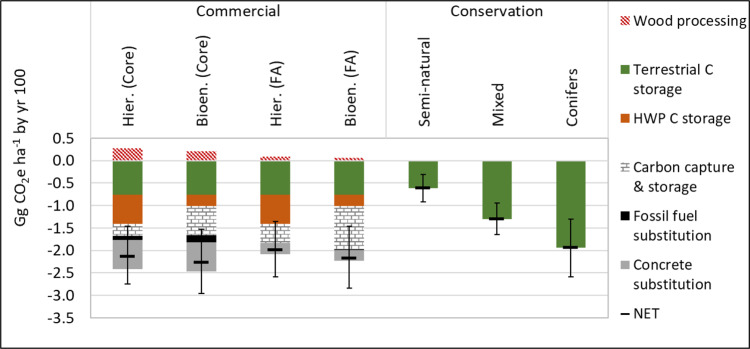
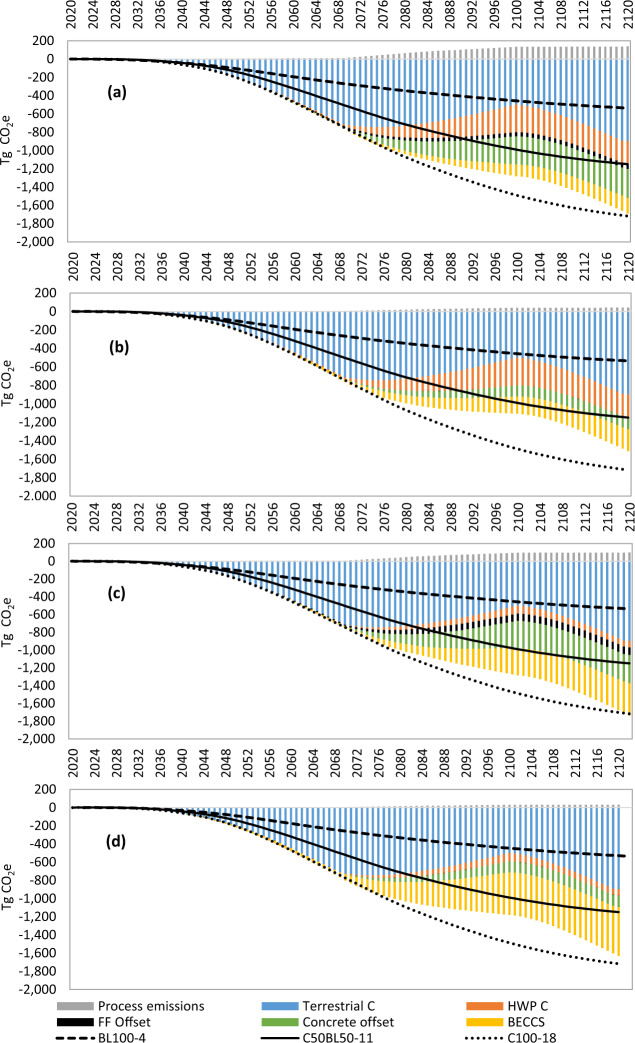
Afforestation is an important greenhouse gas (GHG) mitigation strategy but the efficacy of commercial forestry is disputed. Here, we calculate the potential GHG mitigation of a UK national planting strategy of 30,000 ha yr −1 from 2020 to 2050, using dynamic life cycle assessment. What-if scenarios vary: conifer-broadleaf composition, harvesting, product breakouts, and decarbonisation of substituted energy and materials, to estimate 100-year GHG mitigation. Here we find forest growth rate is the most important determinant of cumulative mitigation by 2120, irrespective of whether trees are harvested. A national planting strategy of commercial forest could mitigate 1.64 Pg CO 2 e by 2120 (cumulative), compared with 0.54–1.72 Pg CO 2 e for planting only conservation forests, depending on species composition. Even after heavy discounting of future product substitution credits based on industrial decarbonisation projections, GHG mitigation from harvested stands typically surpasses unharvested stands. Commercial afforestation can deliver effective GHG mitigation that is robust to future decarbonisation pathways and wood uses.
Overview
The claims and statistics of this paper haven’t been checked yet.
Free: it reads the open-access text and checks the first 5 claims that cite a source we can check. Create a free account to check every claim.
Integrity signals
Registry
Cites
Statistics
Figures
Verification
Claims the paper makes
The claims and statistics of this paper haven’t been checked yet.
Free: it reads the open-access text and checks the first 5 claims that cite a source we can check. Create a free account to check every claim.
Claims other papers make about this one
Each is checked against this paper’s own text: does it say what the citing paper says it does?
The source backs part of the claim, not all of it — or backs it for a different population, condition or comparison.
In the citing paper
“For instance, commercial AR for wood production in tropical regions is less favorable than protection AR for carbon removal (26), but commercial AR in temperate regions show greater GHG mitigation potential (18).”
From Climate-smart forestry through innovative wood products and commercial afforestation and reforestation on marginal land (2023) · cites this paper as [18]
Experimental — accuracy not yet measuredThe cited source says what the claim attributes to it.
In the citing paper
“The GHG mitigation potential of commercial and protection AR has been highlighted in the literature (3, 18–25), but their GHG mitigation efficacy has been debated (18, 26, 27).”
From Climate-smart forestry through innovative wood products and commercial afforestation and reforestation on marginal land (2023) · cites this paper as [18]
The cited source says what the claim attributes to it.
In the citing paper
“GHG mitigation efficacy of AR depends on regional contexts, such as local climate conditions (18, 26), forest plantation management strategies (3, 19, 27–30), tree species (28, 31), and wood product types and their life cycle activities [e.g., manufacturing processes, use phase, substitution benefits, and end of life (EOL)] (18, 19, 29, 30).”
From Climate-smart forestry through innovative wood products and commercial afforestation and reforestation on marginal land (2023) · cites this paper as [18]
The cited source says what the claim attributes to it.
In the citing paper
“Previous studies have compared protection and commercial forest plantations for traditional wood products (18) or compared different product combinations in existing forests (19).”
From Climate-smart forestry through innovative wood products and commercial afforestation and reforestation on marginal land (2023) · cites this paper as [18]
Self-check
Percentages, sums and reported differences re-computed from the paper’s own numbers.
The self-check needs the paper’s full text.
Citations
Cites
The ecoinvent database version 3 (part I): overview and methodology
Wernet, G., Bauer, C., Steubing, B., Reinhard, J., Moreno-Ruiz, E., & Weidema, B. (2016) · The International Journal of Life Cycle Assessment · doi:10.1007/s11367-016-1087-8 · Cited by 5,564
Options for keeping the food system within environmental limits
Springmann, M., Clark, M., Mason-D’Croz, D., Wiebe, K., Bodirsky, B. L., Lassaletta, L., de Vries, W., Vermeulen, S. J., Herrero, M., Carlson, K. M., et al. (2018) · Nature · doi:10.1038/s41586-018-0594-0 · Cited by 3,380
The global tree restoration potential
Bastin, J.-F., Finegold, Y., Garcia, C., Mollicone, D., Rezende, M., Routh, D., Zohner, C. M., & Crowther, T. W. (2019) · Science · doi:10.1126/science.aax0848 · Cited by 2,197
Old-growth forests as global carbon sinks
Luyssaert, S., Schulze, E. D., Börner, A., Knohl, A., Hessenmöller, D., Law, B. E., Ciais, P., & Grace, J. (2008) · Nature · doi:10.1038/nature07276 · Cited by 1,875
IPCC (2022) · Cambridge University Press eBooks · doi:10.1017/9781009157940 · Cited by 1,482
Higher levels of multiple ecosystem services are found in forests with more tree species
Gamfeldt, L., Snäll, T., Bagchi, R., Jonsson, M., Gustafsson, L., Kjellander, P., Ruiz-Jaen, M. C., Fröberg, M., Stendahl, J., Philipson, C. D., et al. (2013) · Nature Communications · doi:10.1038/ncomms2328 · Cited by 1,477
Restoring natural forests is the best way to remove atmospheric carbon
Lewis, S. L., Wheeler, C. E., Mitchard, E. T. A., & Koch, A. (2019) · Nature · doi:10.1038/d41586-019-01026-8 · Cited by 946
Local cooling and warming effects of forests based on satellite observations
Li, Y., Zhao, M., Motesharrei, S., Mu, Q., Kalnay, E., & Li, S. (2015) · Nature Communications · doi:10.1038/ncomms7603 · Cited by 733 · cited 1×
“HWP carbon storage of 69 (53-85) Tg C by 2120 in the Hierarchical value chains (Supplementary Data 1) is likely to increase further following subsequent harvests and cascading use of the circa 140 Tg of wood dry matter remaining within the built environment at the end of the studied time horizon.”
BackgroundAlternative pathways to the 1.5 °C target reduce the need for negative emission technologies
van Vuuren, D. P., Stehfest, E., Gernaat, D. E. H. J., van den Berg, M., Bijl, D. L., de Boer, H. S., Daioglou, V., Doelman, J. C., Edelenbosch, O. Y., Harmsen, M., et al. (2018) · Nature Climate Change · doi:10.1038/s41558-018-0119-8 · Cited by 662
A reassessment of carbon content in wood: variation within and between 41 North American species
Lamlom, S. H., & Savidge, R. A. (2003) · Biomass and Bioenergy · doi:10.1016/s0961-9534(03)00033-3 · Cited by 640
Research works printed but not linked: 7
- Nabuurs, G. J. et al. Forestry. In Climate Change 2007: Mitigation. Contribution of Working Group III to the Fourth Assessment Report of the Intergovernmental Panel on Climate Change (ed. Nabuurs, G. J.) 1–44 (Cambridge University Press, 2007).
- Weidema, B. P., Ekvall, T. & Heijungs, R. Guidelines for Application of Deepened and Broadened LCA. https://pdfs.semanticscholar.org/8be5/9252f6790328a6360d506df522de78bbce4c.pdf (2009).
- Kurz WA Smyth C Lempriere T Climate change mitigation through forest sector activities: principles, potential and prioritiese Unasylva 2016 67 61 67
- European Commission. Directive 2009/31/EC of the European Parliament and of the Council of 23 April 2009 on the geological storage of carbon dioxide and amending Council Directive 85/337/EEC, European Parliament and Council Directives 2000/60/EC, 2001/80/EC, 2004/35/EC, 2006/. Official Journal of the European Union vol. L140/114 114–135 (2009).
- IPCC. 2006IPCC Guidelines for National Greenhouse Gas InventoriesVolume 4 Chapter 4. http://www.ipcc-nggip.iges.or.jp/public/2006gl/pdf/4_Volume4/V4_04_Ch4_Forest_Land.pdf (2006).
- Timber Trade Federation. TTF Statistical Review 2017: Industry Facts and Figures for the Year 2016. https://ttf.co.uk/download/ttf-statistical-review-2017/ (2017).
- IPCC. 2006IPCC Guidelines for National Greenhouse Gas InventoriesVolume 4 Chapter 2. http://www.ipcc-nggip.iges.or.jp/public/2006gl/pdf/4_Volume4/V4_02_Ch2_Generic.pdf (2006).
Cited by
Items 101–184 of 184
Suitor, S., Hadley, D., & Ximenes, F. A. (2025) · Land · doi:10.3390/land14030473 · Cited by 4
Improving biogenic carbon and land use accounting for construction wood
Horan, W., Quilligan, M., Bishop, G., & Styles, D. (2025) · Resources Conservation and Recycling · doi:10.1016/j.resconrec.2025.108434 · Cited by 4
Self-citationLohmander, P. (2022) · Biomedical Journal of Scientific & Technical Research · doi:10.26717/bjstr.2022.47.007501 · Cited by 3
Hirth, S., Drlička, I., Paterson, M., & Thomas, P. W. (2025) · Land Use Policy · doi:10.1016/j.landusepol.2025.107620 · Cited by 3
Aryal, J. P. (2022) · doi:10.56506/vaoy9373 · Cited by 3
“Forster et al. (2021) have shown that forest growth rate is crucial in determining cumulative mitigation.”
BackgroundKitchen, D. E. (2023) · The Conversation · doi:10.64628/aai.kvjwnnnuv · Cited by 3
Sharma, J., & Kumar, P. (2025) · Environmental Research Climate · doi:10.1088/2752-5295/ae228d · Cited by 2
“Forest growth rate influences mitigation potential (Forster et al 2021), with afforestation projected to offset 4.9 GtCO ₂ per year by 2050 at a cost of $200/tCO ₂ (Doelman et al 2020).”
InfluentialHan, Z., Oosawa, K., Kanematsu, Y., Teah, H. Y., & Kikuchi, Y. (2026) · Resources Conservation & Recycling Advances · doi:10.1016/j.rcradv.2026.200314 · Cited by 2
Biochar from Livestock Waste: A Pathway to Sustainable Agriculture and Climate Change Mitigation
Preuss, N., Lehmann, J. C., & You, F. (2026) · Environmental Science & Technology · doi:10.1021/acs.est.5c11216 · Cited by 2
Otsuki, S., & Yamamoto, K. (2026) · Journal of Forest Research · doi:10.1080/13416979.2026.2656555 · Cited by 2
“Such efforts are expected to increase for both commercial and non-commercial purposes (Nilsson and Schopfhauser 1995; Zhang et al. 2016; Forster et al. 2021), and continuous management is essential for their success (Holl and Brancalion 2020; Lefebvre et al. 2021).”
Stephan, L., Schulte, I., & Fuss, S. (2026) · Environmental Research Letters · doi:10.1088/1748-9326/ae608b · Cited by 2
“Despite this, it is not yet a regular component of assessments of the implementation of A/R for climate change mitigation (Forster et al 2021, Walker et al 2022, Hasler et al 2024).”
Dynamic carbon accounting alters the interpretation of emissions in forest–wood product systems
Qian, Y., Gunawardena, T., Mendis, P., & Aye, L. (2026) · Resources Conservation and Recycling · doi:10.1016/j.resconrec.2026.108992 · Cited by 2
Scoping review of climate-smart forestry for carbon sequestration in boreal and temperate forests
Tognetti, R., & Torresan, C. (2026) · European Journal of Forest Research · doi:10.1007/s10342-026-01915-4 · Cited by 3
“While habitat restoration is considered a key strategy for recovering imperilled species, ecosystem restoration may collide with maximising carbon storage.”
Styles, D., Henn, D., Duffy, C., Black, K., & Arce, A. M. (2026) · npj Sustainable Agriculture · doi:10.1038/s44264-026-00185-2 · Cited by 2
“…forests and extensive cattle grazing in the Cattle + Nature pathway would enhance biodiversity and biophysical resilience, but reduce food output and weaken climate mitigation 40 relative to the conifer-dominated forests and more intensive dairy cattle systems within the other transition pathways.”
Self-citationCarbon Sequestration and Climate Change Mitigation
Kamal, M. Z. U., Akter, M., Binte, B. I., & Mina, K. K. (2024) · Springer eBooks · doi:10.1007/978-981-97-6635-2_15 · Cited by 2
Feasibility of woodland expansion for carbon offsetting in Scotland revisited
Ovando, P., Castellazzi, M., Baggio-Compagnucci, A., Hewitt, R. J., & Gimona, A. (2025) · Forest Policy and Economics · doi:10.1016/j.forpol.2025.103481 · Cited by 4
Analyse d’une stratégie de production de bois : perspectives d’experts
Canuel, C., Bernard, A., Thiffault, N., Gélinas, N., Drapeau, P., Thiffault, É., & Bélanger, N. (2022) · The Forestry Chronicle · doi:10.5558/tfc2022-003 · Cited by 2
Wynne‐Jones, S., Dandy, N., Bodner, T., & Healey, J. R. (2022) · Routledge eBooks · doi:10.4324/9781003200208-7 · Cited by 2
Self-citationRising Carbon Price and the Paradoxes of Forest-based Sequestration
Price, C. G., & Willis, R. (2022) · Journal of Forest Economics · doi:10.1561/112.00000557 · Cited by 3
Circular Economy Benefit Indicators for Using Biochar in Regenerative AgriculturePreprint
Baltrėnaitė, E., Huisingh, D., & Yrjälä, K. (2023) · Research Square · doi:10.21203/rs.3.rs-2956227/v1 · Cited by 3
Carbon Capture by Photosynthesis of Plants
Bose, A., O’Shea, R., De, S. K., & Murphy, J. D. (2023) · Elsevier eBooks · doi:10.1016/b978-0-323-93940-9.00052-9 · Cited by 4
Implications for conservation zoning in Teiči Strict Nature Reserve due to land use and cover change
Krūmiņš, J., Kļaviņš, M., & Stankeviča, K. (2024) · Frontiers in Remote Sensing · doi:10.3389/frsen.2024.1497454 · Cited by 1
Guo, Y., Li, S., Tang, H., & He, Z. (2025) · IEEE Journal of Selected Topics in Applied Earth Observations and Remote Sensing · doi:10.1109/jstars.2025.3591398 · Cited by 1
Yao, T., Wang, J., Zhao, M., Xiong, T., Lu, L., & Xia, Y. (2025) · Sustainability · doi:10.3390/su17167379 · Cited by 1
Reducing logging intensity in north temperate rainforests for climate and economic benefits
Dymond, C. C., Venter, M., Lilles, E. B., Barros, L. D. A., Farnell, I., Hirsh‐Pearson, K., Ramírez‐Delgado, J. P., & Venter, O. (2025) · Forest Ecology and Management · doi:10.1016/j.foreco.2025.123163 · Cited by 1
Self-citationHarvested wood products' full lifecycle assessment for sustainable construction: A Systemised review
Eisimsidele, J. I., O’Donoghue, C., & McGetrick, P. J. (2025) · Cleaner Waste Systems · doi:10.1016/j.clwas.2025.100430 · Cited by 2
Shan, R., Chen, H. Y. H., & Ma, Z. (2025) · Journal of Ecology · doi:10.1111/1365-2745.70182 · Cited by 1
“…regular logging rotations to alleviate competition constraints on acquisitive trees, and (2) selecting planting sites in regions with shorter forestry cycles (e.g. subtropical areas) to enhance economic returns and carbon sequestration benefits (Bukoski et al., 2022 ; Forster et al., 2021 ).”
Ohiaeri, O., Portillo‐Quintero, C., & Laza, H. E. (2025) · Sensors · doi:10.3390/s25226821 · Cited by 1
“These changes manifest in grassland ecosystems through shifts in widespread greening and browning patterns, altered species composition and changes in productivity [3–5], large-scale afforestation [1,6], deforestation, and agricultural expansion [7,8].”
A theory of change for transformation of the productive forest system in the United Kingdom
Urquhart, J., Goodenough, A., Healey, J. R., & Ambrose‐Oji, B. (2025) · Forestry An International Journal of Forest Research · doi:10.1093/forestry/cpaf081 · Cited by 2
Self-citationHannadige, N., Fu, G., van Diedenhoven, B., Jia, H., Yuan, Z., & Hasekamp, O. (2026) · Journal of Quantitative Spectroscopy and Radiative Transfer · doi:10.1016/j.jqsrt.2026.109853 · Cited by 1
Suzuki, A., Kanematsu, Y., Heiho, A., Fushimi, M., Kita, S., Nakamura, K., & Kikuchi, Y. (2026) · Resources Conservation and Recycling · doi:10.1016/j.resconrec.2026.108922 · Cited by 1
Optimized afforestation reduces flood risk and limits water loss in Europe
Garroussi, S. E., Wetterhall, F., Barnard, C., Mazzetti, C., Lombardi, A., & Giuseppe, F. D. (2026) · Communications Sustainability · doi:10.1038/s44458-026-00057-3 · Cited by 2
Guillemot, J., Maire, G. L., Campoe, O. C., Laclau, J., Stape, J. L., Cornut, I., Rojas, J. S. D., Álvares, C. A., Barros, G. M., Bonnefond, J.-M., et al. (2026) · Global Change Biology · doi:10.1111/gcb.70881 · Cited by 1
Diverse land-use systems in the Eastern Himalayas: Ecological dynamics and carbon storage potential
Bhutia, P. L., Kawikhonliu, Z., Singh, N. R., Choudhury, B. U., Rangappa, K., Sarkar, P., Verma, H., Kumar, A., Kalita, H., & Mishra, V. K. (2026) · Elsevier eBooks · doi:10.1016/b978-0-443-34098-7.00027-1 · Cited by 1
Pines grow faster and are more drought resilient in the Southern Hemisphere
Fajardo, A., Gazol, A., Camarero, J. J., Gundale, M. J., Piper, F. I., Brewer, J. S., Buxton, R. P., Cieraad, E., Dezzotti, A., Fernández‐Cortés, Á., et al. (2026) · Nature · doi:10.1038/s41586-026-10969-8 · Cited by 1
“27,28).”
Factors Effecting Afforestation Program in Nigeria: Building a Conceptual Framework
Geidam, A. A., & Mohamad, L. Z. (2022) · International Journal of Academic Research in Business and Social Sciences · doi:10.6007/ijarbss/v12-i12/15679 · Cited by 1
Pre‒Emptive Life Cycle Thinking for Utilization of Lignocellulosic Resources
Kikuchi, Y. (2024) · JAPAN TAPPI JOURNAL · doi:10.2524/jtappij.78.934 · Cited by 1
Styles, D., & Berndes, G. (2025) · Biomass and Bioenergy · doi:10.1016/j.biombioe.2025.107623 · Cited by 1
Self-citationZero carbon agriculture: Sustainable practices and technologies for carbon-neutral food production
Pavithra, S. I., Leninraja, D., Kaliappan, S. B., Dhevagi, P., Beaulah, A., & Kavitha, M. P. (2025) · Plant Science Today · doi:10.14719/pst.7014 · Cited by 1
Can Forest Certification Schemes Really Drive Economic Value to European Forest Owners?Preprint
Corticeiro, S. C., Tomé, M., & Vieira, H. (2023) · Preprints.org · doi:10.20944/preprints202311.1966.v1 · Cited by 1
Biochar and Atmospheric Carbon Dioxide Removal
Burns, W. (2024) · Springer eBooks · doi:10.1007/978-3-030-67776-3_64-1 · Cited by 1
Duffy, C. P. (2021) · Geoscientific model development · doi:10.5194/gmd-2021-228-ac1
(2021) · Geoscientific model development · doi:10.5194/gmd-2021-228-rc2
Duffy, C. P. (2021) · Geoscientific model development · doi:10.5194/gmd-2021-228-ac7
Duffy, C. P. (2021) · Geoscientific model development · doi:10.5194/gmd-2021-228-ac4
Duffy, C. P. (2021) · Geoscientific model development · doi:10.5194/gmd-2021-228-ac3
Duffy, C. P. (2021) · Geoscientific model development · doi:10.5194/gmd-2021-228-ac5
Duffy, C. P. (2021) · Geoscientific model development · doi:10.5194/gmd-2021-228-ac6
(2021) · Geoscientific model development · doi:10.5194/gmd-2021-228-rc1
Duffy, C. P. (2021) · Geoscientific model development · doi:10.5194/gmd-2021-228-ac2
Bartels, L. E. (2020) · AEA Randomized Controlled Trials · doi:10.1257/rct.6319-1.0
New Products from Wood Fibre and Their Potential Role in Carbon SequestrationPreprint
Jarvis, M. C. (2023) · Preprints.org · doi:10.20944/preprints202306.0018.v1
Bartels, L. E., Kesternich, M., & Löschel, A. (2020) · AEA Randomized Controlled Trials · doi:10.1257/rct.6319-2.0
(2024) · Elsevier eBooks · doi:10.1016/b978-0-12-815024-5.16001-x
Strategies for mitigating the effects of climate change
Fayaz, A., & Komal, K. (2025) · International Journal of Research in Agronomy · doi:10.33545/2618060x.2025.v8.i2c.2561
Pricing the Cost of Carbon Using Net Emissions Technologies
Makamela, K. C. (2025) · Springer proceedings in business and economics · doi:10.1007/978-3-031-84885-8_29
Hamaguchi, Y. (2025) · Springer eBooks · doi:10.1007/978-981-96-5674-5_6
Marine-Based Carbon Dioxide Removal: The Promise and Perils of Ocean Fertilization
Burns, W., & Boyd, P. W. (2024) · Springer eBooks · doi:10.1007/978-1-4614-6431-0_195-1
Opdatering af skovfremskrivning:Forventet drivhusgasregnskab for de danske skove 2020-2050
Johannsen, V. K., Nord‐Larsen, T., & Bentsen, N. S. (2022) · Research at the University of Copenhagen (University of Copenhagen)
Future-Oriented LCA for Materials Derived from Plant Resources
Kikuchi, Y. (2025) · Journal of Life Cycle Assessment Japan · doi:10.3370/lca.21.166
Ferranti, E. J. S., Jaluzot, A., James, S., & Doick, K. J. (2023) · doi:10.1680/icembgi.65420.135
Marine-Based Carbon Dioxide Removal: The Promise and Perils of Ocean Fertilization
Burns, W., & Boyd, P. W. (2025) · Springer eBooks · doi:10.1007/978-3-031-84483-6_195
Modelling the influence of widespread afforestation on UK hydrology
Buechel, M. (2023) · Oxford University Research Archive (ORA) (University of Oxford) · doi:10.5287/ora-a4amjyr70
Diversidad taxonómica y funcional de aves en pastizales forestados de Uruguay
Fernández Santiago, P. G. (2023) · LA Referencia (Red Federada de Repositorios Institucionales de Publicaciones Científicas) · Cited by 1
Science Advice for Policy by European Academies, S. (2024) · White Rose Research Online (University of Leeds, The University of Sheffield, University of York)
Berglund, S., Langlet, A., Mylläri, A., & Rosberg, J. (2024) · KTH Publication Database DiVA (KTH Royal Institute of Technology)
Chang, C., Lo, H., Wei, C., Chen, C., & Chen, J. (2026) · Forests · doi:10.3390/f17020169
Dynamic carbon accounting alters the interpretation of emissions in forest–wood product systemsPreprint
Qian, Y., Gunawardena, T., Mendis, P., & Aye, L. (2026) · SSRN Electronic Journal · doi:10.2139/ssrn.6187371
Dynamic carbon accounting alters the interpretation of emissions in forest–wood product systemsPreprint
Qian, Y., Gunawardena, T., Mendis, P., & Aye, L. (2026) · SSRN Electronic Journal · doi:10.2139/ssrn.6187370
Afforestation and Reforestation as Cost-Effective Mitigation Tools
Bellion, B. (2026) · Future Earth A Student Journal on Sustainability and Environment · doi:10.29173/bcelnfe760
“A/R is commonly considered a cost-efficient policy for climate change mitigation (Doelman et al., 2019; Forster et al., 2021).”
Sui, Q., ZHAO, Y., Zhao, Y., Zhen, Z., & Wang, X. (2026) · Resources Conservation and Recycling · doi:10.1016/j.resconrec.2026.109054
Climate change as the product of a system
DeGrandi‐Hoffman, G. (2026) · Elsevier eBooks · doi:10.1016/b978-0-443-28995-8.00006-4
Lambert, L. H., English, B. C., Davis, M. R., & Langholtz, M. (2026) · Forestry An International Journal of Forest Research · doi:10.1093/forestry/cpag062
Dymond, C. C., Robertson, A. B., & Hopwood, D. (2026) · Global Environmental Change Advances · doi:10.1016/j.gecadv.2026.100040
Self-citationInforming afforestation decisions with expert knowledge on forest biodiversity
Harrington, K., Mitchell, F. J. G., Ryan, M., O’Donoghue, C., & Stout, J. C. (2026) · European Journal of Forest Research · doi:10.1007/s10342-026-01952-z
“While the trade-offs between timber production and car - bon sequestration/storage have been investigated in detail (Forster et al. 2021; Ryan and O’Donoghue 2021; Triviño et al. 2015), biodiversity has rarely been factored into whole production-cycle models, although there are notable exceptions.”
Ye, X., Zhong, J., Wang, K., Luan, J., Wang, H., Ming, A., Wang, Y., & Liu, S. (2026) · Forest Ecosystems · doi:10.1016/j.fecs.2026.100547
Circularity measures enhance resilience of net zero pathways for agriculture
Henn, D., Domínguez, C. G., Arce, A. M., Bishop, G. D., Duffy, C. P., Lind, V., & Styles, D. (2026) · Communications Earth & Environment · doi:10.1038/s43247-026-04052-3
“Considering that in current practice about 70% of afforestation takes place with coniferous species, this is a due to faster growth rates and lower land demand when utilising a larger share of coniferous species 22,80 .”
Self-citationProcessi ecofisiologici ed ecosistemici nei boschi vetusti
Tognetti, R. (2026) · L’Italia forestale e montana · doi:10.36253/ifm-1206
Kärkkäinen, L., Kurttila, M., & Räty, M. (2026) · Scandinavian Journal of Forest Research · doi:10.1080/02827581.2026.2742937
Thomson, I., Lindsay, O., Allen, H., Averill, C., Brekke, T. D., Nicholls, C., Steidinger, B. S., Vanguelova, E., Waring, B. G., Suz, L. M., et al. (2026) · bioRxiv (Cold Spring Harbor Laboratory) · doi:10.64898/2026.10.26.761856
Isaac, P., Bergsagel, D., Koeck, A., Ridley-Ellis, D., & Cramer, M. (2026) · Wood Material Science and Engineering · doi:10.1080/17480272.2026.2750192
Warner, E., Cook-Patton, S. C., Lewis, O. T., Brown, N., Koricheva, J., Eisenhauer, N., Ferlian, O., Gravel, D., Hall, J. S., Jactel, H., et al. (2023) · doi:10.3389/ffgc.2023.1226514.s001
Metadata
- Authors
- Forster, E. J., Healey, J. R., Dymond, C., & Styles, D.
- Affiliations
- Bangor University (GB)
- Government of British Columbia (CA)
- Corresponding author
- Styles, David
- Venue
- Nature Communications
- Published
- 2021-06-22
- Volume
- 12
- Issue
- 1
- Pages
- 3831-3831
- ISSN
- 2041-1723 (ISSN-L)
- PMC
- PMC8219817
- OpenAlex
- W3174242269
- Semantic Scholar
- d7775678124ec647467a63c327b320f331eafb72
- Cited by
- 169
- References
- 50
- Citations by year
- 2026: 26 · 2025: 33 · 2024: 29 · 2023: 29 · 2022: 34 · 2021: 18
- FWCI
- 11.27
- Type
- journal article
- Language
- en
- Open access
- gold
- doi.org
- Licence
- cc-by
- creativecommons.org/licenses/by/4.0 (tdm)
- creativecommons.org/licenses/by/4.0 (vor)
- Locations
- Nature Communications (publishedVersion, cc-by)
- PubMed Central (publishedVersion, cc-by)
- PubMed (publishedVersion)
- Arrow@dit (Dublin Institute of Technology) (acceptedVersion)
- University of Limerick Institutional Repository (University of Limerick) (acceptedVersion, cc-by-nc-sa)
- RePEc: Research Papers in Economics (submittedVersion)
- DOAJ (DOAJ: Directory of Open Access Journals) (submittedVersion, cc-by-sa)
- Figshare (submittedVersion, cc-by-nc-sa)
- Bangor University Research Portal (Bangor University) (submittedVersion, other-oa)
- University of Limerick Institutional Repository (University of Limerick) (submittedVersion, cc-by-nc-sa)
- University of Limerick Institutional Repository (University of Limerick)
- Funders
- RCUK | Natural Environment Research Council (ENVISION Studentship)
- Topics
- Life Sciences › Agricultural and Biological Sciences › Forestry › Forest Management and Policy
- Life Sciences › Agricultural and Biological Sciences › Forestry › Forest ecology and management
- Social Sciences › Economics, Econometrics and Finance › Economics and Econometrics › Climate Change Policy and Economics
- Keywords
- climate change mitigation, greenhouse gas emissions reduction, dynamic life cycle assessment, forest growth rate, logging, industrial decarbonization, conservation forest
About these checks
Registry, retraction, Cites and statistics results are computed, not judged, with one exception: a printed reference that no index lists is read once by a model before it counts as a citation error. Claims are extracted by a model and kept only when their quote appears verbatim in the text; each cited source is then checked, with a model’s help, for whether it says what the claim relies on. Those verdicts can be wrong — read the claim’s quote and the cited source before relying on one.
Statistics and arithmetic are recomputed, not judged.
Confidence bands are shown only for fields calibrated on our annotated test set. None is calibrated yet, so no band is shown.
What counts as a claim ›How we measure confidence ›How we check this ›
Are you an author, or do you see a problem with this page? Request a review
Data sources
Bibliographic data: Semantic Scholar, OpenAlex, Crossref.
Contains information from the Semantic Scholar Academic Graph Datasets, made available under the ODC Attribution License (ODC-BY 1.0).
Semantic Scholar’s data is described in: Kinney, R., et al. (2023). The Semantic Scholar Open Data Platform. arXiv:2301.10140.
