

Commercial afforestation can deliver effective climate change mitigation under multiple decarbonisation pathways
Open accessThe DOI matches its Crossref record; 49 of the 50 references it cites were found in a registry or an index.
Abstract
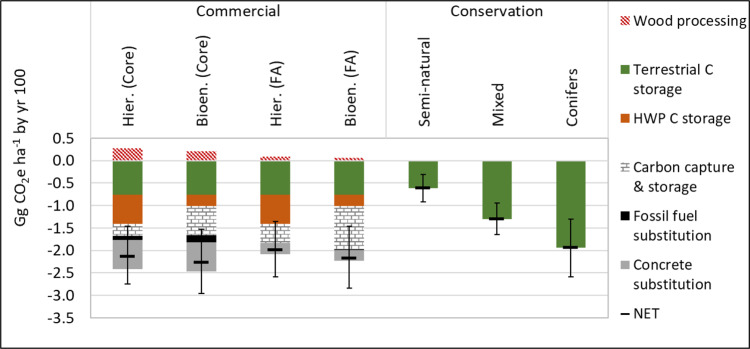
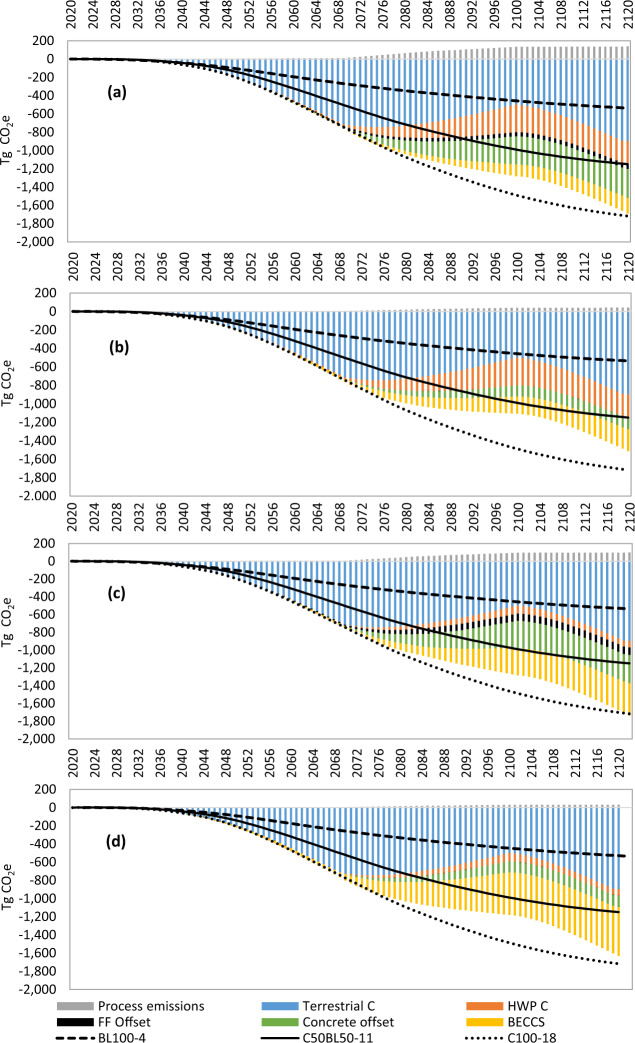
Afforestation is an important greenhouse gas (GHG) mitigation strategy but the efficacy of commercial forestry is disputed. Here, we calculate the potential GHG mitigation of a UK national planting strategy of 30,000 ha yr −1 from 2020 to 2050, using dynamic life cycle assessment. What-if scenarios vary: conifer-broadleaf composition, harvesting, product breakouts, and decarbonisation of substituted energy and materials, to estimate 100-year GHG mitigation. Here we find forest growth rate is the most important determinant of cumulative mitigation by 2120, irrespective of whether trees are harvested. A national planting strategy of commercial forest could mitigate 1.64 Pg CO 2 e by 2120 (cumulative), compared with 0.54–1.72 Pg CO 2 e for planting only conservation forests, depending on species composition. Even after heavy discounting of future product substitution credits based on industrial decarbonisation projections, GHG mitigation from harvested stands typically surpasses unharvested stands. Commercial afforestation can deliver effective GHG mitigation that is robust to future decarbonisation pathways and wood uses.
Overview
The claims and statistics of this paper haven’t been checked yet.
Free: it reads the open-access text and checks the first 5 claims that cite a source we can check. Create a free account to check every claim.
Integrity signals
Registry
Cites
Statistics
Figures
Verification
Claims the paper makes
The claims and statistics of this paper haven’t been checked yet.
Free: it reads the open-access text and checks the first 5 claims that cite a source we can check. Create a free account to check every claim.
Claims other papers make about this one
Each is checked against this paper’s own text: does it say what the citing paper says it does?
The source backs part of the claim, not all of it — or backs it for a different population, condition or comparison.
In the citing paper
“For instance, commercial AR for wood production in tropical regions is less favorable than protection AR for carbon removal (26), but commercial AR in temperate regions show greater GHG mitigation potential (18).”
From Climate-smart forestry through innovative wood products and commercial afforestation and reforestation on marginal land (2023) · cites this paper as [18]
Experimental — accuracy not yet measuredThe cited source says what the claim attributes to it.
In the citing paper
“The GHG mitigation potential of commercial and protection AR has been highlighted in the literature (3, 18–25), but their GHG mitigation efficacy has been debated (18, 26, 27).”
From Climate-smart forestry through innovative wood products and commercial afforestation and reforestation on marginal land (2023) · cites this paper as [18]
The cited source says what the claim attributes to it.
In the citing paper
“GHG mitigation efficacy of AR depends on regional contexts, such as local climate conditions (18, 26), forest plantation management strategies (3, 19, 27–30), tree species (28, 31), and wood product types and their life cycle activities [e.g., manufacturing processes, use phase, substitution benefits, and end of life (EOL)] (18, 19, 29, 30).”
From Climate-smart forestry through innovative wood products and commercial afforestation and reforestation on marginal land (2023) · cites this paper as [18]
The cited source says what the claim attributes to it.
In the citing paper
“Previous studies have compared protection and commercial forest plantations for traditional wood products (18) or compared different product combinations in existing forests (19).”
From Climate-smart forestry through innovative wood products and commercial afforestation and reforestation on marginal land (2023) · cites this paper as [18]
Self-check
Percentages, sums and reported differences re-computed from the paper’s own numbers.
The self-check needs the paper’s full text.
Citations
Cites
The ecoinvent database version 3 (part I): overview and methodology
Wernet, G., Bauer, C., Steubing, B., Reinhard, J., Moreno-Ruiz, E., & Weidema, B. (2016) · The International Journal of Life Cycle Assessment · doi:10.1007/s11367-016-1087-8 · Cited by 5,564
Options for keeping the food system within environmental limits
Springmann, M., Clark, M., Mason-D’Croz, D., Wiebe, K., Bodirsky, B. L., Lassaletta, L., de Vries, W., Vermeulen, S. J., Herrero, M., Carlson, K. M., et al. (2018) · Nature · doi:10.1038/s41586-018-0594-0 · Cited by 3,380
The global tree restoration potential
Bastin, J.-F., Finegold, Y., Garcia, C., Mollicone, D., Rezende, M., Routh, D., Zohner, C. M., & Crowther, T. W. (2019) · Science · doi:10.1126/science.aax0848 · Cited by 2,197
Old-growth forests as global carbon sinks
Luyssaert, S., Schulze, E. D., Börner, A., Knohl, A., Hessenmöller, D., Law, B. E., Ciais, P., & Grace, J. (2008) · Nature · doi:10.1038/nature07276 · Cited by 1,875
IPCC (2022) · Cambridge University Press eBooks · doi:10.1017/9781009157940 · Cited by 1,482
Higher levels of multiple ecosystem services are found in forests with more tree species
Gamfeldt, L., Snäll, T., Bagchi, R., Jonsson, M., Gustafsson, L., Kjellander, P., Ruiz-Jaen, M. C., Fröberg, M., Stendahl, J., Philipson, C. D., et al. (2013) · Nature Communications · doi:10.1038/ncomms2328 · Cited by 1,477
Restoring natural forests is the best way to remove atmospheric carbon
Lewis, S. L., Wheeler, C. E., Mitchard, E. T. A., & Koch, A. (2019) · Nature · doi:10.1038/d41586-019-01026-8 · Cited by 946
Local cooling and warming effects of forests based on satellite observations
Li, Y., Zhao, M., Motesharrei, S., Mu, Q., Kalnay, E., & Li, S. (2015) · Nature Communications · doi:10.1038/ncomms7603 · Cited by 733 · cited 1×
“HWP carbon storage of 69 (53-85) Tg C by 2120 in the Hierarchical value chains (Supplementary Data 1) is likely to increase further following subsequent harvests and cascading use of the circa 140 Tg of wood dry matter remaining within the built environment at the end of the studied time horizon.”
BackgroundAlternative pathways to the 1.5 °C target reduce the need for negative emission technologies
van Vuuren, D. P., Stehfest, E., Gernaat, D. E. H. J., van den Berg, M., Bijl, D. L., de Boer, H. S., Daioglou, V., Doelman, J. C., Edelenbosch, O. Y., Harmsen, M., et al. (2018) · Nature Climate Change · doi:10.1038/s41558-018-0119-8 · Cited by 662
A reassessment of carbon content in wood: variation within and between 41 North American species
Lamlom, S. H., & Savidge, R. A. (2003) · Biomass and Bioenergy · doi:10.1016/s0961-9534(03)00033-3 · Cited by 640
Zhou, X., Li, X., Ye, Y., Zhao, K., Zhuang, Y., Li, Y., Wei, Y., & Wu, M. (2015) · Nature Communications · doi:10.1038/ncomms9679 · Cited by 628
The key role of forests in meeting climate targets requires science for credible mitigation
Grassi, G., House, J., Dentener, F., Federici, S., den Elzen, M., & Penman, J. (2017) · Nature Climate Change · doi:10.1038/nclimate3227 · Cited by 601
CBM-CFS3: A model of carbon-dynamics in forestry and land-use change implementing IPCC standards
Kurz, W. A., Dymond, C. C., White, T. M., Stinson, G., Shaw, C. H., Rampley, G. J., Smyth, C., Simpson, B. N., Neilson, E. T., Trofymow, J. A., et al. (2009) · Ecological Modelling · doi:10.1016/j.ecolmodel.2008.10.018 · Cited by 565
Self-citationEurope’s forest management did not mitigate climate warming
Naudts, K., Chen, Y., McGrath, M. J., Ryder, J., Valade, A., Otto, J., & Luyssaert, S. (2016) · Science · doi:10.1126/science.aad7270 · Cited by 421
Afforestation for climate change mitigation: Potentials, risks and trade‐offs
Doelman, J. C., Stehfest, E., van Vuuren, D. P., Tabeau, A., Hof, A. F., Braakhekke, M. C., Gernaat, D. E. H. J., van den Berg, M., van Zeist, W., Daioglou, V., et al. (2020) · Global Change Biology · doi:10.1111/gcb.14887 · Cited by 382
Understanding the timing and variation of greenhouse gas emissions of forest bioenergy systems
Röder, M., Thiffault, É., Martínez-Alonso, C., Senez-Gagnon, F., Paradis, L., & Thornley, P. (2019) · Biomass and Bioenergy · doi:10.1016/j.biombioe.2018.12.019 · Cited by 326
Albanito, F., Hastings, A., Fitton, N., Richards, M., Martin, M., Dowell, N. M., Bell, D. A., Taylor, S. C., Butnar, I., Li, P., et al. (2019) · GCB Bioenergy · doi:10.1111/gcbb.12630 · Cited by 313
Trade-offs in using European forests to meet climate objectives
Luyssaert, S., Marie, G., Valade, A., Chen, Y.-Y., Njakou Djomo, S., Ryder, J., Otto, J., Naudts, K., Lansø, A. S., Ghattas, J., et al. (2018) · Nature · doi:10.1038/s41586-018-0577-1 · Cited by 257
Substitution effects of wood-based products in climate change mitigation
Leskinen, P., Cardellini, G., González-García, S., Hurmekoski, E., Sathre, R., Seppälä, J., Smyth, C., Stern, T., & Verkerk, P. J. (2018) · From Science to Policy · doi:10.36333/fs07 · Cited by 247
The potential for land sparing to offset greenhouse gas emissions from agriculture
Lamb, A., Green, R., Bateman, I., Broadmeadow, M., Bruce, T., Burney, J., Carey, P., Chadwick, D., Crane, E., Field, R., et al. (2016) · Nature Climate Change · doi:10.1038/nclimate2910 · Cited by 238
By 2050 the Mitigation Effects of EU Forests Could Nearly Double through Climate Smart Forestry
Nabuurs, G.-J., Delacote, P., Ellison, D., Hanewinkel, M., Hetemäki, L., & Lindner, M. (2017) · Forests · doi:10.3390/f8120484 · Cited by 234
A new scenario resource for integrated 1.5 °C research
Huppmann, D., Rogelj, J., Kriegler, E., Krey, V., & Riahi, K. (2018) · Nature Climate Change · doi:10.1038/s41558-018-0317-4 · Cited by 196
Old-growth forest carbon sinks overestimated
Gundersen, P., Thybring, E. E., Nord-Larsen, T., Vesterdal, L., Nadelhoffer, K. J., & Johannsen, V. K. (2021) · Nature · doi:10.1038/s41586-021-03266-z · Cited by 170
Trade-offs between ecosystem services: Water and carbon in a biodiversity hotspot
Chisholm, R. A. (2010) · Ecological Economics · doi:10.1016/j.ecolecon.2010.05.013 · Cited by 166
Carbon management and biodiversity
Huston, M. A., & Marland, G. (2003) · Journal of Environmental Management · doi:10.1016/s0301-4797(02)00190-1 · Cited by 161
Wood product carbon substitution benefits: a critical review of assumptions
Howard, C., Dymond, C. C., Griess, V. C., Tolkien-Spurr, D., & van Kooten, G. C. (2021) · Carbon Balance and Management · doi:10.1186/s13021-021-00171-w · Cited by 141
Self-citationDoes replacing coal with wood lower CO 2 emissions? Dynamic lifecycle analysis of wood bioenergy
Sterman, J. D., Siegel, L., & Rooney-Varga, J. N. (2018) · Environmental Research Letters · doi:10.1088/1748-9326/aaa512 · Cited by 138
Hansen, T. L., Bhander, G. S., Christensen, T. H., Bruun, S., & Jensen, L. S. (2006) · Waste Management & Research: The Journal for a Sustainable Circular Economy · doi:10.1177/0734242x06063053 · Cited by 127
Application of processed organic municipal solid waste on agricultural land – a scenario analysis
Bruun, S., Hansen, T. L., Christensen, T. H., Magid, J., & Jensen, L. S. (2006) · Environmental Modeling & Assessment · doi:10.1007/s10666-005-9028-0 · Cited by 121
Achievement of Paris climate goals unlikely due to time lags in the land system
Brown, C., Alexander, P., Arneth, A., Holman, I., & Rounsevell, M. (2019) · Nature Climate Change · doi:10.1038/s41558-019-0400-5 · Cited by 121
Hof, A. R., Dymond, C. C., & Mladenoff, D. J. (2017) · Ecosphere · doi:10.1002/ecs2.1981 · Cited by 115
Self-citationEnglund, O., Börjesson, P., Berndes, G., Scarlat, N., Dallemand, J.-F., Grizzetti, B., Dimitriou, I., Mola-Yudego, B., & Fahl, F. (2020) · Global Environmental Change · doi:10.1016/j.gloenvcha.2019.101990 · Cited by 99
Vandepaer, L., Treyer, K., Mutel, C., Bauer, C., & Amor, B. (2018) · The International Journal of Life Cycle Assessment · doi:10.1007/s11367-018-1571-4 · Cited by 95
Sustainability: Five steps for managing Europe's forests
Fares, S., Mugnozza, G. S., Corona, P., & Palahí, M. (2015) · Nature · doi:10.1038/519407a · Cited by 94
Harmon, M. E. (2019) · Environmental Research Letters · doi:10.1088/1748-9326/ab1e95 · Cited by 94
Integrating fire risk considerations in landscape-level forest planning
González-Olabarria, J.-R., & Pukkala, T. (2011) · Forest Ecology and Management · doi:10.1016/j.foreco.2010.10.017 · Cited by 90
Damaged forests provide an opportunity to mitigate climate change
Lamers, P., Junginger, M., Dymond, C. C., & Faaij, A. (2014) · GCB Bioenergy · doi:10.1111/gcbb.12055 · Cited by 85
Self-citationWaring, R. H. (2000) · Forestry An International Journal of Forest Research · doi:10.1093/forestry/73.1.65 · Cited by 83
Meeting GHG reduction targets requires accounting for all forest sector emissions
Hudiburg, T. W., Law, B. E., Moomaw, W. R., Harmon, M. E., & Stenzel, J. E. (2019) · Environmental Research Letters · doi:10.1088/1748-9326/ab28bb · Cited by 78
Diversifying managed forests to increase resilience
Dymond, C. C., Tedder, S., Spittlehouse, D. L., Raymer, B., Hopkins, K., McCallion, K., & Sandland, J. (2014) · Canadian Journal of Forest Research · doi:10.1139/cjfr-2014-0146 · Cited by 75
Self-citationThe Effect of Forest Management Options on Forest Resilience to Pathogens
Roberts, M., Gilligan, C. A., Kleczkowski, A., Hanley, N. D., Whalley, A. E., & Healey, J. R. (2020) · Frontiers in Forests and Global Change · doi:10.3389/ffgc.2020.00007 · Cited by 73
Self-citationDymond, C. C. (2012) · Carbon Balance and Management · doi:10.1186/1750-0680-7-8 · Cited by 53
Self-citationSikkema, R., Dallemand, J. F., Matos, C. T., van der Velde, M., & San-Miguel-Ayanz, J. (2017) · Scandinavian Journal of Forest Research · doi:10.1080/02827581.2016.1240228 · Cited by 51
The role of large—scale BECCS in the pursuit of the 1.5°C target: an Earth system model perspective
Muri, H. (2018) · Environmental Research Letters · doi:10.1088/1748-9326/aab324 · Cited by 50
Effect of cascade use on the carbon balance of the German and European wood sectors
Brunet-Navarro, P., Jochheim, H., Kroiher, F., & Muys, B. (2018) · Journal of Cleaner Production · doi:10.1016/j.jclepro.2017.09.135 · Cited by 48
Modeling forest plantations for carbon uptake with the LPJmL dynamic global vegetation model
Braakhekke, M. C., Doelman, J. C., Baas, P., Müller, C., Schaphoff, S., Stehfest, E., & van Vuuren, D. P. (2019) · Earth System Dynamics · doi:10.5194/esd-10-617-2019 · Cited by 48
Hardaker, A., Pagella, T. F., & Rayment, M. B. (2021) · Ecosystem Services · doi:10.1016/j.ecoser.2021.101253 · Cited by 34
Blanco, J. A., Dubois, D., Littlejohn, D., Flanders, D. N., Robinson, P., Moshofsky, M., & Welham, C. V. J. (2015) · Process Safety and Environmental Protection · doi:10.1016/j.psep.2015.04.002 · Cited by 22
Hamad, W. Y., Miao, C., & Beck, S. (2019) · Industrial Biotechnology · doi:10.1089/ind.2019.29172.qyh · Cited by 16
Research works printed but not linked: 7
- Nabuurs, G. J. et al. Forestry. In Climate Change 2007: Mitigation. Contribution of Working Group III to the Fourth Assessment Report of the Intergovernmental Panel on Climate Change (ed. Nabuurs, G. J.) 1–44 (Cambridge University Press, 2007).
- Weidema, B. P., Ekvall, T. & Heijungs, R. Guidelines for Application of Deepened and Broadened LCA. https://pdfs.semanticscholar.org/8be5/9252f6790328a6360d506df522de78bbce4c.pdf (2009).
- Kurz WA Smyth C Lempriere T Climate change mitigation through forest sector activities: principles, potential and prioritiese Unasylva 2016 67 61 67
- European Commission. Directive 2009/31/EC of the European Parliament and of the Council of 23 April 2009 on the geological storage of carbon dioxide and amending Council Directive 85/337/EEC, European Parliament and Council Directives 2000/60/EC, 2001/80/EC, 2004/35/EC, 2006/. Official Journal of the European Union vol. L140/114 114–135 (2009).
- IPCC. 2006IPCC Guidelines for National Greenhouse Gas InventoriesVolume 4 Chapter 4. http://www.ipcc-nggip.iges.or.jp/public/2006gl/pdf/4_Volume4/V4_04_Ch4_Forest_Land.pdf (2006).
- Timber Trade Federation. TTF Statistical Review 2017: Industry Facts and Figures for the Year 2016. https://ttf.co.uk/download/ttf-statistical-review-2017/ (2017).
- IPCC. 2006IPCC Guidelines for National Greenhouse Gas InventoriesVolume 4 Chapter 2. http://www.ipcc-nggip.iges.or.jp/public/2006gl/pdf/4_Volume4/V4_02_Ch2_Generic.pdf (2006).
Cited by
Technologies and perspectives for achieving carbon neutrality
Wang, F., Harindintwali, J. D., Yuan, Z., Wang, M., Wang, F., Li, S., Yin, Z., Huang, L., Fu, Y., Li, L., et al. (2021) · The Innovation · doi:10.1016/j.xinn.2021.100180 · Cited by 1,330
Global warming accelerates soil heterotrophic respiration
Nissan, A., Alcolombri, U., Peleg, N., Galili, N., Jimenez-Martinez, J., Molnar, P., & Holzner, M. (2023) · Nature Communications · doi:10.1038/s41467-023-38981-w · Cited by 188
“Land-use changes, such as deforestation 48 , reforestation 49 , afforestation 50 , and changes in agriculture and land management 51 – 53 , can have a signi fi cant impact on the terrestrial carbon cycle by affecting carbon storage in soil and vegetation.”
Climate Resilient Development Pathways
(IPCC), I. P. O. C. C. (2023) · Cambridge University Press eBooks · doi:10.1017/9781009325844.027 · Cited by 152
Li, S., Brandt, M., Fensholt, R., Kariryaa, A., Igel, C., Gieseke, F. C., Nord‐Larsen, T., Oehmcke, S., Carlsen, A. H., Junttila, S., et al. (2023) · PNAS Nexus · doi:10.1093/pnasnexus/pgad076 · Cited by 134
“Sustainable forest management can mitigate these crises by building carbon stocks, providing materials for a green economy, and develop - ing habitats representing the most important reservoir for biodiversity in the world (3, 4).”
BackgroundYoung mixed planted forests store more carbon than monocultures—a meta-analysis
Warner, E. A., Cook‐Patton, S. C., Lewis, O. T., Brown, N., Koricheva, J., Eisenhauer, N., Ferlian, O., Gravel, D., Hall, J. S., Jactel, H., et al. (2023) · Frontiers in Forests and Global Change · doi:10.3389/ffgc.2023.1226514 · Cited by 122
“Restoration of forest cover can store substantial carbon within the forest (Cook-Patton et al., 2020), as well as potentially in harvested wood products that are substituted for fossil fuels and/or carbon-intensive products such as concrete or steel (Forster et al., 2021).”
Metadata
- Authors
- Forster, E. J., Healey, J. R., Dymond, C., & Styles, D.
- Affiliations
- Bangor University (GB)
- Government of British Columbia (CA)
- Corresponding author
- Styles, David
- Venue
- Nature Communications
- Published
- 2021-06-22
- Volume
- 12
- Issue
- 1
- Pages
- 3831-3831
- ISSN
- 2041-1723 (ISSN-L)
- PMC
- PMC8219817
- OpenAlex
- W3174242269
- Cited by
- 169
- References
- 50
- Citations by year
- 2026: 26 · 2025: 33 · 2024: 29 · 2023: 29 · 2022: 34 · 2021: 18
- FWCI
- 11.27
- Type
- journal article
- Language
- en
- Open access
- gold
- doi.org
- Licence
- cc-by
- creativecommons.org/licenses/by/4.0 (tdm)
- creativecommons.org/licenses/by/4.0 (vor)
- Locations
- Nature Communications (publishedVersion, cc-by)
- PubMed Central (publishedVersion, cc-by)
- PubMed (publishedVersion)
- Arrow@dit (Dublin Institute of Technology) (acceptedVersion)
- University of Limerick Institutional Repository (University of Limerick) (acceptedVersion, cc-by-nc-sa)
- RePEc: Research Papers in Economics (submittedVersion)
- DOAJ (DOAJ: Directory of Open Access Journals) (submittedVersion, cc-by-sa)
- Figshare (submittedVersion, cc-by-nc-sa)
- Bangor University Research Portal (Bangor University) (submittedVersion, other-oa)
- University of Limerick Institutional Repository (University of Limerick) (submittedVersion, cc-by-nc-sa)
- University of Limerick Institutional Repository (University of Limerick)
- Funders
- RCUK | Natural Environment Research Council (ENVISION Studentship)
- Topics
- Life Sciences › Agricultural and Biological Sciences › Forestry › Forest Management and Policy
- Life Sciences › Agricultural and Biological Sciences › Forestry › Forest ecology and management
- Social Sciences › Economics, Econometrics and Finance › Economics and Econometrics › Climate Change Policy and Economics
- Keywords
- climate change mitigation, greenhouse gas emissions reduction, dynamic life cycle assessment, forest growth rate, logging, industrial decarbonization, conservation forest
About these checks
Registry, retraction, Cites and statistics results are computed, not judged, with one exception: a printed reference that no index lists is read once by a model before it counts as a citation error. Claims are extracted by a model and kept only when their quote appears verbatim in the text; each cited source is then checked, with a model’s help, for whether it says what the claim relies on. Those verdicts can be wrong — read the claim’s quote and the cited source before relying on one.
Statistics and arithmetic are recomputed, not judged.
Confidence bands are shown only for fields calibrated on our annotated test set. None is calibrated yet, so no band is shown.
What counts as a claim ›How we measure confidence ›How we check this ›
Are you an author, or do you see a problem with this page? Request a review
Data sources
Bibliographic data: Semantic Scholar, OpenAlex, Crossref.
Contains information from the Semantic Scholar Academic Graph Datasets, made available under the ODC Attribution License (ODC-BY 1.0).
Semantic Scholar’s data is described in: Kinney, R., et al. (2023). The Semantic Scholar Open Data Platform. arXiv:2301.10140.
