

Active coacervate droplets are protocells that grow and resist Ostwald ripening
Open accessPublished version of a preprint
The DOI matches its Crossref record; 50 of the 53 references it cites were found in a registry or an index; 13 of the 18 sources its claims cite were checked for support.
Abstract
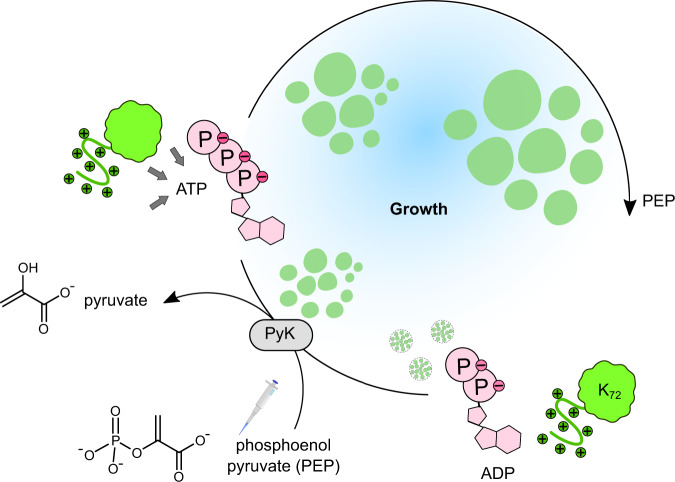
Active coacervate droplets are liquid condensates coupled to a chemical reaction that turns over their components, keeping the droplets out of equilibrium. This turnover can be used to drive active processes such as growth, and provide an insight into the chemical requirements underlying (proto)cellular behaviour. Moreover, controlled growth is a key requirement to achieve population fitness and survival. Here we present a minimal, nucleotide-based coacervate model for active droplets, and report three key findings that make these droplets into evolvable protocells. First, we show that coacervate droplets form and grow by the fuel-driven synthesis of new coacervate material. Second, we find that these droplets do not undergo Ostwald ripening, which we attribute to the attractive electrostatic interactions and translational entropy within complex coacervates, active or passive. Finally, we show that the droplet growth rate reflects experimental conditions such as substrate, enzyme and protein concentration, and that a different droplet composition (addition of RNA) leads to altered growth rates and droplet fitness. These findings together make active coacervate droplets a powerful platform to mimic cellular growth at a single-droplet level, and to study fitness at a population level.
Overview
CoChat Summary
## TL;DR
The paper shows that ATP–K72 complex coacervate droplets can be driven out of equilibrium by pyruvate kinase to grow actively from ADP, while remaining stable without measurable Ostwald ripening for at least an hour. It also shows that growth rate depends on reaction and composition conditions, with RNA-containing droplets growing 5× more slowly than ATP-only droplets.
## Key findings
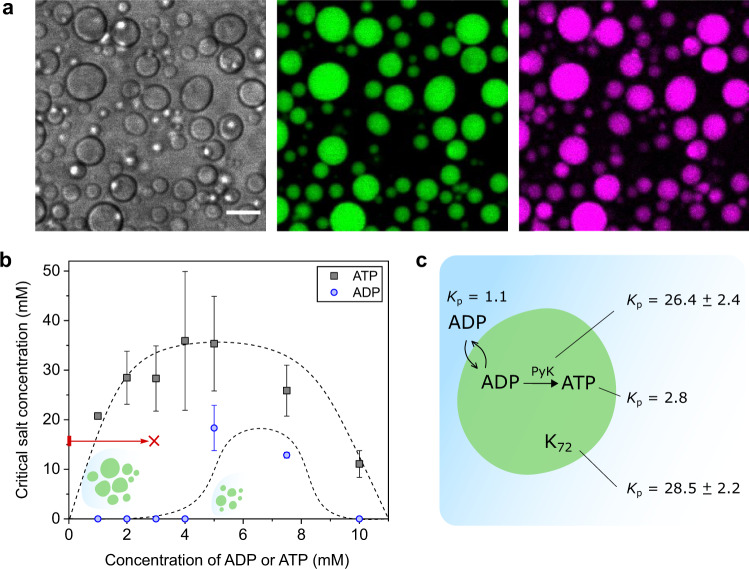
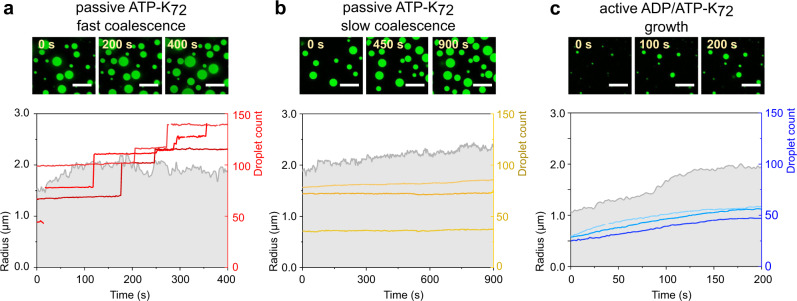
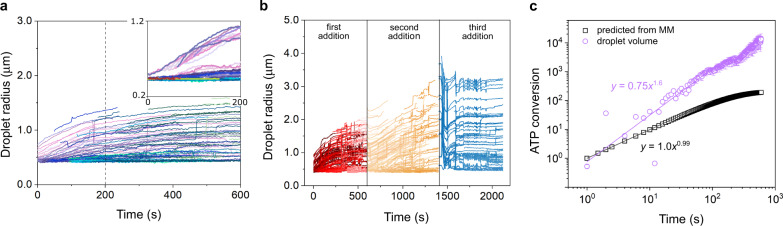
- Active ATP–K72 droplets form by fuel-driven synthesis of ATP from ADP and PEP; after PEP addition, droplets of 0.5 μm radius started forming within a minute and then grew over time.
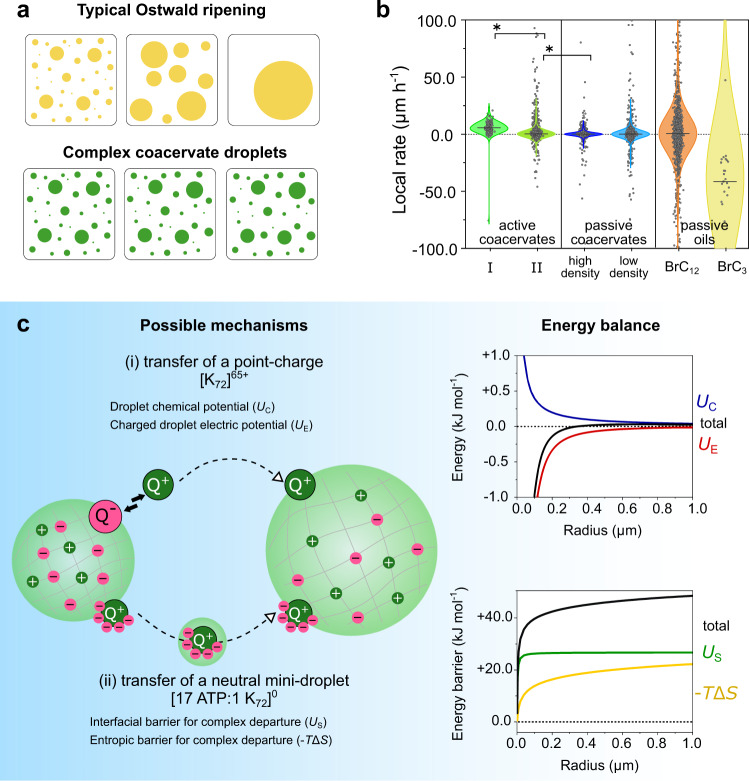
- In both passive and active complex coacervate droplets, the authors did not observe measurable Ostwald ripening; tracked droplets remained stable for at least an hour.
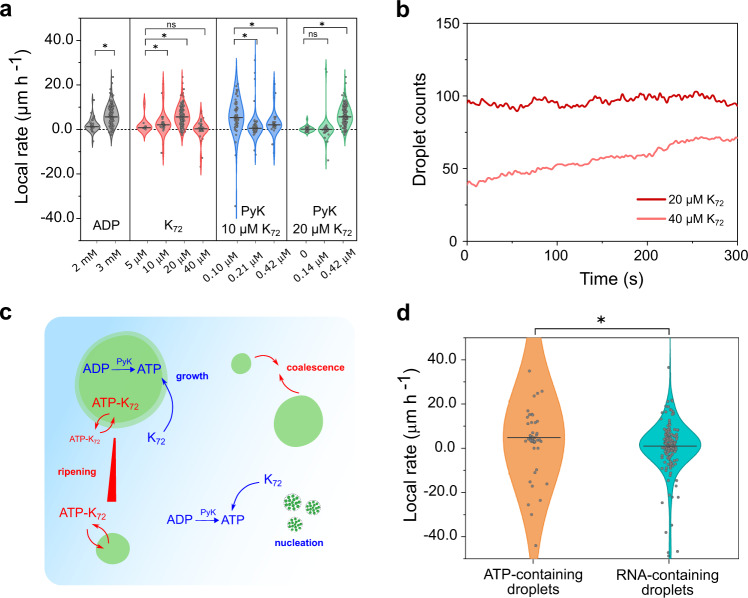
- Under one condition, active droplets from 2 mM ADP grew 20× faster than passive droplets, with growth rates of 1.24 versus 0.06 μm h−1; with 3 mM ADP, droplets could grow 100× faster than passive droplets.
- Droplets with added RNA ((ACGU)6) grew 5× more slowly than ATP-only droplets, and the paper reports RNA-containing droplets had PyK partitioning coefficient Kp = 49.4 and RNA Kp = 18.
## Methods
- The study used ATP-K72 and ADP-K72 complex coacervates, with pyruvate kinase catalyzing ADP → ATP conversion using phosphoenolpyruvate (PEP) as fuel; droplets were monitored by confocal microscopy at the single-droplet level and across populations.
- Phase behavior and partitioning were measured by turbidity assays, microscopy, centrifugation, and HPLC; the paper reports ATP Kp = 2.8 and ADP Kp = 1.1 in ATP-K72 coacervates.
- Growth was quantified from fluorescence video analysis in MatLab by tracking droplet radius over time and fitting local slopes over 20 s intervals; hundreds of droplets were analyzed across experiments.
## Limitations
- The paper states that the system uses an enzyme, which may seem to decrease prebiotic relevance, though the authors argue the principles apply to complex coacervates more generally.
- The authors note that growth eventually slows because the system is limited by the available K72 and PyK, and by local accumulation of reaction products after repeated fuel additions.
- Evident from the text: much of the mechanistic interpretation of suppressed Ostwald ripening is inferential, because the paper says it is “hard to determine which” proposed mechanism is responsible.
Model-written summary. Check it against the paper before relying on it.
Integrity signals
Registry
Cites
Statistics
Figures
Verification
Claims the paper makes
9 Valid · 1 Not valid · 3 Not checked · 94 Own results and interpretations
The cited sources support only part of this claim — read each source’s verdict below.
In the paper
“Assuming a molecular volume of ca. 65 nm3 for K7229, we expect that the ATP-K72 complex coacervate droplets could show an increase in mean radius of 3–7 μm due to ripening per hour (see estimation in Supplementary Table 2)17.”
§ Active coacervate droplets are protocells that grow and resist Ostwald ripening > Results > Suppressed Ostwald ripening of complex coacervate droplets
What the sources say
- Partly supportedcites [29] Erickson, H. P. Size and shape of protein molecules at the nanometer level determined by sedimentation, gel filtration, and electron microscopy. Biol. Proced. Online11, 32–51 (2009). PMC3055910 19495910 sourceExperimental — accuracy not yet measured
Section 2, “How Big Is a Protein Molecule?” (page unavailable), gives a general formula for estimating protein molecular volume from mass. It does not identify K72 or give its volume as approximately 65 nm³. In the citing sentence, the Erickson citation is attached to the volume assumption; the separate ripening estimate carries another citation. (LLM, conf=0.82)
- Partly supportedcites [17] Berry J Weber SC Vaidya N Haataja M Brangwynne CP RNA transcription modulates phase transition-driven nuclear body assembly Proc. Natl Acad. Sci. USA 2015 112 E5237 E5245 10.1073/pnas.1509317112 26351690 PMC4586886 sourceExperimental — accuracy not yet measured
Our copy of Berry et al. (2015) supplies only the framework the estimate rests on: the power-law scaling ⟨R⟩ = (Kt)^n with coarsening mechanisms DLG, DOR and BMC ('Dynamic Scaling in Vitro', p. E5238 area), and the DOR prefactor K_DOR = 8σDc∞Vm²/(9N_A k_B T) in which Vm is explicitly the 'molar volume of droplet forming molecules' (Table 1 footnote, 'Stochastic Variables'). What the source does not support is the system-specific content of the claim: it studies C. elegans ENDs/nucleoli and in vitro FIB-1 droplets, never K72 or ATP-K72 complex coacervates, and it gives no 3–7 μm per hour increase in mean radius — its reported prefactors are K_DOR ≈ 6.0 × 10⁻⁶ (−RNA) and 4.5 × 10⁻⁶ (+RNA) μm·s⁻¹ᐟ³ for FIB-1 in vitro, and it concludes BMC rather than ripening dominates. The 65 nm³ molecular volume and the 3–7 μm/h figure are therefore the citing authors' own calculation (their Supplementary Table 2), not a finding of this paper. (LLM, conf=0.72)
hedgedstates a possible cause- Asserted: passes — The authors put it forward as true.
- Checkable: passes — It can be checked against evidence.
- Load-bearing: passes — The paper’s conclusions depend on it.
- Based: passes — The paper gives a reason why it holds.
- Partly supported
The cited sources support only part of this claim — read each source’s verdict below.
In the paper
“In our experiments with either passive or active coacervate droplets, we did not observe any shrinkage of small droplets, suggesting that Ostwald ripening is being slowed down or prevented by an opposing force closely linked to the nature of our droplets28.”
§ Active coacervate droplets are protocells that grow and resist Ostwald ripening > Results > Suppressed Ostwald ripening of complex coacervate droplets
What the sources say
- Partly supportedcites [28] Dine E Gil AA Uribe G Brangwynne CP Toettcher JE Protein phase separation provides long-term memory of transient spatial stimuli Cell Syst. 2018 6 655 663 10.1016/j.cels.2018.05.002 29859829 PMC6023754 sourceExperimental — accuracy not yet measured
The STAR Methods passage on long-term simulations says that Ostwald ripening or final fusion may occur extremely slowly, or that active processes may prevent a single-droplet equilibrium. It does not identify an opposing force intrinsic to the droplets as the reason ripening slows or stops. The observation about passive and active coacervate droplets is the citing authors’ own experiment, not a finding attributed to this source. (LLM, conf=0.85)
hedgedstates an association- Asserted: passes — The authors put it forward as true.
- Checkable: passes — It can be checked against evidence.
- Load-bearing: passes — The paper’s conclusions depend on it.
- Based: passes — The paper gives a reason why it holds.
- Partly supported
The cited sources that could be checked couldn’t confirm or dispute this claim.
In the paper
“However, this would only change the growth rate constant ξ and not change the scaling of droplet size in time, as these compounds must also be transported by diffusion to the droplet interface5,27.”
§ Active coacervate droplets are protocells that grow and resist Ostwald ripening > Results > Growth at a single-droplet level
What the sources say
- Could not verifycites [5] Wurtz JD Lee CF Chemical-reaction-controlled phase separated drops: formation, size selection, and coarsening Phys. Rev. Lett. 2018 120 1 25 10.1103/PhysRevLett.120.078102 29542937 sourceExperimental — accuracy not yet measured
Our copy of Wurtz & Lee (2018) treats only a two-state ternary mixture (phase-separating P, soluble S, plus solvent): the reaction-diffusion/quasi-static equations and the drop growth rate G_i are derived for P and S diffusing to the interface (Sec. I, p. 6; main text p. 3), and no passage addresses additional compounds (e.g. PyK, PEP) or what happens to the temporal scaling of droplet size when another species' concentration is altered. The only ξ in our copy is the concentration gradient length scale ξ ≡ sqrt(D/(k+h)) (main text p. 3), not a growth-rate constant, and the paper explicitly lists 'the generalization of our formalism to many-component mixtures [25, 26]' as a future direction (p. 5), i.e. it does not report the multi-component result the claim rests on. Searches performed: drop growth rate/scaling of radius in time, gradient length scale ξ, additional species/many-component mixtures, Lifshitz-Slyozov coarsening in time, diffusion coefficient and growth rate — none state the attributed point, so it is neither confirmed nor contradicted. (LLM, conf=0.68)
- Not checked — no full text of the sourcecites [27] Zwicker D Hyman AA Julicher F Suppression of Ostwald ripening in active emulsions Phys. Rev. E - Stat. Nonlinear, Soft Matter Phys. 2015 92 1 13 10.1103/PhysRevE.92.012317 26274171 source
hedged- Asserted: passes — The authors put it forward as true.
- Checkable: passes — It can be checked against evidence.
- Load-bearing: unclear — It is unclear whether the paper’s conclusions depend on it.
- Based: passes — The paper gives a reason why it holds.
- Rests on an assumption not shown here.
- Could not verify
The cited sources support only part of this claim — read each source’s verdict below.
In the paper
“HPLC measurements of PyK kinetics in the presence of coacervates32, which show that the effective kcat of PyK in a coacervate dispersion is the same as in a solution.”
§ Active coacervate droplets are protocells that grow and resist Ostwald ripening > Results > Growth at a single-droplet level
What the sources say
- Partly supportedcites [32] Nakashima KK André AAM Spruijt E Enzymatic control over coacervation Methods Enzymol. 2020 646 353 389 10.1016/bs.mie.2020.06.007 33453932 sourceExperimental — accuracy not yet measured
Section 5.4 ('Concentrations from classical analytical tools') reports HPLC-derived kinetics of ATP formation for the PyK reaction with and without PLL (the 'solution phase control' defined in Section 4.5.2/4.5.3, i.e. a coacervate dispersion measured after quenching), and states that 'coacervation hardly affected the overall reaction' and that the K M and k cat values are 'not remarkably different'. That supports the substance of the claim, but the source hedges it ('not remarkably different', 'hardly affected') and immediately qualifies it as possibly an artefact of the small number of coacervates (ATP-PLL coacervates occupying no more than ~1% of the total volume, Section 5.4), rather than asserting the effective kcat is identical; no actual kcat values are given in our copy. The citing sentence therefore states as fact, and without the volume-fraction caveat, what the source reports as a non-significant difference. (LLM, conf=0.72)
plain- Asserted: passes — The authors put it forward as true.
- Checkable: passes — It can be checked against evidence.
- Load-bearing: passes — The paper’s conclusions depend on it.
- Based: passes — The paper gives a reason why it holds.
- Partly supported
The cited sources support only part of this claim — read each source’s verdict below.
In the paper
“displaces ADP in the droplets37”
§ Active coacervate droplets are protocells that grow and resist Ostwald ripening > Results > Growth at a population level
What the sources say
- Partly supportedcites [37] Cakmak FP Choi S Meyer MCO Bevilacqua PC Keating CD Prebiotically-relevant low polyion multivalency can improve functionality of membraneless compartments Nat. Commun. 2020 11 1 11 10.1038/s41467-020-19775-w 33230101 PMC7683531 sourceExperimental — accuracy not yet measured
The Results section on RNA partitioning (page unavailable) describes RNA entering droplets by displacing ATP or (Asp)n polyanions. It does not report displacement of ADP, so the claim applies the reported mechanism to a different nucleotide. (LLM, conf=0.87)
plainstates a cause- Asserted: passes — The authors put it forward as true.
- Checkable: passes — It can be checked against evidence.
- Load-bearing: passes — The paper’s conclusions depend on it.
- Based: passes — The paper gives a reason why it holds.
- Partly supported
58 more claims
Create a free account to see all 107 claims and to verify the 3 references still open.
- It may state two separate claims as one. 33
- Probably not a substantial claim. 18
Citations
Cites
Double-slit photoelectron interference in strong-field ionization of the neon dimer
Kunitski, M., Eicke, N., Huber, P., Köhler, J., Zeller, S., Voigtsberger, J., Schlott, N., Henrichs, K., Sann, H., Trinter, F., et al. (2019) · Nature Communications · doi:10.1038/s41467-018-07882-8 · Cited by 8,162
Double-slit photoelectron interference in strong-field ionization of the neon dimer
Kunitski, M., Eicke, N., Huber, P., Köhler, J., Zeller, S., Voigtsberger, J., Schlott, N., Henrichs, K., Sann, H., Trinter, F., et al. (2019) · Institutional Repository of Leibniz Universität Hannover (Leibniz Universität Hannover) · doi:10.15488/5174 · Cited by 8,161
Patra, P. P., Chikkaraddy, R., Tripathi, R. P. N., Dasgupta, A., & Kumar, G. V. P. (2014) · Nature Communications · doi:10.1038/ncomms5357 · Cited by 1,635
Erickson, H. P. (2009) · Biological Procedures Online · doi:10.1007/s12575-009-9008-x · Cited by 1,571
The major evolutionary transitions
Szathmáry, E., & Smith, J. M. (1995) · Nature · doi:10.1038/374227a0 · Cited by 1,095
Plasmon induced thermoelectric effect in graphene
Shautsova, V., Sidiropoulos, T., Xiao, X., Güsken, N. A., Black, N. C. G., Gilbertson, A. M., Giannini, V., Maier, S. A., Cohen, L. F., & Oulton, R. F. (2018) · Nature Communications · doi:10.1038/s41467-018-07508-z · Cited by 710
Liquid Nuclear Condensates Mechanically Sense and Restructure the Genome
Shin, Y., Chang, Y.-C., Lee, D. S. W., Berry, J., Sanders, D. W., Ronceray, P., Wingreen, N. S., Haataja, M., & Brangwynne, C. P. (2018) · Cell · doi:10.1016/j.cell.2018.10.057 · Cited by 676
Peptide–nucleotide microdroplets as a step towards a membrane-free protocell model
Koga, S., Williams, D. S., Perriman, A. W., & Mann, S. (2011) · Nature Chemistry · doi:10.1038/nchem.1110 · Cited by 651
Aumiller, W. M., & Keating, C. D. (2016) · Nature Chemistry · doi:10.1038/nchem.2414 · Cited by 612
RNA transcription modulates phase transition-driven nuclear body assembly
Berry, J., Weber, S. C., Vaidya, N., Haataja, M., & Brangwynne, C. P. (2015) · Proceedings of the National Academy of Sciences · doi:10.1073/pnas.1509317112 · Cited by 501 · cited 1×
“We estimated the potential interference of coalescence and Ostwald ripening to reaction-driven growth with the following set of equations and parameters as in reference [1].”
Method
Cited by
Items 101–200 of 211
Phase separation across membranes and condensates in cell organization and function
Mangiarotti, A., & Dimova, R. (2026) · Nature Reviews Molecular Cell Biology · doi:10.1038/s41580-026-00961-5 · Cited by 26
“For example, fuelled coacervates, in which phase separation is coupled to a chemical reaction cycle, demonstrate how energy dissipation can suppress coarsening and thereby control droplets size and distribution 86,97 .”
Motility of microscopic swimmers as protocells
Marincioni, B., Nakashima, K. K., & Katsonis, N. (2023) · Chem · doi:10.1016/j.chempr.2023.10.007 · Cited by 12
Self-citationZhang, M., Qin, Y., Zhang, F., et al. (2024) · Chemical Engineering Journal · doi:10.1016/j.cej.2024.150867 · Cited by 13
Coacervate Droplets as Biomimetic Models for Designing Cell‐Like Microreactors
Ivanov, T., Doan‐Nguyen, T. P., Belahouane, M. A., Dai, Z., Cao, S., Landfester, K., & da Silva, L. C. (2024) · Macromolecular Rapid Communications · doi:10.1002/marc.202400626 · Cited by 16
Smokers, I. B. A., & Spruijt, E. (2024) · Biomacromolecules · doi:10.1021/acs.biomac.4c01201 · Cited by 16
Self-citationBiomineralization‐Inspired Membranization Toward Structural Enhancement of Coacervate Community
Zhao, C., Wang, X., Li, L., Huang, H., Wu, B., Zhang, L., & Huang, X. C. (2025) · Advanced Science · doi:10.1002/advs.202417832 · Cited by 11
Toward Design Principles for Biomolecular Condensates for Metabolic Pathways
André, A. A. M., Rehnberg, N., Garg, A., & Kjærgaard, M. (2025) · Advanced Biology · doi:10.1002/adbi.202400672 · Cited by 16
Self-citationXu, X., van Haren, M. H. I., Smokers, I. B. A., Visser, B. S., White, P. B., Jansen, R. S., & Spruijt, E. (2025) · Nature Communications · doi:10.1038/s41467-025-63755-x · Cited by 15
“11), in reasonable agreement with an apparent dissociation constant of ~1 M and an estimated local protein concentration of 1 mM for K72 28 .”
InfluentialSelf-citationNon-equilibrium demixing and dissolution of chiral coacervates via intrinsic catalysis
Gupta, S., Jha, S., Mahato, C., & Das, D. (2025) · Nature Communications · doi:10.1038/s41467-025-64444-5 · Cited by 18
“25, 26).”
Compartmentalization as a ubiquitous feature of life: from origins of life to biomimetics
Das, S., Patki, G. M., Sridhar, V., Mulewar, S. S., Roy, R., Bandyopadhyay, U., Kulshreshtha, N. N., & Rajamani, S. (2024) · The European Physical Journal Special Topics · doi:10.1140/epjs/s11734-024-01203-5 · Cited by 15
“Therefore, researchers have also studied ‘active’ growth in coacervates that occurs at the expense of energy [75, 76].”
Fujii, Y., Kawamura, A., Morimoto, N., et al. (2025) · Langmuir · doi:10.1021/acs.langmuir.5c00060 · Cited by 11
A Photonastic Prototissue Capable of Photo‐Mechano‐Chemical Transduction
Galanti, A., Rosetti, B., Valente, S., Braidotti, N., Sbacchi, M., Todros, S., Pavan, P. G., & Gobbo, P. (2025) · Advanced Materials · doi:10.1002/adma.202502830 · Cited by 11
Fitness Landscapes and Evolution of Catalytic RNA
Saha, R., Vázquez-Salazar, A., Nandy, A., & Chen, I. A. (2024) · Annual Review of Biophysics · doi:10.1146/annurev-biophys-030822-025038 · Cited by 10
Phase behavior and pathway-selective oligomerization driven by amino acid side-chain recognition
Dai, K., Saile, L., Pol, M. D., Sharma, A., Pramod, T., & Pappas, C. G. (2025) · Chem · doi:10.1016/j.chempr.2025.102589 · Cited by 15
Salt-Bridge-Mediated Coacervate-to-Vesicle Transformation in Arginine-Rich Coacervates
Seo, H., Lee, H. S., & Lee, H. (2025) · ACS Nano · doi:10.1021/acsnano.5c02235 · Cited by 10
Microscopic and stochastic simulations of chemically active droplets
Berthin, R., Fries, J. D., Jardat, M., Dahirel, V., & Illien, P. (2025) · Physical review. E · doi:10.1103/physreve.111.l023403 · Cited by 18
Biomolecular Condensates as Protein Degradation Tools for Intracellular Targets
Li, Y., Jin, Z., Ahmed, S. U., Das, J., Bleher, R., Chang, D., Yu, X., Flynn, C. D., Zhou, J., Hu, X., et al. (2026) · Nature Communications · doi:10.1038/s41467-026-72967-8 · Cited by 17
Cytomimetic calcification in chemically self-regulated prototissues
Sun, R., Yin, Z., Stevens, M. M., Li, M., & Mann, S. (2025) · Nature Communications · doi:10.1038/s41467-025-59251-x · Cited by 11
“10, 11, and Supplementary Table 1).”
Synthetic nucleic-acid droplets: a bioprogramming platform for designer microliquids
Udono, H., Maruyama, T., Evangelista, N. N., Yoshida, N., Aizaki, Y., Goraku, K., Takagi, K., Hasegawa, R., & Takinoue, M. (2025) · Polymer Journal · doi:10.1038/s41428-025-01050-8 · Cited by 11
“Previously, synthetic complex coa-cervates, formed by the electrostatic assembly of poly-anions and polycations, have demonstrated various dynamic behaviors, including formation and dissolution, growth, and division [87 – 90].”
Auth, T. (2025) · Polymers · doi:10.3390/polym17162243 · Cited by 9
“Intriguingly, engineered biomolecular condensates containing enzymes or other chemically active components are non-equilibrium systems that can show internal flows and active regulation of their sizes [198,199].”
Evolution and Single‐Droplet Analysis of Fuel‐Driven Compartments by Droplet‐Based Microfluidics
Bergmann, A. M., Donau, C., Späth, F., Jahnke, K., Göpfrich, K., & Boekhoven, J. (2022) · Angewandte Chemie · doi:10.1002/ange.202203928 · Cited by 7
Insights into the Mechanism of Protein Loading by Chain-Length Asymmetric Complex Coacervates
Apuzzo, E., Cathcarth, M., Picco, A. S., von Bilderling, C., Azzaroni, O., Agazzi, M. L., & Herrera, S. E. (2025) · Biomacromolecules · doi:10.1021/acs.biomac.4c01516 · Cited by 6
Primitive genotype-phenotype coupling in fuel-dependent synthetic cells with an autocatalyst
Soria‐Carrera, H., Kauling, L., & Boekhoven, J. (2025) · Chem · doi:10.1016/j.chempr.2025.102816 · Cited by 8
Phase Behaviors of Charged Macromolecules in Aqueous Solutions
Yang, Y., & Jia, D. (2023) · Macromolecular Chemistry and Physics · doi:10.1002/macp.202300155 · Cited by 7
Song, S., Ivanov, T., Doan‐Nguyen, T. P., da Silva, L. C., Xie, J., Landfester, K., & Cao, S. (2025) · Angewandte Chemie · doi:10.1002/ange.202418431 · Cited by 11
Acyl Phosphates as Chemically Fueled Building Blocks for Self‐Sustaining Protocells
Zozulia, O., Kriebisch, C. M. E., Kriebisch, B. A. K., Soria‐Carrera, H., Ryadi, K. R., Steck, J., & Boekhoven, J. (2024) · Angewandte Chemie · doi:10.1002/ange.202406094 · Cited by 6
Catalytically Active Coacervates Sustained Out‐of‐Equilibrium
Bal, S., Gupta, S., Mahato, C., & Das, D. (2025) · Angewandte Chemie · doi:10.1002/ange.202505296 · Cited by 5
Coacervate Vesicles as Adaptive Platforms for Synthetic Biology and Smart Materials
Vicentini, F., Battistin, F., & Gobbo, P. (2025) · Chemistry - A European Journal · doi:10.1002/chem.202502268 · Cited by 6
Ivanov, T., Cao, S., Schaaf, M., da Silva, L. C., & Landfester, K. (2025) · Chemical Communications · doi:10.1039/d5cc02423d · Cited by 6
Critical Transition between Intensive and Extensive Active Droplets
Bauermann, J., Bartolucci, G., Boekhoven, J., Jülicher, F., & Weber, C. A. (2025) · Physical Review X · doi:10.1103/4nnd-tdky · Cited by 10
Deng, Y., Hu, J., Wang, J., Kuai, Z., Hao, F., He, Y., Liang, M., Song, A., Yin, C., Yi, H., et al. (2026) · ACS Applied Materials & Interfaces · doi:10.1021/acsami.5c20923 · Cited by 15
Theory and quantitative assessment of pH-responsive polyzwitterion–polyelectrolyte complexation
Hoover, S. C., Margossian, K. O., & Muthukumar, M. (2024) · Soft Matter · doi:10.1039/d4sm00575a · Cited by 5
Fractal-Dependent Growth of Solidlike Condensates
Chen, F., Guo, W., & Shum, H. C. (2024) · Physical Review Letters · doi:10.1103/physrevlett.133.118401 · Cited by 6
Shape transformations in peptide–DNA coacervates driven by enzyme-catalyzed deacetylation
van Haren, M. H. I., Helmers, N. S., Verploegen, L., Beckers, V. A. C., & Spruijt, E. (2024) · Soft Matter · doi:10.1039/d4sm01091d · Cited by 9
Self-citationLight‐Responsive Mononucleotide Coacervates
Granda, E. R. J., Karoui, H., Brilland, X., Baret, J., & Martin, N. (2025) · Chemistry - A European Journal · doi:10.1002/chem.202501109 · Cited by 6
Cannelli, S. M. C., Gupta, R. S., Nguyen, T., Poddar, A., Sharma, S., Vithole, P. V., & Jia, T. Z. (2023) · Peptide Science · doi:10.1002/pep2.24331 · Cited by 6
Ettikkan, N. K., Priyanka, P., Mahato, R. R., & Maiti, S. (2024) · Communications Chemistry · doi:10.1038/s42004-024-01333-w · Cited by 6
Static and transient vacuolation in protein-based coacervates induced by charged amino acids
Li, Z., Liu, Q., Ding, H., Meng, Z., Zhao, Q., Deng, N., & Zheng, L. (2025) · Nature Communications · doi:10.1038/s41467-025-61340-w · Cited by 9
“The method to determine the partitioning coef fi cient of AAs was adopted from the reported work 71 .”
Design of peptide-based gene delivery systems to overcome biological barriers
Wang, Z., Zhou, J., Su, R., Qi, W. D., & Wang, Y. (2025) · Journal of Materials Chemistry B · doi:10.1039/d5tb00766f · Cited by 4
Polymeric Artificial Cells: from Interfacial Membranization to Cytomimetic Architecture Engineering
Han, H., Song, S., Pu, Y., Ivanov, T., & Cao, S. (2025) · Biomacromolecules · doi:10.1021/acs.biomac.5c02327 · Cited by 7
Entropic Charge Separation as a General Mechanism Arresting Nanoscale Condensate Coarsening
Chen, F., Yuan, J., Zhang, Y., Tanaka, H., & Shum, H. C. (2026) · Physical Review Letters · doi:10.1103/g1lp-rtd7 · Cited by 11
Adaptisorption of Nonporous Polymer Crystals
Shan, T., Chen, L., Xiao, D. Q., Xiao, X., Wang, J., Chen, X., Guo, Q., Li, G., Stoddart, J. F., & Huang, F. (2024) · Angewandte Chemie · doi:10.1002/ange.202317947 · Cited by 5
Endoskeletal coacervates with mobile-immobile duality for long-term utility
Chen, W., Zheng, S., Zhou, F., Huang, Y., Tu, M., & Jiang, L. (2023) · Chemical Engineering Journal · doi:10.1016/j.cej.2023.142165 · Cited by 4
Design of oscillatory dynamics in numerical simulations of compartment-based enzyme systems
Leathard, A. S., Beales, P. A., & Taylor, A. F. (2023) · Chaos An Interdisciplinary Journal of Nonlinear Science · doi:10.1063/5.0180256 · Cited by 6
Nonenzymatic RNA replication in a mixture of ‘spent’ nucleotides
Patki, G. M., & Rajamani, S. (2023) · FEBS Letters · doi:10.1002/1873-3468.14785 · Cited by 3
“Furthermore, replication happening inside phase-separated systems containing nucleoside triphosphates (NTPs) as anionic moieties [26,27] could also get affected, as the NTPs in these systems could potentially interact with the template and hinder the access of the activated nucleotides to the…”
BackgroundConstrained dynamics of DNA oligonucleotides in phase-separated droplets
Singh, A., Thutupalli, S., Kumar, M., & Ameta, S. (2024) · Biophysical Journal · doi:10.1016/j.bpj.2023.12.025 · Cited by 6
Unveiling the Liquid‐Liquid Phase Separation of Benzene‐1,3,5‐Tricarboxamide in Water
Kumar, M., Hanssen, J. N. S., & Dhiman, S. (2024) · ChemSystemsChem · doi:10.1002/syst.202400013 · Cited by 6
Phase-Separated Droplets Swim to Their DissolutionPreprint
Jambon-Puillet, E., Testa, A., Lorenz, C., et al. (2023) · bioRxiv (Cold Spring Harbor Laboratory) · doi:10.1101/2023.07.18.549556 · Cited by 4
Enzymatisches Reaktionsnetzwerk‐gesteuerte polymerisationsinduzierte transiente Koazervation
Sharma, S., Belluati, A., Kumar, M., & Dhiman, S. (2024) · Angewandte Chemie · doi:10.1002/ange.202421620 · Cited by 4
Deng, J., Deng, J., Zhou, Y., et al. (2025) · Journal of Materials Chemistry C · doi:10.1039/d5tc02364e · Cited by 3
Intracompartmental 3D Printing of Enzymatically Active Organelle Mimics
Sümbelli, Y., Jäkel, A. C., Verwiel, M. A. M., Erkamp, N. A., Mason, A. F., Simmel, F. C., van Hest, J. C. M., & Cook, A. B. (2025) · ACS Nano · doi:10.1021/acsnano.5c14167 · Cited by 3
Emergent properties of supramolecular peptide assemblies
Vila, Á., González, S., & Insua, I. (2025) · Chemical Communications · doi:10.1039/d5cc05628d · Cited by 4
Diffusive and Enzymatic Modulation of the Dynamic Size Distribution of DNA Droplets
Tateno, M., & Saleh, O. A. (2026) · Physical Review Letters · doi:10.1103/x2pf-n27q · Cited by 6
Assembly of Replicating Protocells with Primitive Metabolism
Karabaşoğlu, C., Saytas, A., Akgol, B., Mercimek, S., & Toparlak, Ö. D. (2026) · Astrobiology · doi:10.1177/15311074261435277 · Cited by 3
The RNA-DNA world and the emergence of DNA-encoded heritable traits
Roy, S., & Sengupta, S. (2024) · RNA Biology · doi:10.1080/15476286.2024.2355391 · Cited by 6
Sticky Polyelectrolyte Shield for Enhancing Biological Half-Life of Growth Factors
Kim, Y., Jeon, S., Kim, B., Jeong, Y. J., Kim, T. H., Jeong, S., Kim, I., Oh, J., Jung, Y., Lee, K., et al. (2024) · ACS Applied Materials & Interfaces · doi:10.1021/acsami.4c16261 · Cited by 3
Interfacing bacterial microcompartment shell proteins with genetically encoded condensates
Costantino, M., Young, E. J., Banerjee, A., Kerfeld, C. A., & Ghirlanda, G. (2025) · Protein Science · doi:10.1002/pro.70061 · Cited by 3
Studying Nucleoid-Associated Protein–DNA Interactions Using Polymer Microgels as Synthetic Mimics
Kaufmann, A., Vigogne, M., Neuendorf, T. A., Reverte‐López, M., Rivas, G., & Thiele, J. (2023) · ACS Synthetic Biology · doi:10.1021/acssynbio.3c00488 · Cited by 4
Decoding the role of DNA sequence on protein-DNA co-condensation
Singh, R. K., Swain, P., Ganji, M., & Choubey, S. (2025) · PLoS Computational Biology · doi:10.1371/journal.pcbi.1013829 · Cited by 3
“To address this, theoretical studies have approached the problem from both equilibrium perspectives [36–43] and non-equilibrium models incorporating chemical reactions coupled to phase separation [44–48].”
Sheikhhassani, V., Wong, F., Bonn, D., Schmit, J. D., & Mashaghi, A. (2026) · Nature Communications · doi:10.1038/s41467-026-70757-w · Cited by 4
“Furthermore, UV radiation was abundant on early Earth and contributed to the synthesis of building blocks of life 32 , while coacervate condensates of these building blocks are also considered plausible protocellular structures 33 .”
Chemically Fueled Autonomous Sol→Gel→Sol→Gel→Sol Transitions
Hermans, T. M., & Singh, N. (2023) · Angewandte Chemie · doi:10.1002/ange.202301529 · Cited by 2
Optimizing (Bio) Catalysis with Liquid‐Liquid Phase Separation Systems
Reis, D. Q. P., Calvário, J., Chibeles, I., Kumar, M., & Pina, A. S. (2025) · ChemSystemsChem · doi:10.1002/syst.202400089 · Cited by 4
Wang, X., Bai, J.-L., Fan, X., et al. (2025) · Industrial Crops and Products · doi:10.1016/j.indcrop.2025.122241 · Cited by 2
Recent advances in coacervate protocells from passive catalysts to chemically programmable systems
Chen, C., & Li, J. (2026) · Communications Chemistry · doi:10.1038/s42004-026-01937-4 · Cited by 7
“Fuel-driven Fuel-driven or reaction-coupled LLPS affords temporal control over assembly, opening windows for transient compartments, size regulation, and programmed growth or division 22,23 .”
Computational modelling of thixotropic multiphase fluids
Espinosa-Moreno, A. S., Moreno, N., & Ellero, M. (2026) · Computer Physics Communications · doi:10.1016/j.cpc.2026.110122 · Cited by 4
Excitability and Oscillations of Active Droplets
Haugerud, I. S., Vuijk, H. D., Boekhoven, J., & Weber, C. A. (2026) · Physical Review Letters · doi:10.1103/g9dh-ymx9 · Cited by 11
Mejri, M. Z., & Aschi, A. (2022) · Colloids and Surfaces B Biointerfaces · doi:10.1016/j.colsurfb.2022.112627 · Cited by 3
The Assembly of Miniaturized Droplets toward Functional Architectures
Xu, Y., & Shen, Y. (2024) · Small · doi:10.1002/smll.202404366 · Cited by 2
Acetylation of Short Glycopeptides Enables Phase Separation
Wang, N., Qiao, C., Liu, J., Liu, G., Zhang, K., & Li, M. (2025) · Biomacromolecules · doi:10.1021/acs.biomac.4c01394 · Cited by 2
Selective amide bond formation in redox-active coacervate protocellsPreprint
Wang, J., Abbas, M., Wang, J., et al. (2021) · doi:10.33774/chemrxiv-2021-1zt9k · Cited by 2
Self-citationDroplet drinking in constrictions
Feng, S., Xue, C., Pan, C., & Tao, S. (2024) · Lab on a Chip · doi:10.1039/d4lc00381k · Cited by 1
Lipocoacervate, a tunable vesicle for protein delivery
Yeh, C., Wright, N., Loh, C., Chu, N., & Wang, Y. (2024) · Nano Research · doi:10.1007/s12274-024-6889-6 · Cited by 2
Jung, Y., Yoon, S., Park, Y., Karng, S. W., & Choi, J. (2025) · Engineering · doi:10.1016/j.eng.2025.08.030 · Cited by 1
Chakraborty, N., Ameta, S., & Thutupalli, S. (2025) · Small · doi:10.1002/smll.202507108 · Cited by 3
Huang, H., Zhang, L., Wu, B., Wu, G., & Zhao, C. (2025) · Journal of Colloid and Interface Science · doi:10.1016/j.jcis.2025.139568 · Cited by 1
Complex Coacervate Emulsions as a Strategy to Stabilize Enzymes for Catalysis in Organic Solvents
Penido, J. A., Le, S. P., Varadarajan, A., Thayumanavan, S., Perry, S. L., & Loh, W. (2025) · ACS Macro Letters · doi:10.1021/acsmacrolett.5c00708 · Cited by 2
Chen, C., Wu, S., Wang, Y., Cao, J., & Tian, L. (2023) · Journal of Colloid and Interface Science · doi:10.1016/j.jcis.2023.07.184 · Cited by 1
Complex Pathways Drive Pluripotent Fmoc‐Leucine Self‐Assemblies
Paul, S., Gayen, K., Cantavella, P. G., Escuder, B., & Singh, N. (2024) · Angewandte Chemie · doi:10.1002/ange.202406220
Approaching Dynamic Behaviors of Life through Systems Chemistry
Gu, R., Larsen, K. L., Wang, A., & Tan, J. (2024) · Chemistry - A European Journal · doi:10.1002/chem.202403083 · Cited by 3
Garcke, H., Lam, K. F., Nürnberg, R., & Signori, A. (2025) · European Journal of Applied Mathematics · doi:10.1017/s0956792525100211 · Cited by 1
Spruijt, E. (2022) · Elsevier eBooks · doi:10.1016/b978-0-12-823967-4.00015-4 · Cited by 5
Self-citationSignal responsive transient coacervation in complex coacervate core micellesPreprint
Lewis, R. W., Klemm, B., Macchione, M., & Eelkema, R. (2021) · doi:10.33774/chemrxiv-2021-l3jm1 · Cited by 1
Kantarci, G., Mamasoglu, S., & Kayitmazer, A. B. (2023) · ChemRxiv · doi:10.26434/chemrxiv-2023-5bq6r-v2 · Cited by 1
Solvent demixing-controlled supramolecular polymerizationPreprint
Ghosh, G., Nyenhuis, M., Krüger, T., et al. (2025) · ChemRxiv · doi:10.26434/chemrxiv-2025-dv15x · Cited by 1
Engineering nanocondensate formation through sequence composition and patterningPreprint
Schneider, T. N., Stoffel, F., Bühler, M. A., Mrzílková, K., Radiom, M., & Arosio, P. (2026) · bioRxiv (Cold Spring Harbor Laboratory) · doi:10.64898/2026.02.17.706365 · Cited by 3
“32,33 Irrespective of their mechanism of formation, these dynamic nano-materials are highly attractive for nanotechnology and material science.”
Signal responsive transient coacervation in complex coacervate core micellesPreprint
Lewis, R. W., Klemm, B., Macchione, M., & Eelkema, R. (2021) · doi:10.33774/chemrxiv-2021-l3jm1-v2
Guides: Canadian Children’s Literature: Article Databases
Library, M. (2014)
Qiu, J., & Liu, Y. (2022) · SSRN Electronic Journal · doi:10.2139/ssrn.4007007
Signal responsive transient coacervation in complex coacervate core micellesPreprint
Lewis, R. W., Klemm, B., Macchione, M., & Eelkema, R. (2021) · ChemRxiv · doi:10.26434/chemrxiv-2021-l3jm1
Kantarci, G., Mamasoglu, S., & Kayitmazer, A. B. (2023) · ChemRxiv · doi:10.26434/chemrxiv-2023-5bq6r
Effect of ‘spent’ nucleotides on nonenzymatic RNA replicationPreprint
Patki, G. M., & Rajamani, S. (2023) · bioRxiv · doi:10.1101/2023.07.20.549979
“Furthermore, replication happening inside phase separated systems containing nucleoside triphosphates (NTPs) as anionic moieties[26, 27] could also get affected, as the NTPs in these systems could potentially interact with the template and hinder the access of the activated nucleotides to the templating base.”
BackgroundFibril-Droplet Relationship Through Liquid-Liquid Phase Separation; A BSA-MOF CasePreprint
Latifi, A., Hosseini, E., Daneshgar, H., Edrisi, M., Arghavani, P., Bagherzadeh, M., Yousefi, R., & Moosavi‐Movahedi, A. A. (2024) · Research Square · doi:10.21203/rs.3.rs-3953695/v1
Separation of Sticker-Spacer Energetics Governs the Coalescence of Metastable CondensatesPreprint
Chattaraj, A., & Shakhnovich, E. I. (2024) · Qeios · doi:10.32388/rmdc8n
Deng, J., Zhou, Y., Deng, J., et al. (2025) · SSRN Electronic Journal · doi:10.2139/ssrn.5245122
Mu, Y., Wang, J., Liu, X., Zhou, T., Wang, Y., & Zhou, Q. (2025) · Macromolecules · doi:10.1021/acs.macromol.5c02055 · Cited by 1
Stabilisation d’émulsions eau-dans-eau par auto-assemblages de lipides
Coudon, N. (2023) · theses.fr (ABES) · doi:10.70675/dea431d7z766dz4581z9d22zec08306d2a11
Chen, X., Sommer, J., & Harmon, T. S. (2026) · Proceedings of the National Academy of Sciences · doi:10.1073/pnas.2524346123
Zhu, Y., Yu, X., Yin, C., et al. (2026) · Chem & Bio Engineering · doi:10.1021/cbe.6c00002
Biomass coacervate micro-bridges for eradicating hydrophobic fungal conidia
Li, X., Tursen, J., Yin, C., Yuan, X., Zhu, W., Han, L. L., & Wang, H. (2026) · Journal of Colloid and Interface Science · doi:10.1016/j.jcis.2026.140755
Annunziata, O., & Thomas, S. (2026) · Molecules · doi:10.3390/molecules31111894
“Understanding and controlling condensation of globular proteins in aqueous media is fundamental for comprehending cell compartmentalization [1,2], protein-aggregation diseases [3], developing stable pharmaceutical formulations [4,5], preparing protein-based materials [6], and generating protein…”
Metadata
- Authors
- Nakashima, K. K., van Haren, M. H. I., André, A. A. M., Robu, I., & Spruijt, E.
- Affiliations
- Radboud University Nijmegen (NL)
- Corresponding author
- Spruijt, Evan
- Venue
- Nature Communications
- Published
- 2021-06-21
- Volume
- 12
- Issue
- 1
- Pages
- 3819-3819
- ISSN
- 2041-1723 (ISSN-L)
- PMC
- PMC8217494
- OpenAlex
- W3127845412
- Semantic Scholar
- 9d88e1bf07598c56145faf2f3d706a0a70054321
- Cited by
- 209
- References
- 53
- Citations by year
- 2026: 26 · 2025: 55 · 2024: 52 · 2023: 44 · 2022: 28 · 2021: 3
- FWCI
- 16.93
- Type
- journal article
- Language
- en
- Open access
- gold
- doi.org
- Licence
- cc-by
- creativecommons.org/licenses/by/4.0 (tdm)
- creativecommons.org/licenses/by/4.0 (vor)
- Locations
- Nature Communications (publishedVersion, cc-by)
- ChemRxiv (acceptedVersion, cc-by-nc-nd)
- PubMed Central (publishedVersion, cc-by)
- PubMed (publishedVersion)
- RePEc: Research Papers in Economics (submittedVersion)
- DOAJ (DOAJ: Directory of Open Access Journals) (submittedVersion, cc-by-sa)
- Figshare (submittedVersion, cc-by-nc-nd)
- Radboud Repository (Radboud University) (submittedVersion)
- Radboud Repository (Radboud University) (submittedVersion, other-oa)
- Funders
- Nederlandse Organisatie voor Wetenschappelijk Onderzoek
- Topics
- Physical Sciences › Physics and Astronomy › Astronomy and Astrophysics › Origins and Evolution of Life
- Life Sciences › Biochemistry, Genetics and Molecular Biology › Molecular Biology › RNA and protein synthesis mechanisms
- Life Sciences › Biochemistry, Genetics and Molecular Biology › Genetics › Evolution and Genetic Dynamics
- Keywords
- protocells, Ostwald ripening, droplet growth, electrostatic interactions, translational entropy, RNA, enzyme activity, population fitness, liquid-liquid phase separation, minimal cell model
- MeSH terms
- Adenosine Diphosphate, Adenosine Triphosphate, Elastin, Peptides, Phosphoenolpyruvate, Pyruvate Kinase, Cell Growth Processes, Artificial Cells
About these checks
Registry, retraction, Cites and statistics results are computed, not judged, with one exception: a printed reference that no index lists is read once by a model before it counts as a citation error. Claims are extracted by a model and kept only when their quote appears verbatim in the text; each cited source is then checked, with a model’s help, for whether it says what the claim relies on. Those verdicts can be wrong — read the claim’s quote and the cited source before relying on one.
The claim verdicts this report counts are experimental: their accuracy is not yet measured.
A language model drew the claims from the paper on 2026-10-10, under version 3 of the claim definition (model deepseek-v4.1-flash, prompt extract-v3).
A second model labelled each claim on 2026-10-10 (model jev-1.13-20260917, definition revision gold-guideline-v0.2).
Cited sources are checked with a language model’s help (gpt-6-sol and qwen3.8-omni-flash).
Statistics and arithmetic are recomputed, not judged.
Confidence bands are shown only for fields calibrated on our annotated test set. None is calibrated yet, so no band is shown.
What counts as a claim ›How we measure confidence ›How we check this ›
Are you an author, or do you see a problem with this page? Request a review
Data sources
Bibliographic data: Semantic Scholar, OpenAlex, Crossref.
Contains information from the Semantic Scholar Academic Graph Datasets, made available under the ODC Attribution License (ODC-BY 1.0).
Semantic Scholar’s data is described in: Kinney, R., et al. (2023). The Semantic Scholar Open Data Platform. arXiv:2301.10140.
