

Active coacervate droplets are protocells that grow and resist Ostwald ripening
Open accessPublished version of a preprint
The DOI matches its Crossref record; 52 of the 53 references it cites were found in a registry or an index; 13 of the 18 sources its claims cite were checked for support.
Abstract
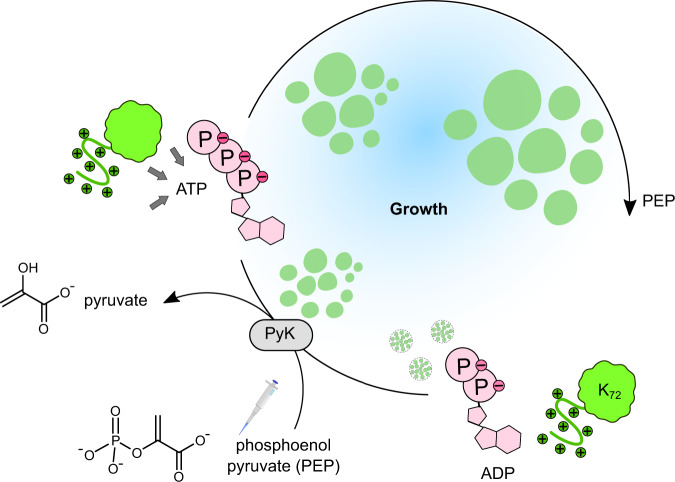
Active coacervate droplets are liquid condensates coupled to a chemical reaction that turns over their components, keeping the droplets out of equilibrium. This turnover can be used to drive active processes such as growth, and provide an insight into the chemical requirements underlying (proto)cellular behaviour. Moreover, controlled growth is a key requirement to achieve population fitness and survival. Here we present a minimal, nucleotide-based coacervate model for active droplets, and report three key findings that make these droplets into evolvable protocells. First, we show that coacervate droplets form and grow by the fuel-driven synthesis of new coacervate material. Second, we find that these droplets do not undergo Ostwald ripening, which we attribute to the attractive electrostatic interactions and translational entropy within complex coacervates, active or passive. Finally, we show that the droplet growth rate reflects experimental conditions such as substrate, enzyme and protein concentration, and that a different droplet composition (addition of RNA) leads to altered growth rates and droplet fitness. These findings together make active coacervate droplets a powerful platform to mimic cellular growth at a single-droplet level, and to study fitness at a population level.
Overview
CoChat Summary
## TL;DR
The paper shows that ATP–K72 complex coacervate droplets can be driven out of equilibrium by pyruvate kinase to grow actively from ADP, while remaining stable without measurable Ostwald ripening for at least an hour. It also shows that growth rate depends on reaction and composition conditions, with RNA-containing droplets growing 5× more slowly than ATP-only droplets.
## Key findings
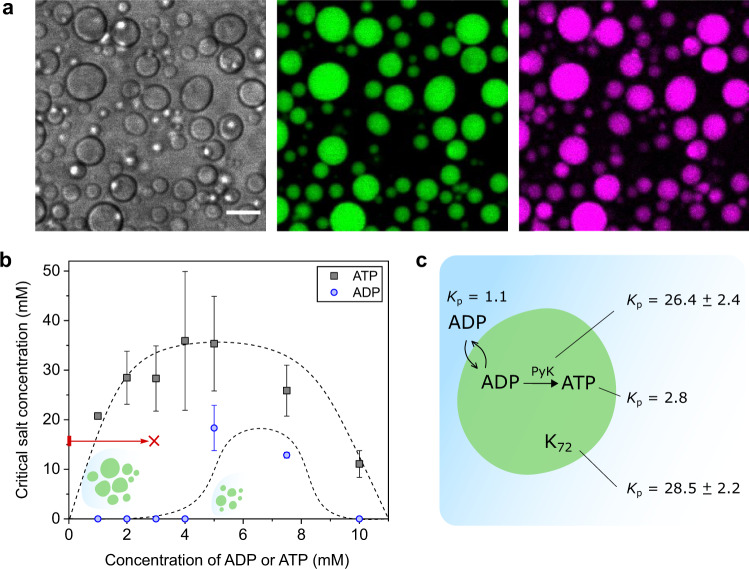
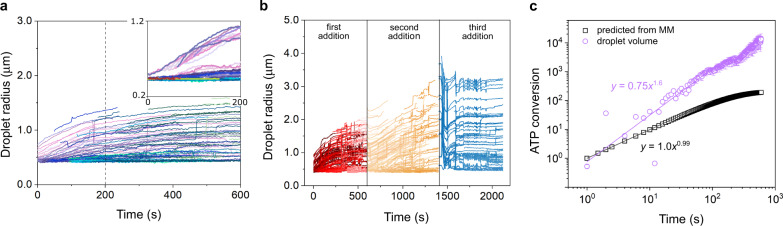
- Active ATP–K72 droplets form by fuel-driven synthesis of ATP from ADP and PEP; after PEP addition, droplets of 0.5 μm radius started forming within a minute and then grew over time.
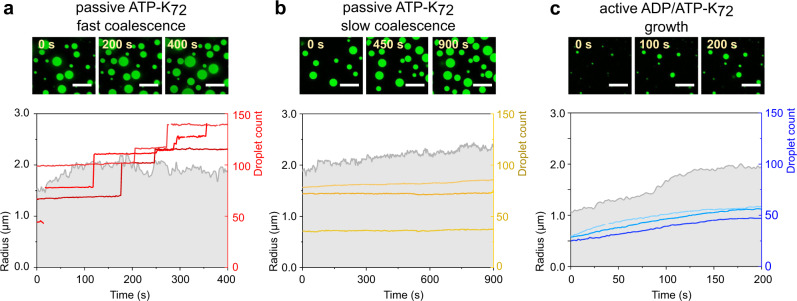
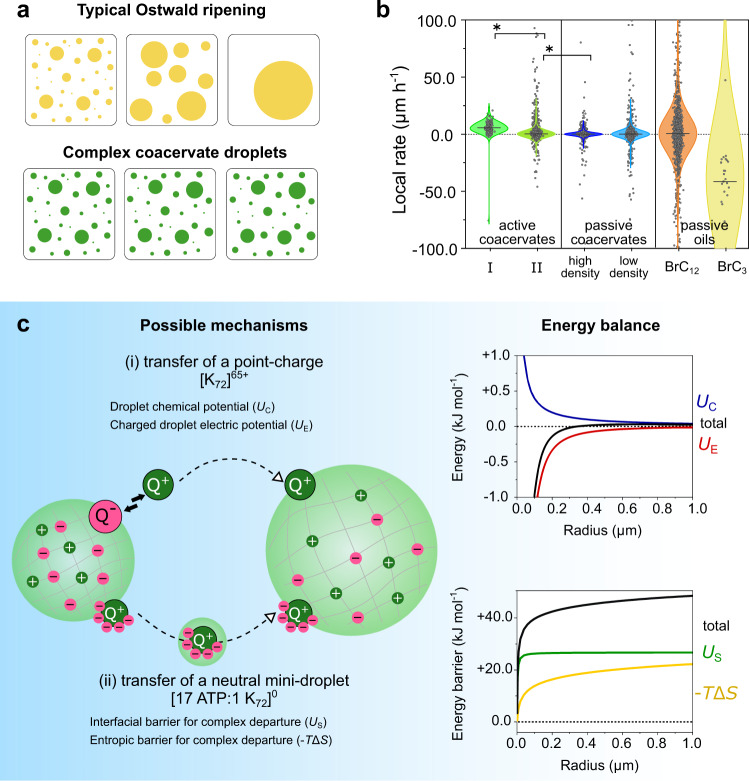
- In both passive and active complex coacervate droplets, the authors did not observe measurable Ostwald ripening; tracked droplets remained stable for at least an hour.
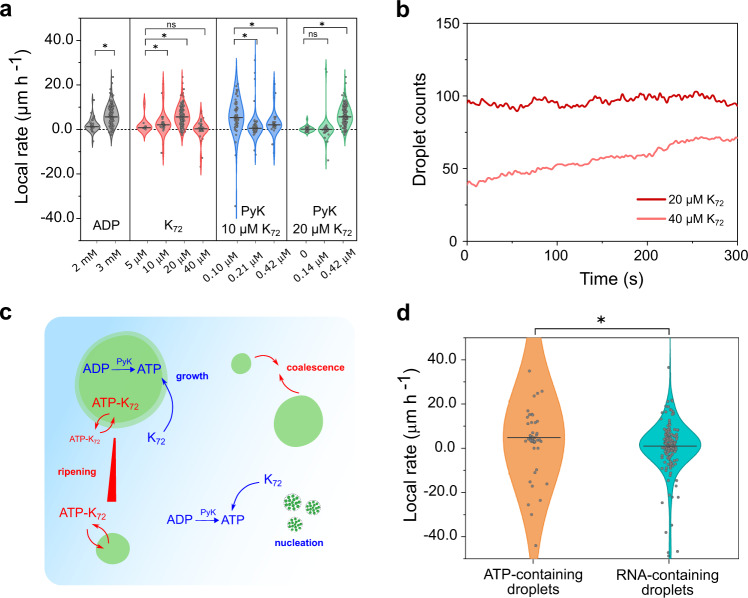
- Under one condition, active droplets from 2 mM ADP grew 20× faster than passive droplets, with growth rates of 1.24 versus 0.06 μm h−1; with 3 mM ADP, droplets could grow 100× faster than passive droplets.
- Droplets with added RNA ((ACGU)6) grew 5× more slowly than ATP-only droplets, and the paper reports RNA-containing droplets had PyK partitioning coefficient Kp = 49.4 and RNA Kp = 18.
## Methods
- The study used ATP-K72 and ADP-K72 complex coacervates, with pyruvate kinase catalyzing ADP → ATP conversion using phosphoenolpyruvate (PEP) as fuel; droplets were monitored by confocal microscopy at the single-droplet level and across populations.
- Phase behavior and partitioning were measured by turbidity assays, microscopy, centrifugation, and HPLC; the paper reports ATP Kp = 2.8 and ADP Kp = 1.1 in ATP-K72 coacervates.
- Growth was quantified from fluorescence video analysis in MatLab by tracking droplet radius over time and fitting local slopes over 20 s intervals; hundreds of droplets were analyzed across experiments.
## Limitations
- The paper states that the system uses an enzyme, which may seem to decrease prebiotic relevance, though the authors argue the principles apply to complex coacervates more generally.
- The authors note that growth eventually slows because the system is limited by the available K72 and PyK, and by local accumulation of reaction products after repeated fuel additions.
- Evident from the text: much of the mechanistic interpretation of suppressed Ostwald ripening is inferential, because the paper says it is “hard to determine which” proposed mechanism is responsible.
Model-written summary. Check it against the paper before relying on it.
Integrity signals
Registry
Cites
Statistics
Figures
Verification
Claims the paper makes
9 Valid · 1 Not valid · 3 Not checked · 94 Own results and interpretations
The cited sources support only part of this claim — read each source’s verdict below.
In the paper
“Assuming a molecular volume of ca. 65 nm3 for K7229, we expect that the ATP-K72 complex coacervate droplets could show an increase in mean radius of 3–7 μm due to ripening per hour (see estimation in Supplementary Table 2)17.”
§ Active coacervate droplets are protocells that grow and resist Ostwald ripening > Results > Suppressed Ostwald ripening of complex coacervate droplets
What the sources say
- Partly supportedcites [29] Erickson, H. P. Size and shape of protein molecules at the nanometer level determined by sedimentation, gel filtration, and electron microscopy. Biol. Proced. Online11, 32–51 (2009). PMC3055910 19495910 sourceExperimental — accuracy not yet measured
Section 2, “How Big Is a Protein Molecule?” (page unavailable), gives a general formula for estimating protein molecular volume from mass. It does not identify K72 or give its volume as approximately 65 nm³. In the citing sentence, the Erickson citation is attached to the volume assumption; the separate ripening estimate carries another citation. (LLM, conf=0.82)
- Partly supportedcites [17] Berry J Weber SC Vaidya N Haataja M Brangwynne CP RNA transcription modulates phase transition-driven nuclear body assembly Proc. Natl Acad. Sci. USA 2015 112 E5237 E5245 10.1073/pnas.1509317112 26351690 PMC4586886 sourceExperimental — accuracy not yet measured
Our copy of Berry et al. (2015) supplies only the framework the estimate rests on: the power-law scaling ⟨R⟩ = (Kt)^n with coarsening mechanisms DLG, DOR and BMC ('Dynamic Scaling in Vitro', p. E5238 area), and the DOR prefactor K_DOR = 8σDc∞Vm²/(9N_A k_B T) in which Vm is explicitly the 'molar volume of droplet forming molecules' (Table 1 footnote, 'Stochastic Variables'). What the source does not support is the system-specific content of the claim: it studies C. elegans ENDs/nucleoli and in vitro FIB-1 droplets, never K72 or ATP-K72 complex coacervates, and it gives no 3–7 μm per hour increase in mean radius — its reported prefactors are K_DOR ≈ 6.0 × 10⁻⁶ (−RNA) and 4.5 × 10⁻⁶ (+RNA) μm·s⁻¹ᐟ³ for FIB-1 in vitro, and it concludes BMC rather than ripening dominates. The 65 nm³ molecular volume and the 3–7 μm/h figure are therefore the citing authors' own calculation (their Supplementary Table 2), not a finding of this paper. (LLM, conf=0.72)
hedgedstates a possible cause- Asserted: passes — The authors put it forward as true.
- Checkable: passes — It can be checked against evidence.
- Load-bearing: passes — The paper’s conclusions depend on it.
- Based: passes — The paper gives a reason why it holds.
- Partly supported
The cited sources support only part of this claim — read each source’s verdict below.
In the paper
“In our experiments with either passive or active coacervate droplets, we did not observe any shrinkage of small droplets, suggesting that Ostwald ripening is being slowed down or prevented by an opposing force closely linked to the nature of our droplets28.”
§ Active coacervate droplets are protocells that grow and resist Ostwald ripening > Results > Suppressed Ostwald ripening of complex coacervate droplets
What the sources say
- Partly supportedcites [28] Dine E Gil AA Uribe G Brangwynne CP Toettcher JE Protein phase separation provides long-term memory of transient spatial stimuli Cell Syst. 2018 6 655 663 10.1016/j.cels.2018.05.002 29859829 PMC6023754 sourceExperimental — accuracy not yet measured
The STAR Methods passage on long-term simulations says that Ostwald ripening or final fusion may occur extremely slowly, or that active processes may prevent a single-droplet equilibrium. It does not identify an opposing force intrinsic to the droplets as the reason ripening slows or stops. The observation about passive and active coacervate droplets is the citing authors’ own experiment, not a finding attributed to this source. (LLM, conf=0.85)
hedgedstates an association- Asserted: passes — The authors put it forward as true.
- Checkable: passes — It can be checked against evidence.
- Load-bearing: passes — The paper’s conclusions depend on it.
- Based: passes — The paper gives a reason why it holds.
- Partly supported
The cited sources that could be checked couldn’t confirm or dispute this claim.
In the paper
“However, this would only change the growth rate constant ξ and not change the scaling of droplet size in time, as these compounds must also be transported by diffusion to the droplet interface5,27.”
§ Active coacervate droplets are protocells that grow and resist Ostwald ripening > Results > Growth at a single-droplet level
What the sources say
- Could not verifycites [5] Wurtz JD Lee CF Chemical-reaction-controlled phase separated drops: formation, size selection, and coarsening Phys. Rev. Lett. 2018 120 1 25 10.1103/PhysRevLett.120.078102 29542937 sourceExperimental — accuracy not yet measured
Our copy of Wurtz & Lee (2018) treats only a two-state ternary mixture (phase-separating P, soluble S, plus solvent): the reaction-diffusion/quasi-static equations and the drop growth rate G_i are derived for P and S diffusing to the interface (Sec. I, p. 6; main text p. 3), and no passage addresses additional compounds (e.g. PyK, PEP) or what happens to the temporal scaling of droplet size when another species' concentration is altered. The only ξ in our copy is the concentration gradient length scale ξ ≡ sqrt(D/(k+h)) (main text p. 3), not a growth-rate constant, and the paper explicitly lists 'the generalization of our formalism to many-component mixtures [25, 26]' as a future direction (p. 5), i.e. it does not report the multi-component result the claim rests on. Searches performed: drop growth rate/scaling of radius in time, gradient length scale ξ, additional species/many-component mixtures, Lifshitz-Slyozov coarsening in time, diffusion coefficient and growth rate — none state the attributed point, so it is neither confirmed nor contradicted. (LLM, conf=0.68)
- Not checked — no full text of the sourcecites [27] Zwicker D Hyman AA Julicher F Suppression of Ostwald ripening in active emulsions Phys. Rev. E - Stat. Nonlinear, Soft Matter Phys. 2015 92 1 13 10.1103/PhysRevE.92.012317 26274171 source
hedged- Asserted: passes — The authors put it forward as true.
- Checkable: passes — It can be checked against evidence.
- Load-bearing: unclear — It is unclear whether the paper’s conclusions depend on it.
- Based: passes — The paper gives a reason why it holds.
- Rests on an assumption not shown here.
- Could not verify
The cited sources support only part of this claim — read each source’s verdict below.
In the paper
“HPLC measurements of PyK kinetics in the presence of coacervates32, which show that the effective kcat of PyK in a coacervate dispersion is the same as in a solution.”
§ Active coacervate droplets are protocells that grow and resist Ostwald ripening > Results > Growth at a single-droplet level
What the sources say
- Partly supportedcites [32] Nakashima KK André AAM Spruijt E Enzymatic control over coacervation Methods Enzymol. 2020 646 353 389 10.1016/bs.mie.2020.06.007 33453932 sourceExperimental — accuracy not yet measured
Section 5.4 ('Concentrations from classical analytical tools') reports HPLC-derived kinetics of ATP formation for the PyK reaction with and without PLL (the 'solution phase control' defined in Section 4.5.2/4.5.3, i.e. a coacervate dispersion measured after quenching), and states that 'coacervation hardly affected the overall reaction' and that the K M and k cat values are 'not remarkably different'. That supports the substance of the claim, but the source hedges it ('not remarkably different', 'hardly affected') and immediately qualifies it as possibly an artefact of the small number of coacervates (ATP-PLL coacervates occupying no more than ~1% of the total volume, Section 5.4), rather than asserting the effective kcat is identical; no actual kcat values are given in our copy. The citing sentence therefore states as fact, and without the volume-fraction caveat, what the source reports as a non-significant difference. (LLM, conf=0.72)
plain- Asserted: passes — The authors put it forward as true.
- Checkable: passes — It can be checked against evidence.
- Load-bearing: passes — The paper’s conclusions depend on it.
- Based: passes — The paper gives a reason why it holds.
- Partly supported
The cited sources support only part of this claim — read each source’s verdict below.
In the paper
“displaces ADP in the droplets37”
§ Active coacervate droplets are protocells that grow and resist Ostwald ripening > Results > Growth at a population level
What the sources say
- Partly supportedcites [37] Cakmak FP Choi S Meyer MCO Bevilacqua PC Keating CD Prebiotically-relevant low polyion multivalency can improve functionality of membraneless compartments Nat. Commun. 2020 11 1 11 10.1038/s41467-020-19775-w 33230101 PMC7683531 sourceExperimental — accuracy not yet measured
The Results section on RNA partitioning (page unavailable) describes RNA entering droplets by displacing ATP or (Asp)n polyanions. It does not report displacement of ADP, so the claim applies the reported mechanism to a different nucleotide. (LLM, conf=0.87)
plainstates a cause- Asserted: passes — The authors put it forward as true.
- Checkable: passes — It can be checked against evidence.
- Load-bearing: passes — The paper’s conclusions depend on it.
- Based: passes — The paper gives a reason why it holds.
- Partly supported
58 more claims
Create a free account to see all 107 claims and to verify the 3 references still open.
- It may state two separate claims as one. 33
- Probably not a substantial claim. 18
Citations
Cites
Double-slit photoelectron interference in strong-field ionization of the neon dimer
Kunitski, M., Eicke, N., Huber, P., Köhler, J., Zeller, S., Voigtsberger, J., Schlott, N., Henrichs, K., Sann, H., Trinter, F., et al. (2019) · Nature Communications · doi:10.1038/s41467-018-07882-8 · Cited by 8,162
Double-slit photoelectron interference in strong-field ionization of the neon dimer
Kunitski, M., Eicke, N., Huber, P., Köhler, J., Zeller, S., Voigtsberger, J., Schlott, N., Henrichs, K., Sann, H., Trinter, F., et al. (2019) · Institutional Repository of Leibniz Universität Hannover (Leibniz Universität Hannover) · doi:10.15488/5174 · Cited by 8,161
Patra, P. P., Chikkaraddy, R., Tripathi, R. P. N., Dasgupta, A., & Kumar, G. V. P. (2014) · Nature Communications · doi:10.1038/ncomms5357 · Cited by 1,635
Erickson, H. P. (2009) · Biological Procedures Online · doi:10.1007/s12575-009-9008-x · Cited by 1,571
The major evolutionary transitions
Szathmáry, E., & Smith, J. M. (1995) · Nature · doi:10.1038/374227a0 · Cited by 1,095
Plasmon induced thermoelectric effect in graphene
Shautsova, V., Sidiropoulos, T., Xiao, X., Güsken, N. A., Black, N. C. G., Gilbertson, A. M., Giannini, V., Maier, S. A., Cohen, L. F., & Oulton, R. F. (2018) · Nature Communications · doi:10.1038/s41467-018-07508-z · Cited by 710
Liquid Nuclear Condensates Mechanically Sense and Restructure the Genome
Shin, Y., Chang, Y.-C., Lee, D. S. W., Berry, J., Sanders, D. W., Ronceray, P., Wingreen, N. S., Haataja, M., & Brangwynne, C. P. (2018) · Cell · doi:10.1016/j.cell.2018.10.057 · Cited by 676
Peptide–nucleotide microdroplets as a step towards a membrane-free protocell model
Koga, S., Williams, D. S., Perriman, A. W., & Mann, S. (2011) · Nature Chemistry · doi:10.1038/nchem.1110 · Cited by 651
Aumiller, W. M., & Keating, C. D. (2016) · Nature Chemistry · doi:10.1038/nchem.2414 · Cited by 612
RNA transcription modulates phase transition-driven nuclear body assembly
Berry, J., Weber, S. C., Vaidya, N., Haataja, M., & Brangwynne, C. P. (2015) · Proceedings of the National Academy of Sciences · doi:10.1073/pnas.1509317112 · Cited by 501 · cited 1×
“We estimated the potential interference of coalescence and Ostwald ripening to reaction-driven growth with the following set of equations and parameters as in reference [1].”
MethodCoupled Growth and Division of Model Protocell Membranes
Zhu, T. F., & Szostak, J. W. (2009) · Journal of the American Chemical Society · doi:10.1021/ja900919c · Cited by 496
Growth and division of active droplets provides a model for protocells
Zwicker, D., Seyboldt, R., Weber, C. A., Hyman, A. A., & Jülicher, F. (2017) · Nature Physics · doi:10.1038/nphys3984 · Cited by 464
Mapping Local and Global Liquid Phase Behavior in Living Cells Using Photo-Oligomerizable Seeds
Bracha, D., Walls, M. T., Wei, M.-T., Zhu, L., Kurian, M., Avalos, J. L., Toettcher, J. E., & Brangwynne, C. P. (2018) · Cell · doi:10.1016/j.cell.2018.10.048 · Cited by 462
The Emergence of Competition Between Model Protocells
Chen, I. A., Roberts, R. W., & Szostak, J. W. (2004) · Science · doi:10.1126/science.1100757 · Cited by 435
From Replicators to Reproducers: the First Major Transitions Leading to Life
Szathmáry, E., & Maynard Smith, J. (1997) · Journal of Theoretical Biology · doi:10.1006/jtbi.1996.0389 · Cited by 357
Compartmentalised RNA catalysis in membrane-free coacervate protocells
Drobot, B., Iglesias-Artola, J. M., Le Vay, K., Mayr, V., Kar, M., Kreysing, M., Mutschler, H., & Tang, T.-Y. D. (2018) · Nature Communications · doi:10.1038/s41467-018-06072-w · Cited by 352
Predatory behaviour in synthetic protocell communities
Qiao, Y., Li, M., Booth, R., & Mann, S. (2017) · Nature Chemistry · doi:10.1038/nchem.2617 · Cited by 329
Hierarchical Self-Assembly of a Copolymer-Stabilized Coacervate Protocell
Mason, A. F., Buddingh’, B. C., Williams, D. S., & van Hest, J. C. M. (2017) · Journal of the American Chemical Society · doi:10.1021/jacs.7b10846 · Cited by 309
Active coacervate droplets as a model for membraneless organelles and protocells
Donau, C., Späth, F., Sosson, M., Kriebisch, B. A. K., Schnitter, F., Tena-Solsona, M., Kang, H.-S., Salibi, E., Sattler, M., Mutschler, H., et al. (2020) · Nature Communications · doi:10.1038/s41467-020-18815-9 · Cited by 309
Competition between model protocells driven by an encapsulated catalyst
Adamala, K., & Szostak, J. W. (2013) · Nature Chemistry · doi:10.1038/nchem.1650 · Cited by 300
Weber, C. A., Zwicker, D., Jülicher, F., & Lee, C. F. (2019) · Reports on Progress in Physics · doi:10.1088/1361-6633/ab052b · Cited by 298
Poudyal, R. R., Guth-Metzler, R. M., Veenis, A. J., Frankel, E. A., Keating, C. D., & Bevilacqua, P. C. (2019) · Nature Communications · doi:10.1038/s41467-019-08353-4 · Cited by 297
The effect of publishing peer review reports on referee behavior in five scholarly journals
Bravo, G., Grimaldo, F., López-Iñesta, E., Mehmani, B., & Squazzoni, F. (2019) · Nature Communications · doi:10.1038/s41467-018-08250-2 · Cited by 273
SYNCHRONIZATION OF CELL DIVISION
Campbell, A. (1957) · Bacteriological Reviews · doi:10.1128/br.21.4.263-272.1957 · Cited by 250
Weber, C., Zwicker, D., Jülicher, F., et al. (2019) · MPG.PuRe (Max Planck Society) · Cited by 247
Zhou, J., Zhang, L., Huang, Y.-C., Dong, C.-L., Lin, H.-J., Chen, C.-T., Tjeng, L. H., & Hu, Z. (2020) · Nature Communications · doi:10.1038/s41467-020-15925-2 · Cited by 238
Suppression of Ostwald ripening in active emulsions
Zwicker, D., Hyman, A. A., & Jülicher, F. (2015) · Physical Review E · doi:10.1103/physreve.92.012317 · Cited by 234
Biomolecular Chemistry in Liquid Phase Separated Compartments
Nakashima, K. K., Vibhute, M. A., & Spruijt, E. (2019) · Frontiers in Molecular Biosciences · doi:10.3389/fmolb.2019.00021 · Cited by 229
Self-citationDissipative adaptation in driven self-assembly leading to self-dividing fibrils
te Brinke, E., Groen, J., Herrmann, A., Heus, H. A., Rivas, G., Spruijt, E., & Huck, W. T. S. (2018) · Nature Nanotechnology · doi:10.1038/s41565-018-0192-1 · Cited by 216
Self-citationSpatiotemporal control of coacervate formation within liposomes
Deshpande, S., Brandenburg, F., Lau, A., Last, M. G. F., Spoelstra, W. K., Reese, L., Wunnava, S., Dogterom, M., & Dekker, C. (2019) · Nature Communications · doi:10.1038/s41467-019-09855-x · Cited by 213
From self-replication to replicator systems en route to de novo life
Adamski, P., Eleveld, M., Sood, A., Kun, Á., Szilágyi, A., Czárán, T., Szathmáry, E., & Otto, S. (2020) · Nature Reviews Chemistry · doi:10.1038/s41570-020-0196-x · Cited by 200
Reversible generation of coacervate droplets in an enzymatic network
Nakashima, K. K., Baaij, J. F., & Spruijt, E. (2018) · Soft Matter · doi:10.1039/c7sm01897e · Cited by 194
Self-citationCakmak, F. P., Choi, S., Meyer, M. O., Bevilacqua, P. C., & Keating, C. D. (2020) · Nature Communications · doi:10.1038/s41467-020-19775-w · Cited by 185
Protein Phase Separation Provides Long-Term Memory of Transient Spatial Stimuli
Dine, E., Gil, A. A., Uribe, G., Brangwynne, C. P., & Toettcher, J. E. (2018) · Cell Systems · doi:10.1016/j.cels.2018.05.002 · Cited by 182
Theory of polyelectrolyte complexation—Complex coacervates are self-coacervates
Delaney, K. T., & Fredrickson, G. H. (2017) · The Journal of Chemical Physics · doi:10.1063/1.4985568 · Cited by 169
Surface electrostatics govern the emulsion stability of biomolecular condensates
Welsh, T. J., Krainer, G., Espinosa, J. R., Joseph, J. A., Sridhar, A., Jahnel, M., Arter, W. E., Saar, K. L., Alberti, S., Collepardo-Guevara, R., et al. (2020) · doi:10.1101/2020.04.20.047910 · Cited by 168
Surface Electrostatics Govern the Emulsion Stability of Biomolecular Condensates
Welsh, T. J., Krainer, G., Espinosa, J. R., Joseph, J. A., Sridhar, A., Jahnel, M., Arter, W. E., Saar, K. L., Alberti, S., Collepardo-Guevara, R., et al. (2022) · Nano Letters · doi:10.1021/acs.nanolett.1c03138 · Cited by 167
Polyamine/Nucleotide Coacervates Provide Strong Compartmentalization of Mg 2+ , Nucleotides, and RNA
Frankel, E. A., Bevilacqua, P. C., & Keating, C. D. (2016) · Langmuir · doi:10.1021/acs.langmuir.5b04462 · Cited by 159
A Novel System of Self-Reproducing Giant Vesicles
Takakura, K., Toyota, T., & Sugawara, T. (2003) · Journal of the American Chemical Society · doi:10.1021/ja029379a · Cited by 147
Can coacervation unify disparate hypotheses in the origin of cellular life?
Ghosh, B., Bose, R., & Tang, T. ‐. D. (2020) · Current Opinion in Colloid & Interface Science · doi:10.1016/j.cocis.2020.101415 · Cited by 134
Chemical-Reaction-Controlled Phase Separated Drops: Formation, Size Selection, and Coarsening
Wurtz, J. D., & Lee, C. F. (2018) · Physical Review Letters · doi:10.1103/physrevlett.120.078102 · Cited by 112
The Wide World of Coacervates: From the Sea to Neurodegeneration
Astoricchio, E., Alfano, C., Rajendran, L., Temussi, P. A., & Pastore, A. (2020) · Trends in Biochemical Sciences · doi:10.1016/j.tibs.2020.04.006 · Cited by 90
Out-of-equilibrium microcompartments for the bottom-up integration of metabolic functions
Beneyton, T., Krafft, D., Bednarz, C., Kleineberg, C., Wölfer, C., Ivanov, I. B., Vidaković-Koch, T. R., Sundmacher, K., & Baret, J. (2018) · Nature Communications · doi:10.1038/s41467-018-04825-1 · Cited by 83
Efficient One-Step PEG-Silane Passivation of Glass Surfaces for Single-Molecule Fluorescence Studies
Gidi, Y., Bayram, S. S., Ablenas, C. J., Blum, A. S., & Cosa, G. (2018) · ACS Applied Materials & Interfaces · doi:10.1021/acsami.8b15796 · Cited by 82
Tuning Ice Nucleation with Supercharged Polypeptides
Yang, H., Ma, C., Li, K., Liu, K., Loznik, M., Teeuwen, R. L. M., van Hest, J. C. M., Zhou, X., Herrmann, A. P., & Wang, J. (2016) · Advanced Materials · doi:10.1002/adma.201600496 · Cited by 81
Physical autocatalysis driven by a bond-forming thiol–ene reaction
Bissette, A. J., Odell, B., & Fletcher, S. P. (2014) · Nature Communications · doi:10.1038/ncomms5607 · Cited by 64
High‐Throughput Synthesis and Screening of Functional Coacervates Using Microfluidics
Beneyton, T., Love, C., Girault, M., Tang, T. ‐. D., & Baret, J. (2020) · ChemSystemsChem · doi:10.1002/syst.202000022 · Cited by 59
The Emergence of Cells During the Origin of Life
Chen, I. A. (2006) · Science · doi:10.1126/science.1137541 · Cited by 48
Enhancing cellular uptake of GFP via unfolded supercharged protein tags
Pesce, D., Wu, Y., Kolbe, A., Weil, T., & Herrmann, A. P. (2013) · Biomaterials · doi:10.1016/j.biomaterials.2013.02.038 · Cited by 44
Directed Growth of Biomimetic Microcompartments
Ivanov, I. B., Lira, R. B., Tang, T. ‐. D., Franzmann, T. M., Kłosin, A., da Silva, L. C., Hyman, A. A., Landfester, K., Lipowsky, R., Sundmacher, K., et al. (2019) · Advanced Biosystems · doi:10.1002/adbi.201800314 · Cited by 40
Complex coacervates as artificial membraneless organelles and protocells
Deng, N.-N. (2020) · Biomicrofluidics · doi:10.1063/5.0023678 · Cited by 40
Accelerated Ripening in Chemically Fueled Emulsions**
Tena‐Solsona, M., Janssen, J., Wanzke, C., Schnitter, F., Park, H., Rieß, B., Gibbs, J. M., Weber, C. A., & Boekhoven, J. (2020) · ChemSystemsChem · doi:10.1002/syst.202000034 · Cited by 39
Enzymatic control over coacervation
(2021) · Methods in Enzymology · doi:10.1016/bs.mie.2020.06.007 · Cited by 20
Self-citation
Cited by
Essential oil nanoemulsions: Properties, development, and application in meat and meat products
da Silva, B. D., do Rosário, D. K. A., Weitz, D. A., & Conte-Junior, C. A. (2022) · Trends in Food Science & Technology · doi:10.1016/j.tifs.2022.01.026 · Cited by 174
Complex Coacervate Materials as Artificial Cells
Cook, A. B., Novosedlik, S., & van Hest, J. C. M. (2023) · Accounts of Materials Research · doi:10.1021/accountsmr.2c00239 · Cited by 167
Protocells: Milestones and Recent Advances
Gözen, İ., Köksal, E. S., Põldsalu, I., Xue, L., Spustová, K., Pedrueza‐Villalmanzo, E., Ryskulov, R., Meng, F., & Jesorka, A. (2022) · Small · doi:10.1002/smll.202106624 · Cited by 157
Biomolecular condensates can both accelerate and suppress aggregation of α-synuclein
Lipiński, W. P., Visser, B. S., Robu, I., Fakhree, M. A. A., Lindhoud, S., Claessens, M. M. A. E., & Spruijt, E. (2022) · Science Advances · doi:10.1126/sciadv.abq6495 · Cited by 132
“In addition, all droplets have been shown to take up or exclude a wide range of biomolecules and complexes ( 38 , 47 – 49 ), and are thus expected to influence the aggregation of Syn.”
Self-citationCoacervate Droplets for Synthetic Cells
Lin, Z., Beneyton, T., Baret, J., & Martin, N. (2023) · Small Methods · doi:10.1002/smtd.202300496 · Cited by 156
Metadata
- Authors
- Nakashima, K. K., van Haren, M. H. I., André, A. A. M., Robu, I., & Spruijt, E.
- Affiliations
- Radboud University Nijmegen (NL)
- Corresponding author
- Spruijt, Evan
- Venue
- Nature Communications
- Published
- 2021-06-21
- Volume
- 12
- Issue
- 1
- Pages
- 3819-3819
- ISSN
- 2041-1723 (ISSN-L)
- PMC
- PMC8217494
- OpenAlex
- W3127845412
- Semantic Scholar
- 9d88e1bf07598c56145faf2f3d706a0a70054321
- Cited by
- 209
- References
- 53
- Citations by year
- 2026: 26 · 2025: 55 · 2024: 52 · 2023: 44 · 2022: 28 · 2021: 3
- FWCI
- 16.93
- Type
- journal article
- Language
- en
- Open access
- gold
- doi.org
- Licence
- cc-by
- creativecommons.org/licenses/by/4.0 (tdm)
- creativecommons.org/licenses/by/4.0 (vor)
- Locations
- Nature Communications (publishedVersion, cc-by)
- ChemRxiv (acceptedVersion, cc-by-nc-nd)
- PubMed Central (publishedVersion, cc-by)
- PubMed (publishedVersion)
- RePEc: Research Papers in Economics (submittedVersion)
- DOAJ (DOAJ: Directory of Open Access Journals) (submittedVersion, cc-by-sa)
- Figshare (submittedVersion, cc-by-nc-nd)
- Radboud Repository (Radboud University) (submittedVersion)
- Radboud Repository (Radboud University) (submittedVersion, other-oa)
- Funders
- Nederlandse Organisatie voor Wetenschappelijk Onderzoek
- Topics
- Physical Sciences › Physics and Astronomy › Astronomy and Astrophysics › Origins and Evolution of Life
- Life Sciences › Biochemistry, Genetics and Molecular Biology › Molecular Biology › RNA and protein synthesis mechanisms
- Life Sciences › Biochemistry, Genetics and Molecular Biology › Genetics › Evolution and Genetic Dynamics
- Keywords
- protocells, Ostwald ripening, droplet growth, electrostatic interactions, translational entropy, RNA, enzyme activity, population fitness, liquid-liquid phase separation, minimal cell model
- MeSH terms
- Adenosine Diphosphate, Adenosine Triphosphate, Elastin, Peptides, Phosphoenolpyruvate, Pyruvate Kinase, Cell Growth Processes, Artificial Cells
About these checks
Registry, retraction, Cites and statistics results are computed, not judged, with one exception: a printed reference that no index lists is read once by a model before it counts as a citation error. Claims are extracted by a model and kept only when their quote appears verbatim in the text; each cited source is then checked, with a model’s help, for whether it says what the claim relies on. Those verdicts can be wrong — read the claim’s quote and the cited source before relying on one.
The claim verdicts this report counts are experimental: their accuracy is not yet measured.
A language model drew the claims from the paper on 2026-10-10, under version 3 of the claim definition (model deepseek-v4.1-flash, prompt extract-v3).
A second model labelled each claim on 2026-10-10 (model jev-1.13-20260917, definition revision gold-guideline-v0.2).
Cited sources are checked with a language model’s help (gpt-6-sol and qwen3.8-omni-flash).
Statistics and arithmetic are recomputed, not judged.
Confidence bands are shown only for fields calibrated on our annotated test set. None is calibrated yet, so no band is shown.
What counts as a claim ›How we measure confidence ›How we check this ›
Are you an author, or do you see a problem with this page? Request a review
Data sources
Bibliographic data: Semantic Scholar, OpenAlex, Crossref.
Contains information from the Semantic Scholar Academic Graph Datasets, made available under the ODC Attribution License (ODC-BY 1.0).
Semantic Scholar’s data is described in: Kinney, R., et al. (2023). The Semantic Scholar Open Data Platform. arXiv:2301.10140.
