

Empirical assessment and comparison of neuro-evolutionary methods for the automatic off-line design of robot swarms
Open accessThe DOI matches its Crossref record; 61 of the 62 references it cites were found in a registry or an index.
Abstract
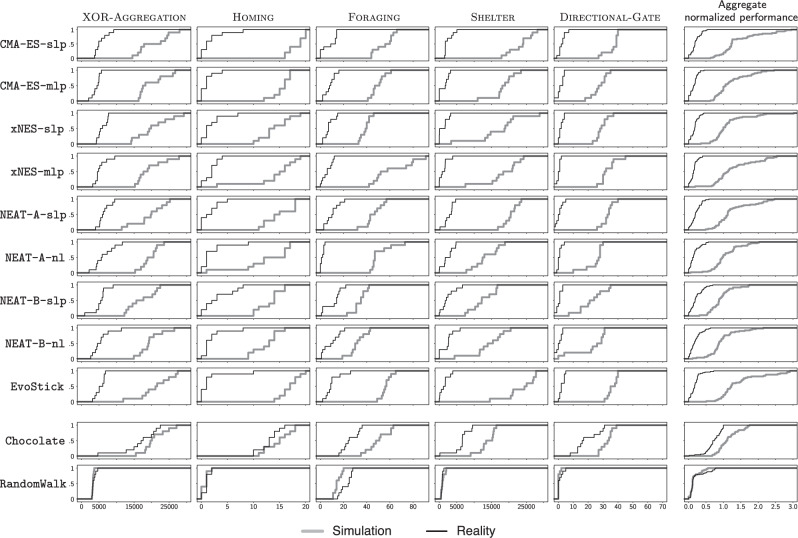
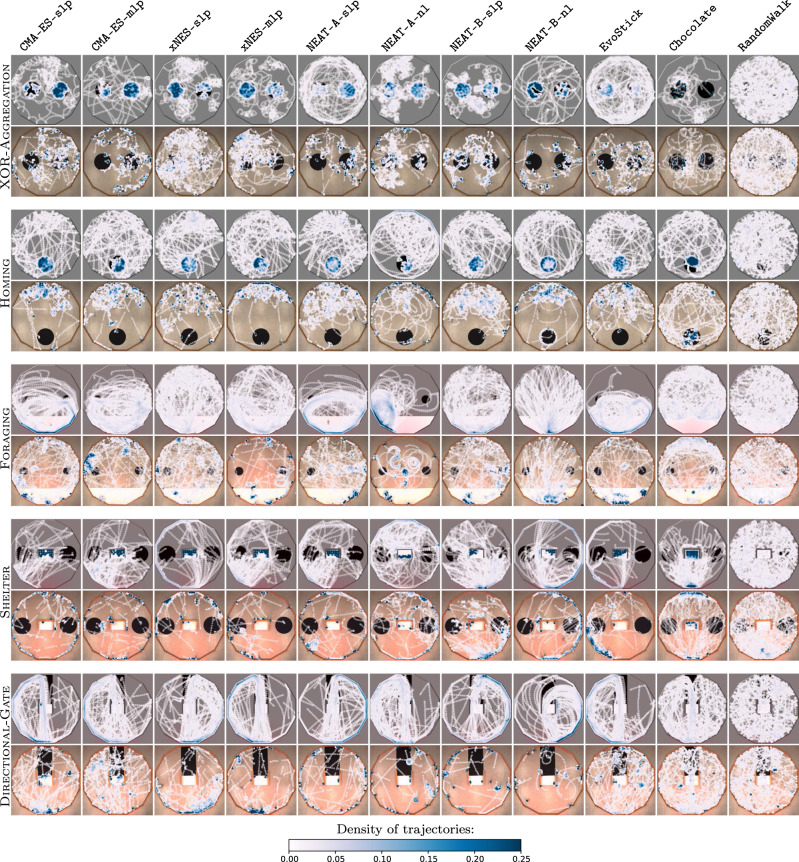
Neuro-evolution is an appealing approach to generating collective behaviors for robot swarms. In its typical application, known as off-line automatic design, the neural networks controlling the robots are optimized in simulation. It is understood that the so-called reality gap, the unavoidable differences between simulation and reality, typically causes neural network to be less effective on real robots than what is predicted by simulation. In this paper, we present an empirical study on the extent to which the reality gap impacts the most popular and advanced neuro-evolutionary methods for the off-line design of robot swarms. The results show that the neural networks produced by the methods under analysis performed well in simulation, but not in real-robot experiments. Further, the ranking that could be observed in simulation between the methods eventually disappeared. We find compelling evidence that real-robot experiments are needed to reliably assess the performance of neuro-evolutionary methods and that the robustness to the reality gap is the main issue to be addressed to advance the application of neuro-evolution to robot swarms.
Overview
The claims and statistics of this paper haven’t been checked yet.
Free: it reads the open-access text and checks the first 5 claims that cite a source we can check. Create a free account to check every claim.
Integrity signals
Registry
Cites
Statistics
Figures
Verification
Claims the paper makes
The claims and statistics of this paper haven’t been checked yet.
Free: it reads the open-access text and checks the first 5 claims that cite a source we can check. Create a free account to check every claim.
Claims other papers make about this one
Each is checked against this paper’s own text: does it say what the citing paper says it does?
The source backs part of the claim, not all of it — or backs it for a different population, condition or comparison.
In the citing paper
“EvoStick is the only neuroevolutionary method that has been tested in the automatic design of robot swarms for several missions, without undergoing any mission-specific modification 48 .”
From Automatic design of stigmergy-based behaviours for robot swarms (2024) · cites this paper as [48]
Experimental — accuracy not yet measuredThe cited source says what the claim attributes to it.
In the citing paper
“It has been observed that the control software produced by AutoMoDe crosses the reality gap [44][45][46][47] better than traditional approaches based on neuroevolution 43,48 , in which robots are controlled by a neural network that is optimised using an evolutionary algorithm [49][50][51] .”
From Automatic design of stigmergy-based behaviours for robot swarms (2024) · cites this paper as [48]
The cited source says what the claim attributes to it.
In the citing paper
“We do not consider more advanced neuroevolutionary methods (e.g., CMA-ES 70 , xNES 71 , and NEAT 72 ) as previous research has shown that they do not provide any performance advantage over EvoStick when applied off the shelf 48 .”
From Automatic design of stigmergy-based behaviours for robot swarms (2024) · cites this paper as [48]
Self-check
Percentages, sums and reported differences re-computed from the paper’s own numbers.
The self-check needs the paper’s full text.
Citations
Cites
The Elements of Statistical Learning
Hastie, T., Tibshirani, R., & Friedman, J. (2009) · Springer Series in Statistics · doi:10.1007/978-0-387-84858-7 · Cited by 25,970
(2016) · Cited by 11,679
Practical Nonparametric Statistics
Groggel, D. J. (2000) · Technometrics · doi:10.1080/00401706.2000.10486067 · Cited by 11,041
Completely Derandomized Self-Adaptation in Evolution Strategies
Hansen, N., & Ostermeier, A. (2001) · Evolutionary Computation · doi:10.1162/106365601750190398 · Cited by 4,397 · cited 13×
“The data indicate that, at least on the missions considered, neither the effective search of CMA-ES and xNES , nor the advanced abilities of NEAT to shape the topology of networks have the potential to improve the performance of the neuro-evolutionary approach.”
MethodInfluentialNeural Networks and the Bias/Variance Dilemma
Geman, S., Bienenstock, E., & Doursat, R. (1992) · Neural Computation · doi:10.1162/neco.1992.4.1.1 · Cited by 3,578 · cited 1×
“The de fi nition of the approach was inspired by the notion of bias/variance trade-off of machine learning 45 .”
Evolving Neural Networks through Augmenting Topologies
Stanley, K. O., & Miikkulainen, R. (2002) · Evolutionary Computation · doi:10.1162/106365602320169811 · Cited by 3,258 · cited 13×
“The data indicate that, at least on the missions considered, neither the effective search of CMA-ES and xNES , nor the advanced abilities of NEAT to shape the topology of networks have the potential to improve the performance of the neuro-evolutionary approach.”
BackgroundMethodInfluentialGraphical Methods for Data Analysis.
Healy, M. J. R., Chambers, J. M., Cleveland, W. S., Kleiner, B., & Tukey, P. A. (1984) · Journal of the Royal Statistical Society. Series A (General) · doi:10.2307/2981587 · Cited by 2,315
Graphical Methods for Data Analysis.
Fisher, N. I., Chambers, J. M., Cleveland, W. S., Kleiner, B., & Tukey, P. A. (1984) · Biometrics · doi:10.2307/2531418 · Cited by 1,982
Swarm robotics: a review from the swarm engineering perspective
Brambilla, M., Ferrante, E., Birattari, M., & Dorigo, M. (2013) · Swarm Intelligence · doi:10.1007/s11721-012-0075-2 · Cited by 1,762
Self-citationThe irace package: Iterated racing for automatic algorithm configuration
López-Ibáñez, M., Dubois-Lacoste, J., Pérez Cáceres, L., Birattari, M., & Stützle, T. (2016) · Operations Research Perspectives · doi:10.1016/j.orp.2016.09.002 · Cited by 1,761 · cited 1×
“The space of the possible combinations of the aforementioned modules is explored using Iterated F-race 69 .”
MethodSelf-citation
Research works printed but not linked: 8
- Berman S Kumar V Nagpal R Design of control policies for spatially inhomogeneous robot swarms with application to commercial pollination in IEEE International Conference on Robotics and Automation, ICRA 2011 Piscataway, NJ, USA IEEE
- Brambilla M Brutschy A Dorigo M Birattari M Property-driven design for swarm robotics: a design method based on prescriptive modeling and model checking ACM Tran. Auton. Adap. 2014 9 17:1 17:28
- Gauci M Chen J Li W Dodd TJ Groß R Clustering Objects with Robots That Do Not Compute in Proceedings of the 2014 International Conference on Autonomous Agents and Multi-Agent Systems - AAMAS2014 2014 Richland, SC, USA International Foundation for Autonomous Agents and Multiagent Systems 421 428
- Brooks, R. A. Artificial life and real robots in Towards a Practice of Autonomous Systems. Proceedings of the First European Conference on Artificial Life (eds. Varela, F. J. & Bourgine, P.) 3–10 (MIT Press, Cambridge, MA, USA, 1992).
- Caruana, R., Lawrence, S. & Giles, C. L. Overfitting in neural nets: backpropagation, conjugate gradient, and early stopping in Advances in Neural Information Processing Systems 13 (eds. Leen, T. K., Dietterich, T. G. & Tresp, V.) 402–408 (MIT Press, Cambridge, MA, USA, 2001).
- Morgan, N. & Bourlard, H. Generalization and Parameter Estimation in Feedforward Nets: Some Experiments in Proceedings of the 2nd International Conference on Neural Information Processing Systems, NIPS (ed. Touretzky, D.) 630–637 (MIT Press, Cambridge, MA, USA, 1989).
- Mondada, F. et al. The e-puck, a robot designed for education in engineering in Proceedings of the 9th Conference on Autonomous Robot Systems and Competitions (eds. Gonçalves, P., Torres, P. & Alves, C.) 59–65 (Instituto Politécnico de Castelo Branco, Castelo Branco, Portugal, 2009).
- Lunacek M Whitley LD The Dispersion Metric and the CMA Evolution Strategy in Proceedings of the 8th annual conference on Genetic and Evolutionary Computation, GECCO 2006 New York, NY, USA ACM 477 484
Cited by
Balancing Collective Exploration and Exploitation in Multi-Agent and Multi-Robot Systems: A Review
Kwa, H. L., Kit, J. L., & Bouffanais, R. (2022) · Frontiers in Robotics and AI · doi:10.3389/frobt.2021.771520 · Cited by 66
“This highlights the need for more extensive experimentation involving larger systems operating in more complex environments (Hasselmann et al., 2021).”
BackgroundSocial learning in swarm robotics
Bredèche, N., & Fontbonne, N. (2021) · Philosophical Transactions of the Royal Society B Biological Sciences · doi:10.1098/rstb.2020.0309 · Cited by 61
“Despite the various problems of using controlled environments during learning [10], this form of prior-to-deployment learning has been successfully applied to several problems, from training builder robots for construction [7] to autonomous high sea boats for surveillance [17] and outdoor UAVs…”
Recent trends in robot learning and evolution for swarm robotics
Kuckling, J. (2023) · Frontiers in Robotics and AI · doi:10.3389/frobt.2023.1134841 · Cited by 49
“, 2009) robots in five different missions such as aggregation, homing, shelter, foraging, and gate passing (Hasselmann et al., 2021).”
BackgroundSemantic-Driven Autonomous Visual Navigation for Unmanned Aerial Vehicles
Yue, P., Xin, J. L., Zhang, Y. M., Lu, Y., & Shan, M. (2024) · IEEE Transactions on Industrial Electronics · doi:10.1109/tie.2024.3363761 · Cited by 38
“This situation is known as reality gap [15].”
BackgroundTowards applied swarm robotics: current limitations and enablers
Kegeleirs, M., & Birattari, M. (2025) · Frontiers in Robotics and AI · doi:10.3389/frobt.2025.1607978 · Cited by 35
Self-citationUnIC: Towards Unmanned Intelligent Cluster and Its Integration into Society
Zhang, F., Yu, J., Lin, D., & Zhang, J. (2022) · Engineering · doi:10.1016/j.eng.2022.02.008 · Cited by 30
Automatic design of stigmergy-based behaviours for robot swarms
Salman, M., Garzón Ramos, D., & Birattari, M. (2024) · Communications Engineering · doi:10.1038/s44172-024-00175-7 · Cited by 26
“Ithasbeen observedthatthecontrolsoftwareproducedbyAutoMoDecrossesthe realitygap 44 – 47 better than traditional approaches based on neuroevolution 43,48 , in which robots are controlled by a neural network that is optimisedusing an evolutionary algorithm 49 – 51 .”
MethodInfluentialSelf-citationCultural evolution of probabilistic aggregation in synthetic swarms
Cambier, N., Albani, D., Frémont, V., Trianni, V., & Ferrante, E. (2021) · Applied Soft Computing · doi:10.1016/j.asoc.2021.108010 · Cited by 19
Gharbi, I., Kuckling, J., Ramos, D. G., & Birattari, M. (2023) · Proceedings - IEEE International Conference on Robotics and Automation/Proceedings · doi:10.1109/icra48891.2023.10160947 · Cited by 20
“In HOMING [12], the swarm must explore the arena and aggregate in the home area represented by a circular black”
BackgroundMethodSelf-citationAutoMoDe-Mate: Automatic off-line design of spatially-organizing behaviors for robot swarms
Mendiburu, F. J., Garzón Ramos, D., Morais, M. R. A., Lima, A. M. N., & Birattari, M. (2022) · Swarm and Evolutionary Computation · doi:10.1016/j.swevo.2022.101118 · Cited by 15
Self-citationGenSwarm: Scalable Multi-Robot Code-Policy Generation and Deployment via Language Models
Ji, W., Chen, H., Chen, M., Zhu, G., Xu, L., Gros, R., Zhou, R., Cao, M., & Zhao, S. (2026) · npj Robotics · doi:10.1038/s44182-025-00065-w · Cited by 24
“For instance, an objective function is first crafted to mathematically describe a desired task and then optimized to generate policies through methods such as evolutionary computation [5–7] or systematic search [8].”
InfluentialAlmansoori, A., Alkilabi, M. H. M., & Tuci, E. (2024) · Swarm Intelligence · doi:10.1007/s11721-023-00233-4 · Cited by 15
Kegeleirs, M., Ramos, D. G., Hasselmann, K., Garattoni, L., Francesca, G., & Birattari, M. (2024) · IEEE Robotics and Automation Letters · doi:10.1109/lra.2024.3360013 · Cited by 18
“Due to the sim-to-real transfer problem, control software produced in simulation via automatic off-line design suffers from the effects of the reality gap [15]: unavoidable differences betweensimulationandrealitycancauseaperformancedrop[4], [16],[17],[18].”
BackgroundMethodResultInfluentialSelf-citationToward an Empirical Practice in Offline Fully Automatic Design of Robot Swarms
Ligot, A., Cotorruelo, A., Garone, E., & Birattari, M. (2022) · IEEE Transactions on Evolutionary Computation · doi:10.1109/tevc.2022.3144848 · Cited by 14
“As an alternative, one could normalize the performance on each mission based on the knowledge of the theoretical maximal and minimal performance, or based on a reasonable estimate of them (including, for example, the best and worse performance observed empirically [20]).”
BackgroundMethodSelf-citationOn Using Simulation to Predict the Performance of Robot Swarms
Ligot, A., & Birattari, M. (2022) · Scientific Data · doi:10.1038/s41597-022-01895-1 · Cited by 16
“In a third one 27 , the mission is called Homing: in this case, the arena contains only one aggregation area.”
BackgroundMethodInfluentialSelf-citationFish-inspired tracking of underwater turbulent plumes
Gunnarson, P., & Dabiri, J. O. (2024) · Bioinspiration & Biomimetics · doi:10.1088/1748-3190/ad7181 · Cited by 11
“Trials using physical robots are needed to validate RL approaches before deployment in real-world scenarios [38].”
Hasselmann, K., Ligot, A., & Birattari, M. (2023) · Swarm and Evolutionary Computation · doi:10.1016/j.swevo.2023.101395 · Cited by 13
Self-citationThe Influence of Robot Traits and Evolutionary Dynamics on the Reality Gap
van Diggelen, F., Ferrante, E., Harrak, N., Luo, J., Zeeuwe, D., & Eiben, A. E. (2021) · IEEE Transactions on Cognitive and Developmental Systems · doi:10.1109/tcds.2021.3112236 · Cited by 17
Wang, C., Zhu, C., Zhu, X., Lei, H., Zhang, W., & Wu, M. C. (2025) · Swarm and Evolutionary Computation · doi:10.1016/j.swevo.2025.101854 · Cited by 9
Ren, C., Lin, L., Liao, Q., Zhou, H., Tian, C., Wang, H., & Lin, Z. (2025) · Environmental Science & Technology · doi:10.1021/acs.est.5c08681 · Cited by 9
Li, W., Wang, Z., Guan, C., Chen, C., Wang, B., Ren, P., Qiu, Y., Zhang, Q., Wang, H., Wang, D., et al. (2025) · Robotics and Autonomous Systems · doi:10.1016/j.robot.2025.105245 · Cited by 11
Kuckling, J., van Pelt, V., & Birattari, M. (2022) · SN Computer Science · doi:10.1007/s42979-021-00988-9 · Cited by 10
“Prior research has shown that high complexity in automatic design methods can increase the difficulties in crossing the reality gap [11, 26, 28].”
BackgroundSelf-citationLee, H., Lee, H., Jung, M., Carvalhais, N., Reichstein, M., Forkel, M., Bloom, A. A., Pacheco-Labrador, J., & Koirala, S. (2025) · Journal of Advances in Modeling Earth Systems · doi:10.1029/2024ms004479 · Cited by 7
Emergence of Specialised Collective Behaviors in Evolving Heterogeneous Swarms
van Diggelen, F., Carlo, M. D., Cambier, N., Ferrante, E., & Eiben, A. E. (2024) · Lecture notes in computer science · doi:10.1007/978-3-031-70068-2_4 · Cited by 9
Adversarial imitation learning with deep attention network for swarm systems
Wu, Y., Wang, T., Liu, T., Zheng, Z., Xu, D., & Peng, X. (2024) · Complex & Intelligent Systems · doi:10.1007/s40747-024-01662-2 · Cited by 6
“Consequently,developingswarmcontrollersoftenrequiresiterative approaches, such as reinforcement learning-based methods [10–12] and evolutionary computation-based methods [13, 14].”
Pagliuca, P., & Vitanza, A. (2025) · IEEE Access · doi:10.1109/access.2025.3554344 · Cited by 5
“In this study [25], an analysis of various neuro-evolutionary strategies was performed in order to evaluate the ability of these methods to deal with the reality gap problem [26].”
InfluentialTowards an integrated automatic design process for robot swarms
Bozhinoski, D., & Birattari, M. (2021) · Open Research Europe · doi:10.12688/openreseurope.14025.1 · Cited by 6
“…a range of missions specified in SML into all the resources needed to launch Chocolate 1 , a state-of-the-art automatic method for the off-line design of robot swarms 19 that, using simulation performed by ARGoS3 20 , produces control software that can be directly ported to e-puck robots 21 .”
Self-citationTang, H., Zhang, H., Shi, Z., Chen, X., Ding, W., & Zhang, X.-P. S. (2023) · IEEE/RSJ International Conference on Intelligent Robots and Systems (IROS) · doi:10.1109/iros55552.2023.10341749 · Cited by 7
“Despite the difficulty in modeling swarm robots, learning-based control can be a promising solution [5].”
BackgroundRamos, D. G., & Birattari, M. (2024) · Proceedings - IEEE International Conference on Robotics and Automation/Proceedings · doi:10.1109/icra57147.2024.10611309 · Cited by 7
“We conduct our experiments with ARGoS3 [45]: a swarm robotics simulator that has been used in the past to automatically design collective behaviors that have been subsequently validated in real-robot experiments [14], [19], [23], [27], [46], [47].”
BackgroundMethodSelf-citationSzpirer, J., Ramos, D. G., & Birattari, M. (2024) · IEEE/RSJ International Conference on Intelligent Robots and Systems (IROS) · doi:10.1109/iros58592.2024.10801506 · Cited by 7
“The authors restricted their study to missions aimed at achieving a single desired behavior [11].”
Self-citationHong, Z. (2025) · IEEE Transactions on Intelligent Transportation Systems · doi:10.1109/tits.2024.3524882 · Cited by 6
“N OWADAYS, the ability to learn skills from simulation to the real world (Sim2Real), has prompted continual transfer for embodied agents to interact with the environment to successfully make the optimum best response [1], [2].”
Insect-scale robots with embodied intelligence: Challenges and future perspectives
Zhou, Y., Wang, D., Gong, Y., Lei, I. M., & Zhong, J. (2026) · eScience · doi:10.1016/j.esci.2026.100549 · Cited by 3
Evolutionary Approaches to Improving the Layouts of Instance-Spaces
Sim, K., & Hart, E. (2022) · Lecture notes in computer science · doi:10.1007/978-3-031-14714-2_15 · Cited by 3
Autonomous Swarm Navigation Using Multi-Agent Reinforcement Learning and Neuro-Evolution
Díez, Á., & Aznar, F. (2024) · IEEE Conference on Evolving and Adaptive Intelligent Systems (EAIS) · doi:10.1109/eais58494.2024.10570010 · Cited by 3
“The parameters of these models ( i.e. , the synaptic weight matrices), and possibly their topologies, are obtained through an optimization process that is conducted with respect to a certain objective function, and all of it via artificial evolution [4].”
Automatic Design of Robot Swarms under Concurrent Design Criteria: A Study Based on Iterated F‐Race
Ramos, D. G., Pagnozzi, F., Stützle, T., & Birattari, M. (2024) · Advanced Intelligent Systems · doi:10.1002/aisy.202400332 · Cited by 5
Self-citationDistributed on-line reinforcement learning in a swarm of sterically interacting robotsPreprint
Zion, M. Y. B., Bredèche, N., & Dauchot, O. (2021) · arXiv (Cornell University) · Cited by 3
Evolutionary Machine Learning in Robotics
Medvet, E., Nadizar, G., Pigozzi, F., & Salvato, E. (2023) · Genetic and evolutionary computation · doi:10.1007/978-981-99-3814-8_23 · Cited by 3
Evolving Dynamic Fault Mitigation Strategies in a Robot Swarm for Collective Transport
Lee, S., & Hauert, S. (2025) · Lecture notes in computer science · doi:10.1007/978-3-031-90062-4_19 · Cited by 1
Multi-agent Deep Reinforcement Learning for Self-organized Aggregation of a Swarm of Robots
Abdelli, A., Yachir, A., & Amamra, A. (2024) · Lecture notes in networks and systems · doi:10.1007/978-3-031-71848-9_21
Matsumura, Y., Kishikawa, T., & Kinoshita, K. (2024) · The Journal of The Institute of Image Information and Television Engineers · doi:10.3169/itej.79.128
Evolutionary Robotics: An Efficient Automatic De-Novo Design of RobotsPreprint
Shi, S., Zou, J., & Liu, W. (2025) · SSRN Electronic Journal · doi:10.2139/ssrn.5255036
KrisshnaKumar, P., Paul, S., & Chowdhury, S. (2025) · Springer proceedings in advanced robotics · doi:10.1007/978-3-032-04584-3_13
Multi-Agent Dynamically Networked and Decentralized Pursuit-Evasion
Kouzehgar, M., Song, Y., Prasetyo, M. B., Loo, Y., Liu, S., Meghjani, M., & Bouffanais, R. (2025) · International Symposium on Multi-Robot and Multi-Agent Systems (MRS) · doi:10.1109/mrs66243.2025.11357257
“Alternatively, the behavioral rules can be automatically established though evolutionary stategies [5], or learned [2].”
PISC: Pheromone-inspired Self-organized Collective Cooperation
Wang, X., Wang, H., Lv, Z., & Tang, J. (2026) · Chaos Solitons & Fractals · doi:10.1016/j.chaos.2026.118219
Designing Collective Behaviors for Robot Swarms from Image Demonstrations
Medina, J. B., Pantoja, A. D., Achicanoy, W., & Ramos, D. G. (2026) · Lecture notes in networks and systems · doi:10.1007/978-3-032-18982-0_17
Bio-Inspired Swarm Navigation on Resource-Constrained Robots for GPS-Denied Environments
Sheikder, C., Zhang, W., Chen, X., Li, F., He, X., He, H., Fan, S., & Tan, X. (2026) · Sensors · doi:10.3390/s26113525
“The unsupervised behaviour clustering algorithm analyses spatio-temporal patterns in robot interactions to autonomously identify emergent role differentiation, while the CNN performs real-time visual target recognition from RGB-D camera imagery [12,19].”
InfluentialRule-Driven Self-Organized Swarm Delivery to Evolutionary Nanorobots
Zou, J., & Shi, S. (2026) · IEEE International Conference on Micro/Nano Sensors for AI, Healthcare, and Robotics (NSENS) · doi:10.1109/nsens71111.2026.11663130
“Recent advances in microscale collective systems have demonstrated that interaction-driven behaviors such as phase transitions, self-propelled particle dynamics, and swarm coordination can significantly enhance robustness in complex environments[7] [8]].”
Curriculum-Based Navigation in Simulated Tunnels using Proportional and Evolutionary Controllers
Gonçalves, A., Mihalache, F., Sousa, J., Leão, G., & Reis, L. P. (2026) · Lecture notes in networks and systems · doi:10.1007/978-3-032-30156-7_23
Visual swarm navigation via deep reinforcement learning and evolutionary hybrid design
Díez, Á., & Aznar, F. (2026) · Engineering Applications of Artificial Intelligence · doi:10.1016/j.engappai.2026.116325
“CMA-ES, one of today’s most effective evolution strategies, is notable for its advanced capabilities in searching the solution space (Hasselmann et al., 2021).”
InfluentialHong, Z. (2026) · SSRN Electronic Journal · doi:10.2139/ssrn.7506740
Structural bias enables reliable sim-to-real transfer in reinforcement learning for robot swarms
Gharbi, I., Kegeleirs, M., Herranz, G. L., Szpirer, J., Hasselmann, K., & Birattari, M. (2026) · Science Robotics · doi:10.1126/scirobotics.adw4624
Self-citationGameiro, T., Soares, S., Viegas, C. X. P., Ferreira, N. M. F., & Valente, A. L. G. (2026) · Electronics · doi:10.3390/electronics15214909
С., Г. Е., & М., Е. Н. (2026) · System Analysis in Science and Education
Metadata
- Authors
- Hasselmann, K., Ligot, A., Ruddick, J., & Birattari, M.
- Affiliations
- Université Libre de Bruxelles (BE)
- Corresponding author
- Birattari, Mauro
- Venue
- Nature Communications
- Published
- 2021-07-16
- Volume
- 12
- Issue
- 1
- Pages
- 4345-4345
- ISSN
- 2041-1723 (ISSN-L)
- PMC
- PMC8285396
- OpenAlex
- W3178918501
- Semantic Scholar
- de7e78240fc174798430f59ab7b82da94c9712c7
- Cited by
- 53
- References
- 62
- Citations by year
- 2026: 10 · 2025: 11 · 2024: 14 · 2023: 5 · 2022: 8 · 2021: 5
- FWCI
- 3.42
- Type
- journal article
- Language
- en
- Open access
- gold
- doi.org
- Licence
- cc-by
- creativecommons.org/licenses/by/4.0 (tdm)
- creativecommons.org/licenses/by/4.0 (vor)
- Locations
- Nature Communications (publishedVersion, cc-by)
- PubMed Central (publishedVersion, cc-by)
- PubMed (publishedVersion)
- RePEc: Research Papers in Economics (submittedVersion)
- Dépôt institutionnel de l'Université libre de Bruxelles (Université Libre de Bruxelles) (submittedVersion, other-oa)
- DOAJ (DOAJ: Directory of Open Access Journals) (submittedVersion, cc-by-sa)
- Funders
- European Commission (681872, HORIZON2020)
- Fonds De La Recherche Scientifique - FNRS
- Topics
- Physical Sciences › Engineering › Mechanical Engineering › Modular Robots and Swarm Intelligence
- Physical Sciences › Computer Science › Artificial Intelligence › Evolutionary Algorithms and Applications
- Physical Sciences › Computer Science › Artificial Intelligence › Metaheuristic Optimization Algorithms Research
- Keywords
- neuroevolution, swarm robotics, reality gap, sim-to-real transfer, collective behavior, neural network controller, evolutionary algorithm comparison
About these checks
Registry, retraction, Cites and statistics results are computed, not judged, with one exception: a printed reference that no index lists is read once by a model before it counts as a citation error. Claims are extracted by a model and kept only when their quote appears verbatim in the text; each cited source is then checked, with a model’s help, for whether it says what the claim relies on. Those verdicts can be wrong — read the claim’s quote and the cited source before relying on one.
Statistics and arithmetic are recomputed, not judged.
Confidence bands are shown only for fields calibrated on our annotated test set. None is calibrated yet, so no band is shown.
What counts as a claim ›How we measure confidence ›How we check this ›
Are you an author, or do you see a problem with this page? Request a review
Data sources
Bibliographic data: Semantic Scholar, OpenAlex, Crossref.
Contains information from the Semantic Scholar Academic Graph Datasets, made available under the ODC Attribution License (ODC-BY 1.0).
Semantic Scholar’s data is described in: Kinney, R., et al. (2023). The Semantic Scholar Open Data Platform. arXiv:2301.10140.
