

Empirical assessment and comparison of neuro-evolutionary methods for the automatic off-line design of robot swarms
Open accessThe DOI matches its Crossref record; 61 of the 62 references it cites were found in a registry or an index.
Abstract
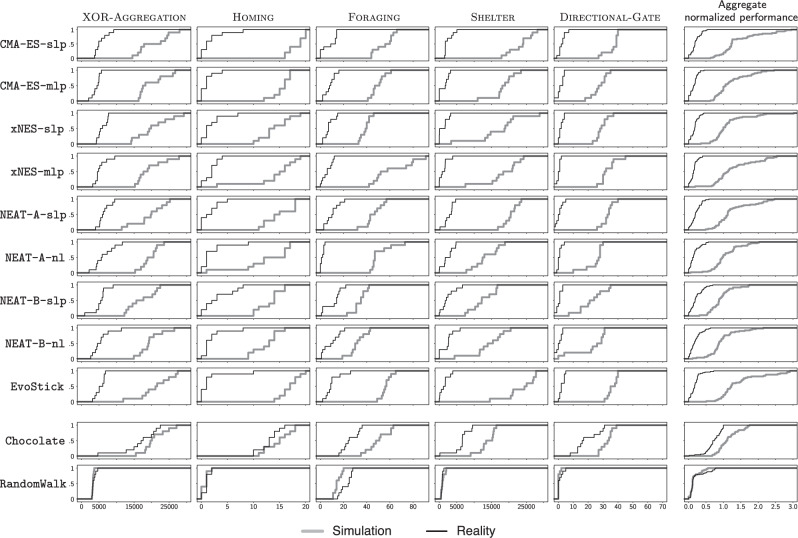
Neuro-evolution is an appealing approach to generating collective behaviors for robot swarms. In its typical application, known as off-line automatic design, the neural networks controlling the robots are optimized in simulation. It is understood that the so-called reality gap, the unavoidable differences between simulation and reality, typically causes neural network to be less effective on real robots than what is predicted by simulation. In this paper, we present an empirical study on the extent to which the reality gap impacts the most popular and advanced neuro-evolutionary methods for the off-line design of robot swarms. The results show that the neural networks produced by the methods under analysis performed well in simulation, but not in real-robot experiments. Further, the ranking that could be observed in simulation between the methods eventually disappeared. We find compelling evidence that real-robot experiments are needed to reliably assess the performance of neuro-evolutionary methods and that the robustness to the reality gap is the main issue to be addressed to advance the application of neuro-evolution to robot swarms.
Overview
The claims and statistics of this paper haven’t been checked yet.
Free: it reads the open-access text and checks the first 5 claims that cite a source we can check. Create a free account to check every claim.
Integrity signals
Registry
Cites
Statistics
Figures
Verification
Claims the paper makes
The claims and statistics of this paper haven’t been checked yet.
Free: it reads the open-access text and checks the first 5 claims that cite a source we can check. Create a free account to check every claim.
Claims other papers make about this one
Each is checked against this paper’s own text: does it say what the citing paper says it does?
The source backs part of the claim, not all of it — or backs it for a different population, condition or comparison.
In the citing paper
“EvoStick is the only neuroevolutionary method that has been tested in the automatic design of robot swarms for several missions, without undergoing any mission-specific modification 48 .”
From Automatic design of stigmergy-based behaviours for robot swarms (2024) · cites this paper as [48]
Experimental — accuracy not yet measuredThe cited source says what the claim attributes to it.
In the citing paper
“It has been observed that the control software produced by AutoMoDe crosses the reality gap [44][45][46][47] better than traditional approaches based on neuroevolution 43,48 , in which robots are controlled by a neural network that is optimised using an evolutionary algorithm [49][50][51] .”
From Automatic design of stigmergy-based behaviours for robot swarms (2024) · cites this paper as [48]
The cited source says what the claim attributes to it.
In the citing paper
“We do not consider more advanced neuroevolutionary methods (e.g., CMA-ES 70 , xNES 71 , and NEAT 72 ) as previous research has shown that they do not provide any performance advantage over EvoStick when applied off the shelf 48 .”
From Automatic design of stigmergy-based behaviours for robot swarms (2024) · cites this paper as [48]
Self-check
Percentages, sums and reported differences re-computed from the paper’s own numbers.
The self-check needs the paper’s full text.
Citations
Cites
The Elements of Statistical Learning
Hastie, T., Tibshirani, R., & Friedman, J. (2009) · Springer Series in Statistics · doi:10.1007/978-0-387-84858-7 · Cited by 25,970
(2016) · Cited by 11,679
Practical Nonparametric Statistics
Groggel, D. J. (2000) · Technometrics · doi:10.1080/00401706.2000.10486067 · Cited by 11,041
Completely Derandomized Self-Adaptation in Evolution Strategies
Hansen, N., & Ostermeier, A. (2001) · Evolutionary Computation · doi:10.1162/106365601750190398 · Cited by 4,397 · cited 13×
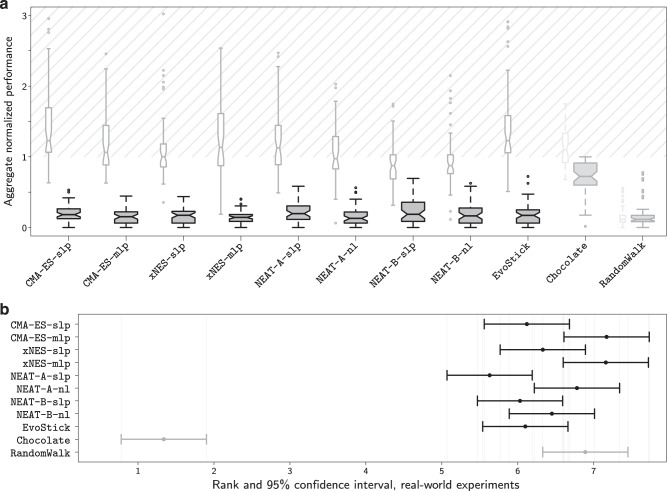
“The data indicate that, at least on the missions considered, neither the effective search of CMA-ES and xNES , nor the advanced abilities of NEAT to shape the topology of networks have the potential to improve the performance of the neuro-evolutionary approach.”
MethodInfluentialNeural Networks and the Bias/Variance Dilemma
Geman, S., Bienenstock, E., & Doursat, R. (1992) · Neural Computation · doi:10.1162/neco.1992.4.1.1 · Cited by 3,578 · cited 1×
“The de fi nition of the approach was inspired by the notion of bias/variance trade-off of machine learning 45 .”
Evolving Neural Networks through Augmenting Topologies
Stanley, K. O., & Miikkulainen, R. (2002) · Evolutionary Computation · doi:10.1162/106365602320169811 · Cited by 3,258 · cited 13×
“The data indicate that, at least on the missions considered, neither the effective search of CMA-ES and xNES , nor the advanced abilities of NEAT to shape the topology of networks have the potential to improve the performance of the neuro-evolutionary approach.”
BackgroundMethodInfluentialGraphical Methods for Data Analysis.
Healy, M. J. R., Chambers, J. M., Cleveland, W. S., Kleiner, B., & Tukey, P. A. (1984) · Journal of the Royal Statistical Society. Series A (General) · doi:10.2307/2981587 · Cited by 2,315
Graphical Methods for Data Analysis.
Fisher, N. I., Chambers, J. M., Cleveland, W. S., Kleiner, B., & Tukey, P. A. (1984) · Biometrics · doi:10.2307/2531418 · Cited by 1,982
Swarm robotics: a review from the swarm engineering perspective
Brambilla, M., Ferrante, E., Birattari, M., & Dorigo, M. (2013) · Swarm Intelligence · doi:10.1007/s11721-012-0075-2 · Cited by 1,762
Self-citationThe irace package: Iterated racing for automatic algorithm configuration
López-Ibáñez, M., Dubois-Lacoste, J., Pérez Cáceres, L., Birattari, M., & Stützle, T. (2016) · Operations Research Perspectives · doi:10.1016/j.orp.2016.09.002 · Cited by 1,761 · cited 1×
“The space of the possible combinations of the aforementioned modules is explored using Iterated F-race 69 .”
MethodSelf-citationEvolutionary Robotics: The Biology, Intelligence, and Technology of Self-Organizing Machines
Nolfi, S., & Floreano, D. (2000) · The MIT Press eBooks · doi:10.7551/mitpress/2889.001.0001 · Cited by 1,513
Programmable self-assembly in a thousand-robot swarm
Rubenstein, M., Cornejo, A., & Nagpal, R. (2014) · Science · doi:10.1126/science.1254295 · Cited by 1,308
A Restart CMA Evolution Strategy With Increasing Population Size
Auger, A., & Hansen, N. (2005) · 2005 IEEE Congress on Evolutionary Computation · doi:10.1109/cec.2005.1554902 · Cited by 952
Prechelt, L. (2012) · Lecture Notes in Computer Science · doi:10.1007/978-3-642-35289-8_5 · Cited by 951
Reconfigurable magnetic microrobot swarm: Multimode transformation, locomotion, and manipulation
Xie, H., Sun, M., Fan, X., Lin, Z., Chen, W., Wang, L., Dong, L., & He, Q. (2019) · Science Robotics · doi:10.1126/scirobotics.aav8006 · Cited by 772
Noise and the reality gap: The use of simulation in evolutionary robotics
Jakobi, N., Husbands, P., & Harvey, I. (1995) · Lecture Notes in Computer Science · doi:10.1007/3-540-59496-5_337 · Cited by 631 · cited 2×
“The models of the e-puck ’ s components have been conceived on the basis of real-world data sampled from the robot ’ s sensors and actuators, according to the best practice 37,63 .”
MethodDesigning Collective Behavior in a Termite-Inspired Robot Construction Team
Werfel, J., Petersen, K., & Nagpal, R. (2014) · Science · doi:10.1126/science.1245842 · Cited by 599
ARGoS: a modular, parallel, multi-engine simulator for multi-robot systems
Pinciroli, C., Trianni, V., O’Grady, R., Pini, G., Brutschy, A., Brambilla, M., Mathews, N., Ferrante, E., Di Caro, G., Ducatelle, F., et al. (2012) · Swarm Intelligence · doi:10.1007/s11721-012-0072-5 · Cited by 551 · cited 2×
“We used version 48 of ARGoS, along with the ARGoS-Epuck library 61 , which provides models for all extension boards.”
MethodSelf-citationUltra-extensible ribbon-like magnetic microswarm
Yu, J., Wang, B., Du, X., Wang, Q., & Zhang, L. (2018) · Nature Communications · doi:10.1038/s41467-018-05749-6 · Cited by 422
Swarm Robotics: A Formal Approach
Hamann, H. (2018) · doi:10.1007/978-3-319-74528-2 · Cited by 366
Evolving Mobile Robots in Simulated and Real Environments
Miglino, O., Lund, H. H., & Nolfi, S. (1995) · Artificial Life · doi:10.1162/artl.1995.2.4.417 · Cited by 358 · cited 1×
“The models of the e-puck ’ s components have been conceived on the basis of real-world data sampled from the robot ’ s sensors and actuators, according to the best practice 37,63 .”
MethodParticle robotics based on statistical mechanics of loosely coupled components
Li, S., Batra, R., Brown, D., Chang, H.-D., Ranganathan, N., Hoberman, C., Rus, D., & Lipson, H. (2019) · Nature · doi:10.1038/s41586-019-1022-9 · Cited by 320
Reflections on the future of swarm robotics
Dorigo, M., Theraulaz, G., & Trianni, V. (2020) · Science Robotics · doi:10.1126/scirobotics.abe4385 · Cited by 282
Embodied Evolution: Distributing an evolutionary algorithm in a population of robots
Watson, R. A., Ficici, S. G., & Pollack, J. B. (2002) · Robotics and Autonomous Systems · doi:10.1016/s0921-8890(02)00170-7 · Cited by 275 · cited 1×
“…the differences between simulation and reality on the basis of the observation of control software produced by speci fi c methods on speci fi c missions could lead to ad hoc solutions that do not necessarily generalize to other methods, missions, platforms, environment, and scenarios 32,35,48 .”
Evolutionary Robotics: What, Why, and Where to
Doncieux, S., Bredeche, N., Mouret, J.-B., & Eiben, A. E. (. (2015) · Frontiers in Robotics and AI · doi:10.3389/frobt.2015.00004 · Cited by 275
The Transferability Approach: Crossing the Reality Gap in Evolutionary Robotics
Koos, S., Mouret, J.-B., & Doncieux, S. (2013) · IEEE Transactions on Evolutionary Computation · doi:10.1109/tevc.2012.2185849 · Cited by 272 · cited 1×
“For example, Koos et al. 39 proposed a method that builds and updates a model of the differences between the performance in simulation and reality.”
MethodBongard, J. C. (2013) · Communications of the ACM · doi:10.1145/2492007.2493883 · Cited by 260
Slavkov, I., Carrillo-Zapata, D., Carranza, N., Diego, X., Jansson, F., Kaandorp, J., Hauert, S., & Sharpe, J. (2018) · Science Robotics · doi:10.1126/scirobotics.aau9178 · Cited by 204
Exponential natural evolution strategies
Glasmachers, T., Schaul, T., Yi, S., Wierstra, D., & Schmidhuber, J. (2010) · Proceedings of the 12th annual conference on Genetic and evolutionary computation · doi:10.1145/1830483.1830557 · Cited by 198 · cited 2×
“…— mlp is the mnemonic for multi-layer perceptron: the input nodes are initially all connected to the hidden nodes, which are in turn all connected to the output. xNES-slp is based on xNES 43 , an evolutionary algorithm similar to CMA-ES but in which the update rule is de fi ned in a principled way.”
BackgroundMethodAutoMoDe: A novel approach to the automatic design of control software for robot swarms
Francesca, G., Brambilla, M., Brutschy, A., Trianni, V., & Birattari, M. (2014) · Swarm Intelligence · doi:10.1007/s11721-014-0092-4 · Cited by 171 · cited 11×
“To the best of our knowledge, EvoStick is the only neuro-evolutionary method for the automatic design of robot swarms that has been tested on more than a single mission without undergoing any manually-applied mission-speci fi c adaptation 26,41 .”
BackgroundMethodInfluentialSelf-citationEarly stopping and non-parametric regression: An optimal data-dependent stopping rule
Raskutti, G., Wainwright, M. J., & Yu, B. (2013) · arXiv (Cornell University) · doi:10.48550/arxiv.1306.3574 · Cited by 167 · cited 1×
“…further research is needed to develop a reliable method, previous results 52 indicate that a popular regularization technique known as early stopping 53 – 56 has the potential to increase the robustness to the reality gap of neuro-evolutionary methods for the automatic design of robot swarms.”
Floreano, D., Husbands, P., & Nolfi, S. (2008) · Springer eBooks · doi:10.1007/978-3-540-30301-5_62 · Cited by 155 · cited 1×
“This bias was introduced with the goal of reducing the variance and preventing that the control software produced over fi ts the features of the simulator that do not have a counterpart in the real world 38,40 .”
MethodDorigo, M., Birattari, M., & Brambilla, M. (2014) · Scholarpedia · doi:10.4249/scholarpedia.1463 · Cited by 149
Self-citationSelf-organized aggregation without computation
Gauci, M., Chen, J., Li, W., Dodd, T. J., & Groß, R. (2014) · The International Journal of Robotics Research · doi:10.1177/0278364914525244 · Cited by 146
Automatic Design of Robot Swarms: Achievements and Challenges
Francesca, G., & Birattari, M. (2016) · Frontiers in Robotics and AI · doi:10.3389/frobt.2016.00029 · Cited by 144
Self-citationA Design Pattern for Decentralised Decision Making
Reina, A., Valentini, G., Fernández-Oto, C., Dorigo, M., & Trianni, V. (2015) · PLOS ONE · doi:10.1371/journal.pone.0140950 · Cited by 139
A framework of space–time continuous models for algorithm design in swarm robotics
Hamann, H., & Wörn, H. (2008) · Swarm Intelligence · doi:10.1007/s11721-008-0015-3 · Cited by 134
Evolution of Collective Behaviors for a Real Swarm of Aquatic Surface Robots
Duarte, M., Costa, V., Gomes, J., Rodrigues, T., Silva, F., Oliveira, S. M., & Christensen, A. L. (2016) · PLOS ONE · doi:10.1371/journal.pone.0151834 · Cited by 134
Trianni, V. (2008) · Studies in computational intelligence · doi:10.1007/978-3-540-77612-3 · Cited by 130
Beyond black-box optimization: a review of selective pressures for evolutionary robotics
Doncieux, S., & Mouret, J.-B. (2014) · Evolutionary Intelligence · doi:10.1007/s12065-014-0110-x · Cited by 129
Evolution of Plastic Neurocontrollers for Situated Agents
Floreano, D., & Francesco Mondada, C. (1996) · The MIT Press eBooks · doi:10.7551/mitpress/3118.003.0049 · Cited by 126
Evolution of Self-Organized Task Specialization in Robot Swarms
Ferrante, E., Turgut, A. E., Duéñez-Guzmán, E., Dorigo, M., & Wenseleers, T. (2015) · PLOS Computational Biology · doi:10.1371/journal.pcbi.1004273 · Cited by 123 · cited 1×
“Admittedly, relatively more complex missions have been considered in the semi-automatic design literature — e.g., see Ferrante et al. 46 .”
BackgroundBeal, J., Dulman, S., Usbeck, K., Mirko Viroli, D., & Correll, N. (2012) · IGI Global eBooks · doi:10.4018/978-1-4666-2092-6.ch016 · Cited by 121
Open Issues in Evolutionary Robotics
Silva, F., Duarte, M., Correia, L., Oliveira, S. M., & Christensen, A. L. (2016) · Evolutionary Computation · doi:10.1162/evco_a_00172 · Cited by 106 · cited 1×
“…the differences between simulation and reality on the basis of the observation of control software produced by speci fi c methods on speci fi c missions could lead to ad hoc solutions that do not necessarily generalize to other methods, missions, platforms, environment, and scenarios 32,35,48 .”
Embodied Evolution in Collective Robotics: A Review
Bredeche, N., Haasdijk, E., & Prieto, A. (2018) · Frontiers in Robotics and AI · doi:10.3389/frobt.2018.00012 · Cited by 103
AutoMoDe-Chocolate: automatic design of control software for robot swarms
Francesca, G., Brambilla, M., Brutschy, A., Garattoni, L., Miletitch, R., Podevijn, G., Reina, A., Soleymani, T., Salvaro, M., Pinciroli, C., et al. (2015) · Swarm Intelligence · doi:10.1007/s11721-015-0107-9 · Cited by 99 · cited 4×
“As baselines, we included in the study also: (1) Chocolate 41 , a design method that belongs to the AutoMoDe family 26 .”
MethodInfluentialSelf-citationSupervisory control theory applied to swarm robotics
Lopes, Y. K., Trenkwalder, S. M., Leal, A. B., Dodd, T. J., & Groß, R. (2016) · Swarm Intelligence · doi:10.1007/s11721-016-0119-0 · Cited by 96
Open E-puck Range & Bearing miniaturized board for local communication in swarm robotics
Gutierrez, A., Campo, A., Dorigo, M., Donate, J., Monasterio-Huelin, F., & Magdalena, L. (2009) · 2009 IEEE International Conference on Robotics and Automation · doi:10.1109/robot.2009.5152456 · Cited by 93 · cited 1×
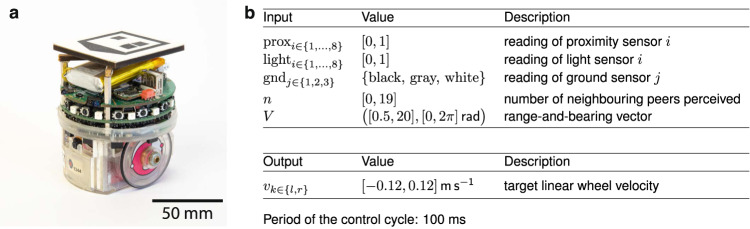
“For the purpose of the research presented here, the e-puck was enhanced with two extension boards: (i) the range-and-bearing 58 , which enables a robot to sense the presence of neighboring peers and estimate their relative position; and (ii) the Overo Gumstix, a Linux board that increases the…”
MethodAutonomous task sequencing in a robot swarm
Garattoni, L., & Birattari, M. (2018) · Science Robotics · doi:10.1126/scirobotics.aat0430 · Cited by 92
Self-citationEvolving Behaviour Trees for Swarm Robotics
Jones, S., Studley, M., Hauert, S., & Winfield, A. F. T. (2018) · Springer proceedings in advanced robotics · doi:10.1007/978-3-319-73008-0_34 · Cited by 90
Automatic Off-Line Design of Robot Swarms: A Manifesto
Birattari, M., Ligot, A., Bozhinoski, D., Brambilla, M., Francesca, G., Garattoni, L., Garzón Ramos, D., Hasselmann, K., Kegeleirs, M., Kuckling, J., et al. (2019) · Frontiers in Robotics and AI · doi:10.3389/frobt.2019.00059 · Cited by 79
Self-citationFormica ex Machina: Ant Swarm Foraging from Physical to Virtual and Back Again
Hecker, J. P., Letendre, K. A., Stolleis, K. A., Washington, D., & Moses, M. E. (2012) · Lecture notes in computer science · doi:10.1007/978-3-642-32650-9_25 · Cited by 59
Ligot, A., & Birattari, M. (2020) · Swarm Intelligence · doi:10.1007/s11721-019-00175-w · Cited by 55 · cited 3×
“As it has been already observed 40 , the reality-gap problem is a relative Fig.”
BackgroundMethodSelf-citationAnalysing an Evolved Robotic Behaviour Using a Biological Model of Collegial Decision Making
Francesca, G., Brambilla, M., Trianni, V., Dorigo, M., & Birattari, M. (2012) · Lecture notes in computer science · doi:10.1007/978-3-642-33093-3_38 · Cited by 51
Self-citationBuzz: A Programming Language for Robot Swarms
Pinciroli, C., & Beltrame, G. (2016) · IEEE Software · doi:10.1109/ms.2016.95 · Cited by 45
Birattari, M., Ligot, A., & Hasselmann, K. (2020) · Nature Machine Intelligence · doi:10.1038/s42256-020-0215-0 · Cited by 44 · cited 1×
“As we have previously observed 47 , in (fully) automatic design, the challenge does not lie much in the complexity of each single mission, but rather in the fact that the design method must be able to produce control software for different missions without undergoing any modi fi cation.”
Self-citationRobust optimization through neuroevolution
Pagliuca, P., & Nolfi, S. (2019) · PLoS ONE · doi:10.1371/journal.pone.0213193 · Cited by 30 · cited 1×
“We set λ = 100, a common choice in the literature 31 ; and σ 0 = 5, that is, half the width of the parameter range, the initial population will therefore cover the entire search space — the same choice was made also in several other studies 64 – 66 .”
ResultModel independence in swarm robotics
Kazadi, S. (2009) · International Journal of Intelligent Computing and Cybernetics · doi:10.1108/17563780911005836 · Cited by 28
Observing the Effects of Overdesign in the Automatic Design of Control Software for Robot Swarms
Birattari, M., Delhaisse, B., Francesca, G., & Kerdoncuff, Y. (2016) · Lecture notes in computer science · doi:10.1007/978-3-319-44427-7_13 · Cited by 19 · cited 1×
“For example, although further research is needed to develop a reliable method, previous results 52 indicate that a popular regularization technique known as early stopping 53 – 56 has the potential to increase the robustness to the reality gap of neuro-evolutionary methods for the automatic design…”
MethodSelf-citationBehavioral and Cognitive Robotics: An Adaptive Perspective
Nolfi, S. (2021) · Cited by 15
Pezzulo, G., Baldassarre, G., Cesta, A., & Nolfi, S. (2011) · Cognitive Processing · doi:10.1007/s10339-011-0402-3 · Cited by 9
Research works printed but not linked: 8
- Berman S Kumar V Nagpal R Design of control policies for spatially inhomogeneous robot swarms with application to commercial pollination in IEEE International Conference on Robotics and Automation, ICRA 2011 Piscataway, NJ, USA IEEE
- Brambilla M Brutschy A Dorigo M Birattari M Property-driven design for swarm robotics: a design method based on prescriptive modeling and model checking ACM Tran. Auton. Adap. 2014 9 17:1 17:28
- Gauci M Chen J Li W Dodd TJ Groß R Clustering Objects with Robots That Do Not Compute in Proceedings of the 2014 International Conference on Autonomous Agents and Multi-Agent Systems - AAMAS2014 2014 Richland, SC, USA International Foundation for Autonomous Agents and Multiagent Systems 421 428
- Brooks, R. A. Artificial life and real robots in Towards a Practice of Autonomous Systems. Proceedings of the First European Conference on Artificial Life (eds. Varela, F. J. & Bourgine, P.) 3–10 (MIT Press, Cambridge, MA, USA, 1992).
- Caruana, R., Lawrence, S. & Giles, C. L. Overfitting in neural nets: backpropagation, conjugate gradient, and early stopping in Advances in Neural Information Processing Systems 13 (eds. Leen, T. K., Dietterich, T. G. & Tresp, V.) 402–408 (MIT Press, Cambridge, MA, USA, 2001).
- Morgan, N. & Bourlard, H. Generalization and Parameter Estimation in Feedforward Nets: Some Experiments in Proceedings of the 2nd International Conference on Neural Information Processing Systems, NIPS (ed. Touretzky, D.) 630–637 (MIT Press, Cambridge, MA, USA, 1989).
- Mondada, F. et al. The e-puck, a robot designed for education in engineering in Proceedings of the 9th Conference on Autonomous Robot Systems and Competitions (eds. Gonçalves, P., Torres, P. & Alves, C.) 59–65 (Instituto Politécnico de Castelo Branco, Castelo Branco, Portugal, 2009).
- Lunacek M Whitley LD The Dispersion Metric and the CMA Evolution Strategy in Proceedings of the 8th annual conference on Genetic and Evolutionary Computation, GECCO 2006 New York, NY, USA ACM 477 484
Cited by
Balancing Collective Exploration and Exploitation in Multi-Agent and Multi-Robot Systems: A Review
Kwa, H. L., Kit, J. L., & Bouffanais, R. (2022) · Frontiers in Robotics and AI · doi:10.3389/frobt.2021.771520 · Cited by 66
“This highlights the need for more extensive experimentation involving larger systems operating in more complex environments (Hasselmann et al., 2021).”
BackgroundSocial learning in swarm robotics
Bredèche, N., & Fontbonne, N. (2021) · Philosophical Transactions of the Royal Society B Biological Sciences · doi:10.1098/rstb.2020.0309 · Cited by 61
“Despite the various problems of using controlled environments during learning [10], this form of prior-to-deployment learning has been successfully applied to several problems, from training builder robots for construction [7] to autonomous high sea boats for surveillance [17] and outdoor UAVs…”
Recent trends in robot learning and evolution for swarm robotics
Kuckling, J. (2023) · Frontiers in Robotics and AI · doi:10.3389/frobt.2023.1134841 · Cited by 49
“, 2009) robots in five different missions such as aggregation, homing, shelter, foraging, and gate passing (Hasselmann et al., 2021).”
BackgroundSemantic-Driven Autonomous Visual Navigation for Unmanned Aerial Vehicles
Yue, P., Xin, J. L., Zhang, Y. M., Lu, Y., & Shan, M. (2024) · IEEE Transactions on Industrial Electronics · doi:10.1109/tie.2024.3363761 · Cited by 38
“This situation is known as reality gap [15].”
BackgroundTowards applied swarm robotics: current limitations and enablers
Kegeleirs, M., & Birattari, M. (2025) · Frontiers in Robotics and AI · doi:10.3389/frobt.2025.1607978 · Cited by 35
Self-citation
Metadata
- Authors
- Hasselmann, K., Ligot, A., Ruddick, J., & Birattari, M.
- Affiliations
- Université Libre de Bruxelles (BE)
- Corresponding author
- Birattari, Mauro
- Venue
- Nature Communications
- Published
- 2021-07-16
- Volume
- 12
- Issue
- 1
- Pages
- 4345-4345
- ISSN
- 2041-1723 (ISSN-L)
- PMC
- PMC8285396
- OpenAlex
- W3178918501
- Cited by
- 53
- References
- 62
- Citations by year
- 2026: 10 · 2025: 11 · 2024: 14 · 2023: 5 · 2022: 8 · 2021: 5
- FWCI
- 3.42
- Type
- journal article
- Language
- en
- Open access
- gold
- doi.org
- Licence
- cc-by
- creativecommons.org/licenses/by/4.0 (tdm)
- creativecommons.org/licenses/by/4.0 (vor)
- Locations
- Nature Communications (publishedVersion, cc-by)
- PubMed Central (publishedVersion, cc-by)
- PubMed (publishedVersion)
- RePEc: Research Papers in Economics (submittedVersion)
- Dépôt institutionnel de l'Université libre de Bruxelles (Université Libre de Bruxelles) (submittedVersion, other-oa)
- DOAJ (DOAJ: Directory of Open Access Journals) (submittedVersion, cc-by-sa)
- Funders
- European Commission (681872, HORIZON2020)
- Fonds De La Recherche Scientifique - FNRS
- Topics
- Physical Sciences › Engineering › Mechanical Engineering › Modular Robots and Swarm Intelligence
- Physical Sciences › Computer Science › Artificial Intelligence › Evolutionary Algorithms and Applications
- Physical Sciences › Computer Science › Artificial Intelligence › Metaheuristic Optimization Algorithms Research
- Keywords
- neuroevolution, swarm robotics, reality gap, sim-to-real transfer, collective behavior, neural network controller, evolutionary algorithm comparison
About these checks
Registry, retraction, Cites and statistics results are computed, not judged, with one exception: a printed reference that no index lists is read once by a model before it counts as a citation error. Claims are extracted by a model and kept only when their quote appears verbatim in the text; each cited source is then checked, with a model’s help, for whether it says what the claim relies on. Those verdicts can be wrong — read the claim’s quote and the cited source before relying on one.
Statistics and arithmetic are recomputed, not judged.
Confidence bands are shown only for fields calibrated on our annotated test set. None is calibrated yet, so no band is shown.
What counts as a claim ›How we measure confidence ›How we check this ›
Are you an author, or do you see a problem with this page? Request a review
Data sources
Bibliographic data: Semantic Scholar, OpenAlex, Crossref.
Contains information from the Semantic Scholar Academic Graph Datasets, made available under the ODC Attribution License (ODC-BY 1.0).
Semantic Scholar’s data is described in: Kinney, R., et al. (2023). The Semantic Scholar Open Data Platform. arXiv:2301.10140.
