

The impact of site-specific digital histology signatures on deep learning model accuracy and bias
Open accessPublished version of a preprint
The DOI matches its Crossref record; 88 of the 88 references it cites were found in a registry or an index.
Abstract
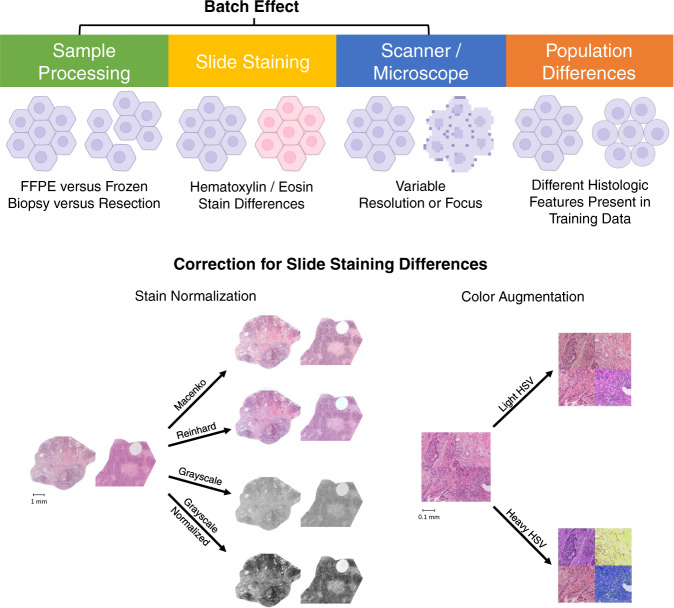
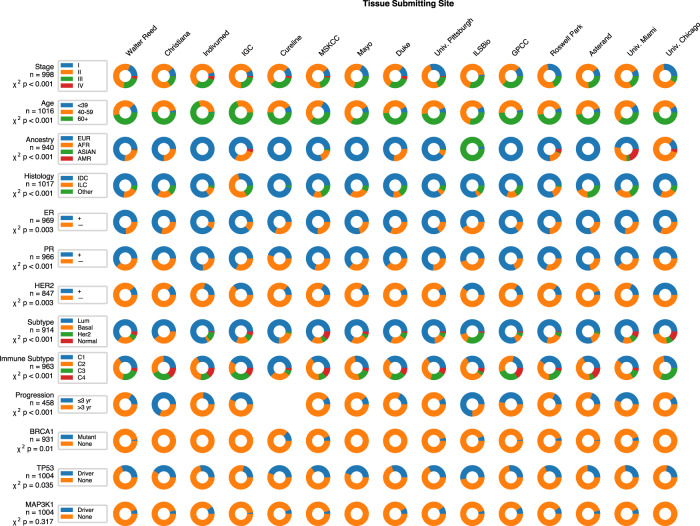
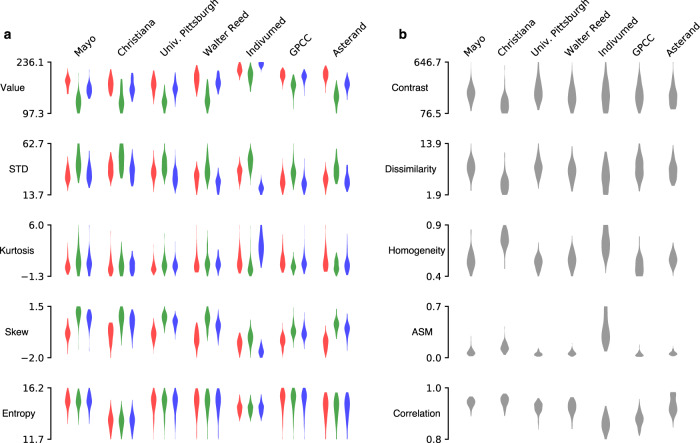
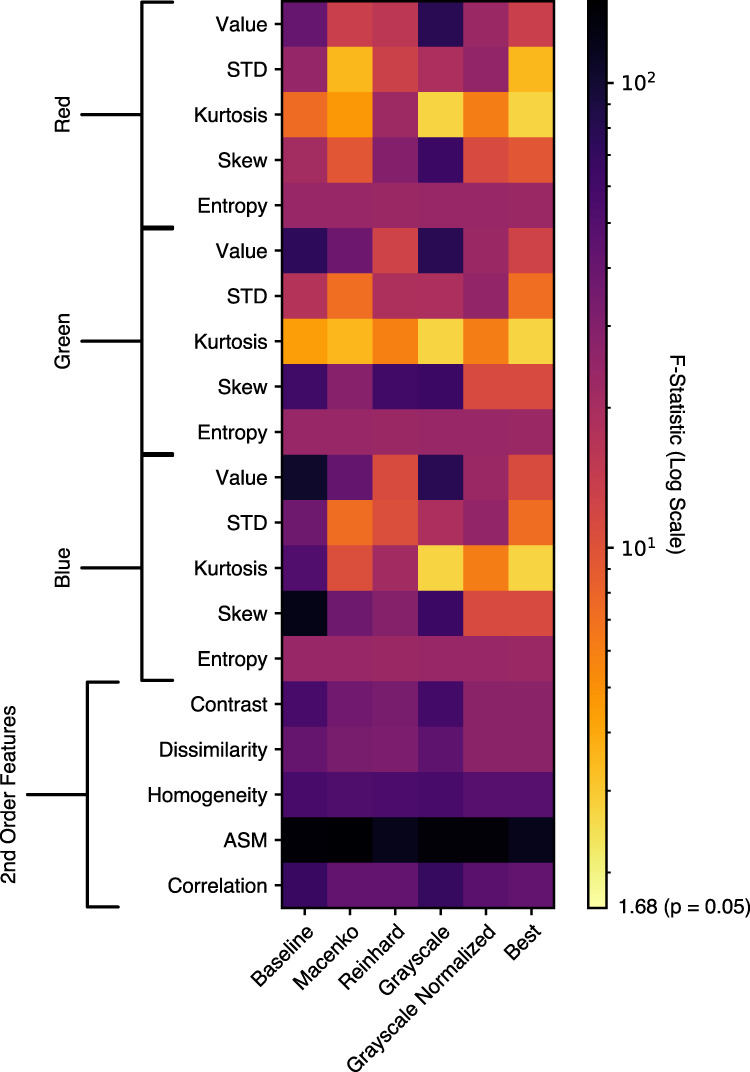
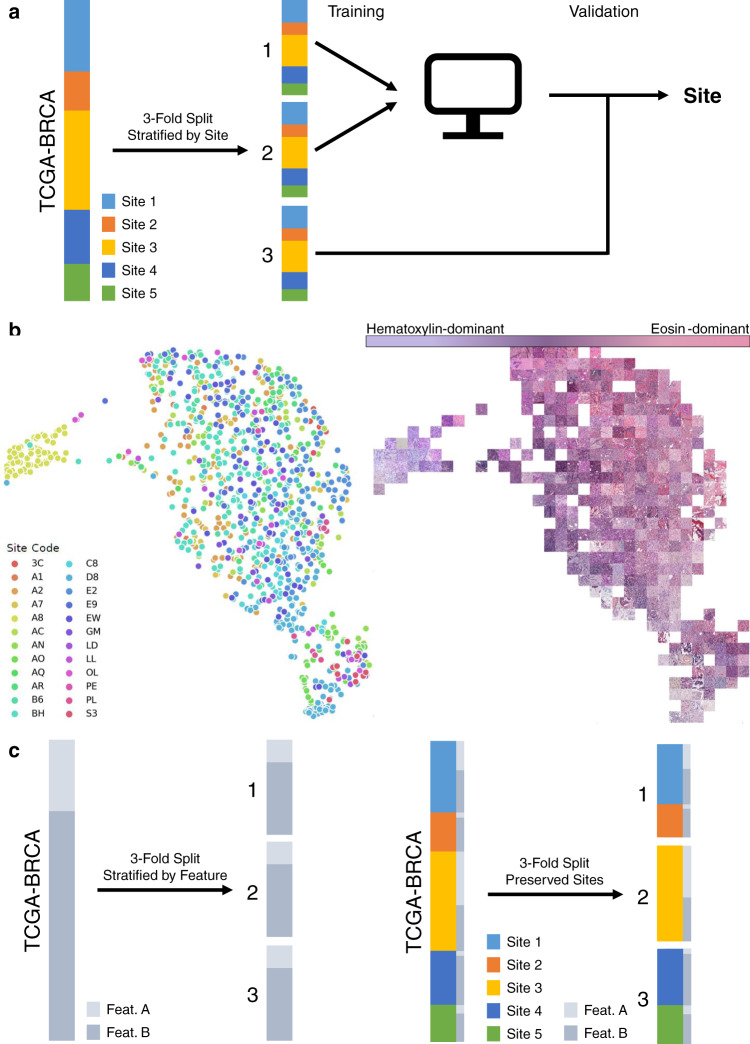
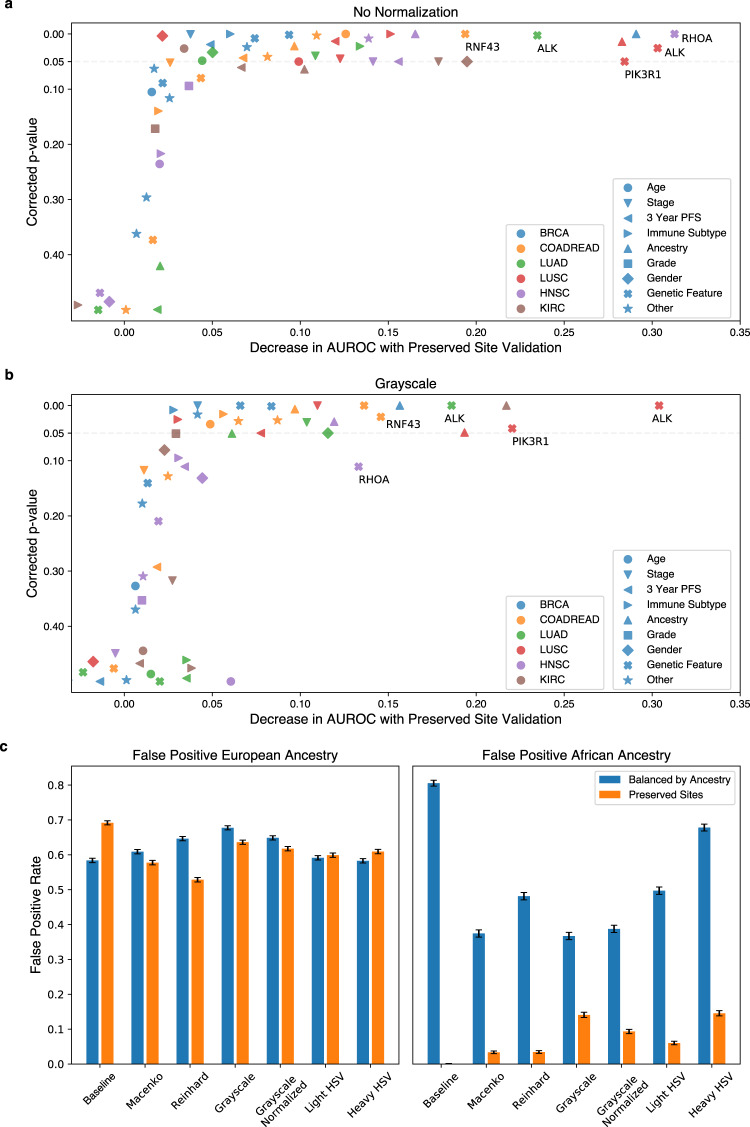
The Cancer Genome Atlas (TCGA) is one of the largest biorepositories of digital histology. Deep learning (DL) models have been trained on TCGA to predict numerous features directly from histology, including survival, gene expression patterns, and driver mutations. However, we demonstrate that these features vary substantially across tissue submitting sites in TCGA for over 3,000 patients with six cancer subtypes. Additionally, we show that histologic image differences between submitting sites can easily be identified with DL. Site detection remains possible despite commonly used color normalization and augmentation methods, and we quantify the image characteristics constituting this site-specific digital histology signature. We demonstrate that these site-specific signatures lead to biased accuracy for prediction of features including survival, genomic mutations, and tumor stage. Furthermore, ethnicity can also be inferred from site-specific signatures, which must be accounted for to ensure equitable application of DL. These site-specific signatures can lead to overoptimistic estimates of model performance, and we propose a quadratic programming method that abrogates this bias by ensuring models are not trained and validated on samples from the same site.
Overview
The claims and statistics of this paper haven’t been checked yet.
Free: it reads the open-access text and checks the first 5 claims that cite a source we can check. Create a free account to check every claim.
Integrity signals
Registry
Cites
Statistics
Figures
Verification
Claims the paper makes
The claims and statistics of this paper haven’t been checked yet.
Free: it reads the open-access text and checks the first 5 claims that cite a source we can check. Create a free account to check every claim.
Claims other papers make about this one
Each is checked against this paper’s own text: does it say what the citing paper says it does?
The source backs part of the claim, not all of it — or backs it for a different population, condition or comparison.
In the citing paper
“To reduce the impact of batch effects, we performed a five-fold site-preserved stratification140.”
From A multimodal whole-slide foundation model for pathology (2025) · cites this paper as [140]
Experimental — accuracy not yet measuredThe cited source says what the claim attributes to it.
In the citing paper
“To mitigate the impact of batch effects, all datasets based on TCGA are split into label-stratified and site-preserving folds such that slides from one clinical site only occur in one fold following140.”
From A multimodal whole-slide foundation model for pathology (2025) · cites this paper as [140]
In the citing paper
“The observation that such low-information patches were flagged by the model as being highly relevant shows that a model trained only on TCGA does not adequately learn to detect relevant patterns, possibly because of pronounced batch effects in the TCGA cohort 22 .”
From Swarm learning for decentralized artificial intelligence in cancer histopathology (2022) · cites this paper as [22]
Self-check
Percentages, sums and reported differences re-computed from the paper’s own numbers.
The self-check needs the paper’s full text.
Citations
Cites
Adam: A Method for Stochastic Optimization
Kingma, D. P., & Ba, J. (2014) · arXiv · doi:10.48550/arxiv.1412.6980 · Cited by 98,946
ImageNet: A large-scale hierarchical image database
Deng, J., Dong, W., Socher, R., Li, L.-J., Li, K., & Fei-Fei, L. (2009) · 2009 IEEE Conference on Computer Vision and Pattern Recognition · doi:10.1109/cvpr.2009.5206848 · Cited by 65,333
Boyd, S., & Vandenberghe, L. (2004) · doi:10.1017/cbo9780511804441 · Cited by 56,601
Textural Features for Image Classification
Haralick, R. M., Shanmugam, K., & Dinstein, I. (1973) · IEEE Transactions on Systems, Man, and Cybernetics · doi:10.1109/tsmc.1973.4309314 · Cited by 22,886
DeLong, E. R., DeLong, D. M., & Clarke-Pearson, D. L. (1988) · Biometrics · doi:10.2307/2531595 · Cited by 22,649
Xception: Deep Learning with Depthwise Separable Convolutions
Chollet, F. (2017) · 2017 IEEE Conference on Computer Vision and Pattern Recognition (CVPR) · doi:10.1109/cvpr.2017.195 · Cited by 20,380
"Why Should I Trust You?": Explaining the Predictions of Any Classifier
Ribeiro, M. T., Singh, S., & Guestrin, C. (2016) · Proceedings of the 22nd ACM SIGKDD International Conference on Knowledge Discovery and Data Mining · doi:10.1145/2939672.2939778 · Cited by 17,555
Molecular portraits of human breast tumours
Perou, C. M., Sørlie, T., Eisen, M. B., van de Rijn, M., Jeffrey, S. S., Rees, C. A., Pollack, J. R., Ross, D. T., Johnsen, H., Akslen, L. A., et al. (2000) · Nature · doi:10.1038/35021093 · Cited by 16,261
Nishimura, R., Osako, T., Nishiyama, Y., Tashima, R., Nakano, M., Fujisue, M., Toyozumi, Y., & Arima, N. (2013) · Oncology · doi:10.1159/000353099 · Cited by 13,166
High-performance medicine: the convergence of human and artificial intelligence
Topol, E. J. (2019) · Nature Medicine · doi:10.1038/s41591-018-0300-7 · Cited by 10,450
Cited by
Towards a general-purpose foundation model for computational pathology
Chen, R. J., Ding, T., Lu, M. Y., Williamson, D. F. K., Jaume, G., Song, A. H., Chen, B., Zhang, A., Shao, D., Shaban, M., et al. (2024) · Nature Medicine · doi:10.1038/s41591-024-02857-3 · Cited by 1,560
Gao, C. A., Howard, F. M., Markov, N. S., Dyer, E. C., Ramesh, S., Luo, Y., & Pearson, A. T. (2023) · npj Digital Medicine · doi:10.1038/s41746-023-00819-6 · Cited by 1,099
“However, AI models have been shown to be highly sensitive to biases in training data 24,25 , and further data is needed to determine the potential for bias perpetuated by ChatGPT — especially given the overt prejudices emerging from prior language generation models 26 .”
Self-citationArtificial intelligence for multimodal data integration in oncology
Lipkova, J., Chen, R. J., Chen, B., Lu, M. Y., Barbieri, M., Shao, D., Vaidya, A. J., Chen, C., Zhuang, L., Williamson, D. F. K., et al. (2022) · Cancer Cell · doi:10.1016/j.ccell.2022.09.012 · Cited by 777
Algorithmic fairness in artificial intelligence for medicine and healthcare
Chen, R. J., Wang, J. J., Williamson, D. F. K., Chen, T. Y., Lipkova, J., Lu, M. Y., Sahai, S., & Mahmood, F. (2023) · Nature Biomedical Engineering · doi:10.1038/s41551-023-01056-8 · Cited by 750
“For example, medical images (such as radiographs, pathology slides and fundus photographs) can leak protected attributes, which can become ‘shortcuts’ to model predictions 9,12,89,90 .”
BackgroundInfluentialArtificial intelligence in drug development
Zhang, K., Yang, X., Wang, Y., Yu, Y., Huang, N., Li, G., Li, X., Wu, J. C., & Yang, S. (2025) · Nature Medicine · doi:10.1038/s41591-024-03434-4 · Cited by 498
“Applying AI and big data tools can effectively address pharmacometric problems and offer a powerful tool for time-to-event analysis, particularly in handling high-dimensional data and nonlinear relationships in the hazard function.”
Metadata
- Authors
- Howard, F. M., Dolezal, J., Kochanny, S., Schulte, J., Chen, H., Heij, L., Huo, D., Nanda, R., Olopade, O. I., Kather, J. N., Cipriani, N., Grossman, R. L., & Pearson, A. T.
- Affiliations
- University of Chicago (US)
- Universitätsklinikum Aachen (DE)
- University of Leeds (GB)
- Corresponding author
- Grossman, Robert L.
- Pearson, Alexander T.
- ORCID
- Venue
- Nature Communications
- Published
- 2021-07-20
- Volume
- 12
- Issue
- 1
- Pages
- 4423-4423
- ISSN
- 2041-1723 (ISSN-L)
- PMC
- PMC8292530
- OpenAlex
- W3186679119
- Semantic Scholar
- b399cc8e8d7a62a4d085b8893a153618ecefcc5f
- Cited by
- 330
- References
- 83
- Citations by year
- 2026: 85 · 2025: 55 · 2024: 71 · 2023: 60 · 2022: 47 · 2021: 11
- FWCI
- 16.72
- Type
- journal article
- Language
- en
- Open access
- gold
- doi.org
- Licence
- cc-by
- creativecommons.org/licenses/by/4.0 (tdm)
- creativecommons.org/licenses/by/4.0 (vor)
- Locations
- Nature Communications (publishedVersion, cc-by)
- bioRxiv (Cold Spring Harbor Laboratory) (acceptedVersion)
- PubMed Central (publishedVersion, cc-by)
- PubMed (publishedVersion)
- RWTH Publications (RWTH Aachen) (submittedVersion, cc-by)
- RePEc: Research Papers in Economics (submittedVersion)
- DOAJ (DOAJ: Directory of Open Access Journals) (submittedVersion, cc-by-sa)
- RWTH Publications (RWTH Aachen)
- Funders
- U.S. Department of Health & Human Services | NIH | National Institute of Dental and Craniofacial Research (K08-DE026500)
- U.S. Department of Health & Human Services | NIH | National Cancer Institute (U01-CA243075)
- Cancer Research Foundation
- Adenoid Cystic Carcinoma Research Foundation
- Topics
- Physical Sciences › Computer Science › Artificial Intelligence › AI in cancer detection
- Health Sciences › Medicine › Radiology, Nuclear Medicine and Imaging › Radiomics and Machine Learning in Medical Imaging
- Life Sciences › Biochemistry, Genetics and Molecular Biology › Molecular Biology › Gene expression and cancer classification
- Keywords
- TCGA, tumor subtypes, survival prediction, tumor stage prediction, algorithmic fairness, quadratic programming, cross-site validation, color normalization, image augmentation
- MeSH terms
- Data Accuracy, Deep Learning, DNA Mutational Analysis, Humans, Image Processing, Computer-Assisted, Mutation, Neoplasm Staging, Neoplasms, Specimen Handling, Biomarkers, Tumor, Risk Assessment, Gene Expression Profiling
About these checks
Registry, retraction, Cites and statistics results are computed, not judged, with one exception: a printed reference that no index lists is read once by a model before it counts as a citation error. Claims are extracted by a model and kept only when their quote appears verbatim in the text; each cited source is then checked, with a model’s help, for whether it says what the claim relies on. Those verdicts can be wrong — read the claim’s quote and the cited source before relying on one.
Statistics and arithmetic are recomputed, not judged.
Confidence bands are shown only for fields calibrated on our annotated test set. None is calibrated yet, so no band is shown.
What counts as a claim ›How we measure confidence ›How we check this ›
Are you an author, or do you see a problem with this page? Request a review
Data sources
Bibliographic data: Semantic Scholar, OpenAlex, Crossref.
Contains information from the Semantic Scholar Academic Graph Datasets, made available under the ODC Attribution License (ODC-BY 1.0).
Semantic Scholar’s data is described in: Kinney, R., et al. (2023). The Semantic Scholar Open Data Platform. arXiv:2301.10140.
