

Improved modeling of human AD with an automated culturing platform for iPSC neurons, astrocytes and microglia
Open accessThe DOI matches its Crossref record; 66 of the 66 references it cites were found in a registry or an index.
Abstract
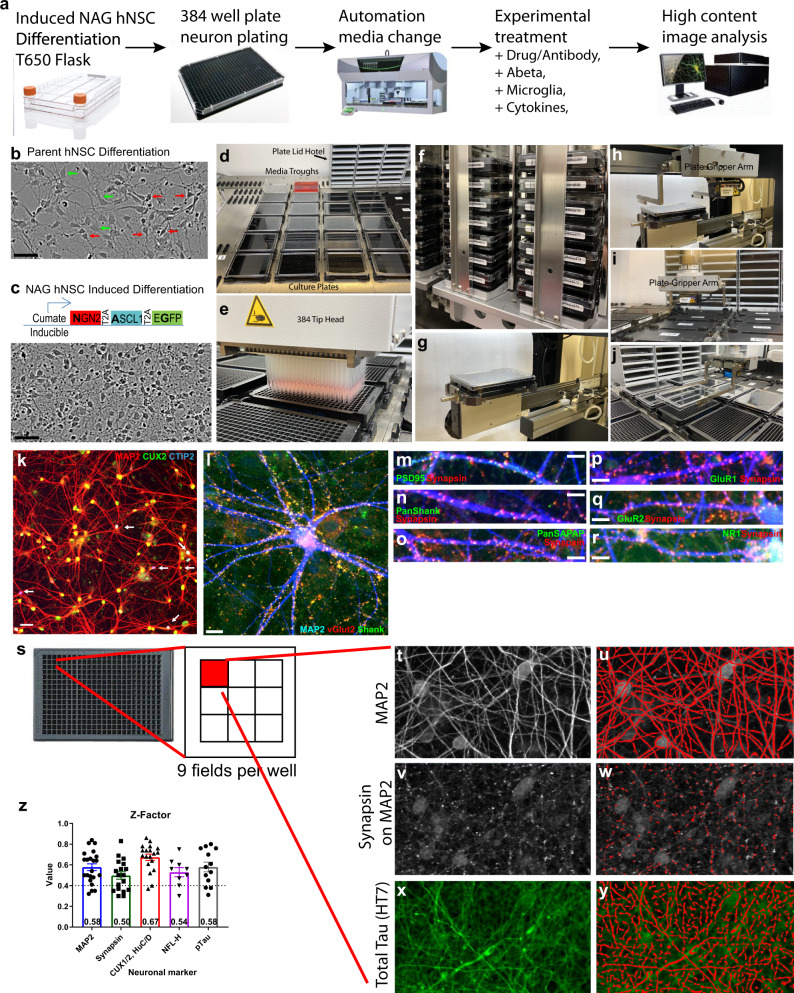
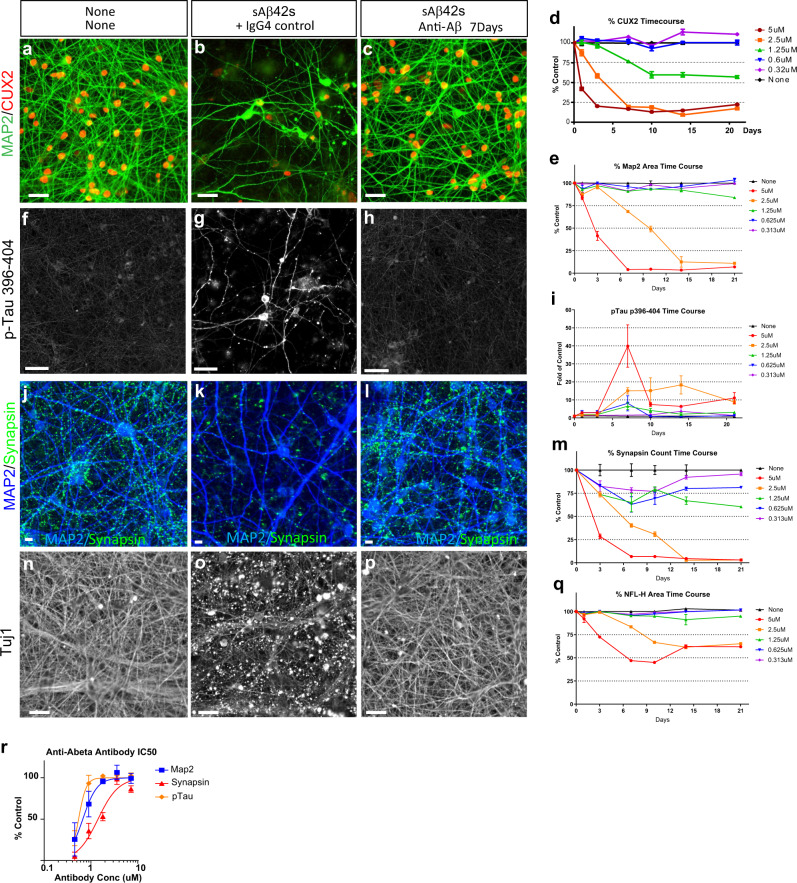
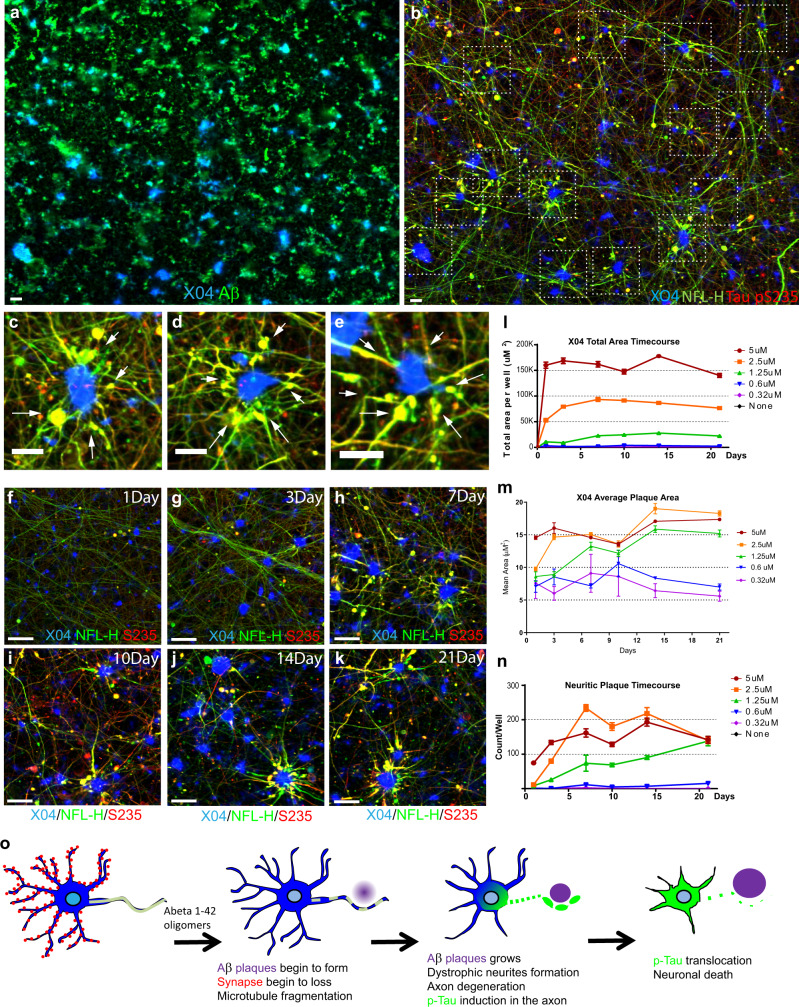
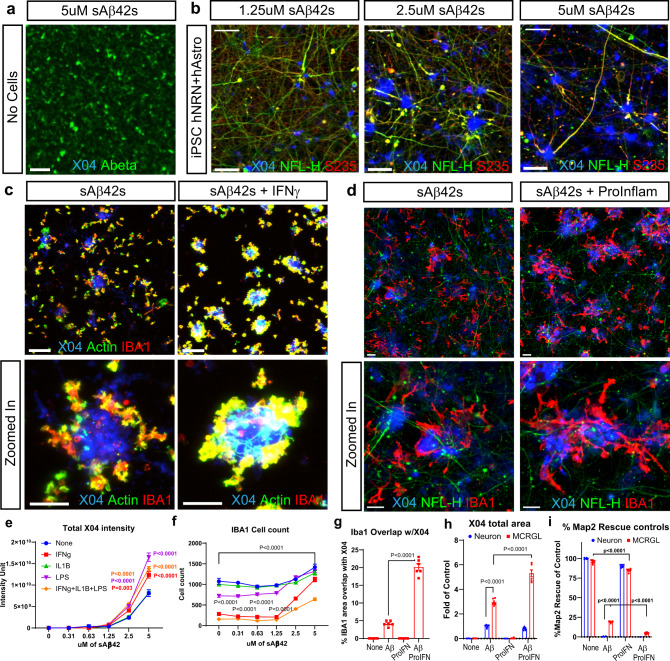
Advancement in human induced pluripotent stem cell (iPSC) neuron and microglial differentiation protocols allow for disease modeling using physiologically relevant cells. However, iPSC differentiation and culturing protocols have posed challenges to maintaining consistency. Here, we generated an automated, consistent, and long-term culturing platform of human iPSC neurons, astrocytes, and microglia. Using this platform we generated a iPSC AD model using human derived cells, which showed signs of Aβ plaques, dystrophic neurites around plaques, synapse loss, dendrite retraction, axon fragmentation, phospho-Tau induction, and neuronal cell death in one model. We showed that the human iPSC microglia internalized and compacted Aβ to generate and surround the plaques, thereby conferring some neuroprotection. We investigated the mechanism of action of anti-Aβ antibodies protection and found that they protected neurons from these pathologies and were most effective before pTau induction. Taken together, these results suggest that this model can facilitate target discovery and drug development efforts.
Overview
The claims and statistics of this paper haven’t been checked yet.
Free: it reads the open-access text and checks the first 5 claims that cite a source we can check. Create a free account to check every claim.
Integrity signals
Registry
Cites
Statistics
Figures
Verification
Claims the paper makes
The claims and statistics of this paper haven’t been checked yet.
Free: it reads the open-access text and checks the first 5 claims that cite a source we can check. Create a free account to check every claim.
Claims other papers make about this one
Each is checked against this paper’s own text: does it say what the citing paper says it does?
The cited source says what the claim attributes to it.
In the citing paper
“Bassil et al., 2021, generated a model of AD which consisted of neurons, astrocytes, and microglia. This model presents AD-like hallmarks such as neuronal loss induced by p-Tau.”
From Utility of iPSC-Derived Cells for Disease Modeling, Drug Development, and Cell Therapy (2022) · cites this paper as [34]
Self-check
Percentages, sums and reported differences re-computed from the paper’s own numbers.
The self-check needs the paper’s full text.
Citations
Cites
Neuropathological stageing of Alzheimer-related changes.
Braak, H., & Braak, E. (1991) · Acta Neuropathologica · doi:10.1007/bf00308809 · Cited by 16,123
The Amyloid Hypothesis of Alzheimer’s Disease: Progress and Problems on the Road to Therapeutics
Hardy, J., & Selkoe, D. J. (2002) · Science · doi:10.1126/science.1072994 · Cited by 13,864
Amyloid oligomers exacerbate tau pathology in a mouse model of tauopathy
Selenica, M.-L. B., Brownlow, M., Jimenez, J. P., Lee, D. C., Pena, G., Dickey, C. A., Gordon, M. N., & Morgan, D. (2013) · Neurodegenerative Diseases · doi:10.1159/000337230 · Cited by 10,359
Alzheimer Disease: An Update on Pathobiology and Treatment Strategies
Long, J. M., & Holtzman, D. M. (2019) · Cell · doi:10.1016/j.cell.2019.09.001 · Cited by 3,204
The Cellular Phase of Alzheimer’s Disease
De Strooper, B., & Karran, E. (2016) · Cell · doi:10.1016/j.cell.2015.12.056 · Cited by 1,990
Rapid single-step induction of functional neurons from human pluripotent stem cells
Zhang, Y., Pak, C., Han, Y., Ahlenius, H., Zhang, Z., Chanda, S., Marro, S., Patzke, C., Acuna, C., Covy, J., et al. (2013) · Neuron · doi:10.1016/j.neuron.2013.05.029 · Cited by 1,644
A three-dimensional human neural cell culture model of Alzheimer’s disease
Choi, S. H., Kim, Y. H., Hebisch, M., Sliwinski, C., Lee, S., D’Avanzo, C., Chen, H., Hooli, B., Asselin, C., Muffat, J., et al. (2014) · Nature · doi:10.1038/nature13800 · Cited by 1,195
iPSC-derived human microglia-like cells to study neurological diseases
Abud, E. M., Ramirez, R. N., Martinez, E. S., Healy, L. M., Nguyen, C. H. H., Newman, S. A., Yeromin, A. V., Scarfone, V. M., Marsh, S. E., Fimbres, C., et al. (2017) · Neuron · doi:10.1016/j.neuron.2017.03.042 · Cited by 1,154
Tau pathology and neurodegeneration
Spillantini, M. G., & Goedert, M. (2013) · The Lancet Neurology · doi:10.1016/s1474-4422(13)70090-5 · Cited by 1,133
Glial fibrillary acidic protein: From intermediate filament assembly and gliosis to neurobiomarker
Yang, Z., & Wang, K. K. W. (2015) · Trends in Neurosciences · doi:10.1016/j.tins.2015.04.003 · Cited by 1,050
Cited by
Items 101–107 of 107
Strooper, B. D., van Vierbergen, J. F. M., Balusu, S., Horré, K., Baligács, N., T'svyen, D., Chrysidou, I., Sierksma, A. S. R., Serneels, L., Thal, D. R., et al. (2026) · Research Square · doi:10.21203/rs.3.rs-9942622/v1
Klimmt, J., Gonçalves, C. C., Montgomery, J. V., Müller, S. A., Bublitz, M., Filser, S., Paeger, L., Nuscher, B., Dannert, A., Roeber, S., et al. (2026) · Nature Neuroscience · doi:10.1038/s41593-026-02367-0 · Cited by 5
A new method for the production of recombinant human Aβ(1-42) peptide
Chen, P., Guo, L., Guo, X., Hong, W., & Meng, W. (2026) · Neurochemistry International · doi:10.1016/j.neuint.2026.106238
Human Stem Cell-Derived Models of the Alzheimer’s Disease Neuroimmune System
Summers, R., Quang, D., & Johnson, N. R. (2026) · International Journal of Molecular Sciences · doi:10.3390/ijms27167360 · Cited by 1
“By combining human genetic backgrounds with multicellular complexity, these systems will enable the evaluation of therapeutic candidates in a physiologically relevant context [172].”
Zhang, Y., Zhang, A., Seo, S., Fredrickson, C., Jung, M., Shan, X., Phu, L., Cramer, A. L., Sánchez-Priego, C., Kulkarni, V. V., et al. (2026) · bioRxiv (Cold Spring Harbor Laboratory) · doi:10.64898/2026.09.07.749934 · Cited by 1
Bach, D., Hoang, V. H., & Nguyễn, T. L. (2026) · Molecular Neurobiology · doi:10.1007/s12035-026-06193-0
“Co-culture platforms using induced pluripotent stem cell (iPSC)–derived neurons and astrocytes have been shown to replicate AD-relevant features such as tau aggregation, synaptic dysfunction, and neuroinflammation, enabling quantitative measurement of therapeutic impact [143, 144].”
BRIDGE-AD reveals Alzheimer’s disease effectors through interpretable large-scale omics integrationPreprint
Baltušytė, G., Cerneckis, J., Convey, H., Sun, G., Abela, Z. C. E., Ramirez, M., Wang, D., Sun, G., Zhou, T., Spring, D. R., et al. (2026) · bioRxiv (Cold Spring Harbor Laboratory) · doi:10.64898/2026.09.14.750802
Metadata
- Authors
- Bassil, R., Shields, K., Granger, K., Zein, I., Ng, S., & Chih, B.
- Affiliations
- Genentech (US)
- Corresponding author
- Chih, Ben
- Venue
- Nature Communications
- Published
- 2021-09-01
- Volume
- 12
- Issue
- 1
- Pages
- 5220-5220
- ISSN
- 2041-1723 (ISSN-L)
- PMC
- PMC8410795
- OpenAlex
- W3198101085
- Cited by
- 106
- References
- 66
- Citations by year
- 2026: 20 · 2025: 21 · 2024: 33 · 2023: 21 · 2022: 11
- FWCI
- 10.37
- Type
- journal article
- Language
- en
- Open access
- gold
- doi.org
- Licence
- cc-by
- creativecommons.org/licenses/by/4.0 (tdm)
- creativecommons.org/licenses/by/4.0 (vor)
- Locations
- Nature Communications (publishedVersion, cc-by)
- Europe PMC (PubMed Central) (publishedVersion, other-oa)
- PubMed Central (publishedVersion, cc-by)
- PubMed (publishedVersion)
- RePEc: Research Papers in Economics (submittedVersion)
- DOAJ (DOAJ: Directory of Open Access Journals) (submittedVersion, cc-by-sa)
- Funders
- National Institute of General Medical Sciences (T32GM133351)
- Topics
- Life Sciences › Neuroscience › Cellular and Molecular Neuroscience › Alzheimer's disease research and treatments
- Life Sciences › Biochemistry, Genetics and Molecular Biology › Molecular Biology › Pluripotent Stem Cells Research
- Life Sciences › Neuroscience › Neurology › Neuroinflammation and Neurodegeneration Mechanisms
- Keywords
- Alzheimer's disease, iPSC-derived neurons, iPSC-derived astrocytes, iPSC-derived microglia, amyloid plaques, tau phosphorylation, anti-amyloid antibodies, neuroprotection, synaptic loss, neuronal cell death, disease modeling
- MeSH terms
- Alzheimer Disease, Astrocytes, Cell Differentiation, Humans, Kinetics, Neurons, Synapses, Microglia, Induced Pluripotent Stem Cells, Plaque, Amyloid
About these checks
Registry, retraction, Cites and statistics results are computed, not judged, with one exception: a printed reference that no index lists is read once by a model before it counts as a citation error. Claims are extracted by a model and kept only when their quote appears verbatim in the text; each cited source is then checked, with a model’s help, for whether it says what the claim relies on. Those verdicts can be wrong — read the claim’s quote and the cited source before relying on one.
Statistics and arithmetic are recomputed, not judged.
Confidence bands are shown only for fields calibrated on our annotated test set. None is calibrated yet, so no band is shown.
What counts as a claim ›How we measure confidence ›How we check this ›
Are you an author, or do you see a problem with this page? Request a review
Data sources
Bibliographic data: Semantic Scholar, OpenAlex, Crossref.
Contains information from the Semantic Scholar Academic Graph Datasets, made available under the ODC Attribution License (ODC-BY 1.0).
Semantic Scholar’s data is described in: Kinney, R., et al. (2023). The Semantic Scholar Open Data Platform. arXiv:2301.10140.
