

Ferromagnetic soft catheter robots for minimally invasive bioprinting
Open accessThe DOI matches its Crossref record; 61 of the 61 references it cites were found in a registry or an index.
Abstract
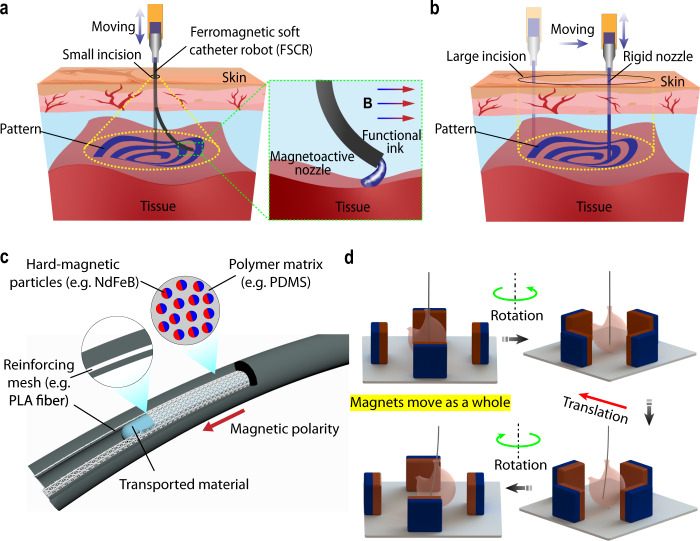
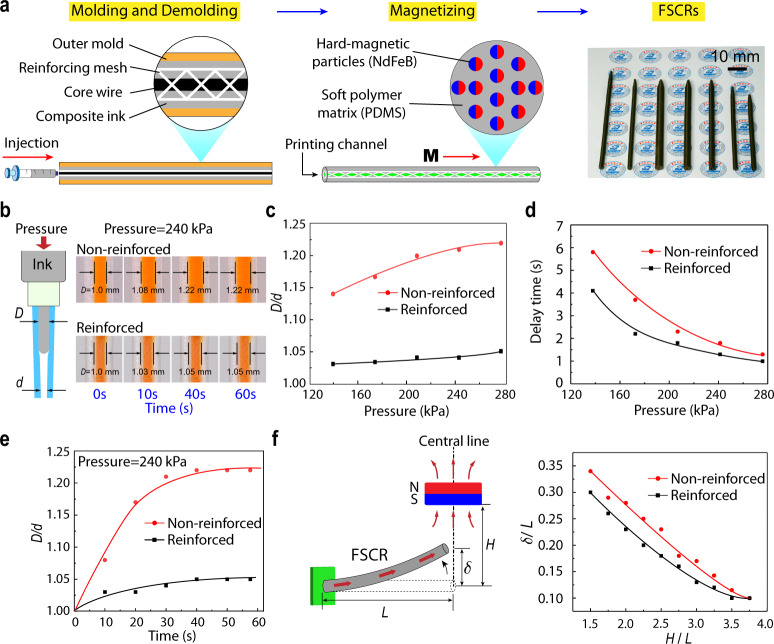
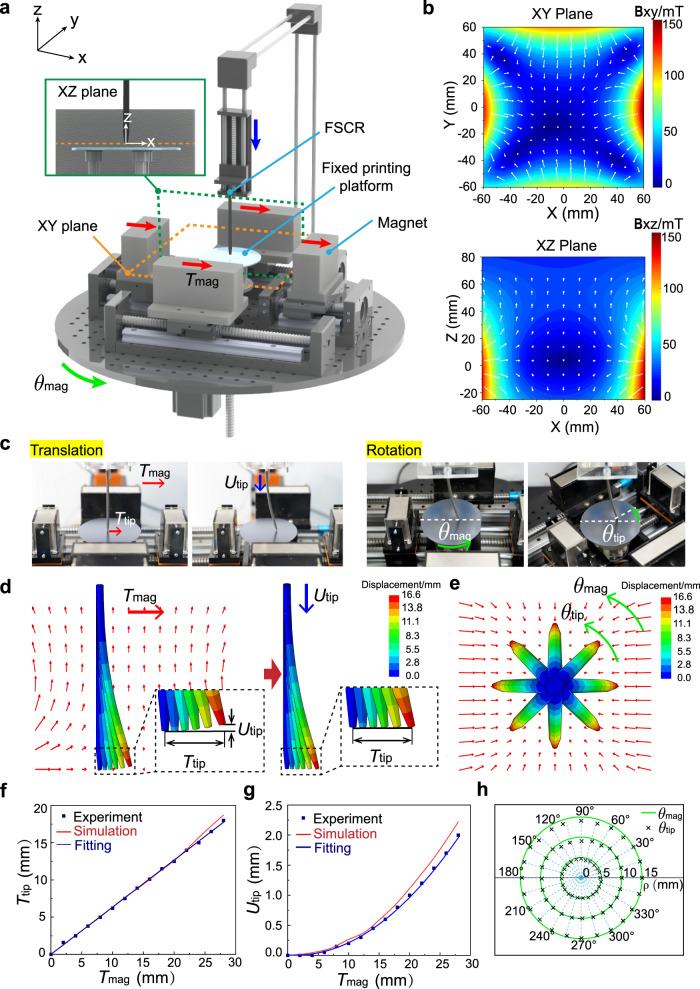
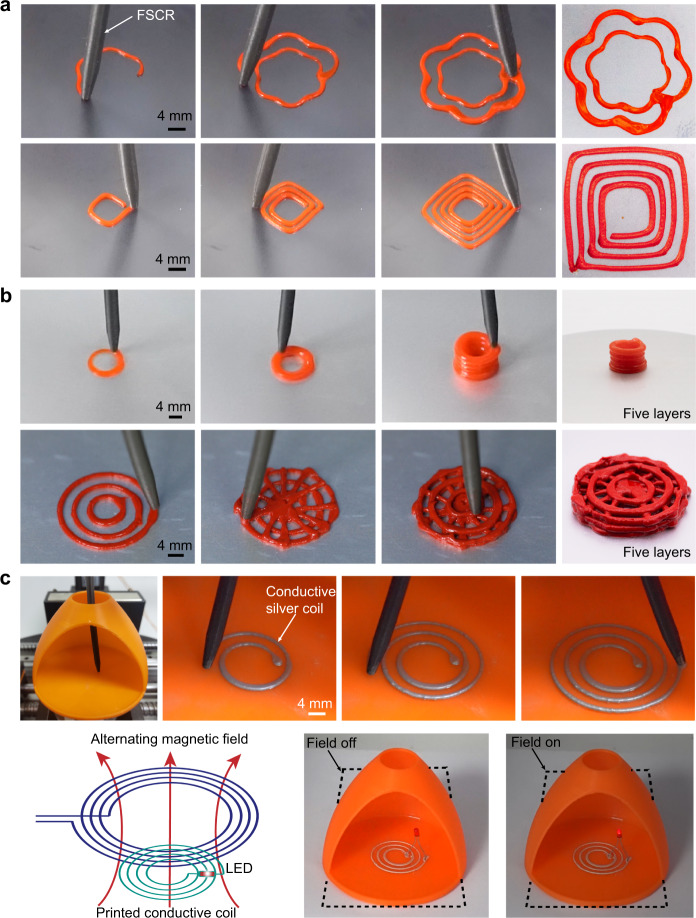
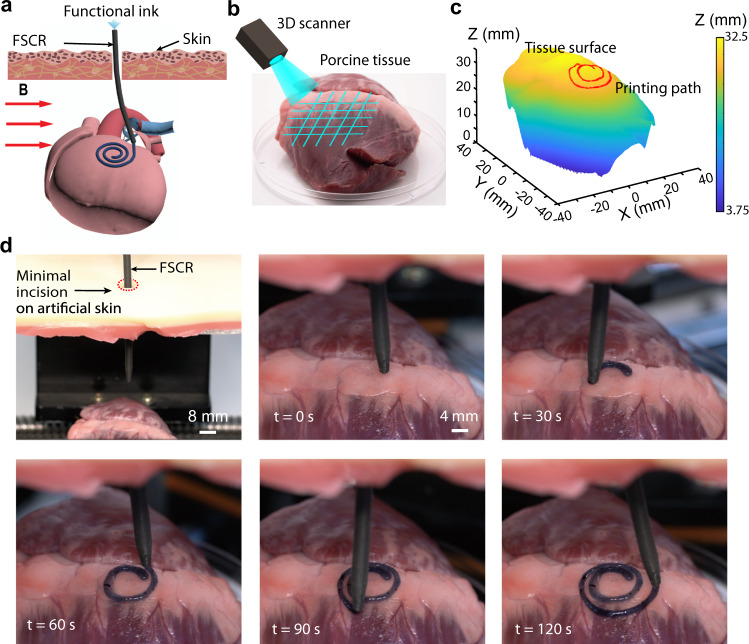
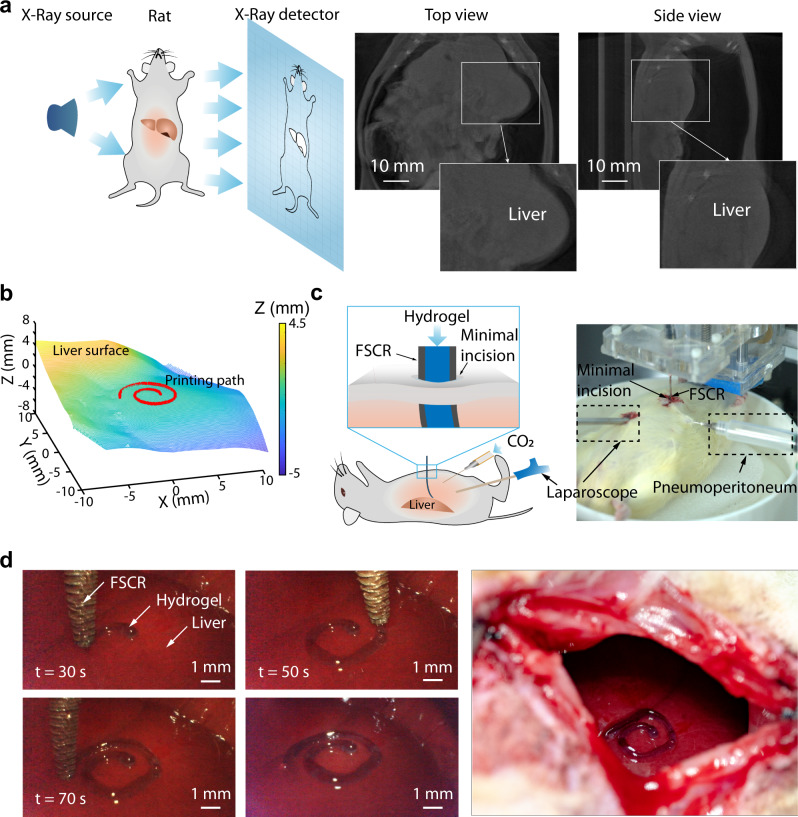
In vivo bioprinting has recently emerged as a direct fabrication technique to create artificial tissues and medical devices on target sites within the body, enabling advanced clinical strategies. However, existing in vivo bioprinting methods are often limited to applications near the skin or require open surgery for printing on internal organs. Here, we report a ferromagnetic soft catheter robot (FSCR) system capable of in situ computer-controlled bioprinting in a minimally invasive manner based on magnetic actuation. The FSCR is designed by dispersing ferromagnetic particles in a fiber-reinforced polymer matrix. This design results in stable ink extrusion and allows for printing various materials with different rheological properties and functionalities. A superimposed magnetic field drives the FSCR to achieve digitally controlled printing with high accuracy. We demonstrate printing multiple patterns on planar surfaces, and considering the non-planar surface of natural organs, we then develop an in situ printing strategy for curved surfaces and demonstrate minimally invasive in vivo bioprinting of hydrogels in a rat model. Our catheter robot will permit intelligent and minimally invasive bio-fabrication.
Overview
The claims and statistics of this paper haven’t been checked yet.
Free: it reads the open-access text and checks the first 5 claims that cite a source we can check. Create a free account to check every claim.
Integrity signals
Registry
Cites
Statistics
Figures
Verification
Claims the paper makes
The claims and statistics of this paper haven’t been checked yet.
Free: it reads the open-access text and checks the first 5 claims that cite a source we can check. Create a free account to check every claim.
Claims other papers make about this one
Each is checked against this paper’s own text: does it say what the citing paper says it does?
The check wasn’t confident either way, so it gives no verdict — never disputed.
In the citing paper
“Another innovative aspect is that the handheld device can be manually operated during surgical procedures [12] or integrated into a robotic arm for more efficient reconstruction [16, 17].”
From Development of silk microfiber-reinforced bioink for muscle tissue engineering and in situ printing by a handheld 3D printer (2025) · cites this paper as [17]
Experimental — accuracy not yet measured
Self-check
Percentages, sums and reported differences re-computed from the paper’s own numbers.
The self-check needs the paper’s full text.
Citations
Cites
3D bioprinting of tissues and organs
Murphy, S. V., & Atala, A. (2014) · Nature Biotechnology · doi:10.1038/nbt.2958 · Cited by 7,034
Small-scale soft-bodied robot with multimodal locomotion
Hu, W., Lum, G. Z., Mastrangeli, M., & Sitti, M. (2018) · Nature · doi:10.1038/nature25443 · Cited by 2,372
Printing ferromagnetic domains for untethered fast-transforming soft materials
Kim, Y., Yuk, H., Zhao, R., Chester, S. A., & Zhao, X. (2018) · Nature · doi:10.1038/s41586-018-0185-0 · Cited by 2,183
Microrobots for Minimally Invasive Medicine
Nelson, B. J., Kaliakatsos, I. K., & Abbott, J. J. (2010) · Annual Review of Biomedical Engineering · doi:10.1146/annurev-bioeng-010510-103409 · Cited by 1,968
Printing soft matter in three dimensions
Truby, R. L., & Lewis, J. A. (2016) · Nature · doi:10.1038/nature21003 · Cited by 1,622
Biomedical applications of soft robotics
Cianchetti, M., Laschi, C., Menciassi, A., & Dario, P. (2018) · Nature Reviews Materials · doi:10.1038/s41578-018-0022-y · Cited by 1,435
Ferromagnetic soft continuum robots
Kim, Y., Parada, G. A., Liu, S., & Zhao, X. (2019) · Science Robotics · doi:10.1126/scirobotics.aax7329 · Cited by 1,312
OctoMag: An Electromagnetic System for 5-DOF Wireless Micromanipulation
Kummer, M. P., Abbott, J. J., Kratochvil, B. E., Borer, R., Sengul, A., & Nelson, B. J. (2010) · IEEE Transactions on Robotics · doi:10.1109/tro.2010.2073030 · Cited by 1,161
Voxelated soft matter via multimaterial multinozzle 3D printing
Skylar-Scott, M. A., Mueller, J., Visser, C. W., & Lewis, J. A. (2019) · Nature · doi:10.1038/s41586-019-1736-8 · Cited by 1,024
3D printing of conducting polymers
Yuk, H., Lu, B., Lin, S., Qu, K., Xu, J., Luo, J., & Zhao, X. (2020) · Nature Communications · doi:10.1038/s41467-020-15316-7 · Cited by 1,001
Cited by
Items 201–263 of 263
Emerging materials and technologies towards in situ biomanufacturing
Davoodi, E., & Gao, W. (2026) · Nature Reviews Materials · doi:10.1038/s41578-026-00926-2 · Cited by 4
“These devices use externally applied magnetic fields to steer the catheter tip while maintaining continuous extrusion 24 , which enables navigation of the device within confined regions (Fig.”
A review of 3D-printed magnetic materials: Material-process-magnetization-application
Liu, Z., Zhang, Y., Jiang, L., Ren, Q., Jiang, X., Zhang, S., Fang, D., & Chi, W. (2026) · Advanced bionics. · doi:10.1016/j.abs.2026.07.002 · Cited by 2
Kinematic concepts in minimally invasive surgical flexible robotic manipulators: State of the art
Lai, J., Lu, B., & Ren, H. (2024) · Elsevier eBooks · doi:10.1016/b978-0-443-13271-1.00070-4 · Cited by 2
Deformation and motion of the mesh shaped robot driven by the magnet
Liu, S., Cheng, Y., Jin, Y., & Liu, J. (2023) · International Journal of Applied Electromagnetics and Mechanics · doi:10.3233/jae-220244 · Cited by 1
“Zang et al. [8] designed a set of devices that can perform 3D printing in organisms, which includes four movable magnets and a magnetic beam with holes.”
Magnetic guidewire/catheter for endovascular treatment
Yang, Z., Yang, H., & Zhang, L. (2024) · Elsevier eBooks · doi:10.1016/b978-0-443-13385-5.00001-5 · Cited by 1
A Review on the Current Research Status of Key Areas in Wireless Capsule Endoscopy
Wang, G., Liu, N., Zhang, H., Zhang, R., Sheng, X., & Qiao, J. (2025) · International Journal of Medical Robotics and Computer Assisted Surgery · doi:10.1002/rcs.70094 · Cited by 1
“Magnetic stay‐in‐place mechanism [60]: The magnetic stay‐in‐place mechanism relies on the interaction between the magnetic material within the capsule and an external magnetic field to stabilise the capsule's position.”
Abdelgader, A., Govender, M., Kumar, P., & Choonara, Y. E. (2025) · International Journal of Pharmaceutics · doi:10.1016/j.ijpharm.2025.126195 · Cited by 1
Dynamic Bonding Enabled Ambient‐Driven Motors
Si, M., Liu, Z., Chen, C., Lü, W., Liu, D., Shi, P., Yu, Y., Yan, Y., He, X., & Chen, T. (2025) · Angewandte Chemie · doi:10.1002/ange.202518011 · Cited by 1
Singh, S., Wei, L., Samiei, E., Gaber, K., Gao, Q., Persad, A. H., Veres, T., & Günther, A. (2026) · Biofabrication · doi:10.1088/1758-5090/ae4ccd · Cited by 1
“While several papers report in situ bioprinting instruments and meth-ods that are suited for anatomically curved substrates, the obtained constructs are often made of viscosity-modified synthetic [16, 17], thermo-responsive [18] or photo-crosslinkable inks [6, 19, 20] (figure 1(B)).”
Automated 3D printing of programmable and functional magnetic soft microrobots
Xie, S., Clancy, K., & Onaizah, O. (2026) · Journal of Micro-Bio Robotics · doi:10.1007/s12213-026-00202-0 · Cited by 1
Magnetic Textiles: A Review of Materials, Fabrication, Properties, and Applications
Ke, L., Kumi, M., Tao, X., & Pu, J. (2026) · Advanced Materials Technologies · doi:10.1002/admt.202502617 · Cited by 2
Zhang, Z., Zeng, Z., Zhang, J., Yu, L., He, R., Han, B., & Ma, Z. (2026) · ACS Applied Materials & Interfaces · doi:10.1021/acsami.6c01695 · Cited by 1
From 3D printing to 3D Bioprinting: Principles and applications in dentistry
Zhu, H., Ma, H., Chen, Y., Wei, Y., Tang, Z., & Li, Q. (2026) · Materials Today Sustainability · doi:10.1016/j.mtsust.2026.101372 · Cited by 1
From magnetism to action: breakthroughs and challenges in magnetic robot technology
Yang, P.-A., Song, L., Wu, D., Chen, Q., Li, R., Shou, M., & Sun, R. (2026) · Engineering Research Express · doi:10.1088/2631-8695/ae7496 · Cited by 1
In situ bioprinting: Control strategies, bioinks, applications, challenges, and future perspectives
Zheng, Z., Tan, X., Liang, H., Li, L., Jiang, Q., & Shi, J. (2026) · International Journal of Bioprinting · doi:10.36922/ijb026200196 · Cited by 1
Glass, P., Hassouna, D., Arachchige, U. E., Jeong, H. Y., Park, S. H., & Joung, D. (2026) · Advanced Science · doi:10.1002/advs.76045 · Cited by 1
“By synchronizing curing kinetics with magnetization, low-viscosity composites enable domains to align efficiently, resulting in higher net magnetic fields and greater bending deformations than post-cured methods [ 15, 17, 20, 22, 30–33 ].”
Single twistable tendon-driven continuum robots
Lai, J., Liu, Y., Ren, T.-A., Ma, Y., Zhang, T., Teoh, J. Y., Cutkosky, M. R., & Ren, H. (2026) · Nature Communications · doi:10.1038/s41467-026-74225-3 · Cited by 2
“The comparison reveals that our prototyped single TDCRs excel in room ef fi ciency and robot dimensions among other steerable continuum robots (viz., tendon-driven 7,38 – 42 , magnetically-driven 15,43,44 , pneumatically-driven 45 – 47 ), andmostconcentricpush – pull robots 9 – 11 .”
Wang, Z., Ji, S., Li, K., Li, Y., Ye, Y., Cao, Z., Zhang, C., & Wang, J. (2026) · ACS Biomaterials Science & Engineering · doi:10.1021/acsbiomaterials.6c00639 · Cited by 1
Self-citationHuang, Z., Li, X., Deng, J., Li, Y., Wan, X., & Wang, L. (2023) · IEEE International Conference on Real-time Computing and Robotics (RCAR) · doi:10.1109/rcar58764.2023.10250004 · Cited by 1
“With the growth of age, the activity of all cells in the body decreases [6], and the level of human metabolism and immunity is greatly reduced [7].”
BackgroundSelf-citationIncorporation of soft materials for flexible electronics
Lee, S. M., Lee, J., & Kang, S. (2024) · Elsevier eBooks · doi:10.1016/b978-0-323-99147-6.00007-7 · Cited by 1
Gao, J. (2024) · Springer eBooks · doi:10.1007/978-981-19-2797-3_26-1 · Cited by 2
Magnetic Functional Materials for Haptic InterfacesPreprint
Ruan, L., Wang, Y., Zhao, X., Li, F., Liu, C., Tao, W., Liang, H., Zhang, X., & Yang, W. (2024) · doi:10.22541/au.172465854.41398182/v1 · Cited by 1
Modular magnetic soft robotic catheter enables visualized intervention in the pancreatobiliary treePreprint
Calmé, B., Greenidge, N. J., Metcalf, A. G., Bacchetti, A., Loza, G., Kpeglo, D., Lloyd, P., Pensabene, V., Chandler, J. H., & Valdastri, P. (2026) · arXiv (Cornell University) · doi:10.48550/arxiv.2601.14837 · Cited by 1
“Studies have demonstrated laser-ablation ability [14], in situ biosensing [16] and printing [17], or carrying micro-robot [18], [19], but to move toward clinical translation, mSCRs must integrate additional functions - imaging, anchoring, manipulation, therapy delivery - without compromising on…”
Role Of 3-D Bioprinting In Forensics- A Review
Beryl Rachel, J., Jawahar, G., Percy, D., & Chrysolite, S. (2024) · International Journal of Forensic Odontology · doi:10.56501/intjforensicodontol.v8i2.967
Ligtenberg, L.-J. W., de Jongh, L., Liefers, H. R., Wasserberg, D., Rot, E. A. M. K., Ami, D. B., Sadeh-Gonik, U., Lomme, R. M. L. M., Tuijthof, G. J. M., Shoseyov, O., et al. (2024) · IEEE/RAS-EMBS International Conference on Biomedical Robotics and Biomechatronics (BioRob) · doi:10.1109/biorob60516.2024.10719845
“Expanding on this progress, Zhou et al . have demonstrated a bioprinting procedure using a magnetically controlled catheter [8].”
MethodGao, J. (2024) · Springer eBooks · doi:10.1007/978-981-97-1614-2_26 · Cited by 1
Magnetically controlled continuum miniature robot
Liu, L., Lin, D., & Jiao, N. (2024) · Elsevier eBooks · doi:10.1016/b978-0-443-13385-5.00002-7
Gong, G., Li, R., & Wang, B. (2025) · Smart Materials and Structures · doi:10.1088/1361-665x/ade8be
Template-Free Magnetic Programming Strategy for 3D-Transformable Soft Robots
Chen, J., Jin, D., & Ma, X. (2025) · Lecture notes in computer science · doi:10.1007/978-981-95-2101-2_2
Petronaitis, A. (2023) · reposiTUm (TU Wien) · doi:10.34726/hss.2023.111328 · Cited by 2
Contact Sensing Along Soft Catheter Robots in Minimally Invasive Surgery Based on Magnetic Signals
Hu, J., Gu, W., Hu, J., Xiao, J., Fu, J., & Hu, S. (2026) · IEEE Transactions on Automation Science and Engineering · doi:10.1109/tase.2026.3658557
“SCR-based minimally invasive surgery has recently demonstrated promising potential in diagnosing and treating a variety of diseases, such as cirrhosis [6], arrhythmias [7], intracerebral hemorrhage [8], and articular cartilage damage [9], [10].”
Puistola, P. (2025) · Tampere University Institutional Repository (Tampere University)
Magnetoactive soft elastomers-materials design, processing and applications
Mondal, S., Spolenak, R., & Clemens, F. J. (2026) · Reports on Progress in Physics · doi:10.1088/1361-6633/ae4bf4
“Magneto-elastomeric fibers can be fabricated using simplified methods like molding [8, 238] and also high-throughput routes like thermal drawing process [40, 41, 239].”
Magnetic fluid offers better seal in heart-plugging medical procedure
Zhang, Y. S. (2026) · Nature · doi:10.1038/d41586-026-00375-5
Navez, T. (2024) · theses.fr (ABES) · doi:10.70675/3f4ac9c0z8406z46f4z894ez0a2920dd4f58 · Cited by 1
Theoretical Investigation on Nonlinear Dynamics of Supported Hard-Magnetic Soft Beams
Liu, B., Chen, W., Wang, G., Zhou, X., Wang, L., & Yin, Z. (2026) · Acta Mechanica Solida Sinica · doi:10.1007/s10338-026-00721-0
Self-citationStrategic Design of Soft Actuators in Translational Medical Robotics for Human‐Centered Healthcare
Jin, H. J., Kim, J., Kim, I. H., & Kim, B. H. (2026) · Advanced Robotics Research · doi:10.1002/adrr.202600003
Patel, A., Hellikson, K., Zhang, Z., & Feig, V. R. (2026) · Device · doi:10.1016/j.device.2026.101141
Investigating the Role of Microstructure Evolution on the Properties of Magneto-Active Elastomers
Patel, P., Roghani, M., Borin, D. Y., Romeis, D., & Saphiannikova, M. (2026) · Springer Proceedings in Materials · doi:10.1007/978-3-032-17254-9_10
Gao, Z., Xu, W., Wang, S., Ge, Z., & Yang, W. (2026) · Journal of Materials Chemistry C · doi:10.1039/d5tc04505c
Groen, S. A. T., Brenken, D., Smocot, S., Forbes, J. R., Mongeau, L., & Sedal, A. (2026) · IEEE International Conference on Soft Robotics (RoboSoft) · doi:10.1109/robosoft67810.2026.11522961
“1A, is an emerging technique in which hydrogels are deposited directly within the body to reconstruct tissue geometry [1], [2], [3], [4].”
Wang, Y., Cui, W., Huang, H., Yang, Y., He, X., & Liu, M. (2026) · Rare Metals · doi:10.1002/rar2.70320 · Cited by 2
Self-citationA Review of Magnetically Controlled Continuum Robots: Principles, Classification, and Applications
Zhang, M., Song, L., Yu, W., An, X., Ren, S., Zhang, J., Wang, S., Li, J., Li, J. S., Li, Y., et al. (2026) · Magnetochemistry · doi:10.3390/magnetochemistry12060066
“…of cutting-edge technologies, such as in vivo bioprinting of ferromagnetic soft catheters [166], millimeter-scale 3D printing of soft robots [147], and magnetic spraying [167], has not only greatly simplified the manufacturing process but also opened up broad prospects for in situ diagnosis…”
InfluentialNext-generation portable bioprinters for in situ cartilage engineering
Qiu, L., & Sun, Y. (2026) · Polymer Bulletin · doi:10.1007/s00289-026-06450-1
“Ferromagnetic soft catheter robots enable minimally invasive bioprinting in confined spaces [ 112 ].”
Fu, G., & Kalulu, M. (2026) · Wiley eBooks · doi:10.1002/9783527854578.ch04
Segmented Therapeutic Delivery via Acoustic Microbubble Relay
Wang, L., Tang, Y., Wu, Y., Zhang, X., Lyu, T., Hua, Z., & Huang, T. (2026) · Advanced Intelligent Systems · doi:10.1002/aisy.70453
“…device is required to possess low stiffness to pass through the region with high curvature, such as animal vascular network and renal tubular network, which often achieve this by integrating flexible materials [78] and optimizing structural design to modulate stiffness [79], as shown in Figure 4a.”
Self-citationThe Next Phase of 3D Bioprinting: AI-Native Systems—A Narrative Review
Zdravkovic, N. D., Zdravkovic, M., & Živanović, M. (2026) · Journal of Functional Biomaterials · doi:10.3390/jfb17070319 · Cited by 1
“In situ bioprinting, the third of these forces, has already moved from concept to working hardware: Zhou et al. [11] demonstrated a ferromagnetic soft catheter robot that performs minimally invasive, magnetically actuated bioprinting on internal organs in vivo, depositing a conductive hydrogel onto…”
Das, S., Singh, P., Pathak, R. K., Das, J., Jana, P., Mahto, B., & Datta, S. (2026) · De Gruyter eBooks · doi:10.1515/9783111719993-004
Hu, J. B., Hu, J. B., Wang, F., & Hu, S. (2026) · IEEE Transactions on Instrumentation and Measurement · doi:10.1109/tim.2026.3716480
“By integrating multiple functional components within MSCRs, researchers have currently demonstrated their remarkable potential in diverse medical applications, including lesion diagnosis [2], [3], drug delivery [4], [5], and in situ bioprinting [6], [7].”
Magnetic Milligripper Platform for Biomedical and Biological Applications
Abdelrahman, D., Savary, A., Feuillard, B., Heuschkel, M. O., Príncipi, D., Roux, A., & Besson, C. (2026) · Micromachines · doi:10.3390/mi17080926
“…active navigation through micro-and millimeter-scale arteries in vivo [23–25], in situ biomechanical force sensing during transluminal procedures [26], and minimally invasive in vivo bioprinting [27], establishing the navigation infrastructure on which milligripper deployment can build.”
Kumar, D., Khanzode, D., & Jha, R. K. (2026) · Research Square · doi:10.21203/rs.3.rs-9680793/v1
ROTATING COLUMNAR MAGNETRON SPUTTERING ENABLES UNIFORM TiN INNER-WALL COATINGS IN SLENDER TUBES
Zhang, X., Gao, K., Hu, T., Tian, X., Gong, C., & Geng, H. (2026) · Surface Review and Letters · doi:10.1142/s0218625x26500800
Equilibrium kink-like torsion deformation of a magnetoactive elastomer under a magnetic field
Dzhezherya, Y. I., Kyryliuk, A. V., Cherepov, S. V., Skirta, Y. B., Reshetniak, S., Ryabchenko, S. M., & Каліта, В. М. (2026) · Applied Physics Letters · doi:10.1063/5.0335089
Intelligent Continuum Micromachines in Complex Confined Spaces
Sai, H., Yang, Y., Xu, S., Hu, J., Wang, J., Gan, Z., Tang, W., & Huang, T. (2026) · SmartBot · doi:10.1002/smb2.70059
Self-citationEngineering magnetic soft materials for biomedical applications
Liu, X., Xia, N., Chan, K. F., Sung, J. J. �., Chiu, P. W. Y., Wang, L., & Zhang, L. (2026) · Nature Reviews Materials · doi:10.1038/s41578-026-00963-x
Self-citationApplying Artificial Intelligence in Multi Axis Additive Manufacturing: A Bibliographic Review
Lasluisa-Naranjo, H. (2024) · Journal of Propulsion Technology
Levin, A. A., Petrov, S. V., Lugovoi, M. E., Zakharova, V. A., Senatov, F. S., Mironov, V. A., Khesuani, Y. D., Mokienko, O. A., Kovalev, A. V., & Koudan, E. V. (2026) · Регенерация органов и тканей. · doi:10.60043/2949-5938-2026-2-22-44
Extrusion‐Based Bioprinting of Living Bioinks for Tissue and Organ Engineering
Silberman, E., Baruch, E., Cohen, R., Shapira, A., & Dvir, T. (2026) · Advanced Materials Technologies · doi:10.1002/admt.71405
Magnetically Actuated Continuum Robots: From Engineering to Clinical Translation
Yang, Z., Jiao, Y., Niu, M., Cui, Y., Yang, L., Xu, Q., & Zhang, L. (2026) · Cyborg and Bionic Systems · doi:10.34133/cbsystems.0745
Liu, Z., Zhang, Y., Chen, F., LI, Y., Zhao, K., Liu, X., Wei, F., Li, Z., & Jiang, L. (2026) · Chemical Engineering Journal · doi:10.1016/j.cej.2026.183347
Self-citationFrom actuation to autonomy: Physical and artificial intelligence in magnetic robots
Yang, K., Jin, S. H., Dadfar, B., Moon, H., Kabay, G., Won, S., & Wie, J. J. (2026) · Device · doi:10.1016/j.device.2026.101332
Levin, A. A., Petrov, S. V., Lugovoi, M. E., Захарова, В. А., Senatov, F. S., Mironov, V. A., Khesuani, Y. D., Mokienko, O. A., Kovalev, A. V., & Koudan, E. V. (2026) · Cell and Tissue Biology · doi:10.1134/s1990519x26100019
“Zhou et al. (2021) developed a ferromagnetic soft catheter robot for minimally invasive bioprinting.”
Xavier, V. V. C., Elabbasi, M., El‐Gendy, A. A., & Barros, A. D. O. (2026) · Journal of Magnetism and Magnetic Materials · doi:10.1016/j.jmmm.2026.174728
Metadata
- Authors
- Zhou, C., Yang, Y., Wang, J., Wu, Q., Gu, Z., Zhou, Y., Liu, X., Yang, Y., Tang, H., Ling, Q., Wang, L., & Zang, J.
- Affiliations
- Wuhan National Laboratory for Optoelectronics (CN)
- Tongji Hospital (CN)
- Jilin University (CN)
- University of Science and Technology of China (CN)
- Corresponding author
- Wang, Liu
- Zang, Jianfeng
- ORCID
- Venue
- Nature Communications
- Published
- 2021-08-20
- Volume
- 12
- Issue
- 1
- Pages
- 5072-5072
- ISSN
- 2041-1723 (ISSN-L)
- PMC
- PMC8379157
- OpenAlex
- W3194935104
- Semantic Scholar
- f250e086e8ebfccb46a18f0894cddb18fe475f83
- Cited by
- 242
- References
- 61
- Citations by year
- 2026: 38 · 2025: 64 · 2024: 59 · 2023: 44 · 2022: 36 · 2021: 1
- FWCI
- 10.63
- Type
- journal article
- Language
- en
- Open access
- gold
- doi.org
- Licence
- cc-by
- creativecommons.org/licenses/by/4.0 (tdm)
- creativecommons.org/licenses/by/4.0 (vor)
- Locations
- Nature Communications (publishedVersion, cc-by)
- Europe PMC (PubMed Central) (publishedVersion, other-oa)
- PubMed Central (publishedVersion, cc-by)
- PubMed (publishedVersion)
- RePEc: Research Papers in Economics (submittedVersion)
- DOAJ (DOAJ: Directory of Open Access Journals) (submittedVersion, cc-by-sa)
- Funders
- National Key Research and Development Program of China (2018YFB1105100)
- Topics
- Physical Sciences › Engineering › Biomedical Engineering › Soft Robotics and Applications
- Physical Sciences › Engineering › Biomedical Engineering › 3D Printing in Biomedical Research
- Physical Sciences › Physics and Astronomy › Condensed Matter Physics › Micro and Nano Robotics
- Keywords
- ferromagnetic particles, magnetic actuation, fiber-reinforced polymer, hydrogels, tissue engineering, rat model
- MeSH terms
- Animals, Cell Line, Elasticity, Electric Conductivity, Humans, Liver, Robotics, Swine, Tomography, X-Ray Computed, Viscosity, Rats, Sprague-Dawley, Hydrogels, Rats, Catheters, Magnets, Bioprinting
About these checks
Registry, retraction, Cites and statistics results are computed, not judged, with one exception: a printed reference that no index lists is read once by a model before it counts as a citation error. Claims are extracted by a model and kept only when their quote appears verbatim in the text; each cited source is then checked, with a model’s help, for whether it says what the claim relies on. Those verdicts can be wrong — read the claim’s quote and the cited source before relying on one.
Statistics and arithmetic are recomputed, not judged.
Confidence bands are shown only for fields calibrated on our annotated test set. None is calibrated yet, so no band is shown.
What counts as a claim ›How we measure confidence ›How we check this ›
Are you an author, or do you see a problem with this page? Request a review
Data sources
Bibliographic data: Semantic Scholar, OpenAlex, Crossref.
Contains information from the Semantic Scholar Academic Graph Datasets, made available under the ODC Attribution License (ODC-BY 1.0).
Semantic Scholar’s data is described in: Kinney, R., et al. (2023). The Semantic Scholar Open Data Platform. arXiv:2301.10140.
