

The DOI matches its Crossref record; 59 of the 61 references it cites were found in a registry or an index.
Dynamic memory to alleviate catastrophic forgetting in continual learning with medical imaging
Open accessAbstract
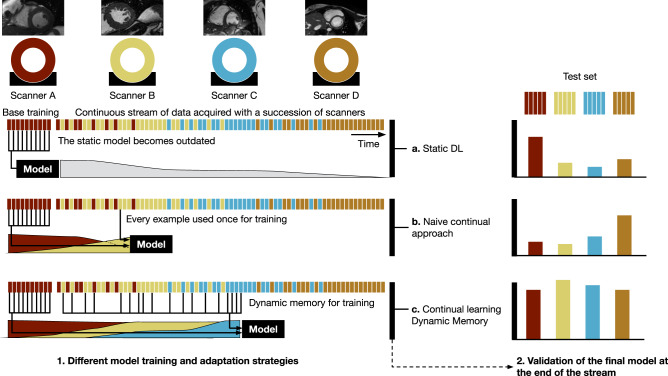
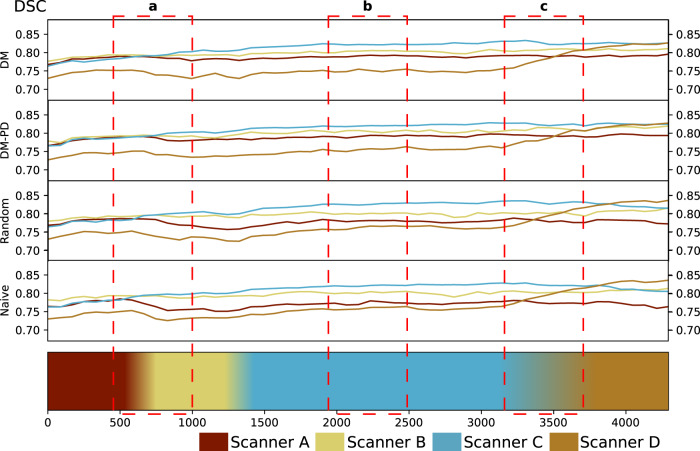
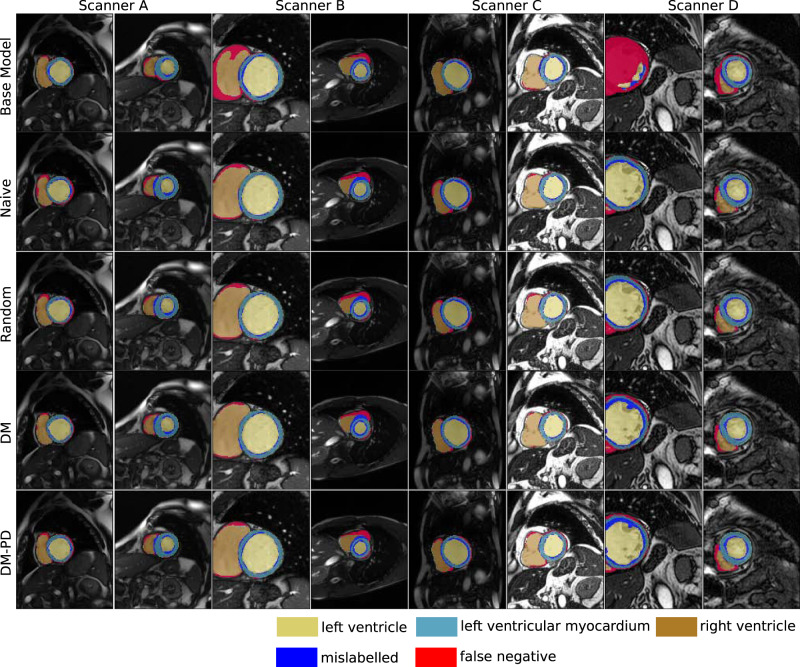
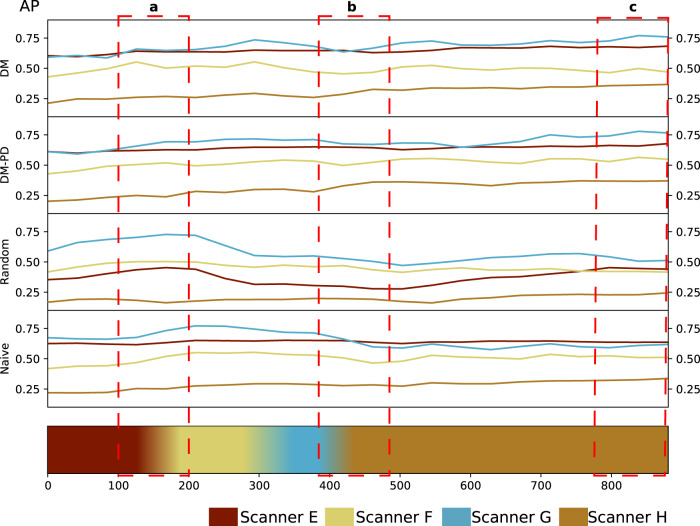
Medical imaging is a central part of clinical diagnosis and treatment guidance. Machine learning has increasingly gained relevance because it captures features of disease and treatment response that are relevant for therapeutic decision-making. In clinical practice, the continuous progress of image acquisition technology or diagnostic procedures, the diversity of scanners, and evolving imaging protocols hamper the utility of machine learning, as prediction accuracy on new data deteriorates, or models become outdated due to these domain shifts. We propose a continual learning approach to deal with such domain shifts occurring at unknown time points. We adapt models to emerging variations in a continuous data stream while counteracting catastrophic forgetting. A dynamic memory enables rehearsal on a subset of diverse training data to mitigate forgetting while enabling models to expand to new domains. The technique balances memory by detecting pseudo-domains, representing different style clusters within the data stream. Evaluation of two different tasks, cardiac segmentation in magnetic resonance imaging and lung nodule detection in computed tomography, demonstrate a consistent advantage of the method.
Overview
The claims and statistics of this paper haven’t been checked yet.
Run the check — free, no account needed. It reads the open-access text and checks the sources it cites.
Integrity signals
Registry
Cites
Statistics
Figures
Verification
Claims the paper makes
The claims and statistics of this paper haven’t been checked yet.
Run the check — free, no account needed. It reads the open-access text and checks the sources it cites.
Claims other papers make about this one
Each is checked against this paper’s own text: does it say what the citing paper says it does?
In the citing paper
“Continuous monitoring systems detect when models encounter data outside their training distribution or when performance begins to degrade [147,148,149,150,151].”
From Artificial Intelligence in Clinical Oncology: From Productivity Enhancement to Creative Discovery (2025) · cites this paper as [149]
Self-check
Percentages, sums and reported differences re-computed from the paper’s own numbers.
The self-check needs the paper’s full text.
Citations
Cites
Deep Residual Learning for Image Recognition
He, K., Zhang, X., Ren, S., & Sun, J. (2016) · 2016 IEEE Conference on Computer Vision and Pattern Recognition (CVPR) · doi:10.1109/cvpr.2016.90 · Cited by 235,474
Faster R-CNN: Towards Real-Time Object Detection with Region Proposal Networks
Ren, S., He, K., Girshick, R., & Sun, J. (2017) · IEEE Transactions on Pattern Analysis and Machine Intelligence · doi:10.1109/tpami.2016.2577031 · Cited by 73,472
(2008) · Journal of Machine Learning Research · Cited by 33,051
PyTorch: An Imperative Style, High-Performance Deep Learning Library
Paszke, A., Gross, S., Massa, F., Lerer, A., Bradbury, J., Chanan, G., Killeen, T., Lin, Z., Gimelshein, N., Antiga, L., et al. (2019) · arXiv · doi:10.48550/arxiv.1912.01703 · Cited by 31,473
The pascal visual object classes (VOC) challenge
Everingham, M., Van Gool, L., Williams, C. K. I., Winn, J., & Zisserman, A. (2010) · International Journal of Computer Vision · doi:10.1007/s11263-009-0275-4 · Cited by 19,599
Fully convolutional networks for semantic segmentation
Shelhamer, E., Long, J., & Darrell, T. (2017) · IEEE Transactions on Pattern Analysis and Machine Intelligence · doi:10.1109/tpami.2016.2572683 · Cited by 11,898
Overcoming catastrophic forgetting in neural networks
Kirkpatrick, J., Pascanu, R., Rabinowitz, N., Veness, J., Desjardins, G., Rusu, A. A., Milan, K., Quan, J., Ramalho, T., Grabska-Barwinska, A., et al. (2017) · Proceedings of the National Academy of Sciences · doi:10.1073/pnas.1611835114 · Cited by 7,899
U1 snRNP regulates cancer cell migration and invasion in vitro
Oh, J.-M., Venters, C. C., Di, C., Pinto, A. M., Wan, L., Younis, I., Cai, Z., Arai, C., So, B. R., Duan, J., et al. (2020) · Nature Communications · doi:10.1038/s41467-019-13993-7 · Cited by 7,157
A Comprehensive Survey on Transfer Learning
Zhuang, F., Qi, Z., Duan, K., Xi, D., Zhu, Y., Zhu, H., Xiong, H., & He, Q. (2021) · Proceedings of the IEEE · doi:10.1109/jproc.2020.3004555 · Cited by 6,678
Liu, F. T., Ting, K. M., & Zhou, Z.-H. (2008) · 2008 Eighth IEEE International Conference on Data Mining · doi:10.1109/icdm.2008.17 · Cited by 6,601
Research works printed but not linked: 2
- Lopez-Paz, D. & Ranzato, M. Gradient episodic memory for continual learning. Adv. Neural Inf. Process. Syst. 30, 6467–6476 (2017).
- Glocker, B., Robinson, R., Castro, D. C., Dou, Q. & Konukoglu, E. Machine learning with multi-site imaging data: an empirical study on the impact of scanner effects. Preprint at https://arxiv.org/abs/1910.04597 (2019). · arXiv
Cited by
Sorted by citations
Items 101–107 of 107
Will the EU AI Act facilitate market entry for adaptive medical AI systems?
Niemiec, E. (2026) · Health Policy and Technology · doi:10.1016/j.hlpt.2026.101295
Modern Continual Learning with Foundation Models, Evaluation Challenges, and Future Directions
Ullah, Z., Hong, M., & Kim, J. (2026) · Mathematics · doi:10.3390/math14152774
Yang, K., Xu, Y., Li, Z., Liu, J.-N., Zhang, Z., Zhang, T., & Chen, C. L. P. (2026) · IEEE Transactions on Network Science and Engineering · doi:10.1109/tnse.2026.3720474
Kowalska, A., Nowak, P., Zielinski, T., & Mazur, K. (2023) · Journal of Health Informatics and Digital Systems · doi:10.68159/u679026846
Moreddu, R., Greulich, P., Baumgartner, C., Borghi, F., & Levin, M. (2026) · Research Square · doi:10.21203/rs.3.rs-10895632/v1
Zhang, J., Guo, Y., Sun, J., Xu, D., Gao, S., & Ma, L. (2026) · Lecture notes in computer science · doi:10.1007/978-3-032-38072-2_48
Gidwani, S. H., Chattopadhyay, T., Thomopoulos, S. I., & Thompson, P. M. (2026) · Frontiers in Computational Neuroscience · doi:10.3389/fncom.2026.1902258
Metadata
- Authors
- Perkonigg, M., Hofmanninger, J., Herold, C. J., Brink, J. A., Pianykh, O., Prosch, H., & Langs, G.
- Affiliations
- Medical University of Vienna (AT)
- Harvard University (US)
- Corresponding author
- Langs, Georg
- ORCID
- Venue
- Nature Communications
- Published
- 2021-09-28
- Volume
- 12
- Issue
- 1
- Pages
- 5678-5678
- ISSN
- 2041-1723 (ISSN-L)
- PMC
- PMC8479083
- OpenAlex
- W3202253200
- Cited by
- 106
- References
- 61
- Citations by year
- 2026: 24 · 2025: 28 · 2024: 15 · 2023: 23 · 2022: 14 · 2021: 2
- FWCI
- 4.75
- Type
- journal article
- Language
- en
- Open access
- gold
- doi.org
- Locations
- Nature Communications (publishedVersion, cc-by)
- PubMed Central (publishedVersion, cc-by)
- PubMed (publishedVersion)
- RePEc: Research Papers in Economics (submittedVersion)
- DOAJ (DOAJ: Directory of Open Access Journals) (submittedVersion, cc-by-sa)
- Funders
- Boehringer Ingelheim
- European Commission (780495, 765148)
- Austrian Science Fund (P34198, P35189)
- Oesterreichische Nationalbank (18207)
- Novartis Pharmaceuticals Corporation
- Topics
- Physical Sciences › Computer Science › Artificial Intelligence › Domain Adaptation and Few-Shot Learning
- Physical Sciences › Computer Science › Artificial Intelligence › Data Stream Mining Techniques
- Physical Sciences › Computer Science › Computer Vision and Pattern Recognition › Medical Image Segmentation Techniques
- Keywords
- catastrophic forgetting, continual learning, dynamic memory, domain shift, diagnostic imaging, cardiac image segmentation, lung nodule detection, magnetic resonance imaging, computed tomography, model updating
- MeSH terms
- Machine Learning, Diagnostic Imaging, Humans, Learning, Lung, Memory, Tomography, X-Ray Computed, Neural Networks, Computer
About these checks
Registry, retraction, Cites and statistics results are computed, not judged, with one exception: a printed reference that no index lists is read once by a model before it counts as a citation error. Claims are extracted by a model and kept only when their quote appears verbatim in the text; each cited source is then checked, with a model’s help, for whether it says what the claim relies on. Those verdicts can be wrong — read the claim’s quote and the cited source before relying on one.
Statistics and arithmetic are recomputed, not judged.
Confidence bands are shown only for fields calibrated on our annotated test set. None is calibrated yet, so no band is shown.
What counts as a claim ›How we measure confidence ›How we check this ›
Are you an author, or do you see a problem with this page? Request a review
