

A national cohort study (2000–2018) of long-term air pollution exposure and incident dementia in older adults in the United States
Open accessPublished version of a preprint
The DOI matches its Crossref record; 56 of the 57 references it cites were found in a registry or an index.
Abstract
Air pollution may increase risk of Alzheimer’s disease and related dementias (ADRD) in the U.S., but the extent of this relationship is unclear. Here, we constructed two national U.S. population-based cohorts of those aged ≥65 from the Medicare Chronic Conditions Warehouse (2000–2018), combined with high-resolution air pollution datasets, to investigate the association of long-term exposure to ambient fine particulate matter (PM 2.5 ), nitrogen dioxide (NO 2 ), and ozone (O 3 ) with dementia and AD incidence, respectively. We identified ~2.0 million incident dementia cases ( N = 12,233,371; dementia cohort) and ~0.8 million incident AD cases ( N = 12,456,447; AD cohort). Per interquartile range (IQR) increase in the 5-year average PM 2.5 (3.2 µg/m 3 ), NO 2 (11.6 ppb), and warm-season O 3 (5.3 ppb) over the past 5 years prior to diagnosis, the hazard ratios (HRs) were 1.060 (95% confidence interval [CI]: 1.054, 1.066), 1.019 (95% CI: 1.012, 1.026), and 0.990 (95% CI: 0.987, 0.993) for incident dementias, and 1.078 (95% CI: 1.070, 1.086), 1.031 (95% CI: 1.023, 1.039), and 0.982 (95%CI: 0.977, 0.986) for incident AD, respectively, for the three pollutants. For both outcomes, concentration-response relationships for PM 2.5 and NO 2 were approximately linear. Our study suggests that exposures to PM 2.5 and NO 2 are associated with incidence of dementia and AD.
Overview
The claims and statistics of this paper haven’t been checked yet.
Free: it reads the open-access text and checks the first 5 claims that cite a source we can check. Create a free account to check every claim.
Integrity signals
Registry
Cites
Statistics
Figures
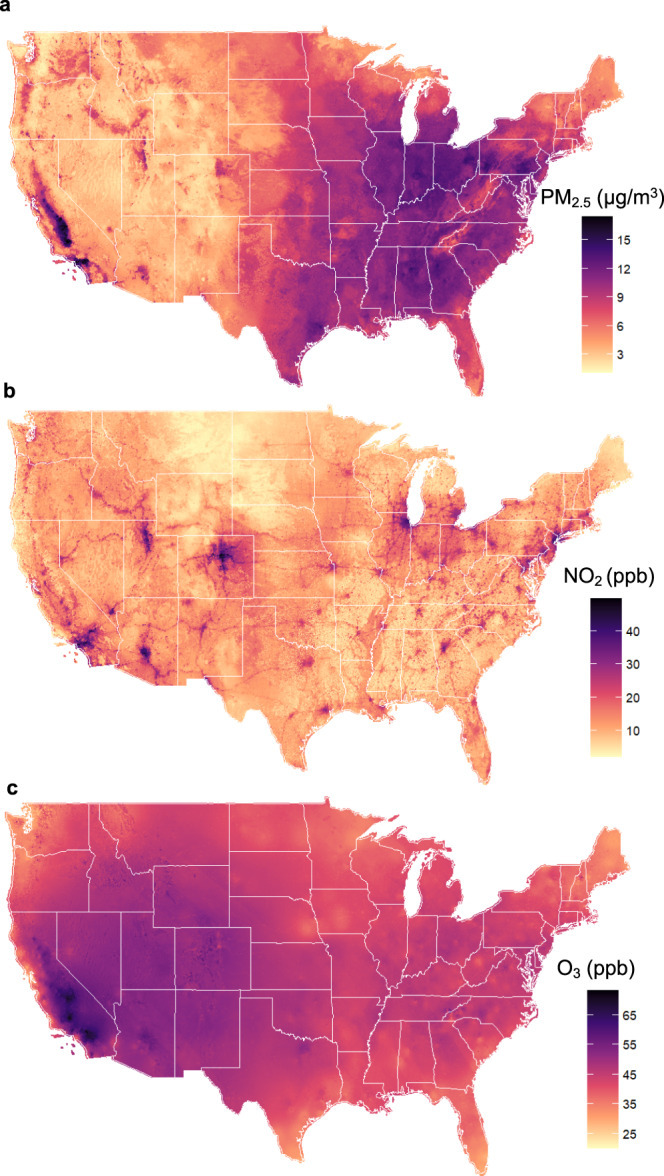
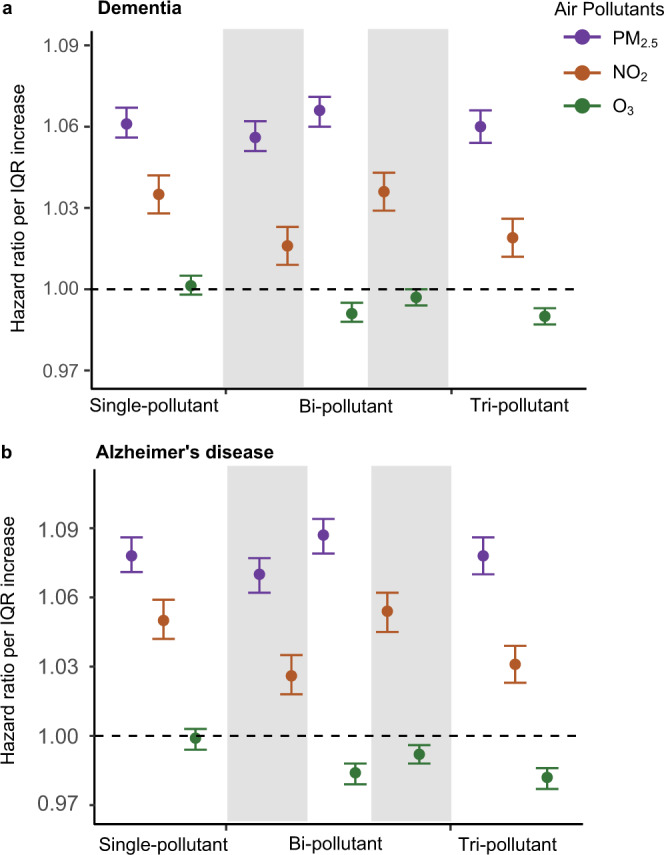
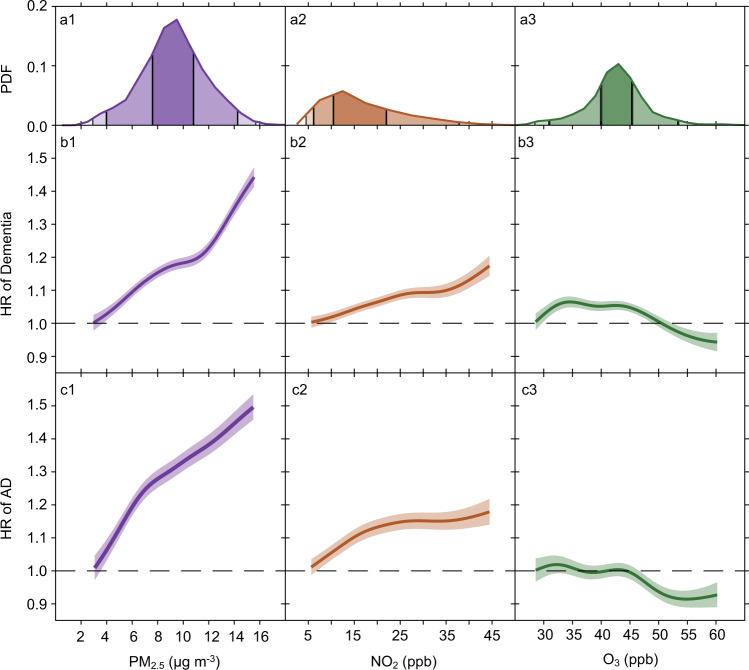
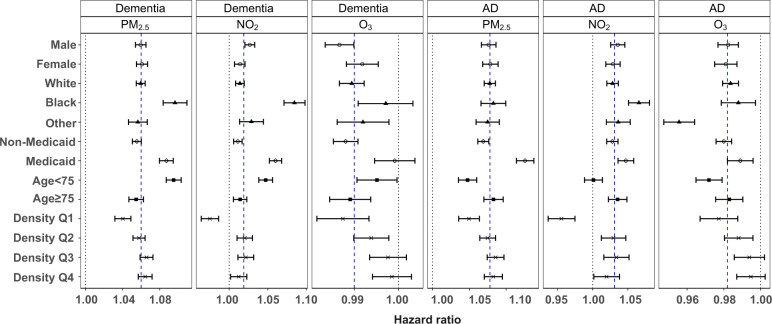
Verification
Claims the paper makes
The claims and statistics of this paper haven’t been checked yet.
Free: it reads the open-access text and checks the first 5 claims that cite a source we can check. Create a free account to check every claim.
Claims other papers make about this one
Each is checked against this paper’s own text: does it say what the citing paper says it does?
The cited source says what the claim attributes to it.
In the citing paper
“Per IQR increase in the 5-year average PM2.5 (3.2 µg m−3) and NO2 (22 µg m−3), they found an association with the development of dementia HR = 1.060 (95% CI 1.054–1.066)”
From Changes in tropospheric air quality related to the protection of stratospheric ozone in a changing climate (2023) · cites this paper as [115]
The cited source says what the claim attributes to it.
In the citing paper
“The authors also observed significant associations between exposure to PM2.5 and the development of Alzheimer’s disease HR = 1.078 (95% CI 1.070–1.086)”
From Changes in tropospheric air quality related to the protection of stratospheric ozone in a changing climate (2023) · cites this paper as [115]
In the citing paper
“and NO2 exposure HR = 1.031 (95% CI 1.023–1.039).”
From Changes in tropospheric air quality related to the protection of stratospheric ozone in a changing climate (2023) · cites this paper as [115]
In the citing paper
“and with exposure to NO2 HR = 1.019 (95% CI 1.012–1.026),”
From Changes in tropospheric air quality related to the protection of stratospheric ozone in a changing climate (2023) · cites this paper as [115]
Self-check
Percentages, sums and reported differences re-computed from the paper’s own numbers.
The self-check needs the paper’s full text.
Citations
Cites
Cohen, A. J., Brauer, M., Burnett, R., Anderson, H. R., Frostad, J., Estep, K., Balakrishnan, K., Brunekreef, B., Dandona, L., Dandona, R., et al. (2017) · The Lancet · doi:10.1016/s0140-6736(17)30505-6 · Cited by 6,583
Dementia prevention, intervention, and care
Livingston, G., Sommerlad, A., Orgeta, V., Costafreda, S. G., Huntley, J., Ames, D., Ballard, C., Banerjee, S., Burns, A., Cohen-Mansfield, J., et al. (2017) · The Lancet · doi:10.1016/s0140-6736(17)31363-6 · Cited by 6,072 · cited 3×
“In the dementia cohort, the outcome dementia was defined as the first occurrence of a diagnosis code of dementia, while for the AD cohort, AD was defined as either (1) the first occurrence of a diagnosis code of AD with no prior diagnosis of dementia, or (2) the first occurrence of a diagnosis code of dementia when th…”
The Lancet Commission on pollution and health
Landrigan, P. J., Fuller, R., Acosta, N. J. R., Adeyi, O., Arnold, R., Basu, N. (., Baldé, A. B., Bertollini, R., Bose-O'Reilly, S., Boufford, J. I., et al. (2018) · The Lancet · doi:10.1016/s0140-6736(17)32345-0 · Cited by 4,929
Hypothetical model of dynamic biomarkers of the Alzheimer's pathological cascade
Jack, C. R., Knopman, D. S., Jagust, W. J., Shaw, L. M., Aisen, P. S., Weiner, M. W., Petersen, R. C., & Trojanowski, J. Q. (2010) · The Lancet Neurology · doi:10.1016/s1474-4422(09)70299-6 · Cited by 4,806
International Journal of Epidemiology
(1973) · Journal of Medical Genetics · doi:10.1136/jmg.10.1.100-a · Cited by 2,838
Translocation of inhaled ultrafine particles to the brain
Oberdörster, G., Sharp, Z., Atudorei, V., Elder, A., Gelein, R., Kreyling, W., & Cox, C. (2004) · Inhalation Toxicology · doi:10.1080/08958370490439597 · Cited by 2,606
Deaths: Leading Causes for 2017.
Heron, M. P. (2019) · PubMed · Cited by 2,406
Long-term ozone exposure and mortality
Jerrett, M., Burnett, R. T., Pope, C. A., Ito, K., Thurston, G., Krewski, D., Shi, Y., Calle, E., & Thun, M. (2009) · New England Journal of Medicine · doi:10.1056/nejmoa0803894 · Cited by 1,602
Exposure measurement error in time-series studies of air pollution: concepts and consequences
Zeger, S. L., Thomas, D., Dominici, F., Samet, J. M., Schwartz, J., Dockery, D., & Cohen, A. (2000) · Environmental Health Perspectives · doi:10.1289/ehp.00108419 · Cited by 1,156
Self-citationMagnetite pollution nanoparticles in the human brain
Maher, B. A., Ahmed, I. A. M., Karloukovski, V., MacLaren, D. A., Foulds, P. G., Allsop, D., Mann, D. M. A., Torres-Jardón, R., & Calderon-Garciduenas, L. (2016) · Proceedings of the National Academy of Sciences · doi:10.1073/pnas.1605941113 · Cited by 1,047
Cited by
Items 101–200 of 239
The development of local ambient air quality standards: A case study of Hainan Province, China
Song, Q., Zhang, N., Zhang, Y., Yin, D., Hao, J., Wang, S., Li, S., Xu, W., Yan, W., Meng, X., et al. (2023) · Eco-Environment & Health · doi:10.1016/j.eehl.2023.10.002 · Cited by 10
“…the averaging time for PM 2.5 and PM 10 includes 24 h and 1 year in most AAQSs because both short-term and long-term exposure to PM 2.5 cause great damage to human health [32,33], while there is only short-term averaging time for CO because it mainly has acute effects on human health [34].”
BackgroundInfluentialSelf-citationZhu, Q., Lyu, Y., Huang, K., Zhou, J., Wang, W., Steenland, K., Chang, H. H., Ebelt, S., Shi, X., & Liu, Y. (2025) · GeoHealth · doi:10.1029/2024gh001023 · Cited by 10
“NO 2 has also been positively linked to cognitive decline or dementia in the US (Shi et al., 2021), England (Carey et al., 2018), and Canada (Chen et al., 2017; Smargiassi et al., 2020).”
Self-citationGlobal Pattern and Disease Heterogeneity Drivers in Aging Populations
Jin, C., Chen, J., Fang, J., Hua, K., Fu, Z., Chen, X., Wu, H., & Hua, Y. (2025) · GeoHealth · doi:10.1029/2025gh001335 · Cited by 15
“In addition, air pollutants, such as PM 2.5 and O 3 , play particularly significant roles in respiratory, cardiovascular, and neurological diseases in older adults (Shi et al., 2021; Shin et al., 2021).”
InfluentialZaręba, M., & Danek, T. (2025) · Ecological Informatics · doi:10.1016/j.ecoinf.2025.103450 · Cited by 13
Stukken, C. V. D., Nawrot, T. S., Wang, C., Lefebvre, W., Vanpoucke, C., Plusquin, M., Roels, H. A., Janssen, B. G., & Martens, D. S. (2022) · Environment International · doi:10.1016/j.envint.2022.107695 · Cited by 11
Yao, Y., Chen, X., Yang, M., Han, Y., Xue, T., Zhang, H., Wang, T., Chen, W., Qiu, X., Que, C., et al. (2022) · Environmental Pollution · doi:10.1016/j.envpol.2022.119822 · Cited by 11
Qin, M., Khoshnevis, N., Dominici, F., Braun, D., Zanobetti, A., & Mork, D. (2024) · American Journal of Epidemiology · doi:10.1093/aje/kwae133 · Cited by 12
A systematic review of associations between the environment, DNA methylation, and cognition
Glover, S., Illyuk, J., Hill, C., McGuinness, B., McKnight, A. J., & Hunter, R. F. (2024) · Environmental Epigenetics · doi:10.1093/eep/dvae027 · Cited by 10
“…H y p o m e t h y l a t i o n c g 12179661 [ 8 ] H y p e r m e t h y l a t i o n c g 084 35683 [ 9 ] H y p e r m e t h y l a t i o n c g 022 86380 [ 10 ] H y p e r m e t h y l a t i o n c g 163 95997 [ 11 ] H y p e r m e t h y l a t i o n c g 183 97450 [ 12 ] H y p e r m e t h y l a t i o n c g…”
An, X., Sheng, L., & Chen, W. (2023) · Atmospheric Environment · doi:10.1016/j.atmosenv.2023.119846 · Cited by 10
Calderón‐Garcidueñas, L. (2022) · Frontiers in Neurology · doi:10.3389/fneur.2022.901447 · Cited by 10
Lynch, K. M., Bennett, E. E., Ying, Q., Park, E. S., Xu, X., Smith, R. L., Stewart, J. D., Liao, D., Kaufman, J. D., Whitsel, E. A., et al. (2024) · Environmental Health Perspectives · doi:10.1289/ehp13906 · Cited by 9
“38 However, we are cautious to draw conclusions due to the homogeneity of race within ARIC sites and the distribution of ARIC sites within broader spatial patterns of health and other factors in the United States (e.g., the MS site is the only ARIC site in the “ stroke belt, ” an area in the…”
Williams, V. J., Trane, R. M., Sicinski, K., Herd, P., Engelman, M., & Asthana, S. (2024) · Alzheimer s & Dementia · doi:10.1002/alz.14216 · Cited by 10
“66,67 A recent national cohort study similarly identified a possibly protective (albeit weak) association between ozone exposure and reduced dementia risk regardless of ApoE genotype, 68 offering some convergence with our findings.”
Andrews, R. M., Adar, S. D., Szpiro, A. A., Kaufman, J. D., Christopher, C. N., Beck, T. L., Dhana, K., Wilson, R. S., Rajan, K. B., Evans, D. A., et al. (2024) · Environmental Health Perspectives · doi:10.1289/ehp14585 · Cited by 10
“1 25 Although numerous epidemiological studies have estimated associations of TRAP exposures with cognitive performance and dementia, 1,5,6,8,12 – 14, 17, 18 , Selection bias also presents challenges to validly estimating TRAP ’ s e ff ects on dementia-related outcomes.”
Do, V., McBrien, H., Teigen, K., Childs, M. L., Kioumourtzoglou, M. A., & Casey, J. A. (2025) · Fire · doi:10.3390/fire8030097 · Cited by 8
Li, Y., Wang, L., Chen, D., Zhang, L., & Zhao, Y. (2025) · Atmospheric Environment · doi:10.1016/j.atmosenv.2025.121401 · Cited by 10
Retinal manifestations and their diagnostic significance in Alzheimer's disease
Abhyankar, S. D., Little, K., Stitt, A. W., & Bhatwadekar, A. D. (2025) · Journal of Alzheimer s Disease Reports · doi:10.1177/25424823251361937 · Cited by 8
“Age is the greatest risk factor for developing AD, 12 although a rare form of AD also exists in people between 30 – 50, which is referred to as early-onset AD (EOAD).”
Zhang, F., Zhang, X., Zhong, Y., Zhu, S., Zhao, G., Zhang, X., Li, T., Zhang, Y., & Zhu, W. (2023) · International Journal of Public Health · doi:10.3389/ijph.2022.1605391 · Cited by 7
“Emerging studies have shown that short- and long-term exposure to air pollution is associated with elevated mortality and morbidity of various diseases [9, 10].”
BackgroundSelf-citationAlhasan, D. M., Larson, G. J., Lohman, M. C., Cai, B., LaPorte, F. B., Miller, M. C., Jackson, W. B., MacNell, N., Hirsch, J. A., & Jackson, C. L. (2024) · Environmental Health Perspectives · doi:10.1289/ehp13183 · Cited by 8
“60 Although we excluded other pollutants (i.e., CO, SO 2 , NO 2 , PM 10 , and O 3 ) from our analysis due to multicollinearity, they may still be relevant regarding ADRD incidence.”
BackgroundQiao, J.-C., Sun, L., Zhang, M., Gui, S., Wang, X.-C., & Hu, C. (2024) · The Science of The Total Environment · doi:10.1016/j.scitotenv.2024.171423 · Cited by 9
Pfleger, E., Drexler, H., & Lutz, R. (2024) · International Journal of Environmental Research and Public Health · doi:10.3390/ijerph21030366 · Cited by 15
“…in newborns when exposed to elevated levels of particulate matter during pregnancy [17–19], as well as impaired cognitive health in old age due to exposure to air pollutants [20,21] or an increased risk of Alzheimer’s dementia after chronic exposure to traffic-related air pollutants [22,23].”
BackgroundKuntić, M., Hahad, O., Al-Kindi, S. G., Oelze, M. W., Lelieveld, J., Daiber, A., & Münzel, T. F. (2025) · Antioxidants and Redox Signaling · doi:10.1089/ars.2024.0659 · Cited by 11
“(E) is adapted from (Shi et al., 2021) under the Creative Commons Attribution 4.0 International License.”
InfluentialAcharyya, S., Kumar, S. H., Chouksey, A., Soni, N., Nazeer, N., & Mishra, P. K. (2024) · NeuroToxicology · doi:10.1016/j.neuro.2024.10.002 · Cited by 8
Assessing the Role of Energy Mix in Long-Term Air Pollution Trends: Initial Evidence from Poland
Zaręba, M. (2025) · Energies · doi:10.3390/en18051211 · Cited by 8
Heffernan, C., Peng, R. D., Gentner, D. R., Koehler, K. A., & Datta, A. (2023) · The Annals of Applied Statistics · doi:10.1214/23-aoas1751 · Cited by 14
“5 is associated with increased risk of mortality even at concentrations below current national air quality standards (U.S. EPA, 2019; Di et al., 2017a,b; Wei et al., 2020; Shi et al., 2021; WardCaviness et al., 2021).”
BackgroundPromise and peril of claims-based dementia ascertainment in causal inference
Festa, N., Moura, L. M. V. R., Blacker, D., Newhouse, J. P., & Hsu, J. (2023) · BMJ Evidence-Based Medicine · doi:10.1136/bmjebm-2022-112134 · Cited by 10
Social cohesion as a modifier of joint air pollution exposure and incident dementia
Frndak, S., Cudjoe, T., Thorpe, R. J., Deng, Z., Ward-Caviness, C. K., Clarke, K. A., & Dickerson, A. S. (2024) · The Science of The Total Environment · doi:10.1016/j.scitotenv.2024.175149 · Cited by 9
Climate Policy Reduces Racial Disparities in Air Pollution from Transportation and Power Generation
Jordan, K. H., Dennin, L. R., Adams, P. J., Jaramillo, P., & Muller, N. Z. (2024) · Environmental Science & Technology · doi:10.1021/acs.est.4c03719 · Cited by 10
Cork, M. A., Mork, D., & Dominici, F. (2025) · Journal of the Royal Statistical Society Series A (Statistics in Society) · doi:10.1093/jrsssa/qnaf004 · Cited by 14
From particulates to pathways: environmental exposures and their impact on Alzheimer’s disease
Liu, B., Ahmad, M. A., Abbas, G., Ahmed, U., Javed, R., Ali, I., Ao, Q., & Deng, X. (2025) · Brain Research · doi:10.1016/j.brainres.2025.149880 · Cited by 8
Air pollution as a key risk factor for alzheimer’s disease: A comprehensive review
Zhu, X., Guo, C., Zhang, Y., & Wei, Y. (2025) · Environmental Technology & Innovation · doi:10.1016/j.eti.2025.104555 · Cited by 6
Self-citationTUBE Project: Transport-Derived Ultrafines and the Brain Effects
Martikainen, M., Aakko-Saksa, P. T., van den Broek, L., Cassee, F. R., Carare, R. O., Chew, S., Dinnyés, A., Giugno, R., Kanninen, K. M., Malm, T., et al. (2021) · International Journal of Environmental Research and Public Health · doi:10.3390/ijerph19010311 · Cited by 8
Oudin, A., Raza, W., Flanagan, E., Segersson, D., Jalava, P., Kanninen, K. M., Rönkkö, T., Giugno, R., Sandström, T., Muala, A., et al. (2024) · Scientific Reports · doi:10.1038/s41598-024-66166-y · Cited by 7
Chen, Y., Dong, Y., Zhang, Y., Xia, D., Wang, Y., Wang, Y., Cai, Y., & Hu, F. (2024) · Journal of Global Health · doi:10.7189/jogh.14.04153 · Cited by 7
Self-citationZhang, F., Zhang, X., Zhu, S., Zhao, G., Li, T., Han, A., Zhang, X., Zhao, T., Li, D., & Zhu, W. (2022) · Archives of Osteoporosis · doi:10.1007/s11657-022-01192-9 · Cited by 6
Iyanna, N., Yolton, K. A., LeMasters, G. K., Lanphear, B. P., Cecil, K. M., Schwartz, J. D., Brokamp, C., Rasnick, E., Xu, Y. Y., MacDougall, M. C., et al. (2023) · International Journal of Hygiene and Environmental Health · doi:10.1016/j.ijheh.2023.114172 · Cited by 6
Self-citationValdez, M. C., Freeborn, D. L., Valdez, J. M., Henriquez, A. R., Snow, S. J., Jackson, T. W., Kodavanti, P. R. S., & Kodavanti, U. P. (2023) · Antioxidants · doi:10.3390/antiox12111964 · Cited by 6
“…gaseous air pollutants have been associated with several neuropsychological ailments, including an increased incidence of Alzheimer’s disease [5], Parkinson’s diseases [4], cognitive decline [6], depression [7], mood disorders [8], decreased hippocampal volume [9] and increases in stress…”
Zhang, T., Liu, W., Yang, T., Zhai, Y., Gu, X., Xu, L., Li, F., Wu, M., & Lin, J. (2024) · Aging Clinical and Experimental Research · doi:10.1007/s40520-024-02793-9 · Cited by 7
“A national cohort study from the United States reported that per interquartile range increase in 5-year PM 2.5 exposure (3.2 µg/m 3 ) corresponded to a 6% higher risk for incident dementia (HR = 1.06, 95% CI: 1.05–1.07) [32].”
BackgroundInfluentialDeng, Y., Liu, Y., Hao, H., Xu, K., Zhu, Q., Li, H., Ma, T., & Steenland, K. (2026) · PLoS Medicine · doi:10.1371/journal.pmed.1004912 · Cited by 7
Self-citationLin, C., Liu, R., Sutton, C., DeWan, A. T., Forastiere, L., & Chen, K. (2025) · Environmental Health Perspectives · doi:10.1289/ehp14723 · Cited by 5
“…ratio (HR) of 1.060 (95% CI: 1.054, 1.066) for incident dementia in a national cohort of 12 million population ≥ 65 y of age in the United States 32 and, in a cohort of 2 million population ≥ 55 y of age in Ontario, Canada, associated with an HR of 1.04 (95% CI: 1.03, 1.05) per 4 : 8 l g = m 3…”
InfluentialA Comprehensive Systematic Review and Meta-Analysis to Unravel the Noise-Dementia Nexus
Hwang, S. A., Singhvi, A., Patil, L., Gohari, K., Yitshak‐Sade, M., Colicino, E., Aldridge, M. D., Baccarelli, A., Kloog, I., Schwartz, J. D., et al. (2025) · Public health reviews · doi:10.3389/phrs.2025.1607355 · Cited by 7
“Across numerous studies, particular matter (PM 2.5 ) and nitrous dioxide (NO 2 ) have most often been linked to cognitive decline and an increased risk of dementia [43, 45, 47, 48].”
InfluentialSelf-citationZhu, Y., Shi, Y. V., Bartell, S. M., Corrada, M. M., Manson, S. M., O’Connell, J., & Jiang, L. (2024) · International Journal of Environmental Research and Public Health · doi:10.3390/ijerph21020128 · Cited by 5
“…found positive associations between incident dementia, dementia hospitalization, or cognitive decline and exposure to PM 2.5 [9–16], NO x /NO 2 [10,11,14,17,18], or O 3 [12,19–21], some found no or negative associations between such outcomes and PM 2.5 [20,22], NO x /NO 2 [18], or O 3 [10,23].”
BackgroundMethodResultInfluentialYang, J., Yin, N., Yang, R., & Faiola, F. (2024) · Reviews of Environmental Contamination and Toxicology · doi:10.1007/s44169-024-00059-z · Cited by 9
“…2021), PD (Finkelstein and Jerrett 2007; Liu et al. 2016; Ritz et al. 2016), ALS (B. Li et al. 2021b, c, a; Myung et al. 2019; Su et al. 2016), and dementia (Chen et al. 2017; Oudin et al. 2016; Shi et al. 2021) has been substantiated through epidemiological, experimental, and statistical evidence.”
InfluentialLiu, N., Avery, A. R., Austin, E., Meschke, J. S., Beck, N. K., Carvlin, G. N., Liu, Y., Moudon, A. V., Novosselov, I. V., Shirai, J. H., et al. (2025) · Environmental Research · doi:10.1016/j.envres.2025.122941 · Cited by 5
“Some studies further considered both health benefits due to exposure reduction and costs to provide the optimal control approach, such as the best ventilation rate and concentration threshold for PACs (Asikainen et al., 2016; Liu et al., 2021; Yang et al., 2024).”
Analisis Kualitas Udara Ambien di Kabupaten Jember Sebagai Salah Satu Indikator Kota Sehat
Khoiron, K., & Moelyaningrum, A. D. (2022) · Buletin Poltanesa · doi:10.51967/tanesa.v23i1.1084 · Cited by 4
“Manusia yang terpapar NO2 kemungkinan menderita peradangan paru-paru, dementia dan Alzheimer’s disease (Shi et al, 2021).”
BackgroundXiong, C., Lu, R., Bui, Q. V. P., Popp, B., Schindler, S. E., Shriver, L. P., Cruchaga, C., Hassenstab, J. J., Benzinger, T. L. S., Agboola, F., et al. (2025) · Journal of Alzheimer s Disease · doi:10.1177/13872877251362667 · Cited by 5
An, S.-M., & Kim, H.-H. (2025) · Brain Sciences · doi:10.3390/brainsci15080868 · Cited by 5
“This study suggests that indoor air pollutants such as PM 2.5 , PM 10 , and CO 2 may negatively affect brain structure in older adults, consistent with previous epidemiological and experimental findings [17,18,68,69].”
InfluentialChen, D., Long, Y., Ma, Y., Sha, W., Zhang, L., Ma, Y., Li, Q., Feng, J., Zeng, R., Luo, D., et al. (2025) · Journal of the American Heart Association · doi:10.1161/jaha.124.040844 · Cited by 4
“While previous research 33–35 has identified that ambient air pollutants might be a risk factor for dementia, to our knowledge, there has been no exploration of the risk trajectory from FCMD to subsequent dementia incidents due to air pollution.”
Peng, W., & Liu, T. (2025) · Scientific Reports · doi:10.1038/s41598-025-11552-3 · Cited by 6
“Interestingly, a nationwide, population-based cohort study with a larger sample size (over 2 million incident cases) found a protective role of ozone in bi-pollutant and tri-pollutant models 15 .”
Association between indoor musty odors and cognitive impairment among older adults
Liu, X., Sun, X., Wang, X., Xu, J., & Zang, S. (2025) · Scientific Reports · doi:10.1038/s41598-025-12000-y · Cited by 3
“However, cognitive decline is common among older adults due to physiological reasons, and they are also more vulnerable to external environmental influences 22 .”
Xu, L., Gu, W., Li, Z., Chen, Y., Du, G., & Liu, S. (2026) · Environmental Pollution · doi:10.1016/j.envpol.2026.127817 · Cited by 3
Li, X., Zhou, Z., Zhou, Y., Hao, H., Zhou, L., Niu, Y., Zhang, Y., Liu, S., Chen, R., Kan, H., et al. (2026) · Ecotoxicology and Environmental Safety · doi:10.1016/j.ecoenv.2026.119950 · Cited by 3
Self-citationLi, F., He, K., & Zhu, R. Y. (2025) · Journal of Asian Economics · doi:10.1016/j.asieco.2025.101924 · Cited by 7
An, X., Chen, W., Chun, L., Sheng, L., Zhang, W., Hai, S., & Hu, P. (2023) · Science China Earth Sciences · doi:10.1007/s11430-023-1181-3 · Cited by 3
“Air pollution (known as haze) dominated by PM 2.5 (fine particulate matter with an aerodynamic diameter ≤ 2.5 μg m −3 ) is harmful to human health (Shi et al., 2021; Liu Y et al., 2022) and socioeconomic development (Graff Zivin and Neidell, 2012; He et al., 2020).”
BackgroundInfluentialExperimental laboratory models as tools for understanding modifiable dementia risk
Sinclair, D., Canty, A. J., Ziebell, J. M., Woodhouse, A., Collins, J. M., Perry, S. E., Roccati, E., Kuruvilla, M. V., Leung, J. Y. K., Atkinson, R. A. K., et al. (2024) · Alzheimer s & Dementia · doi:10.1002/alz.13834 · Cited by 2
Jahedi, F., Goudarzi, G., Ahmadi, M., & Safdari, F. (2025) · Journal of Alzheimer s Disease Reports · doi:10.1177/25424823251368883 · Cited by 4
“28 31”
InfluentialVilor‐Tejedor, N., Rodríguez‐Fernández, B., Genius, P., Fernández-Bonet, A., González‐Escalante, A., Brugulat‐Serrat, A., Sánchez‐Benavides, G., Cumplido‐Mayoral, I., Minguillón, C., Cirach, M., et al. (2024) · medRxiv · doi:10.1101/2024.08.09.24311733 · Cited by 5
“However, the absence of significant direct, indirect and mediated findings for biological brain age emphasizes the need of further research to fully understand the implications (Gunawan et al., 2024; Shi et al., 2021).”
BackgroundSebastijanović, A., Camassa, L. M. A., Malmborg, V., Kralj, S., Pagels, J., Vogel, U. B., Zienolddiny, S., Urbančič, I., Koklič, T., & Štrancar, J. (2024) · Nanotoxicology · doi:10.1080/17435390.2024.2362367 · Cited by 4
“…strong epidemiological correlation between exposure to airborne particulate matter and the development of neurodegenerative diseases (Peeples 2020; shi et al. 2020, 2021), the causal relationship between particulate matter in air pollution and aβ plaque deposition with neurite degeneration in aD…”
Alzhrani, A. S., Stockfelt, L., Xu, Y., Harari, F., Gustafsson, S., Engström, G., Hansson, O., & Oudin, A. (2025) · Journal of Alzheimer s Disease · doi:10.1177/13872877251360225 · Cited by 2
“33 Our fi ndings align with previous studies that have linked traf fi c-related air pollution to increased dementia risk over similar exposure time windows.”
Zhou, A., Wu, Z., Cribb, L., Phyo, A. Z. Z., Vishwanath, S., Zhou, Z., & Ryan, J. L. (2025) · Journal of Alzheimer s Disease · doi:10.1177/13872877251361862 · Cited by 4
“…other studies, which were not eligible for inclusion in this review, attempted to investigate underlying mechanisms by simply adjusting for potential mediators, 57 – 59 such analyses cannot establish temporal sequences, differentiate between mediators and confounders, or quantify indirect effects.”
An, X., Chen, W., Ma, T., & Sheng, L. (2025) · Atmospheric chemistry and physics · doi:10.5194/acp-25-13343-2025 · Cited by 4
Xiao, Q., Qiang, Z., Jin, Y., & Yu, R. (2025) · Environment Development and Sustainability · doi:10.1007/s10668-025-06905-x · Cited by 2
Zhu, C., Li, S., Shi, J., Ai, J., He, J., Zhao, W., Bai, Y., Zheng, J., Zhang, K., Li, Y., et al. (2026) · Environmental Pollution · doi:10.1016/j.envpol.2026.127703 · Cited by 2
Yu, Q., Wei, H., Zhang, M., Zhang, X., Bigambo, F. M., Chen, D., Guan, Q., Hang, B., Snijders, A. M., & Xia, Y. (2024) · Engineering · doi:10.1016/j.eng.2024.09.006 · Cited by 2
Peng, M., Yang, Y., Sun, Z., Wu, J., Zhu, L., Zeng, Y., Zhang, Y., & Yao, Y. (2025) · Journal of Advanced Research · doi:10.1016/j.jare.2025.03.044 · Cited by 4
“In our survival analyses, sex (female and male) and age (e.g., 65–69, 70–74, 75–79, 80–84, 85–89, 90– 94, 95–99 and ≥ 100) were treated as the strata term in the Fragility Cox model to allow for flexible stratum-specific hazard functions [29].”
Self-citationAndrews, R. M., Grady, S. T., Aggarwal, N. T., Beck, T. L., Dhana, K., Evans, D. A., Maillard, P., Rothbard, S., Stuart, E. A., Szpiro, A. A., et al. (2025) · Environmental Epidemiology · doi:10.1097/ee9.0000000000000413 · Cited by 2
A comparison of exposure uncertainty propagation models used in epidemiological studies
Huang, G., & Liu, F. (2023) · Journal of the Royal Statistical Society Series A (Statistics in Society) · doi:10.1093/jrsssa/qnad034 · Cited by 1
Probing the Atomistic Reaction Pathways in CuO/C Catalysts
Hu, J., He, Z., Li, L., Chen, G., Li, K., Qi, M., Zhang, Y., Zhao, P., Meng, W., Jia, S., et al. (2023) · Nano Letters · doi:10.1021/acs.nanolett.3c02651 · Cited by 1
Self-citationGoldman, A. W., Finlay, J., & Bea, M. D. (2025) · Alzheimer s & Dementia Behavior & Socioeconomics of Aging · doi:10.1002/bsa3.70029 · Cited by 7
Akushevich, I. V., Yashkin, A. P., Tupler, L. A., Ouyang, M., & Kravchenko, J. S. (2025) · Journal of Alzheimer s Disease · doi:10.1177/13872877251362785 · Cited by 1
“Our results for the relative patterns are consistent with those reported by Shi et al. 8 Our estimates demonstrate slightly higher effects: HR for PM 2.5 = 15 μg/m³ exceeds 2.0 (Figure 2) versus 1.5 in the prior paper.”
InfluentialThe Epidemiological and Toxicological Intersection of Air Pollution and Dementia
Kotha, S., Kuo, G., Kammula, S. V., Shi, L., Zhang, X., Liu, P. F., & Mao, X. (2025) · Reviews of Environmental Contamination and Toxicology · doi:10.1007/s44169-025-00092-6 · Cited by 4
“In both cohorts, NO 2 was positively correlated with dementia and AD, with the latter being more strongly associated (Shi et al. 2021b).”
InfluentialSelf-citationMorbidity changes induced by future air quality and demographic structure changes
Uchida, H., Yamazaki, K., SEKIZAWA, S., Fujimori, S., Oshiro, K., & Jansakoo, T. (2025) · Atmospheric Environment X · doi:10.1016/j.aeaoa.2025.100396 · Cited by 1
Zhao, Q., & Seow, W. J. (2026) · Ecotoxicology and Environmental Safety · doi:10.1016/j.ecoenv.2025.119626 · Cited by 1
Alzheimer’s disease and exposome: is there really a connection? Literature review and meta-analysis
Zayani, C. B. H. Y., Abdelhédi, R., & Gargouri, I. (2026) · Euro-Mediterranean Journal for Environmental Integration · doi:10.1007/s41207-025-01023-6 · Cited by 1
Inflammatory and metabolic pathways underlying the association between PM2.5 exposure and dementia
Li, S., Guo, J., Wang, Y., Shi, D., 练新尧, Lu, J., & Li, J. (2026) · Environmental Pollution · doi:10.1016/j.envpol.2026.127961 · Cited by 2
Quan, M., Cui, J., Chen, Y., Hao, J., Ge, C., Li, X., Wang, J., Wang, D., Pei, L., Kang, Y., et al. (2026) · Air Quality Atmosphere & Health · doi:10.1007/s11869-026-01975-w · Cited by 1
Low-Level Airborne Particulate Matter and Risk of Hypertension Hospitalization in Older U.S. Adults
Zhang, Y., Zhang, S., Wang, Y., Spatz, E. S., Krumholz, H. M., Lu, Y., & Chen, K. (2026) · Journal of the American College of Cardiology · doi:10.1016/j.jacc.2026.02.5112 · Cited by 1
Self-citationZhang, Z., & Xu, C. (2026) · Alzheimer s Research & Therapy · doi:10.1186/s13195-026-02050-3 · Cited by 1
“A cohort study of 12 million participants also found a significant association between PM 2.5 and dementia, with a hazard ratio of 1.06 (95% CI: 1.05–1.07) per 3.2 µg/m³ increase [22].”
InfluentialAging in a highly polluted world: challenges and solutions to prevent Alzheimer’s disease
Domingo, J. L. (2026) · Archives of Toxicology · doi:10.1007/s00204-026-04469-x · Cited by 2
“Shi et al. (2021), analyzing more than 12 million Medicare beneficiaries in the United States from 2000 to 2018, found that each interquartile range (IQR) increase in 5-year average PM2.”
Li, W., Wang, X., Tang, S., Ye, S., Zeng, R., Zhang, R., Liu, C., Tan, Y., Ji, D., & Xiao, F. (2026) · NeuroToxicology · doi:10.1016/j.neuro.2026.103527 · Cited by 1
Sun, Z., Han, Z., & Zhu, D. (2024) · BMJ Open · doi:10.1136/bmjopen-2022-071209 · Cited by 1
Zhang, X., Zhu, S., Zhang, F., Zhao, G., Zhang, X., Zhu, W., & Li, D. (2024) · International Journal of Environmental Health Research · doi:10.1080/09603123.2024.2337835 · Cited by 1
Song, R., Song, J. H., Liu, J., Li, M., Cui, Z., Huang, Y., Zhang, Z., Kuang, L., Li, C., Yu, X., et al. (2025) · Journal of Affective Disorders · doi:10.1016/j.jad.2025.120022 · Cited by 1
Elucidating HONO formation mechanism and its essential contribution to OH during haze eventsPreprint
Ge, M., Zhang, X., Tong, S., Jia, C., Zhang, W., Wang, Z., Tang, G., Hu, B., Liu, Z., Wang, L., et al. (2022) · Research Square · doi:10.21203/rs.3.rs-1733406/v1
Manriquez, B. A. G., & Kikis, E. A. (2022) · PubMed Central · doi:10.17912/micropub.biology.000613
“Air pollution is an established risk factor for Alzheimer’s disease and age-related dementia (Cacciottolo et al., 2017; Shi et al., 2021) and its mechanism of action is under intense investigation.”
BackgroundA case study on Hashimoto's thyroiditis induced electrolyte imbalance
Nirenjen, S., Singh, S. A., Subramanian, A., Singh, A., Vignesh, D. S., & Somasundaram, P. (2023) · Médecine Nucléaire · doi:10.1016/j.mednuc.2023.05.001
降雨非绝热加热对2023年2月上旬中国东部“南雨-北霾”事件的影响
安, 霞., 陈, 文., 李, 春., 盛, 立., 张, 玮., 海, 尚., & 胡, 鹏. (2023) · SCIENTIA SINICA Terrae · doi:10.1360/sste-2023-0121
Zhang, X., Zhu, S., Zhang, F., Zhao, G., Zhang, X., Zhu, W., & Li, D. (2024) · Research Square · doi:10.21203/rs.3.rs-3885808/v1
Effects of atmospheric air pollutants on human health (overview)
Raikova, S. V., Gusev, Y. S., Mazilov, S. I., Pozdnyakov, M. V., Komleva, N. E., & Mikerov, A. N. (2023) · Theoretical and Applied Ecology · doi:10.25750/1995-4301-2023-4-006-020 · Cited by 3
Sebastijanović, A., Camassa, L. M. A., Malmborg, V., Kralj, S., Pagels, J., Vogel, U. B., Zienolddiny-Narui, S., Urbančič, I., Koklič, T., & Štrancar, J. (2024) · bioRxiv (Cold Spring Harbor Laboratory) · doi:10.1101/2024.03.27.586796
Persistence of wildfire-related school disruptionsPreprint
Clark, R., & Alvarez, R. M. (2024) · Research Square · doi:10.21203/rs.3.rs-4657023/v1
Xiong, C., Lu, R., Bui, Q. V. P., Popp, B., Schindler, S. E., Shriver, L. P., Cruchaga, C., Hassenstab, J. J., Benzinger, T. L. S., Agboola, F., et al. (2024) · Research Square · doi:10.21203/rs.3.rs-5118913/v1
Alzheimer disease: The rising trends derivative of the atmospheric exposures
Maksud, H. (2024) · Glasnik javnog zdravlja · doi:10.5937/serbjph2403185m
Modifiable risk factors of dementia in the Indian scenario
Ankul Singh, S., Chandran, L., & Vellapandian, C. (2025) · Future Science OA · doi:10.1080/20565623.2025.2483132
The neurotoxic effects and the underlying mechanisms of new pollutants
Wei, S., Cao, M., Xu, T., & Yin, D. (2025) · Chinese Science Bulletin (Chinese Version) · doi:10.1360/tb-2025-0193
Liang, L., Sheffield, P. E., Fleur-Calixteb, R. S., Xia, T., Zhang, S.-X., & Lin, J. (2025) · medRxiv · doi:10.1101/2025.06.16.25329589
Acute and Recovery Phase Effects of Diesel Exhaust Particles on Lung and Brain in Mice
Chuang, H., Chen, H., Lee, L.-Y., Wu, K., Chen, T., & Cheng, T. (2025) · Aerosol and Air Quality Research · doi:10.1007/s44408-025-00033-x · Cited by 1
“…study found that a decade of exposure to Extended author information available on the last page of the article PM 2.5 (particulate matter less than 2.5 μm in aerodynamic diameter) and sulfur dioxide (SO 2 ) associated with a faster clinical progression of Alzheimer's disease (AD) (Shi et al. 2021).”
InfluentialShort-term air pollution and fracture admissions in Beijing
Wang, N., Xu, R., Luo, F., Cao, R., Wang, Z., Chen, S., Zhao, X., Lu, S., Zha, Y., Wei, Y., et al. (2025) · Frontiers in Public Health · doi:10.3389/fpubh.2025.1644632
Ambient air pollution and incident dementia: exploration of relevant exposure windows
Power, M. C., Lynch, K. M., Fang, V., Ying, Q., Park, E. S., Smith, R. L., Stewart, J. D., Yanosky, J. D., Whitsel, E. A., & Xu, X. (2025) · Environmental Research · doi:10.1016/j.envres.2025.122850 · Cited by 1
Yu, J., Jeon, H., Lee, K., & Lee, W. (2025) · Journal of Exposure Science & Environmental Epidemiology · doi:10.1038/s41370-025-00832-9 · Cited by 1
Impacts of Contemporaneous Air Pollution Exposure on Cognitive Performance in Kenya
Ma, X., Layvant, M., Miguel, E. A., Ochieng, E., Pillarisetti, A., & Walker, M. (2025) · Journal of Health Economics · doi:10.1016/j.jhealeco.2026.103166
Metadata
- Authors
- Shi, L., Steenland, K., Li, H., Liu, P., Zhang, Y., Lyles, R. H., Requia, W. J., Ilango, S. D., Chang, H. H., Wingo, T., Weber, R. J., & Schwartz, J.
- Affiliations
- Emory University (US)
- Georgia Institute of Technology (US)
- University of Washington (US)
- Harvard University (US)
- Corresponding author
- Shi, Liuhua
- ORCID
- Venue
- Nature Communications
- Published
- 2021-11-19
- Volume
- 12
- Issue
- 1
- Pages
- 6754-6754
- ISSN
- 2041-1723 (ISSN-L)
- PMC
- PMC8604909
- OpenAlex
- W3212481434
- Semantic Scholar
- 5a703cfc8f0919c0161785a65dd509fcedae0b43
- Cited by
- 239
- References
- 57
- Citations by year
- 2026: 42 · 2025: 57 · 2024: 54 · 2023: 42 · 2022: 41 · 2021: 2
- FWCI
- 13.78
- Type
- journal article
- Language
- en
- Open access
- gold
- doi.org
- Licence
- cc-by
- creativecommons.org/licenses/by/4.0 (tdm)
- creativecommons.org/licenses/by/4.0 (vor)
- Locations
- Nature Communications (publishedVersion, cc-by)
- Research Square (acceptedVersion, cc-by)
- PubMed Central (publishedVersion, cc-by)
- PubMed (publishedVersion)
- RePEc: Research Papers in Economics (submittedVersion)
- DOAJ (DOAJ: Directory of Open Access Journals) (submittedVersion, cc-by-sa)
- eScholarship (California Digital Library) (submittedVersion, cc-by)
- Funders
- U.S. Department of Health & Human Services | NIH | National Institute on Aging (R01 AG074357)
- Emory University | Alzheimer's Disease Research Center, Emory University (P50 AG025688)
- Emory University | Rollins School of Public Health (P30 ES019776)
- Topics
- Physical Sciences › Environmental Science › Health, Toxicology and Mutagenesis › Air Quality and Health Impacts
- Health Sciences › Medicine › Psychiatry and Mental health › Dementia and Cognitive Impairment Research
- Physical Sciences › Environmental Science › Health, Toxicology and Mutagenesis › Health, Environment, Cognitive Aging
- Keywords
- air pollution, dementia, Alzheimer's disease, PM2.5, nitrogen dioxide, ozone, long-term exposure, older adults, ambient air quality, concentration-dependent effects
- MeSH terms
- Aged, Aged, 80 and over, Air Pollutants, Air Pollution, Dementia, Environmental Exposure, Environmental Monitoring, Female, Follow-Up Studies, Humans, Male, Risk Factors, United States, Incidence, Particulate Matter
About these checks
Registry, retraction, Cites and statistics results are computed, not judged, with one exception: a printed reference that no index lists is read once by a model before it counts as a citation error. Claims are extracted by a model and kept only when their quote appears verbatim in the text; each cited source is then checked, with a model’s help, for whether it says what the claim relies on. Those verdicts can be wrong — read the claim’s quote and the cited source before relying on one.
Statistics and arithmetic are recomputed, not judged.
Confidence bands are shown only for fields calibrated on our annotated test set. None is calibrated yet, so no band is shown.
What counts as a claim ›How we measure confidence ›How we check this ›
Are you an author, or do you see a problem with this page? Request a review
Data sources
Bibliographic data: Semantic Scholar, OpenAlex, Crossref.
Contains information from the Semantic Scholar Academic Graph Datasets, made available under the ODC Attribution License (ODC-BY 1.0).
Semantic Scholar’s data is described in: Kinney, R., et al. (2023). The Semantic Scholar Open Data Platform. arXiv:2301.10140.
