

Improved gRNA secondary structures allow editing of target sites resistant to CRISPR-Cas9 cleavage
Open accessThe DOI matches its Crossref record; 35 of the 35 references it cites were found in a registry or an index.
Abstract
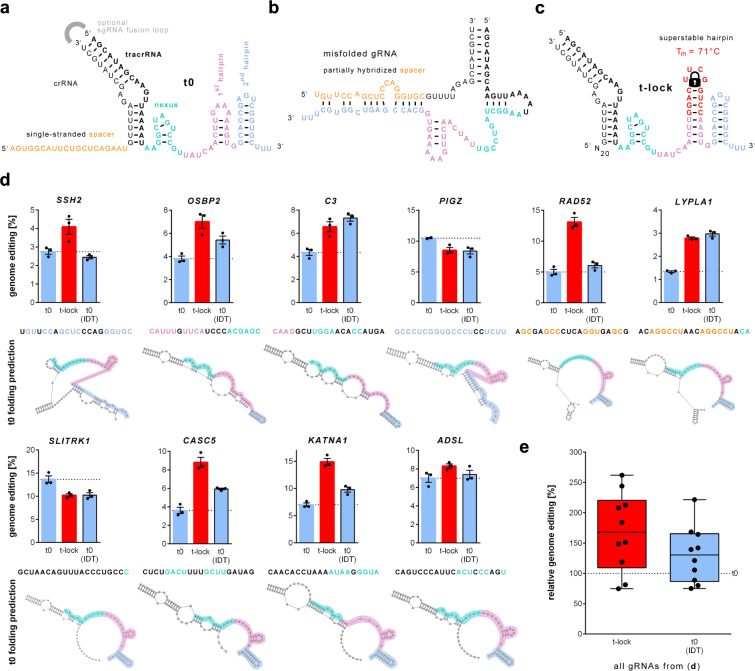
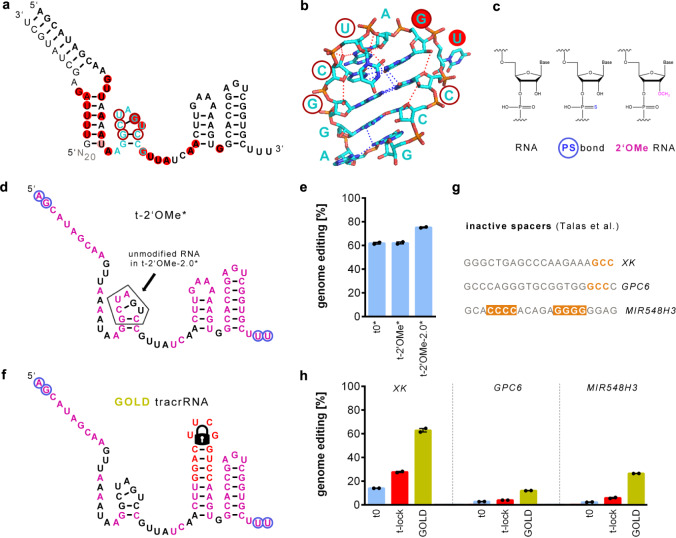
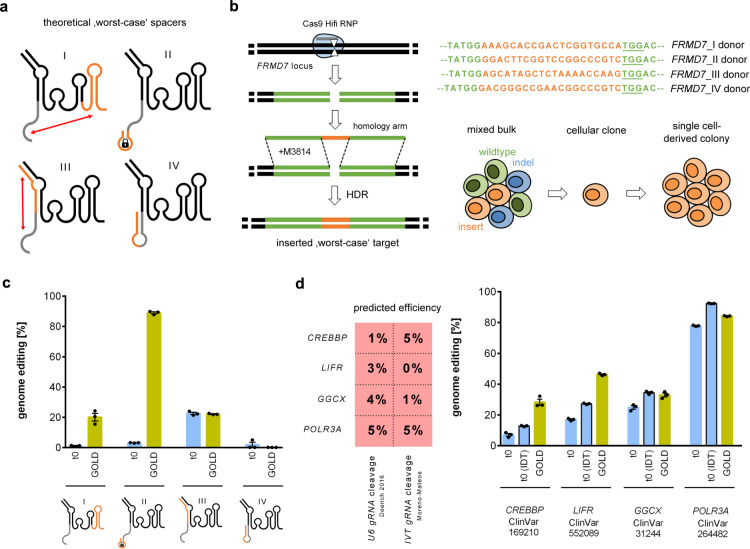
The first step in CRISPR-Cas9-mediated genome editing is the cleavage of target DNA sequences that are complementary to so-called spacer sequences in CRISPR guide RNAs (gRNAs). However, some DNA sequences are refractory to CRISPR-Cas9 cleavage, which is at least in part due to gRNA misfolding. To overcome this problem, we have engineered gRNAs with highly stable hairpins in their constant parts and further enhanced their stability by chemical modifications. The 'Genome-editing Optimized Locked Design' (GOLD)-gRNA increases genome editing efficiency up to around 1000-fold (from 0.08 to 80.5%) with a mean increase across different other targets of 7.4-fold. We anticipate that this improved gRNA will allow efficient editing regardless of spacer sequence composition and will be especially useful if a desired genomic site is difficult to edit.
Overview
The claims and statistics of this paper haven’t been checked yet.
Free: it reads the open-access text and checks the first 5 claims that cite a source we can check. Create a free account to check every claim.
Integrity signals
Registry
Cites
Statistics
Figures
Verification
Claims the paper makes
The claims and statistics of this paper haven’t been checked yet.
Free: it reads the open-access text and checks the first 5 claims that cite a source we can check. Create a free account to check every claim.
Claims other papers make about this one
Each is checked against this paper’s own text: does it say what the citing paper says it does?
The source backs part of the claim, not all of it — or backs it for a different population, condition or comparison.
In the citing paper
“Currently available software is proficient in gRNA nomination, but their predictive power is still lacking because they do not incorporate other metrics for gRNA success, such as secondary structure.40”
From Adenine base editor for knockout of proteins: A practical guide from design to analysis with updated MultiEditRbatch (2026) · cites this paper as [40]
Experimental — accuracy not yet measured
Self-check
Percentages, sums and reported differences re-computed from the paper’s own numbers.
The self-check needs the paper’s full text.
Citations
Cites
The Sequence Alignment/Map format and SAMtools
Li, H., Handsaker, B., Wysoker, A., Fennell, T., Ruan, J., Homer, N., Marth, G., Abecasis, G., Durbin, R., & 1000 Genome Project Data Processing Subgroup (2009) · Bioinformatics · doi:10.1093/bioinformatics/btp352 · Cited by 62,041
A Programmable Dual-RNA–Guided DNA Endonuclease in Adaptive Bacterial Immunity
Jinek, M., Chylinski, K., Fonfara, I., Hauer, M., Doudna, J. A., & Charpentier, E. (2012) · Science · doi:10.1126/science.1225829 · Cited by 17,116
Robinson, J. T., Thorvaldsdóttir, H., Winckler, W., Guttman, M., Lander, E. S., Getz, G., & Mesirov, J. P. (2011) · Nature Biotechnology · doi:10.1038/nbt.1754 · Cited by 15,390
Search-and-replace genome editing without double-strand breaks or donor DNA
Anzalone, A. V., Randolph, P. B., Davis, J. R., Sousa, A. A., Koblan, L. W., Levy, J. M., Chen, P. J., Wilson, C., Newby, G. A., Raguram, A., et al. (2019) · Nature · doi:10.1038/s41586-019-1711-4 · Cited by 4,767
Optimized sgRNA design to maximize activity and minimize off-target effects of CRISPR-Cas9
Doench, J. G., Fusi, N., Sullender, M., Hegde, M., Vaimberg, E. W., Donovan, K. F., Smith, I., Tothova, Z., Wilen, C., Orchard, R., et al. (2016) · Nature Biotechnology · doi:10.1038/nbt.3437 · Cited by 4,637
ClinVar: improving access to variant interpretations and supporting evidence
Landrum, M. J., Lee, J. M., Benson, M., Brown, G. R., Chao, C., Chitipiralla, S., Gu, B., Hart, J., Hoffman, D., Jang, W., et al. (2018) · Nucleic Acids Research · doi:10.1093/nar/gkx1153 · Cited by 4,196
Illumina Sequencing Library Preparation for Highly Multiplexed Target Capture and Sequencing
Meyer, M., & Kircher, M. (2010) · Cold Spring Harbor Protocols · doi:10.1101/pdb.prot5448 · Cited by 2,231
Dynamic Imaging of Genomic Loci in Living Human Cells by an Optimized CRISPR/Cas System
Chen, B., Gilbert, L. A., Cimini, B. A., Schnitzbauer, J., Zhang, W., Li, G.-W., Park, J., Blackburn, E. H., Weissman, J. S., Qi, L. S., et al. (2013) · Cell · doi:10.1016/j.cell.2013.12.001 · Cited by 1,963
Haeussler, M., Schönig, K., Eckert, H., Eschstruth, A., Mianné, J., Renaud, J.-B., Schneider-Maunoury, S., Shkumatava, A., Teboul, L., Kent, J., et al. (2016) · Genome biology · doi:10.1186/s13059-016-1012-2 · Cited by 1,756
The CRISPR tool kit for genome editing and beyond
Adli, M. (2018) · Nature Communications · doi:10.1038/s41467-018-04252-2 · Cited by 1,545
Cited by
Plant organellar genomes: much done, much more to do
Wang, J., Kan, S., Liao, X., Zhou, J., Tembrock, L. R., Daniell, H., Jin, S., & Wu, Z. (2024) · Trends in Plant Science · doi:10.1016/j.tplants.2023.12.014 · Cited by 280
RNA chemistry and therapeutics
Wang, S., Weissman, D., & Dong, Y. (2025) · Nature Reviews Drug Discovery · doi:10.1038/s41573-025-01237-x · Cited by 118
Current advancement in the application of prime editing
Huang, Z., & Liu, G. (2023) · Frontiers in Bioengineering and Biotechnology · doi:10.3389/fbioe.2023.1039315 · Cited by 65
Precise DNA cleavage using CRISPR-SpRYgests
Christie, K. A., Guo, J. A., Silverstein, R. A., Doll, R. M., Mabuchi, M. Y., Stutzman, H. E., Lin, J., Ma, L., Walton, R. T., Pinello, L., et al. (2022) · Nature Biotechnology · doi:10.1038/s41587-022-01492-y · Cited by 56
G-quadruplex-based CRISPR photoswitch for spatiotemporal control of genomic modulation
Deng, H., Xu, H., Wang, Y., Jia, R., Ma, X., Feng, Y., & Chen, H. (2023) · Nucleic Acids Research · doi:10.1093/nar/gkad178 · Cited by 45
Metadata
- Authors
- Riesenberg, S., Helmbrecht, N., Kanis, P., Maricic, T., & Pääbo, S.
- Affiliations
- Max Planck Institute for Evolutionary Anthropology (DE)
- Okinawa Institute of Science and Technology Graduate University (JP)
- Corresponding author
- Riesenberg, Stephan
- Venue
- Nature Communications
- Published
- 2022-01-25
- Volume
- 13
- Issue
- 1
- Pages
- 489-489
- ISSN
- 2041-1723 (ISSN-L)
- PMC
- PMC8789806
- OpenAlex
- W4210558208
- Cited by
- 109
- References
- 35
- Citations by year
- 2026: 24 · 2025: 36 · 2024: 16 · 2023: 20 · 2022: 13
- FWCI
- 6.94
- Type
- journal article
- Language
- en
- Open access
- gold
- doi.org
- Licence
- cc-by
- creativecommons.org/licenses/by/4.0 (tdm)
- creativecommons.org/licenses/by/4.0 (vor)
- Locations
- Nature Communications (publishedVersion, cc-by)
- PubMed Central (publishedVersion, cc-by)
- PubMed (publishedVersion)
- Institutional Repositories DataBase (IRDB) (submittedVersion, cc-by-nc-nd)
- RePEc: Research Papers in Economics (submittedVersion)
- DOAJ (DOAJ: Directory of Open Access Journals) (submittedVersion, cc-by-sa)
- Okinawa Institute of Science and Technology Graduate University (Okinawa Institute of Science and Technology Graduate University) (submittedVersion, cc-by-nc-nd)
- Funders
- Funding was provided by the Max Planck Society and the NOMIS foundation.
- Topics
- Life Sciences › Biochemistry, Genetics and Molecular Biology › Molecular Biology › CRISPR and Genetic Engineering
- Life Sciences › Biochemistry, Genetics and Molecular Biology › Molecular Biology › RNA regulation and disease
- Life Sciences › Biochemistry, Genetics and Molecular Biology › Molecular Biology › RNA Interference and Gene Delivery
- Keywords
- CRISPR/Cas9, guide RNA design, hairpin stability, genome editing efficiency, spacer sequences
- MeSH terms
- Gene Editing, RNA, Guide, CRISPR-Cas Systems, Cell Line, Humans, Nucleic Acid Conformation, Oligonucleotides, Genome, RNA, Guide, Kinetoplastida, CRISPR-Cas Systems
About these checks
Registry, retraction, Cites and statistics results are computed, not judged, with one exception: a printed reference that no index lists is read once by a model before it counts as a citation error. Claims are extracted by a model and kept only when their quote appears verbatim in the text; each cited source is then checked, with a model’s help, for whether it says what the claim relies on. Those verdicts can be wrong — read the claim’s quote and the cited source before relying on one.
Statistics and arithmetic are recomputed, not judged.
Confidence bands are shown only for fields calibrated on our annotated test set. None is calibrated yet, so no band is shown.
What counts as a claim ›How we measure confidence ›How we check this ›
Are you an author, or do you see a problem with this page? Request a review
How to cite
Cite CoChat for the checks on this page, and the paper for its own findings.
- This page
- CoChat. (2026). Citation check: Improved gRNA secondary structures allow editing of target sites resistant to CRISPR-Cas9 cleavage. https://app.cochat.ai/papers/10.1038/s41467-022-28137-7
- The paper
- Riesenberg, S., Helmbrecht, N., Kanis, P., Maricic, T., & Pääbo, S. (2022). Improved gRNA secondary structures allow editing of target sites resistant to CRISPR-Cas9 cleavage. Nature Communications. https://doi.org/10.1038/s41467-022-28137-7
Data sources
Bibliographic data: Semantic Scholar, OpenAlex, Crossref.
Contains information from the Semantic Scholar Academic Graph Datasets, made available under the ODC Attribution License (ODC-BY 1.0).
Semantic Scholar’s data is described in: Kinney, R., et al. (2023). The Semantic Scholar Open Data Platform. arXiv:2301.10140.
