

New seasonal pattern of pollution emerges from changing North American wildfires
Open accessThe DOI matches its Crossref record; 62 of the 63 references it cites were found in a registry or an index.
Abstract
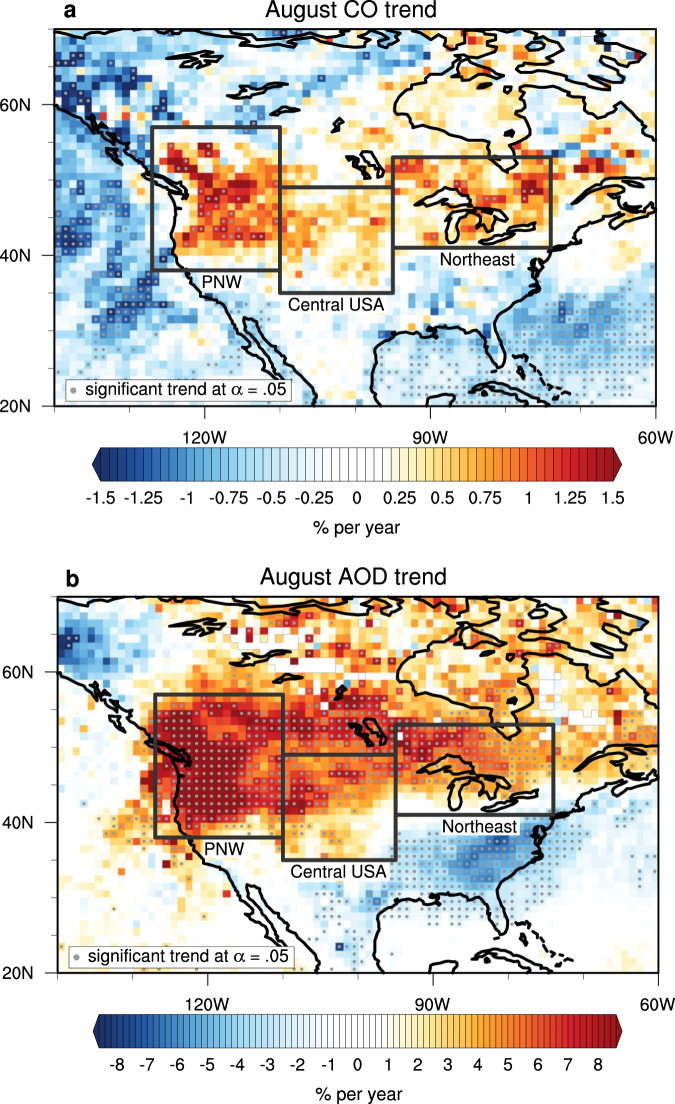
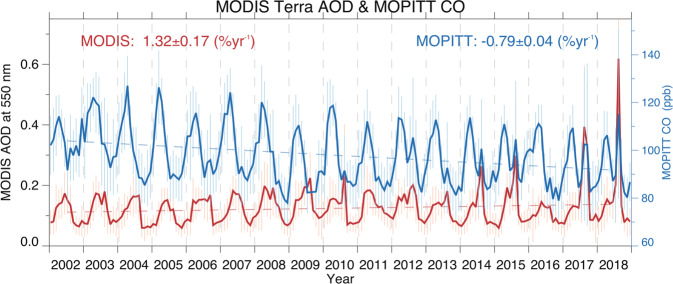
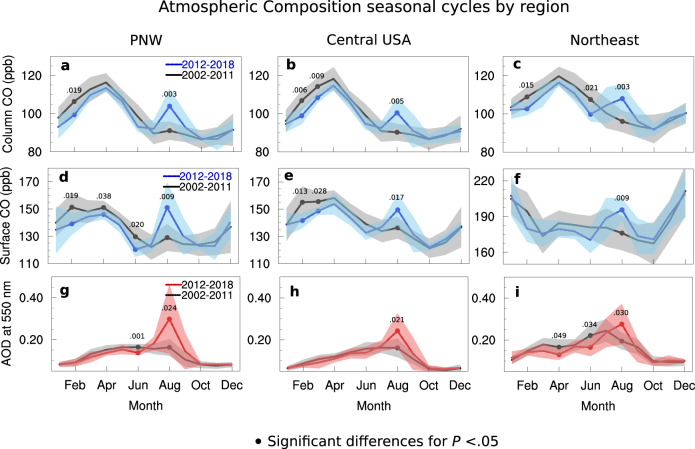
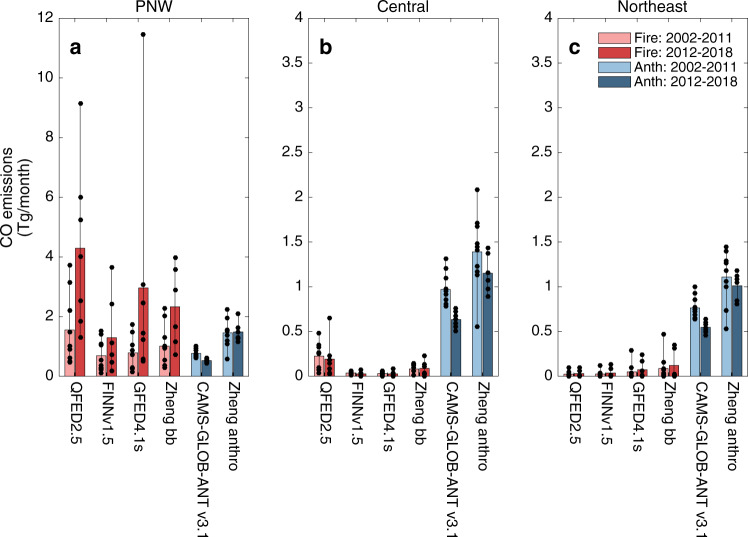
Rising emissions from wildfires over recent decades in the Pacific Northwest are known to counteract the reductions in human-produced aerosol pollution over North America. Since amplified Pacific Northwest wildfires are predicted under accelerating climate change, it is essential to understand both local and transported contributions to air pollution in North America. Here, we find corresponding increases for carbon monoxide emitted from the Pacific Northwest wildfires and observe significant impacts on both local and down-wind air pollution. Between 2002 and 2018, the Pacific Northwest atmospheric carbon monoxide abundance increased in August, while other months showed decreasing carbon monoxide, so modifying the seasonal pattern. These seasonal pattern changes extend over large regions of North America, to the Central USA and Northeast North America regions, indicating that transported wildfire pollution could potentially impact the health of millions of people.
Overview
The claims and statistics of this paper haven’t been checked yet.
Free: it reads the open-access text and checks the first 5 claims that cite a source we can check. Create a free account to check every claim.
Integrity signals
Registry
Cites
Statistics
Figures

Verification
Claims the paper makes
The claims and statistics of this paper haven’t been checked yet.
Free: it reads the open-access text and checks the first 5 claims that cite a source we can check. Create a free account to check every claim.
Claims other papers make about this one
Each is checked against this paper’s own text: does it say what the citing paper says it does?
The source backs part of the claim, not all of it — or backs it for a different population, condition or comparison.
In the citing paper
“As CO concentrations typically peak in the winter and are at the lowest levels in the summer [16]”
From The Burden of Air Pollution on Skin Health: a Brief Report and Call to Action (2024) · cites this paper as [16]
Experimental — accuracy not yet measuredThe cited source says what the claim attributes to it.
In the citing paper
“The impacts of air pollution on human health extend beyond immediate vicinities, affecting communities both near and downwind of wildfires [16]”
From The Burden of Air Pollution on Skin Health: a Brief Report and Call to Action (2024) · cites this paper as [16]
The cited source says what the claim attributes to it.
In the citing paper
“More recently, wildfires in North America have resulted in downwind air pollution, causing rises in CO concentrations [16] to levels that have been associated with a higher prevalence of AD [17].”
From The Burden of Air Pollution on Skin Health: a Brief Report and Call to Action (2024) · cites this paper as [16]
The cited source says what the claim attributes to it.
In the citing paper
“the atmospheric longevity of CO, which arises from incomplete combustion during wildfires, serves as a marker for tracking the transport of pollutants [16]”
From The Burden of Air Pollution on Skin Health: a Brief Report and Call to Action (2024) · cites this paper as [16]
Self-check
Percentages, sums and reported differences re-computed from the paper’s own numbers.
The self-check needs the paper’s full text.
Citations
Cites
Warming and earlier spring increase western U.S. forest wildfire activity.
Westerling, A. L., Hidalgo, H. G., Cayan, D. R., & Swetnam, T. W. (2006) · Science · doi:10.1126/science.1128834 · Cited by 5,176
Emission of trace gases and aerosols from biomass burning
Andreae, M. O., & Merlet, P. (2001) · Global Biogeochemical Cycles · doi:10.1029/2000gb001382 · Cited by 3,902
Organic aerosol and global climate modelling: a review
Kanakidou, M., Seinfeld, J. H., Pandis, S. N., Barnes, I., Dentener, F. J., Facchini, M. C., Van Dingenen, R., Ervens, B., Nenes, A., Nielsen, C. J., et al. (2005) · Atmospheric Chemistry and Physics · doi:10.5194/acp-5-1053-2005 · Cited by 3,244
Impact of anthropogenic climate change on wildfire across western US forests
Abatzoglou, J. T., & Williams, A. P. (2016) · Proceedings of the National Academy of Sciences · doi:10.1073/pnas.1607171113 · Cited by 3,073
Global fire emissions estimates during 1997–2016
(2017) · doi:10.5194/essd-9-697-2017 · Cited by 2,493
The Collection 6 MODIS aerosol products over land and ocean
Levy, R. C., Mattoo, S., Munchak, L. A., Remer, L. A., Sayer, A. M., Patadia, F., & Hsu, N. C. (2013) · Atmospheric Measurement Techniques · doi:10.5194/amt-6-2989-2013 · Cited by 2,323
Self-citationWiedinmyer, C., Akagi, S. K., Yokelson, R. J., Emmons, L. K., Al-Saadi, J. A., Orlando, J. J., & Soja, A. J. (2011) · Geoscientific Model Development · doi:10.5194/gmd-4-625-2011 · Cited by 1,850
Critical Review of Health Impacts of Wildfire Smoke Exposure
Reid, C. E., Brauer, M., Johnston, F. H., Jerrett, M., Balmes, J. R., & Elliott, C. T. (2016) · Environmental Health Perspectives · doi:10.1289/ehp.1409277 · Cited by 1,396
Large wildfire trends in the western United States, 1984–2011
Dennison, P. E., Brewer, S. C., Arnold, J. D., & Moritz, M. A. (2014) · Geophysical Research Letters · doi:10.1002/2014gl059576 · Cited by 1,322
Increasing western US forest wildfire activity: sensitivity to changes in the timing of spring
Westerling, A. L. (2016) · Philosophical Transactions of the Royal Society B: Biological Sciences · doi:10.1098/rstb.2015.0178 · Cited by 1,322
Research works printed but not linked: 4
- Owen RC Cooper OR Stohl A Honrath RE An analysis of the mechanisms of North American pollutant transport to the central North Atlantic lower free troposphere J. Geophys. Res.: Atmos. 2006 111 D23S58
- EPA. Integrated Science Assessment for Particulate Matter. US Environmental Protection Agency. https://www.epa.gov/isa/integrated-science-assessment-isa-particulate-matter (2020). 36630543
- Bordi F Neeck S Scolese C Contribution of EOS Terra to Earth science P. Soc. Photo-Opt. Inst. 1999 3870 260 268
- Buchholz, R. R. et al. Code repository for: New seasonal pattern of pollution emerges from changing North American wildfires. Zenodo v1.0 10.5281/zenodo.6049601, https://github.com/rrbuchholz/fire_atmosphere_analysis_2022 (2022). PMC9018720 35440561 · DOI
Cited by
Tang, W., Emmons, L. K., Wiedinmyer, C., Partha, D. B., Huang, Y., He, C., Zhang, J., Barsanti, K. C., Gaubert, B., Jo, D. S., et al. (2025) · Science Advances · doi:10.1126/sciadv.adr2616 · Cited by 65
“Over North America, the WUI fire signal shows a larger peak in April and a smaller peak in November, while the wildland fire signal has a larger peak in September and a smaller peak in May [consistent with a previous study, ( 36 )].”
Self-citationJuliano, T. W., Lareau, N. P., Frediani, M. E. B., Shamsaei, K., Eghdami, M., Kosiba, K., Wurman, J. M., DeCastro, A. L., Kosović, B., & Ebrahimian, H. (2023) · Geophysical Research Letters · doi:10.1029/2022gl101557 · Cited by 53
Quantifying fire-specific smoke exposure and health impacts
Wen, J., Heft‐Neal, S., Baylis, P., Boomhower, J. P., & Burke, M. (2023) · Proceedings of the National Academy of Sciences · doi:10.1073/pnas.2309325120 · Cited by 51
“We find that all counties in the Western United States (414 counties) experienced an increase in the proportion of total PM 2 .”
BackgroundInfluentialHe, C., Kumar, R., Tang, W., Pfister, G. G., Xu, Y., Qian, Y., & Brasseur, G. P. (2024) · Current Pollution Reports · doi:10.1007/s40726-024-00296-9 · Cited by 58
Self-citationCooper, O. R., Chang, K., Bates, K. H., Brown, S. S., Chace, W. S., Coggon, M. M., Negron, A. M. G., Middlebrook, A. M., Peischl, J., Piasecki, A. M., et al. (2024) · Geophysical Research Letters · doi:10.1029/2024gl111481 · Cited by 48
Ceamanos, X., Coopman, Q., George, M., Riedi, J. C., Parrington, M., & Clerbaux, C. (2023) · Scientific Reports · doi:10.1038/s41598-023-39312-1 · Cited by 45
Chen, Y., Liu, C., Su, W., Hu, Q., Zhang, C., Liu, H., & Yin, H. (2022) · The Science of The Total Environment · doi:10.1016/j.scitotenv.2022.159997 · Cited by 28
Is Portugal Starting to Burn All Year Long? The Transboundary Fire in January 2022
Couto, F. T., Santos, F. L. M., Campos, C., Andrade, N., Purificação, C., & Salgado, R. (2022) · Atmosphere · doi:10.3390/atmos13101677 · Cited by 25
Yan, X., Zang, Z., Li, Z., Chen, H. W., Chen, J., Jiang, Y., Chen, Y., He, B., Chen, Z., Nakajima, T., et al. (2024) · Environmental Science & Technology · doi:10.1021/acs.est.4c02701 · Cited by 28
Zeng, W., Chen, X., Dong, H., & Liu, Y. (2022) · Journal of Environmental Management · doi:10.1016/j.jenvman.2022.116909 · Cited by 22
Continental-scale Atmospheric Impacts of the 2020 Western U.S. Wildfires
Albores, I. S., Buchholz, R. R., Ortega, I., Emmons, L. K., Hannigan, J. W., Lacey, F. G., Pfister, G. G., Tang, W., & Worden, H. M. (2022) · Atmospheric Environment · doi:10.1016/j.atmosenv.2022.119436 · Cited by 24
Self-citationDeveloping user-informed fire weather projections for Canada
Vliet, L. V., Fyke, J., Nakoneczny, S., Murdock, T. Q., & Jafarpur, P. (2024) · Climate Services · doi:10.1016/j.cliser.2024.100505 · Cited by 21
Chen, Z.-Y., Zhang, C., Li, W., Gao, L., Liu, L., Fang, L., & Zhang, C. (2023) · Multimedia Tools and Applications · doi:10.1007/s11042-023-15881-1 · Cited by 17
“The wildfires [6, 8] here included forest fires, grassland fires, and shrubland fires that occurred accidently, while the prescribed burnings were ignited and manipulated by humans in low fire weather conditions that normally none natural fire can occur.”
Pereira, G. M., Kamigauti, L. Y., Pereira, R. F., dos Santos, D. M., Santos, T. D. S., Martins, J. V., Alves, C. A., Gonçalves, C. V. M., Rienda, I. C., Kováts, N., et al. (2025) · Atmospheric chemistry and physics · doi:10.5194/acp-25-4587-2025 · Cited by 23
Bi, J., Zuidema, C., Clausen, D. S., Kirwa, K., Young, M. T., Gassett, A. J., Seto, E., Sampson, P. D., Larson, T. V., Szpiro, A. A., et al. (2022) · Environmental Health Perspectives · doi:10.1289/ehp10889 · Cited by 17
“1,2 Anthropogenic CO is mainly generated from incomplete combustion of carbon fuels from on-road and o ff - road mobile sources, which were responsible for more than 60% of total anthropogenic emissions in the United States in 2017.”
InfluentialSurface ozone trend variability across the United States and the impact of heat waves (1990–2023)
Chang, K., McDonald, B., Harkins, C., & Cooper, O. R. (2025) · Atmospheric chemistry and physics · doi:10.5194/acp-25-5101-2025 · Cited by 15
Liu, Y., Dong, X., Emmons, L. K., Jo, D. S., Liu, Y., Shrivastava, M., Yue, M., Liang, Y., Song, Z., He, X., et al. (2023) · Journal of Geophysical Research Atmospheres · doi:10.1029/2022jd037935 · Cited by 18
“The large IAV induced by wildfires shown in both the IMPROVE measurements and our simulation are also consistent with recent satellite-based studies which reported rising wildfires in the Pacific Northwest (Buchholz et al., 2022).”
ResultCorwin, K. A., Corr, C. A., Burkhardt, J., & Fischer, E. V. (2022) · Journal of Geophysical Research Atmospheres · doi:10.1029/2022jd037446 · Cited by 18
Chapter 7 : Forests. Fifth National Climate Assessment
Domke, G. M., Fettig, C. J., Marsh, A. S., Baumflek, M. J., Gould, W. A., Halofsky, J. E., Joyce, L. A., LeDuc, S. D., Levinson, D. H., Littell, J. S., et al. (2023) · doi:10.7930/nca5.2023.ch7 · Cited by 19
The Burden of Air Pollution on Skin Health: a Brief Report and Call to Action
Santiago Mangual, K. P., Ferree, S., Murase, J. E., & Kourosh, A. S. (2024) · Dermatology and Therapy · doi:10.1007/s13555-023-01080-1 · Cited by 11
“More recently, wildfires in North America have resulted in downwind air pollution, causing rises in CO concentrations [16] to levels that have been associated with a higher prevalence of AD [17].”
BackgroundInfluentialEhret, A., Turquéty, S., George, M., Hadji‐Lazaro, J., & Clerbaux, C. (2025) · Atmospheric chemistry and physics · doi:10.5194/acp-25-6365-2025 · Cited by 20
“This is consistent with the findings of Buchholz et al. (2022), who find a trend of + 8 % yr − AOD in the Pacific Northwest for the period 2002–2018.”
Ortega, I., Gaubert, B., Hannigan, J. W., Brasseur, G. P., Worden, H. M., Blumenstock, T., Fu, H., Hase, F., Jeseck, P., Jones, N., et al. (2023) · Elementa Science of the Anthropocene · doi:10.1525/elementa.2023.00015 · Cited by 14
Self-citationKarppinen, T., Sundström, A., Lindqvist, H., Hatakka, J., & Tamminen, J. (2023) · Remote Sensing Applications Society and Environment · doi:10.1016/j.rsase.2023.101120 · Cited by 15
Transboundary vegetation fire smoke and expressed sentiment: Evidence from Twitter
Du, R., Mino, A., Wang, J., & Zheng, S. (2024) · Journal of Environmental Economics and Management · doi:10.1016/j.jeem.2024.102928 · Cited by 16
Data Linkages for Wildfire Exposures and Human Health Studies: A Scoping Review
Barkoski, J. M., Fleet, E. V., Liu, A. Y., Ramsey, S., Kwok, R. K., & Miller, A. K. (2024) · GeoHealth · doi:10.1029/2023gh000991 · Cited by 12
“…were included for their identification of pollutants from other exposure media and for their use of exposure data sources relevant to human health (Buchholz et al., 2022; Ghetu et al., 2022; Liang et al., 2021; Messier et al., 2019; Nguyen et al., 2021; Ré et al., 2021; Solomon et al., 2021; Wan…”
BackgroundKrishna, M., Saide, P. E., Ye, X., Turney, F. A., Hair, J. W., Fenn, M. A., & Shingler, T. (2024) · Journal of Geophysical Research Atmospheres · doi:10.1029/2023jd039926 · Cited by 12
“Furthermore, wildfire smoke aerosols injected into the atmosphere above the boundary layer can undergo long range transport and affect surface air quality in downwind regions (Buchholz et al., 2022; Hung et al., 2020; Schum et al., 2018).”
BackgroundSmith, T. E. L., & Liu, F. (2025) · Progress in Environmental Geography · doi:10.1177/27539687251348470 · Cited by 14
“Increasing wild fi re activity in the past three decades are expanding the spatial extent and severity of seasonal patterns of smoke pollution, impacting the health of millions (Buchholz et al. 2022).”
Quantifying the impacts of Canadian wildfires on regional air pollution networks
McCracken, T., Chen, P., Metcalf, A. R., & Fan, C. H. (2024) · The Science of The Total Environment · doi:10.1016/j.scitotenv.2024.172461 · Cited by 8
Schwarz, L., Frankland, T. B., Tartof, S. Y., Lee, G. S., Gu, Y. M., Mayeda, E. R., González, D. J. X., Benmarhnia, T., Casey, J. A., & Chen, C. (2025) · Proceedings of the National Academy of Sciences · doi:10.1073/pnas.2509173122 · Cited by 9
Nonlinear and Non‐Gaussian Ensemble Assimilation of MOPITT CO
Gaubert, B., Anderson, J. G., Trudeau, M., Smith, N., McKain, K., Pétron, G., Raeder, K., Arellano, A. F., Granier, C., Emmons, L. K., et al. (2024) · Journal of Geophysical Research Atmospheres · doi:10.1029/2023jd040647 · Cited by 8
“…et al., 2008; Parazoo et al., 2021; Worden et al., 2019), ozone formation (Cheng et al., 2017, 2018), urban plume chemistry (Lama et al., 2022), wildfire emission trends (Buchholz et al., 2022) and chemistry (Juncosa Calahorrano et al., 2021) as well as long‐range transport (Ceamanos et al., 2023).”
BackgroundSelf-citationEstimation of global ground-level PM 10 concentrations using a stacking model
Xu, X., Chen, M., & Shen, J. (2024) · International Journal of Digital Earth · doi:10.1080/17538947.2024.2385071 · Cited by 5
“The west coast of North America is subject to frequent wildfire events, and the number of severe wildfire events is significantly higher in this region than in other regions (Xu et al. 2023).”
InfluentialThe response of Arctic warming to aerosols
Chen, D., & Sun, Q. (2025) · Environmental Research Letters · doi:10.1088/1748-9326/add8a3 · Cited by 6
Quantifying fire-specific smoke severityPreprint
Wen, J., Baylis, P., Boomhower, J. P., & Burke, M. (2023) · doi:10.31223/x5qm1h · Cited by 5
Lee, J. Y., Xian, P., Selimovic, V., Booth, P.-P. M., Anderson, B. G., Liu, J., & Pratt, K. A. (2025) · ACS Earth and Space Chemistry · doi:10.1021/acsearthspacechem.5c00172 · Cited by 7
Impact of ZIF flexibility for aromatic vapor capture
Aumond, T., Daniel, C., Collomb, C., Dedecker, K., Drobek, M., Julbe, A., & Farrusseng, D. (2025) · New Journal of Chemistry · doi:10.1039/d5nj00273g · Cited by 3
Fritz, R., & Cook, D. J. (2025) · JMIR Nursing · doi:10.2196/69052 · Cited by 4
“These increasingly large and intense wildfires are causing a spike in unhealthy pollutants, posing health risks to millions of people, and confining many older adults to their homes each summer [9].”
He, H., Canty, T. P., Dickerson, R. R., Dreessen, J., Sapkota, A., & Boudreaux, M. H. (2025) · Environmental Research Letters · doi:10.1088/1748-9326/ae10c9 · Cited by 3
“In recent years, climate change has intensified wildfire size and severity across North America [1–4], driving increased release and formation of air pollutants, including fine particulate matter with diameter less than 2.5 µ m (PM 2.5 ) and ozone precursors such as nitrogen oxides (NO x ) [5–7].”
InfluentialStructuring the skies: Diel dynamics of migratory animal movement in the lower atmosphere
Giuntini, S., Burt, C. S., Abbott, A. L., Adams, C. A., Belotti, M. C. T. D., Deng, Y., Jimenez, M. F., Kelly, J. F., Maji, S., Nash-Martin, M., et al. (2025) · Ecology · doi:10.1002/ecy.70247 · Cited by 2
A Global, Multidecadal Carbon Monoxide (CO) Record from the Sounder AIRS/CrIS System
Wang, T., Payne, V. H., Manning, E., Pagano, T. S., Lambrigtsen, B., & Monarrez, R. (2025) · Remote Sensing · doi:10.3390/rs18010005 · Cited by 2
Assessing climate and air quality benefits of methane mitigation for U.S. landfills
Folorunsho, A. H., Dudhia, J., Jiang, L., Yokochi, A., & Li, Y. (2026) · Journal of Environmental Management · doi:10.1016/j.jenvman.2026.128707 · Cited by 2
Tang, Z., Yang, P., Miyazaki, K., Worden, J. R., Worden, H. M., Henze, D. K., Jones, D. B. A., & Jiang, Z. (2026) · Atmospheric chemistry and physics · doi:10.5194/acp-26-5531-2026 · Cited by 5
Self-citationIdentifying episodic carbon monoxide emission events in the MOPITT measurement dataset
Jeffery, P. S., Drummond, J. R., Zou, J., & Walker, K. A. (2024) · Atmospheric chemistry and physics · doi:10.5194/acp-24-4253-2024 · Cited by 2
A Comparative Analysis of Satellite‐Derived CO Retrievals During the 2020 Wildfires in North America
Marey, H. S., Drummond, J. R., Jones, D. B. A., Worden, H. M., Clerbaux, C., Borsdorff, T., & Gille, J. C. (2024) · Journal of Geophysical Research Atmospheres · doi:10.1029/2023jd039876 · Cited by 8
Self-citationIntroduction to Arctic Marine Ecotoxicology
Adeniran-Obey, S. O. (2024) · Springer eBooks · doi:10.1007/978-3-031-73584-4_1 · Cited by 3
Choi, M., Lyapustin, A., Yujie Wang, A., Hyer, E. J., Eck, T. F., & Korkin, S. V. (2025) · Frontiers in Remote Sensing · doi:10.3389/frsen.2025.1654779 · Cited by 1
Xu, J., Yang, X., Shi, L., Yang, Z., Zhong, Y., Ma, P., Chen, A., Zhang, Y., & Zhao, W. (2026) · Environmental Research · doi:10.1016/j.envres.2026.124618 · Cited by 1
Yusuf, D. R. D., Sari, I. L., & Aditiya, S. (2024) · IOP Conference Series Earth and Environmental Science · doi:10.1088/1755-1315/1418/1/012047 · Cited by 1
“Cities with heavy vehicular traffic, includes the burning gasses of crop residues or forests fire will contribute to an extreme air pollution [5].”
Ashpole, I., & Wiacek, A. (2023) · Atmospheric measurement techniques · doi:10.5194/amt-16-1923-2023
Li, H., Zhang, K., Sun, H., Wang, X., Yu, H., & Zhang, Z. (2023) · Research Square · doi:10.21203/rs.3.rs-3403946/v1
Jeffery, P. S. (2024) · doi:10.5194/egusphere-2023-2219-ac1
Fritz, R., & Cook, D. J. (2024) · doi:10.2196/preprints.69052
Comment on egusphere-2024-3674
Chang, K.-L., McDonald, B. C., & Cooper, O. R. (2025) · doi:10.5194/egusphere-2024-3674-cc1
Global landscape fire-sourced ambient benzene and health risks in different future scenarios
Sun, W., Tang, D., Yao, Y., & Li, R. (2025) · Environmental Pollution · doi:10.1016/j.envpol.2025.126314
Mitigation of US wildfires through prescribed burning revealed by four decades of satellite dataPreprint
Peiro, H., van der Velde, I. R., Maasakkers, J. D., Stephens, S., Rijsdijk, P., Bögle, M., & Aben, I. (2025) · Research Square · doi:10.21203/rs.3.rs-6726538/v1 · Cited by 1
Flood, V. A., Strong, K., Buchholz, R. R., Kuiper, G., & Magzamen, S. L. (2025) · GeoHealth · doi:10.1029/2024gh001317 · Cited by 1
“To evaluate if the reported increase of wildfire‐related CO emissions has an impact on the health care system in Canada, emergency room (ER) admissions for cardiovascular and respiratory diseases are assessed over the same period discussed in Buchholz et al. (2022), as records are available.”
InfluentialSelf-citationAssessing Carbon Monoxide (CO) Source In Urbanized Area Using Sentinel-5P And Landsat-8
Yusuf, D. R. D., Sukojo, B. M., Sari, I. L., Aditiya, S., Ramadhania, N., & Murdawati (2025) · IEEE International Conference on Aerospace Electronics and Remote Sensing Technology (ICARES) · doi:10.1109/icares67579.2025.11371541
“Large cities with heavy vehicular traffic, burning of crop residues and forest fires may cause severe localized air pollution [3].”
McClure, C. D., Anderson, A., Gostic, C. L., King, D., & Pavlovic, N. (2026) · Journal of the Air & Waste Management Association · doi:10.1080/10962247.2026.2639376
“Recent work has shown that wildfire smoke has significantly increased ozone and PM 2.5 air pollution, leading to an unprecedented number of days where air quality is impacted by wildfire smoke (Wilmot et al. 2021; Buchholz et al. 2022; Thilakaratne et al. 2022).”
InfluentialHan, S., Liu, S., Sheng, M., Kim, J., Cui, X., Zhou, M., Wang, W., Morino, I., Velazco, V. A., & Zeng, Z. (2026) · Remote Sensing of Environment · doi:10.1016/j.rse.2026.115642
Marino, J. F., & Lareau, N. P. (2026) · Journal of Geophysical Research Atmospheres · doi:10.1029/2025jd045680
“In a warming climate—where wildfire frequency, intensity, and duration are projected to increase (Buchholz et al., 2022; Goss et al., 2020; Hurteau et al., 2014)—smoke has emerged not only as a public health crisis but also as an active agent in atmospheric feedbacks.”
Teigen, K., Espinosa, M. C., McKinley, H., Reed, A., Berrang, E., Ramos-Vazquez, J., Houston, C. A., & Isaksen, T. B. (2026) · Environmental Research Communications · doi:10.1088/2515-7620/ae69a6 · Cited by 1
The boiling frog effect: Global warming delays emotional impacts of air pollution in warmer climates
Wang, S., Liu, H., Wu, C. Y. H., Huang, X., Wang, R., Yang, Y., Corcoran, J., Lai, S., Xia, X., & Liu, Y. (2026) · Journal of Hazardous Materials · doi:10.1016/j.jhazmat.2026.142440
Six major risks in modern society: Research progress and future directions
Zhang, Q., Hu, Y., & Wang, S. (2026) · Risk sciences. · doi:10.1016/j.risk.2026.100060
Anjum, M. (2026) · Research Square · doi:10.21203/rs.3.rs-11373778/v1
Metadata
- Authors
- Buchholz, R. R., Park, M., Worden, H. M., Tang, W., Edwards, D. P., Gaubert, B., Deeter, M. N., Sullivan, T., Ru, M., Chin, M., Levy, R. C., Zheng, B., & Magzamen, S.
- Affiliations
- NSF National Center for Atmospheric Research (US)
- University of Colorado Boulder (US)
- Columbia University (US)
- Goddard Space Flight Center (US)
- Tsinghua Shenzhen International Graduate School (CN)
- Colorado State University (US)
- Corresponding author
- Buchholz, Rebecca R.
- Worden, Helen M.
- ORCID
- Venue
- Nature Communications
- Published
- 2022-04-19
- Volume
- 13
- Issue
- 1
- Pages
- 2043-2043
- ISSN
- 2041-1723 (ISSN-L)
- PMC
- PMC9018720
- OpenAlex
- W4224264539
- Semantic Scholar
- 7776083e8ce2e9e8d5f1ff43ae1b44d484356e6b
- Cited by
- 65
- References
- 63
- Citations by year
- 2026: 9 · 2025: 19 · 2024: 16 · 2023: 14 · 2022: 7
- FWCI
- 5.36
- Type
- journal article
- Language
- en
- Open access
- gold
- doi.org
- Licence
- cc-by
- creativecommons.org/licenses/by/4.0 (tdm)
- creativecommons.org/licenses/by/4.0 (vor)
- Locations
- Nature Communications (publishedVersion, cc-by)
- PubMed Central (publishedVersion, cc-by)
- PubMed (publishedVersion)
- RePEc: Research Papers in Economics (submittedVersion)
- DOAJ (DOAJ: Directory of Open Access Journals) (submittedVersion, cc-by-sa)
- Funders
- National Science Foundation (1852977)
- National Aeronautics and Space Administration (1852977)
- National Center for Atmospheric Research (No.1852977, 1852977)
- Canadian Space Agency
- Natural Sciences and Engineering Research Council of Canada
- Topics
- Physical Sciences › Earth and Planetary Sciences › Atmospheric Science › Atmospheric chemistry and aerosols
- Physical Sciences › Environmental Science › Global and Planetary Change › Fire effects on ecosystems
- Physical Sciences › Environmental Science › Global and Planetary Change › Atmospheric aerosols and clouds
- Keywords
- wildfire emissions, carbon monoxide, seasonal variation, air pollution, long-range transport, climate change, aerosol pollution, health effects
- MeSH terms
- Wildfires, Air Pollutants, Air Pollution, Carbon Monoxide, Humans, North America, Seasons
About these checks
Registry, retraction, Cites and statistics results are computed, not judged, with one exception: a printed reference that no index lists is read once by a model before it counts as a citation error. Claims are extracted by a model and kept only when their quote appears verbatim in the text; each cited source is then checked, with a model’s help, for whether it says what the claim relies on. Those verdicts can be wrong — read the claim’s quote and the cited source before relying on one.
Statistics and arithmetic are recomputed, not judged.
Confidence bands are shown only for fields calibrated on our annotated test set. None is calibrated yet, so no band is shown.
What counts as a claim ›How we measure confidence ›How we check this ›
Are you an author, or do you see a problem with this page? Request a review
Data sources
Bibliographic data: Semantic Scholar, OpenAlex, Crossref.
Contains information from the Semantic Scholar Academic Graph Datasets, made available under the ODC Attribution License (ODC-BY 1.0).
Semantic Scholar’s data is described in: Kinney, R., et al. (2023). The Semantic Scholar Open Data Platform. arXiv:2301.10140.
