

Pilot study of bempegaldesleukin in combination with nivolumab in patients with metastatic sarcoma
Open accessThe DOI matches its Crossref record; 67 of the 69 references it cites were found in a registry or an index.
Abstract
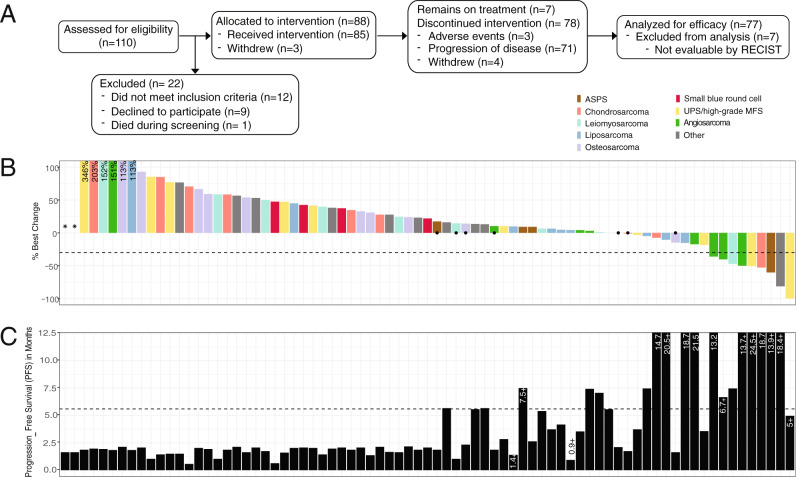
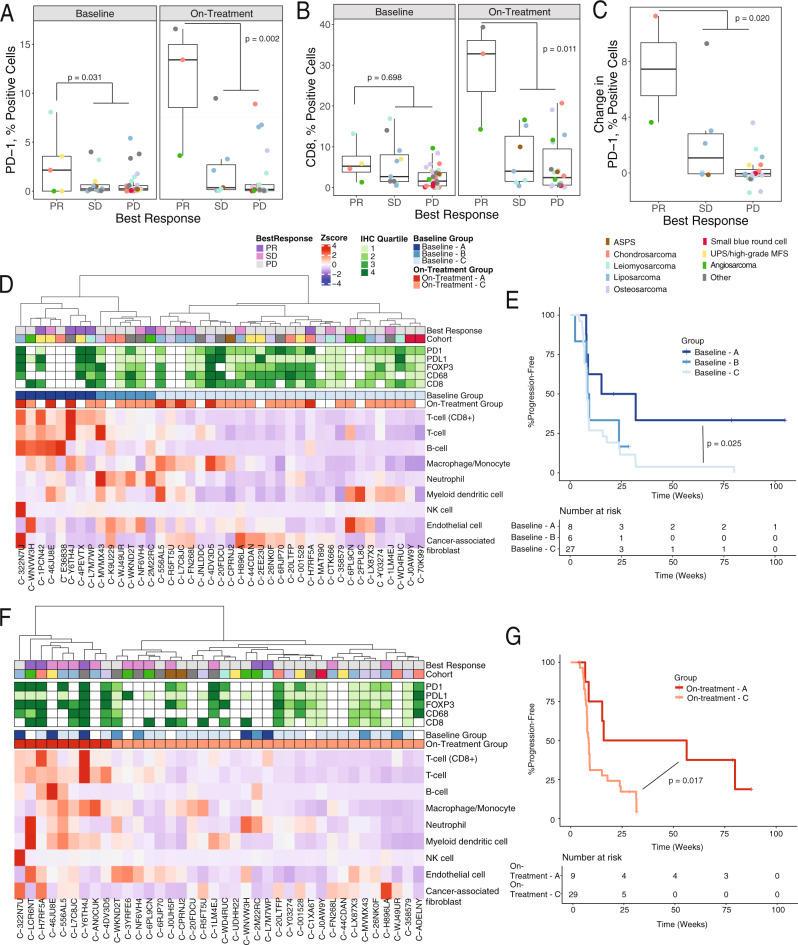
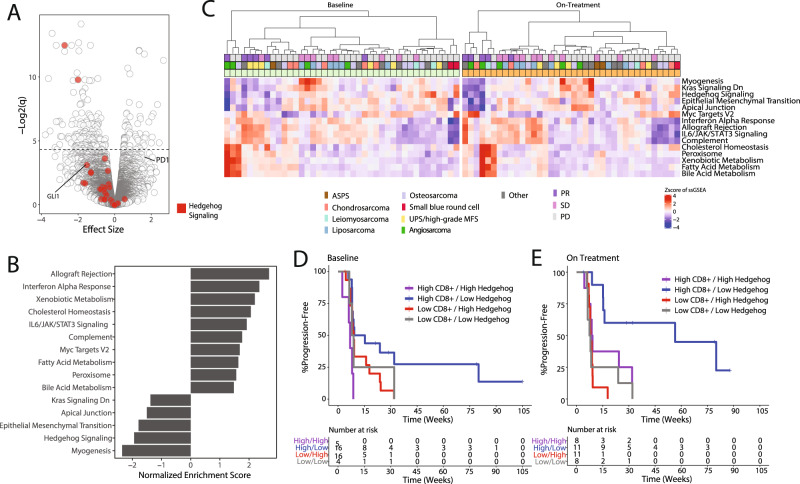
PD-1 blockade (nivolumab) efficacy remains modest for metastatic sarcoma. In this paper, we present an open-label, non-randomized, non-comparative pilot study of bempegaldesleukin, a CD122-preferential interleukin-2 pathway agonist, with nivolumab in refractory sarcoma at Memorial Sloan Kettering/MD Anderson Cancer Centers (NCT03282344). We report on the primary outcome of objective response rate (ORR) and secondary endpoints of toxicity, clinical benefit, progression-free survival, overall survival, and durations of response/treatment. In 84 patients in 9 histotype cohorts, all patients experienced ≥1 adverse event and treatment-related adverse event; 1 death was possibly treatment-related. ORR was highest in angiosarcoma (3/8) and undifferentiated pleomorphic sarcoma (2/10), meeting predefined endpoints. Results of our exploratory investigation of predictive biomarkers show: CD8 + T cell infiltrates and PD-1 expression correlate with improved ORR; upregulation of immune-related pathways correlate with improved efficacy; Hedgehog pathway expression correlate with resistance. Exploration of this combination in selected sarcomas, and of Hedgehog signaling as a predictive biomarker, warrants further study in larger cohorts.
Overview
The claims and statistics of this paper haven’t been checked yet.
Free: it reads the open-access text and checks the first 5 claims that cite a source we can check. Create a free account to check every claim.
Integrity signals
Registry
Cites
Statistics
Figures
Verification
Claims the paper makes
The claims and statistics of this paper haven’t been checked yet.
Free: it reads the open-access text and checks the first 5 claims that cite a source we can check. Create a free account to check every claim.
Claims other papers make about this one
Each is checked against this paper’s own text: does it say what the citing paper says it does?
The source backs part of the claim, not all of it — or backs it for a different population, condition or comparison.
In the citing paper
“BS on average show very low TMB: 0.79–1.96 mutations/Mbase in osteosarcoma, 11 , 17 , 18 , 19 ∼0.2 mutations/Mbas in Ewing sarcoma 19 , 20 and <5 mutations/Mbase in chondrosarcoma with some correlation with grade. 21”
From Nivolumab and sunitinib in patients with advanced bone sarcomas: A multicenter, single‐arm, phase 2 trial (2025) · cites this paper as [18]
Experimental — accuracy not yet measuredThe source backs part of the claim, not all of it — or backs it for a different population, condition or comparison.
In the citing paper
“TMB is not typically associated with response to ICI efficacy with the exception of rare, TMB-high sarcomas including pleomorphic dermal sarcoma and cutaneous angiosarcoma. 13”
From A multicenter, randomized, non-comparative, phase II study of nivolumab ± ipilimumab for patients with metastatic sarcoma (Alliance A091401): expansion cohorts and correlative analyses (2024) · cites this paper as [13]
Experimental — accuracy not yet measuredThe cited source says what the claim attributes to it.
In the citing paper
“In other sarcoma subtypes, CD8+ T cell infiltration, PD-1 expression and upregulation of immunerelated pathways correlated with improved ORR.”
From Advances on immunotherapy for osteosarcoma (2024) · cites this paper as [164]
The cited source says what the claim attributes to it.
In the citing paper
“However, in osteosarcoma, although it has a higher tumor mutational burden, there is no significant response to the combination therapy [164].”
From Advances on immunotherapy for osteosarcoma (2024) · cites this paper as [164]
The cited source says what the claim attributes to it.
In the citing paper
“Tumor mutational burden (TMB), a key indicator of ICI response in most tumors, is generally low across sarcoma subtypes.”
Self-check
Percentages, sums and reported differences re-computed from the paper’s own numbers.
The self-check needs the paper’s full text.
Citations
Cites
STAR: ultrafast universal RNA-seq aligner
Dobin, A., Davis, C. A., Schlesinger, F., Drenkow, J., Zaleski, C., Jha, S., Batut, P., Chaisson, M., & Gingeras, T. R. (2013) · Bioinformatics · doi:10.1093/bioinformatics/bts635 · Cited by 51,709
PD-1 and PD-L1 Immune Checkpoint Blockade to Treat Breast Cancer
Hartkopf, A. D., Taran, F.-A., Wallwiener, M., Walter, C. B., Krämer, B., Grischke, E.-M., & Brucker, S. Y. (2016) · Breast Care · doi:10.1159/000453569 · Cited by 30,845
The Genome Analysis Toolkit: A MapReduce framework for analyzing next-generation DNA sequencing data
McKenna, A., Hanna, M., Banks, E., Sivachenko, A., Cibulskis, K., Kernytsky, A., Garimella, K., Altshuler, D., Gabriel, S., Daly, M., et al. (2010) · Genome Research · doi:10.1101/gr.107524.110 · Cited by 27,895
Regularization Paths for Generalized Linear Models via Coordinate Descent
Friedman, J., Hastie, T., & Tibshirani, R. (2010) · Journal of Statistical Software · doi:10.18637/jss.v033.i01 · Cited by 19,927
GSVA: gene set variation analysis for microarray and RNA-Seq data
Hänzelmann, S., Castelo, R., & Guinney, J. (2013) · BMC Bioinformatics · doi:10.1186/1471-2105-14-7 · Cited by 15,440
The Molecular Signatures Database Hallmark Gene Set Collection
Liberzon, A., Birger, C., Thorvaldsdóttir, H., Ghandi, M., Mesirov, J. P., & Tamayo, P. (2015) · Cell Systems · doi:10.1016/j.cels.2015.12.004 · Cited by 13,807
Near-optimal probabilistic RNA-seq quantification
Bray, N. L., Pimentel, H., Melsted, P., & Pachter, L. (2016) · Nature Biotechnology · doi:10.1038/nbt.3519 · Cited by 9,723
The mutational constraint spectrum quantified from variation in 141,456 humans
Karczewski, K. J., Francioli, L. C., Tiao, G., Cummings, B. B., Alföldi, J., Wang, Q., Collins, R. L., Laricchia, K. M., Ganna, A., Birnbaum, D. P., et al. (2020) · Nature · doi:10.1038/s41586-020-2308-7 · Cited by 9,434
Self-citationMutational landscape determines sensitivity to PD-1 blockade in non–small cell lung cancer
Rizvi, N. A., Hellmann, M. D., Snyder, A., Kvistborg, P., Makarov, V., Havel, J. J., Lee, W., Yuan, J., Wong, P., Ho, T. S., et al. (2015) · Science · doi:10.1126/science.aaa1348 · Cited by 7,802
PD-1 blockade induces responses by inhibiting adaptive immune resistance
Tumeh, P. C., Harview, C. L., Yearley, J. H., Shintaku, I. P., Taylor, E. J. M., Robert, L., Chmielowski, B., Spasic, M., Henry, G., Ciobanu, V., et al. (2014) · Nature · doi:10.1038/nature13954 · Cited by 6,609
Research works printed but not linked: 1
- Li, H. Aligning sequence reads, clone sequences and assembly contigs with BWA-MEM. arXiv: Genomics (2013).
Cited by
Advances on immunotherapy for osteosarcoma
Yu, S., & Yao, X. (2024) · Molecular Cancer · doi:10.1186/s12943-024-02105-9 · Cited by 270
“However, in osteosarcoma, although it has a higher tumor mutational burden, there is no significant response to the combination therapy [164].”
BackgroundMacrophage Repolarization as a Therapeutic Strategy for Osteosarcoma
Anand, N., Peh, K. H., & Kolesar, J. (2023) · International Journal of Molecular Sciences · doi:10.3390/ijms24032858 · Cited by 100
“A novel strategy combining nivolumab and an IL-2 agonist, bempegaldesleukin, was evaluated in a pilot study that enrolled 84 patients with relapsed, refractory, advanced, or metastatic sarcoma [60].”
BackgroundInfluentialOsteosarcoma: Current Concepts and Evolutions in Management Principles
Pilavaki, P., Ardakani, A. H. G., Gikas, P. D., & Constantinidou, A. (2023) · Journal of Clinical Medicine · doi:10.3390/jcm12082785 · Cited by 81
“Bempegaldesleukin and Nivolumab [24] Pilot study 10 -PR: 0/10 -mPFS: 2 months -mOS: 6.”
BackgroundSubramanian, A., Nemat‐Gorgani, N., Ellis-Caleo, T. J., van IJzendoorn, D. G. P., Sears, T. J., Somani, A., Luca, B. A., Zhou, M. Y., Bradić, M., Torres, I. A., et al. (2024) · Nature Cancer · doi:10.1038/s43018-024-00743-y · Cited by 73
“RNA was extracted from frozen tissues, library prepped using the TruSeq Stranded mRNA LT kit (Illumina) and sequenced on a HiSeq 4000 (Illumina) as described previously 45 .”
Self-citationCancer cell-intrinsic PD-1: Its role in malignant progression and immunotherapy
Chen, M., Bie, L., & Ying, J. (2023) · Biomedicine & Pharmacotherapy · doi:10.1016/j.biopha.2023.115514 · Cited by 60
Chu, X., Mi, B., Xiong, Y., Wang, R., Liu, T., Hu, L., Yan, C., Zeng, R., Lin, J., Fu, H., et al. (2024) · Biomaterials · doi:10.1016/j.biomaterials.2024.122714 · Cited by 61
Immunotherapy in Sarcoma: Current Data and Promising Strategies
Wood, G. E., Meyer, C. F., Petitprez, F., & D’Angelo, S. P. (2024) · American Society of Clinical Oncology Educational Book · doi:10.1200/edbk_432234 · Cited by 54
Self-citationAdjusting the scope of natural killer cells in cancer therapy
Shen, Z., Meng, X., Rautela, J., Chopin, M., & Huntington, N. D. (2025) · Cellular and Molecular Immunology · doi:10.1038/s41423-025-01297-4 · Cited by 39
“…city for targeting tumor-resident NK cells or neoantigen-speci fi c T cells, most IL-2 drug development activity is focused on engineering cytokines to preferentially bind and act on activated conventional T cells, which in cancer patients are likely enriched in neoantigen-reactive T cells [67, 68].”
Molecular mechanisms of osteosarcoma metastasis and possible treatment opportunities
Du, X., Wei, H., Zhang, B., Wang, B., Li, Z., Pang, L. K., Zhao, R., & Yao, W. (2023) · Frontiers in Oncology · doi:10.3389/fonc.2023.1117867 · Cited by 33
“0% (84), but a combination of targeted therapy and immunotherapy did not elicit better outcomes (85, 86).”
BackgroundUnraveling molecular aberrations and pioneering therapeutic strategies in osteosarcoma
Yan, P., Wang, J., Yue, B., & Wang, X. (2024) · Biochimica et Biophysica Acta (BBA) - Reviews on Cancer · doi:10.1016/j.bbcan.2024.189171 · Cited by 32
Histology-Specific Clinical Trial of Lenvatinib and Pembrolizumab in Patients with Sarcoma
Movva, S., Seier, K. P., Avutu, V., Banks, L. B., Chan, J. E., Chi, P., Dickson, M. A., Gounder, M. M., Kelly, C. M., Keohan, M. L., et al. (2024) · Clinical Cancer Research · doi:10.1158/1078-0432.ccr-24-2519 · Cited by 31
Self-citationPalmerini, E., Lopez Pousa, A., Grignani, G., Redondo, A., Hindi, N., Provenzano, S., Sebio, A., Lopez Martin, J. A., Valverde, C., Martinez Trufero, J., et al. (2025) · Cancer · doi:10.1002/cncr.35628 · Cited by 29
Current Landscape of Immunotherapy for Advanced Sarcoma
Albarrán, V., Villamayor, M. L., Pozas, J., Chamorro, J., Rosero, D. I., Román, M. S., Guerrero, P., de Aguado, P. P., Calvo, J. C., de Quevedo, C. G., et al. (2023) · Cancers · doi:10.3390/cancers15082287 · Cited by 29
van Ravensteijn, S. G., Versleijen‐Jonkers, Y. M. H., Hillebrandt-Roeffen, M. H. S., Weidema, M. E., Nederkoorn, M. J. L., Bol, K. F., Gorris, M. A. J., Verrijp, K. N., Kroeze, L. I., de Bitter, T. J. J., et al. (2022) · Cancers · doi:10.3390/cancers14235938 · Cited by 24
Seligson, N. D., Chen, J. L., Goodrich, A. C., Van Tine, B. A., Campbell, J. D., Richards, A. L., Antonescu, C. R., Liebner, D. A., Milhem, M. M., Streicher, H., et al. (2024) · Journal for ImmunoTherapy of Cancer · doi:10.1136/jitc-2024-009472 · Cited by 21
Self-citationThe role of tumor immune microenvironment in chordoma: promising immunotherapy strategies
Xu, J., Shi, Q., Wang, B., Ji, T., Guo, W., Ren, T., & Tang, X. (2023) · Frontiers in Immunology · doi:10.3389/fimmu.2023.1257254 · Cited by 21
“Currently, several drugs targeting the PD-1/PD-L1 pathway in chordoma are undergoing clinical trials (96, 97) (Table 1).”
BackgroundStereotactic body radiation therapy for sarcoma pulmonary metastases
Lebow, E. S., Lobaugh, S. M., Zhang, Z., Dickson, M. A., E, E. R. P., D’Angelo, S. P., Nacev, B. A., Shepherd, A. F., Shaverdian, N., Wolden, S. L., et al. (2023) · Radiotherapy and Oncology · doi:10.1016/j.radonc.2023.109824 · Cited by 20
Self-citationInnovative Breakthroughs for the Treatment of Advanced and Metastatic Synovial Sarcoma
Landuzzi, L., Manara, M. C., Pazzaglia, L., Lollini, P., & Scotlandi, K. (2023) · Cancers · doi:10.3390/cancers15153887 · Cited by 20
“In a trial on STS, the presence of CD8+ T-cells and reduced expression of the Hedgehog signaling pathway led to the best clinical outcome; therefore, the relevance and the targeting of Hedgehog signaling in the immune microenvironment should be further investigated in STS and SyS [56].”
BackgroundComplex immune microenvironment of chordoma: a road map for future treatment
Niu, H., Zheng, B., Zou, M., & Zheng, B. (2024) · Journal for ImmunoTherapy of Cancer · doi:10.1136/jitc-2024-009313 · Cited by 19
Emerging immunotherapy and tumor microenvironment for advanced sarcoma: a comprehensive review
Huang, H. W., Fan, Y., Zhang, S., Bai, X., Wang, X., & Shan, F. (2025) · Frontiers in Immunology · doi:10.3389/fimmu.2025.1507870 · Cited by 22
Exploring the landscape of immunotherapy approaches in sarcomas
Pilavaki, P., Panagi, M., Arifi, S., Jones, R. L., Stylianopoulos, T., & Constantinidou, A. (2023) · Frontiers in Oncology · doi:10.3389/fonc.2022.1069963 · Cited by 18
“Angiosarcoma -Nivolumab (73) -Nivolumab & Ipilimumab (38, 43, 87, 88) -Nivolumab & Bempegaldesleukin (45) -Pembrolizumab (37, 48, 49, 51, 53, 55, 88) -Carotuximab (89) -Sintilimab (57) -Durvalumab & Tremelimumab (58) -DC-based vaccines (60) -T-VEC + pembrolizumab (63) -rIL-2 (90– 93)”
ResultInfluentialEmerging Treatments Targeting the Tumor Microenvironment for Advanced Chondrosarcoma
Ingangi, V., Chiara, A. D., Ferrara, G., Gallo, M., Catapano, A., Fazioli, F., Carluccio, G. D., Peranzoni, E., Marigo, I., Carriero, M. V., et al. (2024) · Cells · doi:10.3390/cells13110977 · Cited by 17
Tortorelli, I., Bellan, E., Chiusole, B., Murtas, F., Ruggieri, P., Pala, E., Cerchiaro, M., Buzzaccarini, M. S., Scarzello, G., Krengli, M., et al. (2024) · Critical Reviews in Oncology/Hematology · doi:10.1016/j.critrevonc.2024.104268 · Cited by 15
Hedgehog pathway in sarcoma: from preclinical mechanism to clinical application
Banaszek, N., Kurpiewska, D., Kozak, K., Rutkowski, P. L., & Sobczuk, P. (2023) · Journal of Cancer Research and Clinical Oncology · doi:10.1007/s00432-023-05441-3 · Cited by 14
“Reduced expression of the Hedgehog signaling pathway and the presence of CD8 + T cells have been shown to correlate with the best clinical outcome in patients with sarcoma undergoing immunotherapy (D’Angelo et al. 2022).”
BackgroundSarcoma Common MHC-I Haplotype Restricts Tumor-Specific CD8+ T Cell Response
Mosca, L., Angelis, A. D., Ronchi, A., Chiara, A. D., Fazioli, F., Ruosi, C., Altucci, L., Conte, M., & de Nigris, F. (2022) · Cancers · doi:10.3390/cancers14143414 · Cited by 12
“Subsequent clinical trials testing immunotherapeutic alone or in combination with other agents correlate immune-related pathways with improved efficacy in sarcoma subtypes [16,17].”
Backgroundvan Ravensteijn, S. G., de Haan, J. J., Gelderblom, H. A. J., Nederkoorn, M. J. L., Hillebrandt-Roeffen, M. H. S., Gorris, M. A. J., de Bitter, T. J. J., Boleij, A., Gusinac, A., Ederveen, T. H. A., et al. (2025) · Clinical Cancer Research · doi:10.1158/1078-0432.ccr-25-0311 · Cited by 11
“CD8 + T-cell infiltrates correlated with improved response in AS treated with nivolumab and bempegaldesleukin (13).”
InfluentialAdvances in osteosarcoma research: Pathogenesis and emerging therapeutic strategies
Yan, L. ‐., Dong, X., & Chen, S. (2026) · Critical Reviews in Oncology/Hematology · doi:10.1016/j.critrevonc.2026.105252 · Cited by 11
Yu, K., Wang, L., Bu, F., Zhang, J., Hai, Y., Hu, R., Lu, J., & Shi, X. (2023) · Frontiers in Surgery · doi:10.3389/fsurg.2023.1166764 · Cited by 10
“PD-1 may be a potential therapeutic target for UPS in the future, and its expression is important in influencing CD8+ T lymphocyte infiltration and patient prognosis (55).”
BackgroundDenu, R. A., Moyers, J. T., Gouda, M. A., Conley, A. P., Lazar, A. J., & Subbiah, V. (2023) · Clinical Cancer Research · doi:10.1158/1078-0432.ccr-23-0876 · Cited by 10
Self-citationAngiosarcoma: Role of Immunotherapy
Chen, T. W. (2025) · Current Treatment Options in Oncology · doi:10.1007/s11864-025-01307-7 · Cited by 10
“Importantly, all responding patients had non-cutaneous angiosarcoma and low tumor mutation burden (TMB), suggesting a distinct immunogenicity profile compared to cutaneous angio-sarcoma [14].”
Zeng, Z., Mei, Z., Chen, M., Cao, H., Xiang, Q., Cai, H., Lu, Z., & Qiu, H. (2023) · Clinical Research in Cardiology · doi:10.1007/s00392-023-02251-y · Cited by 10
Leveraging spatial omics for the development of precision sarcoma treatments
Tu, C., Kulasinghe, A., Barbour, A. P., & Souza-Fonseca-Guimarães, F. (2024) · Trends in Pharmacological Sciences · doi:10.1016/j.tips.2023.12.006 · Cited by 9
Sergi, C. M., Burnett, M., Jantuan, E., Hakoum, M., Beug, S. T., Leng, R. P., & Shen, F. (2025) · Biomedicines · doi:10.3390/biomedicines13030664 · Cited by 9
“Bempegaldesleukin, a novel agonist of the IL-2 pathway that specifically targets CD122 has been shown to significantly enhance the effectiveness of PD-1 and CTLA-4 ICIs in metastatic and orthotropic OS mouse models and seems to be promising in humans [111].”
Immunotherapy in the Treatment of Undifferentiated Pleomorphic Sarcoma and Myxofibrosarcoma
Wu, J. T., Nowak, E., Imamura, J., Leng, J., Shepard, D. R., Campbell, S. R., Scott, J. G., Nystrom, L. M., Mesko, N. W., Schwartz, G. K., et al. (2025) · Current Treatment Options in Oncology · doi:10.1007/s11864-025-01349-x · Cited by 8
“A pilot study tested the combination of bempegaldesleukin, an IL-2 agonist, with nivolumab in patients with advanced or metastatic sarco - mas [108].”
An, H., Oh, J., & Bae, J. (2026) · Immune Network · doi:10.4110/in.2026.26.e6 · Cited by 8
Lesovaya, E. A., Fetisov, T. I., Bokhyan, B. Y., Сенченко, М. А., Рогожин, Д. В., Павловна, М. В., Николаевна, Д. А., Belitsky, G. A., Геннадиевна, Я. М., & Игоревич, К. К. (2025) · Cancers · doi:10.3390/cancers17223613 · Cited by 6
“…Pembrolizumab (PD-1) + Gemcitabine (pyrimidine antimetabo-lite) [87,95,96]; Toripalimab (PD-1) + Anlotinib (tyrosine kinase inhibitor, TKI) [90,97] [105,106]; Nivolumab (PD-L1) + Nab-sirolimus (mTOR inhibitor) [107,108]; Pembrolizumab (PD-1) + Eribulin (non-taxane microtubule inhibitor) [109,110];…”
Blood‐based biomarkers in soft tissue sarcoma: Implications for immune checkpoint inhibitor therapy
Mannah, B., Park, J., & Lim, S. Y. (2025) · International Journal of Cancer · doi:10.1002/ijc.35477 · Cited by 5
“38,39 However, these biomarkers were derived from tumour tissue samples, which necessitate invasive and time-intensive biopsy collection.”
Deng, S., Yang, X., He, L., Zhang, Q., Zhao, C., & Meng, H. (2024) · Journal of Cardiothoracic Surgery · doi:10.1186/s13019-024-02752-5 · Cited by 5
“Furthermore, targeted anti-angiogenic drugs and immune checkpoint inhibitors(ICIs) have been applied in clinical practice and achieved good results [10–12].”
BackgroundEmerging predictive biomarkers in the management of bone and soft tissue sarcomas
Haddox, C. L., & Riedel, R. F. (2023) · Expert Review of Anticancer Therapy · doi:10.1080/14737140.2023.2200169 · Cited by 5
“Cell Cycle Regulation Decreased MDM2 levels CDK4/6 inhibitor response Immunoblotting [22] MDM2 copy number ATRX loss CDK4/6 inhibitors non-response NGS, Immunoblotting [22,23] CDKN2A loss CDK4/6 inhibitors response NGS, IHC for p16 [24] Rb loss CDK4/6 inhibitors non-response NGS, IHC for Rb [25,26] DNA Damage Repair S…”
BackgroundNacev, B. A., Bradić, M., Woo, H. J., Richards, A. L., Kelly, C. M., Dickson, M. A., Gounder, M. M., Keohan, M. L., Chi, P., Movva, S., et al. (2025) · Journal for ImmunoTherapy of Cancer · doi:10.1136/jitc-2025-012357 · Cited by 4
“The underlying genetic causes of sarcomas 2 3 are diverse and their biologic and pathologic behavior is highly varied.”
Self-citationThe role of immunotherapy sensitizers and novel immunotherapy modalities in the treatment of cancer
Correia, G. S. D. C., Zhao, Y., Manochakian, R., & Lou, Y. (2024) · Frontiers in Oncology · doi:10.3389/fonc.2024.1336546 · Cited by 4
“Nevertheless, it is still under investigation in other diseases, such as sarcomas (52).”
BackgroundWang, B., Chen, R., Yin, H., Chang, Z., Liu, Y., Zhong, D., & Li, F. (2025) · Frontiers in Immunology · doi:10.3389/fimmu.2025.1668537 · Cited by 3
Guo, Q., Ran, C., Wang, Z., Zhang, X., Yao, Y., Chen, X. Y., Zhang, Y., Yang, J., You, Y., & Dw, Z. (2026) · Regenerative Biomaterials · doi:10.1093/rb/rbag031 · Cited by 3
“Clinically, several trials have reported the limited efficacy of PD-1 inhibitors in osteosarcoma and other solid tumors [119, 120].”
Zhuang, A., Xiao, Z., Chengfei, X., Zhe, X., Chen, Y., Chenhe, Z., Xie, F., Fan, Y., Mengmeng, X., Ye, F., et al. (2025) · Cancer Immunology Immunotherapy · doi:10.1007/s00262-025-04007-1 · Cited by 3
Yang, H., Qin, Z., He, X., Xue, Q., Zhou, H., Sun, J., Li, X., & Zhao, T. (2023) · Frontiers in Oncology · doi:10.3389/fonc.2023.1110997 · Cited by 3
“(29) Clinical Trial 10 Nivolumab and bempegaldesleukin The median PFS for 2.”
BackgroundBabatunde, O. O., Membribes, S. C., Anthonescu, C., Bradić, M., O’Malley, B., Linkov, I., Bartlett, E. K., Momtaz, P., Alektiar, K. M., Gounder, M. M., et al. (2025) · npj Precision Oncology · doi:10.1038/s41698-025-00878-w · Cited by 3
Self-citationOvercoming barriers in primary bone cancer: Nanomaterial-enabled immunotherapy
Liu, Z., Fan, L., Wang, Y., Zhuo, X., & Yu, D. (2025) · Materials Today Bio · doi:10.1016/j.mtbio.2025.102530 · Cited by 2
Wang, K., Silli, E. K., Lv, H., & Song, R. (2025) · Drug Development Research · doi:10.1002/ddr.70207 · Cited by 1
E, E. R. P., Ehrich, F. D., Yosofvand, M., Bradić, M., Lee, J., Adamow, M., Movva, S., Kelly, C. M., Avutu, V., Banks, L. B., et al. (2026) · Clinical Cancer Research · doi:10.1158/1078-0432.ccr-25-3419 · Cited by 1
Self-citationShahnam, A., DiConza, K., Jasnani, S., Desir, R., E, E. R. P., Babatunde, O. O., Kelly, C. M., Banks, L. B., Avutu, V., Chi, P., et al. (2026) · Cancer Medicine · doi:10.1002/cam4.72066 · Cited by 1
Self-citationRicciardi, G., Fiorentino, V., Tralongo, P., Lentini, M., Pepe, L. R., Zuccalà, V., Ballato, M., Giuffrè, G., Ieni, A., Zampogna, B., et al. (2026) · Frontiers in Oncology · doi:10.3389/fonc.2026.1823738 · Cited by 1
“Importantly, PD-L1 expression and tumor mutation burden have not consistently predicted therapeutic response in OS (226), suggesting that immune suppression in this disease extends beyond single checkpoint pathways and should be interpreted through broader, multi-parameter immune pro fi ling rather…”
513 Overcoming hedgehog mediated anti-PD-1 resistance in melanoma through prostaglandin inhibition
DeVito, N. C., Nguyen, Y., Yarla, N. S., Plebanek, M. P., Theivanthiran, B., Aksu, M., Jain, V., & Hanks, B. A. (2022) · Journal for ImmunoTherapy of Cancer · doi:10.1136/jitc-2022-sitc2022.0513 · Cited by 1
Hadi, S., Rahmawati, N. H., & Indriani, E. (2025) · Jurnal Farmasi · doi:10.58794/jfarm.v3i1.1278
“Penyakit ini ditandai dengan proliferasi sel osteoblastik yang tidak terkontrol, mengakibatkan kerusakan struktur tulang dan metastasis ke organ lain, terutama paru-paru [3].”
Biomarker-driven immunotherapy for sarcoma
van Ravensteijn, S. G. (2025) · Radboud University Press eBooks · doi:10.54195/9789465150710
Synovial sarcoma: current view of pathogenesis and therapeutic approaches
Сенченко, М. А., Tararykova, A. A., Козлов, Н. А., Fetisov, T. I., Игоревич, К. К., & Рогожин, Д. В. (2025) · Bone and soft tissue sarcomas tumors of the skin · doi:10.17650/2219-4614-2025-17-3-26-37
Deng, S., Yang, X., He, L., Zhang, Q., Zhao, C., & Meng, H. (2024) · Figshare · doi:10.6084/m9.figshare.25572677
Deng, S., Yang, X., He, L., Zhang, Q., Zhao, C., & Meng, H. (2024) · Figshare · doi:10.6084/m9.figshare.25572526
Oashi, K., Ogata, D., Yokoyama, M., Sano, Y., Fukuda, H., Hiura, A., Nakamura, Y., Uehara, J., Takahashi, A., Namikawa, K., et al. (2026) · British Journal of Dermatology · doi:10.1093/bjd/ljag071
Immunotherapy for Leiomyosarcoma: Current Status and Perspectives
Qi, H., Zhang, H., Wang, Q., Wang, X., Min, L., Zhou, Y., Liu, B., & Li, R. (2026) · Journal of Immunology Research · doi:10.1155/jimr/6614578
Kulkarni, N. J., Kelly, C. M., & Bartlett, E. K. (2026) · Human Vaccines & Immunotherapeutics · doi:10.1080/21645515.2026.2674185
“46 Efficacy varied by histology, with clinical benefit rate, or percent of patients achieving complete response, partial response, or stable disease for 6 months, reaching 63% in angiosarcoma.”
Self-citationZou, S., Li, A., Yang, S., Jin, C., Zhu, J., Xu, J., Wang, Y., Xue, C., & Wu, M. (2026) · Current Treatment Options in Oncology · doi:10.1007/s11864-026-01397-x
“Additionally, CD8⁺T cell infiltration positively correlates with the expression of programmed death-1 (PD-1) and its ligand (PD-L1) [ 36, 37].”
Yan, Q., Yang, J., Liu, Y., Cheng, M., Wang, Z., Chen, J., & Xu, Y. (2026) · Oncology Letters · doi:10.3892/ol.2026.15812
“However, the results in osteosarcoma have been disappointing (32,33).”
Molecular landscape of chondrosarcoma: From tumor biology to therapeutic vulnerabilities
Belluzzi, E., Pozzuoli, A., Trovarelli, G., Angelini, A., & Ruggieri, P. (2026) · Biochimica et Biophysica Acta (BBA) - Reviews on Cancer · doi:10.1016/j.bbcan.2026.189736
蒋, 涵., Gao, F., Liu, P., Wu, Y., Jie, Y., Li, Y., & Jiang, Y. (2026) · bioRxiv (Cold Spring Harbor Laboratory) · doi:10.64898/2026.10.19.760015
Supporting information 1 of Exploring the landscape of immunotherapy approaches in sarcomas
Pilavaki, P., Panagi, M., Arifi, S., Jones, R. L., Stylianopoulos, T., & Constantinidou, A. (2023) · doi:10.3389/fonc.2022.1069963.s001
Metadata
- Authors
- D’Angelo, S. P., Richards, A. L., Conley, A. P., Woo, H. J., Dickson, M. A., Gounder, M., Kelly, C., Keohan, M. L., Movva, S., Thornton, K., Rosenbaum, E., Chi, P., Nacev, B., Chan, J. E., Slotkin, E. K., Kiesler, H., Adamson, T., Ling, L., Rao, P., Patel, S., Livingston, J. A., Singer, S., Agaram, N. P., Antonescu, C. R., Koff, A., Erinjeri, J. P., Hwang, S., Qin, L.-X., Donoghue, M. T. A., & Tap, W. D.
- Affiliations
- Memorial Sloan Kettering Cancer Center (US)
- The University of Texas MD Anderson Cancer Center (US)
- Corresponding author
- D’Angelo, Sandra P.
- ORCID
- D’Angelo, Sandra P.
- Richards, Allison L.
- Conley, Anthony P.
- Woo, Hyung Jun
- Dickson, Mark A.
- Gounder, Mrinal
- Kelly, Ciara
- Keohan, Mary Louise
- Movva, Sujana
- Chi, Ping
- Nacev, Benjamin
- Chan, Jason E.
- Slotkin, Emily K.
- Adamson, Travis
- Ling, Lilan
- Patel, Shreyaskumar
- Livingston, Jonathan A.
- Singer, Samuel
- Agaram, Narasimhan P.
- Antonescu, Cristina R.
- Koff, Andrew
- Erinjeri, Joseph P.
- Hwang, Sinchun
- Qin, Li-Xuan
- Donoghue, Mark T. A.
- Tap, William D.
- Venue
- Nature Communications
- Published
- 2022-06-16
- Volume
- 13
- Issue
- 1
- Pages
- 3477-3477
- ISSN
- 2041-1723 (ISSN-L)
- PMC
- PMC9203519
- OpenAlex
- W4283029304
- Semantic Scholar
- e876ed2e4819dec9c9dbcdcbbcc87dd8b1937ccb
- Cited by
- 60
- References
- 69
- Citations by year
- 2026: 10 · 2025: 15 · 2024: 17 · 2023: 15 · 2022: 3
- FWCI
- 5.23
- Type
- journal article
- Language
- en
- Open access
- gold
- doi.org
- Licence
- cc-by
- creativecommons.org/licenses/by/4.0 (tdm)
- creativecommons.org/licenses/by/4.0 (vor)
- Locations
- Nature Communications (publishedVersion, cc-by)
- PubMed Central (publishedVersion, cc-by)
- PubMed (publishedVersion)
- RePEc: Research Papers in Economics (submittedVersion)
- DOAJ (DOAJ: Directory of Open Access Journals) (submittedVersion)
- Funders
- Bristol-Myers Squibb
- Nektar Therapeutics
- Topics
- Health Sciences › Medicine › Oncology › Cancer Immunotherapy and Biomarkers
- Health Sciences › Medicine › Oncology › Sarcoma Diagnosis and Treatment
- Life Sciences › Immunology and Microbiology › Immunology › Immunotherapy and Immune Responses
- Keywords
- nivolumab, metastatic sarcoma, anti-PD-1 therapy, CD122, combination immunotherapy, objective response rate, angiosarcoma, malignant fibrous histiocytoma, CD8+ T cell infiltration, PD-1 expression, Hedgehog signaling, predictive biomarkers, treatment-related adverse events
- MeSH terms
- Antineoplastic Agents, Immunological, Nivolumab, Humans, Interleukin-2, Pilot Projects, Sarcoma, Neoplasms, Second Primary, Hedgehog Proteins, Programmed Cell Death 1 Receptor
About these checks
Registry, retraction, Cites and statistics results are computed, not judged, with one exception: a printed reference that no index lists is read once by a model before it counts as a citation error. Claims are extracted by a model and kept only when their quote appears verbatim in the text; each cited source is then checked, with a model’s help, for whether it says what the claim relies on. Those verdicts can be wrong — read the claim’s quote and the cited source before relying on one.
Statistics and arithmetic are recomputed, not judged.
Confidence bands are shown only for fields calibrated on our annotated test set. None is calibrated yet, so no band is shown.
What counts as a claim ›How we measure confidence ›How we check this ›
Are you an author, or do you see a problem with this page? Request a review
Data sources
Bibliographic data: Semantic Scholar, OpenAlex, Crossref.
Contains information from the Semantic Scholar Academic Graph Datasets, made available under the ODC Attribution License (ODC-BY 1.0).
Semantic Scholar’s data is described in: Kinney, R., et al. (2023). The Semantic Scholar Open Data Platform. arXiv:2301.10140.
