

Multimodal deep learning for Alzheimer's disease dementia assessment
Open accessThe DOI matches its Crossref record; 53 of the 53 references it cites were found in a registry or an index; 12 of the 20 sources its claims cite were checked for support.
Abstract
Worldwide, there are nearly 10 million new cases of dementia annually, of which Alzheimer's disease (AD) is the most common. New measures are needed to improve the diagnosis of individuals with cognitive impairment due to various etiologies. Here, we report a deep learning framework that accomplishes multiple diagnostic steps in successive fashion to identify persons with normal cognition (NC), mild cognitive impairment (MCI), AD, and non-AD dementias (nADD). We demonstrate a range of models capable of accepting flexible combinations of routinely collected clinical information, including demographics, medical history, neuropsychological testing, neuroimaging, and functional assessments. We then show that these frameworks compare favorably with the diagnostic accuracy of practicing neurologists and neuroradiologists. Lastly, we apply interpretability methods in computer vision to show that disease-specific patterns detected by our models track distinct patterns of degenerative changes throughout the brain and correspond closely with the presence of neuropathological lesions on autopsy. Our work demonstrates methodologies for validating computational predictions with established standards of medical diagnosis.
Overview
CoChat Summary
TL;DR
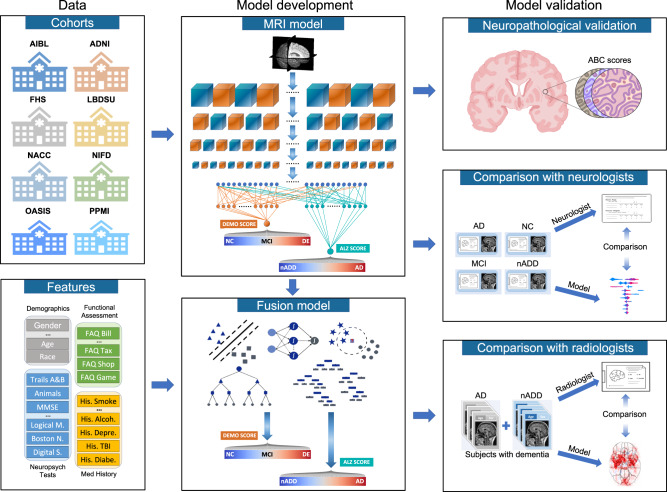
This paper develops and validates a staged deep learning framework to classify normal cognition, mild cognitive impairment, Alzheimer’s disease, and non-AD dementias from MRI and routinely collected clinical data. Across 8 cohorts (n = 8916), the fusion model performed best overall and was benchmarked against clinicians, neuropathology, and interpretability analyses.
Key findings
- The study included 8916 participants across 8 cohorts: 4550 NC, 2412 MCI, 1606 AD, and 348 with other dementias.
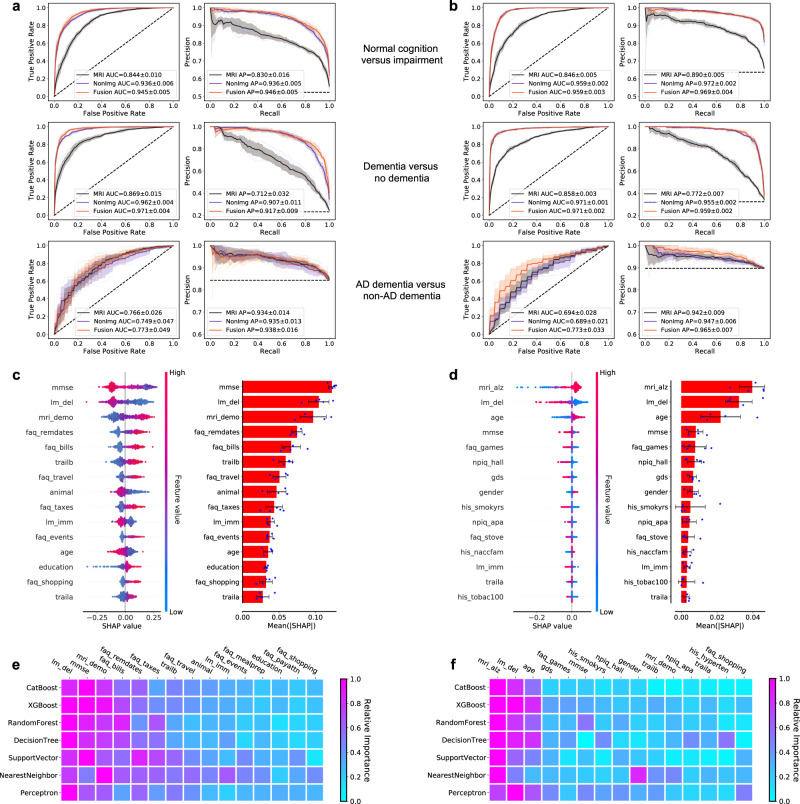
- The fusion model achieved strong discrimination for the staged tasks, including COGNC AUC 0.945 in NACC and 0.959 in OASIS; COGDE AUC 0.971 in both NACC and OASIS; and lower performance for the harder ADD task with AUC 0.773 in both NACC and OASIS.
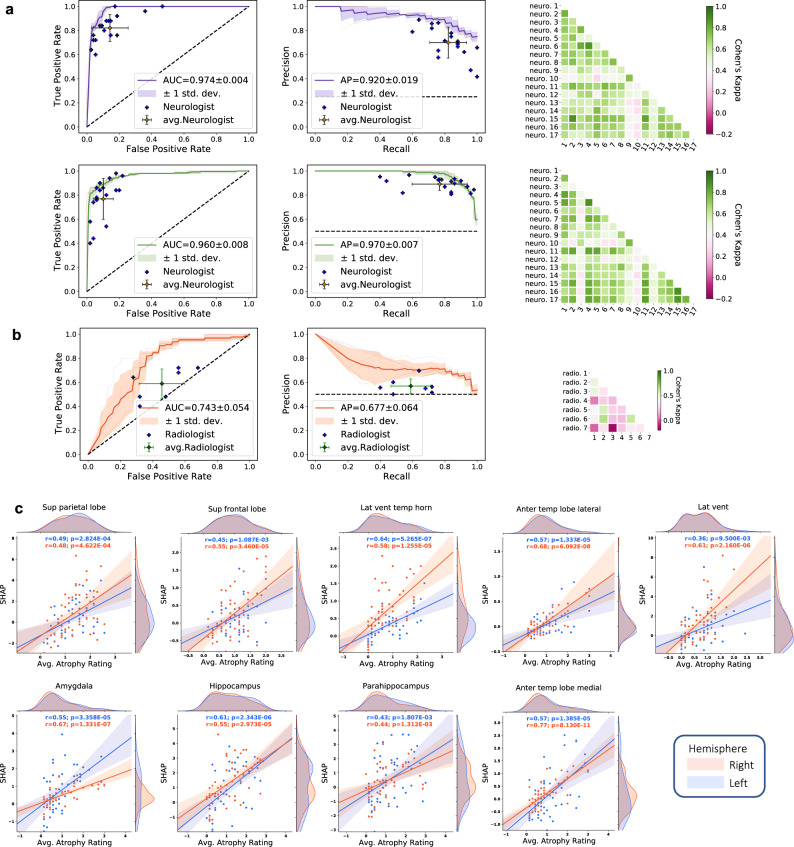
- In expert benchmarking, the fusion model’s overall 4-way accuracy was 0.558 (95% CI 0.482–0.634), reaching the level of neurologists (0.565, 95% CI 0.529–0.601); the MRI-only model improved over neuroradiologists on the ADD task (0.692 vs 0.566 accuracy).
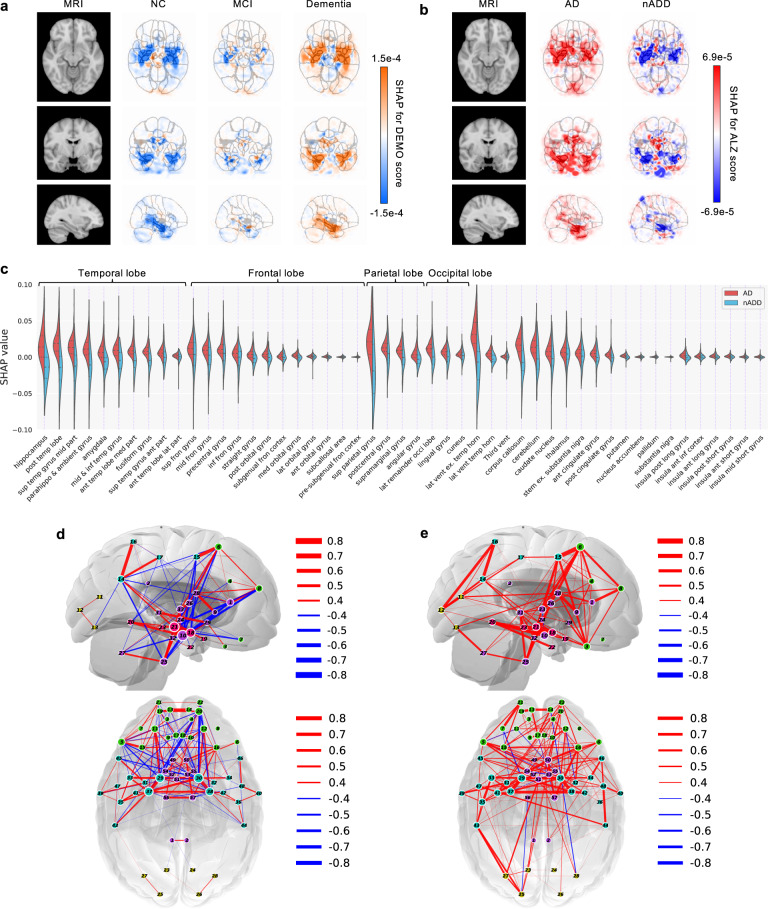
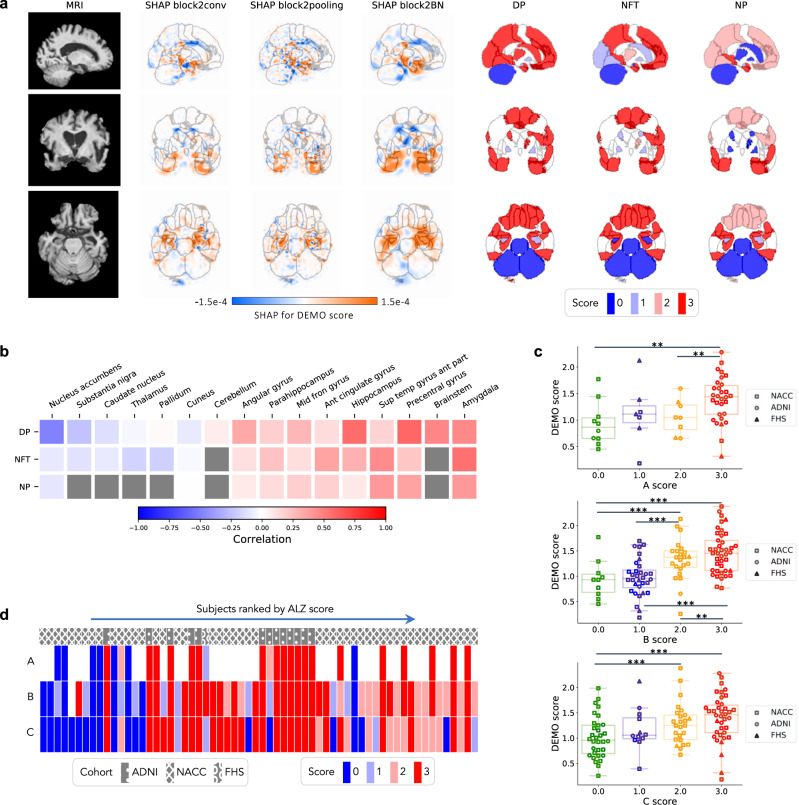
- Interpretability analyses linked model signals to known disease biology: SHAP-highlighted regions included the hippocampus, amygdala, and temporal lobes, and neuropathology validation found significant associations between DEMO scores and A, B, and C neuropathologic scores, with F(3,51)=3.665, p=1.813e-2 for A, F(3,102)=11.528, p=1.432e-6 for B, and F(3,103)=4.924, p=3.088e-3 for C.
Methods
- Multicohort retrospective development/validation study using deidentified MRI and clinical data from 8 cohorts; models were trained on NACC with 5-fold cross-validation and externally tested on other datasets, with some analyses restricted to NACC and OASIS because non-imaging data were available there.
- The authors built three model types: an MRI-only CNN, a non-imaging machine-learning model (best performing: CatBoost), and a fusion model combining CNN-derived scores with clinical variables; the framework was staged as COG (NC/MCI/dementia) followed by ADD (AD vs nADD).
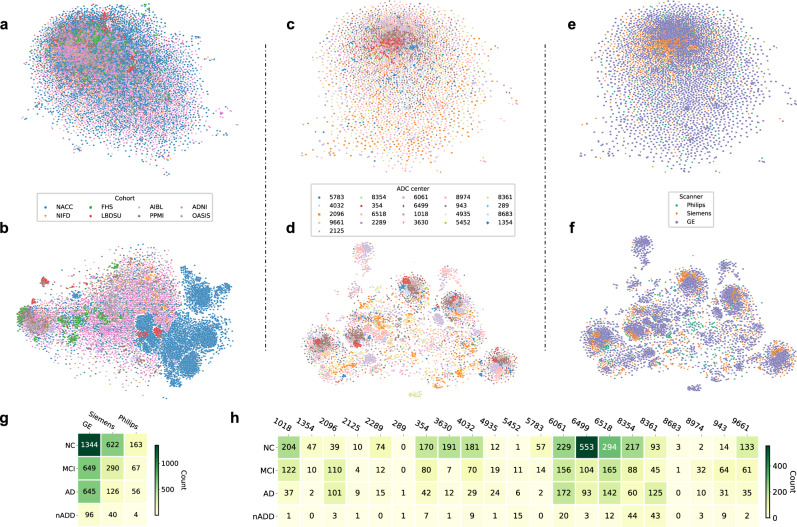
- Main analyses included AUC/AP performance evaluation, t-SNE and mutual information checks for confounding, SHAP for interpretability, neuropathologic validation in 110 participants with autopsy data, and head-to-head clinician comparisons with neurologists and neuroradiologists.
Limitations
- The paper states that in mixed dementia, the model defaults to AD when AD is present, so it does not perform multi-label classification for co-occurring dementias.
- The cohorts had no confirmed atypical AD cases, and the authors note that MCI is a broad category that was not subdivided into amnestic vs non-amnestic forms.
- Evident from the text: the non-imaging and fusion models were limited to NACC and OASIS because of missing non-imaging features in other cohorts, which may limit generalizability to settings with different data availability.
Model-written summary. Check it against the paper before relying on it.
Integrity signals
Registry
Cites
Statistics
Figures
Verification
Claims the paper makes
6 Valid · 2 Not valid · 3 Not checked · 97 Own results and interpretations
Every source the paper cites for this claim was checked and supports it.
In the paper
“we have previously reported interpretable deep learning approaches capable of distinguishing participants with age-appropriate normal cognition (NC) from those with AD using magnetic resonance imaging (MRI) scans, age, sex, and mini-mental state examination (MMSE)17.”
§ Multimodal deep learning for Alzheimer’s disease dementia assessment > Introduction
What the sources say
- Supportedcites [17] Qiu S Development and validation of an interpretable deep learning framework for Alzheimer’s disease classification Brain 2020 143 1920 1933 10.1093/brain/awaa137 32357201 PMC7296847 source
The Methods describe participants classified as having normal cognition or Alzheimer’s disease. The Results describe a fusion deep-learning model using MRI, age, gender and MMSE to classify disease status, while the Discussion describes how the model can associate MRI changes with regional neuropathology, supporting its interpretability. (LLM, conf=0.93)
plainstates an association- Asserted: passes — The authors put it forward as true.
- Checkable: passes — It can be checked against evidence.
- Load-bearing: unclear — It is unclear whether the paper’s conclusions depend on it.
- Based: passes — The paper gives a reason why it holds.
- Supported
The cited sources support only part of this claim — read each source’s verdict below.
In the paper
“Neuropathologic evaluations are considered to be the gold standard for confirming the presence and severity of neurodegenerative diseases50.”
§ Multimodal deep learning for Alzheimer’s disease dementia assessment > Methods > Neuropathologic validation
What the sources say
- Partly supportedcites [50] Besser LM The revised national Alzheimer’s coordinating center’s neuropathology form-available data and new analyses J. Neuropathol. Exp. Neurol. 2018 77 717 726 10.1093/jnen/nly049 29945202 PMC6044344 sourceExperimental — accuracy not yet measured
The Abstract calls neuropathologic evaluation the gold standard for determining the presence and severity of aging-related neurodegenerative diseases. The citing sentence omits “aging-related,” extending the statement beyond the scope specified in the source. (LLM, conf=0.85)
plain- Asserted: passes — The authors put it forward as true.
- Checkable: passes — It can be checked against evidence.
- Load-bearing: passes — The paper’s conclusions depend on it.
- Based: passes — The paper gives a reason why it holds.
- Partly supported
Every source the paper cites for this claim was checked and supports it.
In the paper
“Previously, we developed and externally validated an interpretable deep learning approach to classify AD using multimodal inputs of MRI and clinical variables17.”
§ Multimodal deep learning for Alzheimer’s disease dementia assessment > Discussion
What the sources say
- Supportedcites [17] Qiu S Development and validation of an interpretable deep learning framework for Alzheimer’s disease classification Brain 2020 143 1920 1933 10.1093/brain/awaa137 32357201 PMC7296847 source
The Results describe a fusion model that combines MRI-derived imaging features with clinical variables (age, gender and MMSE) to classify Alzheimer’s disease. The Introduction identifies AIBL, FHS and NACC as external test datasets, and the Discussion describes the model’s interpretable disease-risk colour maps. (LLM, conf=0.94)
plain- Asserted: passes — The authors put it forward as true.
- Checkable: passes — It can be checked against evidence.
- Load-bearing: passes — The paper’s conclusions depend on it.
- Based: passes — The paper gives a reason why it holds.
- Supported
A result the paper reports from its own data — it cites no other source for it, so there is none to check. The quote shows it is in the paper.
In the paper
“Importantly, however, the addition of MRI-derived DEMO and ALZ scores improved 4-way classification performance across all combinations of non-imaging variables (Figs. S4 and S5).”
§ Multimodal deep learning for Alzheimer’s disease dementia assessment > Results > Deep learning model performance
plainstates a cause- Asserted: passes — The authors put it forward as true.
- Checkable: passes — It can be checked against evidence.
- Load-bearing: passes — The paper’s conclusions depend on it.
- Based: passes — The paper gives a reason why it holds.
A result the paper reports from its own data — it cites no other source for it, so there is none to check. The quote shows it is in the paper.
In the paper
“Relative to the fusion model, we observed moderate performance reductions across classifications in our MRI-only model.”
§ Multimodal deep learning for Alzheimer’s disease dementia assessment > Results > Deep learning model performance
plainstates a cause- Asserted: passes — The authors put it forward as true.
- Checkable: passes — It can be checked against evidence.
- Load-bearing: passes — The paper’s conclusions depend on it.
- Based: passes — The paper gives a reason why it holds.
52 more claims
Create a free account to see all 108 claims and to verify the 4 references still open.
- It may state two separate claims as one. 28
- Probably not a substantial claim. 26
Claims other papers make about this one
Each is checked against this paper’s own text: does it say what the citing paper says it does?
The source backs part of the claim, not all of it — or backs it for a different population, condition or comparison.
In the citing paper
“Overall, AI’s integration into various facets of AD research holds promise for advancing our understanding of the disease. 614–618”
From Recent advances in Alzheimer's disease: Mechanisms, clinical trials and new drug development strategies. (2024) · cites this paper as [618]
Experimental — accuracy not yet measuredThe source backs part of the claim, not all of it — or backs it for a different population, condition or comparison.
In the citing paper
“AI is currently making preliminary explorations in various aspects of AD, from detection and diagnosis to understanding disease mechanisms, biomarker discovery, clinical trial design, drug discovery, and prognosis prediction.”
From Recent advances in Alzheimer's disease: Mechanisms, clinical trials and new drug development strategies. (2024) · cites this paper as [618]
Experimental — accuracy not yet measuredThe cited source says what the claim attributes to it.
In the citing paper
“A few studies have attempted to discern neuroimaging signatures unique to AD by contrasting them with other dementia types31–40.”
From AI-based differential diagnosis of dementia etiologies on multimodal data (2024) · cites this paper as [39]
The cited source says what the claim attributes to it.
In the citing paper
“Recently, we proposed a computational approach to stratify individuals based on cognitive status and discern likely AD cases from non-AD dementia types by incorporating imaging with non-imaging data such as demographics, medical histories and neuropsychological assessments39.”
From AI-based differential diagnosis of dementia etiologies on multimodal data (2024) · cites this paper as [39]
Statistics recomputed
Every reported test result, recomputed from its test statistic and degrees of freedom. A result shows as not adding up only once an independent check has confirmed it.
- ConsistentF(3, 51) = 3.665reported p = .01813 · recomputed p = .018
“F(3, 51) = 3.665, p = 1.813e-2”
- ConsistentF(3, 102) = 11.528reported p = .000001432 · recomputed p < .001
“F(3, 102) = 11.528, p = 1.432e-6”
- ConsistentF(3, 103) = 4.924reported p = .003088 · recomputed p = .003
“F(3, 103) = 4.924, p = 3.088e-3”
Self-check
Percentages, sums and reported differences re-computed from the paper’s own numbers.
Self-check results appear here once an independent check has confirmed them.
Citations
Cites
McKhann, G. M., Knopman, D. S., Chertkow, H., Hyman, B. T., Jack, C. R., Kawas, C. H., Klunk, W. E., Koroshetz, W. J., Manly, J. J., Mayeux, R., et al. (2011) · Alzheimer's & Dementia · doi:10.1016/j.jalz.2011.03.005 · Cited by 18,657
Neuropathological stageing of Alzheimer-related changes.
Braak, H., & Braak, E. (1991) · Acta Neuropathologica · doi:10.1007/bf00308809 · Cited by 16,123
17. A Value for n-Person Games
Shapley, L. S. (1953) · Contributions to the Theory of Games (AM-28), Volume II · doi:10.1515/9781400881970-018 · Cited by 6,950
The Alzheimer’s disease neuroimaging initiative (ADNI): MRI methods
Jack, C. R., Bernstein, M. A., Fox, N. C., Thompson, P., Alexander, G., Harvey, D., Borowski, B., Britson, P. J., L. Whitwell, J., Ward, C., et al. (2008) · Journal of Magnetic Resonance Imaging · doi:10.1002/jmri.21049 · Cited by 4,347
Phases of Aβ-deposition in the human brain and its relevance for the development of AD
Thal, D. R., Rüb, U., Orantes, M., & Braak, H. (2002) · Neurology · doi:10.1212/wnl.58.12.1791 · Cited by 3,490
Braak, H., Alafuzoff, I., Arzberger, T., Kretzschmar, H., & Del Tredici, K. (2006) · Acta Neuropathologica · doi:10.1007/s00401-006-0127-z · Cited by 3,172
Hyman, B. T., Phelps, C. H., Beach, T. G., Bigio, E. H., Cairns, N. J., Carrillo, M. C., Dickson, D. W., Duyckaerts, C., Frosch, M. P., Masliah, E., et al. (2012) · Alzheimer's & Dementia · doi:10.1016/j.jalz.2011.10.007 · Cited by 3,092
Alzheimer's Disease Neuroimaging Initiative (ADNI): Clinical characterization
Petersen, R. C., Aisen, P. S., Beckett, L. A., Donohue, M. C., Gamst, A. C., Harvey, D. J., Jack, C. R., Jagust, W. J., Shaw, L. M., Toga, A. W., et al. (2010) · Neurology · doi:10.1212/wnl.0b013e3181cb3e25 · Cited by 3,060
The antibody aducanumab reduces Aβ plaques in Alzheimer’s disease
Sevigny, J., Chiao, P., Bussière, T., Weinreb, P. H., Williams, L., Maier, M., Dunstan, R., Salloway, S., Chen, T., Ling, Y., et al. (2016) · Nature · doi:10.1038/nature19323 · Cited by 3,059
Montine, T. J., Phelps, C. H., Beach, T. G., Bigio, E. H., Cairns, N. J., Dickson, D. W., Duyckaerts, C., Frosch, M. P., Masliah, E., Mirra, S. S., et al. (2012) · Acta Neuropathologica · doi:10.1007/s00401-011-0910-3 · Cited by 2,894
Research works printed but not linked: 2
- Lundberg, S. M. & Lee, S.-I. A Unified Approach to Interpreting Model Predictions: in Proceedings of the 31st International Conference on Neural Information Processing Systems. 4768–4777 (2017).
- Weiner M Khachaturian Z The use of MRI and PET for clinical diagnosis of dementia and investigation of cognitive impairment: a consensus report Alzheimer’s Assoc. Chic., IL 2005 1 1 15
Cited by
Items 101–200 of 413
Alzheimer's disease detection using data fusion with a deep supervised encoder
Trinh, M., Shahbaba, R., Stark, C. E. L., & Ren, Y. (2024) · Frontiers in Dementia · doi:10.3389/frdem.2024.1332928 · Cited by 17
Ma, C., Li, J., Chi, Y., Sun, X., Yang, M., & Sui, X. (2023) · Frontiers in Aging Neuroscience · doi:10.3389/fnagi.2023.1161068 · Cited by 12
Baharoon, M., Almatar, H., Alduhayan, R., Aldebasi, T. M., Alahmadi, B., Bokhari, Y., Alawad, M., Almazroa, A. A., & Aljouie, A. (2024) · Bioengineering · doi:10.3390/bioengineering11111080 · Cited by 25
Jomeiri, A., Navin, A. H., & Shamsi, M. (2025) · Computers in Biology and Medicine · doi:10.1016/j.compbiomed.2025.111065 · Cited by 21
Timofeeva, A. M., Aulova, K. S., & Nevinsky, G. A. (2025) · Brain Sciences · doi:10.3390/brainsci15050486 · Cited by 18
Fan, F., Song, H., Jiang, J. C., He, H., Sun, D. B., Xu, Z., Peng, S., Zhang, R., Li, T., Cao, J., et al. (2024) · iScience · doi:10.1016/j.isci.2024.110945 · Cited by 14
Machine learning approaches in comparative studies for Alzheimer’s diagnosis using 2D MRI slices
Zhao, Z., Chuah, J. H., Chow, C., Xia, K., Tee, Y. K., Hum, Y. C., & Lai, K. W. (2024) · TURKISH JOURNAL OF ELECTRICAL ENGINEERING & COMPUTER SCIENCES · doi:10.55730/1300-0632.4057 · Cited by 14
Liu, S., Zheng, Y., Li, H., Pan, M., Fang, Z., Liu, M., Qiao, Y., Pan, N., Jia, W., & Ge, X. (2023) · Neuroscience · doi:10.1016/j.neuroscience.2023.09.003 · Cited by 13
Robust Fusion of Time Series and Image Data for Improved Multimodal Clinical Prediction
Rasekh, A., Heidari, R., Rezaie, A. H. H. M., Sedeh, P. S., Ahmadi, Z., Mitra, P., & Nejdl, W. (2024) · IEEE Access · doi:10.1109/access.2024.3497668 · Cited by 24
Robust multi-modal fusion architecture for medical data with knowledge distillation
Wang, M., Fan, S., Li, Y., Gao, B., Xie, Z., & Chen, H. (2024) · Computer Methods and Programs in Biomedicine · doi:10.1016/j.cmpb.2024.108568 · Cited by 19
Massoud, M. A., El-Bouridy, M. E., & Ahmed, W. A. (2024) · Neural Computing and Applications · doi:10.1007/s00521-024-09859-9 · Cited by 12
Bit, S., Dey, P., Maji, A., Initiative, A. D. N., & Khan, T. K. (2024) · Journal of Alzheimer s Disease Reports · doi:10.1177/25424823241290694 · Cited by 16
Explainable Machine Learning Models for Brain Diseases: Insights from a Systematic Review
Mallma, M. J. R., Zuloaga-Rotta, L., Borja-Rosales, R., Mallma, J. R. R., Vilca-Aguilar, M., Salas-Ojeda, M., & Mauricio, D. (2024) · Neurology International · doi:10.3390/neurolint16060098 · Cited by 15
Di, X. S., Yin, Y., Fu, Y., Mo, Z., Lo, S., DiGuiseppi, C. G., Eby, D. W., Hill, L. L., Mielenz, T. J., Strogatz, D. S., et al. (2023) · Artificial Intelligence in Medicine · doi:10.1016/j.artmed.2023.102510 · Cited by 18
Hybrid Classical and Quantum Deep Learning Models for Medical Image Classification
Mazher, M., Qayyum, A., Khan, M. K. A. A., Niederer, S., Mokayef, M., Hassan, C. S., & Ridzuan, A. (2024) · Proceedings of International Conference on Artificial Life and Robotics · doi:10.5954/icarob.2024.os7-4 · Cited by 12
Huh, Y. J., Park, J.-H., Kim, Y. J., & Kim, K. G. (2025) · Sensors · doi:10.3390/s25092881 · Cited by 12
Viswan, V., Shaffi, N., Malathy, E., Selvi, G. C., Kavitha, B. R., Abdesselam, A., Wang, S., Suganthan, P. N., Shezawi, I. A., & Mahmud, M. (2026) · Brain Informatics · doi:10.1186/s40708-025-00291-w · Cited by 25
Insights Into Detecting Adult ADHD Symptoms Through Advanced Dual-Stream Machine Learning
Nash, C., Nair, R., & Naqvi, S. M. (2024) · IEEE Transactions on Neural Systems and Rehabilitation Engineering · doi:10.1109/tnsre.2024.3450848 · Cited by 17
FuseNet: Attention-learning based MRI–PET slice fusion for Alzheimer’s diagnosis
Sharma, R., Al‐Dhaifallah, M., & Shakoor, A. (2025) · Computers & Electrical Engineering · doi:10.1016/j.compeleceng.2025.110556 · Cited by 15
Sárkány, Z., Damásio, J., Macedo‐Ribeiro, S., & Martins, P. M. (2025) · Alzheimer s & Dementia · doi:10.1002/alz.70213 · Cited by 10
Huang, L., Li, Z., Zhu, X., Zhao, H. Y., Mao, C., Ke, Z., Mo, Y., Yang, D., Cheng, Y., Qin, R., et al. (2025) · npj Digital Medicine · doi:10.1038/s41746-025-01813-w · Cited by 17
Weijler, L., Kowarsch, F., Reiter, M., Hermosilla, P., Maurer‐Granofszky, M., & Dworzak, M. N. (2024) · IEEE Winter Conference on Applications of Computer Vision · doi:10.1109/wacv57701.2024.00777 · Cited by 14
Alam, M. S. B., Lameesa, A., Sharmin, S., Afrin, S., Ahmed, S. F., Nikoo, M. R., & Gandomi, A. H. (2025) · Digital Communications and Networks · doi:10.1016/j.dcan.2025.04.001 · Cited by 9
Zhao, H., Miao, C., Zhu, Y., Shu, Y., Wu, X., Yin, Z., Deng, X., Gong, W., Yang, Z., & Zou, W. (2025) · BMC Cancer · doi:10.1186/s12885-025-14462-9 · Cited by 14
Fan, L., Zhang, J., Wang, F., Liu, S., & Lin, T. (2023) · Aging Clinical and Experimental Research · doi:10.1007/s40520-023-02461-4 · Cited by 9
Cognitive Handwriting Insights for Alzheimer’s Diagnosis: A Hybrid Framework
Rehman, S. U., & Mitra, U. (2025) · Information · doi:10.3390/info16030249 · Cited by 12
Multimodal fusion architectures for Alzheimer’s disease diagnosis: An experimental study
Leony, F., & Lin, C. (2025) · Journal of Biomedical Informatics · doi:10.1016/j.jbi.2025.104834 · Cited by 11
Aqil, K. H., Dumpuri, P., Ram, K., & Sivaprakasam, M. (2024) · Intelligence-Based Medicine · doi:10.1016/j.ibmed.2024.100159 · Cited by 13
A distributed privacy preserving model for the detection of Alzheimer’s disease
Mandal, P. K. (2024) · Neural Computing and Applications · doi:10.1007/s00521-024-10419-4 · Cited by 15
Small-molecule fluorescence probes for biomarkers of Alzheimer's disease
Wang, J., Shao, X., Wang, C., Wu, S., Bai, M., Zhang, P., Tang, S., Zhang, N., Wang, X., Yang, Z. Y., et al. (2025) · Biosensors and Bioelectronics · doi:10.1016/j.bios.2025.117722 · Cited by 15
Multimodal Federated Learning in Healthcare: A Review
Thrasher, J., Devkota, A., Siwakoti, P., Chivukula, R., Poudel, P., Hu, C., Tafti, A. P., Bhattarai, B., & Gyawali, P. (2025) · Journal of Healthcare Informatics Research · doi:10.1007/s41666-025-00226-4 · Cited by 65
Lee, G.-B., Jeong, Y.-J., Kang, D., Yun, H.-J., & Yoon, M. (2024) · PLoS ONE · doi:10.1371/journal.pone.0315809 · Cited by 10
Chen, J., Zhong, Y., Huang, Q., Huang, C., Jiang, F., Huang, X., & Wang, X. (2025) · IEEE Transactions on Affective Computing · doi:10.1109/taffc.2025.3606964 · Cited by 21
Hierarchical Attention Learning for Multimodal Classification
Zou, X. G., Tang, C., Zhang, W., Sun, K., & Jiang, L. (2023) · IEEE International Conference on Multimedia and Expo (ICME) · doi:10.1109/icme55011.2023.00165 · Cited by 19
Lennon, M. J., Karvelas, N., Ganesh, A., Whitehead, S. N., Sorond, F. A., Laforet, V. D., Head, E., Arfanakis, K., Kolachalama, V. B., Liu, X., et al. (2025) · GeroScience · doi:10.1007/s11357-025-01746-y · Cited by 15
Self-citationMultimodal AI for Alzheimer Disease Diagnosis: Systematic Review of Datasets, Models, and Modalities
Yu, Z., Mulholland, A. J., Huang, T., & Liu, Q. (2026) · Journal of Medical Internet Research · doi:10.2196/85414 · Cited by 23
Sun, J., Han, J. J., & Chen, W. (2024) · Scientific Reports · doi:10.1038/s41598-024-78712-9 · Cited by 10
Liu, Y., Qingsheng, G., & Zheng, C. (2025) · International Journal of Digital Earth · doi:10.1080/17538947.2025.2497490 · Cited by 11
Bayahya, A. Y., Banjar, H. R., Talabay, O., & Alamri, S. H. (2025) · Scientific Reports · doi:10.1038/s41598-025-27914-w · Cited by 10
Explainable AI for time series prediction in economic mental health analysis
Yang, Y. Z., Wen, L., & Li, L. (2025) · Frontiers in Medicine · doi:10.3389/fmed.2025.1591793 · Cited by 9
RetractedImproving clinical efficiency in screening for cognitive impairment due to Alzheimer's
Ren, Y., Shahbaba, B., & Stark, C. E. L. (2023) · Alzheimer s & Dementia Diagnosis Assessment & Disease Monitoring · doi:10.1002/dad2.12494 · Cited by 11
A systematic review on dysphagia treatments for persons living with dementia
Chan, C. T. W., Wu, T. Y., & Cheng, I. (2024) · European Geriatric Medicine · doi:10.1007/s41999-024-01107-6 · Cited by 8
Disease‐driven domain generalization for neuroimaging‐based assessment of Alzheimer's disease
Lteif, D., Sreerama, S., Bargal, S. A., Plummer, B. A., Au, R., & Kolachalama, V. B. (2024) · Human Brain Mapping · doi:10.1002/hbm.26707 · Cited by 14
Self-citationShimbre, N., & Solanki, R. K. (2025) · EPJ Web of Conferences · doi:10.1051/epjconf/202532801059 · Cited by 9
MAFT-SO: A novel multi-atlas fusion template based on spatial overlap for ASD diagnosis
Ma, Y., Mu, X., Zhang, T., & Zhao, Y. (2024) · Journal of Biomedical Informatics · doi:10.1016/j.jbi.2024.104714 · Cited by 9
Prioritization of genes for translation: a computational approach
Rosa, S. C. D. S., Behrooz, A. B., Guedes, S. D. M., Vitorino, R. M. P., & Ghavami, S. (2024) · Expert Review of Proteomics · doi:10.1080/14789450.2024.2337004 · Cited by 7
Gu, Y., Saito, K., & Ma, J. (2025) · Lecture notes in computer science · doi:10.1007/978-3-032-05182-0_28 · Cited by 19
Fan, X., Initiative, A. D. N., Li, H., Liu, L., Zhang, K., Zhang, Z., Chen, Y., Wang, Z., He, X., Xu, J., et al. (2023) · Journal of Alzheimer s Disease · doi:10.3233/jad-230705 · Cited by 12
A vision–language foundation model for Alzheimer's disease diagnosis using MRI and clinical data
Lin, P.-J., Jiang, Z., Liu, Y., Li, W., Qi, Y., Sun, J., Ni, S., Shu, L., Xia, M., Toga, A. W., et al. (2025) · Alzheimer s & Dementia · doi:10.1002/alz.71029 · Cited by 11
Zhang, Y.-H., Zhao, P., Gao, H., Zhong, M., & Li, J. (2024) · Journal of Alzheimer s Disease · doi:10.3233/jad-231389 · Cited by 9
A Bayesian network combiner for multimodal handwriting analysis in Alzheimer’s disease detection
Nardone, E., D’Alessandro, T., Stefano, C. D., Fontanella, F., & di Freca, A. S. (2025) · Pattern Recognition Letters · doi:10.1016/j.patrec.2025.02.019 · Cited by 7
Liu, Y., Liu, M., Zhang, Y., Sun, K., & Shen, D. G. (2024) · Lecture notes in computer science · doi:10.1007/978-3-031-78761-4_12 · Cited by 7
Jiang, S., Tian, Z., Yang, Y., Li, X., Zhou, F., Cheng, J., Lyu, J., Gao, T., Zhang, P., Han, H., et al. (2025) · Acta Pharmaceutica Sinica B · doi:10.1016/j.apsb.2025.08.015 · Cited by 6
Multimodal Medical Image Feature Representation and Fusion for AD Early Diagnosis
Qu, J., Qu, Y., Bai, X., Xu, L., Wang, H., & Liu, G. (2024) · IEEE International Conference on Bioinformatics and Biomedicine (BIBM) · doi:10.1109/bibm62325.2024.10822255 · Cited by 6
Jia, K., Shen, D., Zhao, Y., Liu, H., Xiong, C., Chen, X., & Nie, Z. (2026) · TrAC Trends in Analytical Chemistry · doi:10.1016/j.trac.2026.118705 · Cited by 6
Unified Multi-modal Learning for Any Modality Combinations in Alzheimer's Disease Diagnosis
Feng, Y., Gao, B., Deng, S., Qiu, A.-Q., & Qin, J. (2024) · International Conference on Medical Image Computing and Computer-Assisted Intervention · doi:10.1007/978-3-031-72384-1_46 · Cited by 8
Tang, A. S., Rankin, K., Cerono, G., Miramontes, S., Mills, H., Roger, J. M., Zeng, B., Nelson, C., Soman, K., Woldemariam, S., et al. (2023) · medRxiv · doi:10.1101/2023.03.14.23287224 · Cited by 2
Özkan, D., KATAR, O., Ak, M., Al–antari, M. A., Ak, N. Y., Yıldırım, Ö., Mir, H., Tan, R., & Acharya, U. R. (2024) · IEEE Access · doi:10.1109/access.2024.3454709 · Cited by 9
Explainable artificial intelligence for neuroimaging-based dementia diagnosis and prognosisPreprint
Martin, S. A., Zhao, A., Qu, J., Imms, P. E., Andrei Irimia, A., Barkhof, F., Cole, J. H., & Initiative, T. A. D. N. (2025) · medRxiv · doi:10.1101/2025.01.13.25320382 · Cited by 6
Zhou, W., Wang, Y., Yz, W., Li, X., Liu, H., Wang, H., Zhang, Z., & Huang, H. (2026) · Digital Health · doi:10.1177/20552076251412649 · Cited by 13
Self-citationLocally similar multi-hop fusion GNNs with data augmentation for early Alzheimer’s detection
Li, G., Zhang, Y., Song, X., Yang, P., Dong, L., Huang, Y., Xiao, X., Wang, T., Wang, S., & Lei, B. (2025) · Expert Systems with Applications · doi:10.1016/j.eswa.2025.128333 · Cited by 7
SMAS: Structural MRI-based AD Score using Bayesian supervised VAE
Nemali, A., Bernal, J., Yakupov, R., Singh, D., Dyrba, M., Incesoy, E. I., Mukherjee, S., Peters, O., Ersözlü, E., Hellmann‐Regen, J., et al. (2025) · Computers in Biology and Medicine · doi:10.1016/j.compbiomed.2025.110829 · Cited by 4
Ren, J., Tian, D., Zheng, H., Wang, G., & Li, Z. (2025) · Agronomy · doi:10.3390/agronomy15061279 · Cited by 4
Xu, Z., Liu, A., Su, B., Wu, M., Zhang, B., Chen, G., Lü, F., Hu, L., & Mao, X. (2025) · Translational Vision Science & Technology · doi:10.1167/tvst.14.8.16 · Cited by 5
PED: a novel predictor-encoder-decoder model for Alzheimer drug molecular generation
Liu, D., Song, T., Na, K., & Wang, S. (2024) · Frontiers in Artificial Intelligence · doi:10.3389/frai.2024.1374148 · Cited by 6
Early-Stage Alzheimer’s Disease Prediction Using Deep Learning: A 3D CNN Approach
Bhargava, C. P., Khatri, P., & Gupta, D. (2025) · IEEE International Conference on Intelligent Signal Processing and Effective Communication Technologies (INSPECT) · doi:10.1109/inspect67393.2025.11350915 · Cited by 7
Zhang, Y., Guo, C., Chen, Y., Lv, Z., & Li, Q. (2024) · IEEE International Conference on Acoustics Speech and Signal Processing · doi:10.1109/icassp48485.2024.10448042 · Cited by 4
Multi-Modal Deep Feature Integration for Alzheimer's Disease Staging
Singh, A., Shi, W., & Wang, M. D. (2023) · IEEE International Conference on Bioinformatics and Biomedicine (BIBM) · doi:10.1109/bibm58861.2023.10431906 · Cited by 6
Shehu, M., Malhotra, N., Singh, A. K., Awadelkarim, A. M., Ahmed, S., & Potharaju, S. P. (2025) · Informatics in Medicine Unlocked · doi:10.1016/j.imu.2025.101668 · Cited by 7
Song, F., Li, Y., Jiang, M., Li, K., Zhang, J., Zhang, Y., & Pang, Z. (2025) · IEEE Journal of Biomedical and Health Informatics · doi:10.1109/jbhi.2025.3531419 · Cited by 5
MFISN: Modality Fuzzy Information Separation Network for Disease Classification
Nan, F., Pu, B., Pan, J., Fan, Y., Yang, J., Dong, X., Xu, Z., & Wang, S. (2024) · IEEE Transactions on Fuzzy Systems · doi:10.1109/tfuzz.2024.3371678 · Cited by 4
Longitudinal dementia trajectories for Alzheimer’s Disease characterization and prediction
de Mori, A., & Tauber, C. (2025) · Computers in Biology and Medicine · doi:10.1016/j.compbiomed.2025.110241 · Cited by 5
Artificial Intelligence for Personalized Care, Wellness, and Longevity Research
Shaban‐Nejad, A., Michalowski, M., & Bianco, S. (2023) · Studies in computational intelligence · doi:10.1007/978-3-031-36938-4_1 · Cited by 4
Arvidsson, I., Strandberg, O. T., Palmqvist, S., Stomrud, E., Cullen, N. C., Janelidze, S., Tideman, P., Heyden, A., Åström, K., Hansson, O., et al. (2024) · Alzheimer s Research & Therapy · doi:10.1186/s13195-024-01428-5 · Cited by 7
Synthetic lumbar MRI can aid in diagnosis and treatment strategies based on self-pix networks
Song, K., Zhu, W., Zhang, Z.-X., Liu, B., Zhang, M., Tang, T., Liang, J., & Wu, W. (2024) · Scientific Reports · doi:10.1038/s41598-024-71288-4 · Cited by 3
Attention-Based Dual-Knowledge Distillation for Alzheimer’s Disease Stage Detection Using MRI Scans
Barman, C., Singh, S., Saikia, M. J., & Barma, S. (2025) · IEEE Open Journal of Instrumentation and Measurement · doi:10.1109/ojim.2025.3589698 · Cited by 4
Self-supervised learning for early detection of neurodegenerative diseases with small data
Jiang, H. (2023) · DR-NTU (Nanyang Technological University) · doi:10.32657/10356/166402 · Cited by 9
Empowering scientific discovery with explainable small domain-specific and large language models
Yu, H., Wang, Y., Cheng, T., Yan, Y., Dawson, K. A., Li, S. F. Y., Zheng, Y., & Jin, Y. (2025) · Artificial Intelligence Review · doi:10.1007/s10462-025-11365-w · Cited by 5
Self-citationPredicting Quality Medical Drug Data Towards Meaningful Data using Machine Learning
Al-Showarah, S., Al-Taie, A., Salman, H. E., Alzyadat, W., & Alkhalaileh, M. S. (2023) · International Journal of Advanced Computer Science and Applications · doi:10.14569/ijacsa.2023.01408114 · Cited by 4
Scuteri, D., Adornetto, C., Greco, G., Nicotera, P., Bagetta, G., & Corasaniti, M. T. (2025) · Current Opinion in Pharmacology · doi:10.1016/j.coph.2025.102563 · Cited by 3
Multi-model deep learning for dementia detection: addressing data and model limitations
Bayahya, A. Y., Jammal, F., Banjar, H. R., Eassa, F. E., Talabay, O., & Alamri, S. H. (2025) · Frontiers in Neuroscience · doi:10.3389/fnins.2025.1638022 · Cited by 8
Tan, Q., Zhou, D., Guo, Y., Chen, H., & Xie, P. (2024) · Aging · doi:10.18632/aging.206146 · Cited by 6
Wei, H., Wu, C., Yuan, Y., & Lai, L. (2023) · Frontiers in Aging Neuroscience · doi:10.3389/fnagi.2023.1249682 · Cited by 3
“, traditional physical examinations, neuropsychological testing, and magnetic resonance imaging (MRI; Qiu et al., 2022).”
BackgroundTao, H., Chen, G., Wu, L., & Lou, H. (2025) · BMC Public Health · doi:10.1186/s12889-025-22863-5 · Cited by 3
Advancing Alzheimer's Disease Diagnosis Using VGG19 and XGBoost: A Neuroimaging-Based Method
Boudi, A., He, J., Kader, I. A. E., Liu, X., & Mouhafid, M. (2025) · Current Alzheimer Research · doi:10.2174/0115672050393604250904081342 · Cited by 3
Bracher‐Smith, M., & Escott‐Price, V. (2025) · Molecular Psychiatry · doi:10.1038/s41380-025-03330-4 · Cited by 7
Multimodal Multi-Graph Fusion Learning for Alzheimer’s Disease Diagnosis
Dong, A., Cai, Y., Wang, L., Xu, J., Lv, G., & Zhao, G. (2025) · IEEE Transactions on Multimedia · doi:10.1109/tmm.2025.3623553 · Cited by 5
Shin, H.-J., Yoon, H., Kim, S., & Kang, D. (2022) · Applied Sciences · doi:10.3390/app12157355 · Cited by 5
Enhanced diagnostic interpretation of the MoCA using machine learning
Gourdeau, C., Gourdeau, C. L., Bernier, P. J., & Laforce, R. J. (2026) · Frontiers in Neuroscience · doi:10.3389/fnins.2026.1679649 · Cited by 5
Enhanced diagnosis of osteoporosis using vision transformer with lumbar MRI
Wang, W.-B., Li, D., Luo, F., Zeng, W., Dan, Q., Dai, C.-Z., Hu, Y.-Q., & Zhong, J. (2025) · BMC Medical Imaging · doi:10.1186/s12880-025-01960-2 · Cited by 3
Martin, S., Zhao, A., Qu, J., Imms, P. E., Irimia, A., Barkhof, F., Cole, J. H., & Initiative, A. D. N. (2026) · Human Brain Mapping · doi:10.1002/hbm.70456 · Cited by 18
Ibrahim, N., Elrefaei, L. A., & Abdel-Ghaffar, E. A. (2025) · doi:10.1109/iceeng64546.2025.11031257 · Cited by 3
Abyadeh, M., & Kaya, A. (2025) · Journal of Central Nervous System Disease · doi:10.1177/11795735251336302 · Cited by 6
Yongcharoenchaiyasit, K., Arwatchananukul, S., Hristov, G., & Temdee, P. (2025) · Bioengineering · doi:10.3390/bioengineering12060592 · Cited by 4
Woods, C., Xing, X., Khanal, S., & Lin, A. (2024) · Bioengineering · doi:10.3390/bioengineering11090943 · Cited by 5
Cong, S., Fan, Z., Liu, H., Zhang, Y., Wang, X. Y., Luo, H., & Yao, X. (2024) · IEEE International Conference on Bioinformatics and Biomedicine (BIBM) · doi:10.1109/bibm62325.2024.10822319 · Cited by 4
Farha, R., Ojeme, B., Khalifa, F., & Rahman, M. M. (2026) · Journal of dementia and Alzheimer's disease · doi:10.3390/jdad3020026 · Cited by 6
Metadata
- Authors
- Qiu, S., Miller, M. I., Joshi, P. S., Lee, J. C., Xue, C., Ni, Y., Wang, Y., De Anda-Duran, I., Hwang, P. H., Cramer, J. A., Dwyer, B. C., Hao, H., Kaku, M. C., Kedar, S., Lee, P. H., Mian, A. Z., Murman, D. L., O’Shea, S., Paul, A. B., Saint-Hilaire, M.-H., Alton Sartor, E., Saxena, A. R., Shih, L. C., Small, J. E., Smith, M. J., Swaminathan, A., Takahashi, C. E., Taraschenko, O., You, H., Yuan, J., Zhou, Y., Zhu, S., Alosco, M. L., Mez, J., Stein, T. D., Poston, K. L., Au, R., & Kolachalama, V. B.
- Affiliations
- Boston University (US)
- University of Nebraska Medical Center (US)
- Chinese Academy of Medical Sciences & Peking Union Medical College (CN)
- Emory University (US)
- Lahey Hospital and Medical Center (US)
- Stanford University (US)
- Corresponding author
- Kolachalama, Vijaya B.
- ORCID
- Qiu, Shangran
- Miller, Matthew I.
- Joshi, Prajakta S.
- Wang, Yuwei
- De Anda-Duran, Ileana
- Hwang, Phillip H.
- Cramer, Justin A.
- Dwyer, Brigid C.
- Hao, Honglin
- Kaku, Michelle C.
- Kedar, Sachin
- Mian, Asim Z.
- Murman, Daniel L.
- O’Shea, Sarah
- Saxena, Aneeta R.
- Shih, Ludy C.
- Small, Juan E.
- Swaminathan, Arun
- Takahashi, Courtney E.
- Taraschenko, Olga
- You, Hui
- Yuan, Jing
- Zhou, Yan
- Zhu, Shuhan
- Alosco, Michael L.
- Mez, Jesse
- Stein, Thor D.
- Poston, Kathleen L.
- Au, Rhoda
- Kolachalama, Vijaya B.
- Venue
- Nature Communications
- Published
- 2022-06-20
- Volume
- 13
- Issue
- 1
- Pages
- 3404-3404
- ISSN
- 2041-1723 (ISSN-L)
- PMC
- PMC9209452
- OpenAlex
- W4283156058
- Semantic Scholar
- 7a60758ef1185fb82b74715813d9c2a8f5d3fa16
- Cited by
- 420
- References
- 53
- Citations by year
- 2026: 126 · 2025: 125 · 2024: 111 · 2023: 52 · 2022: 6
- FWCI
- 47.92
- Type
- journal article
- Language
- en
- Open access
- gold
- doi.org
- Licence
- cc-by
- creativecommons.org/licenses/by/4.0 (tdm)
- creativecommons.org/licenses/by/4.0 (vor)
- Locations
- Nature Communications (publishedVersion, cc-by)
- PubMed Central (publishedVersion, cc-by)
- PubMed (publishedVersion)
- RePEc: Research Papers in Economics (submittedVersion)
- DOAJ (DOAJ: Directory of Open Access Journals) (submittedVersion, cc-by-sa)
- Funders
- Michael J. Fox Foundation for Parkinson's Research
- American Heart Association (20SFRN35460031)
- Alzheimer's Drug Discovery Foundation
- Demensförbundet
- Lewy Body Dementia Association
- Karen Toffler Charitable Trust
- National Institutes of Health (1r21ca253498-01, 1r56ag062109-01)
- National Institute on Aging (R56-AG062109, R01AG054076, R01AG033040, RF1AG062109, R01AG016495, RF1AG072654, P30AG013846, U19AG065156, U19AG068753, R01AG072654, P30AG066515, P30AG066546)
- National Heart, Lung, and Blood Institute (R01HL159620)
- National Cancer Institute (R21‐CA253498)
- National Institute of Neurological Disorders and Stroke (K23NS075097, R01NS115114)
- Topics
- Health Sciences › Medicine › Psychiatry and Mental health › Dementia and Cognitive Impairment Research
- Health Sciences › Health Professions › Health Information Management › Artificial Intelligence in Healthcare
- Physical Sciences › Computer Science › Artificial Intelligence › Machine Learning in Healthcare
- Keywords
- Alzheimer's disease, dementia diagnosis, mild cognitive impairment, multimodal deep learning, neuroimaging, neuropsychological assessment, clinical data integration, interpretability, autopsy neuropathology, cognitive impairment classification, diagnostic accuracy
- MeSH terms
- Deep Learning, Alzheimer Disease, Humans, Disease Progression, Neuroimaging, Cognitive Dysfunction
About these checks
Registry, retraction, Cites and statistics results are computed, not judged, with one exception: a printed reference that no index lists is read once by a model before it counts as a citation error. Claims are extracted by a model and kept only when their quote appears verbatim in the text; each cited source is then checked, with a model’s help, for whether it says what the claim relies on. Those verdicts can be wrong — read the claim’s quote and the cited source before relying on one.
The claim verdicts this report counts are experimental: their accuracy is not yet measured.
A language model drew the claims from the paper on 2026-10-10, under version 3 of the claim definition (model deepseek-v4.1-flash, prompt extract-v3).
A second model labelled each claim on 2026-10-10 (model jev-1.13-20260917, definition revision gold-guideline-v0.2).
Cited sources are checked with a language model’s help (gpt-6-sol).
Statistics and arithmetic are recomputed, not judged.
Confidence bands are shown only for fields calibrated on our annotated test set. None is calibrated yet, so no band is shown.
What counts as a claim ›How we measure confidence ›How we check this ›
Are you an author, or do you see a problem with this page? Request a review
Data sources
Bibliographic data: Semantic Scholar, OpenAlex, Crossref.
Contains information from the Semantic Scholar Academic Graph Datasets, made available under the ODC Attribution License (ODC-BY 1.0).
Semantic Scholar’s data is described in: Kinney, R., et al. (2023). The Semantic Scholar Open Data Platform. arXiv:2301.10140.
