

Multimodal deep learning for Alzheimer's disease dementia assessment
Open accessThe DOI matches its Crossref record; 53 of the 53 references it cites were found in a registry or an index; 12 of the 20 sources its claims cite were checked for support.
Abstract
Worldwide, there are nearly 10 million new cases of dementia annually, of which Alzheimer's disease (AD) is the most common. New measures are needed to improve the diagnosis of individuals with cognitive impairment due to various etiologies. Here, we report a deep learning framework that accomplishes multiple diagnostic steps in successive fashion to identify persons with normal cognition (NC), mild cognitive impairment (MCI), AD, and non-AD dementias (nADD). We demonstrate a range of models capable of accepting flexible combinations of routinely collected clinical information, including demographics, medical history, neuropsychological testing, neuroimaging, and functional assessments. We then show that these frameworks compare favorably with the diagnostic accuracy of practicing neurologists and neuroradiologists. Lastly, we apply interpretability methods in computer vision to show that disease-specific patterns detected by our models track distinct patterns of degenerative changes throughout the brain and correspond closely with the presence of neuropathological lesions on autopsy. Our work demonstrates methodologies for validating computational predictions with established standards of medical diagnosis.
Overview
CoChat Summary
TL;DR
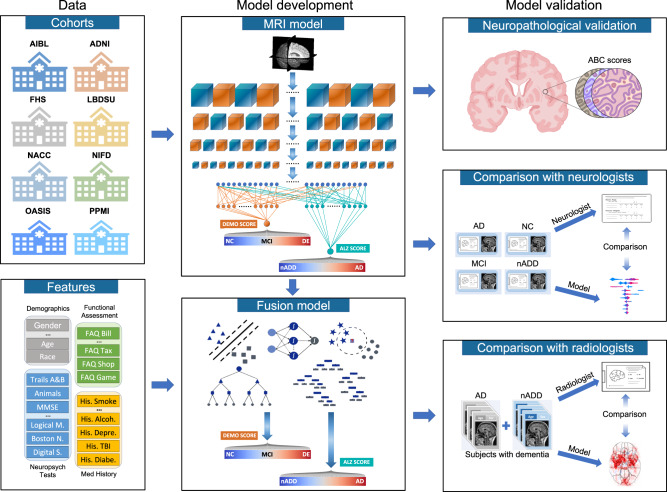
This paper develops and validates a staged deep learning framework to classify normal cognition, mild cognitive impairment, Alzheimer’s disease, and non-AD dementias from MRI and routinely collected clinical data. Across 8 cohorts (n = 8916), the fusion model performed best overall and was benchmarked against clinicians, neuropathology, and interpretability analyses.
Key findings
- The study included 8916 participants across 8 cohorts: 4550 NC, 2412 MCI, 1606 AD, and 348 with other dementias.
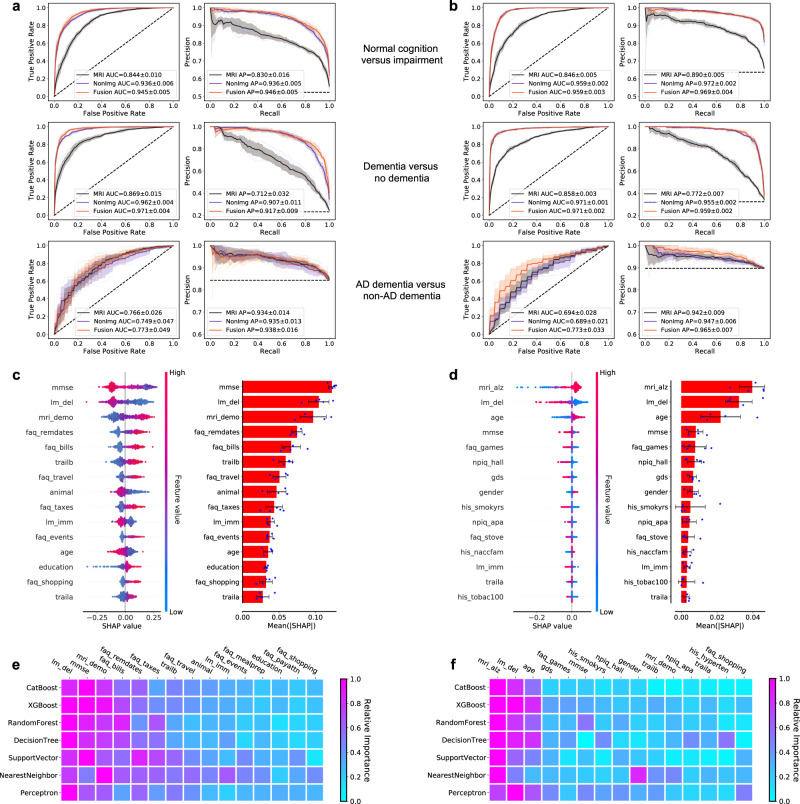
- The fusion model achieved strong discrimination for the staged tasks, including COGNC AUC 0.945 in NACC and 0.959 in OASIS; COGDE AUC 0.971 in both NACC and OASIS; and lower performance for the harder ADD task with AUC 0.773 in both NACC and OASIS.
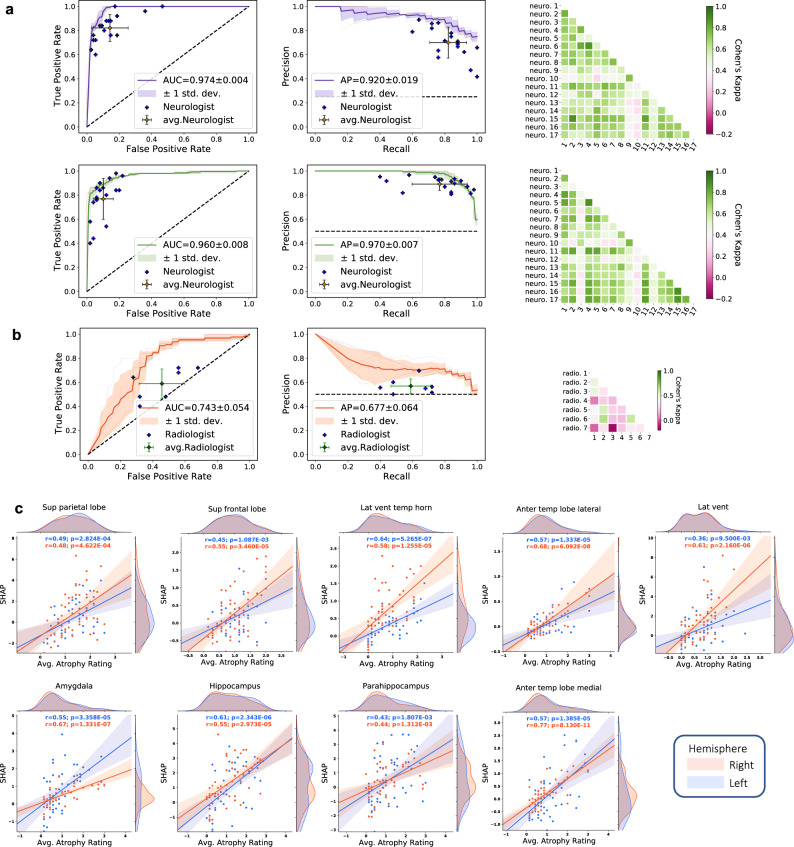
- In expert benchmarking, the fusion model’s overall 4-way accuracy was 0.558 (95% CI 0.482–0.634), reaching the level of neurologists (0.565, 95% CI 0.529–0.601); the MRI-only model improved over neuroradiologists on the ADD task (0.692 vs 0.566 accuracy).
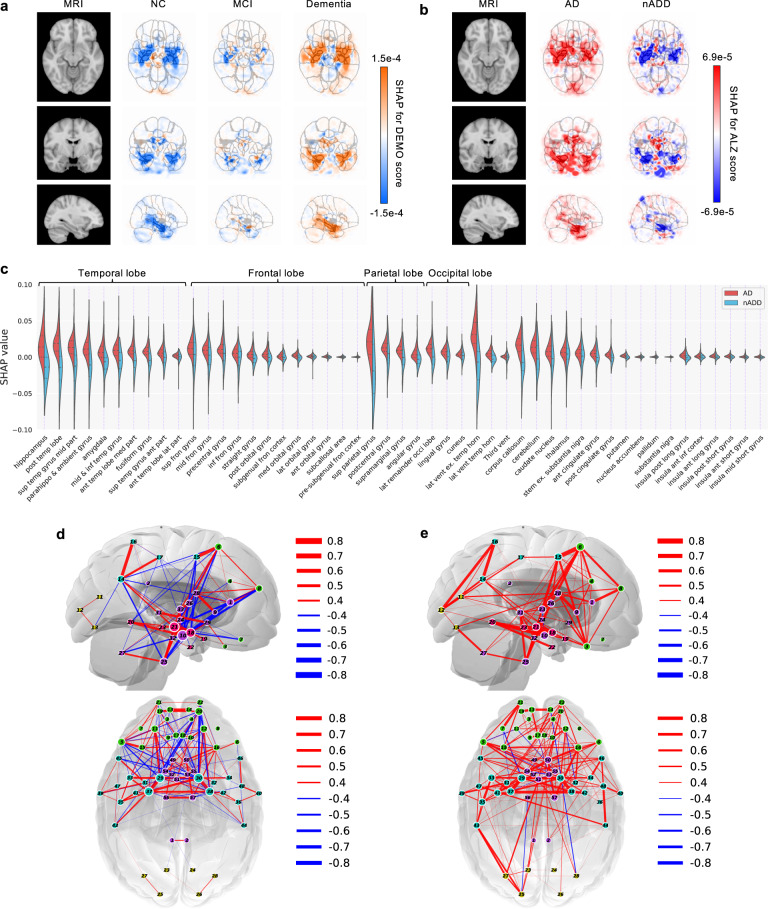
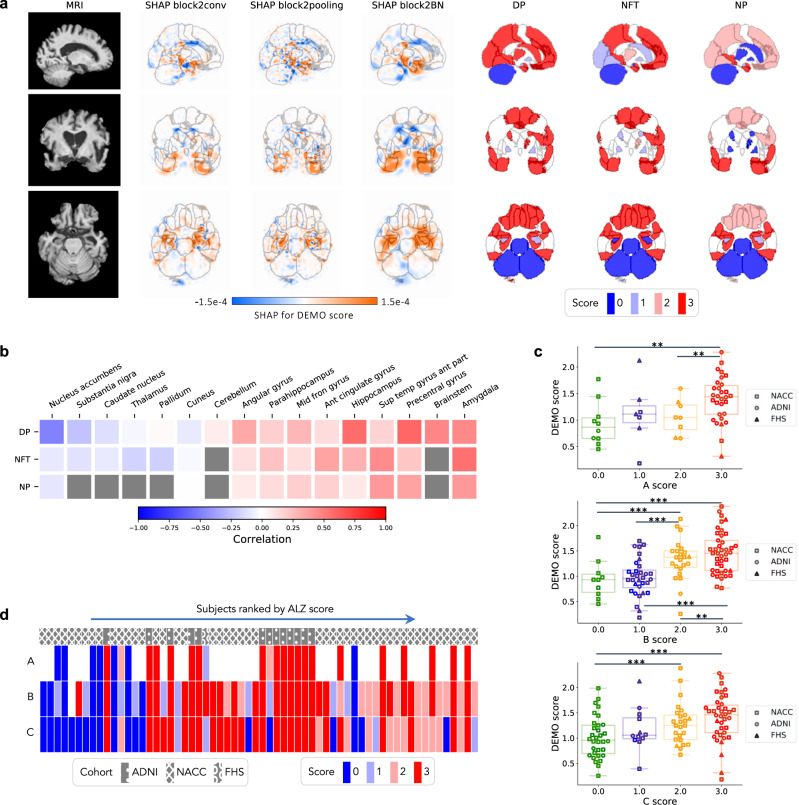
- Interpretability analyses linked model signals to known disease biology: SHAP-highlighted regions included the hippocampus, amygdala, and temporal lobes, and neuropathology validation found significant associations between DEMO scores and A, B, and C neuropathologic scores, with F(3,51)=3.665, p=1.813e-2 for A, F(3,102)=11.528, p=1.432e-6 for B, and F(3,103)=4.924, p=3.088e-3 for C.
Methods
- Multicohort retrospective development/validation study using deidentified MRI and clinical data from 8 cohorts; models were trained on NACC with 5-fold cross-validation and externally tested on other datasets, with some analyses restricted to NACC and OASIS because non-imaging data were available there.
- The authors built three model types: an MRI-only CNN, a non-imaging machine-learning model (best performing: CatBoost), and a fusion model combining CNN-derived scores with clinical variables; the framework was staged as COG (NC/MCI/dementia) followed by ADD (AD vs nADD).
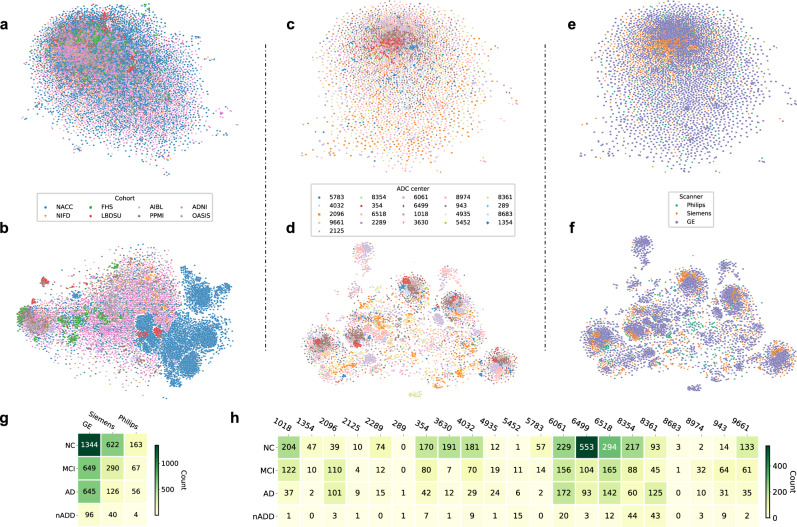
- Main analyses included AUC/AP performance evaluation, t-SNE and mutual information checks for confounding, SHAP for interpretability, neuropathologic validation in 110 participants with autopsy data, and head-to-head clinician comparisons with neurologists and neuroradiologists.
Limitations
- The paper states that in mixed dementia, the model defaults to AD when AD is present, so it does not perform multi-label classification for co-occurring dementias.
- The cohorts had no confirmed atypical AD cases, and the authors note that MCI is a broad category that was not subdivided into amnestic vs non-amnestic forms.
- Evident from the text: the non-imaging and fusion models were limited to NACC and OASIS because of missing non-imaging features in other cohorts, which may limit generalizability to settings with different data availability.
Model-written summary. Check it against the paper before relying on it.
Integrity signals
Registry
Cites
Statistics
Figures
Verification
Claims the paper makes
6 Valid · 2 Not valid · 3 Not checked · 97 Own results and interpretations
Every source the paper cites for this claim was checked and supports it.
In the paper
“we have previously reported interpretable deep learning approaches capable of distinguishing participants with age-appropriate normal cognition (NC) from those with AD using magnetic resonance imaging (MRI) scans, age, sex, and mini-mental state examination (MMSE)17.”
§ Multimodal deep learning for Alzheimer’s disease dementia assessment > Introduction
What the sources say
- Supportedcites [17] Qiu S Development and validation of an interpretable deep learning framework for Alzheimer’s disease classification Brain 2020 143 1920 1933 10.1093/brain/awaa137 32357201 PMC7296847 source
The Methods describe participants classified as having normal cognition or Alzheimer’s disease. The Results describe a fusion deep-learning model using MRI, age, gender and MMSE to classify disease status, while the Discussion describes how the model can associate MRI changes with regional neuropathology, supporting its interpretability. (LLM, conf=0.93)
plainstates an association- Asserted: passes — The authors put it forward as true.
- Checkable: passes — It can be checked against evidence.
- Load-bearing: unclear — It is unclear whether the paper’s conclusions depend on it.
- Based: passes — The paper gives a reason why it holds.
- Supported
The cited sources support only part of this claim — read each source’s verdict below.
In the paper
“Neuropathologic evaluations are considered to be the gold standard for confirming the presence and severity of neurodegenerative diseases50.”
§ Multimodal deep learning for Alzheimer’s disease dementia assessment > Methods > Neuropathologic validation
What the sources say
- Partly supportedcites [50] Besser LM The revised national Alzheimer’s coordinating center’s neuropathology form-available data and new analyses J. Neuropathol. Exp. Neurol. 2018 77 717 726 10.1093/jnen/nly049 29945202 PMC6044344 sourceExperimental — accuracy not yet measured
The Abstract calls neuropathologic evaluation the gold standard for determining the presence and severity of aging-related neurodegenerative diseases. The citing sentence omits “aging-related,” extending the statement beyond the scope specified in the source. (LLM, conf=0.85)
plain- Asserted: passes — The authors put it forward as true.
- Checkable: passes — It can be checked against evidence.
- Load-bearing: passes — The paper’s conclusions depend on it.
- Based: passes — The paper gives a reason why it holds.
- Partly supported
Every source the paper cites for this claim was checked and supports it.
In the paper
“Previously, we developed and externally validated an interpretable deep learning approach to classify AD using multimodal inputs of MRI and clinical variables17.”
§ Multimodal deep learning for Alzheimer’s disease dementia assessment > Discussion
What the sources say
- Supportedcites [17] Qiu S Development and validation of an interpretable deep learning framework for Alzheimer’s disease classification Brain 2020 143 1920 1933 10.1093/brain/awaa137 32357201 PMC7296847 source
The Results describe a fusion model that combines MRI-derived imaging features with clinical variables (age, gender and MMSE) to classify Alzheimer’s disease. The Introduction identifies AIBL, FHS and NACC as external test datasets, and the Discussion describes the model’s interpretable disease-risk colour maps. (LLM, conf=0.94)
plain- Asserted: passes — The authors put it forward as true.
- Checkable: passes — It can be checked against evidence.
- Load-bearing: passes — The paper’s conclusions depend on it.
- Based: passes — The paper gives a reason why it holds.
- Supported
A result the paper reports from its own data — it cites no other source for it, so there is none to check. The quote shows it is in the paper.
In the paper
“Importantly, however, the addition of MRI-derived DEMO and ALZ scores improved 4-way classification performance across all combinations of non-imaging variables (Figs. S4 and S5).”
§ Multimodal deep learning for Alzheimer’s disease dementia assessment > Results > Deep learning model performance
plainstates a cause- Asserted: passes — The authors put it forward as true.
- Checkable: passes — It can be checked against evidence.
- Load-bearing: passes — The paper’s conclusions depend on it.
- Based: passes — The paper gives a reason why it holds.
A result the paper reports from its own data — it cites no other source for it, so there is none to check. The quote shows it is in the paper.
In the paper
“Relative to the fusion model, we observed moderate performance reductions across classifications in our MRI-only model.”
§ Multimodal deep learning for Alzheimer’s disease dementia assessment > Results > Deep learning model performance
plainstates a cause- Asserted: passes — The authors put it forward as true.
- Checkable: passes — It can be checked against evidence.
- Load-bearing: passes — The paper’s conclusions depend on it.
- Based: passes — The paper gives a reason why it holds.
52 more claims
Create a free account to see all 108 claims and to verify the 4 references still open.
- It may state two separate claims as one. 28
- Probably not a substantial claim. 26
Claims other papers make about this one
Each is checked against this paper’s own text: does it say what the citing paper says it does?
The source backs part of the claim, not all of it — or backs it for a different population, condition or comparison.
In the citing paper
“Overall, AI’s integration into various facets of AD research holds promise for advancing our understanding of the disease. 614–618”
From Recent advances in Alzheimer's disease: Mechanisms, clinical trials and new drug development strategies. (2024) · cites this paper as [618]
Experimental — accuracy not yet measuredThe source backs part of the claim, not all of it — or backs it for a different population, condition or comparison.
In the citing paper
“AI is currently making preliminary explorations in various aspects of AD, from detection and diagnosis to understanding disease mechanisms, biomarker discovery, clinical trial design, drug discovery, and prognosis prediction.”
From Recent advances in Alzheimer's disease: Mechanisms, clinical trials and new drug development strategies. (2024) · cites this paper as [618]
Experimental — accuracy not yet measuredThe cited source says what the claim attributes to it.
In the citing paper
“A few studies have attempted to discern neuroimaging signatures unique to AD by contrasting them with other dementia types31–40.”
From AI-based differential diagnosis of dementia etiologies on multimodal data (2024) · cites this paper as [39]
The cited source says what the claim attributes to it.
In the citing paper
“Recently, we proposed a computational approach to stratify individuals based on cognitive status and discern likely AD cases from non-AD dementia types by incorporating imaging with non-imaging data such as demographics, medical histories and neuropsychological assessments39.”
From AI-based differential diagnosis of dementia etiologies on multimodal data (2024) · cites this paper as [39]
Statistics recomputed
Every reported test result, recomputed from its test statistic and degrees of freedom. A result shows as not adding up only once an independent check has confirmed it.
- ConsistentF(3, 51) = 3.665reported p = .01813 · recomputed p = .018
“F(3, 51) = 3.665, p = 1.813e-2”
- ConsistentF(3, 102) = 11.528reported p = .000001432 · recomputed p < .001
“F(3, 102) = 11.528, p = 1.432e-6”
- ConsistentF(3, 103) = 4.924reported p = .003088 · recomputed p = .003
“F(3, 103) = 4.924, p = 3.088e-3”
Self-check
Percentages, sums and reported differences re-computed from the paper’s own numbers.
Self-check results appear here once an independent check has confirmed them.
Citations
Cites
McKhann, G. M., Knopman, D. S., Chertkow, H., Hyman, B. T., Jack, C. R., Kawas, C. H., Klunk, W. E., Koroshetz, W. J., Manly, J. J., Mayeux, R., et al. (2011) · Alzheimer's & Dementia · doi:10.1016/j.jalz.2011.03.005 · Cited by 18,657
Neuropathological stageing of Alzheimer-related changes.
Braak, H., & Braak, E. (1991) · Acta Neuropathologica · doi:10.1007/bf00308809 · Cited by 16,123
17. A Value for n-Person Games
Shapley, L. S. (1953) · Contributions to the Theory of Games (AM-28), Volume II · doi:10.1515/9781400881970-018 · Cited by 6,950
The Alzheimer’s disease neuroimaging initiative (ADNI): MRI methods
Jack, C. R., Bernstein, M. A., Fox, N. C., Thompson, P., Alexander, G., Harvey, D., Borowski, B., Britson, P. J., L. Whitwell, J., Ward, C., et al. (2008) · Journal of Magnetic Resonance Imaging · doi:10.1002/jmri.21049 · Cited by 4,347
Phases of Aβ-deposition in the human brain and its relevance for the development of AD
Thal, D. R., Rüb, U., Orantes, M., & Braak, H. (2002) · Neurology · doi:10.1212/wnl.58.12.1791 · Cited by 3,490
Braak, H., Alafuzoff, I., Arzberger, T., Kretzschmar, H., & Del Tredici, K. (2006) · Acta Neuropathologica · doi:10.1007/s00401-006-0127-z · Cited by 3,172
Hyman, B. T., Phelps, C. H., Beach, T. G., Bigio, E. H., Cairns, N. J., Carrillo, M. C., Dickson, D. W., Duyckaerts, C., Frosch, M. P., Masliah, E., et al. (2012) · Alzheimer's & Dementia · doi:10.1016/j.jalz.2011.10.007 · Cited by 3,092
Alzheimer's Disease Neuroimaging Initiative (ADNI): Clinical characterization
Petersen, R. C., Aisen, P. S., Beckett, L. A., Donohue, M. C., Gamst, A. C., Harvey, D. J., Jack, C. R., Jagust, W. J., Shaw, L. M., Toga, A. W., et al. (2010) · Neurology · doi:10.1212/wnl.0b013e3181cb3e25 · Cited by 3,060
The antibody aducanumab reduces Aβ plaques in Alzheimer’s disease
Sevigny, J., Chiao, P., Bussière, T., Weinreb, P. H., Williams, L., Maier, M., Dunstan, R., Salloway, S., Chen, T., Ling, Y., et al. (2016) · Nature · doi:10.1038/nature19323 · Cited by 3,059
Montine, T. J., Phelps, C. H., Beach, T. G., Bigio, E. H., Cairns, N. J., Dickson, D. W., Duyckaerts, C., Frosch, M. P., Masliah, E., Mirra, S. S., et al. (2012) · Acta Neuropathologica · doi:10.1007/s00401-011-0910-3 · Cited by 2,894
Research works printed but not linked: 2
- Lundberg, S. M. & Lee, S.-I. A Unified Approach to Interpreting Model Predictions: in Proceedings of the 31st International Conference on Neural Information Processing Systems. 4768–4777 (2017).
- Weiner M Khachaturian Z The use of MRI and PET for clinical diagnosis of dementia and investigation of cognitive impairment: a consensus report Alzheimer’s Assoc. Chic., IL 2005 1 1 15
Cited by
Items 201–300 of 413
Ye, S., Xu, W., Jiang, Z., Zhan, Y., Shen, Y., Su, L., Yang, K., & Ju, B. (2025) · Digital Health · doi:10.1177/20552076251384237 · Cited by 4
A study on Multimodal approach for early detection of Dementia using Deep Learning
Santhiya, M., Praveenraj, H., & Madhuvarshini, N. A. (2024) · IEEE International Conference for Women in Innovation, Technology & Entrepreneurship (ICWITE) · doi:10.1109/icwite59797.2024.10502382 · Cited by 3
Multimodal biomarker AI techniques for early neurocognitive disorder diagnosis: A systematic review
Catino, F., Castellana, F., Zupo, R., Giannoccaro, V., Lampignano, L., Petrosillo, A. M., Addabbo, F., Sborgia, G., Colacicco, G., Santoro, C., et al. (2026) · Artificial Intelligence in Medicine · doi:10.1016/j.artmed.2026.103389 · Cited by 5
Christodoulou, R. C., Vamvouras, G., Papageorgiou, P. S., Sarquis, M. D., Petrou, V., Rivera, L., Morales, C., Rivera, G., Papageorgiou, S. G., & Vassiliou, E. K. (2025) · Biomedicines · doi:10.3390/biomedicines13112689 · Cited by 3
Shen, B., Zhou, Y., Yang, S., Zhang, Y., Gao, X., Zhao, E., Rao, X., Zhao, H., & Zeng, H. (2026) · Gondwana Research · doi:10.1016/j.gr.2026.03.008 · Cited by 2
Self-citationSuleman, M. U., Mursaleen, M., Khalil, U., Khan, S. A., Saboor, A., Hussnain, M. A., Zahir, M., Khan, U. A., Rehman, D. U., & Tabassum, S. N. (2025) · Annals of Medicine and Surgery · doi:10.1097/ms9.0000000000004505 · Cited by 2
A survey of multimodal fusion for Alzheimer’s disease prediction: A new taxonomy and trends
Guan, Y., Wang, W., Chen, J., Yang, P., Xu, J., & Qi, J. (2025) · Information Fusion · doi:10.1016/j.inffus.2025.104098 · Cited by 6
Leveraging heterogeneous tabular of EHRs with prompt learning for clinical prediction
Yang, X., Li, L., Wang, C., Zhang, W., Liu, H., & Tang, W. (2025) · Journal of Biomedical Informatics · doi:10.1016/j.jbi.2025.104868 · Cited by 6
Wang, C., Wang, Y., Xue, Q., Zhou, Z., Yan, G., & Qi, X. (2026) · IEEE Transactions on Computational Biology and Bioinformatics · doi:10.1109/tcbbio.2026.3655150 · Cited by 4
Self-citationLu, W., Gong, Q., Chen, Y., Qiu, S., & An, J. (2026) · Neural Networks · doi:10.1016/j.neunet.2026.108542 · Cited by 3
Self-citationDeep Learning Framework using Sparse Diffusion MRI for Diagnosis of Frontotemporal Dementia
Tiwari, A. S., Singhal, A., Shigwan, S. J., & Singh, R. K. (2023) · IEEE International Conference on Computer Vision Workshops · doi:10.1109/iccvw60793.2023.00413 · Cited by 4
MADP: Multi-modal Sequence Learning for Alzheimer’s Disease Prediction with Missing Data
Wang, Y., Wang, Z., Gong, H., Wang, S.-W., Li, M., & Dong, J. (2024) · Communications in computer and information science · doi:10.1007/978-981-97-6125-8_8 · Cited by 3
Self-citationA dynamic multi-modal fusion network for ovarian tumor differentiation
Li, Y., Zou, B., Wu, J., Dai, Y., Bai, H. X., & Jiao, Z. (2022) · IEEE International Conference on Bioinformatics and Biomedicine (BIBM) · doi:10.1109/bibm55620.2022.9995556 · Cited by 3
Early Detection of Alzheimer's Disease Using Machine Learning Techniques
Kumar, Y., Megha, Ladha, A., Chaudhary, V., Arman, A., & Kalbhile, Y. (2025) · IEEE International Conference on Interdisciplinary Approaches in Technology and Management for Social Innovation (IATMSI) · doi:10.1109/iatmsi64286.2025.10984439 · Cited by 2
A Deep Learning Approach to Analyze NMR Spectra of SH-SY5Y Cells for Alzheimer’s Disease Diagnosis
Costanti, F., Kola, A., Scarselli, F., Valensin, D., & Bianchini, M. (2023) · Mathematics · doi:10.3390/math11122664 · Cited by 3
Harnessing artificial intelligence for transpathology advancements
Liu, Z., Dong, S., Zhang, L., & Shi, K. (2024) · Elsevier eBooks · doi:10.1016/b978-0-323-95223-1.00022-9 · Cited by 2
Multimodal deep learning neuroimaging approach to enhance CT-based diagnosis of Alzheimer’s disease
Abbas, A., Tsai, H., Hsu, Y.-L., Kenneth, M. J., Hussain, B., Lai, L. M., & Hsu, B. (2026) · Psychiatry Research Neuroimaging · doi:10.1016/j.pscychresns.2026.112234 · Cited by 2
He, C., Hu, X., Wang, M., Yin, X., Zhan, M., Li, Y., Sun, L., Du, Y., Chen, Z., Wang, H., et al. (2024) · Frontiers in Neuroscience · doi:10.3389/fnins.2024.1352129 · Cited by 4
Comprehensive Review of Multimodal Techniques for Neurodegenerative Disease Diagnosis
Alouani, Z., Beriich, M., Saleh, S., Ouhmida, A., Cherradi, B., & Bouattane, O. (2025) · International Conference on Innovative Research in Applied Science, Engineering and Technology (IRASET) · doi:10.1109/iraset64571.2025.11008353 · Cited by 3
Dong, M., Xie, L., Das, S. R., Wang, J., Wisse, L. E. M., de Florès, R., Wolk, D. A., & Yushkevich, P. A. (2024) · Imaging Neuroscience · doi:10.1162/imag_a_00294 · Cited by 4
Enhancing Autism Diagnosis Using Federated Learning and Multimodal Data Fusion
Saraswat, M., Aman, A., Pal, V., & Prakash, S. (2025) · International Conference on Communication, Security and Artificial Intelligence (ICCSAI) · doi:10.1109/iccsai64074.2025.11064052 · Cited by 3
Jia, N., Zhang, Z., & Jia, T. (2025) · Neural Networks · doi:10.1016/j.neunet.2025.108128 · Cited by 4
A survey on multimodal explainable Artificial Intelligence
Giovannoni, C., Metta, C., Monreale, A., & Rinzivillo, S. (2026) · Intelligent Systems with Applications · doi:10.1016/j.iswa.2026.200671 · Cited by 5
A multimodal synergistic model for personalized neoadjuvant immunochemotherapy in esophageal cancer
Zhao, Z., Chen, D., Wei, X., Li, S., Zhang, X., Lin, W., Zheng, X., Zheng, K., Wu, E., Wen, X., et al. (2025) · Cell Reports Medicine · doi:10.1016/j.xcrm.2025.102479 · Cited by 4
Diagnostic and prognostic multimodal prediction models in Alzheimer's disease: A scoping review
Xia, X., Duffner, L. A., Bintener, C., Bradshaw, A. C., Lamirel, D., & Jönsson, L. (2025) · Journal of Alzheimer s Disease · doi:10.1177/13872877251351630 · Cited by 4
Predicting categorical and continuous Alzheimer’s disease outcomes from a single MRI scan
Ma, D., Pabalan, C., Rajagopal, A., Akanksha, A., Interian, Y., Yang, Y., & Raj, A. (2026) · Nature Aging · doi:10.1038/s43587-026-01121-2 · Cited by 5
Liu, F., Liang, S.-N., Jaward, M. H., Ong, H. F., & Wang, H. (2025) · Computerized Medical Imaging and Graphics · doi:10.1016/j.compmedimag.2025.102664 · Cited by 4
Accurate and Efficient Algorithm for Detection of Alzheimer Disability Based on Deep Learning
Alfayez, F., Rozov, S., & El_Tokhy, M. S. (2024) · Cellular Physiology and Biochemistry · doi:10.33594/000000746 · Cited by 4
Rahman, M. M., Calhoun, V. D., & Plis, S. (2026) · Imaging Neuroscience · doi:10.1162/imag.a.1129 · Cited by 16
Cheng, J., Liu, F., & Wei, S. (2026) · Applied Intelligence · doi:10.1007/s10489-026-07105-4 · Cited by 3
Automated Machine Learning Approach (AutoML) to Alzheimer’s Disease Diagnosis and Prognosis
Guillén, P., & Frías-Martínez, E. (2025) · Applied Artificial Intelligence · doi:10.1080/08839514.2025.2565166 · Cited by 5
COADBench: A benchmark for revealing the relationship between AI models and clinical outcomes
Xie, J., Liu, W., Ma, L., Yao, C., Liang, Q., Tang, S., & Huang, Y. (2024) · BenchCouncil Transactions on Benchmarks Standards and Evaluations · doi:10.1016/j.tbench.2025.100198 · Cited by 2
Shubar, A. G., Ramakrishnan, K., & Ho, C.-K. (2024) · IEEE Access · doi:10.1109/access.2024.3505038 · Cited by 6
Machine learning diagnosis of cognitive impairment and dementia in harmonized older adult cohorts
Mungas, D., Gavett, B. E., Rojas‐Saunero, L. P., Zhou, Y., Hayes‐Larson, E., Shaw, C. L., Farias, S. T., Widaman, K. F., Fletcher, E., Corrada, M. M., et al. (2025) · Alzheimer s & Dementia · doi:10.1002/alz.70508 · Cited by 5
Self-citationArtificial intelligence applications for dementia: A systematic review for clinical researchPreprint
Altares-López, S., & Rauchmann, B. (2025) · medRxiv · doi:10.1101/2025.08.22.25333992 · Cited by 3
Revankar, G. S., Salian, A. C., Ozono, T., Maki, S., Kanemoto, H., Shigenobu, K., Nishio, Y., Yoshiyama, K., Yamamoto, Y., Revankar, S. S., et al. (2025) · medRxiv · doi:10.1101/2025.03.31.25324871 · Cited by 2
Artificial intelligence for differential diagnosis of dementia
(2024) · Nature Medicine · doi:10.1038/s41591-024-03147-8 · Cited by 2
Il contributo dell'intelligenza artificiale nella diagnosi dei disturbi neurodegenerativi
Nappo, R., & Simeoli, R. (2024) · RIVISTA SPERIMENTALE DI FRENIATRIA · doi:10.3280/rsf2024-003008 · Cited by 1
Liang, S.-B., Sun, H., Chen, T., Sun, F.-Q., Ma, H., & Du, W.-C. (2025) · Applied intelligence (Boston) · doi:10.1007/s10489-025-06904-5 · Cited by 1
ALTARN: A Tabular Residual Neural Network for Alzheimer’s Disease Classification and PredictionPreprint
Balakrishna, K., Hammond, A., & Idrissi, A. E. (2025) · medRxiv · doi:10.1101/2025.10.21.25338451 · Cited by 1
Cheng, N., Li, G., Liang, Y., Qiu, Y., Song, X., Hu, H., Tan, E.-L., Wang, T., Wang, S., Xiao, X., et al. (2025) · Neural Networks · doi:10.1016/j.neunet.2025.108530 · Cited by 1
Cao, G., Zhang, M., Wang, Y., Zhang, Y., Guo, J., Huang, J., & Kang, G. (2025) · IEEE Journal of Biomedical and Health Informatics · doi:10.1109/jbhi.2025.3629721 · Cited by 2
Self-citationOptimizing ADHD Detection: An Autoencoder Approach for Multimodal Classification
Nash, C., Nair, R., & Naqvi, S. M. (2025) · IEEE Transactions on Artificial Intelligence · doi:10.1109/tai.2025.3592157 · Cited by 3
Haraldsen, I., Hatlestad‐Hall, C., Marra, C., Maestú, F., Renvall, H., & Rossini, P. M. (2024) · Drug repurposing · doi:10.58647/drugrepo.24.1.0005 · Cited by 5
Wang, M., Sun, Y., Wang, X., Liu, C., Guo, T., Huang, Y., Gao, F., & Qiu, B. (2026) · BMC Neurology · doi:10.1186/s12883-026-04719-6 · Cited by 1
Xu, S., Tang, C., Shi, L., Chen, J., Jia, J., & Qi, J. (2026) · Neurocomputing · doi:10.1016/j.neucom.2026.133697 · Cited by 2
Zheng, W., Wu, Q., Mu, R., Kuang, J., Yang, P., Lv, J., Huang, B., Li, X., Liu, F., Song, Z., et al. (2025) · Neuroscience · doi:10.1016/j.neuroscience.2025.03.012 · Cited by 3
Xu, J., Yuan, C., Jing, Y., Shang, H., Shi, X., & Zhu, X. (2025) · Information Fusion · doi:10.1016/j.inffus.2025.103579 · Cited by 4
Pseudo datasets estimate feature attribution in artificial neural networks
Yang, H.-Y., Chen, Y., Cheng, H., & Guo, C. (2025) · Scientific Reports · doi:10.1038/s41598-025-28840-7 · Cited by 1
A cross-guided multimodal fusion network for Alzheimer’s disease classification
Li, L., Guo, R., Liao, T., Dong, Z., Xu, C., & Li, P. (2026) · Pattern Recognition Letters · doi:10.1016/j.patrec.2026.05.015 · Cited by 1
OpenClinicalAI: An open and dynamic model for Alzheimer’s Disease diagnosis
Huang, Y., Liang, X., Xie, J., Lu, X., Miao, X., Liu, W., Zhang, F. M., Kang, G., Ma, L., Tang, S., et al. (2024) · Expert Systems with Applications · doi:10.1016/j.eswa.2024.125528 · Cited by 4
Kavitha, R., & Premalatha, K. (2026) · Computers in Biology and Medicine · doi:10.1016/j.compbiomed.2026.111879 · Cited by 1
Yang, J., Ding, H., Amini, S., Hao, B., Karjadi, C., Au, R., & Paschalidis, I. C. (2026) · Alzheimer s Research & Therapy · doi:10.1186/s13195-026-02006-7 · Cited by 4
Self-citationPawar, S. V., Hussain, M. A., Bindu Priya, R., Srividya, M. S., & Manonmani, S. (2024) · International Conference on Computation System and Information Technology for Sustainable Solutions (CSITSS) · doi:10.1109/csitss64042.2024.10816863 · Cited by 1
Mukkawar, S., Anokar, B., Limaye, K., Gosavi, C. S., & Pagare, R. (2026) · International Conference on Emerging Trends and Innovations in ICT (ICEI) · doi:10.1109/icei65890.2026.11447679 · Cited by 1
Multimodal Deep Learning Model for Prediction of Prognosis in Central Nervous System Inflammation
Choi, B. K., Choi, Y., Jang, S., Ha, W.-S., Cho, S., Chang, K., Sohn, B., Kim, K. M., & Park, Y. R. (2025) · Brain Communications · doi:10.1093/braincomms/fcaf179 · Cited by 1
“4,8,9,24 This method was mainly applied to neurodegenerative diseases with overall brain atrophy or relatively large and clearly visible brain tumours, aiming to reduce information loss T a b l e 1 and allow intuitive analysis.”
Dual-model deep learning for Alzheimer’s prognostication
Fin, S., Moayedikia, A., & Wiil, U. K. (2026) · Computers in Biology and Medicine · doi:10.1016/j.compbiomed.2026.111672 · Cited by 3
Alzheimer's Disease Detection Using Deep Learning: A Googlenet-Based Classification Framework
Chandralekha, R., Priya, M. S., Selvathi, D., Subhashini, G. K., Amsaveni, K., & Mareeswari, G. (2025) · International Conference on Inventive Systems and Control (ICISC) · doi:10.1109/icisc65841.2025.11188981 · Cited by 1
Liu, F., Wang, H., Jaward, M. H., Liang, S.-N., Ong, H. F., & Cheng, J. (2025) · Lecture notes in computer science · doi:10.1007/978-3-032-04984-1_8 · Cited by 1
Deep learning models identify brain changes during the progression of Alzheimer’s disease
Sun, J., Han, J. J., & Chen, W. (2026) · npj Systems Biology and Applications · doi:10.1038/s41540-026-00666-7 · Cited by 2
Innovative Approaches to Training in Evidence‐Based Neurology
Raman, A., Ahmed, A. T., Sanghvi, G. V., Ballal, S., Aminov, Z., Al‐Hetty, H. R. A. K., Kalia, R., Arya, R., Kariem, M., & Mustafa, Y. F. (2025) · Journal of Evaluation in Clinical Practice · doi:10.1111/jep.70224 · Cited by 4
Parkinson’s Disease Classification Using Gray Matter MRI and Deep Learning: A Comparative Framework
Li, H., Liang, T., Yao, R., & Kuremoto, T. (2025) · Applied Sciences · doi:10.3390/app152111812 · Cited by 2
Rasi, R., Güveniş, A., & Initiative, T. F. L. D. N. (2025) · Neurodegenerative Diseases · doi:10.1159/000550231 · Cited by 1
Li, R., Berlowitz, D. R., Mez, J., Silver, B., Wang, X., Hu, W., Goodwin, R., Keating, H., Liu, W., Lin, H., et al. (2026) · Communications Medicine · doi:10.1038/s43856-025-01206-w · Cited by 2
Self-citationWang, H., Yang, T., Fan, J., Zhang, H., Zhang, W., Ji, M., & Miao, J. (2025) · Journal of X-Ray Science and Technology · doi:10.1177/08953996241300023 · Cited by 5
Sheng, Y., Zhao, B., Cheng, H., Yang, Y., Wang, W.-P., Yang, Y., Ding, Y., Qiu, L., Qin, Z., Yao, Z., et al. (2024) · Journal of Magnetic Resonance Imaging · doi:10.1002/jmri.29230 · Cited by 3
Multistage Alignment and Fusion for Multimodal Multiclass Alzheimer’s Disease Diagnosis
Huang, S., Zhong, L., & Shi, Y. (2025) · Lecture notes in computer science · doi:10.1007/978-3-032-05182-0_37 · Cited by 9
Liu, Y., Yao, J., Ge, H., Liu, Y., Bao, M., Li, Q., & Bai, X. (2026) · Biomedical Signal Processing and Control · doi:10.1016/j.bspc.2026.110603 · Cited by 1
Sekhar, M. C., Kavitha, P. N., Shankar, B. N. V. U., Aakula, A., & Boya, D. (2025) · International Journal of Computational and Experimental Science and Engineering · doi:10.22399/ijcesen.2159 · Cited by 2
Early diagnosis of Alzheimer's disease through handwriting analysis and deep learning: A review
Tang, Q., Jiaxi, L., Fan, C., Zhang, X. X., Zhang, C. F., & Qi, H. (2026) · Journal of Alzheimer s Disease · doi:10.1177/13872877261446573 · Cited by 2
A multimodal deep learning framework for functional brain network classification in rs-fMRI
Robinson, B., Reuther, W., Leggio, O., Cediel, E. G., Jeyabose, A., Kazemi, M. H., & Boerwinkle, V. L. (2025) · Cognitive Neurodynamics · doi:10.1007/s11571-025-10369-0 · Cited by 1
Du, Z., Liu, Z., Fu, L., Wang, C., Sun, Z., Zhu, L., & Deng, K. (2025) · npj Digital Medicine · doi:10.1038/s41746-025-01509-1 · Cited by 2
Manochandar, T., & Diderot, P. K. (2023) · Review of Computer Engineering Research · doi:10.18488/76.v10i4.3562 · Cited by 1
Using Artificial Intelligence Systems in Modern Neurobehavioral Research
Apukhtin, K. V., Zolotova, A. E., Leunenko, A. O., Perfilova, V. N., & Kalueff, A. V. (2025) · Journal of Evolutionary Biochemistry and Physiology · doi:10.1134/s0022093025060080 · Cited by 1
Liu, Q., Ma, C., Liu, M., Chen, S., Yu, M., Xia, L., Zhang, Q., & Wu, M. (2026) · JMIR Rehabilitation and Assistive Technologies · doi:10.2196/79841 · Cited by 2
Evidence-Aware Multi-Modal Data Fusion and its Application to Total Knee Replacement Prediction
Liu, X., Wang, J., Zhou, S. K., ENGSTROM, C. M., & Chandra, S. S. (2024) · International Conference on Digital Image Computing: Techniques and Applications (DICTA) · doi:10.1109/dicta63115.2024.00042 · Cited by 5
[Research progress on electronic health records multimodal data fusion based on deep learning].
(2024) · PubMed Central · doi:10.7507/1001-5515.202310011 · Cited by 1
Design of a configurable SoC for Alzheimer’s disease detection based on multimodal signals
Yuan, Y., Sheng, L., Chen, Z., Zhang, Y., Li, Q., Chen, J., Ding, K., Shi, L., Hu, Q., & He, W. (2026) · BMC Bioinformatics · doi:10.1186/s12859-026-06410-6 · Cited by 1
Perna, P., Alessandra, C., Stasolla, F., & Nappo, R. (2026) · Technologies · doi:10.3390/technologies14030183 · Cited by 1
A composable multimodal framework for cine CMR-text–driven prediction of heart failure outcomes
Chen, J. M., Sun, J., Wang, X., Chen, X., Chu, H., Song, G., Luo, Y., Zhou, X., & Gu, R. (2026) · Physiological Measurement · doi:10.1088/1361-6579/ae6f6c
Huang, Y., Guo, X., Li, Z., & Fan, M. (2026) · Journal of Imaging Informatics in Medicine · doi:10.1007/s10278-026-02220-7
Bukaita, W., Arelli, C., & Kamindla, R. (2026) · American Journal of Health Research · doi:10.11648/j.ajhr.20261401.17
NeuroAlign: Hierarchical multimodal fusion of dynamic and structural neuroimaging for MCI analysis
Shen, X., Song, Z., wang, J., Zhong, Y., Zhao, L., Xu, C., Li, L., Wei, Y., Liang, L., Deng, D., et al. (2026) · Information Fusion · doi:10.1016/j.inffus.2026.104705
Huang, Y., Chen, L., Zhou, C., & Yang, S. (2026) · Journal of Visual Communication and Image Representation · doi:10.1016/j.jvcir.2026.104821
Zhao, Z., Jia, T., & Jia, N. (2026) · IEEE International Conference on Cyber Technology in Automation, Control, and Intelligent Systems · doi:10.1109/cyber71431.2026.11695532
SA-LanSeg: Bridging semi-automatic interaction and language guidance for medical image segmentation
Huang, Z., Peng, Y., Xu, M.-M., Jung, Y., Ahn, E., Kim, J., & Bi, L. (2026) · Pattern Recognition · doi:10.1016/j.patcog.2026.114665
Xie, X., Xue, P., Guo, Y., Chen, H., Fan, L., Tang, R., Xu, Z., Wang, X., Liu, T., & Chen, F. (2026) · Interdisciplinary Sciences Computational Life Sciences · doi:10.1007/s12539-025-00805-4 · Cited by 2
Ding, R., Yu, J., & Liu, M. (2025) · IEEE International Conference on Bioinformatics and Biomedicine (BIBM) · doi:10.1109/bibm66473.2025.11356331
Chen, Y., Liu, T., & Cheng, G. (2026) · Frontiers in Human Neuroscience · doi:10.3389/fnhum.2026.1958462
Shateri, A., & Rezaei, S. (2026) · Romanian Journal of Neurology · doi:10.37897/rjn.2026.3.7
The global research of artificial intelligence on Alzheimer disease: A 25-year bibliometric analysis
Wu, H., Wang, X.-S., Yang, M., & Cai, J. (2026) · Medicine · doi:10.1097/md.0000000000050370
Zhang, Q., Yue, Y., Zhang, D., Zhao, K., Wang, A., Xue, B., Liu, Y., & Zong, F. (2026) · Lecture notes in computer science · doi:10.1007/978-981-95-7072-0_38
Wang, C., Piao, S., Wang, J., Li, Z., Chen, T., Cui, M., Zhao, J., Guo, Q., Zhang, J., Xie, F., et al. (2026) · The Innovation Informatics · doi:10.59717/j.xinn-inform.2026.100048 · Cited by 2
Rong, Y., Wang, Y., Wei, X., Feng, L., Hu, B., & Wang, Q. (2024) · International Conference on Computer and Communication Systems (ICCCS) · doi:10.1109/icccs61882.2024.10603033
Self-citation
Metadata
- Authors
- Qiu, S., Miller, M. I., Joshi, P. S., Lee, J. C., Xue, C., Ni, Y., Wang, Y., De Anda-Duran, I., Hwang, P. H., Cramer, J. A., Dwyer, B. C., Hao, H., Kaku, M. C., Kedar, S., Lee, P. H., Mian, A. Z., Murman, D. L., O’Shea, S., Paul, A. B., Saint-Hilaire, M.-H., Alton Sartor, E., Saxena, A. R., Shih, L. C., Small, J. E., Smith, M. J., Swaminathan, A., Takahashi, C. E., Taraschenko, O., You, H., Yuan, J., Zhou, Y., Zhu, S., Alosco, M. L., Mez, J., Stein, T. D., Poston, K. L., Au, R., & Kolachalama, V. B.
- Affiliations
- Boston University (US)
- University of Nebraska Medical Center (US)
- Chinese Academy of Medical Sciences & Peking Union Medical College (CN)
- Emory University (US)
- Lahey Hospital and Medical Center (US)
- Stanford University (US)
- Corresponding author
- Kolachalama, Vijaya B.
- ORCID
- Qiu, Shangran
- Miller, Matthew I.
- Joshi, Prajakta S.
- Wang, Yuwei
- De Anda-Duran, Ileana
- Hwang, Phillip H.
- Cramer, Justin A.
- Dwyer, Brigid C.
- Hao, Honglin
- Kaku, Michelle C.
- Kedar, Sachin
- Mian, Asim Z.
- Murman, Daniel L.
- O’Shea, Sarah
- Saxena, Aneeta R.
- Shih, Ludy C.
- Small, Juan E.
- Swaminathan, Arun
- Takahashi, Courtney E.
- Taraschenko, Olga
- You, Hui
- Yuan, Jing
- Zhou, Yan
- Zhu, Shuhan
- Alosco, Michael L.
- Mez, Jesse
- Stein, Thor D.
- Poston, Kathleen L.
- Au, Rhoda
- Kolachalama, Vijaya B.
- Venue
- Nature Communications
- Published
- 2022-06-20
- Volume
- 13
- Issue
- 1
- Pages
- 3404-3404
- ISSN
- 2041-1723 (ISSN-L)
- PMC
- PMC9209452
- OpenAlex
- W4283156058
- Semantic Scholar
- 7a60758ef1185fb82b74715813d9c2a8f5d3fa16
- Cited by
- 420
- References
- 53
- Citations by year
- 2026: 126 · 2025: 125 · 2024: 111 · 2023: 52 · 2022: 6
- FWCI
- 47.92
- Type
- journal article
- Language
- en
- Open access
- gold
- doi.org
- Licence
- cc-by
- creativecommons.org/licenses/by/4.0 (tdm)
- creativecommons.org/licenses/by/4.0 (vor)
- Locations
- Nature Communications (publishedVersion, cc-by)
- PubMed Central (publishedVersion, cc-by)
- PubMed (publishedVersion)
- RePEc: Research Papers in Economics (submittedVersion)
- DOAJ (DOAJ: Directory of Open Access Journals) (submittedVersion, cc-by-sa)
- Funders
- Michael J. Fox Foundation for Parkinson's Research
- American Heart Association (20SFRN35460031)
- Alzheimer's Drug Discovery Foundation
- Demensförbundet
- Lewy Body Dementia Association
- Karen Toffler Charitable Trust
- National Institutes of Health (1r21ca253498-01, 1r56ag062109-01)
- National Institute on Aging (R56-AG062109, R01AG054076, R01AG033040, RF1AG062109, R01AG016495, RF1AG072654, P30AG013846, U19AG065156, U19AG068753, R01AG072654, P30AG066515, P30AG066546)
- National Heart, Lung, and Blood Institute (R01HL159620)
- National Cancer Institute (R21‐CA253498)
- National Institute of Neurological Disorders and Stroke (K23NS075097, R01NS115114)
- Topics
- Health Sciences › Medicine › Psychiatry and Mental health › Dementia and Cognitive Impairment Research
- Health Sciences › Health Professions › Health Information Management › Artificial Intelligence in Healthcare
- Physical Sciences › Computer Science › Artificial Intelligence › Machine Learning in Healthcare
- Keywords
- Alzheimer's disease, dementia diagnosis, mild cognitive impairment, multimodal deep learning, neuroimaging, neuropsychological assessment, clinical data integration, interpretability, autopsy neuropathology, cognitive impairment classification, diagnostic accuracy
- MeSH terms
- Deep Learning, Alzheimer Disease, Humans, Disease Progression, Neuroimaging, Cognitive Dysfunction
About these checks
Registry, retraction, Cites and statistics results are computed, not judged, with one exception: a printed reference that no index lists is read once by a model before it counts as a citation error. Claims are extracted by a model and kept only when their quote appears verbatim in the text; each cited source is then checked, with a model’s help, for whether it says what the claim relies on. Those verdicts can be wrong — read the claim’s quote and the cited source before relying on one.
The claim verdicts this report counts are experimental: their accuracy is not yet measured.
A language model drew the claims from the paper on 2026-10-10, under version 3 of the claim definition (model deepseek-v4.1-flash, prompt extract-v3).
A second model labelled each claim on 2026-10-10 (model jev-1.13-20260917, definition revision gold-guideline-v0.2).
Cited sources are checked with a language model’s help (gpt-6-sol).
Statistics and arithmetic are recomputed, not judged.
Confidence bands are shown only for fields calibrated on our annotated test set. None is calibrated yet, so no band is shown.
What counts as a claim ›How we measure confidence ›How we check this ›
Are you an author, or do you see a problem with this page? Request a review
Data sources
Bibliographic data: Semantic Scholar, OpenAlex, Crossref.
Contains information from the Semantic Scholar Academic Graph Datasets, made available under the ODC Attribution License (ODC-BY 1.0).
Semantic Scholar’s data is described in: Kinney, R., et al. (2023). The Semantic Scholar Open Data Platform. arXiv:2301.10140.
