

Modulating co-translational protein folding by rational design and ribosome engineering
Open accessThe DOI matches its Crossref record; 88 of the 88 references it cites were found in a registry or an index.
Abstract
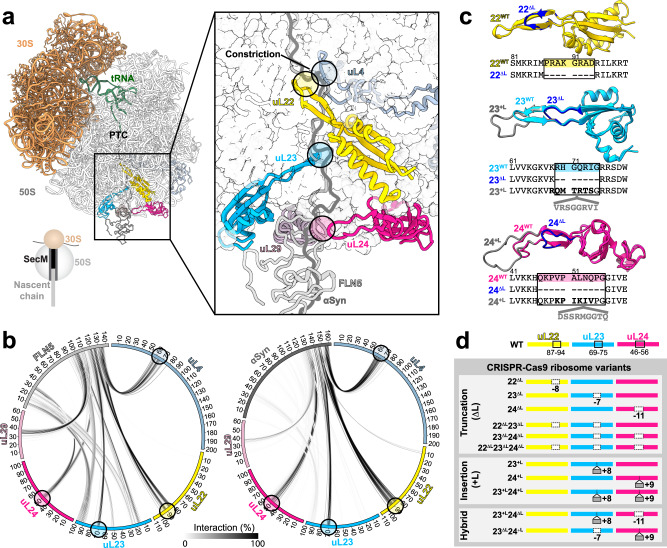
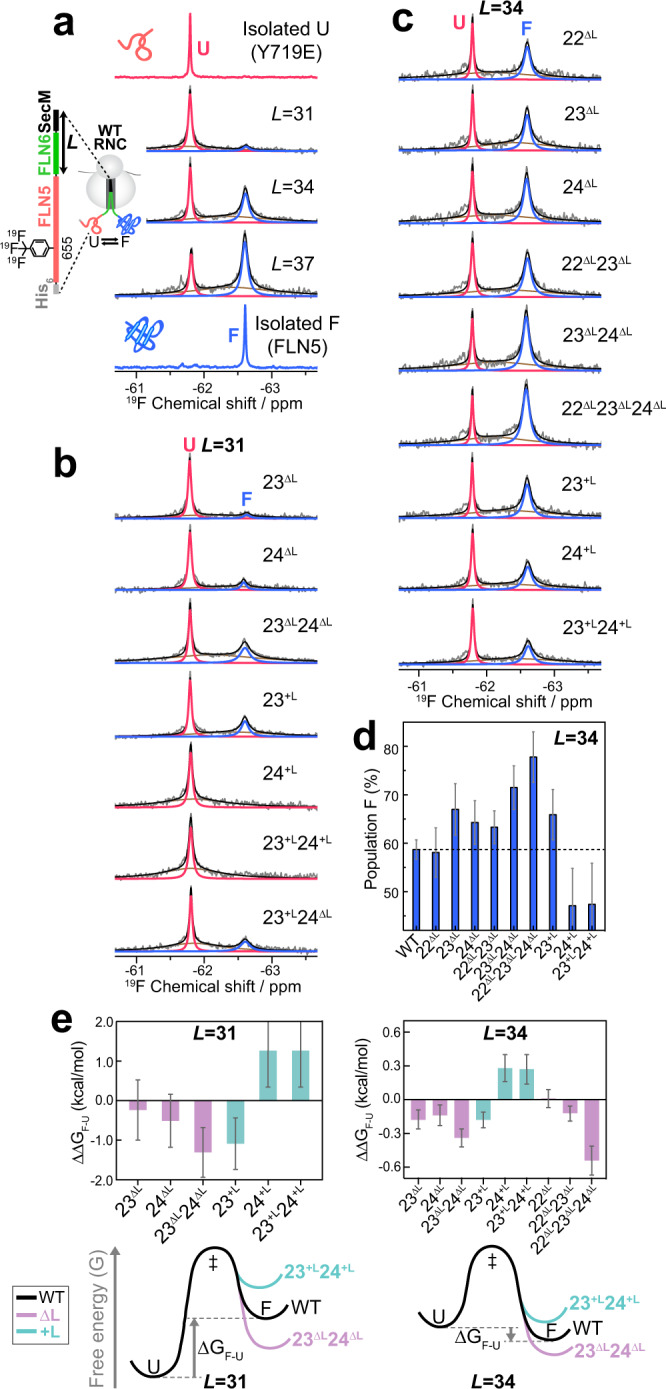
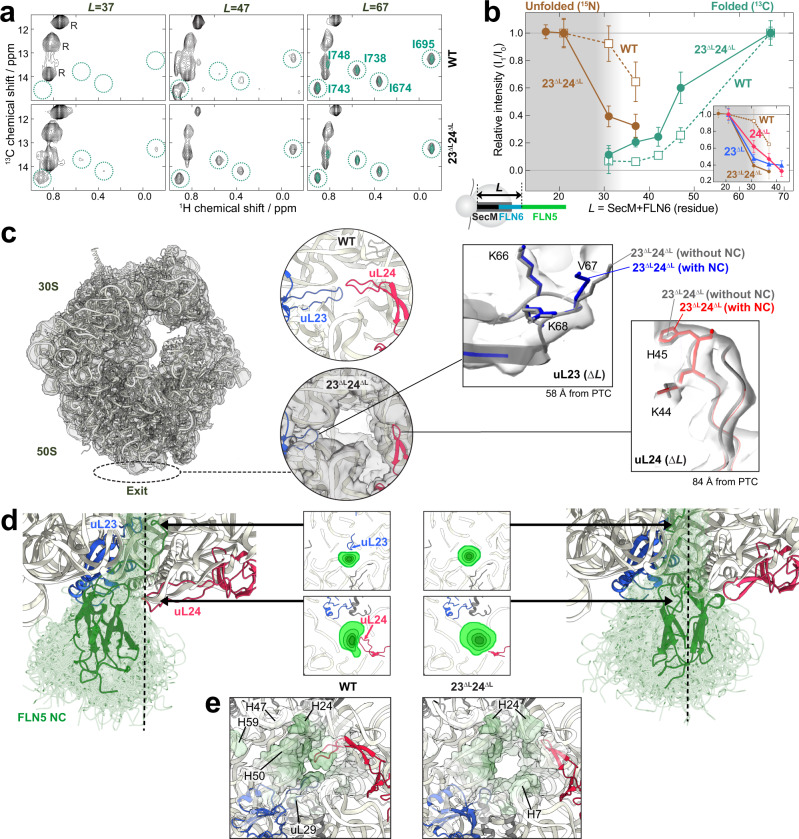
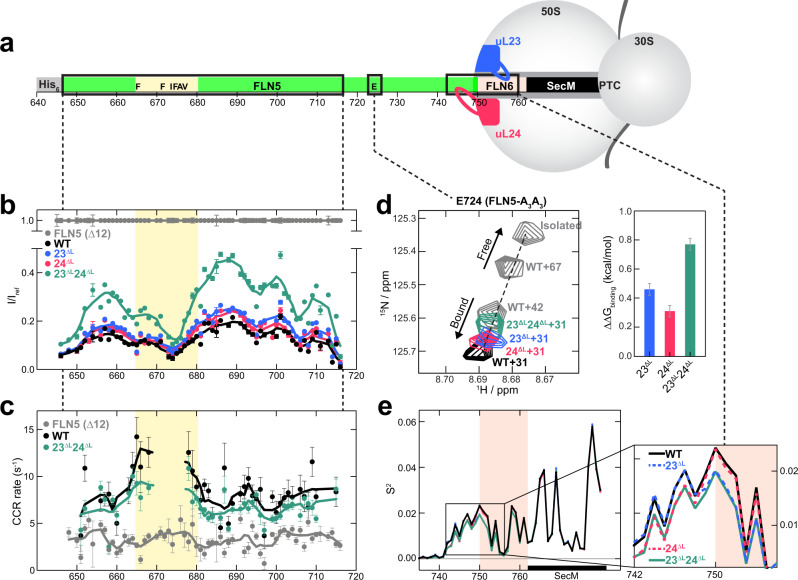
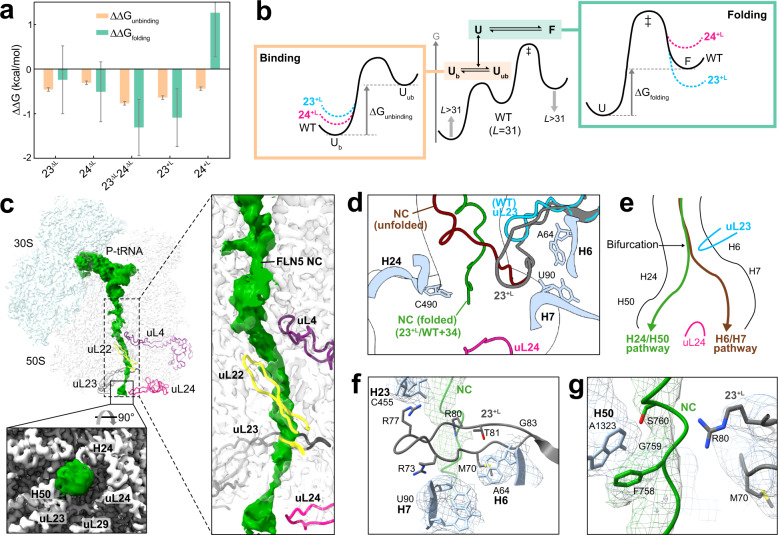
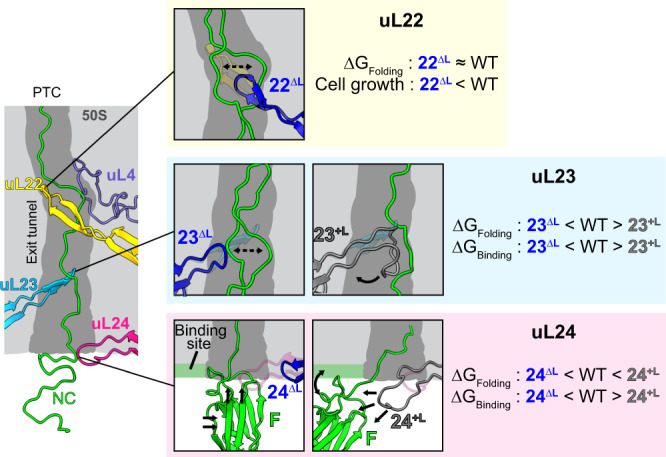
Co-translational folding is a fundamental process for the efficient biosynthesis of nascent polypeptides that emerge through the ribosome exit tunnel. To understand how this process is modulated by the shape and surface of the narrow tunnel, we have rationally engineered three exit tunnel protein loops (uL22, uL23 and uL24) of the 70S ribosome by CRISPR/Cas9 gene editing, and studied the co-translational folding of an immunoglobulin-like filamin domain (FLN5). Our thermodynamics measurements employing 19 F/15 N/methyl-TROSY NMR spectroscopy together with cryo-EM and molecular dynamics simulations reveal how the variations in the lengths of the loops present across species exert their distinct effects on the free energy of FLN5 folding. A concerted interplay of the uL23 and uL24 loops is sufficient to alter co-translational folding energetics, which we highlight by the opposite folding outcomes resulting from their extensions. These subtle modulations occur through a combination of the steric effects relating to the shape of the tunnel, the dynamic interactions between the ribosome surface and the unfolded nascent chain, and its altered exit pathway within the vestibule. These results illustrate the role of the exit tunnel structure in co-translational folding, and provide principles for how to remodel it to elicit a desired folding outcome.
Overview
The claims and statistics of this paper haven’t been checked yet.
Free: it reads the open-access text and checks the first 5 claims that cite a source we can check. Create a free account to check every claim.
Integrity signals
Registry
Cites
Statistics
Figures
Verification
Claims the paper makes
The claims and statistics of this paper haven’t been checked yet.
Free: it reads the open-access text and checks the first 5 claims that cite a source we can check. Create a free account to check every claim.
Claims other papers make about this one
Each is checked against this paper’s own text: does it say what the citing paper says it does?
The source backs part of the claim, not all of it — or backs it for a different population, condition or comparison.
In the citing paper
“Aligning the structure of a translating E. coli 70S ribosome with a nascent peptide (PDB:7ZP8)23 to our structure of E. coli 70S ribosome bound to Doxycycline revealed that the three Doxycycline molecules completely occlude the NPET near the PTC and sterically clash with the nascent polypeptide chain”
From Dual site targeting of the bacterial 70S ribosome by tetracyclines (2026) · cites this paper as [23]
Experimental — accuracy not yet measured
Self-check
Percentages, sums and reported differences re-computed from the paper’s own numbers.
The self-check needs the paper’s full text.
Citations
Cites
VMD: visual molecular dynamics
Humphrey, W., Dalke, A., & Schulten, K. (1996) · Journal of Molecular Graphics · doi:10.1016/0263-7855(96)00018-5 · Cited by 66,952
UCSF Chimera—A visualization system for exploratory research and analysis
Pettersen, E. F., Goddard, T. D., Huang, C. C., Couch, G. S., Greenblatt, D. M., Meng, E. C., & Ferrin, T. E. (2004) · Journal of Computational Chemistry · doi:10.1002/jcc.20084 · Cited by 45,828
Coot : model-building tools for molecular graphics
Emsley, P., & Cowtan, K. (2004) · Acta Crystallographica Section D Biological Crystallography · doi:10.1107/s0907444904019158 · Cited by 30,571
PHENIX : a comprehensive Python-based system for macromolecular structure solution
Adams, P. D., Afonine, P. V., Bunkóczi, G., Chen, V. B., Davis, I. W., Echols, N., Headd, J. J., Hung, L.-W., Kapral, G. J., Grosse-Kunstleve, R. W., et al. (2010) · Acta Crystallographica Section D Biological Crystallography · doi:10.1107/s0907444909052925 · Cited by 23,716
NMRPipe: A multidimensional spectral processing system based on UNIX pipes
Delaglio, F., Grzesiek, S., Vuister, G., Zhu, G., Pfeifer, J., & Bax, A. (1995) · Journal of Biomolecular NMR · doi:10.1007/bf00197809 · Cited by 15,965
GROMACS 4: Algorithms for Highly Efficient, Load-Balanced, and Scalable Molecular Simulation
Hess, B., Kutzner, C., van der Spoel, D., & Lindahl, E. (2008) · Journal of Chemical Theory and Computation · doi:10.1021/ct700301q · Cited by 15,908
MolProbity : all-atom structure validation for macromolecular crystallography
Chen, V. B., Arendall, W. B., Headd, J. J., Keedy, D. A., Immormino, R. M., Kapral, G. J., Murray, L. W., Richardson, J. S., & Richardson, D. C. (2010) · Acta Crystallographica Section D Biological Crystallography · doi:10.1107/s0907444909042073 · Cited by 14,115
Jalview Version 2—a multiple sequence alignment editor and analysis workbench
Waterhouse, A. M., Procter, J. B., Martin, D. M. A., Clamp, M., & Barton, G. J. (2009) · Bioinformatics · doi:10.1093/bioinformatics/btp033 · Cited by 11,399
Circos: An information aesthetic for comparative genomics
Krzywinski, M., Schein, J., Birol, İ., Connors, J., Gascoyne, R., Horsman, D., Jones, S. J., & Marra, M. A. (2009) · Genome Research · doi:10.1101/gr.092759.109 · Cited by 10,964
MotionCor2: anisotropic correction of beam-induced motion for improved cryo-electron microscopy
Zheng, S. Q., Palovcak, E., Armache, J.-P., Verba, K. A., Cheng, Y., & Agard, D. A. (2017) · Nature Methods · doi:10.1038/nmeth.4193 · Cited by 7,777 · cited 1×
“DNA constructs of SecM-stalled RNCs of FLN5 with increasing linker lengths ( L ) of FLN6 ( L = 21, 31, 34, 37, 42, 45, 47 and 67, Supplementary Fig.”
Background
Cited by
The ribosome lowers the entropic penalty of protein folding
Streit, J. O., Bukvin, I. V., Chan, S. H. S., Bashir, S., Woodburn, L. F., Włodarski, T., Figueiredo, A. M., Jurkeviciute, G., Sidhu, H. K., Hornby, C. R., et al. (2024) · Nature · doi:10.1038/s41586-024-07784-4 · Cited by 49
“There is increasing evidence of a direct role for the ribosome in regulating folding of the nascent chain 2–10 , with increasing clarity on how it interacts with the elongating nascent chain 7,11–13 , which is thought to contribute to alterations to nascent chain thermodynamic stability 6–10 and…”
Self-citationHow the ribosome shapes cotranslational protein folding
Samatova, E., Komar, A. A., & Rodnina, M. V. (2023) · Current Opinion in Structural Biology · doi:10.1016/j.sbi.2023.102740 · Cited by 47
The SecM arrest peptide traps a pre-peptide bond formation state of the ribosome
Gersteuer, F., Morici, M., Gabrielli, S., Fujiwara, K., Safdari, H. A., Paternoga, H., Bock, L. V., Chiba, S., & Wilson, D. N. (2024) · Nature Communications · doi:10.1038/s41467-024-46762-2 · Cited by 43
Chen, J., Gong, J., Su, C., Li, H., Xu, Z., & Shi, J. (2023) · Metabolic Engineering · doi:10.1016/j.ymben.2023.05.007 · Cited by 41
Resolving chaperone-assisted protein folding on the ribosome at the peptide level
Wales, T. E., Pajak, A., Roeselová, A., Shivakumaraswamy, S., Howell, S. A., Kjær, S., Hartl, F. U., Engen, J. R., & Balchin, D. (2024) · Nature Structural & Molecular Biology · doi:10.1038/s41594-024-01355-x · Cited by 42
“Other factors, such as interactions of the NC with the ribosome surface (Figure 6B-G), are also likely to play a role in modulating the stability of cotranslational folding intermediates (10, 66).”
Integrative approaches for characterizing protein dynamics: NMR, CryoEM, and computer simulations
Zadorozhnyi, R., Gronenborn, A. M., & Polenova, T. E. (2023) · Current Opinion in Structural Biology · doi:10.1016/j.sbi.2023.102736 · Cited by 33
Leonarski, F., Henning‐Knechtel, A., Kırmızıaltın, S., Ennifar, E., & Auffinger, P. (2024) · Nucleic Acids Research · doi:10.1093/nar/gkae1148 · Cited by 22
Rational design of 19F NMR labelling sites to probe protein structure and interactions
Streit, J. O., Chan, S. H. S., Daya, S., & Christodoulou, J. (2025) · Nature Communications · doi:10.1038/s41467-025-59105-6 · Cited by 17
“…sample concentrations are required, with greater spectral observability of larger molecules and challenging systems, including membrane proteins 2,3,5 – 7 , nascent polypeptides in complex with their ~ 2.5-MDa parent ribosome 8 – 10 , and within living bacterial 11,12 and mammalian cells 13,14 .”
InfluentialSelf-citationNavigating the complexities of multi-domain protein folding
Rajasekaran, N., & Kaiser, C. (2024) · Current Opinion in Structural Biology · doi:10.1016/j.sbi.2024.102790 · Cited by 17
Rational design of 19 F NMR labelling sites to probe protein structure and interactions
(2024) · doi:10.1101/2024.12.11.627779 · Cited by 17
Włodarski, T., Streit, J. O., Mitropoulou, A. N., Cabrita, L. D., Vendruscolo, M., & Christodoulou, J. (2024) · Scientific Reports · doi:10.1038/s41598-024-68468-7 · Cited by 14
Self-citationPellowe, G. A., Voisin, T. B., Karpauskaite, L., Maslen, S. L., Roeselová, A., Skehel, J. M., Roustan, C., George, R., Nans, A., Kjær, S., et al. (2025) · Nature Structural & Molecular Biology · doi:10.1038/s41594-025-01676-5 · Cited by 13
“On the bacterial ribosome, the NC engages prokaryote-specific loops on uL23 and uL24 that protrude into the vestibule and are established to affect the onset of folding 49,59 .”
Pellowe, G. A., Voisin, T. B., Karpauskaite, L., Maslen, S. L., Roeselová, A., Skehel, J. M., Roustan, C., George, R., Nans, A., Kjær, S., et al. (2024) · doi:10.1101/2024.09.19.613857 · Cited by 13
Structures of protein folding intermediates on the ribosome
Chan, S. H. S., Streit, J. O., Włodarski, T., Mitropoulou, A. N., Cassaignau, A. M. E., Bukvin, I. V., Waudby, C. A., Cabrita, L. D., & Christodoulou, J. (2026) · Nature Structural & Molecular Biology · doi:10.1038/s41594-026-01814-7 · Cited by 11
“…(RNCs) has enabled residue-level measurements of different nascent protein conformations by using specific isotopic labeling schemes 3,5,13,16,39–41 , providing experimental data to guide the determination of accurate structures of unfolded 3,13 and folded 23 RNCs from all-atom molecular…”
Self-citationUnderstanding the heterogeneity intrinsic to protein folding
Bhatia, S., & Udgaonkar, J. B. (2023) · Current Opinion in Structural Biology · doi:10.1016/j.sbi.2023.102738 · Cited by 10
“Heterogeneity can be modulated by changing the protein sequence [28], and also by the presence of other co-solutes and proteins [29 e 31].”
BackgroundThe critical role of co-translational folding: An evolutionary and biophysical perspective
Bitran, A., Jacobs, W. M., & Shakhnovich, E. I. (2023) · Current Opinion in Systems Biology · doi:10.1016/j.coisb.2023.100485 · Cited by 8
Masse, M. M., Hutchinson, R. B., Morgan, C. E., Allaman, H. J., Guan, H., Yu, E. W., & Cavagnero, S. (2024) · ACS Central Science · doi:10.1021/acscentsci.3c00777 · Cited by 7
Lipid Modification and Membrane Localization of Proteins in Cell-Free System
Matsumoto, R., Niwa, T., Kuno, K., Shimane, Y., Kuruma, Y., & Kanamori, T. (2025) · ACS Synthetic Biology · doi:10.1021/acssynbio.5c00155 · Cited by 7
Roeselová, A., Pajak, A., Wales, T. E., Pellowe, G. A., Kjær, S., Engen, J. R., & Balchin, D. (2026) · Nature Protocols · doi:10.1038/s41596-025-01279-w · Cited by 6
Cotranslational membrane insertion of the voltage-sensitive K + channel KvAP
Westerfield, J. M., Kozojedová, P., Juli, C., Metola, A., & von HEIJNE, G. (2025) · Proceedings of the National Academy of Sciences · doi:10.1073/pnas.2412492122 · Cited by 6
Cotranslational protein folding through non-native structural intermediates
Wang, S., Bitran, A., Samatova, E., Shakhnovich, E. I., & Rodnina, M. V. (2025) · Science Advances · doi:10.1126/sciadv.ady2211 · Cited by 6
Masse, M. M., Guzmán‐Luna, V., Varela, A. E., Shapla, U. M., Hutchinson, R. B., Srivastava, A., Wei, W., Fuchs, A. M., & Cavagnero, S. (2024) · Scientific Reports · doi:10.1038/s41598-024-61274-1 · Cited by 5
Cotranslational folding of human growth hormone in vitro and in Escherichia coli
Mermans, D., Nicolaus, F., Baygin, A., & von HEIJNE, G. (2022) · FEBS Letters · doi:10.1002/1873-3468.14562 · Cited by 5
“Finally, FPs can be quantitatively reproduced by molecular dynamics simulations of cotranslational protein folding [15,26], and are affected by changes in the size and shape of the exit tunnel in ways expected for cotranslational folding [27,28].”
BackgroundLong-range electrostatic forces govern how proteins fold on the ribosomePreprint
Streit, J. O., Chan, S. H. S., Burridge, C., Wallace, J., Waudby, C. A., Cabrita, L. D., & Christodoulou, J. (2025) · bioRxiv (Cold Spring Harbor Laboratory) · doi:10.1101/2025.02.10.637539 · Cited by 4
Self-citationStructural basis of enhanced stalling efficiency of an engineered ribosome arrest peptide
Sriramoju, M. K., Ko, T., Drączkowski, P., & Hsu, S. D. (2025) · Nucleic Acids Research · doi:10.1093/nar/gkaf978 · Cited by 3
“The cryo-EM structure of the eRAP has been reported (PDB: 7Z20) [ 39 ].”
Hu, M., Liu, J., Gan, Y., Zhu, H., Han, R., Liu, K., Liu, Y., Zhao, M., Li, X., & Xue, Z. (2024) · Bioresources and Bioprocessing · doi:10.1186/s40643-024-00777-1 · Cited by 3
“N-terminal truncation technology has found extensive use in the study of protein-protein interactions (Sista Kameshwar and Qin 2018; Dunham et al. 2009), protein folding (Ahn et al. 2022), and enzymatic activities (Lu et al. 2016; McGlinchey et al. 2021).”
BackgroundThe Great Codon Escape: Vacating Codons for Genetic Code Expansion and Ribosome Stalling
Hopstaken, A. J. P., Wichtrup, E. G., & Jongkees, S. A. K. (2024) · Israel Journal of Chemistry · doi:10.1002/ijch.202400012 · Cited by 5
Pathway regulation mechanism by cotranslational protein folding
Tao, P., & Xiao, Y. (2025) · Communications Chemistry · doi:10.1038/s42004-025-01636-6 · Cited by 3
VirtualIce: Half-synthetic CryoEM Micrograph GeneratorPreprint
Noble, A. J. (2024) · bioRxiv (Cold Spring Harbor Laboratory) · doi:10.1101/2024.09.28.615520 · Cited by 7
The ribosome directs nascent chains through two folding-dependent pathwaysPreprint
Mitropoulou, A. N., Włodarski, T., Streit, J. O., Chan, S. H. S., Plessa, E., Woodburn, L. F., Cabrita, L. D., & Christodoulou, J. (2025) · bioRxiv (Cold Spring Harbor Laboratory) · doi:10.1101/2025.04.08.647855 · Cited by 3
Self-citationDual site targeting of the bacterial 70S ribosome by tetracyclines
Devarkar, S. C., Lomakin, I. B., Wang, J., Grada, A., & Bunick, C. G. (2026) · Nature Communications · doi:10.1038/s41467-026-72788-9 · Cited by 2
“…critical residues would most likely inhibit the PTC. Aligning the structure of a translating E. coli 70S ribosome with a nascent peptide (PDB:7ZP8) 23 to our structure of E. coli 70S ribosome bound to Dox-ycycline revealed that the three Doxycycline molecules completely occlude the NPET near the…”
Cárdenas-Guerra, R. E., Montes-Flores, O., Nava-Pintor, E. E., Reséndiz-Cardiel, G., Flores-Pucheta, C. I., Rodríguez-Gavaldón, Y. I., Arroyo, R., Bottazzi, M. E., Hotez, P. J., & Ortega‐López, J. (2024) · Protein Expression and Purification · doi:10.1016/j.pep.2024.106458 · Cited by 2
Cryo-EM reveals multiple mechanisms of ribosome inhibition by doxycycline
Stuart, W. S., Isupov, M. N., McLaren, M., Jenkins, C. H., Monier, A., Daum, B., Norville, I. H., Gold, V. A. M., & Harmer, N. J. (2026) · Nature Communications · doi:10.1038/s41467-026-73421-5 · Cited by 3
Evolution of the ribosomal exit tunnel through the eyes of the nascent chain
Włodarski, T. (2026) · Nucleic Acids Research · doi:10.1093/nar/gkag689 · Cited by 3
Self-citationTranslation in a Box: Orthogonal Evolution in the Saccharomyces cerevisiae MitochondrionPreprint
Rothschild-Mancinelli, B., Álvarez-Carreño, C., Guo, W., Ito, C., Costa, A. B., Petrov, A. S., Lobachev, K. S., & Williams, L. D. (2023) · bioRxiv (Cold Spring Harbor Laboratory) · doi:10.1101/2023.04.28.538752 · Cited by 1
“Advances require transformation of catalytic competencies of the PTC and aaRS and of delivery/transport functionality of the exit tunnel (28,48-50).”
BackgroundDetection of prokaryotic-like ribosome exit tunnels within eukaryotic kingdomsPreprint
Yu, S., Kushner, A., Srebnik, S., & Duc, K. D. (2025) · bioRxiv (Cold Spring Harbor Laboratory) · doi:10.1101/2025.04.08.647849 · Cited by 1
Cotranslational folding of HemK C-terminal domain
Daberger, J. (2023) · eDiss (Georg-August-Universität Göttingen) · doi:10.53846/goediss-9786
How protein fold: Insights from nuclear magnetic resonance spectroscopy
Zhuravelva, A. (2023) · Elsevier eBooks · doi:10.1016/b978-0-323-90800-9.00246-8
Evolution of ribosome X-ray crystallography: from first crystals to atomic resolution
Nurullina, L., Biktimirov, A. D., Yusupov, M., & Usachev, K. S. (2025) · Biophysical Reviews · doi:10.1007/s12551-025-01357-z · Cited by 1
“While studies have identified that the ribosome can modulate protein folding through electrostatic interactions and spatial constraints, the precise mechanisms by which different ribosomal elements coordinate to influence folding remain unclear (Ahn et al. 2022).”
Yoshida, K., Solovieva, E., Miura, N., Shichino, S., Hamada, M., Muratani, M., Amano, T., & Honda, K. (2025) · bioRxiv (Cold Spring Harbor Laboratory) · doi:10.1101/2025.11.05.686667
Jeong, Y., Yang, C., Hariri, R. F. M., Kim, J., Lee, E. K., Lee, Y., Kim, W. J., Lee, S. S., & Choi, I. S. (2026) · ACS Synthetic Biology · doi:10.1021/acssynbio.5c00844 · Cited by 1
Hu, M., Liu, J., Gan, Y., Zhu, H., Han, R., Liu, K., Liu, Y., Zhao, M., Li, X., & Xue, Z. (2024) · Figshare · doi:10.6084/m9.figshare.26738703
Hu, M., Liu, J., Gan, Y., Zhu, H., Han, R., Liu, K., Liu, Y., Zhao, M., Li, X., & Xue, Z. (2024) · Figshare · doi:10.6084/m9.figshare.26738706
Momordicine I induces ER stress and inhibits OSCC by targeting ribosomal proteins
Kong, J., Zhu, Z., Hu, Y., Zhou, S., Gu, T., Shen, X., Wang, H., Yu, M., & Liu, Y. (2025) · Journal of Zhejiang University SCIENCE B · doi:10.1631/jzus.b2500142 · Cited by 1
“Ri ‐ bosomes not only are the primary sites of translation but also function as crucial organelles in protein folding (Kaiser et al., 2011; Holtkamp et al., 2015; Liu et al., 2019; Waudby et al., 2019; Ahn et al., 2022; Wales et al., 2024).”
Rôle de la traduction et du ribosome dans la résistance aux thérapies dans les cancers
Mourksi, N. (2023) · theses.fr (ABES) · doi:10.70675/dd7b577cz67a3z4a52zb4adz2057147efb7f
The initiation of de novo protein folding on the ribosomePreprint
Bukvin, I. V., Streit, J. O., Włodarski, T., Hornby, C. R., Chan, S. H. S., Cassaignau, A. M. E., & Christodoulou, J. (2026) · bioRxiv (Cold Spring Harbor Laboratory) · doi:10.64898/2026.07.24.740641
Self-citationMultivalent weak contacts shape chaperone–nascent protein interactions
Rajasekaran, N., Toptygin, D., Liao, T., Hilser, V. J., Ha, T., & Kaiser, C. (2026) · Proceedings of the National Academy of Sciences · doi:10.1073/pnas.2607201123
Cryo-EM reveals multiple mechanisms of ribosome inhibition by doxycycline
Stuart, W. S., Isupov, M. N., McLaren, M., Jenkins, C. H., Monier, A., Daum, B., Norville, I. H., Gold, V. A. M., & Harmer, N. J. (2025) · doi:10.1101/2025.11.08.686982
Metadata
- Authors
- Ahn, M., Włodarski, T., Mitropoulou, A., Chan, S. H. S., Sidhu, H., Plessa, E., Becker, T. A., Budisa, N., Waudby, C. A., Beckmann, R., Cassaignau, A. M. E., Cabrita, L. D., & Christodoulou, J.
- Affiliations
- Institute of Structural and Molecular Biology (GB)
- Ludwig-Maximilians-Universität München (DE)
- University of London (GB)
- Corresponding author
- Cabrita, Lisa D.
- Christodoulou, John
- ORCID
- Venue
- Nature Communications
- Published
- 2022-07-22
- Volume
- 13
- Issue
- 1
- Pages
- 4243-4243
- ISSN
- 2041-1723 (ISSN-L)
- PMC
- PMC9307626
- OpenAlex
- W4286559954
- Semantic Scholar
- 86700d642b20ab97ac2e98a0366bd93b0f210457
- Cited by
- 45
- References
- 86
- Citations by year
- 2026: 8 · 2025: 14 · 2024: 14 · 2023: 8 · 2022: 1
- FWCI
- 3.02
- Type
- journal article
- Language
- en
- Update notices
- correction (2022-09-16)
- Open access
- gold
- doi.org
- Licence
- cc-by
- creativecommons.org/licenses/by/4.0 (tdm)
- creativecommons.org/licenses/by/4.0 (vor)
- Locations
- Nature Communications (publishedVersion, cc-by)
- PubMed Central (publishedVersion, cc-by)
- PubMed (publishedVersion)
- Explore Bristol Research (publishedVersion, cc-by)
- BIROn (Birkbeck, University of London) (acceptedVersion, other-oa)
- RePEc: Research Papers in Economics (submittedVersion)
- DOAJ (DOAJ: Directory of Open Access Journals) (submittedVersion, cc-by-sa)
- UCL Discovery (University College London) (submittedVersion)
- Bristol Research (University of Bristol) (submittedVersion, cc-by)
- Funders
- Wellcome Trust (206409/Z/17/Z)
- Topics
- Life Sciences › Biochemistry, Genetics and Molecular Biology › Molecular Biology › RNA and protein synthesis mechanisms
- Life Sciences › Biochemistry, Genetics and Molecular Biology › Molecular Biology › Protein Structure and Dynamics
- Life Sciences › Biochemistry, Genetics and Molecular Biology › Molecular Biology › Heat shock proteins research
- Keywords
- co-translational folding, ribosome exit tunnel, 70S ribosome, nascent polypeptide folding, folding free energy
- MeSH terms
- Proteins, Ribosomes, Thermodynamics, Protein Biosynthesis, Protein Folding, Molecular Dynamics Simulation
About these checks
Registry, retraction, Cites and statistics results are computed, not judged, with one exception: a printed reference that no index lists is read once by a model before it counts as a citation error. Claims are extracted by a model and kept only when their quote appears verbatim in the text; each cited source is then checked, with a model’s help, for whether it says what the claim relies on. Those verdicts can be wrong — read the claim’s quote and the cited source before relying on one.
Statistics and arithmetic are recomputed, not judged.
Confidence bands are shown only for fields calibrated on our annotated test set. None is calibrated yet, so no band is shown.
What counts as a claim ›How we measure confidence ›How we check this ›
Are you an author, or do you see a problem with this page? Request a review
Data sources
Bibliographic data: Semantic Scholar, OpenAlex, Crossref.
Contains information from the Semantic Scholar Academic Graph Datasets, made available under the ODC Attribution License (ODC-BY 1.0).
Semantic Scholar’s data is described in: Kinney, R., et al. (2023). The Semantic Scholar Open Data Platform. arXiv:2301.10140.
