

Lead federated neuromorphic learning for wireless edge artificial intelligence
Open accessPublished version of a preprint
The DOI matches its Crossref record; 52 of the 52 references it cites were found in a registry or an index.
Abstract
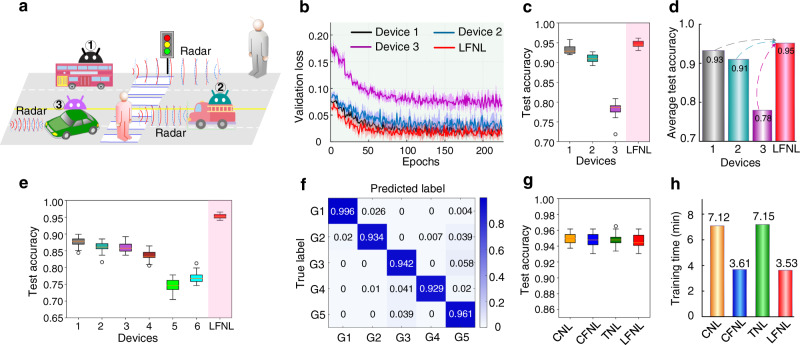
In order to realize the full potential of wireless edge artificial intelligence (AI), very large and diverse datasets will often be required for energy-demanding model training on resource-constrained edge devices. This paper proposes a lead federated neuromorphic learning (LFNL) technique, which is a decentralized energy-efficient brain-inspired computing method based on spiking neural networks. The proposed technique will enable edge devices to exploit brain-like biophysiological structure to collaboratively train a global model while helping preserve privacy. Experimental results show that, under the situation of uneven dataset distribution among edge devices, LFNL achieves a comparable recognition accuracy to existing edge AI techniques, while substantially reducing data traffic by >3.5× and computational latency by >2.0×. Furthermore, LFNL significantly reduces energy consumption by >4.5× compared to standard federated learning with a slight accuracy loss up to 1.5%. Therefore, the proposed LFNL can facilitate the development of brain-inspired computing and edge AI.
Overview
The claims and statistics of this paper haven’t been checked yet.
Free: it reads the open-access text and checks the first 5 claims that cite a source we can check. Create a free account to check every claim.
Integrity signals
Registry
Cites
Statistics
Figures




Verification
Claims the paper makes
The claims and statistics of this paper haven’t been checked yet.
Free: it reads the open-access text and checks the first 5 claims that cite a source we can check. Create a free account to check every claim.
Claims other papers make about this one
Each is checked against this paper’s own text: does it say what the citing paper says it does?
The source backs part of the claim, not all of it — or backs it for a different population, condition or comparison.
In the citing paper
“This unlocks new possibilities for real-time making decisions as well as enhanced confidentiality and safety [81].”
From Edge AI: A survey (2023) · cites this paper as [81]
Experimental — accuracy not yet measuredThe cited source says what the claim attributes to it.
In the citing paper
“Therefore, brain-inspired computing approaches potentially can not only improve the energy efficiency, but also privacy in the processing of sensitive data [226].”
From Brain-inspired computing systems: a systematic literature review (2024) · cites this paper as [226]
Self-check
Percentages, sums and reported differences re-computed from the paper’s own numbers.
The self-check needs the paper’s full text.
Citations
Cites
Very Deep Convolutional Networks for Large-Scale Image Recognition
Simonyan, K., & Zisserman, A. (2014) · arXiv · doi:10.48550/arxiv.1409.1556 · Cited by 114,148
LeCun, Y., Bengio, Y., & Hinton, G. (2015) · Nature · doi:10.1038/nature14539 · Cited by 84,126
Gradient-based learning applied to document recognition
Lecun, Y., Bottou, L., Bengio, Y., & Haffner, P. (1998) · Proceedings of the IEEE · doi:10.1109/5.726791 · Cited by 58,805
Federated Learning: Strategies for Improving Communication Efficiency
Konečný, J., McMahan, H. B., Yu, F. X., Richtárik, P., Suresh, A. T., & Bacon, D. (2016) · arXiv · doi:10.48550/arxiv.1610.05492 · Cited by 3,766
Networks of spiking neurons: The third generation of neural network models
Maass, W. (1997) · Neural Networks · doi:10.1016/s0893-6080(97)00011-7 · Cited by 3,481
Federated Learning in Mobile Edge Networks: A Comprehensive Survey
Lim, W. Y. B., Luong, N. C., Hoang, D. T., Jiao, Y., Liang, Y.-C., Yang, Q., Niyato, D., & Miao, C. (2020) · IEEE Communications Surveys & Tutorials · doi:10.1109/comst.2020.2986024 · Cited by 2,565
Self-citationEdge Intelligence: Paving the Last Mile of Artificial Intelligence With Edge Computing
Zhou, Z., Chen, X., Li, E., Zeng, L., Luo, K., & Zhang, J. (2019) · Proceedings of the IEEE · doi:10.1109/jproc.2019.2918951 · Cited by 2,455
Catastrophic forgetting in connectionist networks
French, R. (1999) · Trends in Cognitive Sciences · doi:10.1016/s1364-6613(99)01294-2 · Cited by 2,311
Adaptive Federated Learning in Resource Constrained Edge Computing Systems
Wang, S., Tuor, T., Salonidis, T., Leung, K. K., Makaya, C., He, T., & Chan, K. (2019) · IEEE Journal on Selected Areas in Communications · doi:10.1109/jsac.2019.2904348 · Cited by 2,232
1.1 Computing's energy problem (and what we can do about it)
Horowitz, M. (2014) · 2014 IEEE International Solid-State Circuits Conference Digest of Technical Papers (ISSCC) · doi:10.1109/isscc.2014.6757323 · Cited by 2,069
Research works printed but not linked: 2
- Che, C., Li, X., Chen, C., He, X. & Zheng, Z. A decentralized federated learning framework via committee mechanism with convergence guarantee. Preprint at https://arxiv.org/pdf/2108.00365.pdf (2021). · arXiv
- Chintamani, N., Yash, M., Nikhil, P., Vivek, P. & Sandeep, P. Smart traffic control using deep learning. Preprint at https://github.com/nikhilpatil99/Smart-Traffic-Management-Using-Deep-Learning (2019).
Cited by
Singh, R., & Gill, S. S. (2023) · Internet of Things and Cyber-Physical Systems · doi:10.1016/j.iotcps.2023.02.004 · Cited by 572
Spike-based dynamic computing with asynchronous sensing-computing neuromorphic chip
Yao, M., Richter, O., Zhao, G., Qiao, N., Xing, Y., Wang, D., Hu, T., Fang, W., Demirci, T., Marchi, M. D., et al. (2024) · Nature Communications · doi:10.1038/s41467-024-47811-6 · Cited by 270
“Following this line of thinking, in SNNs, the theoretical energy consumption in the network is also evaluated by FLOPs 28,55,57,58 , which are mainly AC operations and are strongly correlated with the number of spikes.”
Tao, S., Liu, H., Sun, C., Ji, H., Ji, G., Han, Z., Gao, R., Ma, J., Ma, R., Chen, Y., et al. (2023) · Nature Communications · doi:10.1038/s41467-023-43883-y · Cited by 191
Privacy-Preserving Aggregation in Federated Learning: A Survey
Liu, Z., Guo, J., Yang, W., Fan, J., Lam, K., & Zhao, J. (2022) · IEEE Transactions on Big Data · doi:10.1109/tbdata.2022.3190835 · Cited by 259
Self-citationGreen Edge AI: A Contemporary Survey
Mao, Y., Yu, X., Huang, K., Zhang, Y. A., & Zhang, J. (2024) · Proceedings of the IEEE · doi:10.1109/jproc.2024.3437365 · Cited by 184
“Notably, there are recent interests of training SNNs under the framework of FEEL [300], [301] and SNN-based cooperative edge inference [302].”
Background
Metadata
- Authors
- Yang, H., Lam, K.-Y., Xiao, L., Xiong, Z., Hu, H., Niyato, D., & Vincent Poor, H.
- Affiliations
- Nanyang Technological University (SG)
- Xiamen University (CN)
- Singapore University of Technology and Design (SG)
- Corresponding author
- Lam, Kwok-Yan
- Venue
- Nature Communications
- Published
- 2022-07-25
- Volume
- 13
- Issue
- 1
- Pages
- 4269-4269
- ISSN
- 2041-1723 (ISSN-L)
- PMC
- PMC9314401
- OpenAlex
- W4287218656
- Semantic Scholar
- c3eeada16799d0298944dc9d431ad08447dc682c
- Cited by
- 127
- References
- 47
- Citations by year
- 2026: 22 · 2025: 39 · 2024: 28 · 2023: 30 · 2022: 8
- FWCI
- 8.64
- Type
- journal article
- Language
- en
- Update notices
- correction (2022-08-17)
- Open access
- gold
- doi.org
- Licence
- cc-by
- creativecommons.org/licenses/by/4.0 (tdm)
- creativecommons.org/licenses/by/4.0 (vor)
- Locations
- Nature Communications (publishedVersion, cc-by)
- Research Square (acceptedVersion, cc-by)
- PubMed Central (publishedVersion, cc-by)
- PubMed (publishedVersion)
- RePEc: Research Papers in Economics (submittedVersion)
- DOAJ (DOAJ: Directory of Open Access Journals) (submittedVersion, cc-by-sa)
- DR-NTU (Nanyang Technological University) (submittedVersion, cc-by)
- Funders
- National Science Foundation (1908308)
- National Research Foundation (SRG-ISTD-2021-165)
- National Research Foundation Singapore
- Nanyang Technological University (RG16/20, Tier 1)
- National Natural Science Foundation of China (1908308, 61971366, U21A20444, SUTD SRG-ISTD-2021-165)
- Ministry of Education, India
- Singapore University of Technology and Design (SRG-ISTD-2021165)
- Info-communications Media Development Authority
- Topics
- Physical Sciences › Computer Science › Artificial Intelligence › Privacy-Preserving Technologies in Data
- Physical Sciences › Engineering › Electrical and Electronic Engineering › Advanced Memory and Neural Computing
- Physical Sciences › Computer Science › Computer Networks and Communications › IoT and Edge/Fog Computing
- Keywords
- federated learning, spiking neural networks, neuromorphic computing, energy efficiency, privacy preservation, non-IID data, data traffic reduction, edge devices
- MeSH terms
- Artificial Intelligence, Brain, Neural Networks, Computer, Recognition, Psychology
About these checks
Registry, retraction, Cites and statistics results are computed, not judged, with one exception: a printed reference that no index lists is read once by a model before it counts as a citation error. Claims are extracted by a model and kept only when their quote appears verbatim in the text; each cited source is then checked, with a model’s help, for whether it says what the claim relies on. Those verdicts can be wrong — read the claim’s quote and the cited source before relying on one.
Statistics and arithmetic are recomputed, not judged.
Confidence bands are shown only for fields calibrated on our annotated test set. None is calibrated yet, so no band is shown.
What counts as a claim ›How we measure confidence ›How we check this ›
Are you an author, or do you see a problem with this page? Request a review
How to cite
Cite CoChat for the checks on this page, and the paper for its own findings.
- This page
- CoChat. (2026). Citation check: Lead federated neuromorphic learning for wireless edge artificial intelligence. https://app.cochat.ai/papers/10.1038/s41467-022-32020-w
- The paper
- Yang, H., Lam, K.-Y., Xiao, L., Xiong, Z., Hu, H., Niyato, D., & Vincent Poor, H. (2022). Lead federated neuromorphic learning for wireless edge artificial intelligence. Nature Communications. https://doi.org/10.1038/s41467-022-32020-w
Data sources
Bibliographic data: Semantic Scholar, OpenAlex, Crossref.
Contains information from the Semantic Scholar Academic Graph Datasets, made available under the ODC Attribution License (ODC-BY 1.0).
Semantic Scholar’s data is described in: Kinney, R., et al. (2023). The Semantic Scholar Open Data Platform. arXiv:2301.10140.
